
By Laura M. Smith
Within the walls of Library and Archives Canada’s Winnipeg facility, we find an accession from Parks Canada containing numerous field notebooks used by its employees. These notebooks contain measurements, calculations, technical drawings and notes on field conditions, all neatly inscribed from various surveying projects in the national parks. These small, utilitarian hardcover books are simple in design but rich with empirical data on park infrastructure, and they would become useful to researchers studying a diverse range of topics. Despite the uniformity of these field books, one of these items, titled Misc Surveys Winter ’56 stands out from the rest. It contains not only the meticulously recorded field data, but also an enriching detail that we find upon closer examination: marginalia from a Parks Canada employee that captures details of field life.
Most of the marginalia, text and images are mixed in with the standard information found on the pages and could potentially be missed at first glance. For example, a daily weather reading, commonly found in these notebooks, is recorded here with atypical candour and commentary: “SUNNY DAMN COLD – NO HOT COFFEE – 3” OF SNOW – JAN. 27/1956.” These descriptive additions change the tone from a generic logbook to that of a personal journal or a letter. However, they are subtle enough to be missed at first glance and reward a viewer who is reading closely.
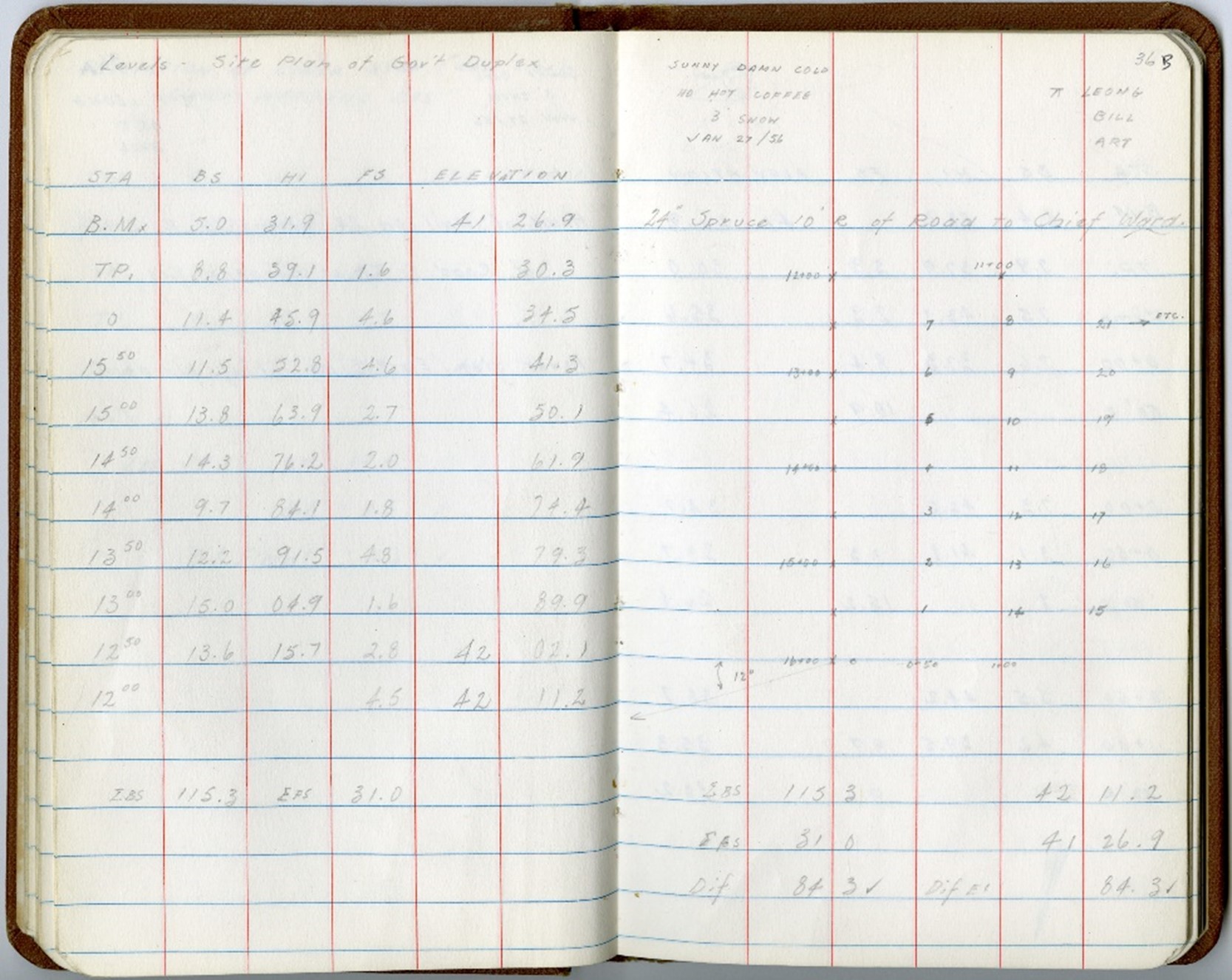
Page 36B of Misc Surveys Winter ’56 field book. (MIKAN 48775)
Technical drawings are commonly found in these field books to record topographic features like the elevation of a riverbed or the slope of a hill. Here the author has decorated these diagrams with silly cartoonish faces.
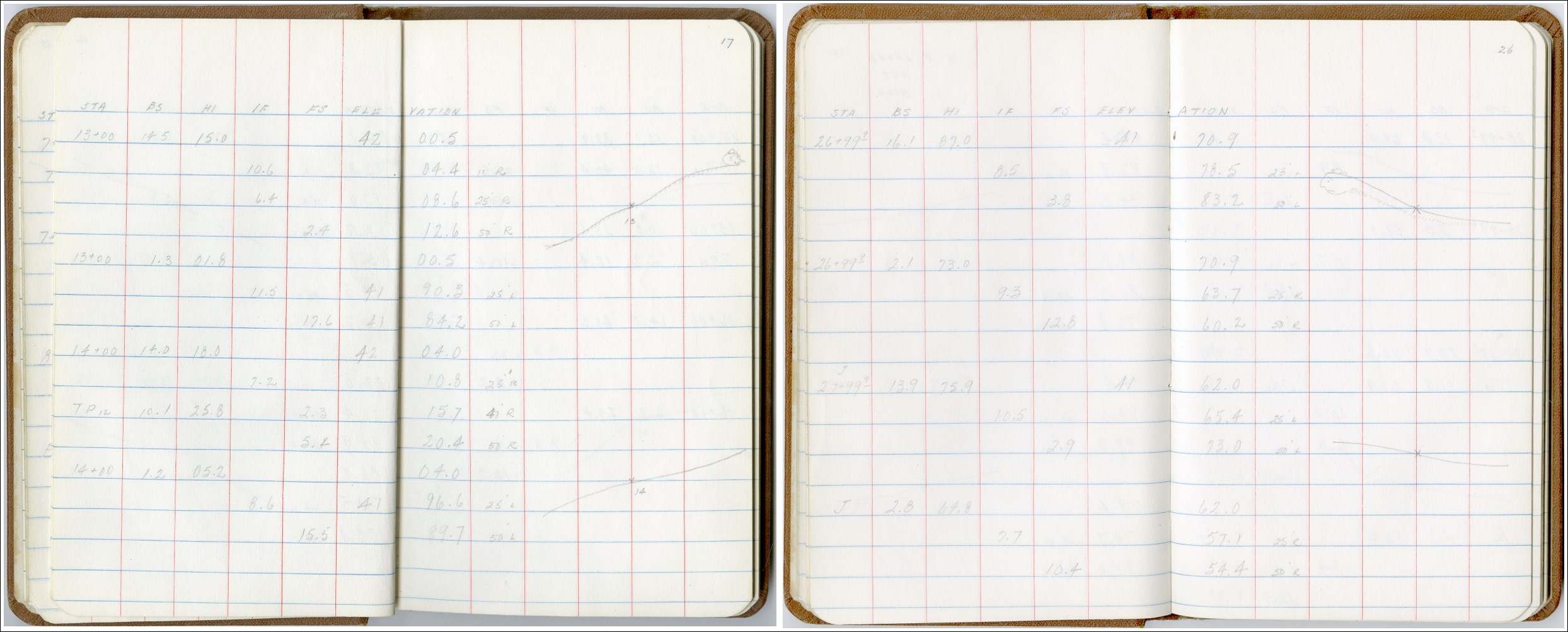
Details from page 17 and page 26. (MIKAN 48775)
The simple doodles captured in this volume seem to be spontaneous ideas, emerging either from boredom or sudden creative flashes but always maintaining a certain cheeky “made you look” sensibility and a lighthearted tone. In the next example, a rudimentary figure in profile is depicted at the top of the page throwing a paper airplane that swoops and glides to the bottom of the page. These imaginative images create an atmosphere of silliness and draws in the reader, leaving them to wonder what will be found next when they flip the page.
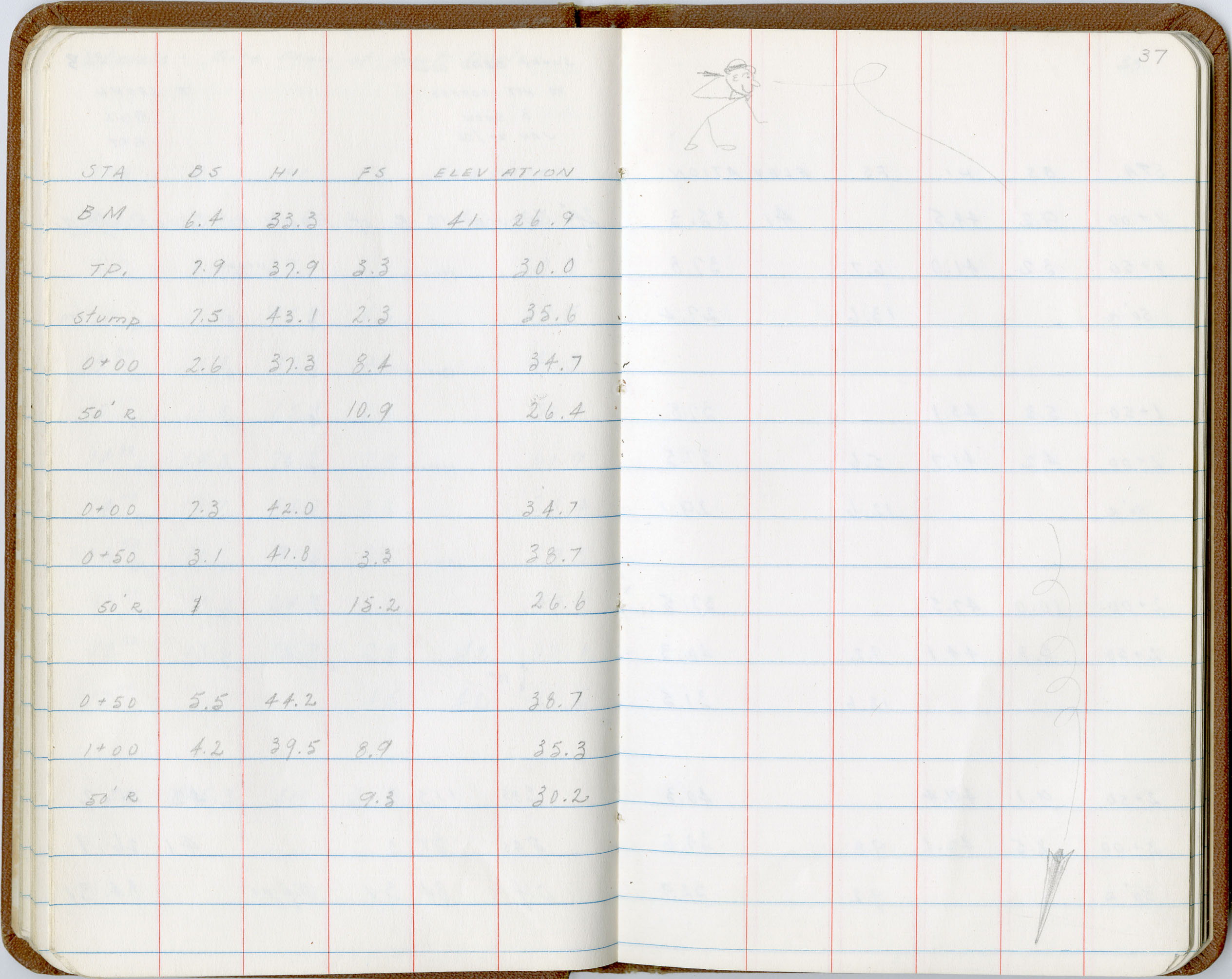
Page 37 of Misc Surveys Winter ’56 field book. (MIKAN 48775)
The creator’s personal sense of humour is also clearly articulated in these entries. For instance, we find a line drawing of an overturned umbrella with three handles, that appears with the following caption “Two monkeys in an umbrella!”.
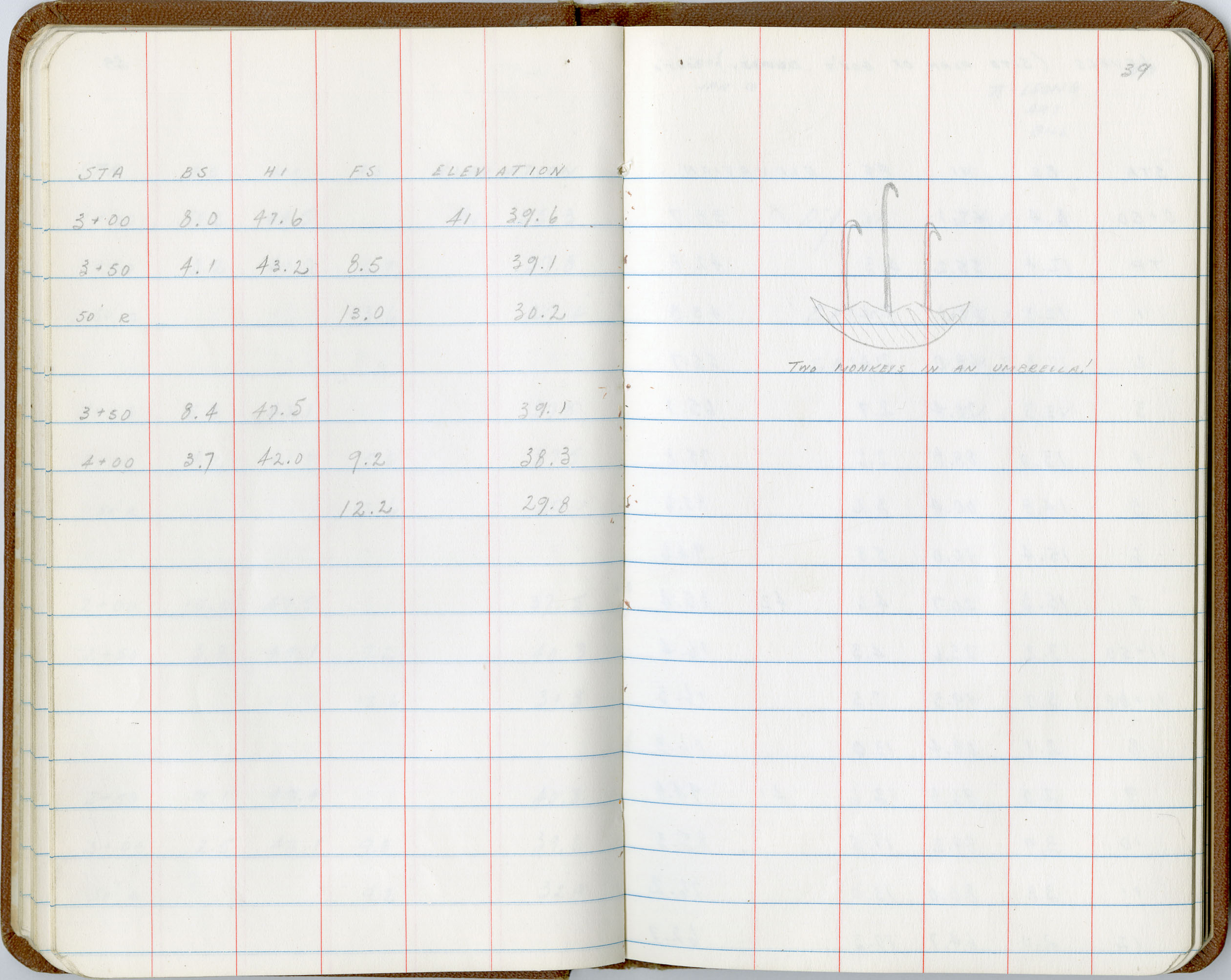
Page 39 of Misc Surveys Winter ’56 field book. (MIKAN 48775)
An observational quality can be detected in many of these annotations representing the environment of the creator at that time. One drawing records animal tracks that the author presumably observed in the park. On another page, the Parks Canada employee sketches the logo from a pack of Matinee filter tipped cigarettes, a makeshift still life placed between measurements of elevations. These doodles seemingly capture a quiet moment, a period of inactivity, maybe a few spare minutes spent on a break. From a close reading of this book, we continue to learn more details about this individual and the type of work they performed.
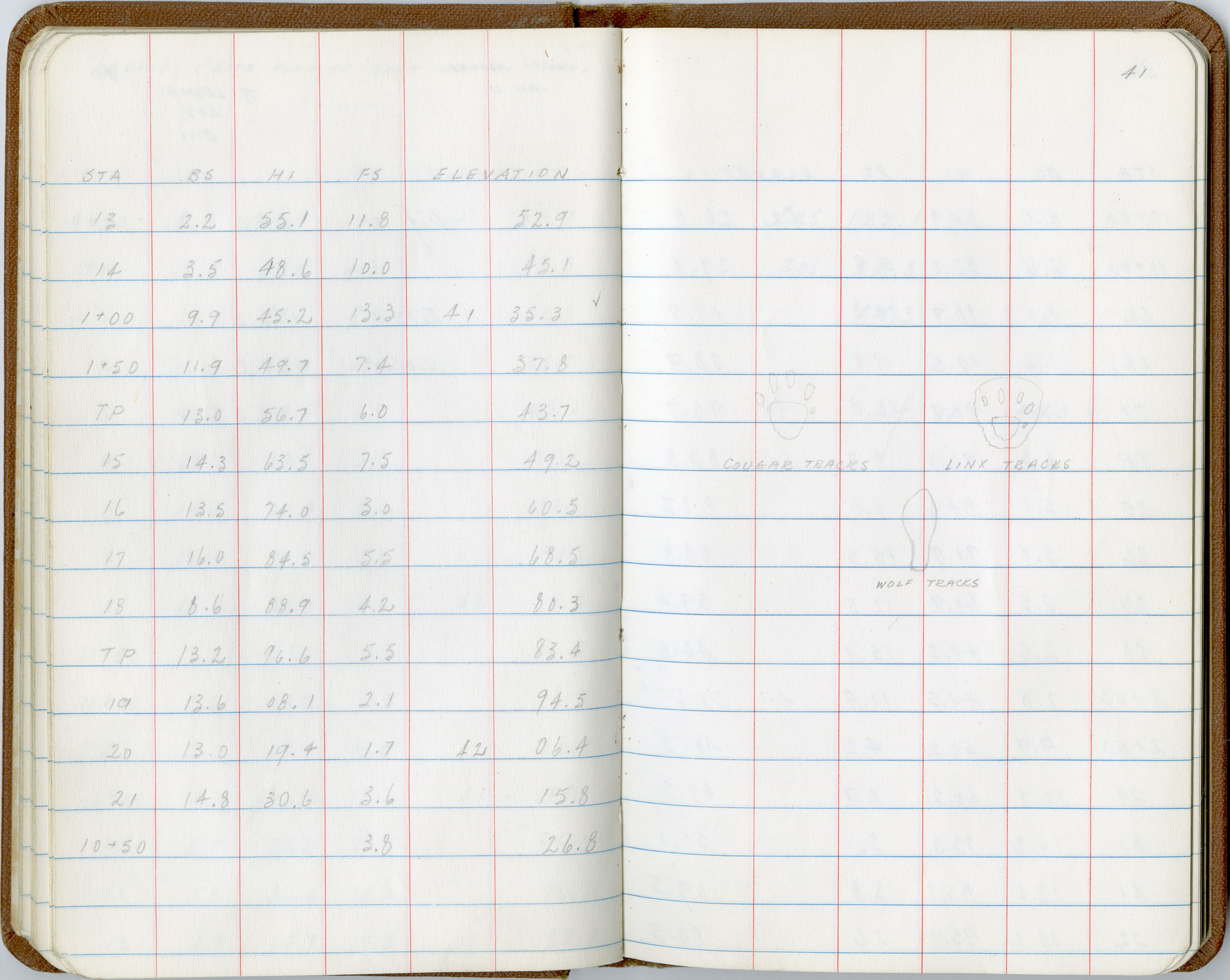
Page 41 of Misc Surveys Winter ’56 field book. (MIKAN 48775)
Another illustration found in this field book references a pop cultural image which circulated widely in the post-WWII era, mainly in the form of graffiti. The origins of this analog meme are disputed, but it is best known as “Kilroy” or “Kilroy Was Here” because the image was often accompanied by this phrase. The iconography associated with Kilroy is a bald man with a long nose, peering from behind a wall. In Library and Archives Canada’s collections, we hold a black and white negative of a photograph from a 1959 University of Toronto publication, the Clap Hands Revue, that depicts a group of people striking a Kilroy Was Here pose. While no longer as commonplace, the popularity and reach of the Kilroy image at the time of our field book were extensive.
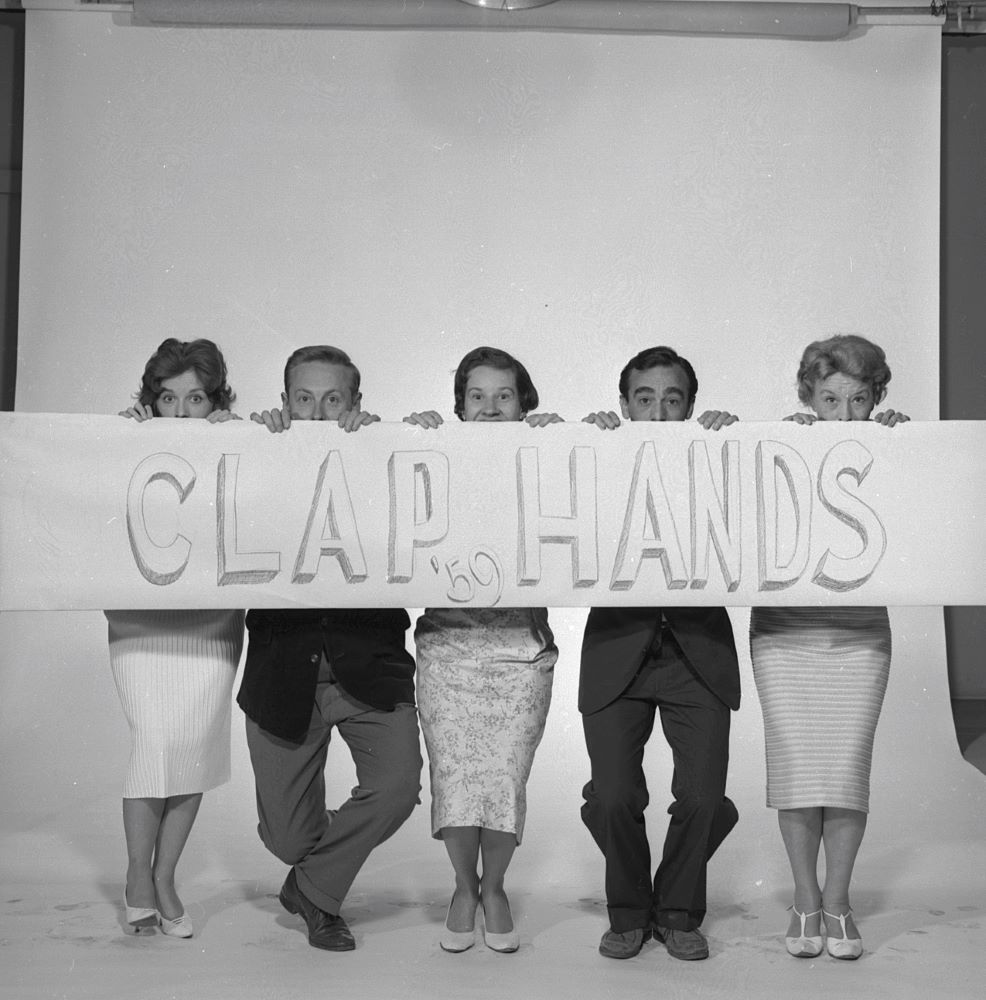
One of the photos taken for the Clap Hands Revue 1959, Hart House, University of Toronto R11224-1856-3-E, Box number: 6354, File number: Assignment 5916-1. Library and Archives Canada/e010745731. Credit: Walter Curtin.
The fact that a Kilroy image appears in this book is quite interesting. It links this record to what is happening in mainstream visual culture. The image’s origin as graffiti art has obvious appeal to someone who is creating their own marginalia and is a clear source of inspiration to the author. This version presents the figure peering from behind a pile of logs next to a wood-cutting axe, which adds some Parks Canada flare and ties this Kilroy to the surveyor’s present location in Yoho National Park. It is an interesting case study of how popular images can evolve over time.
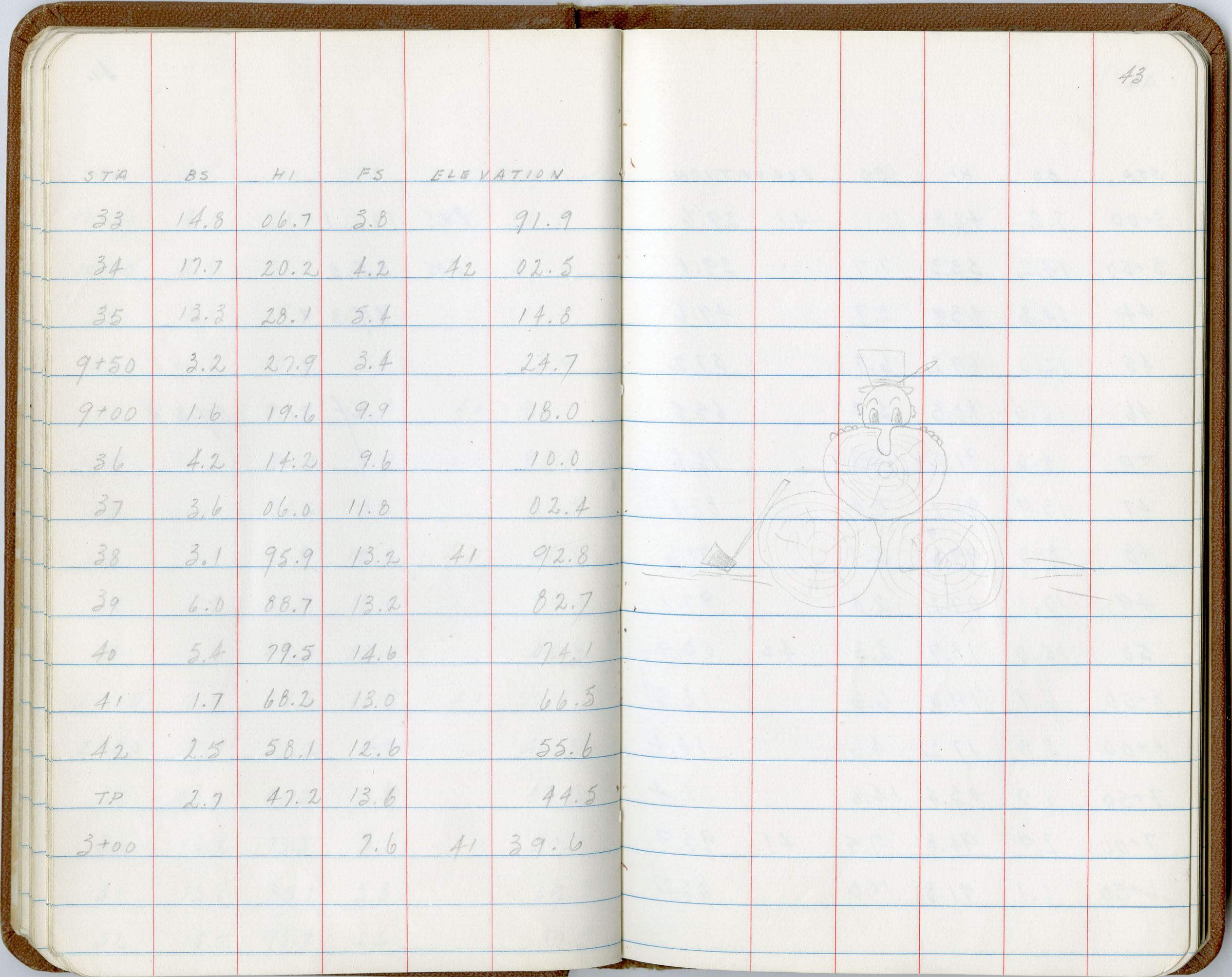
Page 43 of Misc Surveys Winter ’56 field book. (MIKAN 48775)
While most of the annotations and marginalia found in this field book are relatively discreet and simply inserted between routine information, there is one exception. Diverging from other entries, the author writes two journal style entries that conspicuously take up two full pages of the book but remain unpaginated, indicating they were never a part of the official record.
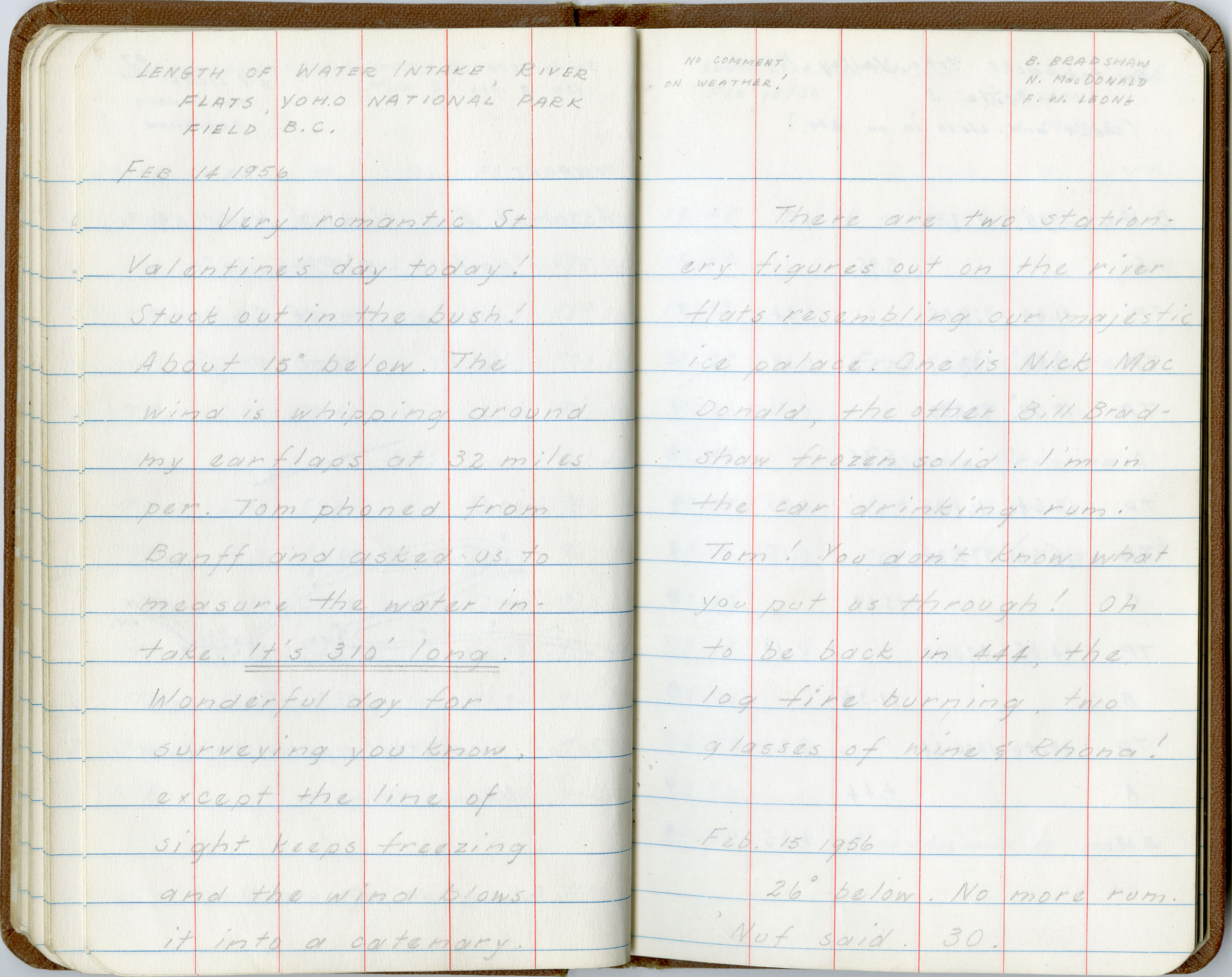
Unpaginated entry in Misc Surveys Winter ’56 field book. (MIKAN 48775)
These notes are equally humorous and wonderfully descriptive. They transport a contemporary reader to this exact time and place; you can almost hear the wind howling! “February 14, 1956. Very romantic St. Valentine’s day today! Stuck out in the bush! About 15 degrees below. The wind is whipping around my earflaps at 32 miles per. Tom phoned from Banff and asked us to measure the water intake. It’s 310’ long. Wonderful day for surveying you know, except the line of sight keeps freezing and the wind blows it into a catenary. There are two stationery figures out on the river flats resembling our majestic ice palace. One is Nick MacDonald, the other Bill Bradshaw frozen solid. I’m in the car drinking rum. Tom! You don’t know what you put us through! Oh to be back in 444, the log fire burning, two glasses of wine & Rhona! February 15, 1956. 26 degrees below. No more rum. ‘Nuf said.”
While these journal entries match the playful tone found throughout the field book, this text reveals more about the creator’s motivations. It becomes evident that the purpose of the field book was not transitory; it was intended to be kept and referenced later by others. Therefore, these comments and jokes were meant to be discovered, left to be found. This shifts our understanding of the marginalia from personal to public. The notes and drawings deposited into this book are meant to entertain. Certainly, the author did not envision this field book to be read by a wide audience or to have any longevity, but we are fortunate to get to enjoy it too. This record provides us with a rare perspective into someone’s lived experience. While we do not know the author personally, their point of view comes across strongly in their humorous antics and friendly demeanour. By providing the reader with a glimpse into the conditions of the work of a surveyor in the 1950s, the marginalia found in this field book enrich the text and change its significance as a social record.
Laura M. Smith works at the Winnipeg Regional Office of Library and Archives Canada.
 Library and Archives Canada Blog