
By François Larivée
Library and Archives Canada has recently acquired a fonds related to religious heritage: the Desmarais et Robitaille fonds. The Desmarais et Robitaille company specialized in the sale of liturgical items, as well as in the renovation and furnishing of churches. This family-owned company, which operated between 1909 and 2021, had long been a fixture in Old Montréal, with branches in Ottawa and Toronto. Its archives include the many documents created and received by the company over more than a century. They testify to the importance of religious practice in Canada during the 20th century and its profound changes from the 1960s onwards.
The sale of religious items
The archival fonds documents the company’s main activities, namely the import, manufacture and sale of various types of items related to Christian liturgy: altars, stoups, chalices, candles and candlesticks, chasubles, stations of the cross, ciboria, confessionals, crosses, incense burners, baptismal fonts, church furniture, monstrances, statues, tabernacles, etc. The fonds contains a large number of photographs, mainly used to illustrate the company’s annual catalogue. It also contains many drawings, mainly by Jean-Charles Charuest, a renowned designer of liturgical arts. In this role, Mr. Charuest worked for the company from 1945 to 1960, producing the drawings presented to clients and artisans for the sale and production of the items. The many drawings and photographs help us understand the importance of religious practice at a particular time, thanks to the wide variety of models offered for each religious item. For example, for items such as altars, baptismal fonts, chalices and candlesticks, clients could choose from dozens of different models (at a wide range of prices).

High altar designed by Jean-Charles Charuest for the Christ-Roi church, Amos, Quebec [195-]. (e011783145, MIKAN 5758370)
The renovation of churches
The Desmarais et Robitaille fonds is a testament to another branch of the company’s activities: the renovation, furnishing and decoration of churches and chapels. This specialization developed mainly towards the end of the 1960s, following the Second Vatican Council (1962–1965), which profoundly transformed the way Mass and the Eucharist were celebrated, causing an equivalent transformation of liturgical space.
Several photos and architectural drawings reflect the many projects undertaken by the company in this regard. These projects were carried out for churches in Canada (Quebec, Ontario and the Maritimes) as well as in the Northeastern United States (notably New York and Vermont). The chapels to be renovated were located both in religious sites (such as convents or monasteries) and in secular sites (such as hospitals or military bases).
The majority of the architectural designs for these projects are the work of the company’s liturgical arts designers, the Reverend Toby McGivern and Rob McDonnell, who were very active in the 1980s and 1990s.

The Notre-Dame-du-Rosaire church, Bathurst, New Brunswick: renovation of the sanctuary and furnishings. Drawing by the Reverend Toby McGivern, 1987. (e011783151, MIKAN 5758372)

Blessed Sacrament Parish, Cornwall, Ontario: proposed renovations to the sanctuary. Designed by Rob McDonnell, 1989. (e011783152, MIKAN 5758372)
The workshop of silversmith Gilles Beaugrand
The year 1983 marks an important milestone in the company’s history. It was at this time that the company acquired the workshop of the renowned silversmith Gilles Beaugrand, known for his production of top-quality chalices. (The chalice is the sacred cup in which the wine of the Mass is consecrated.)
The chalices designed by Gilles Beaugrand were primarily ordination chalices, with each new priest acquiring his own on ordination. Designed by Gilles Beaugrand, they were then crafted by the artisans in his silversmith’s workshop, who specialized in stamping, plating, polishing, engraving, chiselling, crimping and sculpting.
The Desmarais et Robitaille fonds contains all the original drawings by this great silversmith, over 7,000 drawings produced between 1943 and 2006. They were made with extreme care, and although they were intended for production, their artistic quality is undeniable.
Each original drawing is accompanied by a copy containing the specifications and measurements required to craft the chalice. All drawings were classified by number, and the same chalice number may have been ordered more than once. These were recorded in documents (called contracts) that were transferred to the Desmarais et Robitaille fonds.
These contracts contain a wealth of information for researchers interested in religious history. Reflecting the workings of a 20th century silversmith’s workshop dedicated to religious art, they also bear indirect witness to the major changes that affected religious practice from the 1950s onwards. A brief examination of the documents reveals, among other things, an increase in chalice orders until the mid-1950s, followed by a gradual decrease that becomes more marked in the late 1960s.

Drawing by Gilles Beaugrand: chalice no. 404 [194-]. (e011783271, MIKAN 5882654)
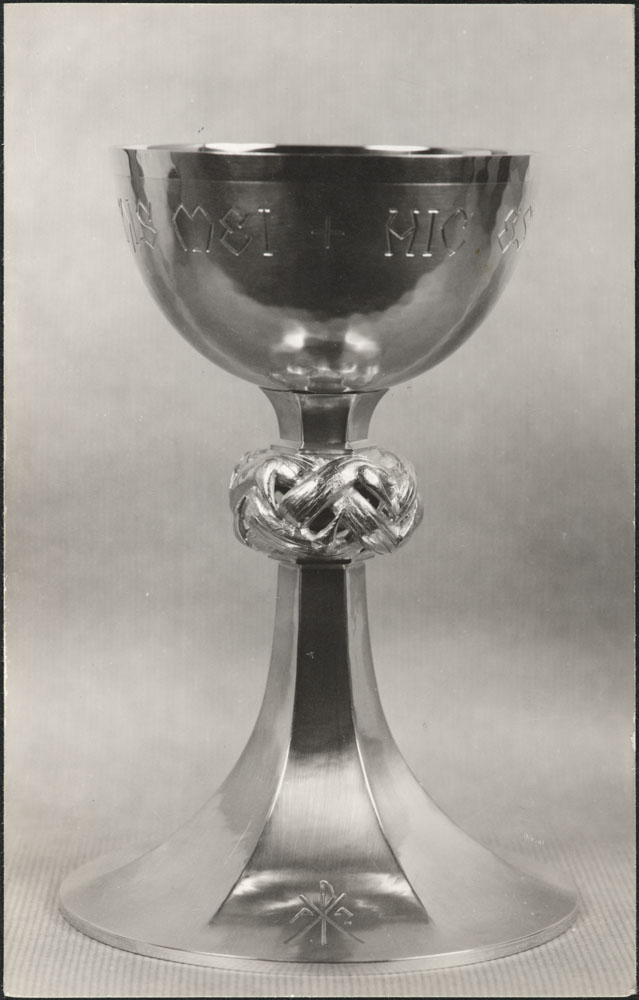
Chalice made by the artisans of Gilles Beaugrand’s silversmith workshop, no. 404 [194-]. (e011783270, MIKAN 5882481)
The creation of stained glass
Finally, the Desmarais et Robitaille archival fonds illustrates one of the company’s major activities: the production of stained-glass windows. A stained-glass studio was established in 1971. Many drawings and photographs show that the company produced stained-glass windows for several churches in Canada and the Northeastern United States. Interesting fact: Desmarais et Robitaille manufactured the stained-glass windows for the St. Joseph Cathedral in Gatineau.

Stained-glass windows, St. Joseph Cathedral, Gatineau, Quebec, 1996. (e011783272, MIKAN 5879559)
The decrease in activities and closing
Unfortunately, due to the significant decline in religious practice, the company had to gradually scale back its activities during the 2000s. It closed its Ottawa branch in 2000 and left Old Montréal in 2008. By 2016, it was only able to offer its services by catalogue, until it finally closed its doors in 2021. Fortunately, the archival fonds preserved at Library and Archives Canada will help us share its important achievements with future generations.
François Larivée is an archivist in the Science, Environment and Economy Section of the Archives Branch at Library and Archives Canada.
 Library and Archives Canada Blog
Francois,Thanks for a fascinating essay revealing a fact many of us do not know: the decline of religiosity and the subsequent closing of churches impacts many businesses and of course workers as well. Sorry to say we are also dealing with this phenomenon here in New York. Fred
Thank you, Fred. It does indeed affect a lot of people and businesses.
I am in receipt of a Beaugrand sterling goblet that is signed by the artist (Aziz) dated 1970. The piece is absolutely spectacular with gemstones and bees affixed to it. I would love to know some more history about it and the artist if anyone is able to help me. Thank you.
Hi, our Research Support section should be able to help you with your research. Please use our “Ask us a question” form available at: https://library-archives.canada.ca/eng/services/public/ask-us-question/pages/ask-us-question.aspx