
By Rebecca Murray
“A [Queen’s Counsel] appointment is a mark of recognition to honour lawyers who demonstrate exemplary service to Canadian society through their dedication to the law and to Canada’s justice system.” (Minister’s Transition Book, Department of Justice) Among members of the Bar itself, getting the designation is sometimes referred to in English as “taking silk.” This is because when you get the designation you become entitled to wear silk robes that are also cut differently from the plain black cotton robes. In the pre-Confederation era, appointments were granted through federal letters patent, now found in the sous-fonds of the Registrar General (RG68) held at Library and Archives Canada.
To identify these appointments via letters patent, follow these steps:
Step 1
Find the General Index for the period. For the pre-Confederation era, look at one of the following two indices:
- RG68 volumes 894 and 895, “General Index,” 1651–1841, available on digitized microfilm reel C-2883; or
- RG68 volumes 897 and 898, “General Index,” 1841–1867, available on digitized microfilm reel C-2884.
Step 2
Next, find the entry in the alphabetical table of contents:
Step 3
Go to the corresponding page in the General Index. For example, you will find the index to appointments for pre-1841 records for both Upper and Lower Canada on pages 539 and 540. The post-1841 indices are on pages 316–318 for Lower Canada, and pages 318–320 for Upper Canada.
Step 4
Looking at page 540 of RG68 volumes 894 and 895, “General Index,” C-2883, as an example, we can read the list of names and select those of interest. Let’s take Alexander Buchanan as our example. The letters patent granting his King’s Counsel (KC) designation were issued on June 19, 1835, and can be found in liber 14 on page (folio) 279.
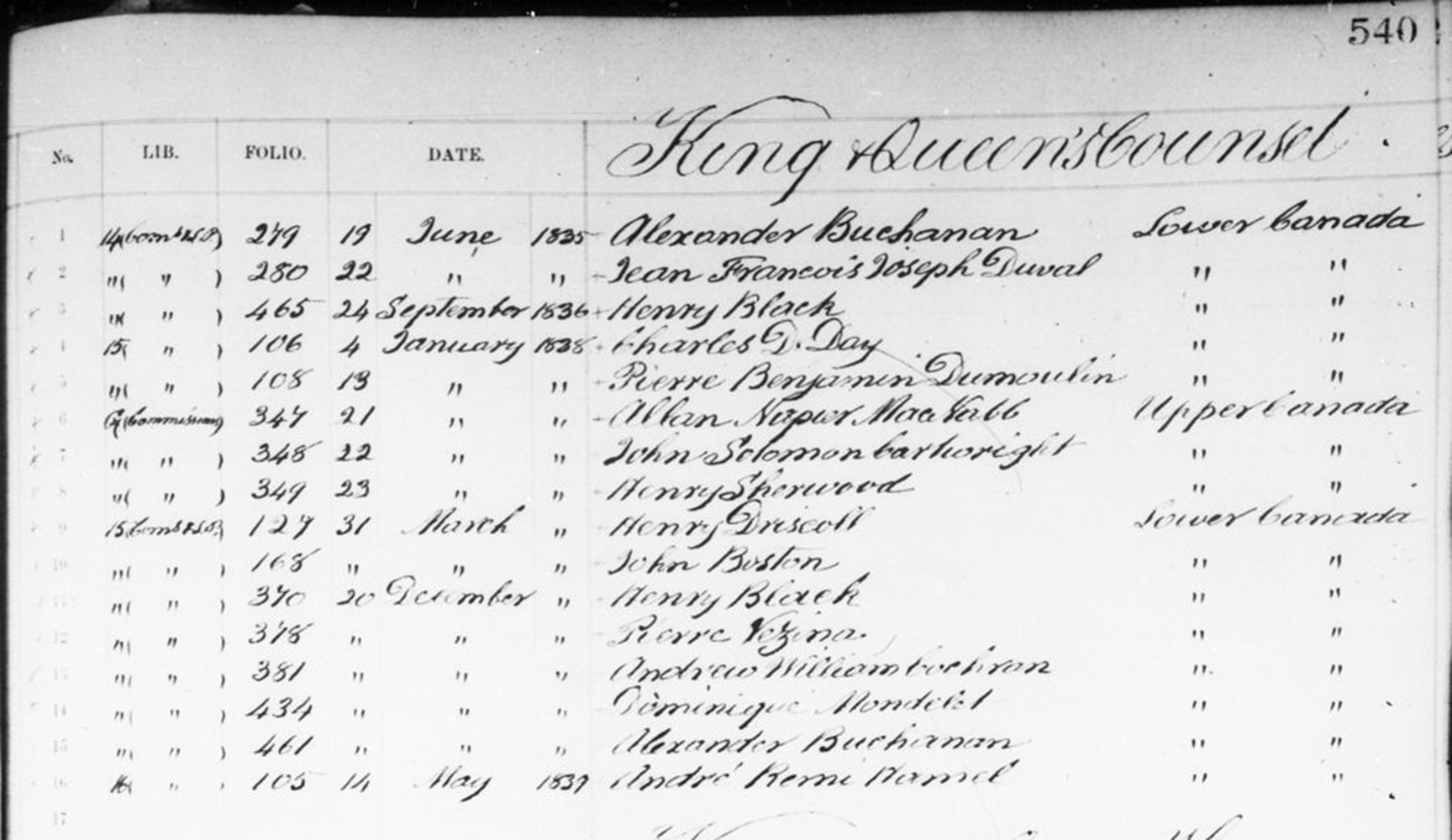
Excerpt from page 540 of the General Index for pre-1841 records, specifically for King’s and Queen’s Counsel appointments.
Step 5
To find the specific liber within the record group (RG68), use Collection Search and follow the model below. The first and second screenshots below show the search screen and terms used while the third shows the item level result.
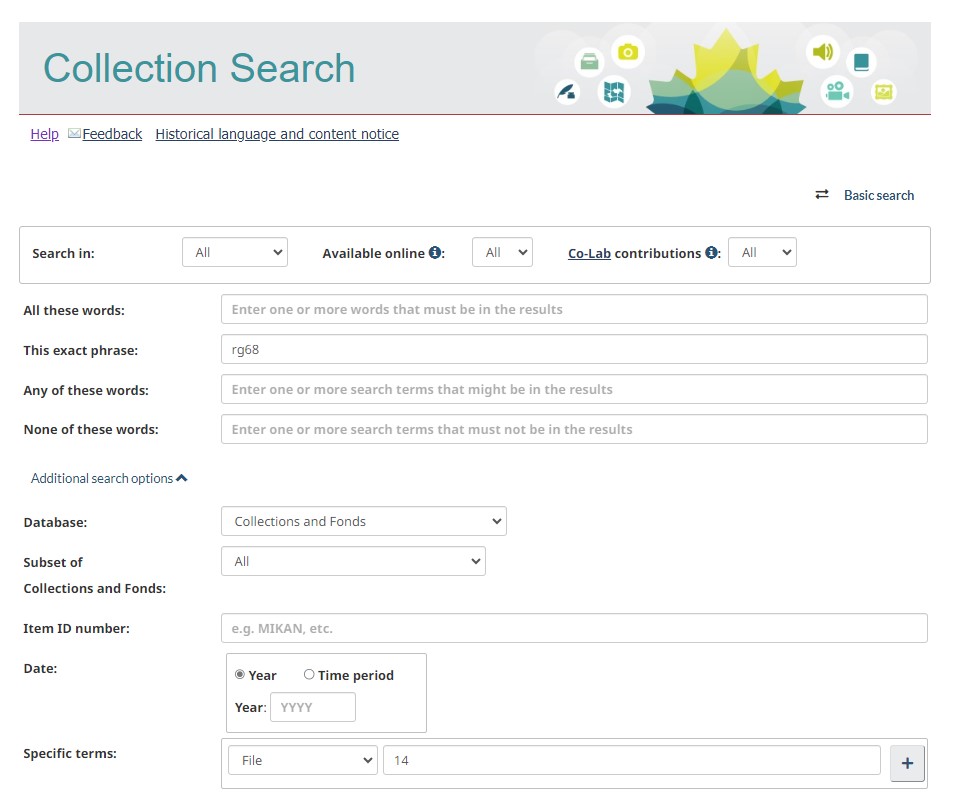
A screenshot showing the search terms in the Collection Search – Advanced Search function.
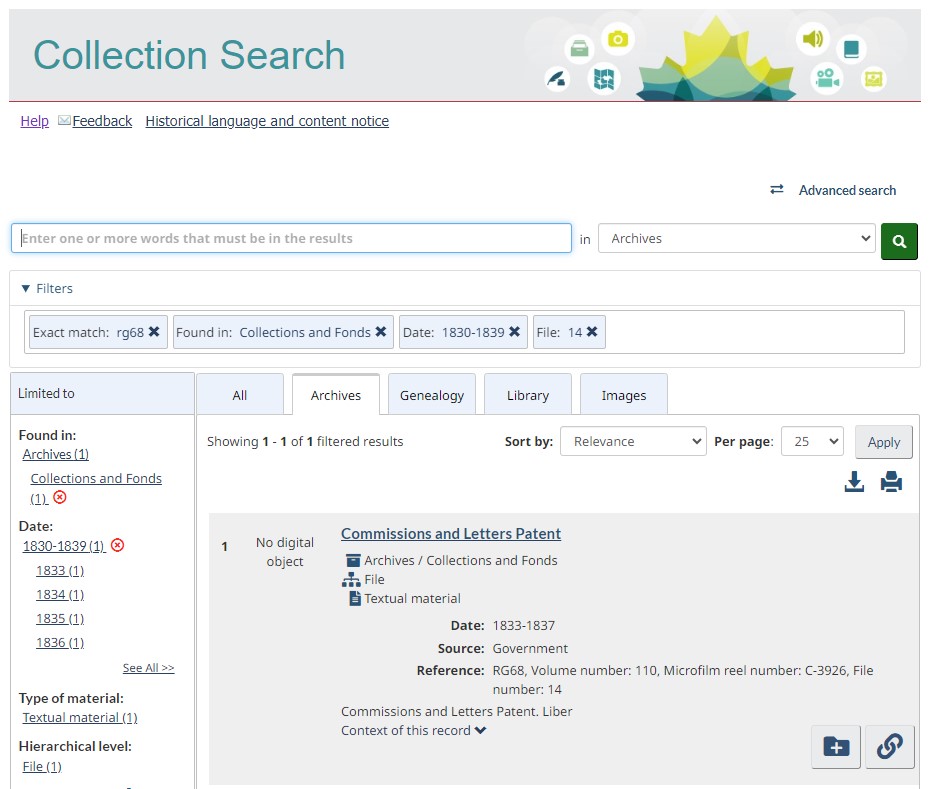
A screenshot showing filtered results by date.

A screenshot showing the file level result.
Step 6
From the results page, we see that the document is available on microfilm, and in this specific case, it is available on digitized microfilm.

An excerpt of the text of the commission appointing Alexander Buchanan Esquire, King’s Counsel, in RG68 volume 110, file 14, page 279, found at image 514 of digitized microfilm reel C-3926.
When Alexander Buchanan received the designation “KC” in 1835, Canada was just years away from the arrival of Queen Victoria to the British throne. This means that if he had still been practicing law in good standing at the time of her coronation, Buchanan would have changed the “KC” designation to “QC”, to reflect the female monarch. Similarly, QCs in Canada changed their designation to “KC” upon the coronation of King Charles III.
Library and Archives Canada also holds the private fonds of numerous King’s and Queen’s Counsel appointees, such as the Ramon J. Hnatyshyn fonds (R10945) and the John Duggan fonds (MG29-E88).
If you are interested in the history of King’s and Queen’s Counsel appointments in Canada, pre- and post-Confederation, I encourage you to review LAC’s holdings for related records and to do research to find out more about how the appointment is awarded in your home province or territory today.
Rebecca Murray is a Senior Reference Archivist in the Reference Services Division at Library and Archives Canada.
 Library and Archives Canada Blog
It would have been helpful to know whether information is accessible about more recent appointments as KCs and QCs i.e. appointments made during the 20th Century. If a person wished to know which lawyers in the history of a community had ‘taken silk’, would she be able to search by community? By name? and how/where.
Hi Judy, thanks for your question and comment. Library and Archives Canada holds federal records. We chose to highlight this period because the records are available online. Similar records exist for the post-1867 period but are not all online. If you are looking for a post-1867 federal appointment, please write to us with the specifics: http://www.bac-lac.gc.ca/eng/ask-us-question. If you are looking for local information please contact your provincial or territorial bar society or archival institution.
Good luck in your search!
Pingback: This week’s crème de la crème — October 27, 2018 | Genealogy à la carte
Just a note that Territories are generally considered not to have the capacity to award a Kings/Queens Counsel designation due to their status as subordinate territories.
You need to be a Crown (ie Crown in right of Alberta, Crown in right of Canada) to offer up the honour. Any KC in Yt/Nt/Nu would be federally awarded.
Hi, thank you for contacting us. This blog post has just been updated.