
By Ariane Gauthier
We make surprising connections throughout our lives. Things we thought were confined to our work or social circles unexpectedly surface in other areas. For me, several long drives with my husband to Northern Ontario led me to learn more about the Kapuskasing internment camp. Few people know that there were internment camps in Canada during both world wars. And even fewer know that these camps were not all for prisoners of war—many detained Canadian civilians of so-called “enemy” nationality.
The Kapuskasing camp was active from the start of the First World War in 1914 until 1920. It mainly held Ukrainian civilians. They were sentenced to forced labour, including constructing buildings and clearing several hectares of surrounding forests so the government could establish an experimental farm.

The Kapuskasing internment camp. (e011196906)
My work as a reference archivist has allowed me to delve deeper into the resources of Library and Archives Canada to learn more about this grim period in Canadian history. During my research, I came across the documents of William Doskoch, born on April 5, 1893, in Laza, Galicia, a territory of the Austro‑Hungarian Empire that is now part of Ukraine.
In 1910, at the age of 17, William Doskoch joined his brother in Canada to work in the coal mines in Nanaimo, British Columbia. While he was in Vancouver in 1915, he was arrested, as he was considered an enemy alien. He was interned in several camps: first at Morrissey, then at Mara Lake, and later at Vernon, before finally being transferred to Kapuskasing. It was from there that he was released five years later, on January 9, 1920.
The William Doskoch fonds is rich in resources that help us understand internment camps from an internee’s perspective. While it contains information on several camps, I was mainly interested in William’s notes about Kapuskasing. According to his writings, the conditions were similar to those at Vernon: mistreatment of prisoners, random executions, many cases of tuberculosis, and inadequate internment conditions for the cold weather.
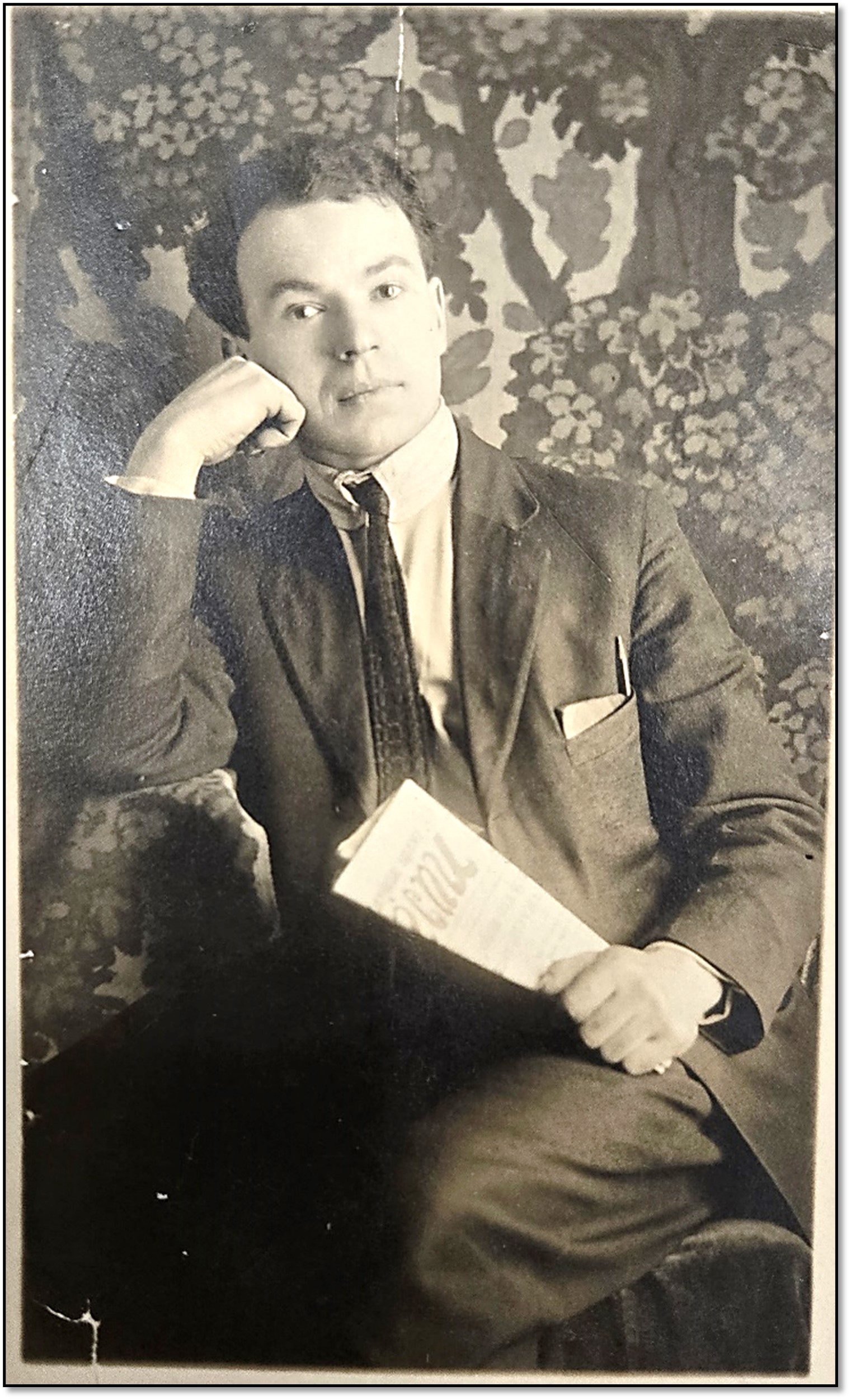
Portrait of William Doskoch. (MIKAN 107187)
I also found a letter written by George Macoun, a guard at the Kapuskasing camp, detailing events that occurred there between November 1917 and the summer of 1919. Although of lesser magnitude than the William Doskoch fonds, the letter provides us with a rare glimpse into the experience of an internment camp guard.
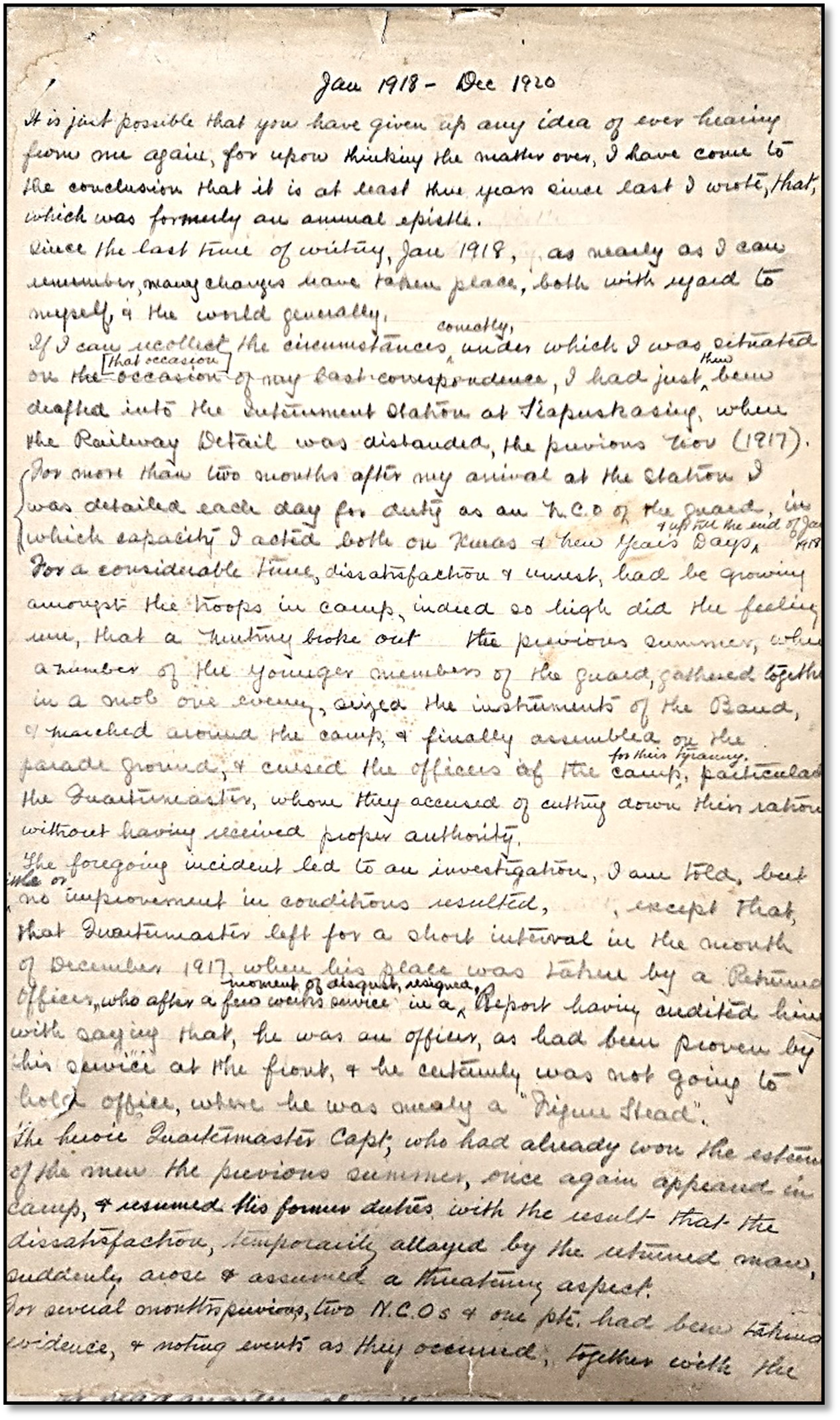
Letter from George Macoun, a guard at the Kapuskasing internment camp. (MIKAN 102082)
Originally from Ireland, George Macoun immigrated to Canada, where he joined the militia in February 1915. This is how he became involved in the operations at the Kapuskasing internment camp. He wrote this letter after the war ended, following his dismissal as a guard. Reminiscent of a memoir, he recalls the significant experiences of his time in Kapuskasing, including the conflicts and tensions among the guards due to abuses of power. He recounts the following:
“One little incident took place in March 1918, which aroused the wrath of the company generally against this commander owing to the manner in which the case was brought up being considered, according to military custom, absolutely irregular. One evening, whilst an entertainment was being held in the recreation room about the last week of Feb 1918 a certain corporal, one of the most popular men of the guard had the misfortune to get drunk and a disturbance during the night, not only in his own room but also in one of the other rooms. This information was conveyed to the popular O.C. [officer commanding] by some weak about two weeks later, when a charge was at once laid against the corporal.”
The Department of the Secretary of State of Canada fonds also contains a wealth of information. Notably, it includes a sub‑series entitled Custodian of Enemy Property and Internment Operations records, covering the period from 1914 to 1951 (R174-59-6-E, RG6-H-1). During both world wars, the Secretary of State was responsible for, among other things, matters arising from internment operations. However, some activities, such as those related to the management of properties confiscated by the State from internees, were eventually transferred to other departments over the years. The fonds still contains documentation on the certificates of release from internment camps and on the administration of the camps. Boxes 760 to 765 inclusively hold documents concerning the operations of the Kapuskasing camp.
Because there’s a lot of information, I will only focus on a few interesting elements for Kapuskasing. For example:
- According to correspondence from the director of internment operations, the experimental farm built by the prisoners at Kapuskasing was completed in early December 1917.
- According to statistics from December 1918, the camp housed the following prisoners: 607 Germans, 371 Austrians, 7 Turks, 5 Bulgarians, and 6 classified as “other.” A note suggests that the term “other” was used for prisoners of war, but it is not clear.
- Several letters written by prisoners to their family members were censored. This is the case for the letters that Adolf Hundt sent to his wife. Discouraged by the extent of censorship, he gave up writing to her, leading his wife to worry about his health.
This blog post gives you an overview of the information available about the Kapuskasing camp in the Library and Archives Canada collection. This rich resource offers valuable insights into this troubling chapter of Canadian history. To support further research, we have created a guide on internment camps in Canada during the two world wars, which was very helpful to me in writing this blog post.
To consult the guide, follow this link:
- Thematic research guides on internment camps
Ariane Gauthier is a reference archivist in the Access and Services Branch at Library and Archives Canada.
 Library and Archives Canada Blog
Ariane, Fascinating reading, especially in light of my Ukrainian heritage! You have provided invaluable insight into possible explanations to questions related to why early twentieth century immigrants (my grandfather) were reluctant to discuss the locations of their former homes in Europe. Thank you! Fred
I mentioned Kap Camp. There was a strange note on a Kap medical with Mitchell signature. This suggests that is how Dr. Mitchell came to Camp Borden via returning on a guard rotation. More investigation into this matter is required. I believe he was a civilian MO appointed to the Camp. He was from Port Arthur, Ontario.
Hi! You raise interesting questions about Dr. Mitchell. I recommend that you take a look at our internment camp guide linked at the end of this blog post, it will certainly provide you with a good starting point into this research. Good luck! 😊 – Ariane
Good Morning Ariane,
I am a collector of Canadian militaria and P.O.W. memorabilia. I have in my collection a window from the Kapuskasing internment camp. This window was found at a dump west of Timmins Ontario about 10years ago. I am thrilled that this piece of Canadian history was rescued. If you would like photos of the window, please send me an email address to which I could send them to. I tried here but couldn’t find a way to send photos. Thank you for a great article about the history of the camp!
This is a very cool find! You can forward the images to Reference@bac-lac.gc.ca and mention that you are forwarding these images in relation to this blog post. I’m very excited to see the photos! – Ariane
“random executions”? …very very unlikely. Please provide a source.
Hello, as mentioned in the blog post, this information comes from the William Doskoch fonds (https://central.bac-lac.gc.ca/.redirect?app=fonandcol&id=107187&lang=eng). The specific mention of this comes from one of his notebooks during internment that eventually became the base of his autobiography. The material is considered open for consultation; if you’re in Ottawa, it can be consulted to learn more about William Doskoch’s experience with internment camps.
Recent article on the subject: https://scholars.wlu.ca/cmh/vol34/iss1/3/
Thanks for sharing this, Fred. I’m excited to give it a read! – Ariane
Hi Ariane: Thanks for this blog about the Kapuskasing Internment Camp. In May, 1918, 16 Ukrainian men from Ottawa were arrested and interned as ‘Radical Aliens’ at the Kapuskasing Internment Camp for participating in a political meeting on May 1. Due to the Bolshevik Revolution in Russia, the Canadian government was concerned about this ‘Revolution’ spreading to Canada and began to intern ‘Radical Aliens’ rather than ‘Enemy Aliens’ since the First World War was almost over. The Camp was also used to hold other ‘political prisoners’. I should mention that I organized the William Doskoch Papers when I worked at Library and Archives Canada.
Thanks again.
Thanks for sharing your insight, Myron! Your comment illustrates perfectly the complexity of internment operations in Canada. – Ariane
Pingback: The Kapuskasing Internment Camp – NiCHE