Black Porter Perspectives: Bringing Thomas Nash, a Canadian National Railway Porter, Back to Life

Version française

By Andrew Elliott

In the first post of the Black Porter Perspectives series, Rebecca Murray highlighted a wartime photograph that identified a railway sleeping car porter: Jim Jones of Calgary. In the Canadian National (CN) fonds, with which I work, it is worth noting that finding a porter’s name is rare. This collection (RG30/R231), one of Library and Archives Canada’s (LAC) largest private acquisitions, should logically contain a plethora of records about porters due to their central role in railway service. Sadly, until recently, this has not been the case. A basic keyword search for “porter” often yielded few, if any, results. I am working hard to correct this situation.

Over the last few months, my work has involved sifting through backlogged material relating to the CN Passenger Services Department. I recently found a collection of files from the late 1960s documenting employees who worked for the CN Sleeping, Dining, and Passenger Car Department. These files cover a range of issues, including accidents, insurance claims, thefts of company property, and retirements, as well as provide insight into the lives of cooks, waiters, stewards, and porters. Among these, I discovered an important and interesting personnel file for a Black porter named Mr. Thomas Nash. His file stood out due to his remarkable 42-year career, spanning from his hiring on June 23, 1927, to his retirement in August 1969. This documentation sheds light on who Nash was and offers a deeper understanding of what portering looked like for him and other Black men during this period.

Who was Mr. Thomas Nash?

Nash’s personnel file is rich with details, allowing us to begin to piece together his biography. Raised by his adoptive parents in Antigonish, Nova Scotia, Nash later moved to Montréal, where he worked as a CN porter. The path to learning this information is particularly interesting.

In the late 1940s, CN’s Staff Record Bureau began seeking Nash’s birth date to determine his retirement eligibility. Like many Black citizens in Canada and the United States, Nash faced challenges with recordkeeping, which were compounded by his adoption. He offered several possible birth years, including 1899, 1900, 1902, 1904, 1905, and 1907, which further complicated the Bureau’s task.
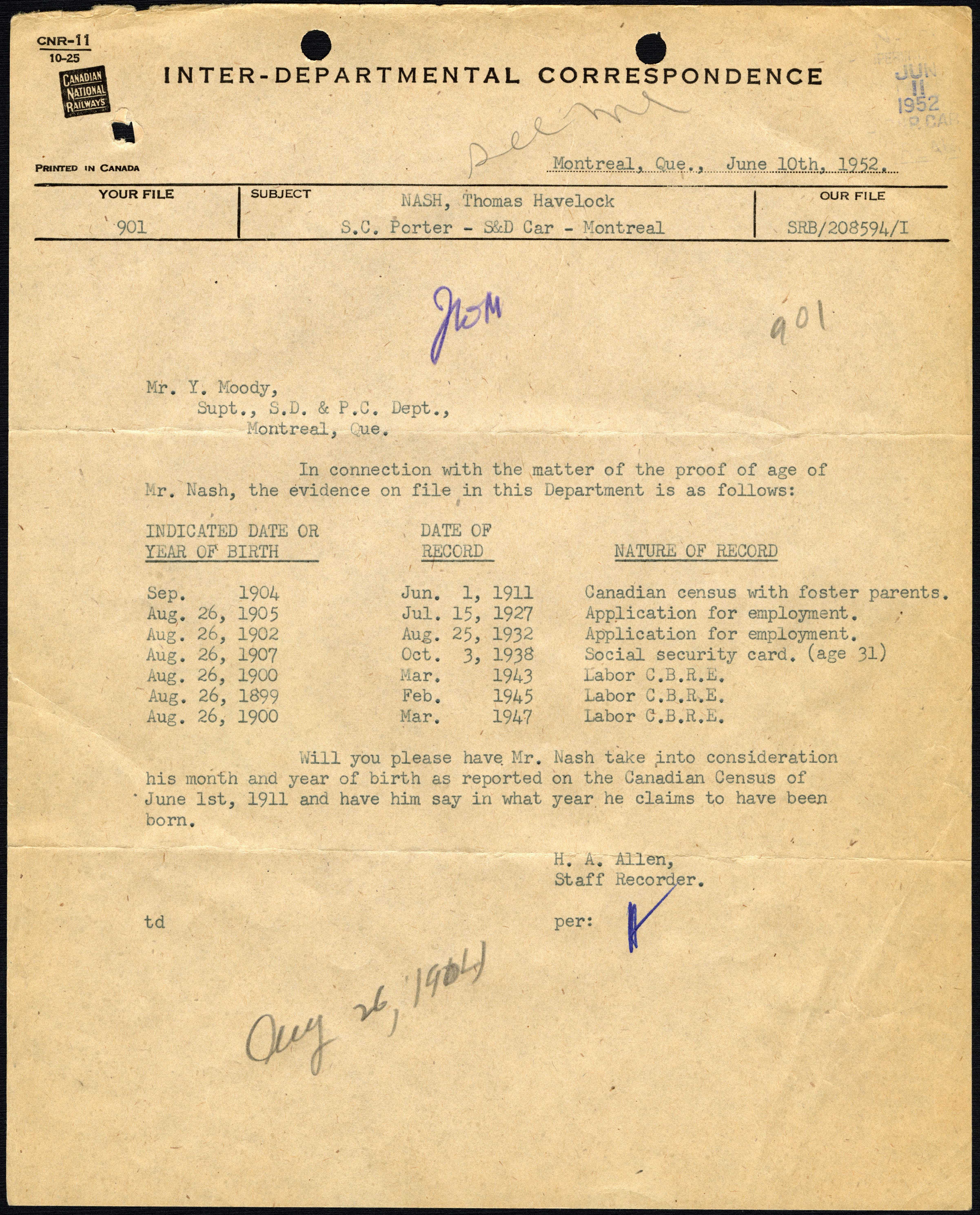
Page showing possible birth dates for a CN porter.

Documentation from the CN Staff Record Bureau detailing various possible birth dates for Thomas Nash, dated June 10, 1952. (MIKAN 6480775)

Due to Nash’s inability to provide accurate information about his birth, the CN Bureau contacted the principal of St. Ninian School in Antigonish, Nova Scotia, which Nash had attended as a youth. This inquiry in 1952 proved unsuccessful. The following year, the CN Bureau contacted the Dominion Bureau of Statistics, which confirmed that Nash had actually been born on August 26, 1904. The 1911 Census further revealed that Nash lived with his adoptive parents in Antigonish, a detail that is recorded in his personnel file. Interestingly, while his personnel file does not address the matter explicitly, Nash’s last name appears to have changed between his youth and his move to Montréal. As a child, he went by the surname “Ash,” which later became “Nash” before he began his job with the CN. Was this a recording error? Determining his correct birth details led to Nash’s eligibility for the CN Pension Plan, which went into effect on January 1, 1935.

In addition to learning a little bit about his early life, we also see that upon relocating to Montréal, Nash became part of the city’s tight-knit Black community, living in what was then known as the St. Antoine District. This is unsurprising given the racial segregation in housing and the community’s proximity to the train station.

While his early years in Montréal are undocumented in his personnel file, we see that Nash resided at 729 Seigneurs Street in the 1950s and early 1960s. A 1968 letter he wrote to the CN Staff Record Bureau reveals that he had married and later resided with his wife at 2458 Coursol Street, just a few streets over from his former residence.

Nearly every household in the St. Antoine District had ties to portering. This profession was deeply respected, as evidenced by a community ritual honouring retiring porters: family, friends, colleagues, and bosses gathered at the train station to welcome these men home from their final runs. The Black Worker, the Brotherhood of the Sleeping Car Porters’ union newsletter, often documented these special moments. Nash undoubtedly experienced such recognition when he retired in 1969.
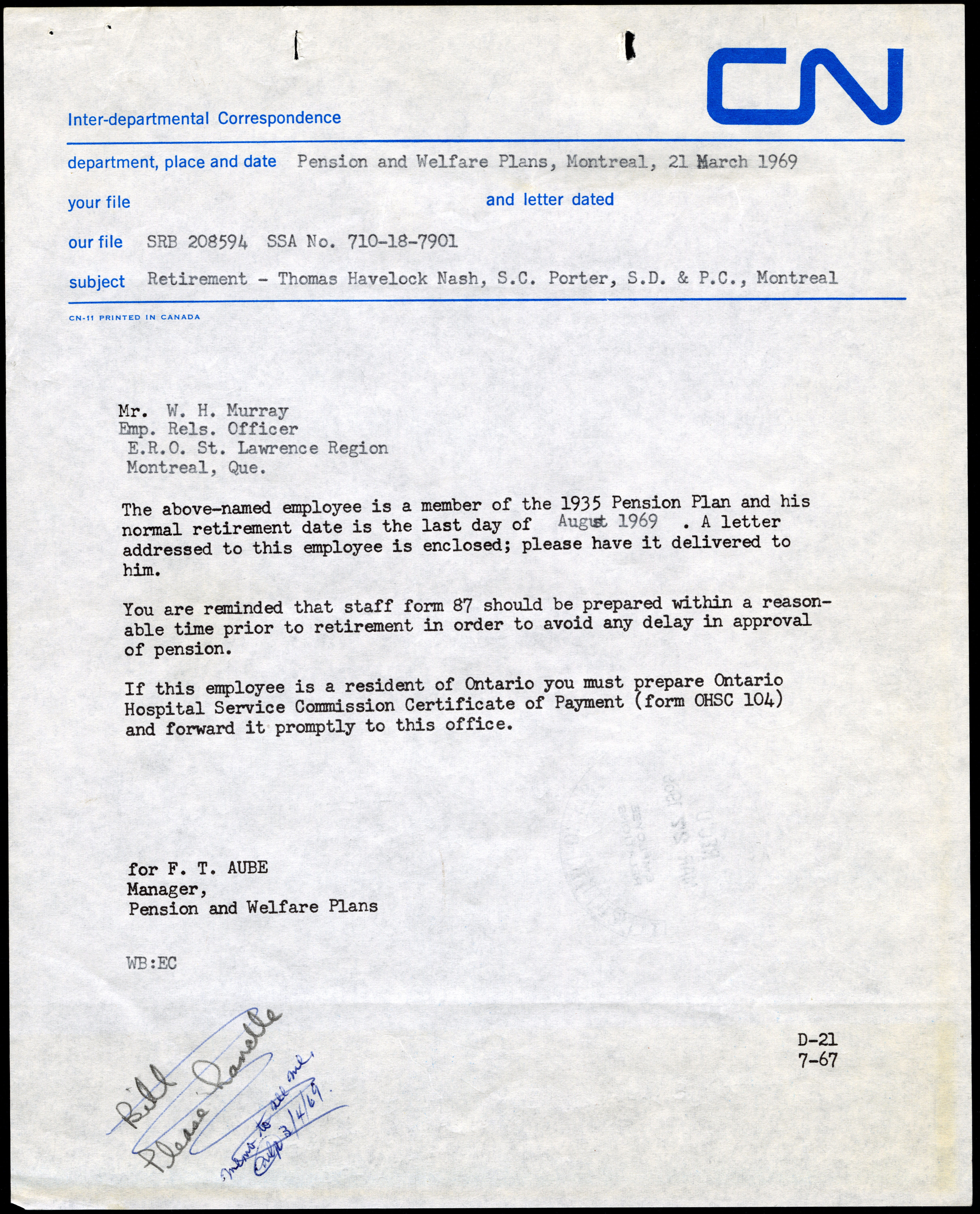
Letter from CN’s Human Resources Department outlining details relating to a CN porter’s upcoming retirement in August 1969.

Letter detailing Thomas Nash’s upcoming retirement in August 1969. (MIKAN 6480775)

The rights and experiences of porters

Nash’s career began in 1927, a pivotal year for both CN and its employees. That year, CN and its union, the Canadian Brotherhood of Railway Employees (CBRE), created a segregated system dividing employees into two groups. Group 1 included dining car employees and sleeping car conductors (white men), while Group 2 consisted of sleeping car porters. These separate collective agreements restricted seniority and promotion opportunities within each group, effectively locking Black workers into portering and barring them from advancing within CN’s ranks.

Nash would have quickly realized that upward mobility was impossible for him. Dr. Steven High helps us contextualize Nash’s experience, noting that porters in the 1920s and 1930s worked very long hours with a fixed monthly salary, regardless of the actual number of hours worked. On average, porters were allowed just three hours of sleep per day while in transit. Needless to say, their working conditions were difficult and highly exploitative. Unfortunately, Nash’s early years on the job, including his contributions during the Second World War, are undocumented in his personnel file—a troubling omission given the essential nature of his work.

Despite their invisibility in these records, Black porters began agitating for improved conditions. In 1945, Canadian Pacific Railway sleeping car porters successfully negotiated a new collective agreement that including better wages, vacation time, and reduced hours. These union gains, however, did not extend to CN employees who remained bound by CBRE’s more restrictive agreement. The agreement featured below, dated 1948, shows that all porters remained among the lowest-paid employees, second only to pantrymen, with monthly salaries ranging between $174 to $209. Also, unlike some of the other occupations listed, porters’ salaries would not increase in years two or three. In truth, these men saw little improvement to their working conditions until 1964, when the Canadian Brotherhood of Railway, Transport and General Workers came into existence, ending occupational colour barriers and creating a combined seniority list.

(For more information about the long fight for porters’ rights, listen to “Porter Talk: The Long Fight for Porters’ Rights.”)
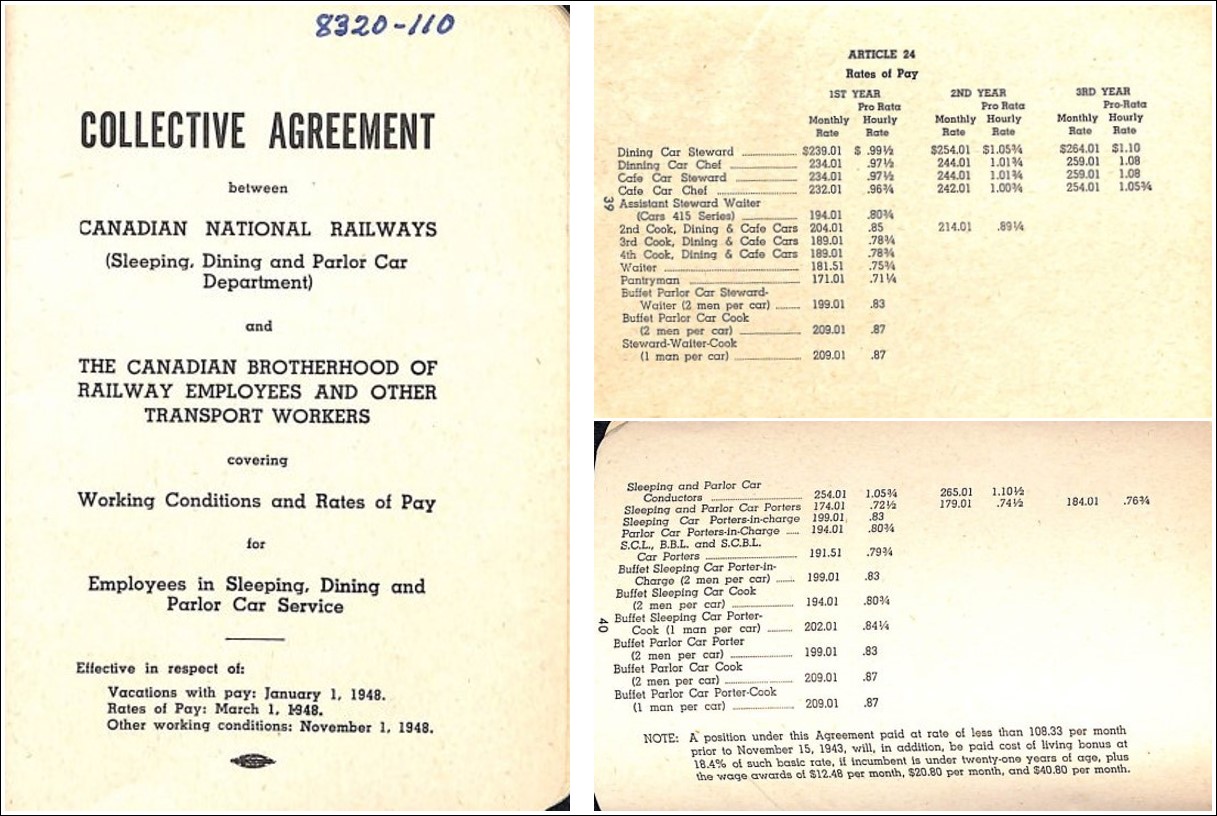
Cover page of the CBRE Collective Agreement along with details of employee wages.

Pages from the 1948 CBRE Collective Agreement, covering working conditions and rates of pay for employees in sleeping, dining, and parlour car service. (MIKAN 1559408)

A cursory engagement with the CN fonds might obscure the contribution of porters, but Thomas Nash’s personnel file provides valuable insight into the nature of their work. His employee service rating card, in particular, emphasized the stresses inherent in portering. This card was designed to document and rank the quality of service provided, a reminder that Nash and his colleagues were under constant scrutiny—whether by CN staff or passengers. It is interesting to point out that even minor infractions could result in demerit points, colloquially known as “brownies.” Accumulating 60 demerit points led to automatic termination without the possibility of appeal. Remarkably, Nash’s record stands out: in his 42-year career, he never incurred a single demerit point. The comment card below showcases a passenger’s remark from 1958, providing a vivid anecdote and serving as a testament to Nash’s exceptional service: “Excellent Porter but talks too much.” While seemingly contradictory, this remark sheds light on Nash’s engaging personality and unwavering commitment to his duties.
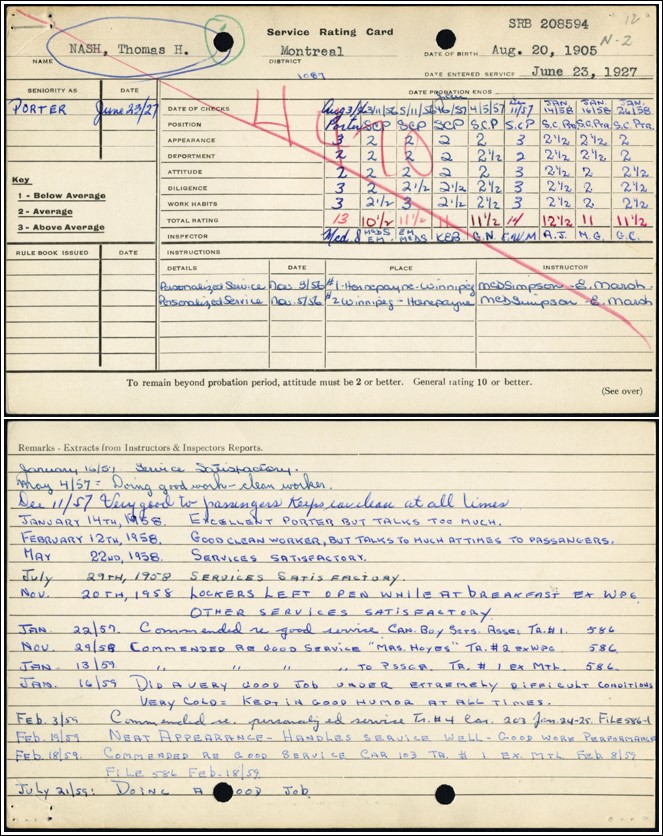
Cards displaying employee rating numbers and comments on Thomas Nash’s service performance.

Front and back of Thomas Nash’s employee service rating card. (MIKAN 6480775)

In 1961, another passenger went further, commending Nash for his service:
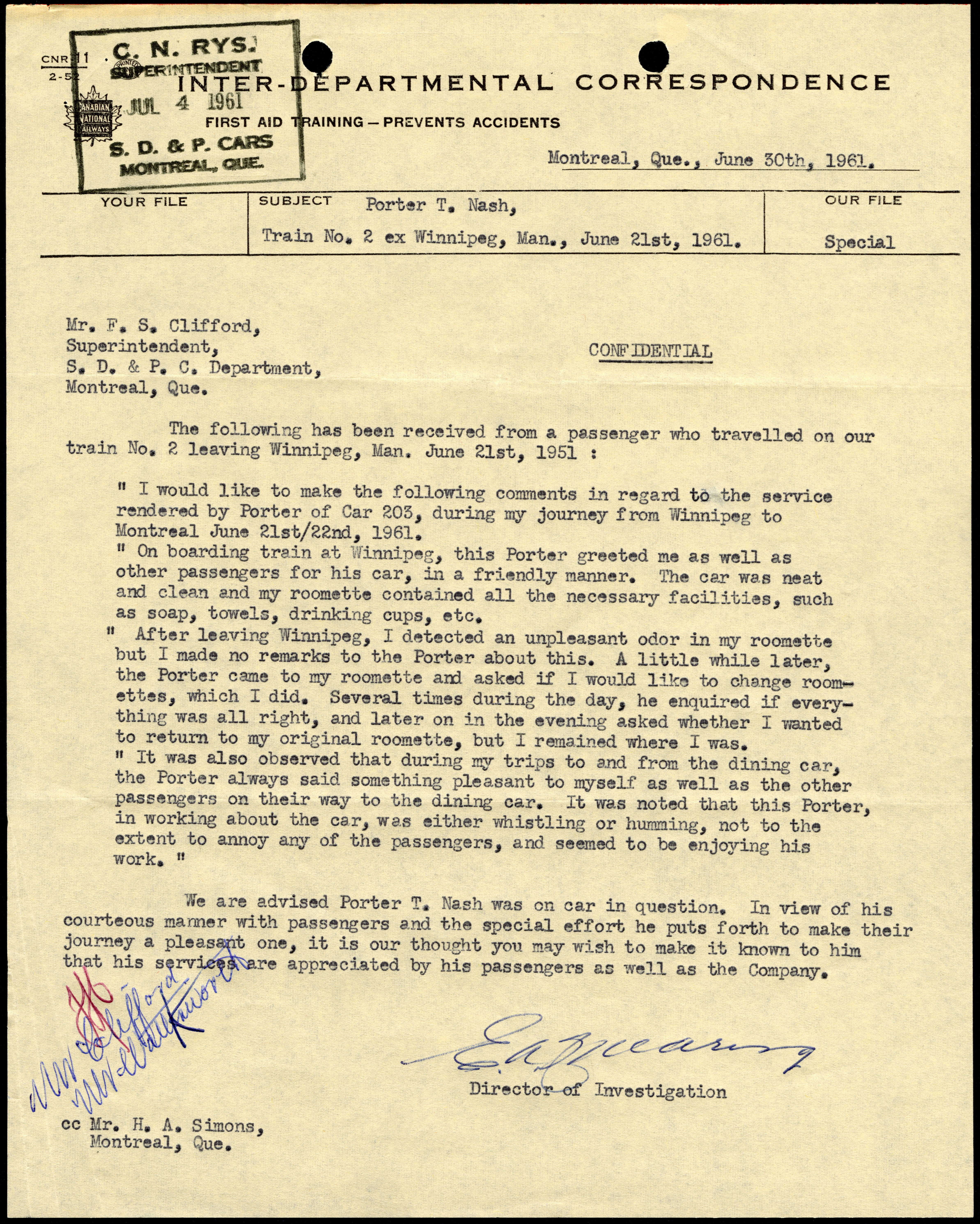
Typewritten letter detailing a passenger’s compliments on the service provided by CN porter Thomas Nash.

Letter documenting a passenger’s commendation of CN porter Thomas Nash for service excellence, 1961. (MIKAN 6480775)

Making porters’ service visible

My team remains committed to uncovering more information about the lives porters led and the experiences they had on the rails. Since last year, we have uploaded over 21 000 service files related to employees who worked for CN and its predecessor companies—including records for 1 066 porters—to the series entitled Employees’ provident fund service record cards. Slowly but surely, we are uncovering records within the CN fonds that shed light on the invaluable contributions of porters, making their essential service visible. In many ways, this work allows us to honour their legacy and bring their stories back to life, contributing to a new understanding of their profound impact in shaping modern Canada.


Andrew Elliott is an archivist in the Archives Branch at Library and Archives Canada.
What’s in a Name: the Carnegies in context

Version française

By Sali Lafrenie

“What a trip. It was as if I had been shot through a time tunnel from the fields of Willowdale to a field of dreams. The many threads of my life have all come together to produce a beautiful tapestry.”

Herb Carnegie, A Fly in a Pail of Milk: The Herb Carnegie Story (OCLC 1090850248)

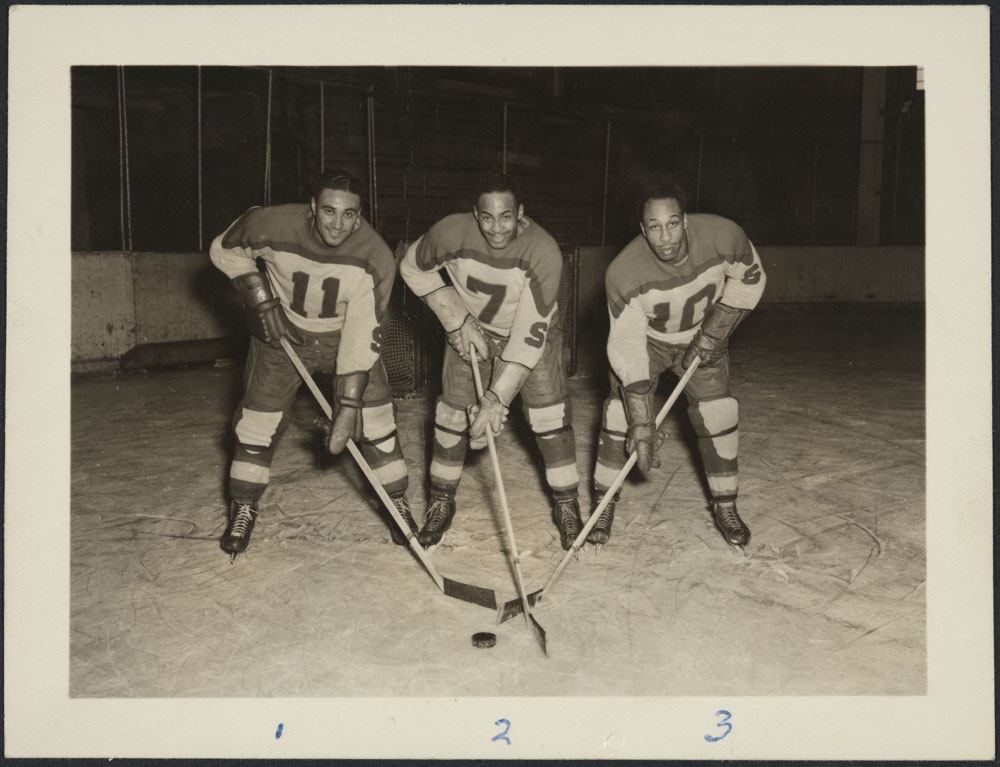
Herb “Swivel Hips” Carnegie (1919–2012) was an exceptional athlete with multiple golf championships and an impressive career in hockey spanning over a decade. During his playing career, he travelled to numerous cities and played at the amateur and semi-professional levels for teams like the Toronto Observers, the Toronto Young Rangers, the Perron Flyers, the Timmins Buffalo Ankerites, the Shawinigan Cataractes, the Sherbrooke Randies (also known as the Saints), the Quebec Aces and, in his last season, the Owen Sound Mercurys. Carnegie had a decorated sports career, winning MVP for three straight years in the Quebec Senior Hockey League (QSHL) and playing on the first all-Black line in semi-pro hockey since the Colored Hockey League.

A black and white photograph of three Black hockey players standing in a line with their sticks on the ice.

A photo of the famous all-Black Line: Herb Carnegie, Ossie Carnegie, and Manny McIntyre. (Library and Archives Canada/e011897004)

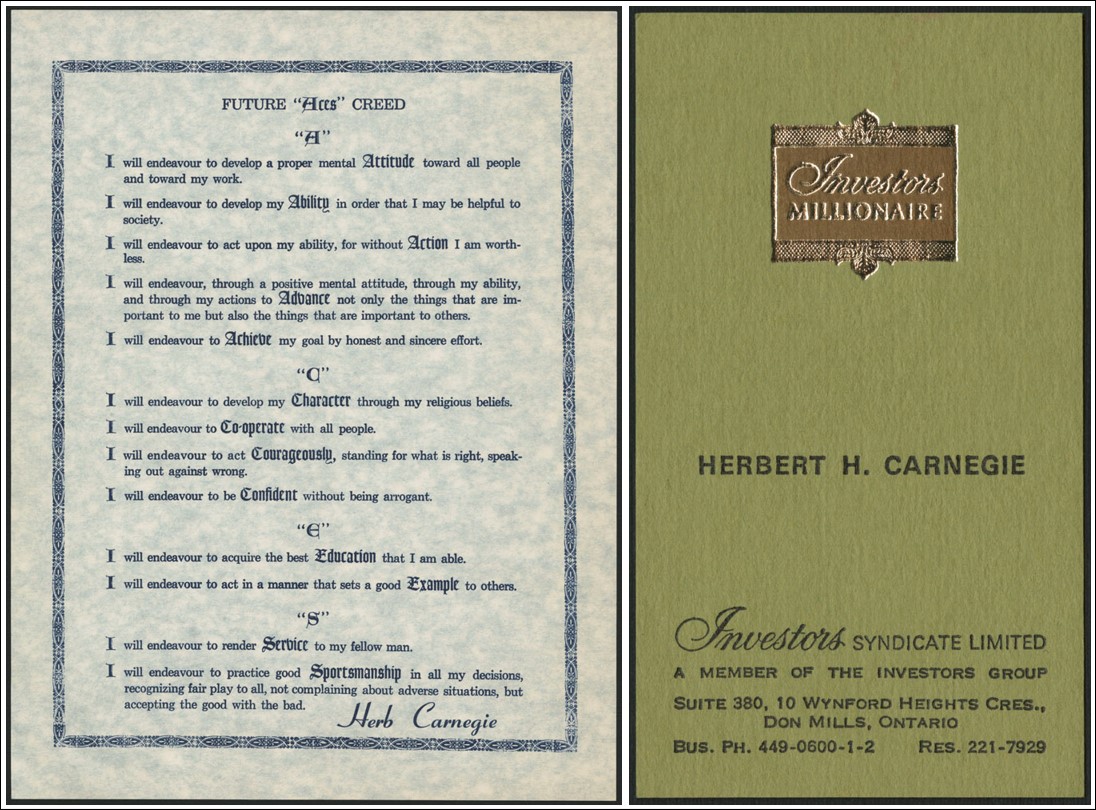
After hanging up his skates, Carnegie became a successful businessman and the first Black Canadian financial advisor employed by Investors Group. He had a 32-year long career with Investors Group, and an award was established in 2003 in his honour: the Herbert H. Carnegie Community Service Award. Carnegie was more than just an example of business excellence; he was a community leader and an entrepreneur. He founded one of the first hockey schools in Canada, invented a hockey instructional board and devised a board game with the hope of helping people understand the sport and improve their hockey IQ. Further, Carnegie established the Future Aces Foundation and Philosophy alongside his wife and daughter, Audrey and Bernice. His impact can be seen in many places like the comic book features he received, the halls of fame he has been inducted into, the awards named after him, and the schools that adopted his Future Aces Creed (there is even a school named after him).

Two colour photographs of records related to Herb Carnegie. The first photograph is a paper with an intricate blue border surrounding text that consists of I-statements. The second photograph is a vertical green business card bearing an embossed “Investors Millionaire” logo with the name “Herbert H. Carnegie” printed in the middle, and the company’s contact information at the bottom.

Future Aces Creed and Investors Millionaire Card. (Library and Archives Canada/e011897005 and e011897007)

But what’s in a name?

 I’d disagree with Shakespeare, at least in this instance, and say that names do have power. They have histories, they have legacies, and they can act as maps. The Carnegie name does this for the world of sports, entrepreneurship, business, labour, and nursing.

Drawing attention for his skills and style of play, along with his race, there is even more we can learn from Herb Carnegie’s ice time if we stop to ask a few questions:

  • How does Herb’s experience in hockey reflect larger issues in Canadian society at the time?
  • If Black hockey players existed in 1895, why wasn’t the colour barrier in the NHL broken until 1958 by Willie O’Ree?
  • Whose shoulders are hockey players of colour standing on today?

While Herb Carnegie is often remembered for his exceptional hockey skills and for being the best Black hockey player to never play in the NHL, his impact off the ice has also been significant. He deserves to be remembered for all his contributions and for all the ways he and his family have worked for generations to make their communities better.

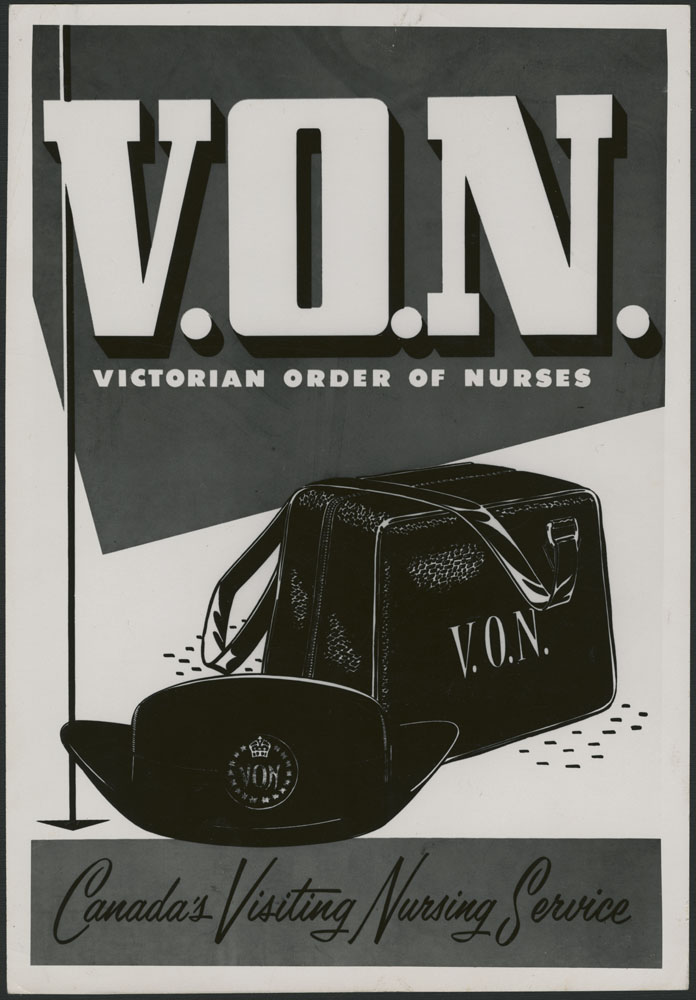
Pivoting to Herb Carnegie’s sister, we find Bernice Isobel Carnegie Redmon, the first Black public health nurse in Canada (1945) and the first Black woman appointed to the Victorian Order of Nurses in Canada (VON). We can learn more about the context of nursing and blackness in Canada by asking more questions:

  • How did Bernice Redmon become the first Black public health nurse in Canada in 1945?
  • What prevented Black women from entering the field before World War II?
  • When did the first Canadian nursing program start?

A quick search tells us that Bernice Redmon trained to become a nurse in the United States because Black women were prohibited from training as nurses in Canada until the mid-1940s, and that while the VON was established in 1897, the first Canadian nursing program opened  in 1919. However, Bernice Redmon was not alone for long, as Ruth Bailey, Gwen Barton, Colleen Campbell, Marian Overton, Frieda Parker Steele, Cecile Wright Lemon, Marisse Scott and Clotilda Douglas-Yakimchuk joined her in the following years. Despite the roadblocks and unofficial policies like quotas, the face of medicine and nursing began to change in the 1940s and 1950s. This year marks the 80th anniversary of Bernice Redmon’s achievement.

A black and white promotional poster of a white nurse’s hat and a black medical bag.

Victoria Order of Nurses poster. (Library and Archives Canada/e011897008)

Shifting to the next generation of Carnegies, we find Bernice Yvonne Carnegie, Herb’s daughter. She is the self-dubbed family historian and a leader in the hockey community, co-founding the Future Aces Foundation with her parents and establishing the Carnegie Initiative in 2021. Like her father, Bernice is working to support her community and to ensure that hockey is more inclusive. She has been giving back for over a decade through educational programming using the Future Aces Philosophy, academic grants, and her work as a public speaker. Moreover, she was a member of the BIPOC ownership group that purchased the Toronto Six hockey team.

In 2019, Bernice updated her father’s memoir, A Fly in A Pail of Milk, by sharing her own reflections on his life, lessons learned, and how she has continued the work he started. Once you read Herb Carnegie’s memoir and her reflections, it’s hard to stop there. I found myself diving into the family histories she maintains online, and I was struck by how deep the roots between her family and Canada run. I found myself asking questions again:

  • What jobs were available to Black men between 1900 and 1950?
  • What was the average salary at a mining company? What about for hockey players?
  • How do we define the Carnegie family’s multigenerational legacy?

Trailblazing is exciting, but it’s also important to remember that the individuals who broke through colour bars, de-segregated schools, and advocated for their inclusion are people too. In their extraordinary achievements, they face obstacles, racism and often trauma at the hands of the organizations they admire. Navigating predominantly white institutions is not easy; it has a cost. Being the first or one of few is challenging. It’s not often that we take the time to think about how history maps onto our lives and our families. Like the Carnegies, I know there are other families in Canada whose lives and family trees contain branches that blaze a trail through the national landscape. Without hesitation, I can think of families like the Nurses, the Grizzles, the Crowleys and the Newbys.

So, what’s in a name? A tapestry. A history. An archive.

Additional resources


Sali Lafrenie is an archivist in the Private Archives and Published Heritage Branch at Library and Archives Canada.
Black Porter Perspectives: Through the Lens of Military Records

Version française

By Rebecca Murray

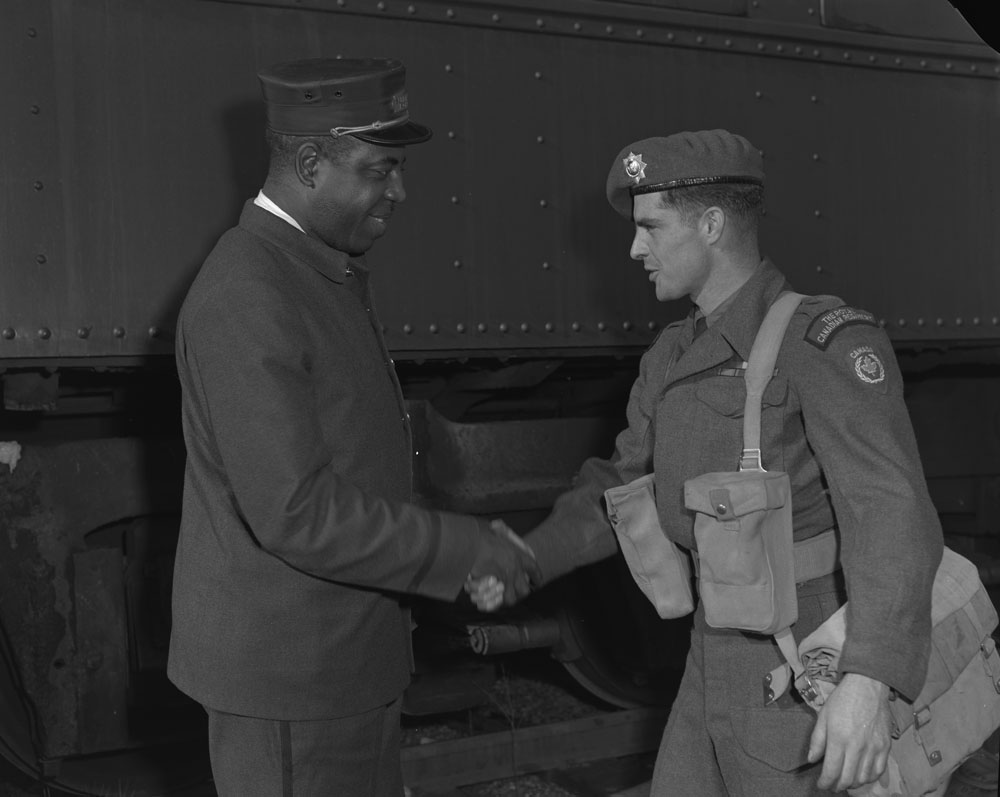
Library and Archives Canada (LAC) holds over 30 million images in various formats, including born digital images, negatives and photographic prints. A single archival photograph can tell us much about the fashion, weather, technology, customs and culture of an era! Yet, much of these secondary, but important, themes found in imagery are often ignored in the archival description process, with more attention given to the primary subjects or those captured by the photographer’s gaze. The popular saying “a picture is worth 1000 words” rings true every time I look at an image from the holdings. Even in this relatively simple image of two figures with little to no visible background, there is a wealth of detail and history to explore. What can the uniforms worn by the two men tell us? If there was a building or landscape in the background, what could we learn about where this image was taken?

Photograph of a sleeping car porter (on the left) shaking hands with a soldier (on the right).

1967-052, item Z-6244-4 “Arrival of RCRs at Fort Lewis: Units of the Canadian Army Special Force having completed their move to Fort Lewis, Wash., will shortly commence training at brigade strength. Among the recent arrivals with the Royal Canadian Regiment was one of many Halifax men serving with the Special Force. He is Pte. Harry Adams, above, seen being wished “Best of luck” by Porter Jim Jones of Calgary. (e011871942)

I first came across this image while reviewing others from the Department of National Defence (DND) accession 1967-052 for servicewomen, none of whom are pictured here. Though my main focus was the depiction of servicewomen, a minority group in these photographs, there are many other secondary or non-traditional narratives that are reflected in visual records, including those of sleeping car porters. Despite holding a degree in Canadian history, I had only recently been introduced to these men and their experiences through various books, including Genevieve Graham’s Bluebird and Suzette Mayr’s The sleeping car porter.

If you were to come to LAC looking for photographs of railway porters, you likely wouldn’t start in the DND photographs. Instead, you’d be drawn to those found in the Department of Transport (RG12) or the Canadian National Railways (RG30) fonds archives. In this instance, neither the porters nor the railway (nor the War in Korea) are mentioned in the description of the “Z prefix – CA” sub-sub-series. This is not entirely surprising, as it’s a large set of photographs — approximately 7 500 images — covering several decades worth of events, including the Second World War. Fewer than 15% of the images in this sub-sub-series are described at the item (photograph) level in the database, but most are described to varying levels of detail in digitized finding aids (item lists) that are attached to the sub-sub-series level description. The full caption for image Z-6244-4, which is available only on the original envelope and must be ordered for in-person consultation, mentions the presence of the porter and — surprisingly to this researcher — identifies him by name: Porter Jim Jones of Calgary. This is a stark contrast to most of the other images identified as part of my research. I wondered why this photograph had been so well described relative to others. Without a complete listing of captions and photographer’s notes, there is only so much we can infer from the limited data that we do have.

Coming across these images and working to pair them with their full descriptions, especially when they include the names of individuals and other identifiers, is an opportunity to press pause on one’s research intentions. The relatively hidden history in these images merits well more than a thousand-word description.

We call this process reparative description: the remediation of practices or data that have excluded, silenced or mischaracterized people or histories in archival records. Whether on a large scale or one photograph at a time, this is an ongoing process. So, when I came across these images of porters and other Black railway staff from the Second World War era, I kept notes and shared them with my colleagues who were working on the Discover Library and Archives podcast, Voices Revealed: “Porter Talk.” We were then able to work with other colleagues who are interested in this period, the presence of porters in the DND photographs and their representation in the collection as a whole.

Keep an eye out for the next piece in this series.


Rebecca Murray is a Literary Programs Advisor in the Outreach and Engagement Branch at Library and Archives Canada.
Snow Whirl Chocolate Roll from the 1930s

Version française

Cooking with Library and Archives Canada banner

By Ariane Gauthier

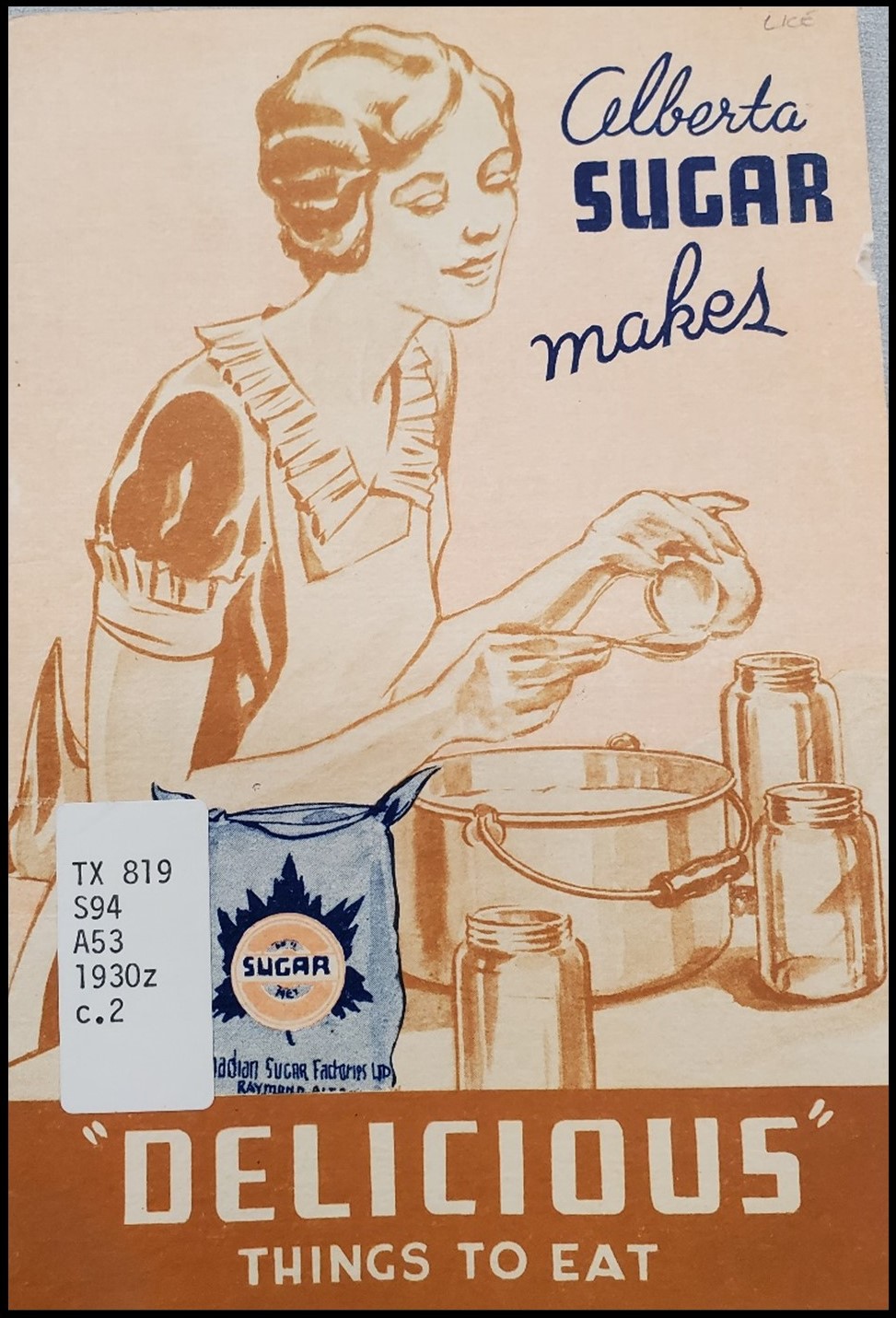
Alberta Sugar Makes Delicious Things to Eat is a booklet created by Canadian Sugar Factories some time in the 1930s to promote its production of “pure” Alberta beet sugar. This sugar is refined from thousands of sugar beet farms in the province, and the booklet includes a two-page exposé on the nuances of this farming culture. A great emphasis is put on what was then the most modern of mass-farming technology, likely to legitimize sugar beet farming, which was new and in fierce competition with the very popular (and largely preferred) cane sugar.

Booklet cover with image of a woman pouring sugar in a spoon over a pot. Three mason jars surround the pot on a counter and a bag of sugar is at the front of the image.

The booklet cover of Alberta Sugar Makes Delicious Things to Eat. (OCLC 1007785982)

This booklet is available in Library and Archives Canada’s published collections catalogue Aurora: OCLC 1007785982.

While the history of sugar in Alberta is quite interesting, what attracted me to this booklet was the historical context surrounding the publication of this book: the Great Depression. The booklet mentions that Canadian Sugar Factories started business in 1925, which means they only had about five years before the economic collapse derailed production and profitability. Perhaps this is why there is such a sense of desperation or defensiveness in dispelling misconceptions surrounding beet sugar at the end of its biographical exposé:

Page of booklet with seven points explaining why “beet sugar is the same as cane sugar” and two drawings of a train and a factory.

The cropped second page of The Story of Alberta Sugar, specifically the subsection “Beet sugar is the same as cane sugar,” from the booklet Alberta Sugar Makes Delicious Things to Eat. This is the note on which this corporate “biography” leaves the reader. Notice how points 1, 3, 4 and 7 essentially argue the same thing: that it is impossible to distinguish beet sugar from other types of sugar. (OCLC 1007785982)

Like many cookbooks published during the Great Depression, the recipes have an important emphasis on affordability and longevity: food had to be cheap, and it had to last. However, with this booklet emphasizing Alberta sugar, most of the recipes reflect sweets and pastries, which are decidedly neither of those things.

Nevertheless, I chose this booklet for its aesthetics and because the snow whirl chocolate roll recipe seemed tasty!

The image lists the ingredients and steps to follow for the snow whirl chocolate roll recipe.

The recipe for the snow whirl chocolate roll from Alberta Sugar Makes Delicious Things to Eat. Remarkably, it lists the oven temperature and cooking duration! (OCLC 1007785982)

As I flipped through the pages of the booklet, I noticed there was a section on frosting and icing. In keeping with the spirit of vintage cooking, I decided to pick one of each to pair with the cake: I chose the mountain cream icing for the filling and the fudge frosting for the exterior.

A blue outline indicates the mountain cream icing and fudge frosting recipes that were used for the snow whirl chocolate roll.

Frostings and Icings page from Alberta Sugar Makes Delicious Things to Eat. (OCLC 1007785982)

In both instances I was pleasantly surprised by the number of details that would guide the recipes I planned to undertake. Not only was I given oven temperatures, I was also given cooking times! The only thing I was truly missing was a Fahrenheit or Celsius indication of the “soft-ball” stage, but my handy-dandy candy thermometer filled in the blanks (the answer is about 240 ⁰F or 115 ⁰C). I was then off to the races!

I started by gathering all my ingredients.

Three side-by-side photos of the ingredients from all three recipes, including sugar, flour, cocoa, eggs, milk, etc.

All the required ingredients for the snow whirl chocolate roll (image on the left), the fudge frosting (image in the middle) and the mountain cream icing (image on the right). Photo credit: Ariane Gauthier.

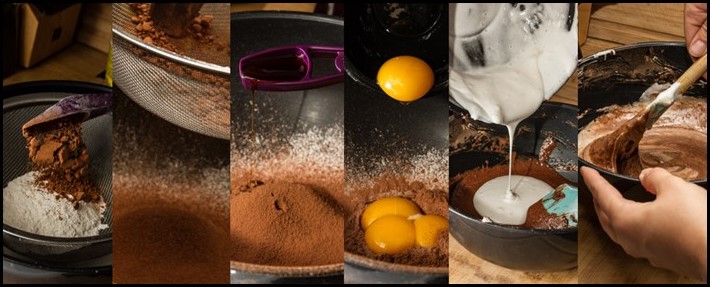
I decided to begin with the snow whirl chocolate roll as it required time to cool down, during which time I would work on the frosting and icing. The first step was sifting all dry ingredients thrice. After, I separated the egg yolks and whites, whipping the whites into soft peaks. Here’s where I went a little rogue: rather than fold the sugar into the egg whites after whipping, I incorporated it during whipping, as this helps to give them more volume.

Four photos of the steps to follow to make the snow whirl chocolate roll.

I carefully cracked all four eggs and used the eggshells to separate the egg yolks from the egg whites. Once this was done, I used an electric beater to whip the egg whites with the sugar until it formed soft peaks. Photo credit: Dylan Roy.

I then made a little mistake: I mixed the egg yolks and vanilla with the dry ingredients rather than the egg white mixture. This ultimately negated the sifting of the dry ingredients, but here’s how I fixed it: I added about half of the egg white mixture and mixed it all together vigorously until no clumps remained. What this effectively did was somewhat defeat the whole point of whipping the egg whites, which was to have an airy and light cake mixture. However, since I only used some of the egg white mixture, I was able to gently fold in what remained and maintain some of the lightness I had previously built.

Six side-by-side photos of all the ingredients being incorporated into a bowl to make a snow whirl chocolate roll.

Negating the whole point of sifting the dry ingredients by prematurely mixing in some of the wet ingredients. The steps in order from left to right of how I mixed the dry and wet ingredients together. The last two images show how I salvaged the mix: I used half of the egg white mixture and vigorously mixed it with the dry ingredients until no clumps remained, and then I gently folded in what remained. Photo credit: Ariane Gauthier.

Once this step is done, a cooking sheet with edges is required to cook the cake. This may appear a little thin at first, but you must remember that the cake will eventually be rolled. And so off it went into a 400 ⁰F oven for 13 minutes. Now, it was time for filling and garnish!

Every vintage cooking recipe is a new experience where I’ve at least done one thing I’ve never done before. In this case, I’d never used a candy thermometer, despite owning one for many years. It’s complex and stressful, but in times like these it’s best to just trust the process and believe that Canadian Sugar Factories knew what it was doing in the 1930s!

Two side-by-side images of a thermometer being used while making the mountain cream icing and the fudge frosting. A third image shows the fudge frosting being mixed with a whisk.

Using a candy thermometer to make mountain cream icing and fudge frosting. The candy thermometer had to be held in both instances as the end could not touch the bottom of the pan; otherwise, it would provide a false reading of the temperature. In both cases, the steam produced by both mixtures obscured the reading of the thermometer, making what was already a difficult step even harder. Photo credit: Dylan Roy.

I regret to say that I didn’t do great with the mountain cream icing. I’m unsure whether I pulled it from the heat too early or if I simply let too much water evaporate, but I was ultimately left with a dry and crumbly icing that did not spread well. However, it did taste fairly good on its own.

Comparatively, the fudge frosting fared much better, as I had learned from my mistakes. Though I admit to having been unpleasantly surprised with two unlisted ingredients: butter and vanilla. I advise that any who attempt this recipe have both measured and on hand.

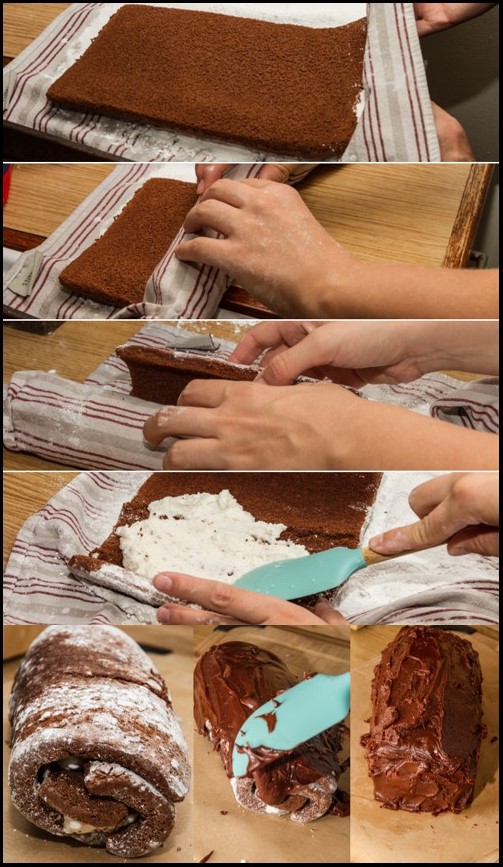
Thirteen minutes later, the cake sheet was ready. Here, again, I must admit to having strayed from the instructions. I’ve made Yule logs before for the holidays and the instructions are very clear: immediately roll the cake sheet tightly in a clean dish cloth sprinkled with powdered sugar and wait for it to cool. Do not add your frosting immediately as the heat of the cake will cause it to melt. You will be left with a gooey mess! I heeded my previous experience and waited for the cake to cool down before frosting.

Seven photos of the steps to roll the cake, add the icing and add the frosting.

Cake rolling and cake frosting. Rolling the cake is easier than one might think; the challenge is knowing how long to let it cool down. While I let it get a tad too dry, the beauty of frosting is that it hides the cracks! Photo credit: Dylan Roy.

The trick with these kinds of cakes is that they have to cool enough to not melt the icing but not so much that they dry out. Unfortunately for me, I waited a little too long, and the cake cracked when I unrolled it. I was able to smear some icing to patch the cracks and was fortunately able to cover the rest up with the fudge frosting. As we say in French: ni vu, ni connu (literally: unseen, unknown)!

Two side-by-side photos of a cross-section of the snow whirl chocolate roll.

Cross-section of the snow whirl chocolate roll cake. As you can see, I didn’t quite have enough icing to fill out the inside completely. Photo credit: Ariane Gauthier.

What do you think?

The cake, icing and frosting were delicious! I brought it into the office and my colleagues were pleasantly surprised. Everyone was more or less in agreement that the best part was the fudge frosting—it could almost have been a dessert on its own!

If you try this recipe, please share pictures of your results with us using the hashtag #CookingWithLAC and tagging our social media: FacebookInstagramX (Twitter)YouTubeFlickr and LinkedIn.

For more content on historical cooking, please consider the following links:


Ariane Gauthier is a Reference Archivist in the Access and Services Branch at Library and Archives Canada.
Jellied Vegetable Salad: Less is More!

Version française

Cooking with Library and Archives Canada banner

By Rebecca Murray

When I opened the Canadian Army Recipe Book, I didn’t just look for sweets—my eyes also landed on a variety of savoury recipes for breads, meat pies, and salads. Enter the Jellied Vegetable Salad!

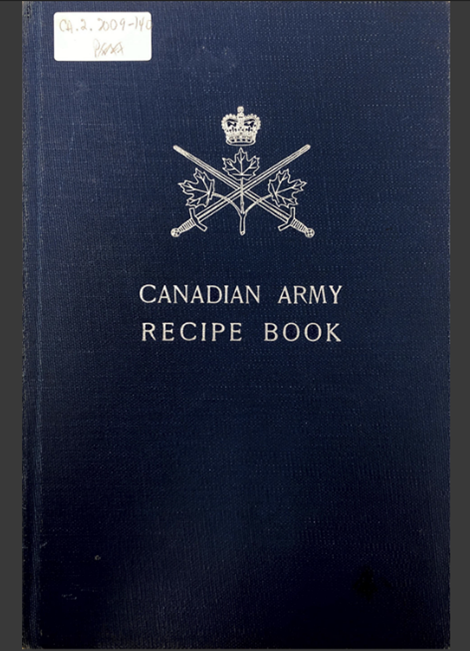
Blue, slightly worn book cover featuring the title “Canadian Army Recipe Book” in capital letters. Above the title is the Canadian Army badge topped by a St. Edward’s Crown. The badge displays three maple leaves on one stem and a pair of crossed swords, all in silvery grey.

Cover of the Canadian Army Recipe Book, published by the Department of National Defence,1961 (OCLC 299227447).

You might recognize jellied or layered salads from TV programs like That ‘70s Show or How I Met Your Mother. Or maybe you’ve had the “pleasure” of experiencing them firsthand at home. When I was invited to a family barbeque this past summer, I decided it was the perfect occasion to prepare this Jellied Vegetable Salad. But first, I had to assemble the ingredients and get cooking! Yes, you read that right—this salad involves actual cooking, which isn’t always fun in the summer heat, but it’s essential for pulling off this recipe!

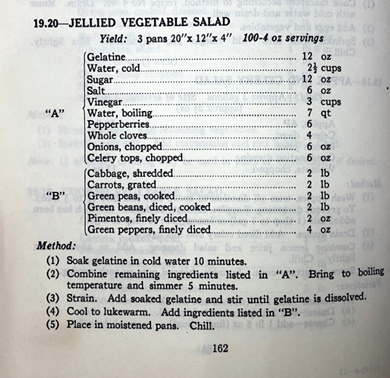
Page of text featuring a recipe for jellied vegetable salad.

Recipe for Jellied Vegetable Salad from the Canadian Army Recipe Book (OCLC 299227447).

Because the original recipe was meant to feed a crowd, I had to adjust the quantities—time to do some math! This time, I took my own advice and measured MANY times before cooking.

Ingredient Original quantity (full) Adjusted quantity (quarter)
Gelatin 12 oz. 3 oz. (90 ml)
Water, cold 2.5 cups 0.625 cups (150 ml)
Sugar 12 oz. 3 oz. (90 ml)
Salt 6 oz. 1.5 oz. (45 ml)
Vinegar 3 cups 3/4 cups (180 ml)
Water, boiling 7 qt. 1.75 qt. or 7 cups (1.75 L)
Pepperberries 6 1.5
Whole cloves 4 1
Onions, chopped 6 oz. 1.5 oz. (45 ml)
Celery tops, chopped 6 oz. 1.5 oz. (45 ml)
Cabbage, shredded 2 lb. 1/2 lb. (250 g)
Carrots, grated 2 lb. 1/2 lb. (250 g)
Green peas, cooked 2 lb. 1/2 lb. (250 g)
Green beans, diced, cooked 2 lb. 1/2 lb. (250 g)
Pimentos, finely diced 2 oz. 1/2 oz. (15 ml)
Green peppers, finely diced 4 oz. 1 oz. (30 ml)
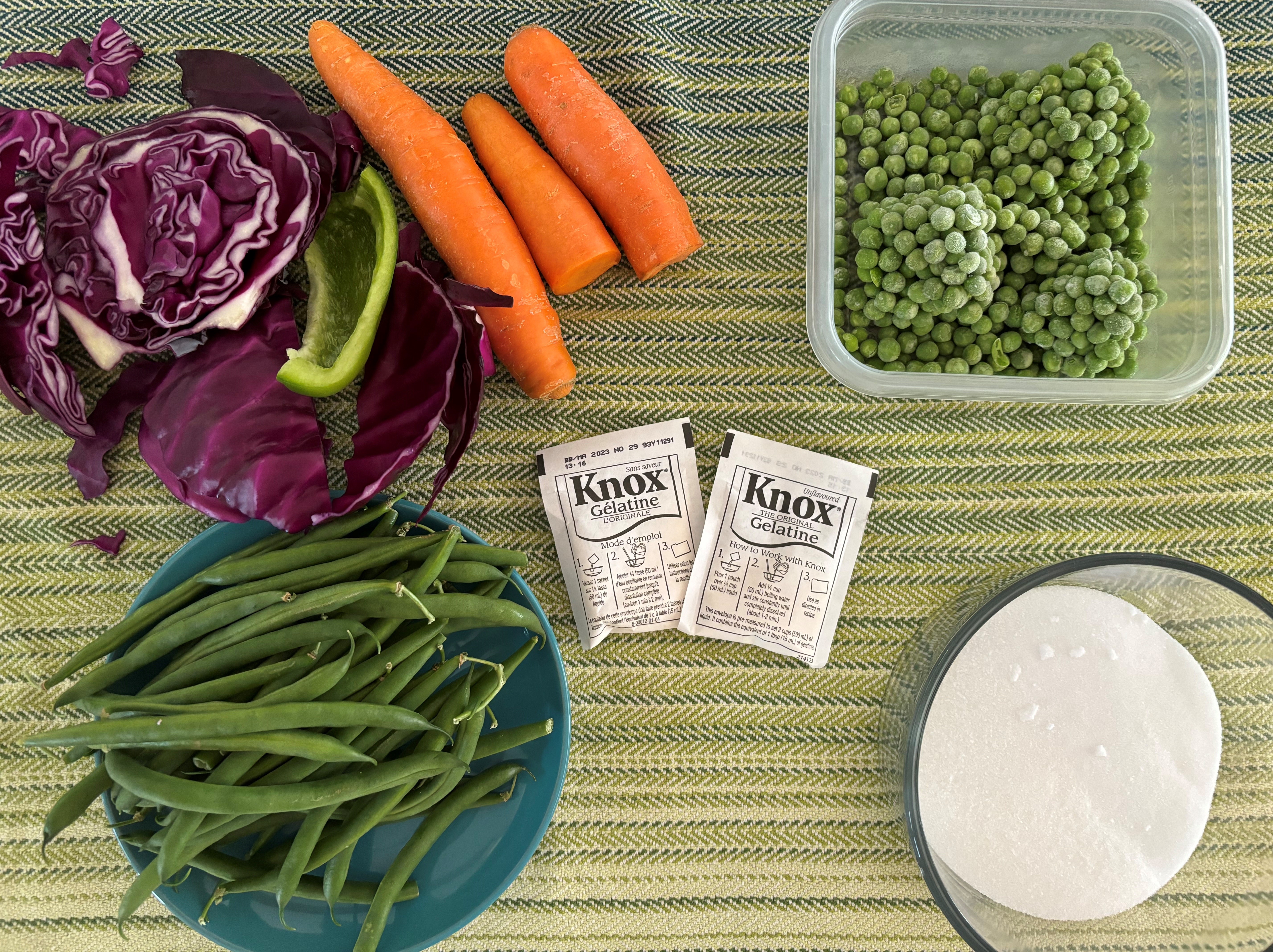
Fresh and dry ingredients presented on a green tea towel.

Ingredient prep, from left to right: green beans, cabbage, green pepper, carrots, gelatin packets, frozen peas, and the dry ingredients (sugar and salt). Photograph: Rebecca Murray.

Next up: ingredients! Once I’d figured out the quantities, I had to source the ingredients. Most were already in my pantry or easily purchasable. The one exception? Pepperberries, an Australian spice with fruity, spicy notes (not to be confused with peppercorns). Unable to find pepperberries and opting out of pimentos, I was pleasantly surprised the dish didn’t suffer for it. A last-minute save came from a VERY helpful neighbour who provided whole cloves. I also swapped green cabbage for purple, adding a vibrant twist that made the final dish not only delicious but a visual standout!

The structure of this recipe really resonated with me (and perhaps other archivists or cooks!). Grouping the ingredients into “A” and “B” made it easier to organize my prep work and keep everything separate as I worked. I was hesitant to alter the method, despite adjusting the quantities, but I did soak the gelatin for longer than the recommended 10 minutes and simmered the other “A” ingredients for five minutes while keeping a close eye (this smelled really good!).

One thing I would have appreciated is a time estimate for the cooling process in step 4. I left the mixture on the counter for about 45 minutes before moving on to the next step, which was honestly a bit intimidating, but also fun!

Here’s an in-progress look at the vegetables after I’d strained the broth (or “A” minus the gelatin and water) into “B.” I’m used to straining things over the sink, not into another bowl, so it was a near calamity when I headed to the sink, but I redirected myself to the counter in time for the first of two potentially perilous transfers!

An overview shot of a bowl filled with colourful vegetables in liquid.

A shot of the second part of step 4. Photograph: Rebecca Murray.

There was only one real “oopsie,” as pictured below. Surprisingly, it wasn’t during the risky transfer of hot broth (or “A” ingredients) into the awaiting “B” ingredients, but rather a clumsy attempt to rearrange the portions for a photo that caused a spill.

Three cups of purple jellied salad set against a green backdrop next to a larger bowl of the same dish. A small portion of the liquid and filling has spilled onto the green backdrop and grey counter.

Let’s not cry over spilled jellied salad—it almost looks like abstract art! Photograph: Rebecca Murray.

Overall, the feedback was positive, but my main takeaway is that less is more with this dish! It’s a relatively easy, make-ahead option and a perfect addition to any family gathering year-round.

A hand holding a small glass cup filled with jellied salad.

A perfect serving of the jellied salad! Photograph: Rebecca Murray.

Bon appétit!

If you try this recipe, please share pictures of your results with us using the hashtag #CookingWithLAC and tagging our social media: FacebookInstagramX (Twitter)YouTubeFlickr and LinkedIn.

For more recipes in this series, go to #CookingWithLAC.


Rebecca Murray is a Literary Programs Advisor in the Outreach and Engagement Branch at Library and Archives Canada.

LAC’s collection of labour union charters

Version française

By Dalton Campbell

Library and Archives Canada (LAC) has a collection of approximately 300 labour union charters dating from the 1880s to the 1980s. A sample of the charters has been digitized: the images are available through Collection Search.

These charters were formal documents granted by unions to the locals when they were officially accepted into the union. The charters in the LAC collection can also tell us a lot about the unions, their membership, Canadian workers and work life in the twentieth century.

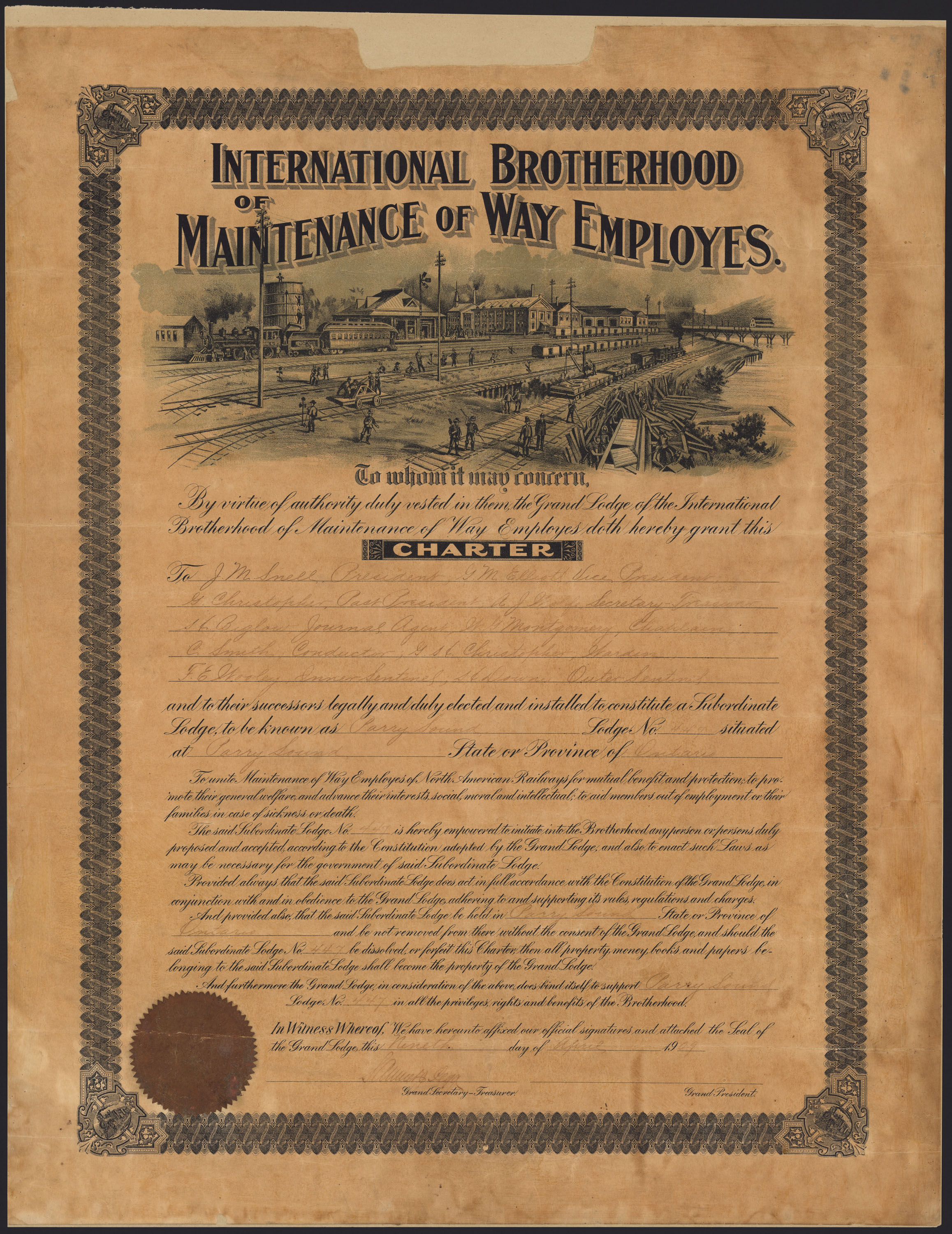
For example, the Brotherhood of Maintenance of Way Employes charter features a detailed illustration showing the range of jobs done by its members, including tending to trains in the yard, inspecting and maintaining the rails, signals, water towers and buildings, as well as clearing the wreckage of rail cars.

Textual document titled International Brotherhood of Maintenance of Way Employes featuring a drawing of a train station filled with people and railcars at the top of the document.

Charter granted by the International Brotherhood of Maintenance of Way Employes to the Parry Sound Lodge no. 447, Parry Sound, Ontario, April 1909. (e011893857)

This charter, like many of the charters in the LAC collection, includes the names of the members of the local, potentially making charters a small piece of documentation in family history research. Some charters are also a window into social history. For instance, the members’ names listed in the Canadian Congress of Labour (CCL) charters show the industries and companies where women were employed in the 1920s, 1930s and 1940s.

Illustrations of union members at work and their workplaces are a common theme in the charters. The Amalgamated Society of Carpenters and Joiners charter uses a series of illustrations of workers in different workplaces as well as illustrations of workers receiving benefits from their union.

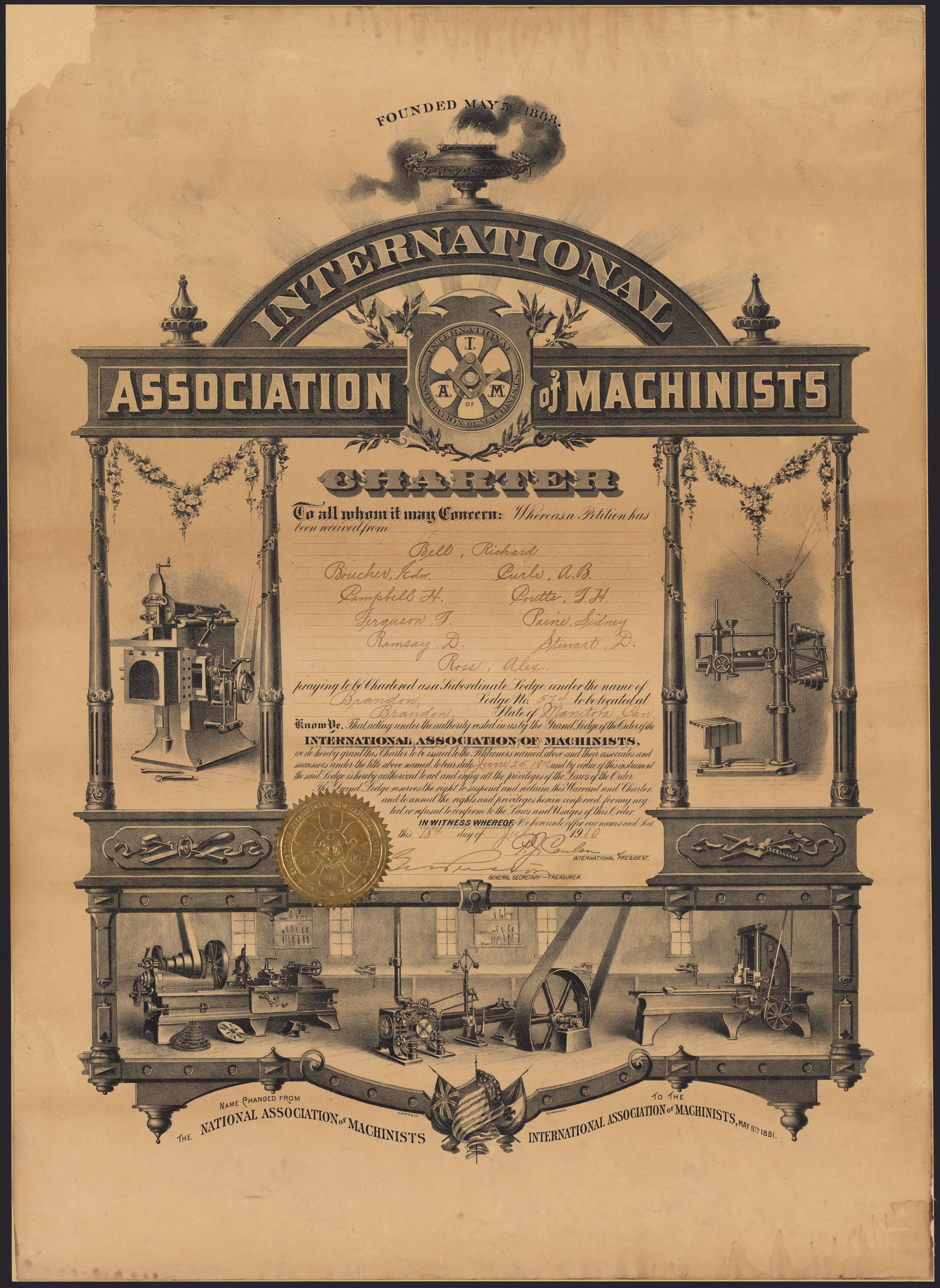
The International Association of Machinists charter features a workshop scene without any workers, showing only a lathe, drills, workbenches, clamps and hand tools—leaving it to the viewer to picture the tasks performed at each workstation.

Document titled International Association of Machinists featuring text and drawings of machinery.

Charter granted by the International Association of Machinists (IAM) to Local 574, Brandon, Manitoba, July 1910. (e011893856)
This charter is very different from the charter granted by the same union 20 years earlier, in 1890, to Pioneer Lodge no. 103, Stratford, Ontario. (See: MIKAN 4970006)

The International Chemical Workers Union used the same theme, featuring the beakers, flasks and glass tubing of a laboratory in the foreground with an external view of a chemical plant in the background. The Brotherhood of Painters, Decorators and Paperhangers took a different approach, using text to list the many trades and industries in which the union membership worked.

Many of the charters in the LAC labour collection rely primarily on text, with few or no illustrations. Some feature a small illustration such as the union’s seal or logo, something associated with the industry, or something representative of union membership in general (such as a handshake). In some cases, illustrations of figures such as Benjamin Franklin or a bald eagle clearly show that the Canadian local was part of a U.S.-based international parent union.

Some of the text-only charters use detailed, colourful and eye-catching lettering, as seen in those from the International Typographical Union and the Hotel and Restaurant International Employees’ Association.

Textual document titled International Typographical Union Charter.

Charter granted by the International Typographical Union (ITU) to the Ottawa Typographical Union, Local 102, Ottawa, Ontario, 1883. The charter states the local was in “Ottawa, Canada West;” Canada West had been renamed Ontario in 1867. (e011893860)

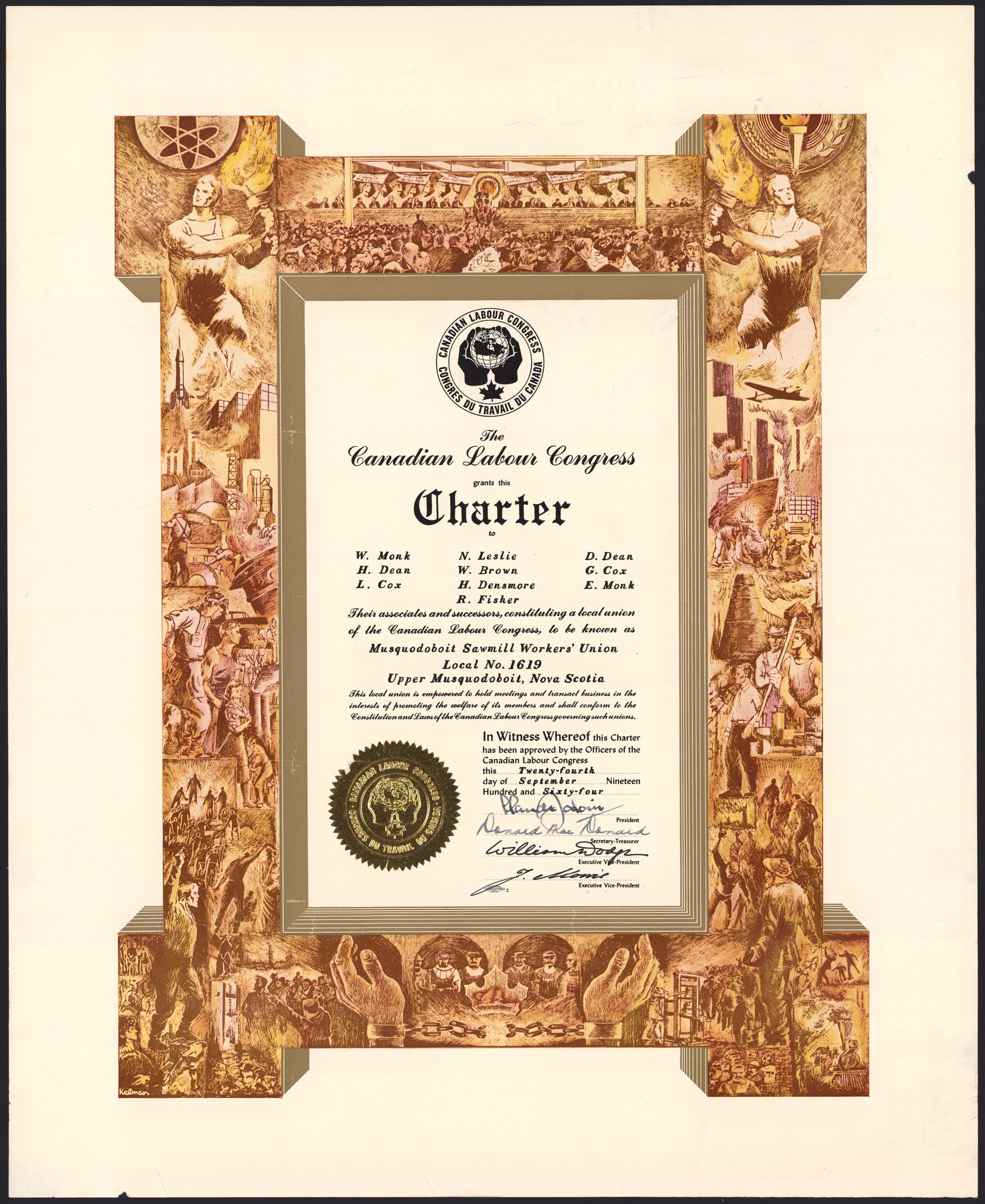
The most ambitious and arguably most artistically successful charter in the collection is the Canadian Labour Congress (CLC) charter, designed by CLC artist Harry Kelman in the 1950s.

Textual document titled The Canadian Labour Congress.

Charter granted by the Canadian Labour Congress to the Musquodoboit Sawmill Workers’ Union, CLC Local 1619, Upper Musquodoboit, Nova Scotia, September 1964. (e011893866)
For a detailed explanation of the illustrations in this charter, please consult: MIKAN 2629372.
The CLC also printed this same charter in a different colour scheme: see, for example, Buckingham Plastic Workers’ Union, Local 1551, Buckingham, Quebec. (e011537977)

The illustration in this charter uses realistic figures and symbols to show a brief history of the Canadian labour movement from the nineteenth century to the 1950s. The bottom panel shows working conditions in the nineteenth century. This was the time when, as historian Desmond Morton wrote, there was the “harsh reality of […] appalling rates of sickness, death and injury” in lumber camp bunkhouses, high rates of death in mining, and an “appalling toll of life and limb, often of young children” in factories and mills.

The vertical panels on the left and right of the charter show life in the twentieth century. The workers step into the light to work in an industrialized Canada, manufacturing cars and refining minerals; they then move into the “space age,” where they are building and operating rockets, aircraft, skyscrapers and telecommunication systems. The horizontal panel at the top shows the founding convention of the CLC in 1956. The CLC charter has an optimistic tone. The workers contribute to economic and technological progress and they share in the benefits. The present is bright and the future will be brighter.

Looking at the LAC collection of charters, it’s also interesting to look at what is under the surface and what that can show us of life in the early- to mid-twentieth century.

The workers depicted in the charters have little or no safety equipment, reflecting the standards of the era. The charters feature few images of desk workers, but it seems that only a small percentage of locals in the early to mid-twentieth century represented clerical and other office workers.

Additionally, the flag shown in the charters of the Machinists, the Brotherhood of Painters and other unions was the old Red Ensign. The unions designed these charters years, and sometimes decades, before the current Canadian flag was adopted in 1965.

The smokestacks in the CLC charter are symbols of progress and wealth and not pollution and environmental damage.

As well, the workers depicted in the charters are almost entirely white men. The CLC charter includes a few women workers; the only other depictions of women in charters are as customers or grieving widows. Racialized workers and workers with disabilities are absent from the illustrations.

According to files in the labour fonds, it appears that many of the charters in the LAC collection were returned to the union, and later donated to LAC, when the local dissolved, the membership of the local voted to move to another union, the union merged into another union or the union asked the local to leave the union.

In some cases, locals in good standing sometimes had old charters in their offices. In 1972, the CLC asked its locals to return any old charters to the head office and then the CLC would in turn donate the old charters to LAC.

Originally created as official documents to mark the affiliation between locals and the unions, these charters also fostered a sense of shared identity and membership while providing a visually appealing addition to the offices and meeting rooms of the locals. Today, the charters have a secondary value as a window into the unions, workers, workplaces and work life of the twentieth century—and as an introduction to LAC’s collection of labour archives.

Further research:

  • Charters of the Canadian Labour Congress (CLC) (MIKAN 107969)
    • The Canadian Labour Congress Charter. Development and interpretation of its imagery (MIKAN 2629372)
  • Charters of the Canadian Congress of Labour (CCL) (MIKAN 107924)
  • Charters of the All-Canadian Congress of Labour (ACCL) (MIKAN 107906)
  • Charters of the Trades and Labor Congress (TLC) (MIKAN 107903)
  • Charters of the International Association of Machinists (IAM) (MIKAN 191424)
  • Charters of the United Electrical, Radio and Machine Workers of America (UE) (MIKAN 130940)

Published sources on Canadian labour history:

  • Titles available to read online:
    • Carmela Patrias and Larry Savage, Union power: solidarity and struggle in Niagara (OCLC 806034399)
    • David Frank and Nicole Lang, Labour landmarks in New Brunswick = Lieux historiques ouvriers au Nouveau-Brunswick (OCLC 956657952)
    • Eric Strikwerda, The wages of relief: cities and the unemployed in prairie Canada, 1929-39 (OCLC 847132332)
  • Other titles:
    • Desmond Morton, Working people: an illustrated history of the Canadian labour movement (OCLC 154782615)
    • Steven C. High, One job town: work, belonging, and betrayal in Northern Ontario (OCLC 1035230411)

Dalton Campbell is an archivist in the Science, Environment and Economy section of the Private Archives Division at Library and Archives Canada.

The Abella Commission: A step closer to equality in the labour market

Version française

By Mathieu Rompré

The year 2024 marks the 40th anniversary of the tabling of the final report of the Royal Commission on Equality in Employment, also known as the Abella Commission. It was named after Justice Rosalie Silberman Abella, who presided over it. (You can consult the electronic version of the report in three parts.) This federal commission of inquiry was established in 1983 by the Honourable Lloyd Axworthy, Minister of Employment and Immigration in the then-Liberal government.

Photograph of a young girl facing forward, in close-up. The bold text above the photograph reads: [translation] “Girls? As many opportunities as boys? Why not?”

Advertisement for International Women’s Year, 1975. Source: Library and Archives Canada (e010753405).

The social context of the early 1980s and the workforce outlook at the time explain the creation of the Abella Commission. It was already expected that women and people from other target groups would make up the majority of entrants to the labour market in the coming years. The Commission was tasked with investigating and reporting on the most effective and equitable ways to promote employment opportunities, eliminate systemic discrimination, and ensure equal employment opportunities for all. Its first task was to examine employment practices in major federal Crown corporations (Petro-Canada, Air Canada, Canadian National Railway Company, Canada Mortgage and Housing Corporation, Canada Post Corporation, Canadian Broadcasting Corporation, Atomic Energy of Canada Limited, Export Development Corporation, Teleglobe Canada, De Havilland Aircraft of Canada Limited, and Federal Business Development Bank). In its second phase, the Commission would investigate ways to address shortcomings in employment practices, which included the study of a mandatory affirmative action program.

A 1981 Vancouver Sun cartoon showing a man sitting at his desk speaking to a female employee. The text below the image, written in English, says: “I want you to know, Miss Fairgender, I'm completely in accord with the call for equal pay for equal work, bearing in mind the difference in our equality...”

Cartoon from the Vancouver Sun, November 24, 1981. Source: Leonard Matheson Morris fonds, Library and Archives Canada (cr0016620).

The Commission held hearings in 17 Canadian cities between August 1983 and March 1984, receiving a total of 274 submissions. Although not widely known to the general public today, the Abella Commission had a significant impact on Canadian society. The federal government took advantage of the establishment of the Commission to extend an affirmative action program across the Public Service of Canada. In the following years, many private companies implemented similar programs, and today, initiatives aimed at promoting the employment of women or certain minority groups have become common practice.

Although much work remains to be done regarding workplace equality, the Abella Commission significantly improved the situation for women and several minority groups in Canada. It was through the Commission that the concept of “employment equity” and theories on equality and discrimination, which form the foundation of the final report, were created. The report’s recommendations were implemented not only in Canada, but also in New Zealand, Northern Ireland, and South Africa. Given this influence, it is not surprising that Justice Abella was appointed to the Supreme Court of Canada in 2004.

Portrait of the Honourable Justice Rosalie Silberman Abella, facing forward, in close-up, wearing her Supreme Court of Canada robe.

Official portrait of the Honourable Justice Rosalie Silberman Abella at the Supreme Court of Canada.
© Supreme Court of Canada. Credit: Philippe Landreville.

For more information about the Abella Commission and its critiques, please visit the Commission of Inquiry on Equality in Employment fonds (RG33-133, R1066-0-3-E, which includes approximately 5.5 metres of textual records) held at Library and Archives Canada, as well as the texts below.

Additional resources

  • Rapport de la Commission sur l’égalité en matière d’emploi, Rosalie Silberman Abella (OCLC 16024519)
  • Research Studies of the Commission on Equality in Employment, Rosalie Silberman Abella (OCLC 503015915)
  • Focus on Employment Equity. A Critique of the Abella Royal Commission Report, Walter Block and Michael A. Walker (OCLC 300593021)

Mathieu Rompré is an archivist with the Government Archives Division of Library and Archives Canada.

My Dear Friend: Letters from Normandy to our Canadian Soldiers

Version française

By Ariane Gauthier

As part of my work as a reference archivist at Library and Archives Canada (LAC), I often find myself delving into the many documents in the Second World War collection. Many people around the world are interested in the history of Canadians in this conflict and, more specifically, in the experiences of our soldiers. What I find even more fascinating is how the quest begins for the researchers I am lucky enough to work with. The starting point is often a personal story, passed down in a family or a small community: “I found out that my mother served in the Royal Canadian Air Force” or “I heard that my village hid a Canadian spy during the Second World War.” This is enough to fuel the fire of researchers, who then dig to find evidence or fill in these stories with new details.

My colleagues and I participate in this quest on an ad hoc basis, mainly to facilitate access to documents from LAC’s vast collection. When circumstances allow, we delve into the information in these documents in search of relevant details that can help researchers piece together the story they seek to understand.

That is how I found three letters from Normandy addressed to our Canadian soldiers. Unfortunately, the context of the letters, including the identity of the recipient, remains a mystery. I found these letters in a file from Royal Canadian Air Force headquarters (Reference: R112, RG24-G-3-1-a, BAN number: 2017-00032-9, Box number: 30, File number: 181.009 (D0624)). This file documents the experiences of Canadian soldiers who were captured and interned in prison camps during the Second World War. It also contains transcripts of interviews about the soldiers’ experiences.

In this case, the three letters are not linked to specific interviews and are included in this file as loose sheets. There is no correspondence explaining why they were placed in this file. Nor is it known whether these were letters addressed to soldiers who had been taken prisoner during the war. The information in these letters is truly the only information we have. In reality, though it may not seem like much, these three letters tell us a great deal about the experience of soldiers in Normandy and of the French, especially the risks faced by those who resisted the Germans.

Here are the letters in question:

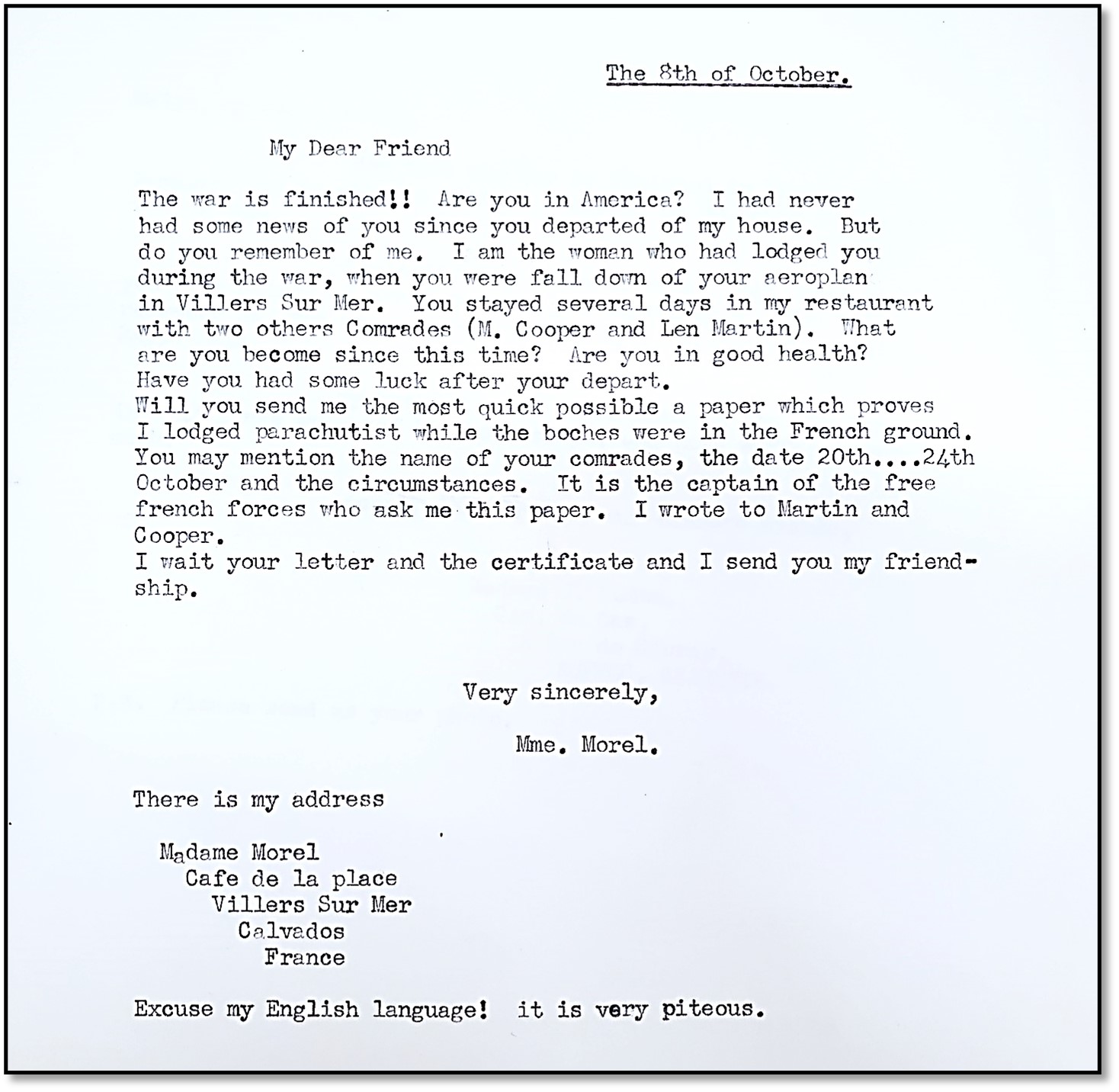
Letter to a Canadian soldier from Mrs. Morel, written on October 8. The year is not indicated on the letter. We only know that it was written and sent once the war was over.

Letter to a Canadian soldier from Mrs. Morel, dated October 8 (MIKAN 5034948)

In this first letter, we discover part of the story of Mrs. Morel, who apparently sheltered one of our soldiers after he jumped from a plane near Villers-sur-Mer. We learn that this soldier was a paratrooper and that he had taken refuge in Mrs. Morel’s restaurant with two of his fellow soldiers, M. Cooper and Len Martin, while the village was still under German occupation.

Letter written by Mrs. J. Cottu, expressing her desire to receive news of the soldier she sheltered in November 1943.

Letter to a Canadian soldier from Mrs. J. Cottu (MIKAN 5034948)

This second letter gives us a glimpse into the story of Mrs. J. Cottu and could possibly be related to that of the paratrooper mentioned in Mrs. Morel’s letter. Without more specific information, it is difficult to confirm this hypothesis, but the second letter refers to a Sergeant Martin (possibly Len Martin?) and places his departure in November. Mrs. Morel stated that she had taken in the soldier at the end of October, without specifying the year, so everything could fit together chronologically.

Mrs. J. Cottu mentions having housed three soldiers in her house in Ruffec in November 1943: the recipient of the letter, Sergeant Martin and Captain Ralph Palm. Although this story seems to have gone well, she said that she was arrested by the Gestapo in 1944 because of her husband’s activities. The seriousness of the situation is clear from this confession: “I was arrested by the Gestapo, and have suffered very much.”

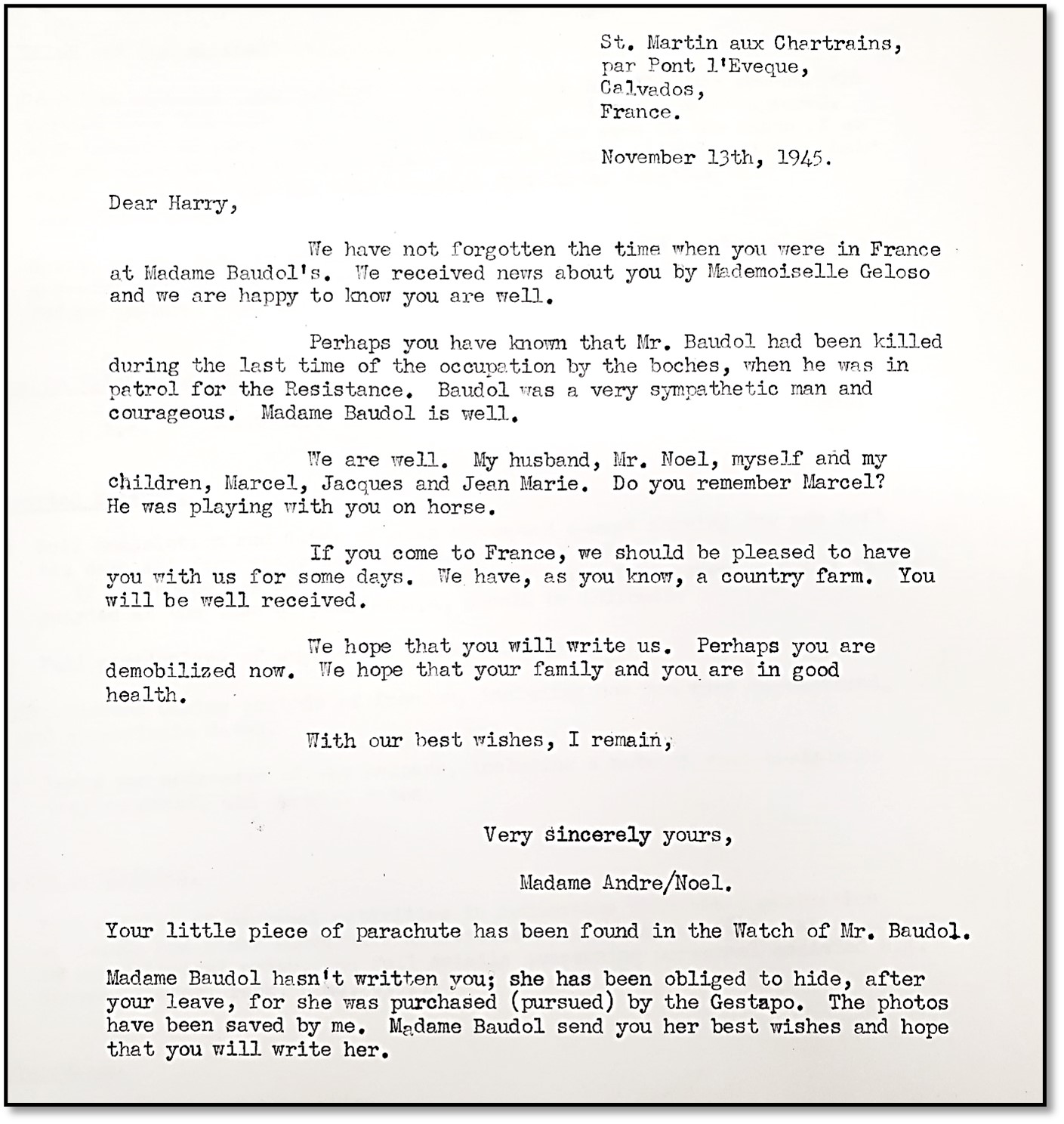
Letter written by Mrs. Noel to check on Harry and give him news about the French people he met during his stay in Saint-Martin-aux-Chartrains.

Letter to Harry from Mrs. Andre Noel, dated November 13, 1945. (MIKAN 5034948)

In this third letter, Mrs. Noel clearly illustrates the dangers that members of the Resistance faced. She bears the burden of announcing the death of Mr. Baudol, a member of the Resistance, who was killed while on patrol. She also shows us the strong bonds that Harry seems to have formed with the residents of Saint-Martin-aux-Chartrains. Although this letter expresses suffering, grief and fear, it also highlights the bravery and sacrifice of three families who came to the aid of a Canadian soldier.


Ariane Gauthier is a reference archivist with the Access and Services Branch at Library and Archives Canada.