Dutch Apple Cake from 1943

Version française

Cooking with Library and Archives Canada bannerBy Ariane Gauthier

The Cook’s Recipe Manual is a collection of 300 recipes designed for military personnel who were part of the navy, army, air force munitions plants, camps, and schools. Printed in 1943, the goal of this cookbook was to make the most of army rations through simple recipes. Each recipe makes 100 or 125 servings, taking care to specify how many ounces should comprise a single serving. The recipes themselves were fitted for modest kitchens, meaning that the cook should still be able to successfully complete the recipe even if they don’t have electric cooking implements at their disposal.

This book is available online on Library and Archives Canada’s published collections catalogue Aurora: OCLC 3231635.

At the time that I picked up this book and undertook this latest challenge, we were well into autumn, and I had just returned home from apple picking with more apples than I could eat myself. I was flipping through the index of the cookbook, hoping to find an attractive recipe in which to funnel most of my apples, when I stumbled upon a recipe for “Dutch apple cake”.

The recipe for Dutch apple cake, including a list of ingredients and the instructions.

A photo of the recipe for Dutch apple cake from The Cook’s Recipe Manual (OCLC 3231635). Please note the breakdown of recipe ingredients into categories A, B, and C, as well as the yield of 100 four-ounce servings.

Beyond the exorbitant amount of apples required, part of what attracted me to this recipe was that I did not know what a Dutch apple cake was. While it isn’t too difficult to put together, I had no visual image of its modern equivalent to keep in mind as I assembled this recipe and so, unlike the previous two recipes I tried, I went into this challenge ignorant of the expected result. Nevertheless, the first step was to assemble the ingredients.

The ingredients for the recipe: apples, eggs, butter, baking powder, salt, flour, sugar, milk, nutmeg, and cinnamon.

Ingredients used by the author to make the Dutch apple cake recipe from The Cook’s Recipe Manual. Courtesy of the author, Ariane Gauthier.

The next step was to do a bit of math, as I was not about to make a cake serving 100 portions. Instead, I settled on 10 portions and used the following quantities:

Biscuit dough
  • 2.6 cups of flour
  • 25 ml baking powder
  • 4.5 ml salt
  • 50 ml butter
  • 50 ml sugar
  • 2 eggs
  • 150 ml (oat) milk
Apples
  • 900 g apples
Sugar and spice mix
  • 50 ml sugar
  • a pinch of cinnamon and nutmeg
Butter
  • 50 ml butter

The ingredients comprising the dough of the Dutch apple cake are divided into three sections, A, B, and C, marking the order in which they will be incorporated. The first step is to mix the dry ingredients and the fat (in this case I opted for butter). The added instruction in the original recipe of “as in making tea biscuit dough” is unclear, so I opted to ignore it. The most it told me was that the recipe was written with a somewhat experienced reader in mind. Similarly, I didn’t quite understand why the sugar needed to be added separately, but I adhered to the order of things all the same.

Dry ingredients from the recipe being mixed with a whisk.

All the dry ingredients from sections A and B mixed with a whisk. Courtesy of the author, Ariane Gauthier.

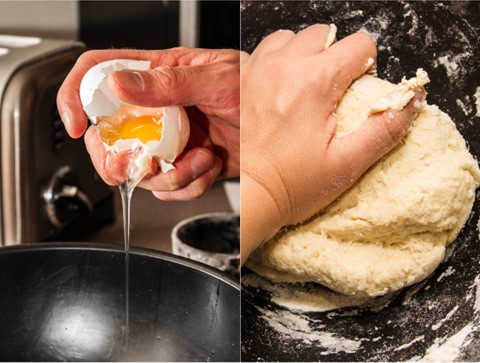
The last part of the dough recipe called to mix all the wet ingredients (section C) before incorporating them to the dry mix (sections A and B). I do not recommend using a whisk, as I did, because it’s incompatible with the thickness of the dough. I started using my hands before remembering that the cookbook’s author strongly recommended the use of electronic kitchen appliances, which I did possess but neglected during this phase of the process.

Side-by-side photos of an egg being cracked into a pan and dough being kneaded by hand.

Mixing the wet ingredients from section C with the dry ingredients from sections A and B. While the author used her hands, it’s recommended that you use a stand mixer should you possess one. Courtesy of the author, Ariane Gauthier.

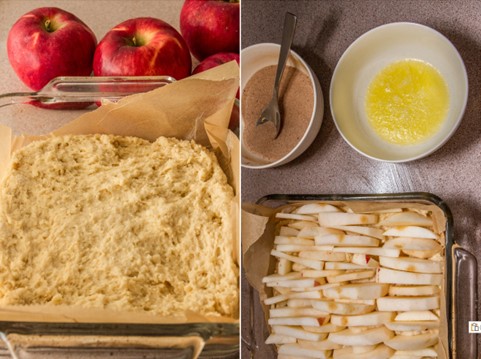
Once the dough was made, it needed to be put onto a baking sheet or baking tray lined with parchment paper. Then it was time to peel and slice 900 g of apples, cut them into eighths and insert them into the cake “thin edge” first. This frankly felt wrong as I was doing it, but I pushed through all the same.

Side-by-side photos of dough in a baking dish lined with parchment paper and the baking dish with slices of apples on top of the dough, with a bowl of melted butter and a bowl of sugar and spice mix next to it.

Setting the dough into a baking dish lined with parchment paper. The next step is to then insert the apples. Courtesy of the author, Ariane Gauthier.

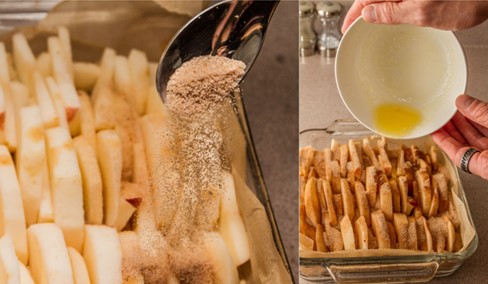
The final step was to make the sugar and spice mix and sprinkle it onto the cake as evenly as I could. Then I melted 50 ml of butter, which I drizzled overtop before sending it to the oven for 25 minutes at 400 ⁰F.

Side-by-side photos of the sugar and spice mix being sprinkled on top of the apple slices and the melted butter being drizzled on top of the apples and the sugar and spice mix.

Adding the sugar and spice mix and the butter onto the apple cake. This is the element chiefly responsible for giving the cake any flavour. Courtesy of the author, Ariane Gauthier.

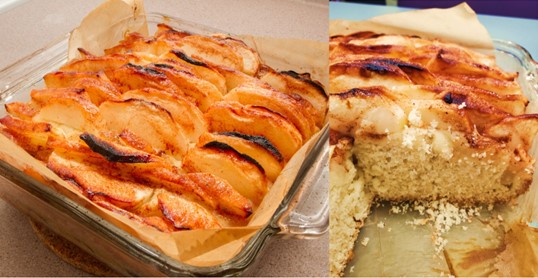
Having never made a Dutch apple cake before, I wasn’t sure what to expect. I felt as though this might very well be my first failure of a recipe, especially when I initially pulled the cake from the oven. It bubbled with butter and apple juice in a way that resembled a classic Québécois dish known as pouding chômeur, which, I was fairly certain, was wrong. For those who are unfamiliar, pouding chômeur is essentially a cake boiled in sweet syrup. However, part of the pleasure of following older recipes is opening the door to failure, and so I brought it to work the next day all the same for my colleagues to try. Here was the final result:

Side-by-side photos of the baked Dutch apple cake and a view of the layers after cutting into the cake.

The final product with a view of the cross section. Courtesy of the author, Ariane Gauthier.

What do you think?

I was surprised by how well it turned out, all things considered! The cake was fully cooked through, and the apples became quite jammy. That helped to keep the cake somewhat moist and wasn’t too sweet. I brought it to the Reference Section for another tasting and showed that, once again, these recipes can withstand the test of time!

If you try this recipe, please share pictures of your results with us using the hashtag #CookingWithLAC and tagging our social media: FacebookInstagramX (Twitter)YouTubeFlickr and LinkedIn.

Additional resources


Ariane Gauthier is a Reference Archivist in the Access and Services Branch at Library and Archives Canada.

Porter Talk

By Stacey Zembrzycki

This article contains historical language and content that some may consider offensive, such as language used to refer to racial, ethnic, and cultural groups. Please see our historical language advisory for more information.

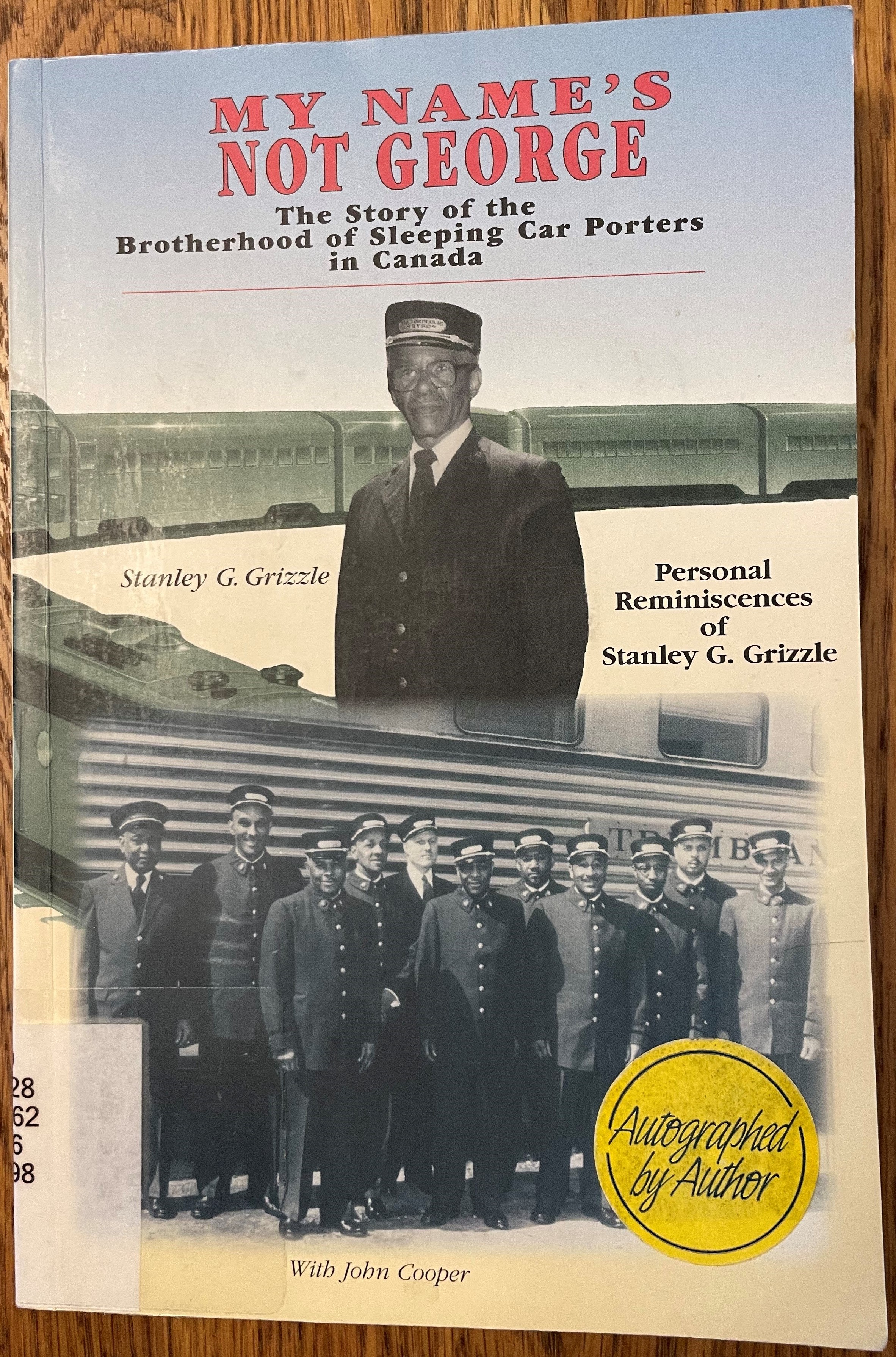
Stanley Grizzle was born in Toronto in 1918, to parents who had immigrated separately from Jamaica in 1911. His mother laboured as a domestic servant while his father found work as a chef with the Grand Trunk Railway (Grizzle, My Name’s Not George, p.  31). The eldest of seven children, Grizzle became a porter for the Canadian Pacific Railway (CPR) at the age of 22, pulled away from school to help his parents meet their dire financial obligations. “Porters,” as he puts it in his memoir My Name’s Not George: The Story of the Brotherhood of Sleeping Car Porters in Canada, “were well respected, and looked up to by many in the community because they had steady employment. In essence, they were the aristocrats of African-Canadian communities. They were the most eligible bachelors and parents often encouraged their daughters to marry a porter” (p. 37).

Book cover featuring a man with a train behind him, and a group of men below, all dressed in uniforms.

Book cover of My Name’s Not George: The Story of the Brotherhood of Sleeping Car Porters in Canada: Personal Reminiscences of Stanley G. Grizzle (OCLC 1036052571). Image courtesy of the author, Stacey Zembrzycki.

Grizzle’s early life began to follow this well-established trajectory, especially since portering was one of the only employment options available to Black men in the mid-twentieth century, until it was interrupted by the realities of the Second World War. Conscripted into the Canadian Army in 1942—legislation he firmly opposed throughout his life—Grizzle spent an extended amount of time away from the family he had only just started. In fact, his first child, Patricia, arrived on the very day he departed for Europe and did not have the opportunity to meet her father until he returned home, when she was three years old (Grizzle, My Name’s Not George, p. 57).

Grizzle’s early experiences with poverty, and the racism he encountered as a porter and a soldier, went on to dictate the new career path he paved for himself. First, as a celebrated labour union activist with the Toronto division of the Brotherhood of Sleeping Car Porters (BSCP), then as the first Black Canadian to be employed by the Ontario Ministry of Labour as a clerk with the Ontario Labour Relations Board, and later as the first Black Canadian to be appointed as a judge in the Court of Canadian Citizenship. There is no doubt that these experiences also informed the interviews he conducted in 1986 and 1987, now held by Library and Archives Canada (LAC).

As I mentioned in a previous blog, these 53 informal conversations among friends and acquaintances constituted what many, including Melvin Crump, referred to as “porter talk.” Meeting in Crump’s Calgary living room on November 1, 1987, the two men spent the afternoon discussing the intricacies of what it meant to be a porter. Not only did they describe what the job signified for them as Black men, they also explained how it shaped their identities and the larger Black communities that supported them.

Having been born in Edmonton in 1916 after his parents immigrated in 1911 as homesteaders from Clearview, Oklahoma, Crump’s early circumstances were much different from Grizzle’s. However, the men had both experienced the abject racism that was central to Black experience in Canada, which ultimately led them to a career with the CPR. Like Grizzle, Crump went to work for the company because it offered stable employment, away from the meatpacking plants and farms in the region that provided little stability and paid poor wages. In fact, Crump knew that this would be the only way to get ahead, so he lied about his age to obtain a job when he was just nineteen years old, thereby defying the age restriction that limited employment to those over twenty-one.

Like Grizzle, Crump spent about twenty years working for the CPR before seeking employment beyond the rails. The move from steam to diesel engines, coupled with automation, drastically changed the size, shape and appearance of this labour force, as well as passenger experience forever. As they had always done, the men moved toward a secure future. Regardless of their similar but divergent histories, both men prided themselves on having done their jobs well, and continued to stress the inherent value of unionization, regardless of the risks, nearly thirty years after leaving portering.

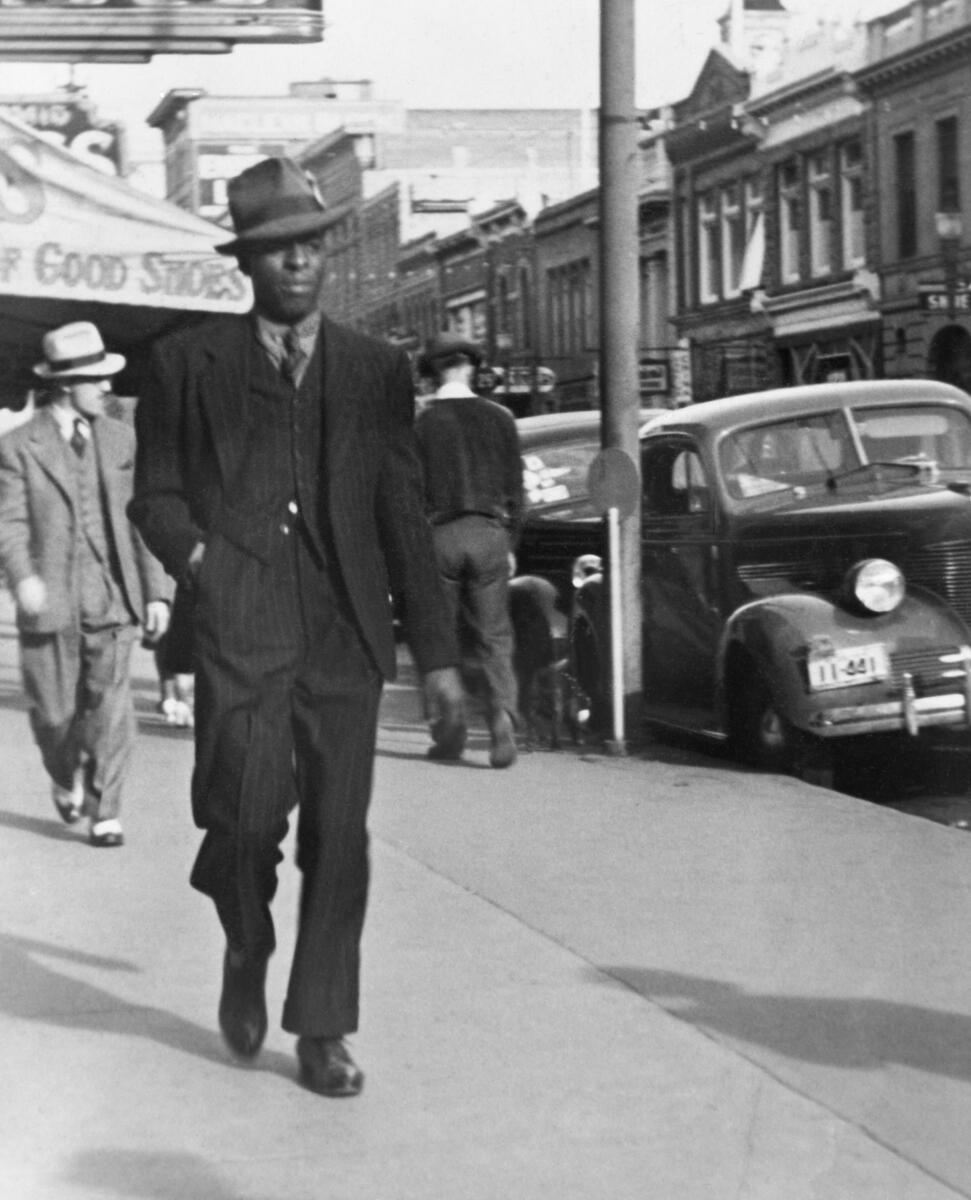
A man in a suit and hat walking down a sidewalk lined with cars and buildings.

Melvin Crump on 8th Avenue, Calgary, Alberta, ca. 1940, (CU1117465).
Photograph: Collection, Libraries and Cultural Resources Digital Collections, University of Calgary.

There is a coded language to this conversation. It is implicit, organic and almost impossible to understand without having lived through the institutional racism and systemic segregationist policies that guided nearly every aspect of these men’s lives, on and off the rails (Mathieu, North of the Color Line). The conversation is warm, the laughter is heartfelt, and the experiences intersect in complex ways. There is no need for detailed explanations between the men. These conversations were meant to support the writing of Grizzle’s memoir. While he was committed to documenting and preserving the history of portering in Canada, one wonders if these conversations were meant to be heard by others. And yet, here we are, listening in, translating their meaning and breaking the coded nature of these exchanges nearly forty years later.

By pushing Crump to articulate the particular circumstances that defined his experiences in Calgary—the friendships that were made, nurtured and even broken there, the specifics of unionization within that branch and the role of the wider community in fighting for change and supporting porters and their families—Grizzle highlighted the similar ways in which porters across the country were bound together by this demanding and often degrading profession.

And yet these intersections, which we hear across the collection, quickly become more complex when Grizzle asks Crump, as he did with all interviewees, to recount memorable railroad anecdotes. Porter talk offers insight into how each man put one foot in front of the other and built a life around portering. We get brief but powerful glimpses of who these men were, how they saw the world and why they tolerated and overcame the abuse they endured daily. As we gain a superficial understanding of each man’s personality, we also hear about resilience. Stories about memorable passengers naturally shift to stories about the other Black men with whom they shared railcars and responsibilities. The sense of community among porters and the conversations that started on the trains and flowed over into these interviews are what make these recordings so special. The laughter, reinforced by years of hindsight, reflection, recognition of service and a job well done, fuels the jovial exchanges that lead us into the realm of porter talk.

When Grizzle asked Crump to tell him about the prominence of nicknames between porters, Crump let out a roaring laugh, declaring:

Oh nicknames used between porters? Oh-oh-oh-oh, yes. Yeah, I know what you mean. You mean porter talk? You mean porter talk? Well, uh, uh, some of the porter talk names I wouldn’t wanna mention on tape, because if I did uh, it would shock some of the readers or some of the listeners, but they had a language all of their own, I’ll tell you. And some of the conversations that they would get in between themselves. I couldn’t dare, I wouldn’t dare to start to-to mention none of those things. (Interview 417403, File 2 [22:33])

And yet, porter talk is exactly what he, and nearly all of Grizzle’s other interviewees, transmit on these recordings. He couldn’t dare and yet he does. We are offered a seat at the proverbial table to listen, learn and take in a world that no longer exists, and yet remains central to who we are as Canadians.

It is this passing reference that inspired Discover Library and Archives Canada’s new miniseries Porter Talk. This will be the first in a new podcast production entitled Voices Revealed, which will delve into the vast and rich oral history holdings at LAC. While porters have figured prominently in popular culture in recent years, this will be the first time that these men, along with their wives and children, will speak for themselves. It is not enough to write about their exceptional experiences. Readers must hear these narratives. They must be able to differentiate accents, listen to laughter alongside rage, pause to ponder the challenges of portering and the resilience of Black communities in Canada, and grasp the power in these men’s voices and the history they convey.

Grizzle, Crump and all those who graciously agreed to be interviewed, will guide us through this history on their own terms, revealing why it is imperative for us to keep listening, to keep remembering, and to keep porter talk alive, especially as we continue to navigate the many challenges posed by institutional and systemic racism and discrimination in this country and beyond. The structures that these men, alongside their wives and children, worked so hard to dismantle, continue to matter. These voices remind us of the work that remains to be done.

To listen to this miniseries, you can subscribe to Discover Library and Archives Canada for free wherever you get your podcasts.

Additional resources


Stacey Zembrzycki is an award-winning oral and public historian of immigrant, ethnic, and refugee experiences. She is currently employed as a Podcast Development Specialist in the Outreach and Engagement Branch at Library and Archives Canada.

The Life of Private Marcel Gauthier (Part 2)

Version française

By Ariane Gauthier

I first learned about Marcel Gauthier a few years ago when I was visiting the Bény-sur-Mer Canadian War Cemetery, in France. Although we share the same surname, Marcel is not my ancestor. Still, I have always remembered this young man—the only Gauthier buried in this large cemetery. With the release of the 1931 Census, I finally had the opportunity to learn more about him. As a result, I would like to share with you how the many resources of Library and Archives Canada (LAC) can be used to piece together a person’s life, such as an ancestor or a soldier.

The second part of this blog will explore Marcel Gauthier’s life, from his military enlistment to his death.

A black and white picture of a young man in his military uniform.

Photograph of Private Marcel Gauthier, age 21, published in an Ottawa newspaper to announce his death overseas (Canadian Virtual War Memorial).

Private Marcel Gauthier (Joseph Jean Marcel Gauthier)

  • C/102428
  • Le Régiment de la Chaudière, R.C.I.C.
  • Date of birth: November 18, 1922
  • Date of death: July 15, 1944
  • Age at time of death: 21 years old

His military record is available in LAC’s database Second World War Service Files—War Dead, 1939 to 1947.

On January 29, 1943, shortly after enlisting, Marcel left Ottawa to begin training in Cornwall, unaware that he would never see his hometown again.

Despite the convictions that led him to join the army, Marcel is not a model soldier. In Cornwall, he left his station, the camp hospital, without official permission. His seven-day absence resulted in disciplinary action being taken against him in the form of monetary penalties—in this case, the loss of three days’ pay—for being AWOL (absent without official leave). The rest of his training is without further incident. On April 1, 1943, Marcel is transferred to the Valcartier base where he joins the Voltigeurs de Québec infantry unit. On July 11, 1943, Marcel embarked on a ship bound for England, where he would train alongside 14,000 other Canadian soldiers in preparation for the Normandy landings. On September 3, 1943, he was transferred to the Régiment de la Chaudière, with which he would storm Juno Beach on the fateful day of June 6, 1944.

Training for the Normandy landings is very well documented, thanks in particular to war diaries. Produced by each regiment of the Canadian Army, these documents make it possible to follow their actions and activities. For example, the war diary of the Régiment de la Chaudière tells us that shortly after Marcel’s assignment on September 4, 1943, the order was given to move to Camp Shira, in Scotland, to carry out exercises in preparation for the landings. In the same month, the war diary describes the training and progress of the Régiment de la Chaudière’s four different companies, A, B, C and D, in reaching their targets, as well as incidents along the way.

The regiment’s war diary also includes regimental orders, which are precise enough to trace Marcel’s route at the time of the landings and during the Battle of Normandy, since they include his company and its movements. According to the regimental orders of September 1943, Marcel was assigned to D Company. On D-Day, Marcel was to remain on the landing craft until A and B companies had reached their objectives in the Nan White sector, before disembarking on the beach as reinforcements. To this end, the diary provides the training syllabus and describes the exercises carried out in preparation for the landing.

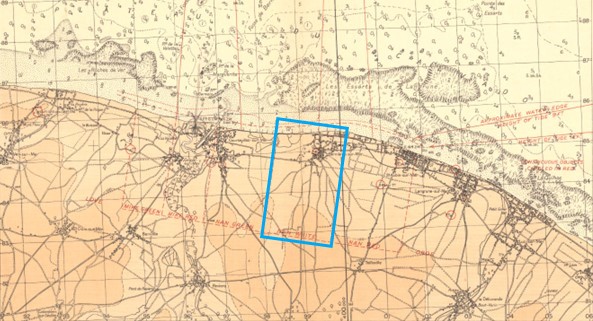
On June 6, 1944, Marcel embarked with D Company on the ship Clan Lamont, which was preparing to cross the English Channel. The last breakfast was served at 4:30 a.m. and then, by 6:20 a.m., everyone was aboard the ship that set off in turbulent seas toward Bernières-sur-Mer. Many were ill due to anxiety and seasickness. At 8:30 a.m., the Régiment de la Chaudière disembarked to join the fight in which the Queen’s Own Rifles Regiment was already engaged. But a storm the night before, which disrupted the tidal currents, combined with fierce resistance from the Germans, delayed the arrival and progress of the Queen’s Own Rifles. While they should have already taken Bernières-sur-Mer before the Régiment de la Chaudière arrived, they were trapped on the beach under enemy fire, unable to advance.

Close-up of a map of Juno Beach divided into sectors.

Detail from a map of the Juno Beach area (e011297133). The Régiment de la Chaudière landed in the Nan White sector at Bernières-sur-Mer.

Ultimately, the German defence gave way under pressure, allowing the Canadian Army to enter Bernières-sur-Mer and to secure the surrounding area. By day’s end, the companies of the Régiment de la Chaudière regrouped at Colomby-sur-Thaon, thus helping establish a bridgehead for the Allies in France. It was an important victory, but only the beginning of the Battle of Normandy, which would last for more than two months and claim many more lives.

Advances continued throughout the month of June. The Régiment de la Chaudière gradually approached the city of Caen to seize control of it. However, there was still one vital objective to conquer: Carpiquet. This village with its airfield had been fortified by the Germans, who relied heavily on it to resist the Allies. Taking Carpiquet and its airfield would be tantamount to dismantling the strategic point of the German air force closest to the Allies. It would also open the doors to the conquest of Caen.

The offensive on Carpiquet began on July 4 at 5:00 a.m. B and D companies were part of the first Allied assault group, advancing under cover of an enormous barrage provided by 428 guns and the 16-inch cannons of Royal Navy battleships HMS Rodney and HMS Roberts. However, the enemy’s defence was fierce. The Germans were better positioned and organized; they had even had time to fortify their positions with concrete walls at least six feet thick. That morning, they rained down a veritable deluge of artillery shells and mortar rounds. The first day’s action left many members of the Régiment de la Chaudière dead or wounded.

Canadian soldiers attend a briefing at Carpiquet airfield.

Briefing of Canadian infantrymen outside a hangar at the airfield, Carpiquet, France, July 12, 1944 (a162525). Taken after this vital point was seized, this photo reveals the ravages of this bloody battle.

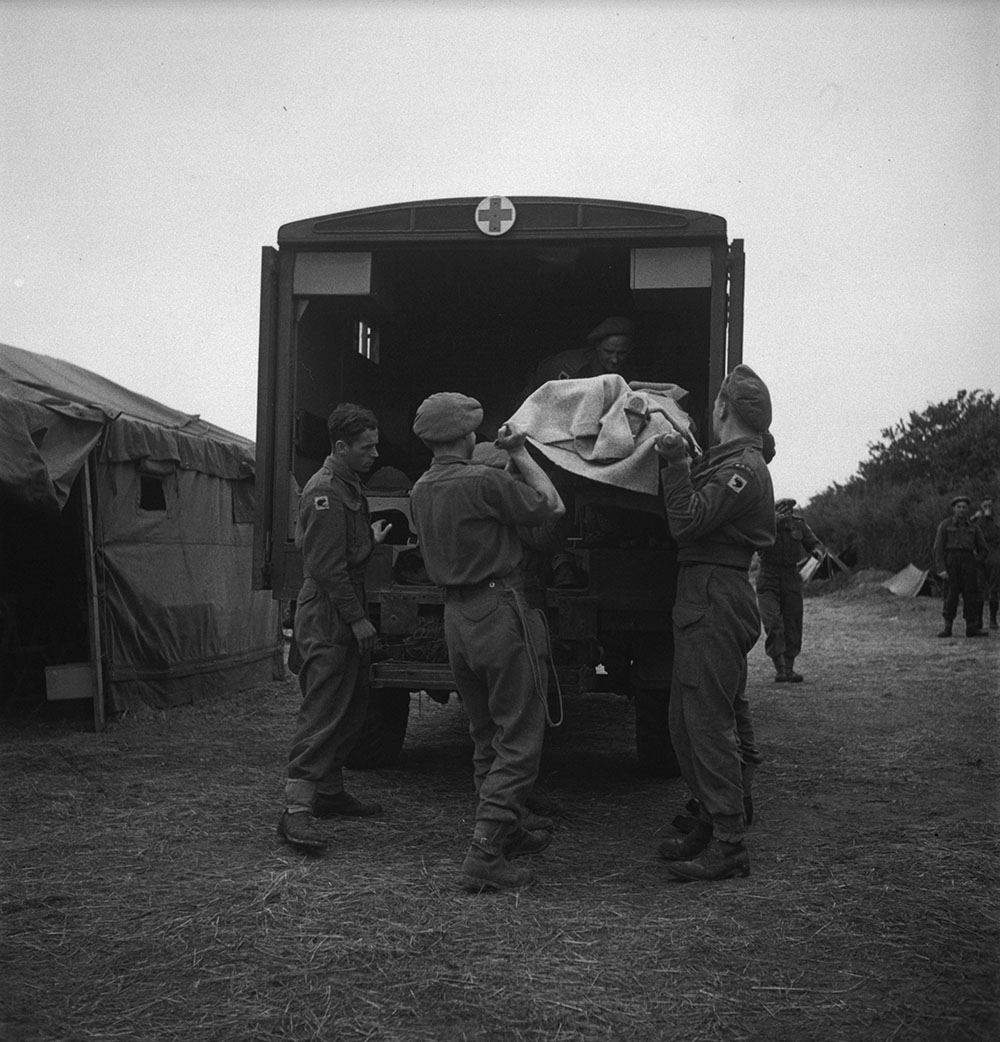
On July 8, 1944, Marcel Gauthier was hit by shell fragments. The explosion left him with a serious head wound and his regiment quickly brought him to the nearest Canadian Army Medical Corps station. He was taken to the 22nd Canadian Field Ambulance, then sent to Casualty Evacuation Station No. 34, and was finally admitted to the 81st British General Hospital where, despite the personnel’s best efforts, he succumbed to his injuries on July 15, 1944. He was posthumously awarded the France and Germany Star for his service.

Soldiers load a wounded soldier on a stretcher into a military ambulance.

A soldier of the Régiment de la Chaudière who was wounded on July 8, 1944, during the battle for Carpiquet receives care from the 14th Field Ambulance of the Canadian Army Medical Corps (a162740). This is not Marcel Gauthier, but one of his fellow soldiers.

Marcel Gauthier is buried in lot IX.A.11 at the Bény-sur-Mer Canadian War Cemetery. His gravestone bears the inscription submitted by his father, Henri: “Our dear Marcel, so far away from us, we will always think of you resting in peace,” where his name liveth for evermore.

Additional resources


Ariane Gauthier is a Reference Archivist with the Access and Services Branch of Library and Archives Canada.

The Life of Private Marcel Gauthier (Part 1)

Version française

By Ariane Gauthier

I learned about Marcel Gauthier a few years ago when I was visiting the Canadian cemetery in Beny-sur-Mer in France. Although we have the same last name, Marcel is not my ancestor. However, I have always kept a memory of this young man—the only Gauthier buried in this large cemetery. With the release of the 1931 census, I finally had the opportunity to learn more about him. Now, I would like to demonstrate how the many resources of Library and Archives Canada (LAC) can help piece together the life of a person, such as an ancestor or a soldier!

This first part of the blog will cover Marcel Gauthier’s life from his childhood to his military enlistment.

A black and white picture of a young man in his military uniform.

Photograph of Private Marcel Gauthier, age 21, published in an Ottawa newspaper to announce his death overseas (Canadian Virtual War Memorial).

Private Marcel Gauthier (Joseph Jean Marcel Gauthier)

  • C/102428
  • Le Régiment de la Chaudière, R.C.I.C.
  • Date of birth: November 18, 1922
  • Date of death: July 15, 1944
  • Age at time of death: 21 years old

His military service file is available in LAC’s War Dead database, 1939 to 1947.

Born on November 18, 1922, in Ottawa, Ontario, Marcel Gauthier is the seventh child of a large French-Canadian family of nine. When we look at the Gauthiers in the censuses, we learn that Henri, the father of the family, is from Rigaud, Quebec. When he arrived in Ottawa, he settled in Lowertown with his family. This is where Marcel built his life before enlisting.

At that time, Ottawa’s Lowertown attracted many Franco-Ontarians. The 1931 Census shows that the homes and dwellings of the By Ward – St. George’s Ward sub-district were largely inhabited by French Canadians. Some of them were born in Ontario, others came from Quebec. Several historical studies indicate that the population of Lowertown was mainly Francophone, with a significant Irish population as well. This is one of the reasons why this area has been the site of many language issues in the history of Franco-Ontarians, particularly on the issue of Regulation 17 (available in French only), adopted in 1912. Additional resource: https://www.thecanadianencyclopedia.ca/en/article/ontario-schools-question.

Screenshot of the 1931 Census, with an arrow indicating where Marcel Gauthier’s information is found.

Screenshot of the 1931 Census. Marcel Gauthier’s name is found on the 48th line of the By Ward – St. George’s Ward sub-district, No. 74 (Lowertown), on the 7th page of the document (record 8 of 13). He was nine years old at the time (MIKAN 81022015).

Lowertown was considered a disadvantaged neighborhood with a predominantly working-class population. We can therefore assume that Marcel was not born into wealth. His large family lived in close quarters, first at 199 Cumberland Street, with at least seven children (1921 Census), then at 108 Clarence Street, with nine children (1931 Census).

The absence of his mother, Rose Blanche Gauthier (née Tassé), from the 1931 Census indicates that she had probably died by this time. We can assume, by referring to the 8th page of the document (or record 9 of 13), that she died between 1928 and 1931. This theory is based on the registration of the youngest family member, Serge Gauthier, three years old at the time. Marcel’s military record validates this theory and confirms Mrs. Gauthier’s death on October 6, 1928, possibly due to complications arising from the birth of her last child. She is buried in the Notre-Dame Cemetery in Carleton Place, Ontario, where she was born.

In 1931, Marcel’s father and eight of his children lived in a nine-bedroom apartment at 108 ½ Clarence Street. If it had not been for the help of the older children, Henri’s mail carrier salary would not have been sufficient to support his children and cover their tuition. We can therefore assume that Yvette (24 years old and single), the oldest in the household, looked after the home and the younger siblings. We also know that Léopold (22 years old) worked as a driver and that Marie-Anne (21 years old) was a salesperson. It is very likely that they were helping their father financially, just as their older sister, Oraïda (27 years old), had more than likely done ten years earlier. She had now moved out and married a Mr. Homier.

In 1931, Marcel became a student and learned to read, write and communicate in English. At 16, he completed his education. He entered the workforce as a cook and then moved alone to 428 Rideau Street.

Photograph of a two-storey building. Bowles Lunch restaurant is located on the first floor.

Bowles Lunch restaurant where Marcel Gauthier worked before enlisting in the army in 1943 (a042942).

In Europe, tensions with Hitler’s Germany escalated and led to the outbreak of World War II in 1939. Unlike many young men, Marcel did not immediately feel the need to join the fight, likely because he was satisfied with his job as a cook at Bowles Lunch. He waited until January 11, 1943, before reporting to Enlistment Office No. 3 in Ottawa. We can theorize that, like many, he wanted to help change the course of the war or that he wanted to follow the example of two of his brothers, Conrad and Georges Étienne.

Shortly after, on January 29, 1943, he left Ottawa to begin training in Cornwall, unaware that he was leaving his hometown forever.

Additional resources


Ariane Gauthier is a reference archivist in the Access and Services Branch at Library and Archives Canada.

The Ships of Dominion Bridge: A Second World War Story of Teamwork, Technology and Innovation

Version française

By Rian Manson

In 1940, following the Dunkirk evacuation, the British situation was grim. The German Navy, operating from the French coast, was sinking cargo ships at a rate of 50 per month. At the start of the Second World War, Canada only had 41 sea-worthy cargo vessels. To keep the supply of war materials and food from being cut off, it was imperative that cargo ships be constructed at phenomenal speed to prevent Britain from starving to death.

Posters from the Second World War featuring cargo ships.

To keep up morale, posters like these were displayed at Dominion Bridge and United Shipyards, in Montréal. Canadian Transportation, November 1941, pg. 638-639 C-204-4*C-205-1 (OCLC 1080360026).

With the entire shipbuilding industry gearing up for war production, Canada needed a new and large shipyard to help fulfill the huge order of 200 10,000-ton cargo vessels. For this crucial project, the federal government put every Canadian shipbuilder from Nova Scotia to British Columbia on contract to construct naval craft, tugboats and cargo ships.

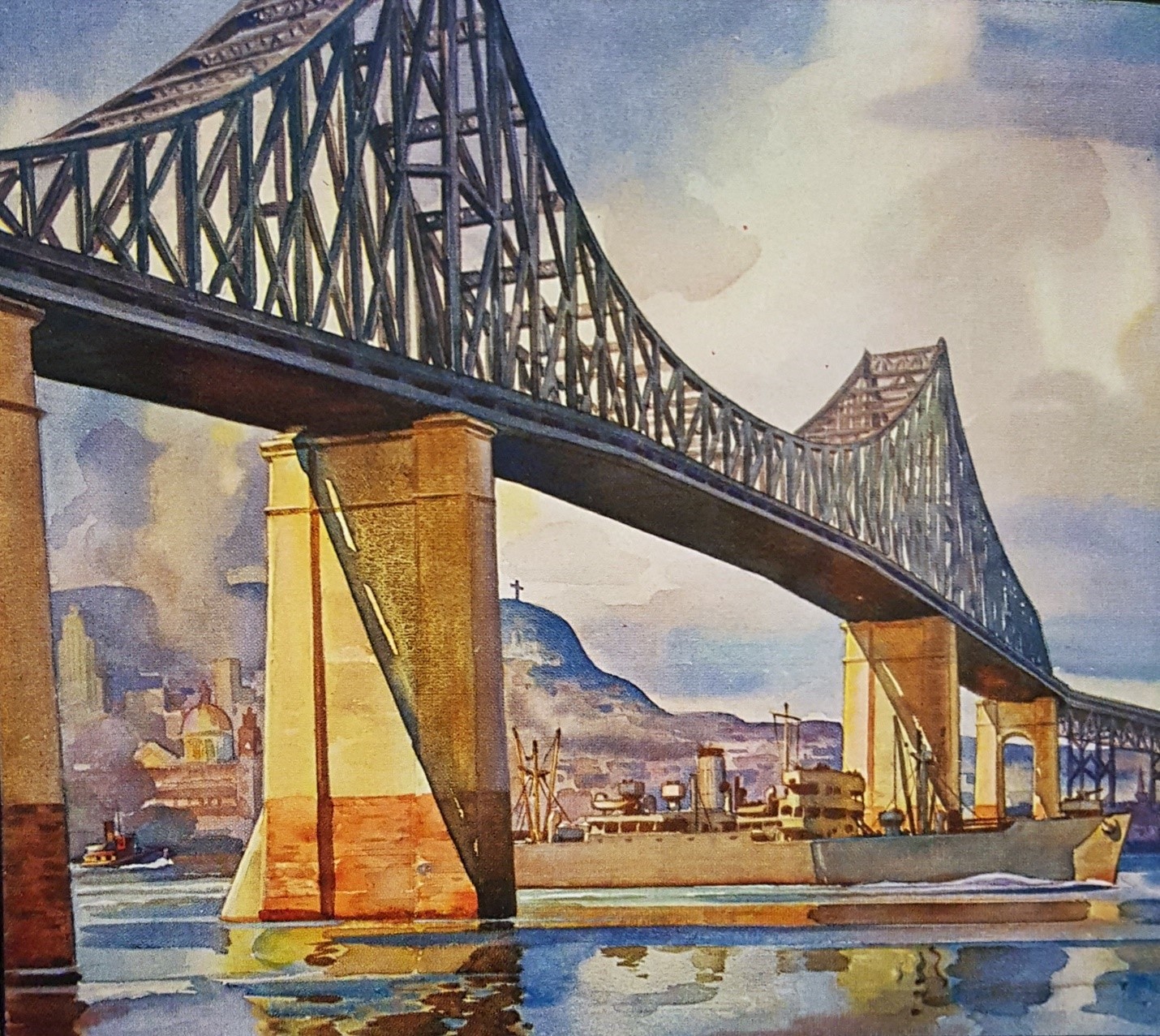
A bridge over water with a city in the background and a cargo ship passing underneath.

A 10,000-ton North Sands-class cargo ship bound for sea, passing under Montréal’s Jacques Cartier Bridge (OCLC 321000549).

Minister of Munitions, C.D. Howe, approached the Dominion Bridge Company of Montréal to ask if they could use its huge plant and machinery to help with shipbuilding. Since 1882, Dominion Bridge had been supplying Canadian railways and provinces with all types of bridges. Its massive workshops were constructing enormous iron and steel components for huge hydroelectric projects, and supplying countless towns and cities with the structural steel beams needed to erect stores, homes and hotels.

A technical drawing showing dimensions and measurements for a cast-brass nameplate.

Technical drawing of a cast-brass nameplate for marine steam engines of 4700-ton cargo vessels built at the Dominion Bridge’s Lachine workshops, R5607, vol. 2073 (MIKAN 5183995).

Since its first contract with the Canadian Pacific Railway (CPR) in 1882, Dominion Bridge had developed a huge assembly plant with machines specially designed to manufacture heavy steel, iron products and boilers. The Lachine location was a perfect fit: access to water transport; direct rail access from the Canadian National Railway (CNR); and available high-voltage electricity for heavy stick welding. One problem: the company had never considered building a shipyard, let alone ocean-going ships. They needed advice from a trusted source. Fraser Brace Ltd., another respected Canadian company with superior experience in the heavy shipbuilding industry, partnered with Dominion Bridge to help construct and operate the new United Shipyards Ltd., at the Bickerdike Basin in Montréal.

A group of people standing on a dock with a shipyard and cranes in the background.

Thanks to a forest of derrick cranes United Shipyards at Bickerdike Basin was able to continue building ships throughout the winter months, even when the St. Lawrence River was frozen over (e000761650).

Work on the shipyard began in January 1942, and only four months later, the keel was laid for the first cargo vessel. Although this was Canada’s newest and largest single-unit shipyard, the shipyard’s machinery—derricks, cranes and locomotives—were on long-term loan from the Harbour Board, Fraser Brace Ltd., Dominion Bridge, and Montreal Locomotive Works. Even the railway trucks were, according to one writer, “skillfully stolen from the CPR and CNR” to make this giant enterprise work.

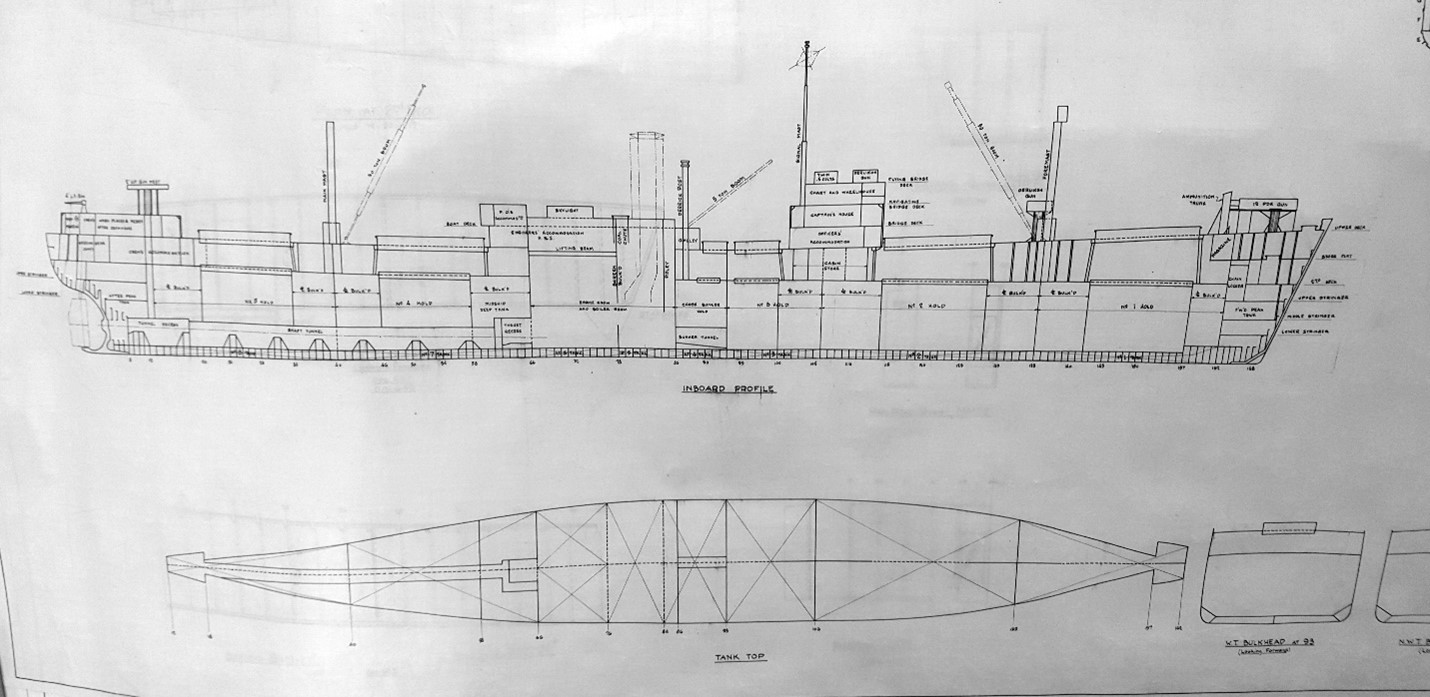
A profile elevation diagram illustrating the location of various parts of the cargo ship.

A profile elevation diagram by Dominion Bridge of a 10,000-ton North Sands-class cargo vessel, Lachine, November 1943, R5607, vol. 1612 (MIKAN 5183995).

Dominion Bridge set out a unique prefabrication plan to construct 10,000-ton ships and smaller 4700-ton cargo vessels. In the main shops at Lachine, workers welded the aft section and forepeak of the ship as one piece. These completed sections were delivered by railway flatcars to the Bickerdike Basin, where the custom-built derrick cranes would position the aft sections and forepeak for riveting to the hull.

Side-by-side of a close-up photo and technical drawing of a ship’s stern and propeller.

From the drawing to the dockyard: Dominion Bridge’s pre-fabrication of the aft assembly contributed to the accelerated mass production of ships at United Shipyards, Montréal (photograph: e000761682; drawing: R5607, vol. 1613, MIKAN 5183995).

Dominion Bridge drew on its early bridge and boiler welding experience. All inboard bulkheads, cabins, cargo holds and interior fittings were welded. Welding saved precious time, weight and materials for each vessel.

The savings generated helped United Shipyards set a new Canadian record for shipbuilding speed. From the keel being laid to the final touches of paint, it took 58 days—one month faster than the previous record. The cargo ship arrived in Great Britain fully loaded 86 days after the keel was laid. C.D. Howe praised United Shipyards as the yard where the cheapest 10,000-ton vessels were built in Canada.

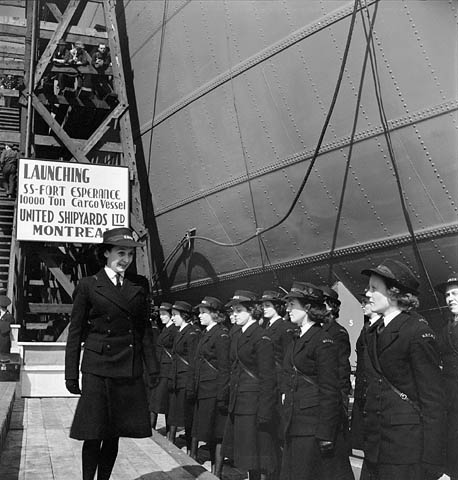
Bow of ship with naval officers at attention.

View of the christening podium and guests of honour at the launch ceremony of the 10,000-ton cargo ship, the S.S. Fort Esperance, at United Shipyards Ltd. (e000761721).

A Style of Their Own

On a sunny afternoon on July 15, 1944, Dominion Bridge launched a new type of cargo ship, the “Canadian,” from the United Shipyards slipways. Identical in design to the 10,000-ton British North Sands, but with new improvements, such as boilers capable of burning oil or coal with rapid changeover for each fuel; improved crew quarters; and hatches and decks with greater strength to withstand heavier loads.

Virtually all the manufacturing was carried out in Dominion Bridge’s own workshops. Very little outfitting was subcontracted because Dominion Bridge used its creative bridge welding techniques. Special in-house built jigs with attached electric motors rotated to help with complex welding jobs so the welder could operate “downhand,” and the use of welded engine bedplates instead of bolts considerably reduced vibrations and withstood the shocks caused by explosions at sea.

A group of women standing at attention next to the hull of a cargo ship.

Women’s Royal Canadian Naval Service officers lined up at the walkway to the christening podium during the launch ceremony of the S.S. Fort Esperance at United Shipyards Ltd., Montréal (e000761719).

A person welding a large piece of metal.

A welder at the Lachine plant using a special rotating jig for welding the steel bedplate for a marine steam engine that provides the power for the 10,000-ton cargo vessels (OCLC 321000549).

Of the 403 ships built in Canada (including those built by Dominion Bridge), 112 were sunk and 18 were severely damaged by enemy action. Additionally, before the end of the war, 1146 Canadian merchant sailors lost their lives on the high seas and many more endured the trauma of trying to survive in enemy prison camps.

The construction of cargo ships is a forgotten component of Canada’s role in the Second World War. But without the Herculean human effort of the Dominion Bridge Company and other shipbuilders in Canada, one wonders if Britian could have survived the war? Would it have been starved into surrendering to Nazi Germany?

This blog would not have been possible without the remarkable technical drawings of the Dominion Bridge Company fonds at Library and Archives Canada.

Additional resources

  • A Bridge of Ships: Canadian Shipbuilding during the Second World War, by Pritchard,James S., Montréal: McGill-Queen’s University Press, 2011 (OCLC 693809715)
  • Canadian Transportation, January 1941–December 1945 (OCLC 1080360026)
  • Of Tasks Accomplished : The story of the Accomplishments of the Dominion Bridge Company Limited and its Wholly Owned Subsidiaries in World War II, by Dominion Bridge Company Limited, 1945, Montréal: Dominion Bridge Co. (OCLC 321000549)
  • Dominion Bridge Company fonds, R5607, vols. 1612, 1613, 2073 (MIKAN 5183995)
  • Canadian Merchant Ship Losses, 1939-1945 by Robert C. Fisher, The Northern Mariner

Rian Manson is an Archival Assistant in the Private Archives and Published Heritage Branch at Library and Archives Canada.

Cream puffs from 1898

Version française

Cooking with Library and Archives Canada bannerBy Ariane Gauthier

The New Galt Cook Book (1898) is a revised edition of a book that was popular in English Canada, particularly in the Galt region in southwestern Ontario. The publishers claimed that copies were sent to the United States, Egypt, South Africa, India, Australia and China. Like many early cookbooks, this collection offered recipes as well as hints for simplifying domestic chores, and a list of cures for common illnesses.

The book is available online on Library and Archives Canada’s published collections catalogue, Aurora: OCLC 1049883924.

As an amateur cook fascinated by old recipes and the history of cooking, I once again put my skills to the test, and this time I tried to make cream puffs. For my previous attempt at recipes from yesteryear, see my “A pumpkin pie from 1840” blog post.

Now, what needs to be understood when attempting to follow recipes as old as this one is that they differ greatly from the modern recipe format. Much like La cuisinière canadienne, a French-language cookbook first published in 1840, each recipe section begins with a text explaining the overall basics of the recipe type. In the case of cream puffs, authors Margaret Taylor and Frances McNaught decided to include their recipe in the Cookies section.

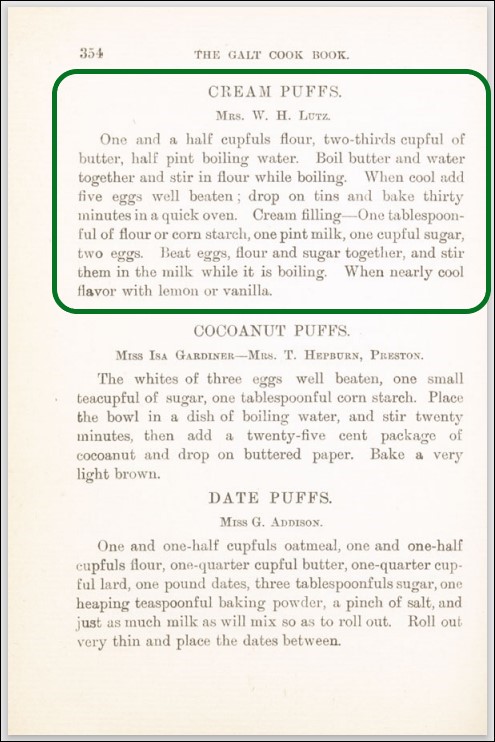
Page from The New Galt Cook Book with the cream puffs recipe followed by two other recipes.

Page 354 from The New Galt Cook Book by Margaret Taylor and Frances McNaught, Toronto: G.J. McLeod, 1898 (OCLC 5030366).

In the more than 50 years separating the publication of La cuisinière canadienne from that of The New Galt Cook Book, much about Canadian cooking had changed. This is evident in the required ingredients. The recipe for cream puffs calls for flour, butter and eggs for the pastry, and flour or corn starch, milk, sugar and more eggs for the cream filling. The final line in the recipe suggests adding either lemon or vanilla to flavour the cream.

There are two things of note here. The first is the inclusion of granulated sugar, which in 1840 was inconceivable for the lower classes. It was an expensive commodity, largely due to import tariffs that inflated the price. In my blog post about pumpkin pie from 1840, I mention that La cuisinière canadienne offered several alternatives as sweeteners, including syrup and molasses. These were the go-to sweeteners for Canadian cooks in the 1800s, until the 1885 Tariff Act came into effect and lifted the import tariffs on cane sugar. In the subsequent five years, the cost of sugar gradually became comparable to the cost of syrup and molasses. After 1890, sugar became the most popular sweetener because it was the cheapest.

The second item of interest is lemon as a flavouring option. In my pumpkin pie from 1840 blog post, I mention that La cuisinière canadienne suggested the inclusion of orange in the pumpkin filling. This was somewhat strange, as oranges were not imported as widely across Canada as they are today. However, given that La cuisinière canadienne was published in Montréal, which was the major commercial port of Canada at the time, access to this then-elusive ingredient was understandable. In comparison, Toronto was just at the start of its development. In the 50 years that followed the publication of La cuisinière canadienne, Toronto boomed into a metropolis, fueled by railway developments linking it to important North American cities like Montréal and New York City. As more railways connected Toronto more fully to the world, its commerce also diversified. In this case, lemon as a flavouring option is reflective of Toronto’s and Canada’s overall development. The lemon became a fruit accessible to cities located inland as transportation technology improved. This allowed for its distribution across greater distances, in climates not suited for local production.

With these interesting facts in mind, I gathered my ingredients and got to work.

Eggs, vanilla extract, milk, sugar, flour, margarine and lemon.

The ingredients for the recipe. Courtesy of the author, Ariane Gauthier.

I started with the cream puff pastry. Fortunately, unlike for the pumpkin pie, there was much less guessing this time around, as The New Galt Cook Book gives fairly precise measurements: “One and a half cupfuls flour, two-thirds cupful of butter, half pint boiling water. Boil butter and water together and stir in flour while boiling. When cool add five eggs well beaten; drop on tins and bake thirty minutes in a quick oven.”

Six photos showing the steps in making the dough: breaking eggs in bowl, stirring flour in another bowl, adding flour to boiling water and butter in saucepan, stirring saucepan ingredients, adding beaten eggs to cooled batter in saucepan, and stirring batter in saucepan.

Creating the cream puff pastry as described in The New Galt Cook Book. Courtesy of the author, Ariane Gauthier.

I needed to pipe the dough onto a lined baking sheet. Since I lacked a piping bag, I settled on the trick of using a reusable bag and snipping off the end. To transfer the dough more easily into the reusable bag, I used my coffee maker as a receptacle. Unsure of what exactly qualified as a “quick oven,” I settled for 400°F on convection and, as with the pumpkin pie, used my eyes and nose to determine when the pastry was done.

Three photos showing the steps in making the puffs: filling a reusable bag with batter, consolidating batter, and piping batter onto baking sheet.

Piping the cream puffs and getting them ready for the oven. Courtesy of the author, Ariane Gauthier.

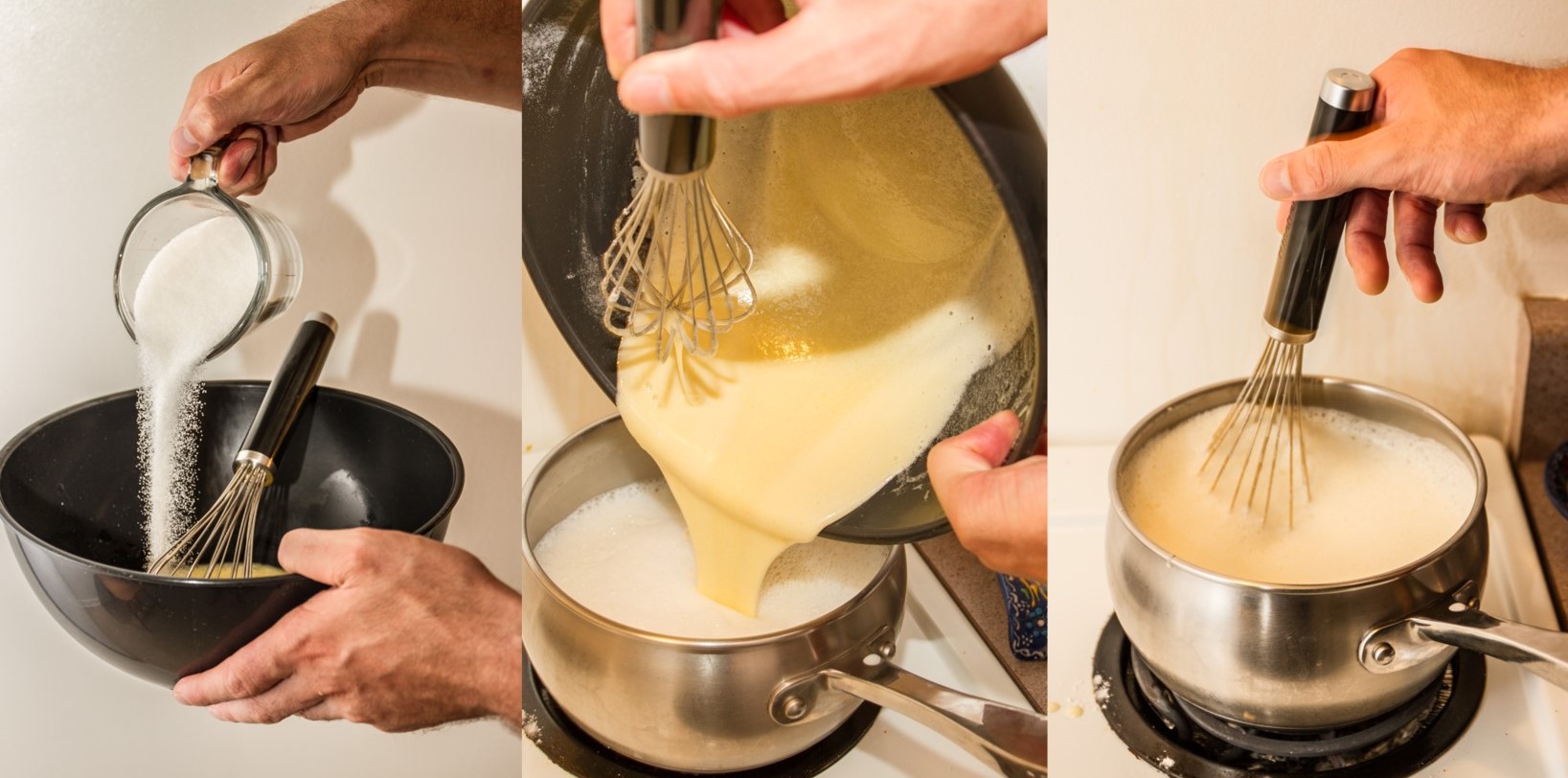
Once the anxiety of baking the cream puff pastry was settled, I worked on the custard. Having made custard previously, I felt much more comfortable with this procedure. Once again, The New Galt Cook Book is precise: “Cream filling – One tablespoonful of flour or corn starch, one pint milk, one cupful sugar, two eggs. Beat eggs, flour and sugar together, and stir them in the milk while it is boiling. When nearly cool flavor with lemon or vanilla.”

Three photos showing the steps in making the cream filling: adding sugar to eggs and flour in bowl, pouring mixture in bowl into saucepan containing milk, and stirring filling in saucepan.

Preparing the cream filling as described in The New Galt Cook Book. Courtesy of the author, Ariane Gauthier.

The only piece of advice that I would add, based on my previous experience, is to be careful once you combine the egg, flour and sugar mixture with the milk. It is best to temper the mixture by adding a little of the boiling milk, whisking vigorously as you do so. This elevates the temperature of the mixture and allows for a smoother transition to the whole of the boiling milk as opposed to simply shocking it. Once the mixture is added to the boiling milk, it is important to whisk it constantly until it thickens; otherwise, you will wind up with sweetened scrambled eggs!

As for the flavouring, I chose to divide the custard, and flavoured one with vanilla extract and the other with lemon zest.

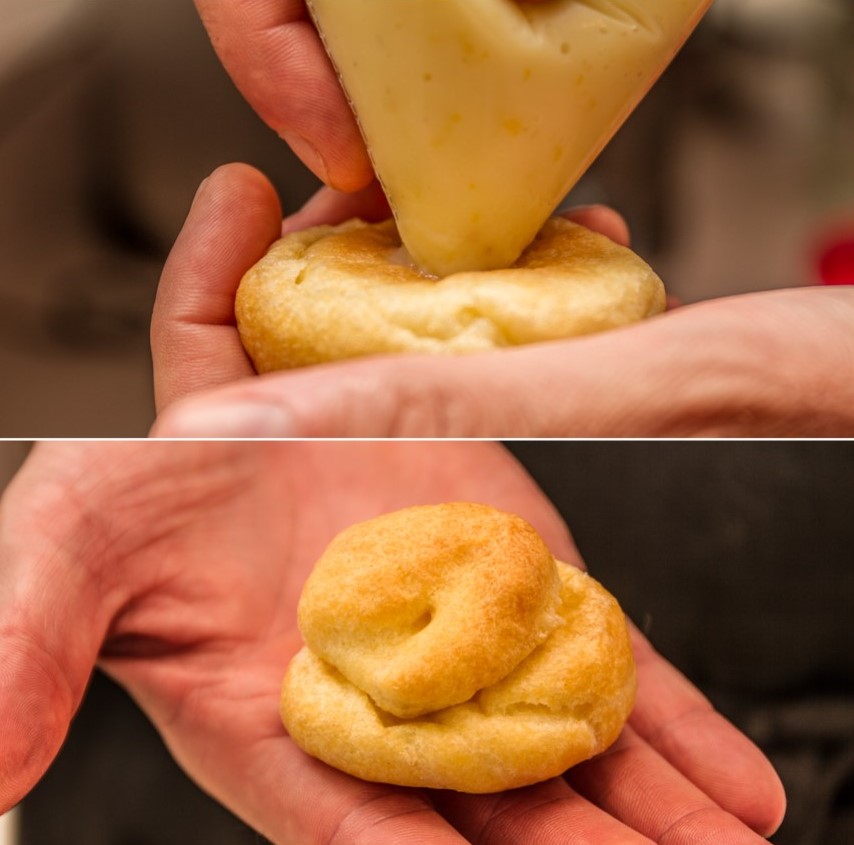
Finally, The New Galt Cook Book abandons the cook in the final phase of the recipe: the assembly. Knowing what a cream puff is supposed to be was extremely helpful here. The pastry is meant to be filled with the custard, so I put the custard in a reusable bag and snipped off one of the edges, since I do not own a piping bag. Before inserting the custard, I made an X-shaped incision at the bottom of each cream puff pastry to make the insertion easier.

One photo showing the cream filling being added to a puff, and another of the final product: a cream puff.

A filled cream puff. Courtesy of the author, Ariane Gauthier.

What do you think?

I was surprised by how well the cream puffs turned out, all things considered! These puffs are much lighter than contemporary cream puffs and allow for ample filling. I brought them to a Reference Section gathering, and my colleagues quite enjoyed them. This shows that, once again, these old recipes can stand the test of time!

If you try this recipe, please share pictures of your results with us using the hashtag #CookingWithLAC and tagging our social media: Facebook, Instagram, X (Twitter), YouTube, Flickr and LinkedIn.

Additional resources


Ariane Gauthier is a Reference Archivist in the Access and Services Branch at Library and Archives Canada.

Discovering my grandfather, Robert Roy Greenhorn, his life in Scotland (Part 2)

Version française

Group of boys working in a field at the Philanthropic Society Farm School.By Beth Greenhorn

This article contains historical language and content that some may consider offensive, such as language used to refer to racial, ethnic, and cultural groups. Please see our historical language advisory for more information.

In the first article of this four-part series, I wrote about my grandfather, Robert Roy Greenhorn (1879–1962), and my discovery that he was a Home Child with Quarrier’s Orphan Homes of Scotland. The second part of this story takes us to Gartsherrie and Falkirk, Scotland, the birthplace of my grandfather Robert and his parents.

I would like to acknowledge Anna Greenhorn, her daughter Pat Greenhorn, and my cousin Joyce Madsen, for generously sharing their memories of Robert Roy Greenhorn.
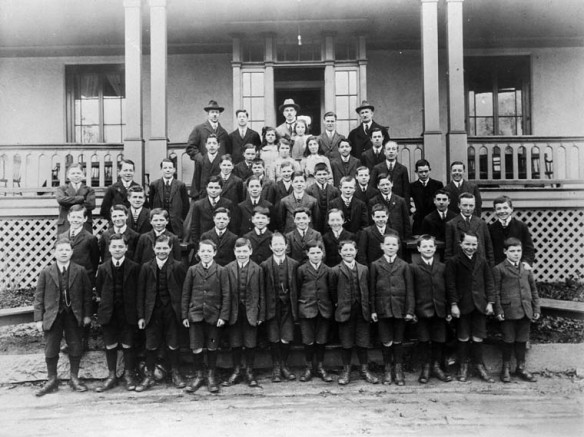
Black-and-white photograph of a group of 53 people on the steps of a large house with a veranda. Boys are standing in four rows, with more boys, four girls and three men wearing hats standing behind them.

Group of children from Quarrier’s Orphan Homes of Scotland at Fairknowe Home in Brockville, Ontario, ca. 1920–30 (a041418). This photograph was taken about 30 years after the arrival of my grandfather Robert and his brothers.

When doing genealogical research, gaps in the records and even missing information are often encountered. Researchers need to access a variety of archival and published sources to connect the proverbial “dots” when researching an individual’s life story. This is particularly the case when the person whose life is being researched was not rich or famous. While researching my grandfather’s story, I was able to piece together facts about his life through Canadian census records, passenger lists and Home Children records held at LAC, digitized primary sources on Ancestry, the Census of Scotland, historical publications, newspapers, and exhibitions available online.

I am grateful to my Uncle John and Aunt Anna (my father’s brother and his wife) for their research on the Greenhorn side of the family. Special thanks to Aunt Anna, who gave me photocopies of two pages from ledger books. The first sheet, titled “Greenhorn, John & Robert,” which is page 40, has entries for December 10, 1885; June 11, 1886; and March 15, 1889. The second sheet is titled “Greenhorn, Norval” and is page 285, with entries made on July 6 and 8, 1892; March 29, 1894; and November 25, 1904.

I contacted the Quarriers Aftercare team in Bridge of Weir, Scotland, to verify the source of these photocopied records and am awaiting a reply. However, I think it is safe to assume that they are copies from ledgers kept by Quarrier’s Orphan Homes of Scotland. Although they consist of only two pages, the information in these entries provide answers about why my grandfather Robert and his brothers, John and Norval, became wards of the Orphan Homes of Scotland and were relocated to Canada. Significantly, they mention Jeanie Greenhorn, my grandfather’s eldest sister, who is a key figure in this story.

Given that my grandparents, Robert and Blanche (née Carr) Greenhorn, were dairy farmers, I assumed that my grandfather came from a family of farmers, or at least had ties to an agricultural past. Little did I know that my grandfather’s family were among the working poor and victims of industrialization in Scotland. My great-grandfather, Norval Greenhorn (1839–82) and his father-in-law, my great-great-grandfather, John Fleming (1805–87), were employed as ironworkers in the manufacturing towns of Gartsherrie and Falkirk.

Gartsherrie, now a suburb of Coatbridge, was a former industrial village located about 14 kilometres east of Glasgow. This was the birthplace of my great-grandmother, Margaret (née Fleming) Greenhorn (1845–85). By 1843, the Gartsherrie Ironworks was probably the largest pig-iron producer in the world. In 1864, Andrew Miller wrote a vivid, but bleak, description of Coatbridge and Gartsherrie:

To all who may have visited an iron producing district such as Coatbridge, around which the fiery beacons flash, the scene on a dark night must have been most impressive; but what strange ideas would enter the mind of any man who had never been near or heard of an iron work… and looked down [from Gartsherrie Church] for the first time on nearly two score and ten blast furnaces belching forth their forked flames, while the innumerable stalks and furnaces of the surrounding mills and forges darted their meteor-like flashes of glaring white heat amid the gloom of darkness. (quoted on “The Bairds of Gartsherrie” web page, North Lanarkshire Council)

This photograph of the Gartsherrie Ironworks, taken in the mid-1870s, shows the blast furnaces (for the smelting of ore) on the “New Side,” built on the Monkland Canal. The “Old Side,” located on the opposite side of the canal and not visible in this photo, had another 8 furnaces, making 16 in total.

Black-and-white photograph of an industrial scene. A multi-storey brick building with a smokestack is on the left, and eight blast furnaces on the right take up two thirds of the photograph. There are two large barges in a canal located in front of the work yard and furnaces.

Gartsherrie Ironworks, “New Side,” with eight blast furnaces, Gartsherrie, Scotland, ca. 1875.
Photo: The Bairds of Gartsherrie – CultureNL Museums (North Lanarkshire Council Museums Collections).

In the Ordnance Gazetteer of Scotland (1884, vol. I, p. 273), edited by Francis H. Groome, Coatbridge and district is described as follows: “Fire, smoke, and soot, with the roar and rattle of machinery, are its leading characteristics; the flames of its furnaces cast on the midnight sky a glow as if of some vast conflagration.”

The 1851 Census of Scotland (Scottish census records are available through Ancestry) lists my great-grandmother, Margaret Fleeming [sic], age six, as living in Gartsherrie. It shows her father, John Fleeming [sic], age 43, as being employed as a furnace filler. I assume that he worked at the Gartsherrie Ironworks since their address was 154 North Square. This was one of the housing units built for the workers by William Baird and Company, founders of the Gartsherrie Ironworks. By the time this photograph was taken in 1966, North Square was derelict, and it was eventually demolished in 1969.

Black-and-white photograph of a paved street in front of a long unit of derelict row houses. The houses are built of stone and no longer have roofs.

The now-demolished group of buildings originally known as North Square was housing for workers of the Gartsherrie Ironworks, Gartsherrie, Scotland, 1966. Photo: Canmore National Record of the Historic Environment.

A street map from the 1930s shows North Square hemmed in by railway tracks on two sides. The ironworks with the blast furnaces would have been within view. According to the Wikipedia page for Coatbridge: “Most of the town’s population lived in tight rows of terraced houses built under the shadow of the iron works” in appalling and overcrowded living conditions, where “tuberculosis was rife.” The Ordnance Gazetteer of Scotland (1883, vol. III, p. 80) states that in Gartsherrie, “There are 400 workmen’s houses, each with two or three apartments, a small garden plot, and a cheap supply of gas and water.” It also mentions a school at the ironworks, which had 253 students in 1881 and could accommodate 612 children, and an academy with 400 students that could take 666 pupils.

I imagine that the ironworkers and their families seldom escaped the misery of Gartsherrie. The Industrial Revolution extended working hours: Work was no longer seasonal or limited to daylight hours, with workdays lasting from 14 to 16 hours, six days a week. This 1853 painting of Gartsherrie by Night shows the blast furnaces operating at night.

According to the 1861 Census of Scotland, my great-grandfather, Norval Greenhorn, lived with his parents and brothers in unit 8 on Back Row in Falkirk, an iron and steel manufacturing town, about 27 kilometres northeast of Coatbridge. Norval, age 22, was employed as an “iron manedar” (ironworker?).

The housing for workers in Falkirk sounds as miserable as in Gartsherrie. The Falkirk Local History Society describes the Victorian-era Back Row (or Manor Street) as grim and narrow, with overcrowded and insanitary buildings, notorious for their dilapidated condition and prone to regular outbreaks of cholera and typhus.

My great-grandparents, Margaret and Norval Greenhorn, married in March 1864. Curiously, the 1871 Census of Scotland does not mention Norval in the entry for Margaret. She was working as a general servant and living with both of her parents, her brother, his wife and their infant son at 154 North Square (see third image above) in Gartsherrie. The census does, however, mention a granddaughter “James Grenham,” age six. I believe that this was Jeanie Greenhorn, the eldest child of Norval and Margaret, born in 1864. As for Norval’s omission, I suspect that he was still working in Falkirk, although his name was not recorded there, nor in any other 1871 census records.

Norval and Margaret had seven or eight children, with only four surviving: Jeanie (1864–1938), John (1877–1961), my grandfather Robert (1879–1962) and Norval (1883–ca. 1960), the last to be born.

By the time of the 1881 Census of Scotland, Margaret and Norval were both living at 154 North Square in Gartsherrie, along with her father (John Fleming) and their sons: my great-uncle John, age three, and my grandfather Robert, age one. John Fleming was an unemployed furnace filler. Norval (senior) was working as a tube finesher [sic]. Jeanie Greenhorn, age 16, had left home and was employed as a servant for George Bissett, a fruit merchant, and his wife, Sarah, in Cleland Place, about 17 kilometres southeast of Gartsherrie.

I learned from the Orphan Homes of Scotland that my great-grandfather Norval died from inflammation of the lungs in late December 1882. My great-grandmother Margaret became a widow at age 37 or 38, losing the breadwinner in the family. She was pregnant with their youngest son, Norval, who was born sometime in 1883. She had two boys to care for: John, age five, and Robert, age three. I can only imagine the hardship and suffering that she and her children endured. My Aunt Anna’s ledger pages show that on December 3, 1885, Margaret died from kidney failure, or “dropsy” as it was called in the 19th century, leaving my grandfather and his siblings as orphans.

According to the entry for John and Robert Greenhorn from the Orphan Homes of Scotland ledger, Jeanie was about 20 years old and working as a servant for Margaret (née Campbell) Kerr at Gallowhill House in Paisley when her mother, Margaret Greenhorn, became ill. Mrs. Kerr gave Jeanie a month’s “holiday” to tend to her mother on her deathbed.

The burden on Jeanie would have been immense. She was suddenly left with the responsibility of caring for her three young brothers, all under the age of eight. The situation would have been difficult for most people her age, but especially challenging for an unmarried woman employed as a servant.

Jeanie was undoubtedly aware of the philanthropist William Quarrier. In 1876, he founded City Orphan Home in Glasgow and, in 1878, he opened the Orphan Homes of Scotland at Bridge of Weir, about 24 kilometres west of Glasgow. Throughout the mid-1870s and the 1880s, local newspapers regularly published articles praising Quarrier for his tireless and evangelical work in rescuing destitute children in Glasgow and elsewhere in Scotland. On March 28, 1884, the Glasgow Herald reported on a meeting in Glasgow the day before that year’s group of boys departed for Canada:

…in a large and populous city like Glasgow …institutions were needed to do the good that was necessary for the public to confer upon these poor little things left without proper guardians …To Mr. Quarrier and his staff the public owed a great debt of gratitude for all they had done in the past. (Applause) …all the boys that had gone out to Canada in the past, and who wished to do well, had found comfortable homes, and could get plenty of employment… Canada …was a place where the cities were not so densely populated, where there were no poor persons, and the population was very much an agricultural one. (“Orphan Homes of Scotland,” p. 9)

Just a few weeks before Margaret Greenhorn passed away, The Evening News in Glasgow published an article entitled “The Charitable Institutions of Glasgow: Their Past Work and Future Condition,” Part III (November 16, 1885, p. 2). The author commended William Quarrier, describing him as “a remarkable man… doing remarkable work which demands special notice. Amongst the poor and the outcast of Glasgow, his name was a household word long before it was known to the general public.” While I will never know if Jeanie had read this particular news article, I am certain that she, like other people in Glasgow and neighbouring towns, was well aware and supportive of Quarrier’s charitable work. Given the deplorable housing and working conditions as well as the pollution in Gartsherrie and vicinity, Canada would have sounded like a safe and healthy place where destitute children would thrive.

On December 10, 1885, John and Robert Greenhorn became wards of the Orphan Homes of Scotland. According to my Aunt Anna’s photocopied ledger entry, Jeanie handed “over these two boys and is quite willing they should go to Canada having had all arrangements fully explained” by Mr. Colin, a Pastor with the Baptist Church in Coatbridge. Norval, age three, was taken in by an aunt, Mrs. Greenhorn, in Haddington, east of Edinburgh.

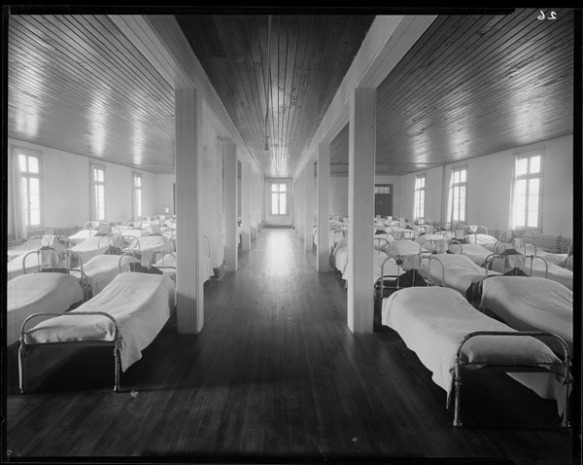
For the next six months, Robert and John lived at City Orphan Home in Glasgow. They moved to the Orphan Homes of Scotland at Bridge of Weir on June 11, 1886. I have not found any interior photographs of the home in Glasgow, but I imagine that my grandfather and my great-uncle slept in a room similar to this dormitory in an orphanage at Huberdeau, Quebec.
Black-and-white photograph of the interior of a large dormitory room, showing beds with white covers arranged sideways in two long rows on either side of an aisle.

Dormitory at the orphanage at Huberdeau, Quebec, 1926 (e004665752).

In the third article of this series, Robert Roy Greenhorn’s story will take us to the Orphan Homes of Scotland in Bridge of Weir and then to Canada, to Fairknowe Home in Brockville, Ontario.


Beth Greenhorn is an Online Content Manager in the Outreach and Engagement Branch at Library and Archives Canada.

Launching the Federal Royal Commissions and Commissions of Inquiry Web Archival Collection: a Brief History of Some of Canada’s Most Important Publications

Image of fingers on a keyboardBy Tom J. Smyth

What is web archiving and why do we do it?

“Web archiving” is a specialized digital curation and preservation discipline that guarantees future access to unique resources from the Internet. It uses specialized hardware and software to target, download and replay the original published and interactive context of web resources via an access portal. This work involves committing to the permanent stewardship and preservation of the data comprising those resources and ensuring its informational continuity for research and use far into the future.

Web archiving is practiced by national libraries and archives internationally to ensure the preservation and future access to online (Internet) and digital cultural heritage that is expressed in no other medium. Preserving the resources comprising our digital documentary heritage from our national Internet domain is therefore of vital importance to our contemporary history.

What are Federal Royal Commissions and Commissions of Inquiry?

The Web and Social Media Preservation Program (WSMPP) is pleased to announce the launch of a new web archival collection via our access portal: the Federal Royal Commissions and Commissions of Inquiry Collection.

In the words of the Canadian Encyclopedia,

“[Commissions] descend from the British monarch’s prerogative power to order investigations, said by some to have been exercised under King William I [“the Conqueror” of Normandy] when he commanded the preparation of the Domesday Book, though the Commission on Enclosures initiated by Henry VIII in 1517 [nearly 450 years later] is a more likely prototype of contemporary royal commissions.”

Federal-level commissions may or may not use the word “royal” in their title, depending on their circumstances. These commissions, when struck to investigate a federal-level issue, are created under an Order in Council (OIC) from the Governor in Council and under the authority of the Inquiries Act (R.S.C., 1985) Part I. Investigations regarding a department of the federal government are struck under this Act, section II. The purpose of any commission is to investigate “any matter connected with the good government of Canada or the conduct of any part of the public business thereof.”

Generally, the Lieutenant Governor in Council or Commissioner in Executive Council of the provinces and territories of Canada may order commissions of inquiry under the authority of their Public Inquiry Acts; however, these are non-federal and so are not contained within the Government of Canada Web Archive (GCWA) collections. Royal commissions are also common to governments throughout the Commonwealth.

The Governor in Council appoints, via OIC, person(s) as commissioners by whom the inquiry shall be conducted; the commissions may summon any witnesses and require them to give evidence under oath, orally or in writing. They may also order witnesses to produce documents “and such things as the commissioners deem requisite to their full investigation”. Their legal authority to enforce the attendance of witnesses and to compel them to give evidence is as “any court of record in civil cases” (Inquiries Act (R.S.C., 1985), s. 3–5.).

While not binding on the government, a commission’s findings are highly influential. The final reports of commissions are therefore among the most important (quasi-official) publications produced in Canada. The investigations and resulting reports have highlighted and documented matters of importance to society since Confederation.

History of publishing practices and the digital Commission of Inquiries published collections at LAC

From the inception of digital publishing, LAC and the Privy Council Office (PCO) have collaborated for the stewardship of analog, digitized, born-digital and website-borne Federal Royal Commissions and Commissions of Inquiry.

Since 2008, PCO has expended considerable effort to locate and digitize paper-based commission documents for preservation and wider public access. In 2009, PCO and LAC established a partnership whereby PCO provided the digitized copies and LAC entered them into the national library collections, conducted the preservation and provided public discovery, access and reference (research support) services. The digitized collections resulting from this collaboration with PCO now date from 1868 to the present day.

Furthermore, starting with the Romanow Commission on the Future of Health Care (2001), the findings of commissions were published via specialized websites, which necessitated shifting acquisition strategies, with LAC responsible for preserving these special websites since 2005.

Replacing the legacy Index to Federal Royal Commissions at LAC

With the re-launch of the GCWA in August 2023, the WSMPP has also developed and launched a Digital Curation Tool. This tool enables web archiving staff to select, arrange, and present acquired web archival data and resources from within the web archive and present them as logical collections for discovery and public access via the GCWA (for example, as was done for the currently accessible Truth and Reconciliation, COVID-19 and Government of Canada collections).

There have been some technical, data, and logistical challenges over the years that have complicated access to these commissions and digital library publications. The GCWA and the new Digital Curation Tool now present an opportunity to restore a specialized portal that can enable full-text search, discovery and access to LAC’s historical commissions publications in a single place.

How do I access the Federal Royal Commissions and Commissions of Inquiry Web Archival Collection?

The GCWA Royal Commissions collection can be found here. The WSMPP staff have also created bibliographic records, which makes these web resources and publications discoverable and accessible by clients using Voilà, Aurora and LAC Collection Search.

This means any topical search from these search tools will now enable clients to discover and access web collections and resources in the GCWA. While this previously required the user to search the GCWA independently, now a search for commissions in Voilà, Aurora, or Collection Search will return a hit for the GCWA collection and enable its consultation with a single click.

This is a major advance for client research use of the GCWA and for clients looking for commissions-published information from anywhere on library-archives.canada.ca or webarchiveweb.bac-lac.canada.ca.

The impetus of this work was severalfold, but was driven primarily by the commissions that have closed in Canada:

The launch of the Federal Royal Commissions and Commissions of Inquiry Web Archival Collection in the GCWA will be most timely, as it provides a specialized access point at LAC for accessing all historical commissions websites and publications, as well as the most recent upon their respective closures.

This collection, the most comprehensive and authoritative in Canada, also restores and greatly advances client research capacity, efficiency, discovery and access for published data, websites and commissions publications, while adding new functionalities and tools in the form of extensive full-text search and commissions curation and discovery facets. For example, as is traditional for this type of publication, it is possible to search and browse by commissioner name (e.g., “Chair Roy Romanow”) as well as the commission name (e.g., “Commission on the Future of Health Care in Canada”).

This launch aligns closely with LAC’s Vision 2030 objectives for delivering advanced digital access services directly to the public (in this case, to a new degree of comprehension, where it was previously and technically impossible to search all commissions, and from multiple tools). We’re very proud of this work and our ability to restore the client research facilitation formerly provided by the Index to Federal Royal Commissions at LAC.

This work will be very welcomed by PCO and university libraries, but also by practitioners across the GC and Canada who specialize in official publications, legal work, government data and Royal Commissions and Commissions of Inquiry for the provision of their own research.

Clients can get in touch with us at archivesweb-webarchives@bac-lac.gc.ca.

Dedication

The launch of the Federal Royal Commissions and Commissions of Inquiry Web Archival Collection and this blog post are dedicated to the memory of our friend and valued colleague, Mr. Michael Maurice Dufresne (March 24, 1971–August 15, 2023), who spent many years as the PCO Portfolio Archivist at LAC and with whom I worked (i.e., who taught me the ropes) from my early days on PCO commissions, research and OIC matters. His help, expertise, wisdom, patience and quick wit will be sorely missed.


Tom J. Smyth is the Manager of the Web and Social Media Preservation Program and the Government of Canada Web Archive at Library and Archives Canada. The WSMPP team includes Elizabeth Doyle, Kevin Palendat, Jason Meng and Russell White.

“Are You Fit, Soldier?”: Fitness in the CEF during the First World War

Version française

By Dylan Roy

Are you fit, soldier? Do you have what it takes to make it in the Canadian Expeditionary Force (CEF)? War is upon the world since 1914, and we need brave young recruits like yourself to take up the mantle of freedom and fight for the Crown!

However, before you can join the fight, we need to ensure that you are ready for the arduous rigours of battle! I do not say that lightly; it will be a gruelling task. Are you up for it?

To get you in shape, we need you to exercise regularly. However, the Special tables. Physical training note that “Exercises if correctly performed strengthen and stimulate every portion of the body. Some are harmful if correct positions are not assumed.” So remember, not only do you need to exercise, but you need to do it properly for it to be effective.

To get you in gear whilst carrying your gear, we need you to carry out the following exercises.

First, we need to train you how to stand at attention. Although it may seem like a simple thing, you must avoid two main faults: do not slouch back nor lean too far ahead. We need you straight and narrow. If you can first properly stand at attention, you are well on your way to being a disciplined soldier. For visual cues, consult the picture below:

Guide with two figures in incorrect positions of attention and two figures in correct positions of attention.

Guide on how to stand at attention (MIKAN 3831498).

Marching effectively is a fundamental aspect of any soldier worth his salt. However, one cannot simply march around willy-nilly. There needs to be structure and order in the way a soldier marches. The image below shows how to execute both a proper march and jump within the CEF’s principles:

Guide with three figures showing how to slow march, double march and upward jump.

Guide on how to properly march and jump within CEF’s principles (MIKAN 3831498).

Now that we have the fundamentals in order, we need to show you how we are going to make you true soldiers who can overcome the numerous obstacles that await you on the other side of the pond. This requires strength, agility and flexibility, and there are numerous exercises that will test such abilities.

“On-the-hands” exercises will allow you to rise up from a prone position. This is essential in warfare as taking cover and recovering from the prone position is crucial to success during battle. It could also be the determining factor between life and death.

Leg raises will test your core muscles as well as your upper body and legs. All these muscles work in conjunction with one another to facilitate full-body movements. A good soldier needs to be able to contort and control his body in many ways in order to execute both simple and complex actions.

Leg raises are great exercises as they can be performed in a variety of ways. You can do a sideways one-handed leg raise; a two-handed variation with the trunk facing the floor; and, finally, leg raises with your back on the ground. Remember, the core is the connector of both the arms and legs, and it therefore needs to be strong and flexible!

Below you will find examples of on-the-hands movements and leg raises, as well as the trunk backward-bend, which aids in flexibility. All these exercises will help to ensure both your safety and that of your comrades-at-arms while in battle!

Guide with five figures showing exercise positions of on the hands, on the left hand turn with leg raised, on the hands with leg raised, trunk backward-bend and right leg raised from lying on back with arms raised upward.

Guide of leg raise exercises and trunk backward-bend (MIKAN 3831498).

Where would the CEF be without the speed and agility of its soldiers? One way to ensure quick speed is through strong legs. To make a powerful lower body, train it! Exercises like heel raises and knee bends will strengthen the multitude of leg muscles necessary to run, sprint, march, jump, dip, duck, dodge and dive. Fortify them and you in turn fortify yourself! For examples of these two critical movements, see the picture below:

Guide with five figures showing position of closed, open and full open feet, heel raises and knee bends.

Guide on how to build strong legs (MIKAN 3831498).

Where would the legs be without the arms? We need strong soldiers who can lift their share and shoulder the burden that is sure to surface during the war. One of the best types of exercises to improve the strength of the arms is heaving exercises. As the Manual of physical training explains, “Heaving exercises are those in which the body hangs by the hands from some apparatus, either without other support or with the weight partially taken by the feet.” To see examples of heaving exercises, consult the image below:

Guide with eight figures showing the proper positions of pull-ups and one figure showing the incorrect way to do a pull-up.

Guide on how to improve arm strength through heaving exercises (MIKAN 3831502).

To conclude, we need soldiers who can not only face the hardships of war but who can overcome them. To do so requires strict discipline, obedience and regimentation. So what say you, soldier, are you fit enough to join the CEF?


Dylan Roy is a Reference Archivist in the Access and Services Branch at Library and Archives Canada.

Discovering my grandfather, Robert Roy Greenhorn, a “Home Child” (Part 1)

Version française

Group of boys working in a field at the Philanthropic Society Farm School.By Beth Greenhorn

This article contains historical language and content that some may consider offensive, such as language used to refer to racial, ethnic, and cultural groups. Please see our historical language advisory for more information.

Robert Roy Greenhorn (1879–1962), my paternal grandfather, was among the thousands of children brought to Canada by William Quarrier’s Orphan Homes of Scotland. This made him a “Home Child,” a term I first encountered in 2003, when I began working at Library and Archives Canada (LAC). In fact, it was only in 2012 that I learned that my grandfather and two of his brothers, John and Norval, were Home Children. Eleven years have passed since I discovered this information. During the past summer, I decided that it was time to write about my grandfather’s story.

This is the first of a four-part series about Robert Roy Greenhorn and is a tribute to my grandfather. LAC is publishing this article on November 20 to mark National Child Day in Canada.

Photographic portrait printed on linen of a young man shown from the chest up, wearing a button-down shirt, tie, vest and suit jacket in an oval frame.

Robert Roy Greenhorn, unknown place, early 1900s. Courtesy of the author, Beth Greenhorn.

Like many Canadians, I had never heard the term Home Child and was not taught about Home Children in school. Nor was it ever mentioned by my father or older family members. I finally learned about child migration schemes while doing research for images to accompany an LAC podcast about Home Children in 2012. My curiosity about my grandfather and the circumstances as to why he emigrated to Canada was piqued. Thus began my journey to uncover his story.

From the 1860s to the mid-1900s, more than 100,000 orphaned, homeless and poverty-stricken children in Great Britain were relocated to Canada and other British colonies. They worked as indentured servants for families in rural Canada until they were 18 years of age, mostly as domestic help and farm labourers. The term for the children sent to Canada was Home Children because they went from emigration agency homes in Great Britain to receiving homes in Canada.

Industrialization in 19th-century Britain caused hardship and suffering for hundreds of thousands of people. This period saw a rise in pollution, poverty, slum housing and social inequalities (“The Home Children” by Patrick Stewart, p. 1). Children from poverty-stricken homes were particularly hard hit. A search through headlines of British newspapers during the Victorian era reveals the harsh labels given to children experiencing misfortune: “waifs and strays,” “paupers,” “delinquents” and “street urchins,” to name a few. There were no social welfare systems to care for the increasing numbers of impoverished, neglected and orphaned children. Describing the dire conditions of the working poor in industrial Great Britain, Patricia Roberts-Pichette writes in “About Home Children” (p. 7):

Most home children came from the poorest working-class families who lived in the worst slums of the great industrial cities. Their families were living in or had fallen into abject poverty because of job loss, illness and incapacity or death of the breadwinner. . . . Social activists, church and civic officials viewed them [children] as being in danger of adopting delinquent behaviours just to feed themselves and thus becoming criminals.

Philanthropic, benevolent and religious organizations were convinced that social and economic problems would be managed by removing the children, as Susan Elizabeth Brazeau explains in “They Were But Children: The Immigration of British Home Children to Canada” (p. 1):

The intention of the child migration schemes was to remove children from what were believed to be unhealthy and socially and morally unacceptable living conditions in England, and place them in Canadian homes, farms and families. Here, it was expected the children would learn skills and become productive members of the working class. . . . These children migrants came to be known as “Home Children.”

The British child migrant program thus served a few purposes: to lessen the burden created by destitute children in Great Britain, while increasing the population in the colonies, and providing a cheap source of farm labour.

Postage stamp with a framed sepia photograph of a boy in a long coat with a suitcase, overlaid on a sepia photograph of a boy ploughing a field with two horses. There is a black-and-white photograph of a ship across the bottom of the stamp.

Canadian postage stamp, issued on September 1, 2010, to commemorate Home Children (e011047381).

Quarrier’s Orphan Homes of Scotland was among the many child migration agencies created in the 19th century. Founded by shoemaker and philanthropist William Quarrier (1829–1903), this private organization was responsible for bringing my grandfather and his brothers to Canada. From 1870 to 1938, Quarrier, and later his daughters, relocated more than 7,000 children to Canada, most of whom ended up in Ontario.

Sadly, I never met my paternal grandfather, Robert Roy Greenhorn. He passed away before I was born. My knowledge of him is what I pieced together from some recollections shared by my father, and a few family photographs. My father, the youngest in his family, had a close relationship with his mother, Blanche (née Carr, 1898–1970). As the “baby” of the family, and given the rigidly prescribed gender roles of the era, my father likely spent more time helping his mother and sisters around the house and vegetable gardens than with his father. My grandfather was also 51 years old when my father was born. This difference in age probably added to the lack of connection between the two. Consequently, most of my father’s memories of his childhood were about his mother and siblings, particularly his brother Arnold, who was the closest in age, being just three years older.

Black-and-white photograph of three women crouched in front of five men and a woman standing behind them.

Front row, left to right: Aunt “Jo” (Josephine), Aunt Jean and Aunt Jennie. Back row, left to right: Uncle Roy, Uncle Arnold, my grandfather Robert, my grandmother Blanche, Uncle John, and my father, Ralph, Philipsville, Ontario, 1947. Courtesy of the author, Beth Greenhorn.

I have little information about my grandfather Robert’s childhood. I know that he had two brothers, John and Norval, and that they were all born near Glasgow in Scotland and emigrated to Canada when they were boys. I also know that they came without their parents. I have since learned that they were orphaned when very young. I had always assumed that my grandfather and his brothers travelled together. While researching my grandfather’s story, I learned that Robert and John departed for Canada in March 1889, and Norval arrived five years later, in April 1894.

In an unpublished memoir from 2015, my father shared one of his few memories of my grandfather:

My dad. [He was] a hard worker… that was his forte. Yes, he laughed, and he was a pretty good hockey player so I understand, but I think the easiest way to sum it up was that the environment had really left its scars, and he was living behind that curtain of scars… I wish I’d asked him more questions about his childhood. I would have understood him more.

Initially, Canadians supported juvenile emigration organizations and welcomed the immigrant children. But as Susan Elizabeth Brazeau describes in “They Were But Children” (pp. 5–6), enthusiasm waned after stories began circulating of children running away, attacking their hosts, stealing food, starving, and in one case, dying. Public opinion changed from acceptance to mistrust, and people questioned whether Great Britain was “ridding itself of the lowest of the low: guttersnipes, idiots, the ill, and children with criminal intent.”

I will never know my grandfather Robert’s perceptions or his experiences as an orphan. Given the derogatory labels used to describe children from impoverished backgrounds, I am sure that the stigma and shame attached to being a Home Child did indeed leave a “curtain of scars.” I wanted to learn about my grandfather’s life and what might be buried behind the “curtain.” What happened to the boys’ parents? What were the circumstances causing him and his two brothers to become wards of the Orphan Homes of Scotland?

In the second article in this series, I will continue with Robert Roy Greenhorn’s story. This will take us to his roots in Gartsherrie and Falkirk, Scotland.

Additional resources


Beth Greenhorn is an Online Content Manager in the Outreach and Engagement Branch at Library and Archives Canada.