Peter Rindisbacher podcast images now on Flickr

Peter Rindisbacher was an artist that immigrated to Canada from Switzerland with his family when he was just 15.  Living in the Red River Colony from 1821 to 1826, he became the first artist to paint and sketch the Canadian west.

Images of fore-edge paintings now on Flickr

Fore-edge images are painted images on the edges of book pages. The pages are either fanned or closed for the image to be visible. These types of paintings can be found as far back as the 10th century. Early images were symbolic or decorative, but the art evolved into scenic landscapes or portraiture by the 18th century. Library and Archives Canada’s (LAC) Rare Book Collection has 12 volumes that are known to have fore-edge paintings.

Images by Jean-Joseph Girouard now on Flickr

Jean-Joseph Girouard (1794–1855) was a notary, an amateur artist, and a member of the Parti Patriote in Lower Canada during the first part of the 19th century. The Parti Patriote was a political party that sought political reform and rallied for French Canadian cultural heritage, rights and interests.

Girouard was incarcerated twice for his role in the Rebellion. He maintained a notarial office and, unexpectedly, an artist’s studio while imprisoned in Montreal.

Images by Charles William Jefferys now on Flickr

Charles William Jefferys (August 25, 1869 – October 8, 1951) determined that Canada needed a visual history and a national mythology and he would create it. He chose to portray Canada’s epic events of discovery, courage, war and nation-building. His images placed an almost mythological importance on the nation’s historical events.

In the early 20th century Canadians struggled to define what it meant to be Canadian and how to express their budding feelings of nationalism. Jefferys’ work reflects this and; his historical illustrations are an expression of this growing nationalism. They are representative of the period, and may not be how we would define ourselves today.

Images of Patents of Invention now on Flickr 

The history of patents in Canada is a story of ingenuity in response to the necessities of everyday life.

Images of storms now on Flickr

Storms are violent disturbances of the atmosphere with strong winds and usually rain, thunder, lightning, or snow. Canadians are no strangers to these occurrences!

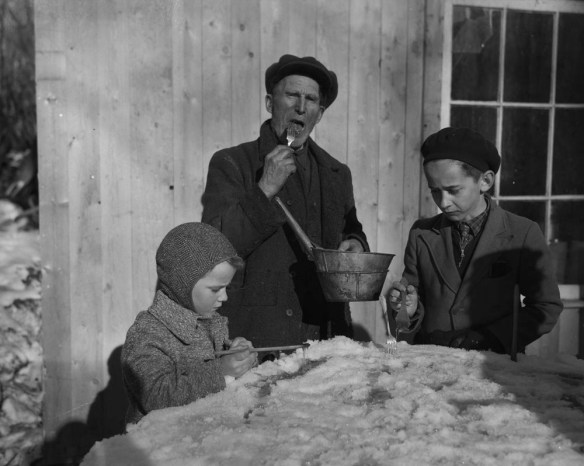
Images of Sugar Shacks now on Flickr

A black-and-white photograph showing three people eating maple taffy on snow.

People tasting maple taffy at a sugar bush.

The collection of maple sap and the production of maple products has evolved from the early practices of First Nations communities, such as the Ojibwa and Iroquois. The bark of a maple tree is pierced, the sweet sap is collected, and then the excess water is boiled off leaving a syrup. The syrup can be used as a sweetener or cooking additive. Neighbouring First Nations communities most likely taught French colonists how to process maple sap. The maple industry has evolved technologically over the years, but its core process of tapping trees and collecting sap has remained basically the same. Today, Quebec provides a majority of the maple syrup products on the global market. Numerous sugar shacks new and old fuel the world’s desire for this tasty treat.

Centre Block: Rising from the Ashes

On February 3, 1916 at 8:37 p.m., the alarm was raised on Parliament Hill that a fire had broken out in the Centre Block. By the next morning, the building had been reduced to a smoking ruin, encrusted in ice. The exact cause of the fire was never determined.

Images for Women’s Suffrage Now on Flickr

Women won the vote in small incremental steps, with the western provinces leading the way. However, it was not until the 1960s that the majority of women in Canada gained the right to vote. Women’s suffrage was a powerful and early expression of women’s rights in Canada.

New Flickr set: Curling in Canada

Curling could be considered the unofficial national sport of Canada. Explore the evolution of the game of Curling; its development as an organized sport; and the creation of a Canadian curling culture.