The Mountain Legacy Project images now on Flickr
1

At the beginning of the 20th century the Canadian government, led by Sir Robert Borden, wanted to strengthen Canada’s sovereignty in the Arctic, in response to the presence of the United States and Russia in the North. The Canadian Arctic Expedition was established by Order-in-Council 406, dated February 22, 1913, under the responsibility of the Ministry of Naval Services and other government bodies.
The expedition was comprised of two groups, each with its own objective: the Northern Party, led by Vilhjalmur Stefansson, was responsible for geographic exploration of the Arctic to ensure Canadian sovereignty in the western part, while the Southern Party, led by Dr. Rudolph M. Anderson, focused on scientific discovery.
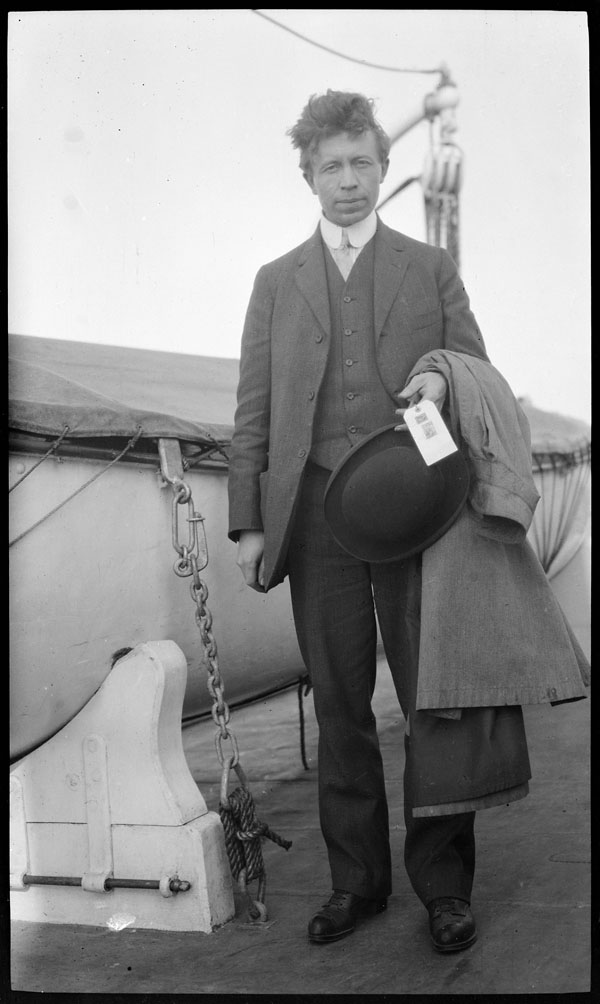
V. Stefansson on board the Karluk. Source

Rudolph Martin Anderson. Source
An expedition fraught with challenge
On June 17, 1913, the expedition set sail from Esquimalt Harbour in British Columbia aboard the Karluk headed for Herschel Island in the Beaufort Sea. In August, the ship became trapped in ice and drifted for over four months, eventually sinking in Siberia. The ship’s captain, Robert Bartlett, describes the final days of the voyage in his book Northward ho! The last voyage of the Karluk. Stefansson’s decision to leave the ship on September 19, 1913, to continue his exploration occurred in a climate of crisis. Stefansson’s departure remains a source of controversy and debate among historians.

The Karluk sails near Esquimalt Harbour. Source
To find out more
The following are some of the archival documents and government reports that constitute the information resources related to this expedition.
For consultation on-site at Library and Archives Canada:
Available online from Library and Archives Canada:
Other sources:
Please note that the majority of the documents are available in English only.
For more information, be sure to visit the virtual exhibition at the Canadian Museum of Civilization: Northern People, Northern Knowledge: The story of the Canadian Arctic Expedition 1913-1918.
Visit our Flickr album for more photographs.
On May 19, 1845, HMS Erebus and HMS Terror left England under the command of Sir John Franklin in search of the Northwest Passage. This expedition was without a doubt a most ill-fated venture, as not a single member returned alive.

An iceberg, HMS Terror and some walruses near the entrance of Hudson Strait
Library and Archives Canada, Acc. No. 1979-49-1. Source
Major search efforts were launched to find the missing men, including three expeditions to the Arctic in spring 1848. Rewards were also offered in 1849 and 1850 for any information about Franklin’s expedition. These searches did produce results: in 1850, the first relics—the graves of three crewmen who died in 1846—were found at Beechey Island, west of Devon Island.
In July 1857, Lady Franklin also financed an expedition under the command of Francis McClintock aboard the ship Fox. On May 5, 1859, William Hobson, Lieutenant of the Fox, found a document placed beneath a cairn containing two messages. The first, written by Franklin on May 28, 1847, indicated that the crew of the two ships had spent the winter of 1845–46 off Beechey Island, and that all was well. The second message, dated April 25, 1848, indicated that the Erebus and Terror had been trapped in ice since September 1846, west of King William Island, and that 24 men had died, including Franklin on June 11, 1847.
In the wake of expeditions undertaken to find Franklin, numerous maps were drawn, including the Discoveries in the Arctic Sea, 1616-1927 and the Chart showing the vicinity of King William Island. These identified the sites Franklin visited, the places where his group wintered and the site in which his ships were abandoned. The second map also mentions the diverted courses the two wrecks may have followed.
Although we now know the fate of the members of this expedition, every attempt to find the wrecks of the Erebus and the Terror has been unsuccessful, despite the magnitude of the searches and modern technologies deployed.
For more information about the period prior to the expeditions:
For more information about the periods prior to and following the expeditions:
For more information about the period following the expeditions:
Publications, bibliographies and guides held at Library and Archives Canada:
Please visit our Flickr album for more photographs.

Newfoundland in the summer, completely inaccessible because of its winged garrison. Library and Archives Canada. (Source)
Did you know that thanks to the collection of Library and Archives Canada (LAC) it is possible to patrol the French Shore of the island of Newfoundland with Lieutenant Louis Koenig and discover this particular area where the French had cod fishing rights for almost 200 years, because of two treaties signed between France and England? Accompany Koenig and the crew of the French frigate La Clorinde during a campaign that brought them to Newfoundland, Cape Breton Island and Saint-Pierre and Miquelon in 1885.
Recognized by the French Navy for his artistic talents, Koenig created the 145 drawings and watercolours, the hand-drawn maps and the logbook, which are found in the Louis Koenig fonds and Louis Koenig Collection. The illustrations, most of which were done on site, show the landscapes and military installations he observed, as well as daily activities on board La Clorinde. The maps give three views of the French Shore and include notes by the artist.The logbook, also written by Koenig, documents the voyage, the places visited and gives his candid impressions of his experiences; devoting particular attention to the mosquitoes, which were apparently delighted to welcome the French sailors! The collection also includes a small sketchbook containing an illustrated, much more personal, account of the voyage, full of humour and whimsy presented by Koenig as a gift to La Clorinde’s commander, Félix-Auguste Le Clerc. Koenig also wrote an article Le « French Shore » (souvenirs de campagne à Terre-Neuve) (The “French Shore”, Memoirs of a Newfoundland Campaign), embellished with his maps and illustrations and published in 1890 in the periodical Tour du monde.
To order published documents that are unavailable online, use our online Request for Retrieval of Documents, or call 613-996-5115, or toll-free 1-866-578-7777, to consult them in person at 395 Wellington Street in Ottawa.
Enjoy the discoveries and view the Flickr set of images from Koenig’s albums!
Questions or comments? We would love to hear from you!
 Library and Archives Canada Blog
