Library and Archives Canada releases ninth podcast episode

Library and Archives Canada (LAC) is releasing its latest podcast episode: Pulp Canada: between the covers. Pulps, with their screaming story titles and attention-grabbing cover art, already began to capture the public interest by the turn of the 20th century.

Professor Carolyn Strange, author of True Crime True North: The Golden Age of Canadian Pulp Magazines, and author Ian Driscoll join us to talk about LAC ’s pulp fiction collection. They discuss the different aspects of the collection and bring to light some of the incredible stories surrounding this literature form.

Subscribe to our podcast episodes using RSS or iTunes, or just tune in at: Podcast – Discover Library and Archives Canada: Your History, Your Documentary Heritage.

For more information, please contact us at podcast@bac-lac.gc.ca.

Library and Archives Canada releases eighth podcast episode

Library and Archives Canada (LAC) is pleased to announce the release of its latest podcast episode: Canada’s Photographic Memory.

In this episode, we explore the evolution of photography using Library and Archives Canada’s extensive photographic collection as our guide. Archivist Jill Delaney takes us through the collection and brings to light some of the incredible stories surrounding these iconic images.

Subscribe to podcast episodes using RSS or iTunes, or just tune in at: Podcast – Discover Library and Archives Canada: Your History, Your Documentary Heritage.

For more information, please contact us at podcasts@bac-lac.gc.ca.

Home Children (Part VI)—Mary Scott Pearson, ancestor of former Ontario Member of Provincial Parliament Jim Brownell

Today’s article features Mary Scott Pearson who was born in Scotland. Mary’s name appears in the Scottish Census of 1881. The entry indicates that she lived in Glasgow with her sister Maggie and their widowed mother, also named Mary. The two sisters became orphans when their mother died in 1888. The next census (1891) indicates that the sisters lived at the Girls Industrial School in Maryhill, in the County of Lanarkshire.

The Pearson sisters were separated in September 1891 when Mary boarded the SS Hibernian en route to Canada as part of a group of 20 young women recruited to work as domestic servants. The young Scottish women’s transportation and accommodations were arranged by Ms. E. Cameron, an Industrial School official.

As in previous articles, you must first consult our main home children online resource. Enter the surname Pearson and the given name Mary into this database and it will generate only one result for Mary Pearson, age 14, whose destination was Saint John, New Brunswick. The Fairknowe foster home, administered by a charitable organization known as Quarriers, was Mary Pearson’s first place of residence in Canada.

Ten years after her arrival, according to the Census of 1901, Mary was living in Prescott, Ontario, with the family of Patrick MacMillen. She married Curtis Brownell five years later, on March 21, 1906, in Cornwall, County of Stormont. The couple’s first son, Earl Kenneth, was born in September of the following year.

Mary Scott Pearson and Curtis Brownell raised their family in Cornwall, where they lived until the time of their deaths; Curtis died in 1931 and Mary died in 1945.

Jim Brownell, son of Earl Kenneth Brownell, honours his grandmother’s arrival in Canada

Her grandson, Jim, elected Member of the Legislative Assembly of Ontario in 2003, travelled to Scotland in 2009 when he visited the city of Glasgow, officially representing the Government of Ontario. The articles that appeared in the Cornwall daily newspaper, the Standard Freeholder, on September 23, 2009 and May 25, 2011, describe the journey of Mary S. Pearson and her sister Maggie, and Mr. Brownell’s work to foster a better understanding of the often little-known home children movement.

In 2011, as Member of Provincial Parliament for Stormont-Dundas-South Glengarry, Jim Brownell tabled Bill 185 in the Legislative Assembly of Ontario to have September 28 proclaimed “British Home Child Day.” The purpose of the bill, which received royal assent on June 1 of that year, was to honour his grandmother and his great-aunt Maggie, as well as the more than 100,000 British home children.

Don’t forget to read the previous articles in this series on home children and listen to our podcast!

Happy hunting and enjoy your discoveries!

Project Naming: The first ten years and beyond

Initiated in 2002, Project Naming is a community engagement and photo identification project that aims to reconnect Inuit with their past by identifying the people and events portrayed in photographs held at Library and Archives Canada (LAC). We have added the names of individuals and descriptions of activities to our database, which you can search online.

Over the last ten years, we have digitized more than 8,000 of those photographs and have received identifications for approximately 1,900 individuals. New information about these pictures is gathered through a variety of methods, including an online form, community slide shows and other social gatherings, weekly features in local newspapers, social media and on-site research visits.

Quite often, identifications come as a result of intergenerational conversations that take place in person or virtually—or both. Such was the case when Nunavut News/North published a photograph of Rhoda Qaqsauq, and her daughters, Lucy Evo and Janet Tagoona, on February 11, 2013; upon discovering this picture, Deborah Kigjugalik Webster shared it on Facebook, thus sparking a lively conversation between her and other family members.

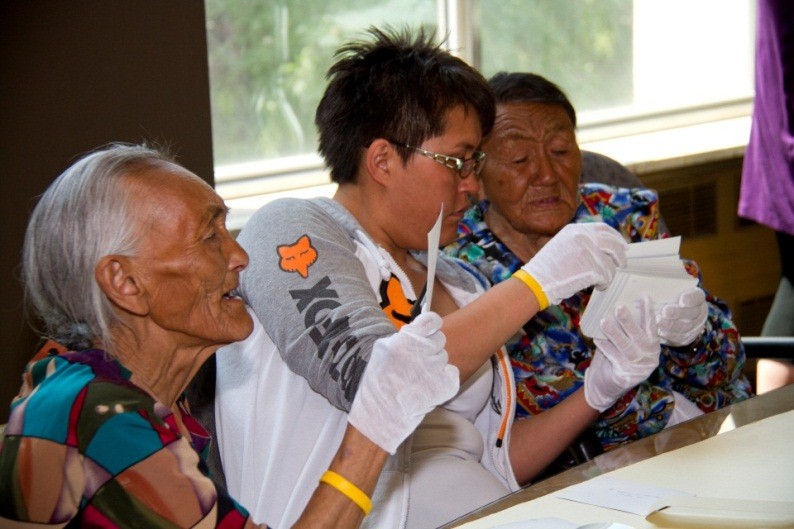
An example of a successful on-site visit occurred in June 2012 when a group of Elders and youth from Arviat, Nunavut, located on the southwest coast of Hudson Bay, made a trip to Ottawa. They looked through hundreds of photographs and negatives taken between the 1920s and the 1970s.

This enabled them to identify 31 family members in 17 images. Louisa Gibbons discovered her mother, Catherine Kopak, and her grandmother, Yarat, in a picture taken in Kingayualik, near Padlei.

Elder Eva Muyunaganiak (left), Louisa Gibbons (centre) and Elder Mary Nowtalik (right).

Elder Eva Muyunaganiak also discovered a photograph of her mother, Uyaupiak, dating from the late 1960s. Today, the remaining 22 Elders in the community of Arviat are the only ones able to recognize people and describe what life was like in photographs taken more than 50 years ago. Elder Muyunaganiak passed away in September 2012; her death reminds us of how time-sensitive an initiative Project Naming is.

Project Naming has now evolved into a broader community engagement initiative that has expanded beyond the territory of Nunavut to other Aboriginal communities in the Yukon, the Northwest Territories, Nunavik (northern Quebec) and Labrador. We hope to build upon this dialogue with members of Northern communities using new technologies and social media.

To learn more, listen to our Project Naming and Canada’s North podcast.

Library and Archives Canada Announces the Opening of Two Exhibitions

Library and Archives Canada continues to display the richness and diversity of its collections with the opening of two exhibitions.

In Saskatchewan, the Mendel Art Gallery in Saskatoon is hosting the I Know You by Heart: Portrait Miniatures exhibition until June 2, 2013. The exhibition highlights the intimate, personal nature of portrait miniatures, and the reasons that such images are commissioned and created. Find out more about the conservation of these portraits on Library and Archives Canada’s YouTube video.

In Quebec, the Canadian Museum of Civilization in Gatineau is presenting the exhibition Double Take: Portraits of Intriguing Canadians until October 14, 2013. Discover portraits of Canadians who have left—and are still leaving—their mark on our country and our culture. Tune in to Library and Archives Canada’s podcast for an overview of the featured works and the stories behind them.

By presenting exhibitions such as these, Library and Archives Canada is able to make original works of documentary heritage accessible in galleries, museums and other community venues to Canadians across the country.

Keep following this blog to stay informed about upcoming events.

Timothy Eaton

There’s no better time than the internationally celebrated St. Patrick’s Day for highlighting the history of Irish Canadians. So let’s take this opportunity to learn about Timothy Eaton, the famous founder of the Eaton’s retail chain. Born in Ballymena, County Antrim, Northern Ireland, Timothy Eaton settled in Canada with his family around 1854. You can find out more about him in various Library and Archives Canada (LAC) resources—here’s how.

The Dictionary of Canadian Biography Online contains an interesting biography of Timothy Eaton, with a number of genealogical details such as the dates of his birth, marriage and death, and the names of his parents.

Unfortunately, since few lists of arrivals prior to 1865 have survived, Timothy Eaton’s name cannot be traced on any passenger lists.

LAC’s various databases—particularly the census databases—are excellent sources of information. For instance, the 1871 census lists Timothy Eaton as a merchant living in Toronto West with his wife Margaret and their three children, Edward, Josina and Margaret. Continue reading

Library and Archives Canada releases seventh podcast episode

Library and Archives Canada (LAC) is pleased to announce the release of its latest podcast episode: Canada’s Royal Winter Game.

Author and hockey expert Paul Kitchen joins us to discuss the origins of the game, its evolution, and what our love for it says about the Canadian character. Mr. Kitchen also speaks to us about the wealth of hockey-related resources held by LAC.

Subscribe to podcast episodes using RSS or iTunes, or just tune in at: Podcast – Discover Library and Archives Canada: Your History, Your Documentary Heritage.

For more information, please contact us at podcasts@bac-lac.gc.ca.

Home Children (Part V)—The Honourable James Murdock

Today’s article is about the Honourable James Murdock, a labour minister in Mackenzie King’s cabinet who was appointed senator in 1930. He arrived in Canada through the home children movement.

Since James Murdock was a Member of Parliament, the logical place to start your research is his biography on the Parliament of Canada website. There we find out that he was born in Brighton, England, on August 15, 1871. Additionally, an article in The Ottawa Citizen announcing the death of his wife Annette Follis in 1965 also states that James and Annette married in 1903.

As explained in previous articles, you must first consult our main home children online resource. Enter the surname Murdock and the first name James into this database and it will generate three results, including two for James Murdock, age six, who arrived in 1876 under the auspices of Annie Macpherson’s organization. Unfortunately, it is impossible to know which of the two references relates to the James Murdock we are looking for.

Other Library and Archives Canada sources also provide information about James Murdock and his family. The 1911 Census indicates that James Murdock and his wife Nettie (short for Annette) lived in Toronto South―the same district where Murdock would run for election in 1921―with their two children Basil and Elena, as well as a servant named Ada Hennings.

You can also find further references to James Murdock in other published sources, such as city directories and newspapers.

It is possible to learn more about the British origins of James Murdock or another home child by contacting the organization responsible for the child in question. In this case, it was an agency managed by Annie Macpherson, which was taken over by Dr. Barnardo’s organization in 1924 (Barnardo’s Family History Service).

Finally, don’t forget to read the previous articles in this series: Introduction, Part II on Edward Brignall, Part III on Harold Mornington and Part IV on Wallace Ford.

Happy hunting!

Questions or comments? We would love to hear from you!

Library and Archives Canada releases sixth podcast episode

Library and Archives Canada (LAC) is pleased to announce the release of its latest podcast episode: Home Children.

LAC Project Manager and Genealogist Marthe Séguin-Muntz along with John Sayers of the British Isles Family History Society of Greater Ottawa, join us to talk about the lives of Canada’s Home Children. They will discuss some of the incredible stories of hardship and prosperity in early Canada, share a wealth of resources available at LAC and provide helpful research tips and tools to discover your family history.

Subscribe to podcast episodes using RSS or iTunes, or just tune in at: Podcast – Discover Library and Archives Canada: Your History, Your Documentary Heritage

For more information, please contact us at podcast@bac-lac.gc.ca.

New Podcast Episode: Faces of 1812

We are pleased to announce the release of our latest podcast episode: Faces of 1812.

Listen Now!

 For more information on recent announcements at LAC, visit ” News.