Do you have Doukhobor ancestors?

Do you want to know who your first Doukhobor ancestor was and when he or she arrived in Canada? Are you curious about your Doukhobor origins?

If so, our website is a great place to begin your research. Here you will find a page dedicated to genealogical research on the Doukhobors. This page provides you with historical information, archival documents and published material from the Library and Archives Canada collection, as well as links to other websites and institutions.

If your ancestor came to Canada between 1865 and 1935, you might find his or her name on the passenger lists.

Searching for the Service Files of Soldiers of the First World War

Database

You can find references to the service files of soldiers who served in the Canadian Expeditionary Force in our database Soldiers of the First World War: 1914–1918.

However, it is sometimes difficult to find a soldier for several reasons:

  • His given name or surname may be written in a variety of ways
    The information in the indexes is what was written in the archival records, which were often written by hand. There may also be an error in the database. The database search engine may find words with the same root. For example, “Worth*” will lead to a search for “Worth”, “Worthing” and “Worthington.”
  • Several soldiers had the same name
    To identify your soldier, you need to check the attestation papers (enlistment forms) because they contain personal information about him.
  • He gave an incorrect date of birth
    To be able to enlist in the army during the First World War, a recruit had to be between the ages of 18 and 45.

Continue reading

Launch of “Ukrainian Immigrants, 1891–1930” Database

Library and Archives Canada (LAC) is pleased to announce the launch of a new online database, Ukrainian Immigrants, 1891–1930.

This online database allows you to access more than 14,700 references to names of Ukrainians who arrived in Canada and the United States between 1891 and 1930. Names were taken from passenger lists held at LAC for the following Canadian and American ports:

  • Halifax, Nova Scotia
  • Montréal and Québec, Quebec
  • Saint John, New Brunswick
  • New York, New York
  • Portland, Maine

Names were also taken from notes about early Ukrainian settlers and pioneer families in Canada gathered by Dr. Vladimir Julian Kaye (1896–1976).

Start searching immigrants from Ukraine now!

Did your ancestors come from East India?

Do you want to know who your first East Indian ancestor was and when he or she left East India and arrived in Canada? Are you curious about your East Indian origins?

If so, our website is a great place to begin your research. Here you will find a page dedicated to genealogical research on the East Indians. This page provides you with historical information, archival documents and published material from the Library and Archives Canada collection, as well as links to other websites and institutions.

If your ancestor came to Canada between 1865 and 1935, you might find his or her name on the passenger lists.

Images of Georges Philéas Vanier now on Flickr

Born in Montréal on April 23, 1888, Georges Vanier would feel the influence of his bilingual parents throughout his life. After graduating from high school, he attended Loyola College and then the Université Laval where he received a law degree in 1911. He started practicing law thereafter, although priesthood was also on his mind. It was the outbreak of the First World War however, that eventually grabbed his attention and he enlisted in the Canadian Army. He was a strong recruiter and played an important role in the creation of the French-Canadian 22nd Battalion. It was also during the war that he was injured and had to have his right leg amputated.

Born to Serve: Georges P. Vanier

Born in Montréal on April 23, 1888, Georges Vanier would feel the influence of his bilingual parents throughout his life. After graduating from high school, he attended Loyola College and then the Université Laval where he received a law degree in 1911. He started practicing law thereafter, although priesthood was also on his mind. It was the outbreak of the First World War however, that eventually grabbed his attention and he enlisted in the Canadian Army. He was a strong recruiter and played an important role in the creation of the French-Canadian 22nd Battalion. It was also during the war that he was injured and had to have his right leg amputated.

A black-and-white photograph showing a man smiling broadly in an officer’s uniform with cap.

Major Georges P. Vanier of the 22nd Battalion, June 1918 (MIKAN 3192070)

Continue reading

Multiple Contexts: Library and Archives Canada at the Canadian Museum of Immigration at Pier 21

Five pieces from the rich collection of Library and Archives Canada (LAC) are currently part of the new exhibition space at The Canadian Museum of Immigration at Pier 21 in Halifax, Nova Scotia. These objects including a commemorative medal, stamps, a map, and a land treaty will help illustrate the complex experience of immigration that continues to shape Canada’s past and present.

Attestation papers—informative documents from Canada’s history

One of the items from the Library and Archives collection included in the exhibition at Pier 21 is a document known as an attestation paper. An attestation paper was a form that recruits filled in and signed to show their willingness to serve overseas in the Canadian Expeditionary Force (CEF) in the First World War. Library and Archives Canada currently holds 620,000 attestation papers, all of which are digitized and available online.

A black-and-white image of a typed form describing Joseph Wilder’s personal and physical information. It is signed by him and witnessed by a medical officer.

Joseph Wilder’s attestation paper (MIKAN 46114, Box 10355-39, 312833)

The details these papers provide allow us to learn a lot about individual soldiers. For example, each form provides details about their physical appearance such as height, eye colour, and chest measurements. Recruits also had to state their “trade or calling” (job), place of birth, next of kin and present address, among other information. When trying to learn about individuals from the past who did not leave a lot (or any!) documentation behind, attestation papers can be incredibly helpful in piecing together histories.

Joseph Wilder—Medical Sergeant and pharmacist

The attestation paper included in the exhibition at Pier 21 belonged to a man named Joseph Wilder. From this document, we learn that he lived at 140 Alfred Avenue in Winnipeg, Manitoba, was born in Romania, and made his living as a druggist (pharmacist). The information about Joseph Wilder that can be found on his attestation paper is valuable to a number of interest groups such as his later descendants, members of Winnipeg’s local community, and Canada’s national history. It also complements the information available about Wilder in his two books Read All About It: Reminiscences of an Immigrant Newsboy and Lotions, Potions and Liniments Pure: A Look at the Drug Trade in Winnipeg in the 1900’s.

You can find out more information about the Soldiers of the First World War database and the large-scale digitization initiative to make these documents available online.

Launch of “Immigrants to Canada, Porters and Domestics, 1899–1949” Database

Library and Archives Canada is pleased to announce the launch of a new online database, Immigrants to Canada, Porters and Domestics, 1899–1949.

This online database allows you to access more than 8,600 references to individuals who came to Canada as porters or domestics between 1899 and 1949. Names were taken from lists contained in the Central Registry Files series of the Immigration Branch (RG76 BIA) and other files held at LAC.

Start searching porters and domestics now!

Naturalization Records, 1915-1951 database – 2015 Update

Library and Archives Canada is pleased to announce the release of a new version of the online database Naturalization Records, 1915-1951. The nominal index has been extended with the addition of more than 68,000 names and now covers the years from 1915 to 1944, inclusively. Work is ongoing to extend the nominal index to 1951, and volunteers are welcome to help. Those interested should write to Cdn-Nat-Coord@jgs-montreal.org.

This database is one of the few Canadian genealogical resources specifically designed to benefit researchers having roots other than British. The reference numbers indicated in the database can be used to request copies of the original naturalization records, which are held by Citizenship and Immigration Canada.

Library and Archives Canada would like to thank the Jewish Genealogical Society of Montreal and its volunteers, without whom this project would not have happened.

The Parliament Hill Precinct

The Parliament Buildings in Ottawa are some of the most recognizable structures in Canada. Although the Peace Tower may be the most iconic part of the exterior of the buildings, it’s the newest addition to the precinct. Originally built between 1859 and 1866 in the Victorian High Gothic Revival style, Centre Block officially opened on June 6, 1866 as Parliament for the Provinces of Canada. The location was chosen by Queen Victoria in 1857 and was the biggest construction project of its time in North America, running way over budget, in part due to the cost of blasting out the bedrock to build the foundation. On July 1, 1867, Centre Block was chosen to be the official Parliament for the Dominion of Canada. Its location was considered ideal for many reasons, namely its distance from the American border, as well as its visibility to those who lived in the area.

A black-and-white photograph of the original Centre Block on Parliament Hill.

Parliament Buildings, Centre Block, by Captain Jacobs, c. 1886 (MIKAN 3319558)

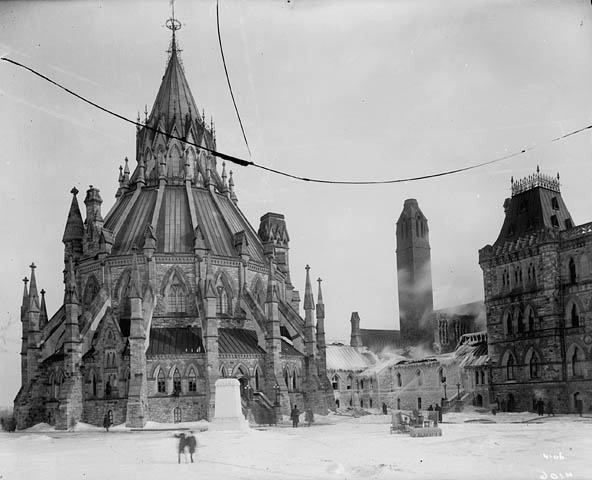
Centre Block stood on Parliament Hill for 50 years until the evening of February 3, 1916 when a fire broke out in the House of Commons’ reading room. The flames spread quickly and seven lives were lost that night. While many of the stone walls remained standing, the only part of the building to truly survive was the library, which was built in 1876 with iron doors (which were closed by a clerk before leaving that evening). Although rumours claimed arson was the cause, the fire was a result of a discarded cigar.
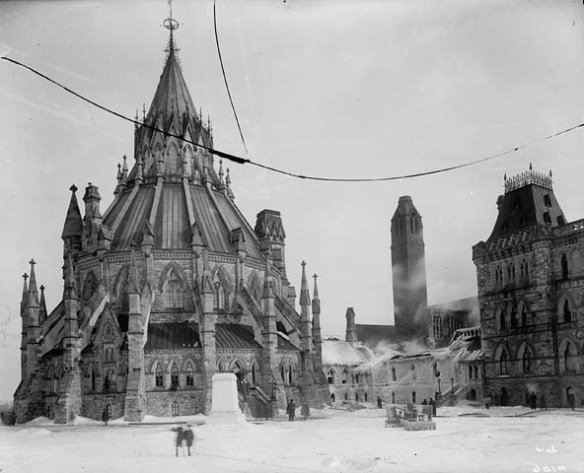
A black-and-white photograph showing a very elaborate round building with pinnacles and flying buttresses in a wintry setting next to a building partly encased in ice. Firemen are putting out a fire.

View of the Library of Parliament and Centre Block on the day after the Centre Block fire, taken by William Topley in 1916 (MIKAN 3194673)

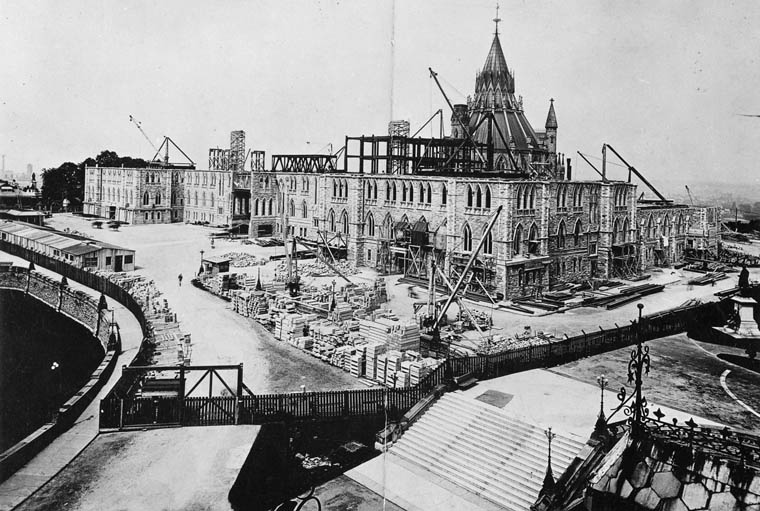
Despite Canada being heavily involved in the First World War at the time, it was clear that the buildings had to be rebuilt. With the country expanding, it was decided that the Parliament Buildings would follow suit. The plan was to keep the same Gothic Revival style as the original buildings without creating carbon copies of them. Construction started later that year and was completed in 1922. The Peace Tower, named in commemoration of Canada’s commitment to peace, was completed in 1927.
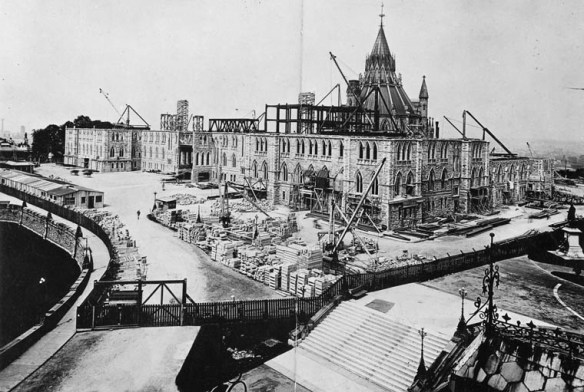
A black-and-white photograph showing the first three stories of a building with the rotunda of the Library of Parliament in the background. Cranes and construction materials surround the area.

Rebuilding of the Centre Block, Parliament Buildings, c. 1917-1918. Photo taken by Samuel J. Jarvis (MIKAN 3319865)

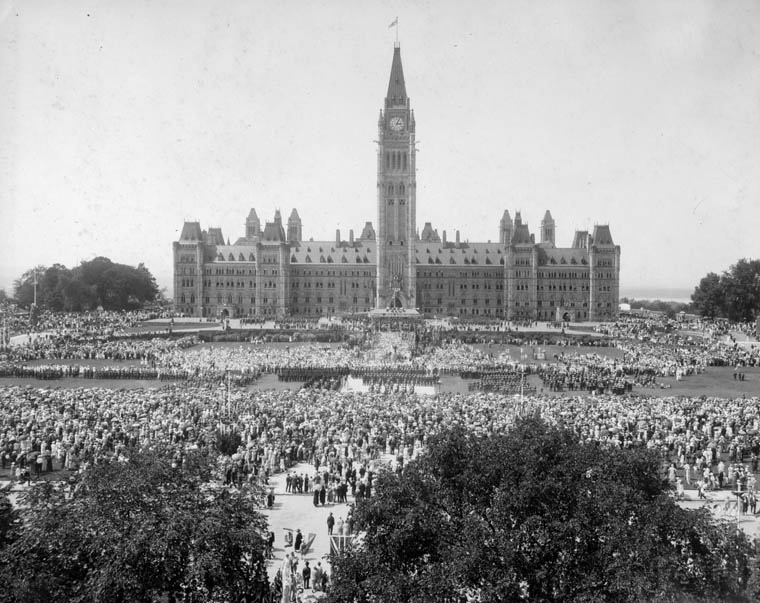
A black-and-white photograph showing the main Parliament building from the front with crowds of people filling Parliament Hill.

Jubilee celebrations on Parliament Hill in 1927 (MIKAN 3549627)

Today, Centre Block is bordered by the East and West Blocks and by a large public open space that serves many purposes—it’s a celebration area on Canada Day, a place for demonstrations and protests, a spot for noontime yoga in the summer, etc. Tours of Centre Block are given throughout the year and it’s become one of Ottawa’s most popular attractions.

Other resources