The Life of Private Marcel Gauthier (Part 1)

Version française

By Ariane Gauthier

I learned about Marcel Gauthier a few years ago when I was visiting the Canadian cemetery in Beny-sur-Mer in France. Although we have the same last name, Marcel is not my ancestor. However, I have always kept a memory of this young man—the only Gauthier buried in this large cemetery. With the release of the 1931 census, I finally had the opportunity to learn more about him. Now, I would like to demonstrate how the many resources of Library and Archives Canada (LAC) can help piece together the life of a person, such as an ancestor or a soldier!

This first part of the blog will cover Marcel Gauthier’s life from his childhood to his military enlistment.

A black and white picture of a young man in his military uniform.

Photograph of Private Marcel Gauthier, age 21, published in an Ottawa newspaper to announce his death overseas (Canadian Virtual War Memorial).

Private Marcel Gauthier (Joseph Jean Marcel Gauthier)

  • C/102428
  • Le Régiment de la Chaudière, R.C.I.C.
  • Date of birth: November 18, 1922
  • Date of death: July 15, 1944
  • Age at time of death: 21 years old

His military service file is available in LAC’s War Dead database, 1939 to 1947.

Born on November 18, 1922, in Ottawa, Ontario, Marcel Gauthier is the seventh child of a large French-Canadian family of nine. When we look at the Gauthiers in the censuses, we learn that Henri, the father of the family, is from Rigaud, Quebec. When he arrived in Ottawa, he settled in Lowertown with his family. This is where Marcel built his life before enlisting.

At that time, Ottawa’s Lowertown attracted many Franco-Ontarians. The 1931 Census shows that the homes and dwellings of the By Ward – St. George’s Ward sub-district were largely inhabited by French Canadians. Some of them were born in Ontario, others came from Quebec. Several historical studies indicate that the population of Lowertown was mainly Francophone, with a significant Irish population as well. This is one of the reasons why this area has been the site of many language issues in the history of Franco-Ontarians, particularly on the issue of Regulation 17 (available in French only), adopted in 1912. Additional resource: https://www.thecanadianencyclopedia.ca/en/article/ontario-schools-question.

Screenshot of the 1931 Census, with an arrow indicating where Marcel Gauthier’s information is found.

Screenshot of the 1931 Census. Marcel Gauthier’s name is found on the 48th line of the By Ward – St. George’s Ward sub-district, No. 74 (Lowertown), on the 7th page of the document (record 8 of 13). He was nine years old at the time (MIKAN 81022015).

Lowertown was considered a disadvantaged neighborhood with a predominantly working-class population. We can therefore assume that Marcel was not born into wealth. His large family lived in close quarters, first at 199 Cumberland Street, with at least seven children (1921 Census), then at 108 Clarence Street, with nine children (1931 Census).

The absence of his mother, Rose Blanche Gauthier (née Tassé), from the 1931 Census indicates that she had probably died by this time. We can assume, by referring to the 8th page of the document (or record 9 of 13), that she died between 1928 and 1931. This theory is based on the registration of the youngest family member, Serge Gauthier, three years old at the time. Marcel’s military record validates this theory and confirms Mrs. Gauthier’s death on October 6, 1928, possibly due to complications arising from the birth of her last child. She is buried in the Notre-Dame Cemetery in Carleton Place, Ontario, where she was born.

In 1931, Marcel’s father and eight of his children lived in a nine-bedroom apartment at 108 ½ Clarence Street. If it had not been for the help of the older children, Henri’s mail carrier salary would not have been sufficient to support his children and cover their tuition. We can therefore assume that Yvette (24 years old and single), the oldest in the household, looked after the home and the younger siblings. We also know that Léopold (22 years old) worked as a driver and that Marie-Anne (21 years old) was a salesperson. It is very likely that they were helping their father financially, just as their older sister, Oraïda (27 years old), had more than likely done ten years earlier. She had now moved out and married a Mr. Homier.

In 1931, Marcel became a student and learned to read, write and communicate in English. At 16, he completed his education. He entered the workforce as a cook and then moved alone to 428 Rideau Street.

Photograph of a two-storey building. Bowles Lunch restaurant is located on the first floor.

Bowles Lunch restaurant where Marcel Gauthier worked before enlisting in the army in 1943 (a042942).

In Europe, tensions with Hitler’s Germany escalated and led to the outbreak of World War II in 1939. Unlike many young men, Marcel did not immediately feel the need to join the fight, likely because he was satisfied with his job as a cook at Bowles Lunch. He waited until January 11, 1943, before reporting to Enlistment Office No. 3 in Ottawa. We can theorize that, like many, he wanted to help change the course of the war or that he wanted to follow the example of two of his brothers, Conrad and Georges Étienne.

Shortly after, on January 29, 1943, he left Ottawa to begin training in Cornwall, unaware that he was leaving his hometown forever.

Additional resources


Ariane Gauthier is a reference archivist in the Access and Services Branch at Library and Archives Canada.

Finding Royalton: Searching the 1921 Census

By Julia McIntosh

For those of you wanting to learn more about searching the Census of Canada, this blog will give you some helpful tips and techniques to use in your own research.

Background

In my work at the reference desk, I received a question about the population data for Royalton, New Brunswick, specifically the number of males between the two World Wars, as the query related to recruitment. “A piece of cake,” I thought, “How difficult can it be?” As a librarian, I tend to head to the first appropriate published document. To my surprise, Royalton was too small to have been mentioned in any of the standard print sources, which focus on larger towns and cities rather than on small rural hamlets or unincorporated villages. It was time to rethink my search strategy.

Two censuses took place between the wars: 1921 and 1931. The former was preferred because it was already digitized and my client would be able to access the documents online (see the 1921 Census).

The Issues

The first issue was to find the exact location of Royalton, according to the census districts and sub-districts. For this, I had to find a contemporary map and compare it with the 1921 Census Districts and Sub-districts: New Brunswick. I also had to determine in which county and parish Royalton was situated and then determine the correct sub-district by the written description provided. Sadly, Internet map sites tend not to provide the county detail required, nor do they provide easy access to maps of the era. However, the Provincial Archives of New Brunswick did just that. Their website told me that Royalton was “Located E of the New Brunswick and Maine border, 3.16 km SW of Knoxford: Wicklow Parish, Carleton County.”

Back to the census districts and sub-districts, I searched for Carleton, assuming that the district would be related to the county name. As we all know, assumptions can be problematic! The district was not under “C,” but “V”—District 48 – Victoria and Carleton. Who knew?

My trials and tribulations were not over, however. Complicating things, there were three sub-districts in Wicklow Parish, with nary a mention of Royalton:

  • Sub-district 11 Wicklow (Parish)
    “For all that portion of the Parish of Wicklow, north and east of the following described line: Beginning at the River Saint John at the Hugh Tweedie farm; thence west along the road known as the ‘Carr Road’ to the Greenfield Road, thence north along said Greenfield Road to the Summerfield Road; thence west along said Summerfield Road to the Knoxford Road, and thence northerly along said Knoxford Road and a prolongation of the same northerly to the line between Carleton and Victoria and to include all those who border on said roads.
  • Sub-district 12 Wicklow (Parish)
    “For all that part of the Parish of Wicklow, south and east of the following line, beginning at the River Saint John at Hugh Tweedie’s farm, thence west along the road known as the ‘Carr Road’to the Greenfield Road, south along said Greenfield Road to the south line of the Parish of Wicklow, and to include those bordering on said Greenfield Road, south of said ‘Carr Road.’”
  • Sub-district 13 Wicklow (Parish)
    “Beginning at a point where the Knoxford Road crosses the county line between Carleton and Victoria, thence running west along said county line until it reaches the American boundary line, thence south along said boundary line until it reaches the Parish of Wilmot, thence east along said Parish line until it reaches the Greenfield Road, thence north along the Greenfield Road until it reaches the Summerfield Road, leading from Summerfield to Knoxford Road, thence following the Summerfield Road west, until it reaches the Knoxford Road; thence north along the Knoxford Road to place of beginning.”

What map to use? As time was of the essence, I didn’t have the luxury of waiting for a 1921 Census map to be called up for me, so I checked our digitized map collection. The most current available was a Population map from the 1891 Census. At that time, Royalton was found in the Electoral District of Carleton. Hoping that not much had changed in 30 years, I compared the map with the written descriptions and deduced that Royalton was in Sub-district 13 – Wicklow (Parish). Worried that a map from 1895 might be too old, a subsequent check of the Electoral Atlas of the Dominion of Canada, 1915 confirmed the Electoral District of Victoria and Carleton, but surprisingly, Royalton was missing. At least the county hadn’t changed its boundaries in the intervening years!

A black-and-white map of the Electoral District of Carleton, New Brunswick, with boundaries indicated in a thick red line.

Map of the Electoral District of Carleton (N.B.) taken from the Electoral Atlas of the Dominion of Canada (1895) database. Original source is the Electoral atlas of the Dominion of Canada: according to the Redistribution Act of 1914 and the Amending Act of 1915 (OCLC 1004062506)

The second issue, the identification of those enumerated as living in the village of Royalton, should have been straightforward, but it quickly became evident that this also was going to be complicated. I went to the printed Volume I – Population of the Sixth Census of Canada, 1921, and found Table 8 – Population by Districts and Sub-districts. Under Victoria and Carleton, then Carleton County, I found Wicklow – population 1,689. However, there was no entry for Royalton under the heading Towns, nor was there a breakdown by sex. However, Table 16 – Population…classified by sex gave me the breakdown for Wicklow – 900 males and 789 females. This was definitely getting closer, but remember, Wicklow Parish has three sub-districts, of which no. 13 includes Royalton. I needed to get as close to the census numbers for the village as possible.

Results

My only option at this point was to consult the raw data collected for the census, which meant going to the digitized version of the 1921 Census on our website. A search by keywords Royalton and Province: New Brunswick gave zero results. However, Wicklow and Province: New Brunswick gave 1,600, which more or less tallied with the totals I had already found for the parish. The prospect of going through all those entries was daunting, to say the least.

Luckily, after opening a few pages and skipping around the document, I found a Title page for the enumerations of District 48, Sub-district 13, Wicklow Parish, pages 1-14. Success!

A handwritten title page in black ink, which reads: 1921, N.B. Dist. 48 Carleton, Sub. Dist. 13, Wicklow Parish. Pages 1–14.

Title page for the enumerations of Sub-district 13 – Wicklow Parish, District 48 – Carleton, New Brunswick, 1921 Census.

I still had the dilemma of the breakdown by sex, however. Even though the numbers would be smaller than for all of Wicklow Parish, it would still involve a fair amount of counting. Fortunately, the enumerator had tallied the numbers on the last page of the section for Sub-district 13, Wicklow:

Males – 340; Females – 316

Still hoping for the specific numbers for Royalton, I saw that column 5 on the form was titled “Municipality.” So, with happy expectations, I set out to do the smaller count.

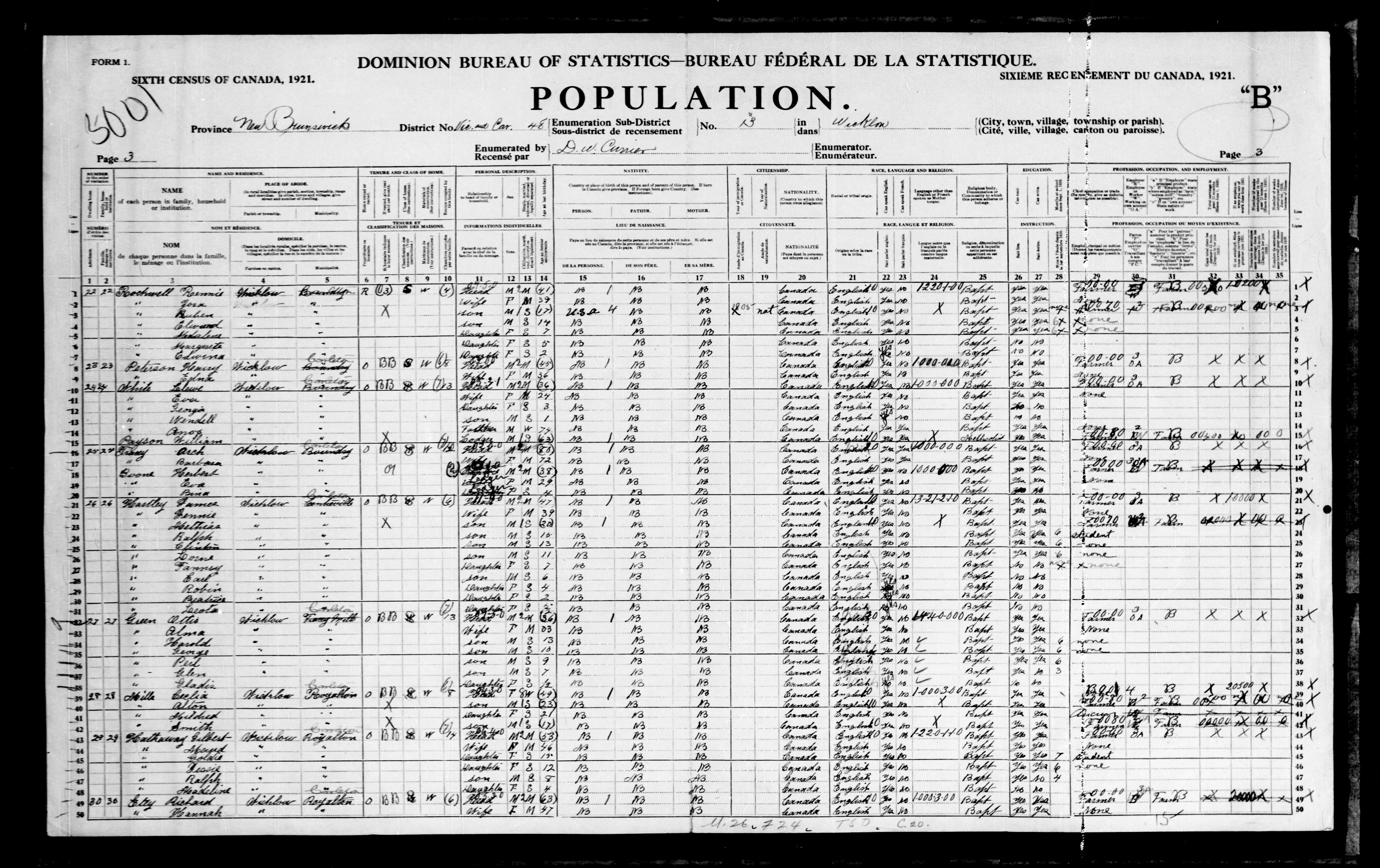
Remember those trials and tribulations that dogged me previously? They hadn’t disappeared in my search for the specific Royalton population count. Royalton first appears on page 3, line 39 for Sub-district 13. The enumerator starts by indicating Royalton by name in the municipality column, but then crosses these entries out and replaces the name with Carleton, which, as we all know, is the county! Subsequently, and consistently, the enumerator enters Carleton as the municipality by page 4.

First page of Census of Canada, 1921 document showing the enumeration entries for Royalton.

Census of Canada, 1921, Province of New Brunswick, District no. 48, Sub-district no. 13. See column 5, Municipality for Royalton.

At this point, I conceded that I wasn’t going to find the number of males in Royalton and passed along the information to my client, who may have been able to further tease apart the specific information by family name.

For more information on searching the 1921 Census, have a look at the section entitled Issues about this census and the database. There are some very helpful tips about navigating from image to image.

Happy searching to all who may be on a quest to find their own Royalton!


Julia McIntosh is a Reference Librarian in the Reference Services Division at Library and Archives Canada.