
By Rebecca Murray
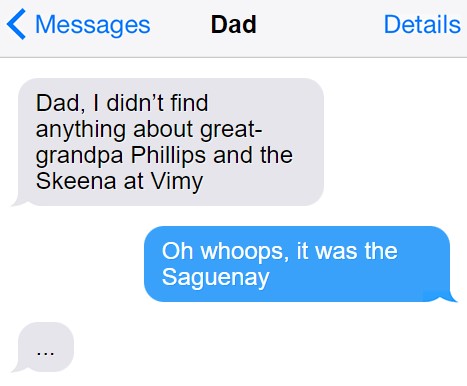
Text messages between the author and her father. Image courtesy of the author, Rebecca Murray.
Has this ever happened to you? You started your primary research with abandon and came up empty, only to discover that the facts you were using were incorrect. This can be extremely frustrating. You might feel like you have wasted your time and energy. And yet, this happens more often than you might think, even to seasoned researchers.
Happily, history is not going anywhere, so we can take a second kick at the proverbial can. Come along and see what we find this time!
Do you remember my previous blog about trying to trace my great-grandfather’s attendance at the unveiling of the Vimy Memorial in July 1936?
We knew that Thomas Caleb Phillips went to France alongside a Canadian naval band. We thought it was the band associated with the HMCS Skeena, but in fact, it was the HMCS Saguenay.
What a difference this one word, this one piece of information, makes in the search!
To confirm, with archival records, that the HMCS Saguenay was even in the vicinity of Arras, France, in the summer of 1936, I consulted RG24 volume 7812 file “Ship’s log – SAGUENAY – Old,” 1935/07 – 1937/09.
Look at what I found in the log for July 1936: the first image shows that a group from the ship visited the memorial the day before the unveiling.
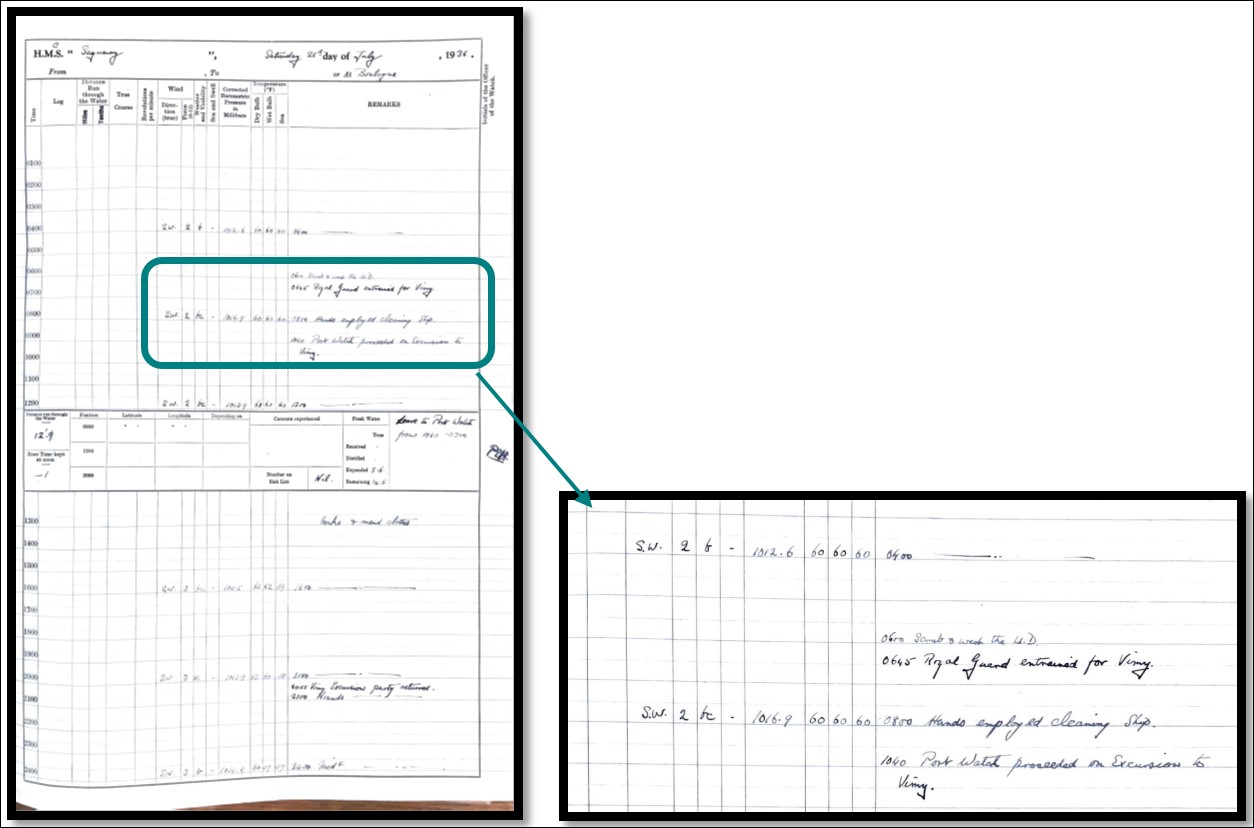
Ship’s log, HMCS SAGUENAY, July 25, 1936 (MIKAN 1084556). Image courtesy of the author, Rebecca Murray.
The next day’s information is even better, providing further details about the memorial from the perspective of the crew’s movements.
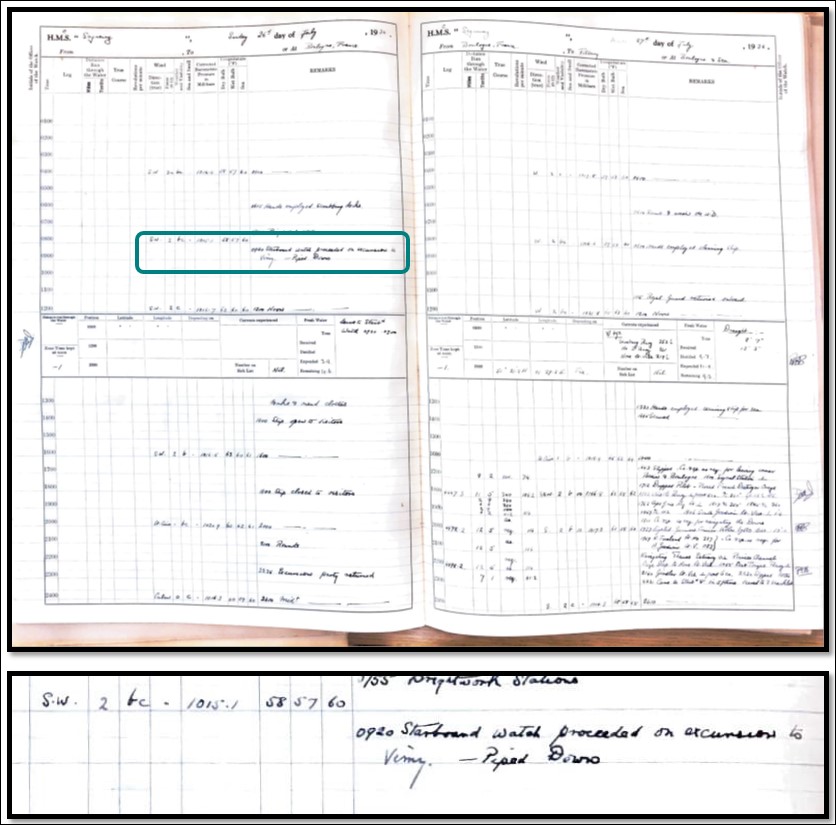
Ship’s log, HMCS SAGUENAY, July 26, 1936 (MIKAN 1084556). Image courtesy of the author, Rebecca Murray.
For me, reading these entries was one of those exciting moments where you are in a very quiet room surrounded by other researchers and staff doing important work, and you just want to jump up and down and squeal with delight at what you have found! Then I turned the page, because you never know what is waiting around the corner, and lo and behold, what did I find? A truly unexpected mention of my great-grandfather, the very man I was looking for, in the handwritten logbook.
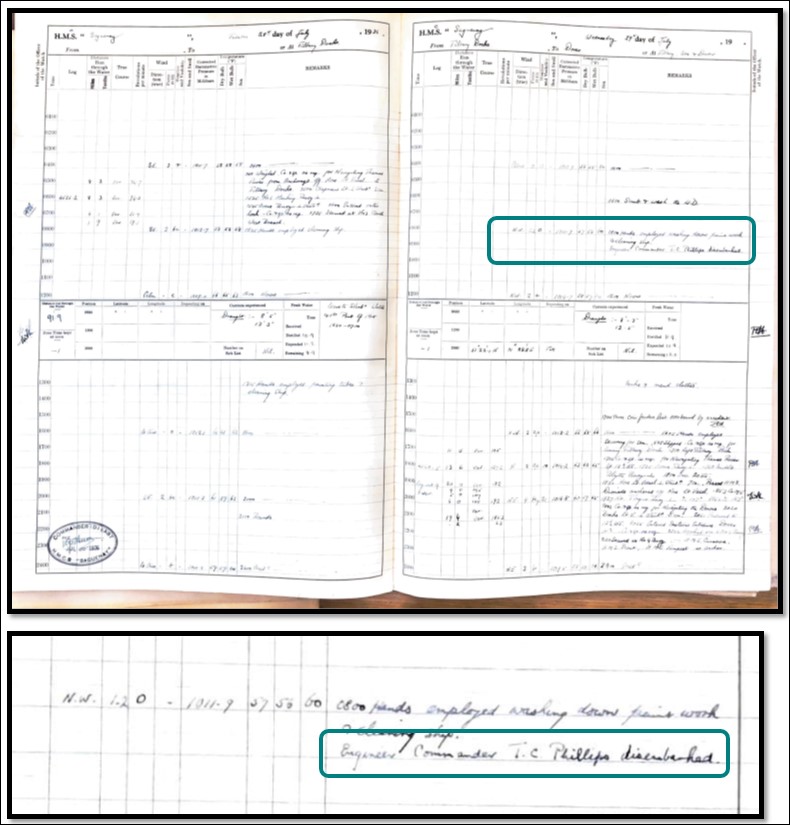
Ship’s log, HMCS SAGUENAY, July 29, 1936 (MIKAN 1084556). Image courtesy of the author, Rebecca Murray.
Now it is July 29, and the ship is at Dover in England, and look who went ashore for a visit!
This is the link I had been searching for! (Exaggerated fist pump.) Let us just hit pause for a moment and make an observation: I previously wrote about how research with archival records, especially government records, can be very time consuming and take a lot of patience. I did not expect to find any mention of T.C. Phillips in the ship’s log. I was simply trying to confirm that the HMCS Saguenay had been near Vimy Ridge (or as close as a ship can get to rural northern France). This “find” was almost enough to convince me to stop searching for further records—almost.
Something else that I was happily reminded of by the experience of sharing my research on the previous blog is that when you share a problem, it can be halved. One of the benefits of working with naturally curious colleagues is that they will offer their suggestions about how you might find the answer you are looking for. For example, one colleague suggested checking specific sailing lists related to the Vimy Pilgrimage.
And in sharing the story of my research with extended family, I not only gathered corrected secondary information (ahem!), but also an item that I will be filing away for my own archives: a worn postcard that T.C. Phillips sent to his wife, my great-grandmother, in Ottawa, dated July 27, 1936. Although the message itself tells us little about the role he was fulfilling by being at the unveiling of the memorial, the card itself is full of information that could send any researcher, let alone the writer’s great-granddaughter, down any number of rabbit holes. For example, the stamp affixed to the postcard appears to be an image of the sculpted figures, The Defenders, shown on the card itself.
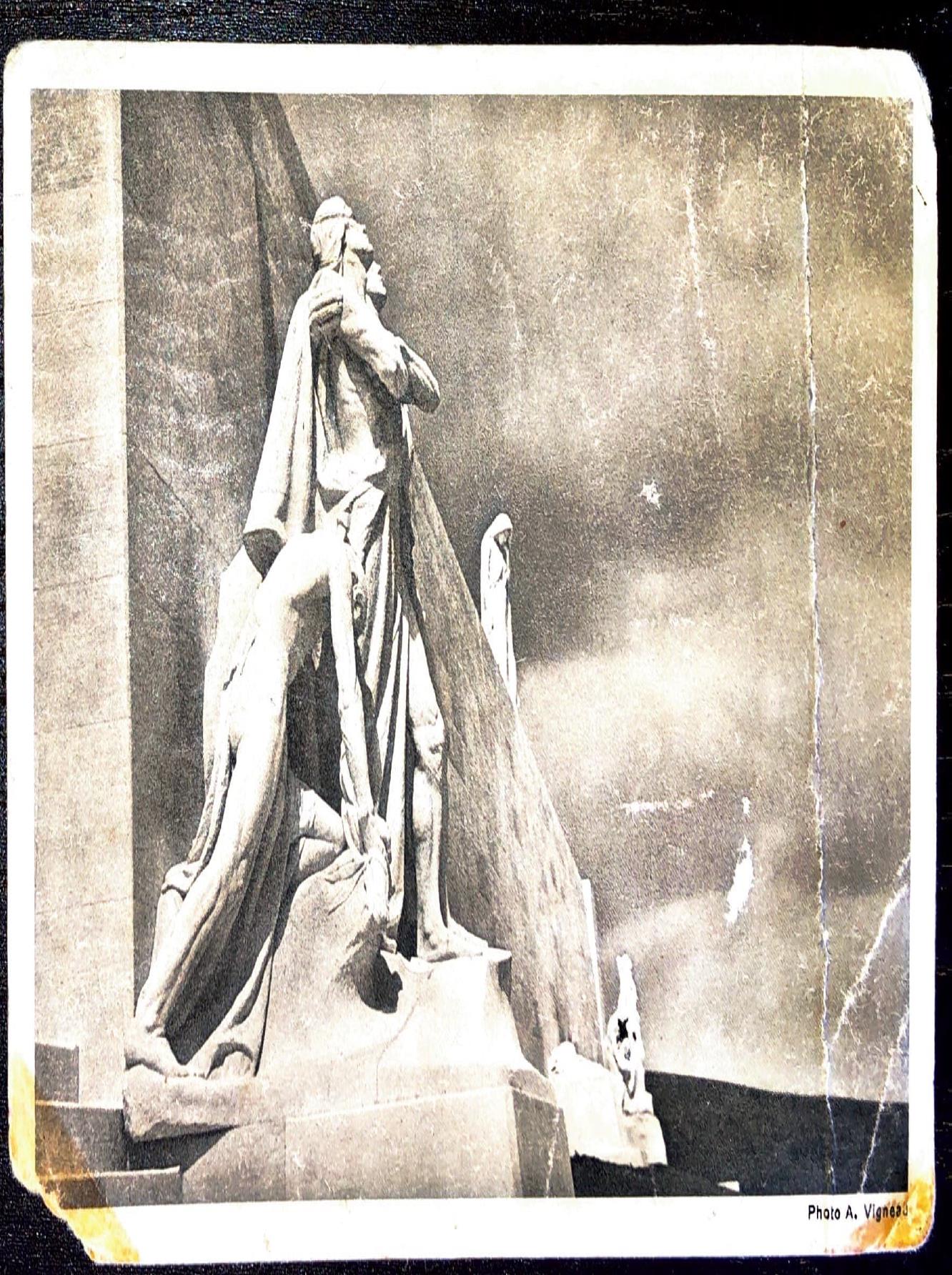
Postcard sent by T.C. Phillips on July 27, 1936, from France to Ottawa. Image courtesy of the author, Rebecca Murray.
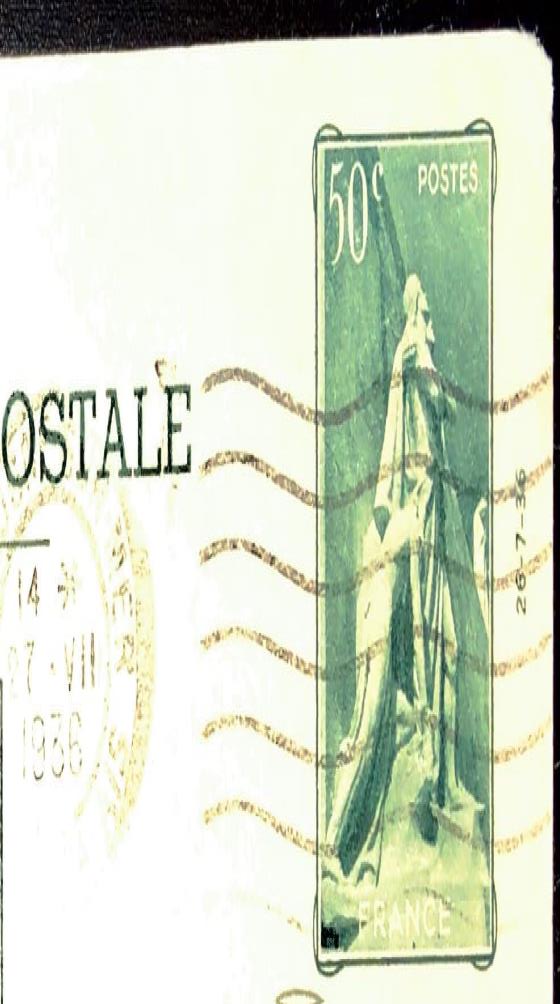
Part of the postcard with the cancelled stamp. Image courtesy of the author, Rebecca Murray.
Another research path that I could explore is the journey that T.C. Phillips took to get to France. A bit more research in the family album tells me that he travelled to France on the SS Alaunia, a ship that served mainly on Cunard’s Canadian service. I found historic passenger lists confirming that the ship departed from Montréal on July 20, 1936, and arrived in London, England, but T.C. Phillips’s name is not among those who “landed” there. For today, though, this is far enough, and that too is a valuable lesson to learn and incorporate into our research. There is always one more lead to follow up on, one more potentially relevant fonds or publication to check, but, as I mentioned in the previous post, where is the fun in being done? So I will hold on to this particular mystery until my next foray into this story.
Family lore can be subjective, so it can be challenging to match it with primary source records. As such, it requires a delicate approach, whether you are working with your own family or helping someone else, as we so often find ourselves doing in Reference Services. I cannot emphasize enough the importance of good secondary research and preparation before a visit to an archive for primary source research.
Rebecca Murray is a Senior Reference Archivist in the Reference Services Division at Library and Archives Canada.
 Library and Archives Canada Blog