Black Porter Perspectives: Giving Voice to Rail Service During and After the Second World War

Version française

By Stacey Zembrzycki

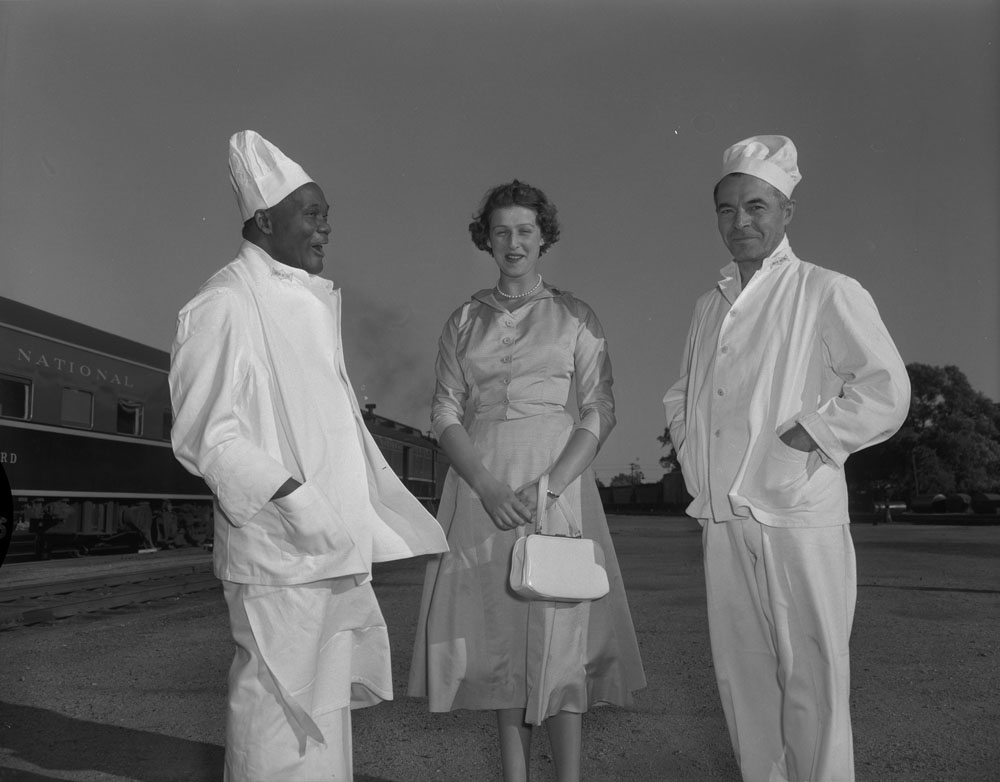
This four-part Black Porter Perspectives blog series is inspired by a striking and haunting set of images found within the Department of National Defence (DND) accession 1967-052. These photographs provide a window into service to country through various vantage points during and after the Second World War, revealing the intersections of class, race and duty.

A white woman standing between a black man on the left and a white man on the right.

Princess Alexandra represents the British Crown on Canadian soil during her Royal Tour in 1954. (e011871943)

Volunteer, and in some cases, conscripted servicemen departing for and returning from battle offer us a glimpse into the realities of preparing for war, deploying to distant fronts, and returning home again.

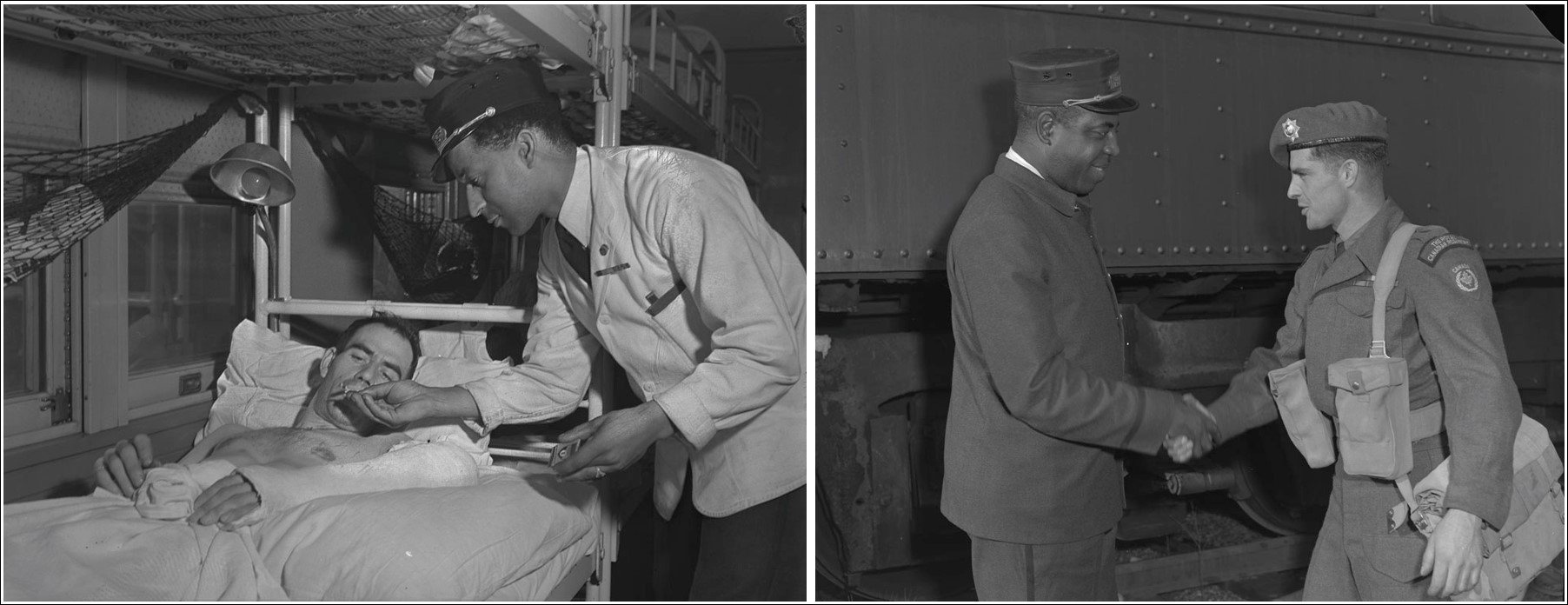
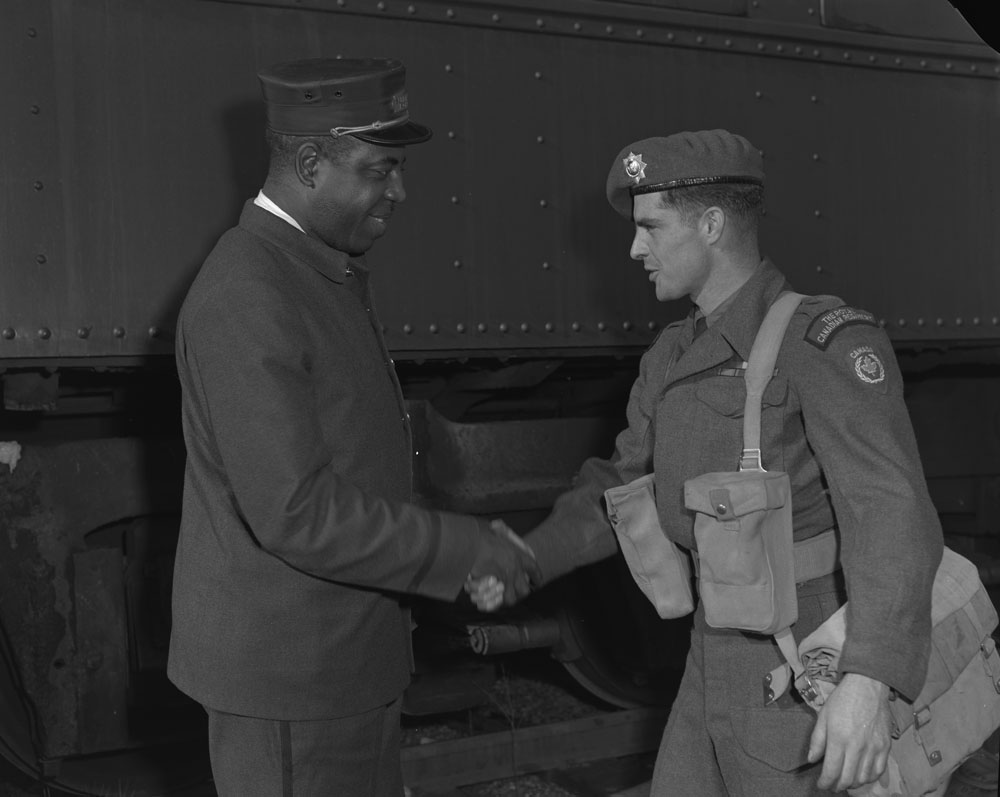
Side-by-side photographs of a Black sleeping car porter lighting a cigarette for an injured white soldier lying in a bed on a train, and of a Black sleeping car porter shaking hands with a white soldier.

Image on left: A sleeping car porter and an injured soldier on the Lady Nelson hospital train. Image on right: Porter Jim Jones of Calgary shakes hands with Private Harry Adams, a Halifax member of the Royal Canadian Regiment, as Canadian Army Special Force units arrive at Fort Lewis, Washington, for brigade-strength training. (e011871940 and e011871942)

Black men, often identified as train staff in the image descriptions, appear in every photograph—serving as the unifying thread in these historical moments. Their essential work, whether as cooks or sleeping car porters, made train travel possible, luxurious even, in times of war and peace. While this labour has often been silenced and overlooked in our national narratives, it is undeniably present in these images.

How can we begin to piece together the experiences that are captured in these images? One way is to turn to the Stanley G. Grizzle collection, particularly the interviews he conducted in 1986 and 1987 with former Canadian National (CN) and Canadian Pacific Railway (CPR) sleeping car porters. Grizzle sought to document the exploitative company culture Black men endured up to the mid-twentieth century and the long and complex struggle that ultimately led to their unionization. At the same time, he also made space for his narrators to recount memorable stories from their time on the rails. These recollections, if listened to closely, allow us to begin piecing together a narrative that enables us to better contextualize some of these DND images. Like the past, however, these moments remain fleeting and fragmentary, with much lost to history.

Five interview clips from Grizzle’s collection provide insight into what portering looked like during the Second World War. While these exchanges provide few details about the images above, they offer glimpses into porters’ working conditions and the added responsibilities they shouldered during wartime. Let’s listen to what these conversational tangents reveal about their experiences:

You can read the transcript from this sound clip here. (ISN 417383, File 1, 34:30)

You can read the transcript from this sound clip here. (ISN 417397, File 2, 9:26)

You can read the transcript from this sound clip here. (ISN 417379, File 1, 17:18)

You can read the transcript from this sound clip here. (ISN 417379, File 1, 5:56)

You can read the transcript from this sound clip here. (ISN 417386, File 1, 32:12)

The experiences of the men, the people they served, and their feelings about the additional duties thrust upon them as a result of the Second World War offer valuable insights that help humanize the role of portering. For George Forray, the demands of wartime rail service provided financial security, allowing him—and many others—to secure full-time employment during this turbulent period. Bill Overton, while recounting the hard-fought union gains he helped achieve, shared a story of being overwhelmed by 83 hungry Air Force cadets needing lunch. While there were white off-duty staff members on the train at the time, he explained the challenges of asking for their assistance. Through his account, we gain a deeper understanding of the intricacies and misunderstandings surrounding overtime pay during this era and the racialized structures that governed and divided rail workers.

In one of the clearest and most concise wartime stories in Grizzle’s collection, an unknown narrator recounts—despite audible breaks in the sound recording—details of transporting German prisoners of war. While he describes the sleeping cars’ physical environment and the meals served, much is left to the imagination, leaving gaps about how porters perceived this service and the potential dangers they faced. These insights are largely lost to history. Eddie Green builds on this discussion while speaking about the evolution of train technology in the early twentieth century. The reintroduction of outdated train cars to meet wartime demands posed significant challenges and physical dangers for porters, who had to navigate these risks while managing increased passenger loads. The stress would have been tremendous.

In many ways, the final interview clip brings the narrative full circle. In it, Joseph Morris Sealy reflects on how the high demand for wartime rail service paved the way for significant union gains. Government-backed wage increases served as a crucial starting point for negotiating the first collective agreement between the International Brotherhood of Sleeping Car Porters and the CPR in 1945. There was no going back to the way things were before the war. The uninterrupted movement of people and goods by rail had proven essential to sustaining a stable and functioning economy. Porters, fully aware of the critical role they played, fought to ensure they were treated fairly and justly compensated.

While piecing together the contextual information behind the images included above may not be possible, these accompanying narratives contain enough information to reveal what may have been happening before and after photographers captured these moments in time. They give a voice to the experiences of porters, shedding light on the complexities of their work during and after the Second World War. Yet, as with all historical sources, this oral and photographic evidence underscores the challenges of reconstructing the past—we must work with the fragments available to us. Despite their limitations, these sources compel us to fundamentally rethink our national narrative and the pivotal role of Black labour within it.

Additional Resources


Stacey Zembrzycki is an award-winning oral and public historian of immigrant, ethnic, refugee, and racialized experiences. She is a faculty member in the Department of History and Classics at Dawson College.

Black Porter Perspectives: Hospital Ships and Hospital Trains

Version française

By Jeff Noakes
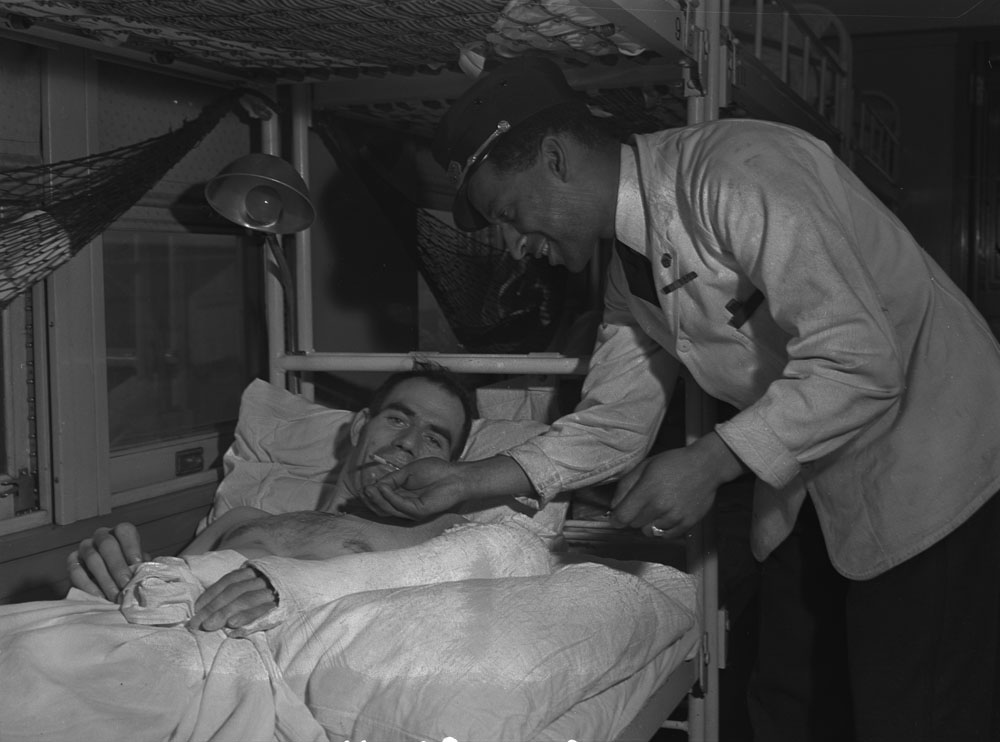
Black-and-white photograph of a porter (on the right, with white jacket and dark cap) leaning over to light the cigarette of a patient lying in the bed on the left.

Porter Jean-Napoléon Maurice (right) leans over to light the cigarette of Private Clarence Towne, a patient on a hospital train, August 20, 1944. (e011871941)

The image above comes from a series of photographs of Black sleeping car porters from during and after the Second World War. This series documents service to country through various vantage points. It also forces us to ponder the backstories to the images. Who appears in these photographs? Why were they taken? Why are they significant? And what stories can they help us uncover?

The date and original cataloguing provide enough information to look further into parts of some of these stories. As a photograph taken for public consumption, this image soon appeared in Canadian newspapers, which identified the two men appearing in the image: Porter Jean-Napoléon Maurice and Private Clarence Towne. Newspaper captions also provided some additional information about both men, noting that Maurice had served with the Royal 22e Régiment and had been wounded in Italy, while Towne had been wounded in fighting at Caen, in Normandy. Not mentioned in some instances is Maurice’s earlier service with Les Fusiliers Mont-Royal, including his participation in the Dieppe Raid.

While Maurice’s military service is explicitly mentioned in the newspaper caption, it is also conveyed through his uniform. Visible on his white jacket are medal ribbons, along with the shield-shaped General Service Badge that he was entitled to wear because of his military service. Both would have been readily recognized by many viewers at the time. Towne’s service, and his wounds, are clearly depicted by his left arm, encased in a plaster cast. In at least one newspaper, the photograph was retouched to make the white cast more clearly visible against the bedsheets.

The photograph was very likely intended as part of a wider publicity campaign relating to hospital trains. Maurice was one of four Canadian Pacific Railway (CPR) porters who were veterans, had been wounded in service and were chosen to work on such trains. Stories about these four men—along with Maurice, they were identified in newspapers as Randolph Winslow, Sam Morgan and James E. Thompson—their military service and their work as porters, including the photograph seen above, appeared in late August 1944.

The date and original caption also furnish enough information to conduct further research into records held by Library and Archives Canada (LAC). While there was no “Lady Nelson Hospital Train,” one of Canada’s Second World War hospital ships was the Lady Nelson. Originally a civilian ocean liner, in 1942 the ship was sunk in the harbour at Castries, Saint Lucia, by a German submarine. After being salvaged, the Lady Nelson was converted into a hospital ship for transporting wounded, injured and sick military personnel; it would later be used to repatriate other military personnel and their dependents. Its voyages included trips from ports in the United Kingdom to Halifax, Nova Scotia. From there, hospital trains, using equipment provided by both the Canadian National Railway (CNR) and the CPR, transported patients to destinations across the country. The photograph, therefore, depicts a scene aboard a hospital car in one of these trains, carrying patients from the Lady Nelson.

During the Second World War, responsibility for many aspects of these operations fell to the Department of National Defence’s Directorate of Movements. Its records form part of the Department of National Defence fonds at LAC [R112-386-6-E, RG24-C-24]. This substantial collection covers the movement of hundreds of thousands of military personnel to and from Canada, as well as the transportation of cargo and military equipment. It also includes extensive records relating to the movement to Canada of military dependents, including war brides and their children, during and after the war. The records, which were microfilmed around 1950, are now available on digitized microfilm at Canadiana by the Canadian Research Knowledge Network.

Advisory: these records are in English only and can include medical information that some people may find disturbing, offensive or potentially harmful, including historical language used to refer to medical diagnoses. The records can also contain other historical language and content that may be considered offensive or potentially harmful, such as language used to refer to racial, ethnic and cultural groups. The items in the collections, their content and descriptions reflect the period in which they were created and the views of their creators.

These records include files relating to the movements of hospital ships and the personnel they repatriated, as well as the planning and operation of the hospital trains and other means of transportation that brought these patients to points across Canada and in Newfoundland. In some cases, these voyages extended even further. This included the repatriation of Americans serving in the Canadian military, as well as members of Allied militaries whose lengthy homeward journeys took them through this country.

Since the cataloguing information notes that this photograph was taken on August 20, 1944, it suggests a connection with an arrival by the Lady Nelson a few days before. A search of the LAC catalogue turns up a Directorate of Movements file [RG24-C-24-a, Microfilm reel number: C-5714, File number: HQS 63-303-713] for such an event on August 18, although the ship may in fact have docked just before midnight on August 17. As a result, the photograph offers an entry point into what the records of this specific voyage contain. It also provides an opportunity to discuss how these sorts of records can be useful, as well as some of their inherent limitations, especially with respect to the experiences of sleeping car porters on these hospital trains.
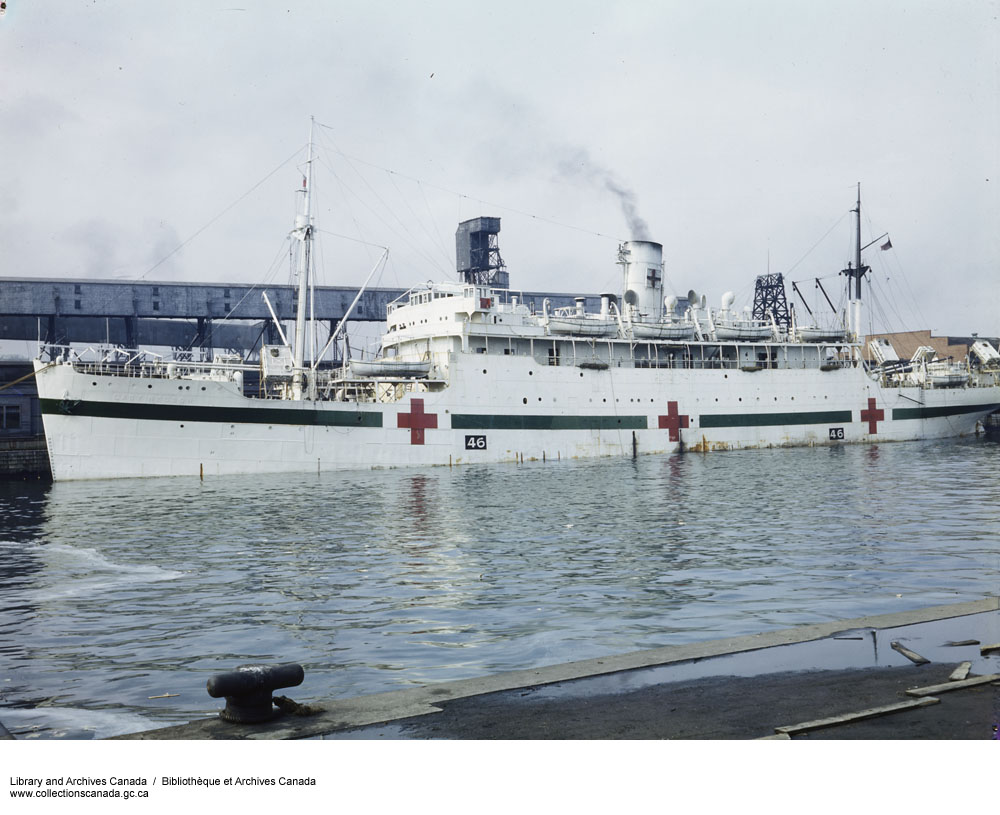
Colour photograph of a hospital ship with a white hull and superstructure and a single funnel, with grey port buildings in the background. A green stripe with three red crosses runs horizontally along the ship’s hull. The number 46 is painted in black rectangles below the green stripe.

The Canadian hospital ship Lady Nelson in Halifax, Nova Scotia. (e010778743)

This particular file’s hundreds of pages of messages, letters, memos and lists of repatriated personnel provide a general outline of these events. When the Lady Nelson left Liverpool shortly before midnight on August 8, 1944, it was carrying a total of 507 personnel to Halifax for medical reasons. Nearly all were members of the Canadian military, with some 90 percent from the Canadian Army. The ship was also transporting two Newfoundlanders who had served in Britain’s Royal Navy, as well as one Royal New Zealand Air Force officer on his lengthy way home via Canada. Two patients died during the trip and were buried at sea: Private George Alfred Maguire on August 11 and Captain Theodore Albert Miller on August 15. Their service files, digitized and available through LAC’s catalogue, help provide some details of their final voyages.

The file for this trip also reflects a number of broader stories, in particular the way that wounded, injured and sick military personnel were being returned to Canada from overseas. In mid-August 1944, this capacity was about 500 at a time aboard the Lady Nelson. The following month, a second Canadian hospital ship, the Letitia, entered service, with the ability to transport around 750 patients. At that point, some 1,000 or more wounded, injured and sick could be repatriated every month across the North Atlantic to Canada.

The need for this augmented capacity speaks to the growing number of repatriations arising from increased combat activity overseas following the D-Day landings on June 6, 1944, and the subsequent campaign in Normandy. The casualties from this fighting added to the ongoing toll of the land campaign in Italy and the war at sea and in the air; a mid-August memorandum refers to a “back log” of casualties in the United Kingdom awaiting repatriation to Canada. The records also make it clear that in addition to those whose wounds, both physical and psychological, were suffered in battle, the patients included those being repatriated for non-combat injuries and for illnesses of various sorts.

The focus of the Directorate of Movements for these voyages was on the personnel returning home, including identifying their medical requirements during their travels and at their destinations. The records consequently provide details of personnel down to the individual level, with lists of those being transported to various locations across Canada, their medical status and their care needs, as well as information about their next of kin.

The records also detail the provision of services to help make these voyages happen, but generally do not discuss those who did this work. Hospital train crews and staff provided by the railways, including porters, do not appear as individuals. While there was one porter assigned to each hospital car in addition to medical staff, as well as porters in other passenger and sleeper cars that made up the trains, the porters themselves and their experiences do not truly speak in these documents. They appear briefly and anonymously in the files as requirements for the hospital trains and indirectly in comments that are made about the train staff and crews more generally. As part of a service being provided by the railways, the porters were an operational requirement, who the military wrote about and recorded in the same way that the remainder of the personnel operating the trains were described.

In the roughly four hundred pages of documents relating to this voyage of the Lady Nelson and the hospital train in Canada, there is only one clear and unambiguous mention of porters. A letter from the Directorate of Movements to the Canadian Pacific Railway in early August 1944 alerted the company to the anticipated arrival of the Lady Nelson on or around August 16. In addition to noting that hospital cars would be required for the movement of patients, the letter also requested that porters be on hand for the train. Four CPR hospital cars were identified, each of which required a porter. Given the railway’s decision to provide hospital car porters who had been wounded during their military service, this would have meant Jean-Napoléon Maurice and his three comrades.
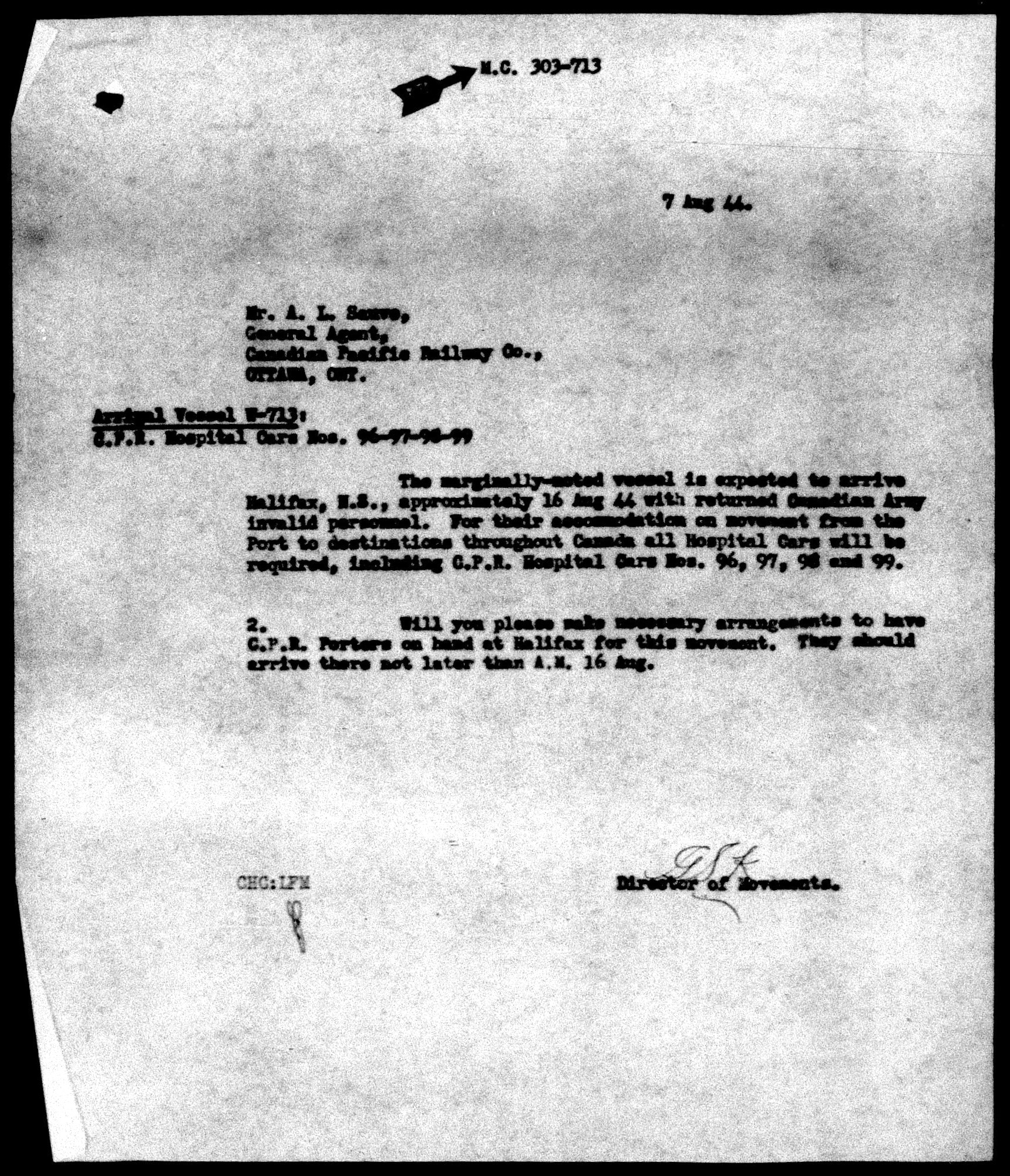
Typed letter from the Director of Movements.

This letter from the Directorate of Movements to the Canadian Pacific Railway Company is the only clear and direct reference to porters in the Directorate of Movements file relating to the arrival of the Lady Nelson in mid-August 1944. (MIKAN 5210694, oocihm.lac_reel_c5714.1878)

Transcript for the letter above:

M.C. 303-713

7 Aug 44.

Mr. A.L. Sauve,
General Agent,
Canadian Pacific Railway Co.,
OTTAWA, ONT.

Arrival Vessel W-713:
C.P.R. Hospital Cars Nos. 96-97-98-99

The marginally-noted vessel is expected to arrive Halifax, N.S., approximately 16 Aug 44 with returned Canadian Army invalid personnel. For their accommodation on movement from the Port to destinations throughout Canada all Hospital Cars will be required, including C.P.R. Hospital Cars Nos. 96, 97, 98 and 99.

2. Will you please make necessary arrangements to have C.P.R. Porters on hand at Halifax for this movement. They should arrive there not later than A.M. 16 Aug.

[Signature]
Director of Movements.

CHC:LFM

Directorate of Movements records are more forthcoming about Clarence Towne. They note that he had served with the North Nova Scotia Highlanders and had been wounded in the left elbow and arm by German machine gun fire. Assigned to one of the beds in hospital car 98, he was travelling home to his wife Jane in St. Catharines, Ontario. Towne might have been chosen as a representative patient because, while he was travelling in a hospital car, his wounds would not have been graphic, disfiguring or unsettling for viewers on the home front. The same could not be said for some of the other personnel being repatriated. Towne’s injuries were safely and indirectly depicted by the cast encasing his left arm. Unlike some of the other patients aboard the train, they were also physical and the direct result of combat, rather than being psychological or the result of accident or illness, which may also have played a role in his selection.

In addition to serving as an entry point for unpacking individual stories using a variety of sources, this photograph makes visible the wider history of the essential service of porters in the functioning of hospital trains during and immediately after the Second World War. At the time of its creation, it also likely served other functions. By showing Jean-Napoléon Maurice lighting Clarence Towne’s cigarette, it may have been intended to build on and reinforce popular perceptions and depictions of Black railway porters, the nature of their jobs and their racial and social status, especially how these were manifested through their role in serving travellers.

The photograph also incidentally serves as a reminder of the prevalence of tobacco and smoking in the 1940s. Among their many features, the specially modified hospital cars were equipped with an ashtray for each of the patient beds—something that would be unbelievable today. By depicting personal interactions such as the lighting of a cigarette, the scene was likewise meant to show the attention being paid to military patients. Images such as this provided an opportunity for the Canadian military and government to demonstrate the care being provided to those being repatriated, an important consideration given that the hospital trains and their passengers were a powerful home front manifestation of the increasing human costs of the Second World War.

Additional Resources


Jeff Noakes is Historian, Second World War, at the Canadian War Museum.

Black Porter Perspectives: Bringing Thomas Nash, a Canadian National Railway Porter, Back to Life

Version française

By Andrew Elliott

In the first post of the Black Porter Perspectives series, Rebecca Murray highlighted a wartime photograph that identified a railway sleeping car porter: Jim Jones of Calgary. In the Canadian National (CN) fonds, with which I work, it is worth noting that finding a porter’s name is rare. This collection (RG30/R231), one of Library and Archives Canada’s (LAC) largest private acquisitions, should logically contain a plethora of records about porters due to their central role in railway service. Sadly, until recently, this has not been the case. A basic keyword search for “porter” often yielded few, if any, results. I am working hard to correct this situation.

Over the last few months, my work has involved sifting through backlogged material relating to the CN Passenger Services Department. I recently found a collection of files from the late 1960s documenting employees who worked for the CN Sleeping, Dining, and Passenger Car Department. These files cover a range of issues, including accidents, insurance claims, thefts of company property, and retirements, as well as provide insight into the lives of cooks, waiters, stewards, and porters. Among these, I discovered an important and interesting personnel file for a Black porter named Mr. Thomas Nash. His file stood out due to his remarkable 42-year career, spanning from his hiring on June 23, 1927, to his retirement in August 1969. This documentation sheds light on who Nash was and offers a deeper understanding of what portering looked like for him and other Black men during this period.

Who was Mr. Thomas Nash?

Nash’s personnel file is rich with details, allowing us to begin to piece together his biography. Raised by his adoptive parents in Antigonish, Nova Scotia, Nash later moved to Montréal, where he worked as a CN porter. The path to learning this information is particularly interesting.

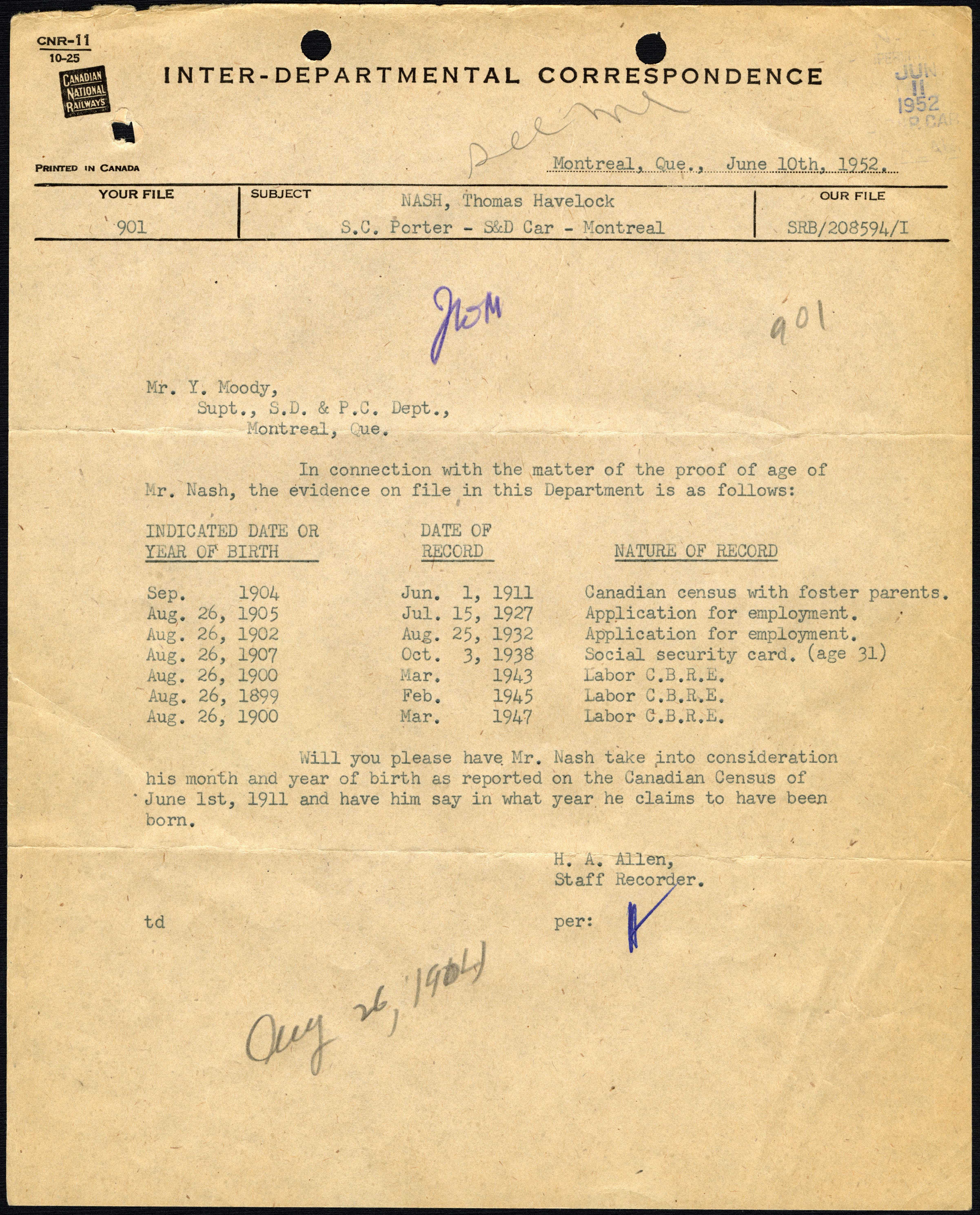
In the late 1940s, CN’s Staff Record Bureau began seeking Nash’s birth date to determine his retirement eligibility. Like many Black citizens in Canada and the United States, Nash faced challenges with recordkeeping, which were compounded by his adoption. He offered several possible birth years, including 1899, 1900, 1902, 1904, 1905, and 1907, which further complicated the Bureau’s task.

Page showing possible birth dates for a CN porter.

Documentation from the CN Staff Record Bureau detailing various possible birth dates for Thomas Nash, dated June 10, 1952. (MIKAN 6480775)

Due to Nash’s inability to provide accurate information about his birth, the CN Bureau contacted the principal of St. Ninian School in Antigonish, Nova Scotia, which Nash had attended as a youth. This inquiry in 1952 proved unsuccessful. The following year, the CN Bureau contacted the Dominion Bureau of Statistics, which confirmed that Nash had actually been born on August 26, 1904. The 1911 Census further revealed that Nash lived with his adoptive parents in Antigonish, a detail that is recorded in his personnel file. Interestingly, while his personnel file does not address the matter explicitly, Nash’s last name appears to have changed between his youth and his move to Montréal. As a child, he went by the surname “Ash,” which later became “Nash” before he began his job with the CN. Was this a recording error? Determining his correct birth details led to Nash’s eligibility for the CN Pension Plan, which went into effect on January 1, 1935.

In addition to learning a little bit about his early life, we also see that upon relocating to Montréal, Nash became part of the city’s tight-knit Black community, living in what was then known as the St. Antoine District. This is unsurprising given the racial segregation in housing and the community’s proximity to the train station.

While his early years in Montréal are undocumented in his personnel file, we see that Nash resided at 729 Seigneurs Street in the 1950s and early 1960s. A 1968 letter he wrote to the CN Staff Record Bureau reveals that he had married and later resided with his wife at 2458 Coursol Street, just a few streets over from his former residence.

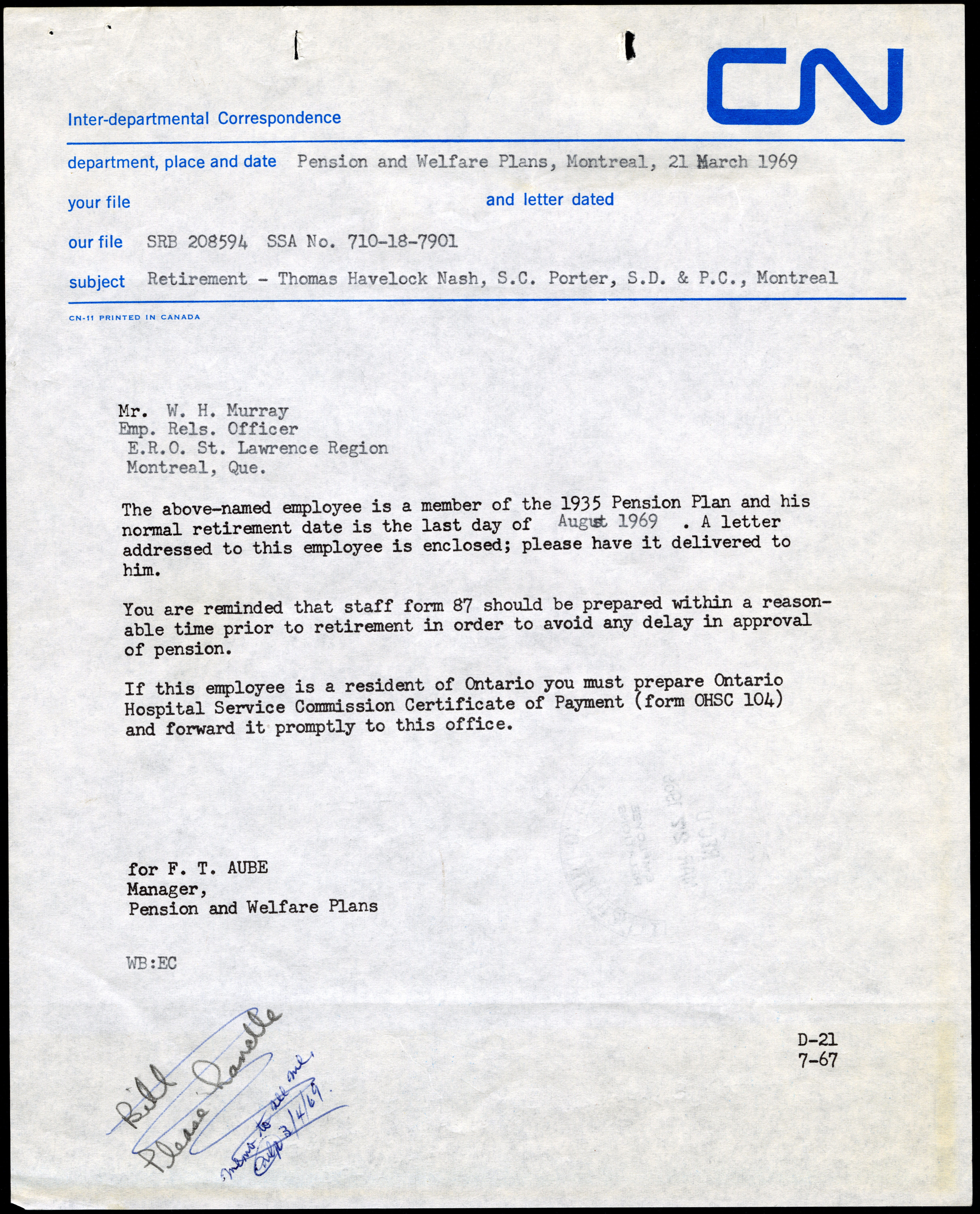
Nearly every household in the St. Antoine District had ties to portering. This profession was deeply respected, as evidenced by a community ritual honouring retiring porters: family, friends, colleagues, and bosses gathered at the train station to welcome these men home from their final runs. The Black Worker, the Brotherhood of the Sleeping Car Porters’ union newsletter, often documented these special moments. Nash undoubtedly experienced such recognition when he retired in 1969.

Letter from CN’s Human Resources Department outlining details relating to a CN porter’s upcoming retirement in August 1969.

Letter detailing Thomas Nash’s upcoming retirement in August 1969. (MIKAN 6480775)

The rights and experiences of porters

Nash’s career began in 1927, a pivotal year for both CN and its employees. That year, CN and its union, the Canadian Brotherhood of Railway Employees (CBRE), created a segregated system dividing employees into two groups. Group 1 included dining car employees and sleeping car conductors (white men), while Group 2 consisted of sleeping car porters. These separate collective agreements restricted seniority and promotion opportunities within each group, effectively locking Black workers into portering and barring them from advancing within CN’s ranks.

Nash would have quickly realized that upward mobility was impossible for him. Dr. Steven High helps us contextualize Nash’s experience, noting that porters in the 1920s and 1930s worked very long hours with a fixed monthly salary, regardless of the actual number of hours worked. On average, porters were allowed just three hours of sleep per day while in transit. Needless to say, their working conditions were difficult and highly exploitative. Unfortunately, Nash’s early years on the job, including his contributions during the Second World War, are undocumented in his personnel file—a troubling omission given the essential nature of his work.

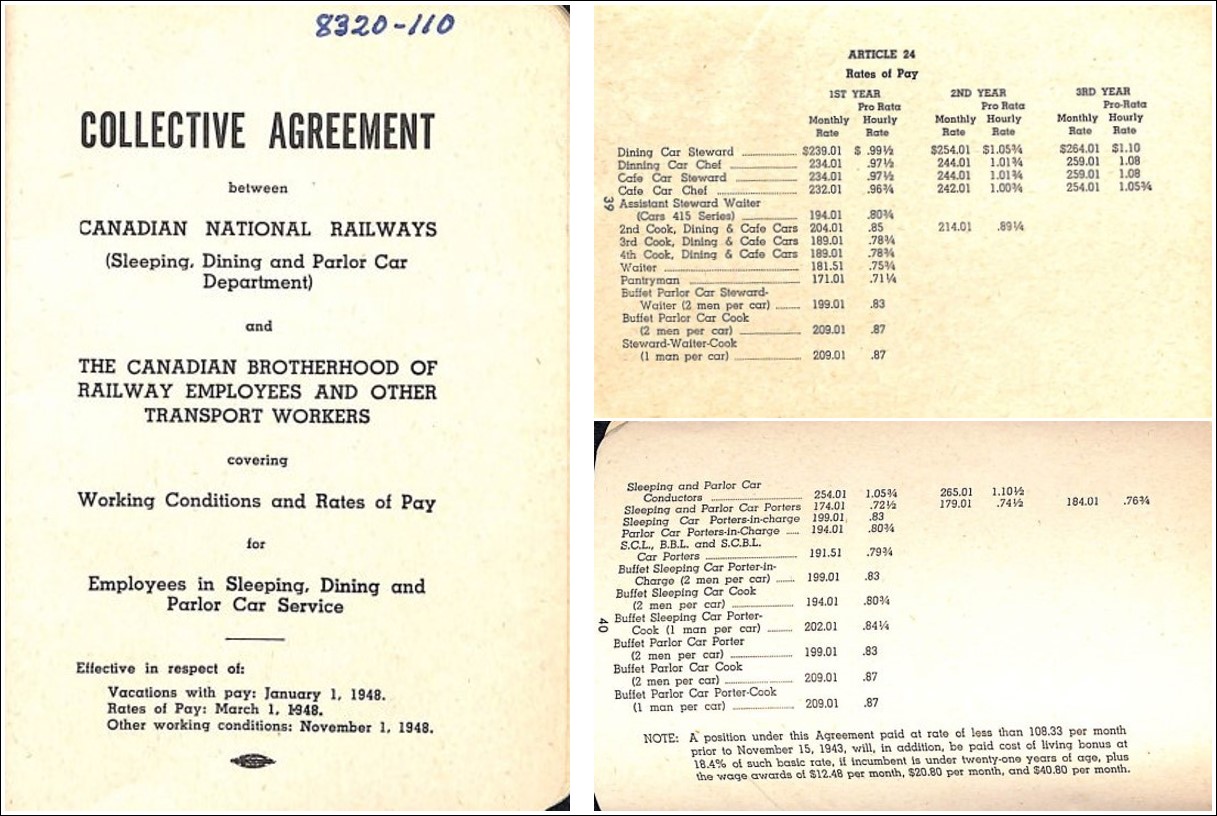
Despite their invisibility in these records, Black porters began agitating for improved conditions. In 1945, Canadian Pacific Railway sleeping car porters successfully negotiated a new collective agreement that including better wages, vacation time, and reduced hours. These union gains, however, did not extend to CN employees who remained bound by CBRE’s more restrictive agreement. The agreement featured below, dated 1948, shows that all porters remained among the lowest-paid employees, second only to pantrymen, with monthly salaries ranging between $174 to $209. Also, unlike some of the other occupations listed, porters’ salaries would not increase in years two or three. In truth, these men saw little improvement to their working conditions until 1964, when the Canadian Brotherhood of Railway, Transport and General Workers came into existence, ending occupational colour barriers and creating a combined seniority list.

(For more information about the long fight for porters’ rights, listen to “Porter Talk: The Long Fight for Porters’ Rights.”)

Cover page of the CBRE Collective Agreement along with details of employee wages.

Pages from the 1948 CBRE Collective Agreement, covering working conditions and rates of pay for employees in sleeping, dining, and parlour car service. (MIKAN 1559408)

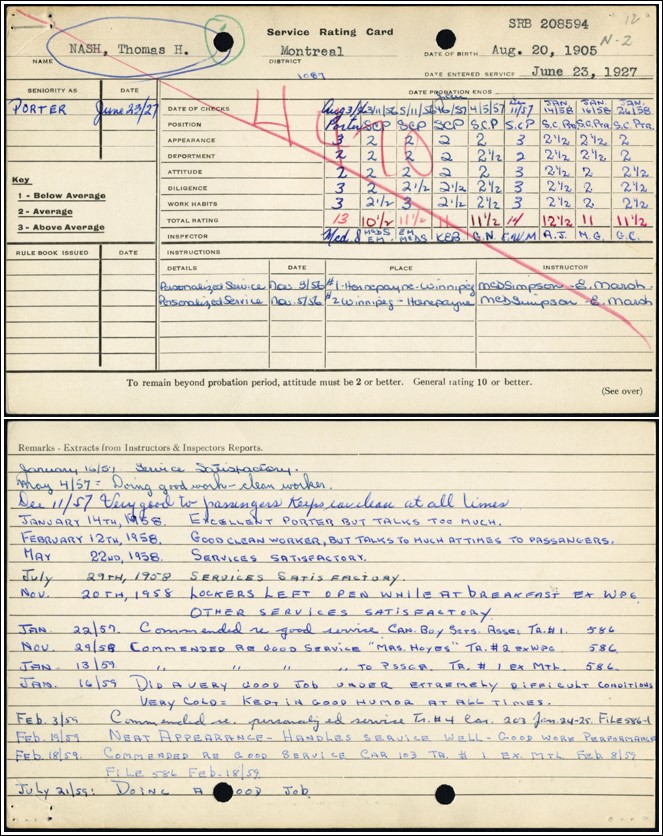
A cursory engagement with the CN fonds might obscure the contribution of porters, but Thomas Nash’s personnel file provides valuable insight into the nature of their work. His employee service rating card, in particular, emphasized the stresses inherent in portering. This card was designed to document and rank the quality of service provided, a reminder that Nash and his colleagues were under constant scrutiny—whether by CN staff or passengers. It is interesting to point out that even minor infractions could result in demerit points, colloquially known as “brownies.” Accumulating 60 demerit points led to automatic termination without the possibility of appeal. Remarkably, Nash’s record stands out: in his 42-year career, he never incurred a single demerit point. The comment card below showcases a passenger’s remark from 1958, providing a vivid anecdote and serving as a testament to Nash’s exceptional service: “Excellent Porter but talks too much.” While seemingly contradictory, this remark sheds light on Nash’s engaging personality and unwavering commitment to his duties.

Cards displaying employee rating numbers and comments on Thomas Nash’s service performance.

Front and back of Thomas Nash’s employee service rating card. (MIKAN 6480775)

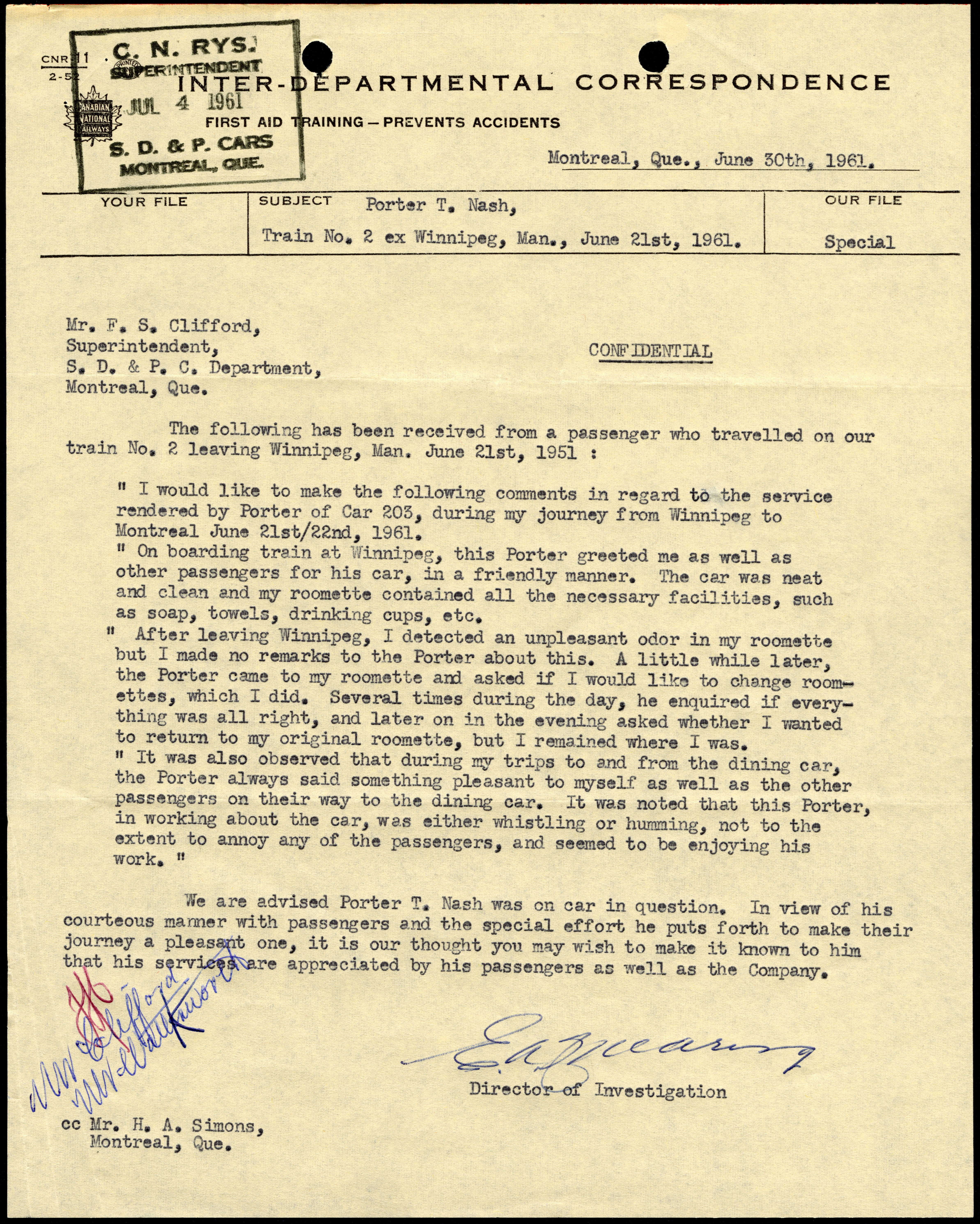
In 1961, another passenger went further, commending Nash for his service:

Typewritten letter detailing a passenger’s compliments on the service provided by CN porter Thomas Nash.

Letter documenting a passenger’s commendation of CN porter Thomas Nash for service excellence, 1961. (MIKAN 6480775)

Making porters’ service visible

My team remains committed to uncovering more information about the lives porters led and the experiences they had on the rails. Since last year, we have uploaded over 21 000 service files related to employees who worked for CN and its predecessor companies—including records for 1 066 porters—to the series entitled Employees’ provident fund service record cards. Slowly but surely, we are uncovering records within the CN fonds that shed light on the invaluable contributions of porters, making their essential service visible. In many ways, this work allows us to honour their legacy and bring their stories back to life, contributing to a new understanding of their profound impact in shaping modern Canada.


Andrew Elliott is an archivist in the Archives Branch at Library and Archives Canada.

What’s in a Name: the Carnegies in context

Version française

By Sali Lafrenie

“What a trip. It was as if I had been shot through a time tunnel from the fields of Willowdale to a field of dreams. The many threads of my life have all come together to produce a beautiful tapestry.”

Herb Carnegie, A Fly in a Pail of Milk: The Herb Carnegie Story (OCLC 1090850248)

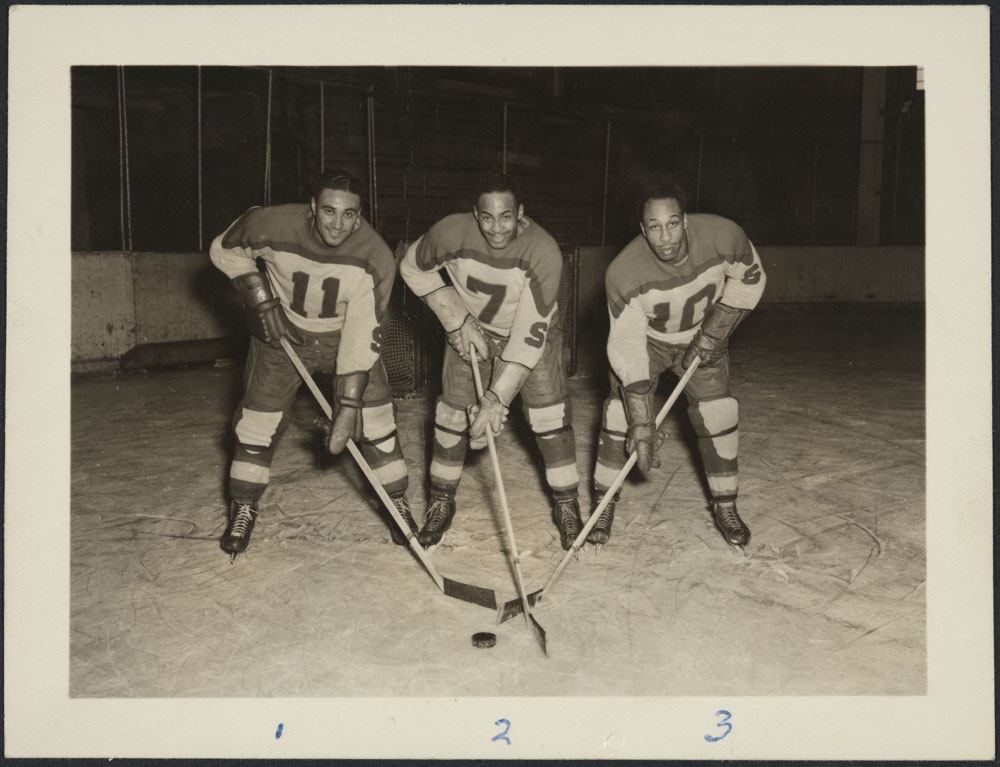
Herb “Swivel Hips” Carnegie (1919–2012) was an exceptional athlete with multiple golf championships and an impressive career in hockey spanning over a decade. During his playing career, he travelled to numerous cities and played at the amateur and semi-professional levels for teams like the Toronto Observers, the Toronto Young Rangers, the Perron Flyers, the Timmins Buffalo Ankerites, the Shawinigan Cataractes, the Sherbrooke Randies (also known as the Saints), the Quebec Aces and, in his last season, the Owen Sound Mercurys. Carnegie had a decorated sports career, winning MVP for three straight years in the Quebec Senior Hockey League (QSHL) and playing on the first all-Black line in semi-pro hockey since the Colored Hockey League.

A black and white photograph of three Black hockey players standing in a line with their sticks on the ice.

A photo of the famous all-Black Line: Herb Carnegie, Ossie Carnegie, and Manny McIntyre. (Library and Archives Canada/e011897004)

After hanging up his skates, Carnegie became a successful businessman and the first Black Canadian financial advisor employed by Investors Group. He had a 32-year long career with Investors Group, and an award was established in 2003 in his honour: the Herbert H. Carnegie Community Service Award. Carnegie was more than just an example of business excellence; he was a community leader and an entrepreneur. He founded one of the first hockey schools in Canada, invented a hockey instructional board and devised a board game with the hope of helping people understand the sport and improve their hockey IQ. Further, Carnegie established the Future Aces Foundation and Philosophy alongside his wife and daughter, Audrey and Bernice. His impact can be seen in many places like the comic book features he received, the halls of fame he has been inducted into, the awards named after him, and the schools that adopted his Future Aces Creed (there is even a school named after him).

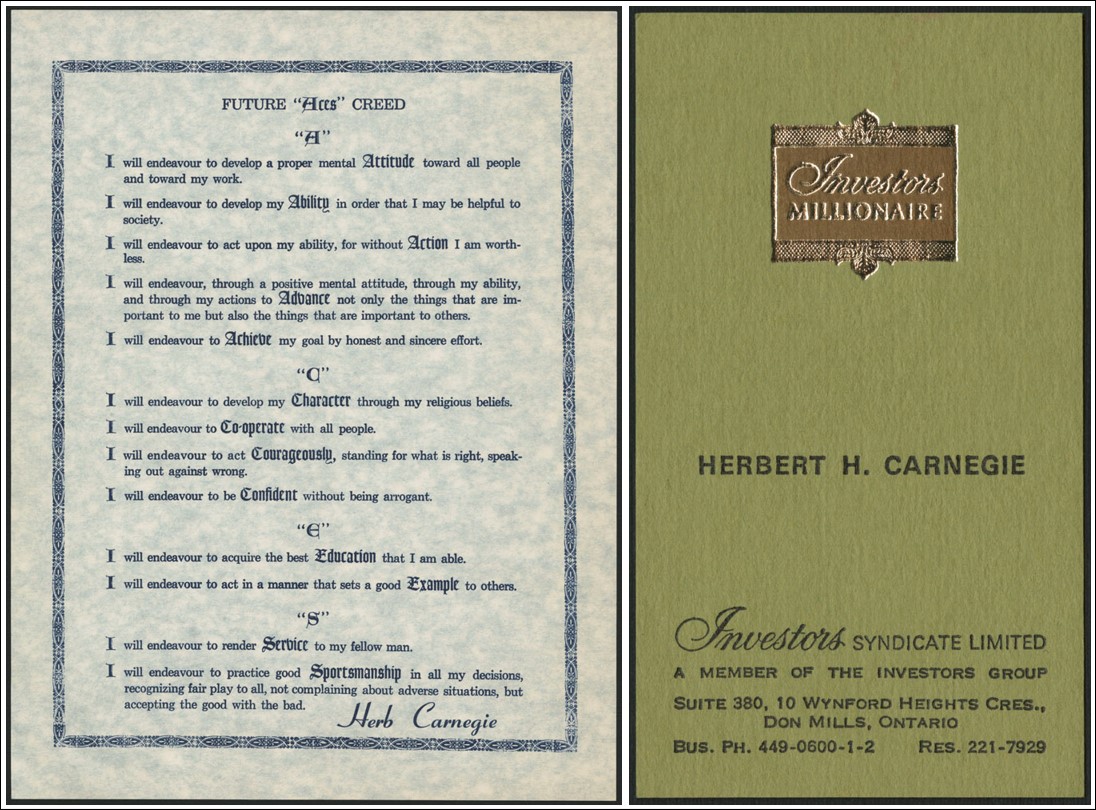
Two colour photographs of records related to Herb Carnegie. The first photograph is a paper with an intricate blue border surrounding text that consists of I-statements. The second photograph is a vertical green business card bearing an embossed “Investors Millionaire” logo with the name “Herbert H. Carnegie” printed in the middle, and the company’s contact information at the bottom.

Future Aces Creed and Investors Millionaire Card. (Library and Archives Canada/e011897005 and e011897007)

But what’s in a name?

 I’d disagree with Shakespeare, at least in this instance, and say that names do have power. They have histories, they have legacies, and they can act as maps. The Carnegie name does this for the world of sports, entrepreneurship, business, labour, and nursing.

Drawing attention for his skills and style of play, along with his race, there is even more we can learn from Herb Carnegie’s ice time if we stop to ask a few questions:

  • How does Herb’s experience in hockey reflect larger issues in Canadian society at the time?
  • If Black hockey players existed in 1895, why wasn’t the colour barrier in the NHL broken until 1958 by Willie O’Ree?
  • Whose shoulders are hockey players of colour standing on today?

While Herb Carnegie is often remembered for his exceptional hockey skills and for being the best Black hockey player to never play in the NHL, his impact off the ice has also been significant. He deserves to be remembered for all his contributions and for all the ways he and his family have worked for generations to make their communities better.

Pivoting to Herb Carnegie’s sister, we find Bernice Isobel Carnegie Redmon, the first Black public health nurse in Canada (1945) and the first Black woman appointed to the Victorian Order of Nurses in Canada (VON). We can learn more about the context of nursing and blackness in Canada by asking more questions:

  • How did Bernice Redmon become the first Black public health nurse in Canada in 1945?
  • What prevented Black women from entering the field before World War II?
  • When did the first Canadian nursing program start?

A quick search tells us that Bernice Redmon trained to become a nurse in the United States because Black women were prohibited from training as nurses in Canada until the mid-1940s, and that while the VON was established in 1897, the first Canadian nursing program opened  in 1919. However, Bernice Redmon was not alone for long, as Ruth Bailey, Gwen Barton, Colleen Campbell, Marian Overton, Frieda Parker Steele, Cecile Wright Lemon, Marisse Scott and Clotilda Douglas-Yakimchuk joined her in the following years. Despite the roadblocks and unofficial policies like quotas, the face of medicine and nursing began to change in the 1940s and 1950s. This year marks the 80th anniversary of Bernice Redmon’s achievement.

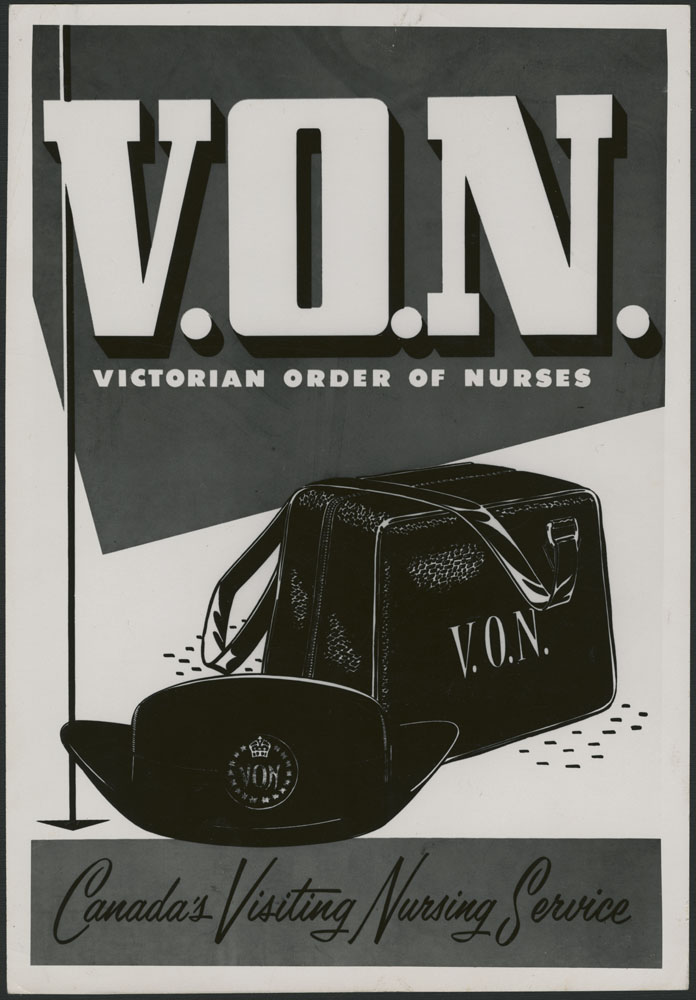
A black and white promotional poster of a white nurse’s hat and a black medical bag.

Victoria Order of Nurses poster. (Library and Archives Canada/e011897008)

Shifting to the next generation of Carnegies, we find Bernice Yvonne Carnegie, Herb’s daughter. She is the self-dubbed family historian and a leader in the hockey community, co-founding the Future Aces Foundation with her parents and establishing the Carnegie Initiative in 2021. Like her father, Bernice is working to support her community and to ensure that hockey is more inclusive. She has been giving back for over a decade through educational programming using the Future Aces Philosophy, academic grants, and her work as a public speaker. Moreover, she was a member of the BIPOC ownership group that purchased the Toronto Six hockey team.

In 2019, Bernice updated her father’s memoir, A Fly in A Pail of Milk, by sharing her own reflections on his life, lessons learned, and how she has continued the work he started. Once you read Herb Carnegie’s memoir and her reflections, it’s hard to stop there. I found myself diving into the family histories she maintains online, and I was struck by how deep the roots between her family and Canada run. I found myself asking questions again:

  • What jobs were available to Black men between 1900 and 1950?
  • What was the average salary at a mining company? What about for hockey players?
  • How do we define the Carnegie family’s multigenerational legacy?

Trailblazing is exciting, but it’s also important to remember that the individuals who broke through colour bars, de-segregated schools, and advocated for their inclusion are people too. In their extraordinary achievements, they face obstacles, racism and often trauma at the hands of the organizations they admire. Navigating predominantly white institutions is not easy; it has a cost. Being the first or one of few is challenging. It’s not often that we take the time to think about how history maps onto our lives and our families. Like the Carnegies, I know there are other families in Canada whose lives and family trees contain branches that blaze a trail through the national landscape. Without hesitation, I can think of families like the Nurses, the Grizzles, the Crowleys and the Newbys.

So, what’s in a name? A tapestry. A history. An archive.

Additional resources


Sali Lafrenie is an archivist in the Private Archives and Published Heritage Branch at Library and Archives Canada.

Black Porter Perspectives: Through the Lens of Military Records

Version française

By Rebecca Murray

Library and Archives Canada (LAC) holds over 30 million images in various formats, including born digital images, negatives and photographic prints. A single archival photograph can tell us much about the fashion, weather, technology, customs and culture of an era! Yet, much of these secondary, but important, themes found in imagery are often ignored in the archival description process, with more attention given to the primary subjects or those captured by the photographer’s gaze. The popular saying “a picture is worth 1000 words” rings true every time I look at an image from the holdings. Even in this relatively simple image of two figures with little to no visible background, there is a wealth of detail and history to explore. What can the uniforms worn by the two men tell us? If there was a building or landscape in the background, what could we learn about where this image was taken?

Photograph of a sleeping car porter (on the left) shaking hands with a soldier (on the right).

1967-052, item Z-6244-4 “Arrival of RCRs at Fort Lewis: Units of the Canadian Army Special Force having completed their move to Fort Lewis, Wash., will shortly commence training at brigade strength. Among the recent arrivals with the Royal Canadian Regiment was one of many Halifax men serving with the Special Force. He is Pte. Harry Adams, above, seen being wished “Best of luck” by Porter Jim Jones of Calgary. (e011871942)

I first came across this image while reviewing others from the Department of National Defence (DND) accession 1967-052 for servicewomen, none of whom are pictured here. Though my main focus was the depiction of servicewomen, a minority group in these photographs, there are many other secondary or non-traditional narratives that are reflected in visual records, including those of sleeping car porters. Despite holding a degree in Canadian history, I had only recently been introduced to these men and their experiences through various books, including Genevieve Graham’s Bluebird and Suzette Mayr’s The sleeping car porter.

If you were to come to LAC looking for photographs of railway porters, you likely wouldn’t start in the DND photographs. Instead, you’d be drawn to those found in the Department of Transport (RG12) or the Canadian National Railways (RG30) fonds archives. In this instance, neither the porters nor the railway (nor the War in Korea) are mentioned in the description of the “Z prefix – CA” sub-sub-series. This is not entirely surprising, as it’s a large set of photographs — approximately 7 500 images — covering several decades worth of events, including the Second World War. Fewer than 15% of the images in this sub-sub-series are described at the item (photograph) level in the database, but most are described to varying levels of detail in digitized finding aids (item lists) that are attached to the sub-sub-series level description. The full caption for image Z-6244-4, which is available only on the original envelope and must be ordered for in-person consultation, mentions the presence of the porter and — surprisingly to this researcher — identifies him by name: Porter Jim Jones of Calgary. This is a stark contrast to most of the other images identified as part of my research. I wondered why this photograph had been so well described relative to others. Without a complete listing of captions and photographer’s notes, there is only so much we can infer from the limited data that we do have.

Coming across these images and working to pair them with their full descriptions, especially when they include the names of individuals and other identifiers, is an opportunity to press pause on one’s research intentions. The relatively hidden history in these images merits well more than a thousand-word description.

We call this process reparative description: the remediation of practices or data that have excluded, silenced or mischaracterized people or histories in archival records. Whether on a large scale or one photograph at a time, this is an ongoing process. So, when I came across these images of porters and other Black railway staff from the Second World War era, I kept notes and shared them with my colleagues who were working on the Discover Library and Archives podcast, Voices Revealed: “Porter Talk.” We were then able to work with other colleagues who are interested in this period, the presence of porters in the DND photographs and their representation in the collection as a whole.

Keep an eye out for the next piece in this series.


Rebecca Murray is a Literary Programs Advisor in the Outreach and Engagement Branch at Library and Archives Canada.

Porter Talk

By Stacey Zembrzycki

This article contains historical language and content that some may consider offensive, such as language used to refer to racial, ethnic, and cultural groups. Please see our historical language advisory for more information.

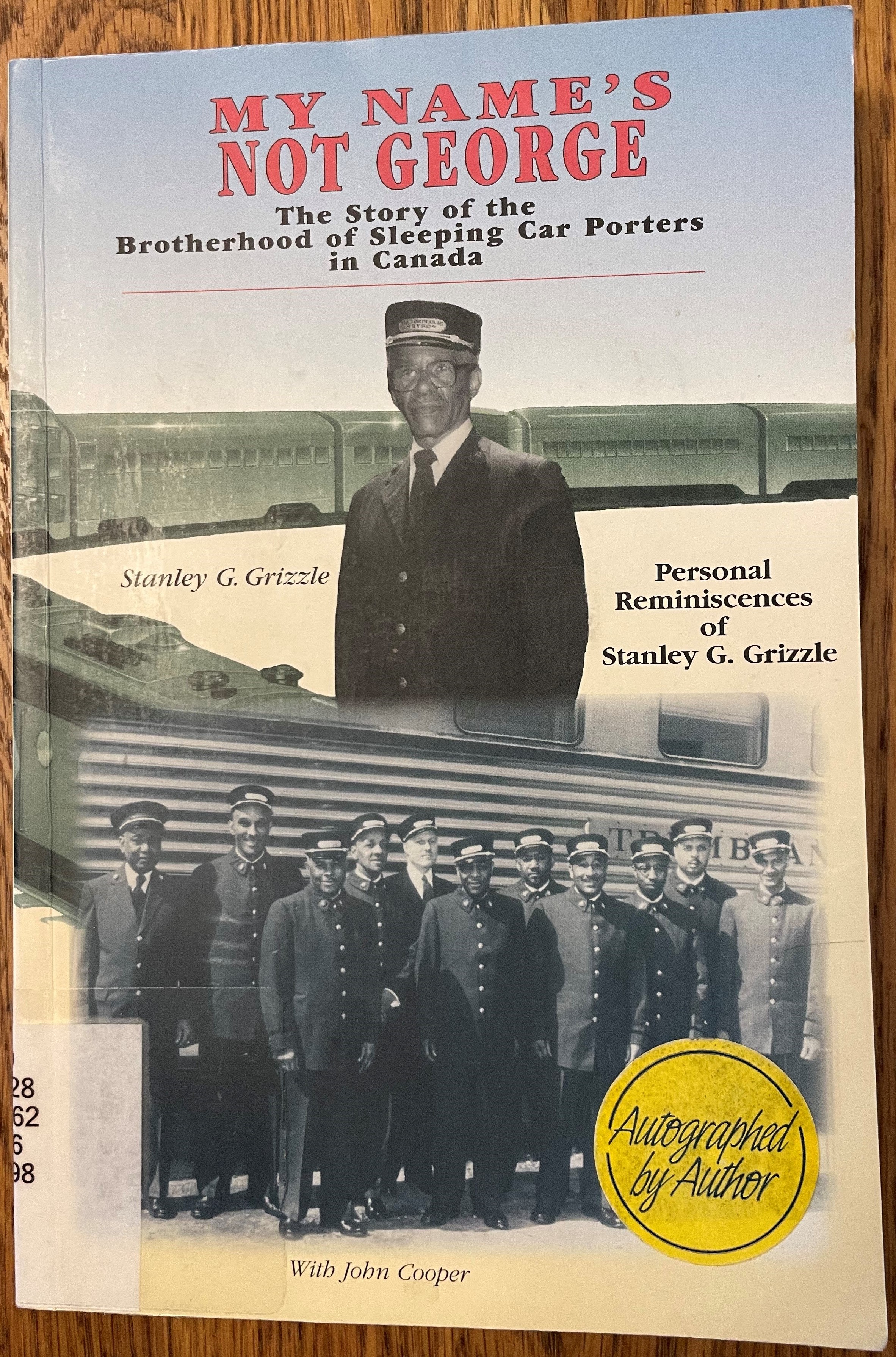
Stanley Grizzle was born in Toronto in 1918, to parents who had immigrated separately from Jamaica in 1911. His mother laboured as a domestic servant while his father found work as a chef with the Grand Trunk Railway (Grizzle, My Name’s Not George, p.  31). The eldest of seven children, Grizzle became a porter for the Canadian Pacific Railway (CPR) at the age of 22, pulled away from school to help his parents meet their dire financial obligations. “Porters,” as he puts it in his memoir My Name’s Not George: The Story of the Brotherhood of Sleeping Car Porters in Canada, “were well respected, and looked up to by many in the community because they had steady employment. In essence, they were the aristocrats of African-Canadian communities. They were the most eligible bachelors and parents often encouraged their daughters to marry a porter” (p. 37).

Book cover featuring a man with a train behind him, and a group of men below, all dressed in uniforms.

Book cover of My Name’s Not George: The Story of the Brotherhood of Sleeping Car Porters in Canada: Personal Reminiscences of Stanley G. Grizzle (OCLC 1036052571). Image courtesy of the author, Stacey Zembrzycki.

Grizzle’s early life began to follow this well-established trajectory, especially since portering was one of the only employment options available to Black men in the mid-twentieth century, until it was interrupted by the realities of the Second World War. Conscripted into the Canadian Army in 1942—legislation he firmly opposed throughout his life—Grizzle spent an extended amount of time away from the family he had only just started. In fact, his first child, Patricia, arrived on the very day he departed for Europe and did not have the opportunity to meet her father until he returned home, when she was three years old (Grizzle, My Name’s Not George, p. 57).

Grizzle’s early experiences with poverty, and the racism he encountered as a porter and a soldier, went on to dictate the new career path he paved for himself. First, as a celebrated labour union activist with the Toronto division of the Brotherhood of Sleeping Car Porters (BSCP), then as the first Black Canadian to be employed by the Ontario Ministry of Labour as a clerk with the Ontario Labour Relations Board, and later as the first Black Canadian to be appointed as a judge in the Court of Canadian Citizenship. There is no doubt that these experiences also informed the interviews he conducted in 1986 and 1987, now held by Library and Archives Canada (LAC).

As I mentioned in a previous blog, these 53 informal conversations among friends and acquaintances constituted what many, including Melvin Crump, referred to as “porter talk.” Meeting in Crump’s Calgary living room on November 1, 1987, the two men spent the afternoon discussing the intricacies of what it meant to be a porter. Not only did they describe what the job signified for them as Black men, they also explained how it shaped their identities and the larger Black communities that supported them.

Having been born in Edmonton in 1916 after his parents immigrated in 1911 as homesteaders from Clearview, Oklahoma, Crump’s early circumstances were much different from Grizzle’s. However, the men had both experienced the abject racism that was central to Black experience in Canada, which ultimately led them to a career with the CPR. Like Grizzle, Crump went to work for the company because it offered stable employment, away from the meatpacking plants and farms in the region that provided little stability and paid poor wages. In fact, Crump knew that this would be the only way to get ahead, so he lied about his age to obtain a job when he was just nineteen years old, thereby defying the age restriction that limited employment to those over twenty-one.

Like Grizzle, Crump spent about twenty years working for the CPR before seeking employment beyond the rails. The move from steam to diesel engines, coupled with automation, drastically changed the size, shape and appearance of this labour force, as well as passenger experience forever. As they had always done, the men moved toward a secure future. Regardless of their similar but divergent histories, both men prided themselves on having done their jobs well, and continued to stress the inherent value of unionization, regardless of the risks, nearly thirty years after leaving portering.

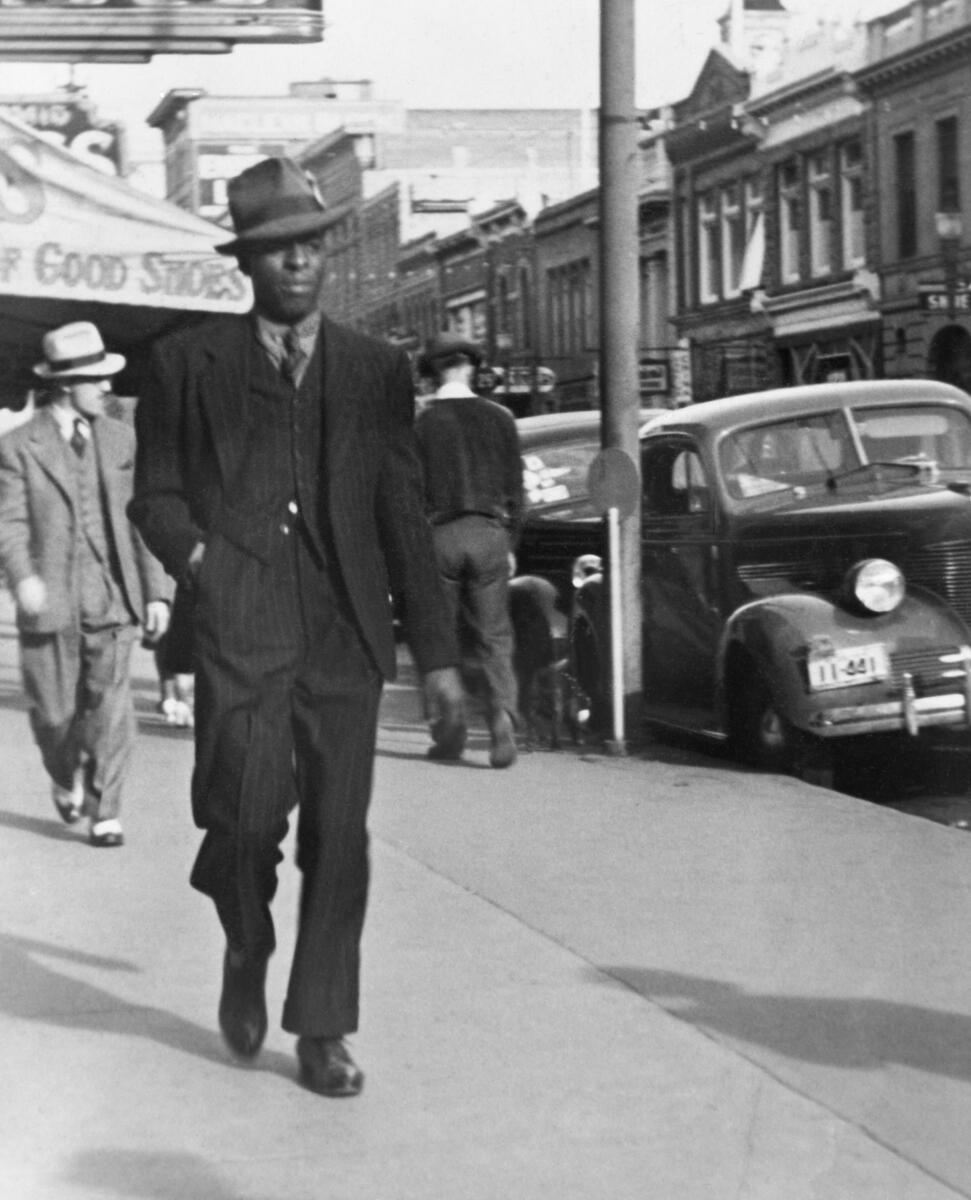
A man in a suit and hat walking down a sidewalk lined with cars and buildings.

Melvin Crump on 8th Avenue, Calgary, Alberta, ca. 1940, (CU1117465).
Photograph: Collection, Libraries and Cultural Resources Digital Collections, University of Calgary.

There is a coded language to this conversation. It is implicit, organic and almost impossible to understand without having lived through the institutional racism and systemic segregationist policies that guided nearly every aspect of these men’s lives, on and off the rails (Mathieu, North of the Color Line). The conversation is warm, the laughter is heartfelt, and the experiences intersect in complex ways. There is no need for detailed explanations between the men. These conversations were meant to support the writing of Grizzle’s memoir. While he was committed to documenting and preserving the history of portering in Canada, one wonders if these conversations were meant to be heard by others. And yet, here we are, listening in, translating their meaning and breaking the coded nature of these exchanges nearly forty years later.

By pushing Crump to articulate the particular circumstances that defined his experiences in Calgary—the friendships that were made, nurtured and even broken there, the specifics of unionization within that branch and the role of the wider community in fighting for change and supporting porters and their families—Grizzle highlighted the similar ways in which porters across the country were bound together by this demanding and often degrading profession.

And yet these intersections, which we hear across the collection, quickly become more complex when Grizzle asks Crump, as he did with all interviewees, to recount memorable railroad anecdotes. Porter talk offers insight into how each man put one foot in front of the other and built a life around portering. We get brief but powerful glimpses of who these men were, how they saw the world and why they tolerated and overcame the abuse they endured daily. As we gain a superficial understanding of each man’s personality, we also hear about resilience. Stories about memorable passengers naturally shift to stories about the other Black men with whom they shared railcars and responsibilities. The sense of community among porters and the conversations that started on the trains and flowed over into these interviews are what make these recordings so special. The laughter, reinforced by years of hindsight, reflection, recognition of service and a job well done, fuels the jovial exchanges that lead us into the realm of porter talk.

When Grizzle asked Crump to tell him about the prominence of nicknames between porters, Crump let out a roaring laugh, declaring:

Oh nicknames used between porters? Oh-oh-oh-oh, yes. Yeah, I know what you mean. You mean porter talk? You mean porter talk? Well, uh, uh, some of the porter talk names I wouldn’t wanna mention on tape, because if I did uh, it would shock some of the readers or some of the listeners, but they had a language all of their own, I’ll tell you. And some of the conversations that they would get in between themselves. I couldn’t dare, I wouldn’t dare to start to-to mention none of those things. (Interview 417403, File 2 [22:33])

And yet, porter talk is exactly what he, and nearly all of Grizzle’s other interviewees, transmit on these recordings. He couldn’t dare and yet he does. We are offered a seat at the proverbial table to listen, learn and take in a world that no longer exists, and yet remains central to who we are as Canadians.

It is this passing reference that inspired Discover Library and Archives Canada’s new miniseries Porter Talk. This will be the first in a new podcast production entitled Voices Revealed, which will delve into the vast and rich oral history holdings at LAC. While porters have figured prominently in popular culture in recent years, this will be the first time that these men, along with their wives and children, will speak for themselves. It is not enough to write about their exceptional experiences. Readers must hear these narratives. They must be able to differentiate accents, listen to laughter alongside rage, pause to ponder the challenges of portering and the resilience of Black communities in Canada, and grasp the power in these men’s voices and the history they convey.

Grizzle, Crump and all those who graciously agreed to be interviewed, will guide us through this history on their own terms, revealing why it is imperative for us to keep listening, to keep remembering, and to keep porter talk alive, especially as we continue to navigate the many challenges posed by institutional and systemic racism and discrimination in this country and beyond. The structures that these men, alongside their wives and children, worked so hard to dismantle, continue to matter. These voices remind us of the work that remains to be done.

To listen to this miniseries, you can subscribe to Discover Library and Archives Canada for free wherever you get your podcasts.

Additional resources


Stacey Zembrzycki is an award-winning oral and public historian of immigrant, ethnic, and refugee experiences. She is currently employed as a Podcast Development Specialist in the Outreach and Engagement Branch at Library and Archives Canada.

Soundscapes of the Stanley Grizzle Interview Collection

By Stacey Zembrzycki

This article contains historical language and content that some may consider offensive, such as language used to refer to racial, ethnic and cultural groups. Please see our historical language advisory for more information.

It is rare, when listening to oral history interviews, for the soundscape, the noises that one hears in the background, to be just as interesting and important as the stories being shared by interviewees. Practitioners today are trained to conduct interviews in quiet spaces, limiting noise so that every word spoken is clear and easy to understand. The crispness of each voice matters since it determines the life an interview will have among future listeners and within multimedia projects.

The Stanley Grizzle Interview Collection is fascinating because it flies in the face of this orthodoxy. When Stanley Grizzle travelled throughout the country documenting the stories of Canadian Pacific Railway (CPR) sleeping car porters, their fight to unionize and create the Brotherhood of Sleeping Car Porters (BSCP), and the important role of the women who served on the BSCP’s Ladies’ Auxiliary, he did so as an insider. A twenty-year CPR veteran, Stanley Grizzle conducted interviews that revolved around a clearly defined set of questions, which were replicated in each encounter. There were also, however, conversations among friends, many of whom Grizzle had worked with either on the railroad or during his time as a labour leader. Moving from home to home with a tape recorder that he started and stopped at will and at the request of interviewees, Grizzle instantly swept listeners into his world, where the formalities of the typical interview were cast aside, informal banter transpired, and drinks – complete with clinking ice cubes – were stirred in the background.

Grizzle’s insider knowledge both helped and hindered his ability to document the history of the BSCP. In most cases, he was immediately recognized as a “Brother.” Gaining trust was not difficult given the existence of prior relationships. As a result, many of the men tended to get right to the heart of what it meant to be a porter during the first part of the twentieth century. “Porter talk,” as Melvin Crump called it, allows listeners to see this world through the eyes of each porter with whom Grizzle met. It is an intimate look into a world that has now been lost. Viewing the job of a porter through this Black lens reveals how the men, and the women who supported them, thought about their everyday lives and viewed others. Ultimately, it also demonstrates the varied ways that they understood and negotiated societal inequality.

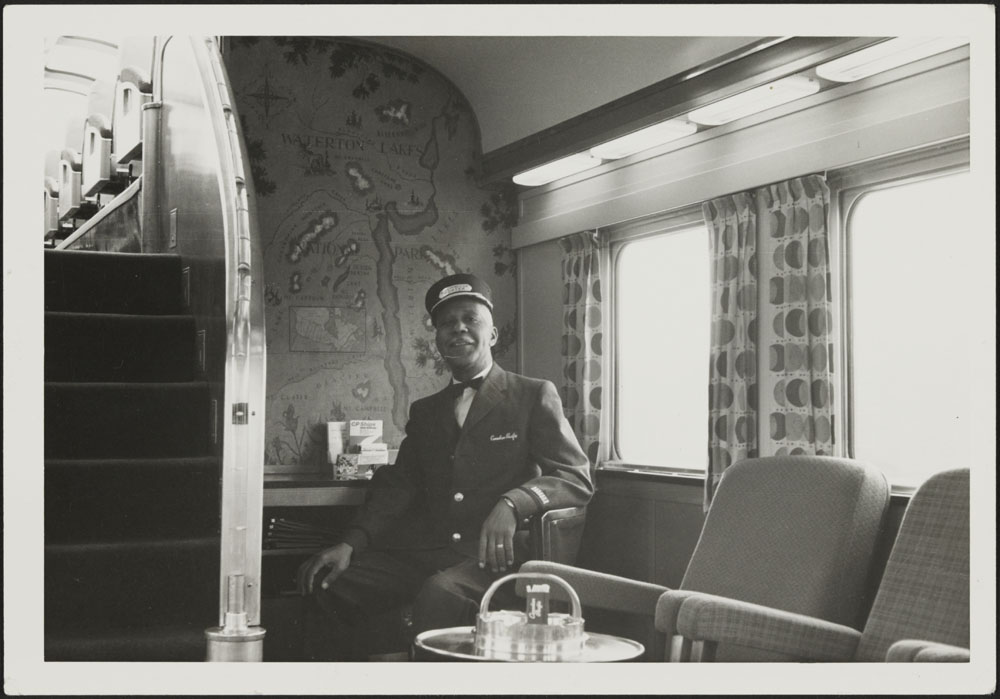
Canadian Pacific Railway sleeping car porter sitting in a train wagon.

Albert Budd, C.P.R., S.C. Porter, 1940s–1960s (e011781984)

Unfortunately, being an insider was not always beneficial. Given Grizzle’s own experiences, and his quest to document the history of the BSCP’s formation and of the men and women who made it possible, there were many missed opportunities along the way. In addition to Grizzle’s inclination to correct interviewees, stories pertaining to the fight for civil rights in the United States, experiences of migration, and some of the more problematic—and even controversial—issues that porters faced on the railroad are limited and, at times, absent from the record. The point was not to glorify porters’ diverse experiences, but there was a careful dance being done by those who recognized that reputations were at stake and the power that the company still wielded, despite the existence of the union, was real. In addition to these considerations, stories that should have been given space to be told were cut short given Grizzle’s objectives. Listeners hear the tape recorder stop and then restart at different stages in the life narratives being recounted. There is never any explanation. Listeners are left to try to listen for what was omitted, silenced, or simply lost to the past.

Nevertheless, along with these aspects of the interview, listeners are presented with wonderful opportunities to hear the ways that various sounds cut across these narratives and give us a way into a deeper understanding of who these interviewees were. Interviewees’ voices reveal the varied countries from which they descended. Heavy accents from America’s Deep South as well as those from a host of Caribbean nations tell us about lives lived elsewhere and the struggle of migrant labourers, who were often highly educated, to make a better life in Canada.

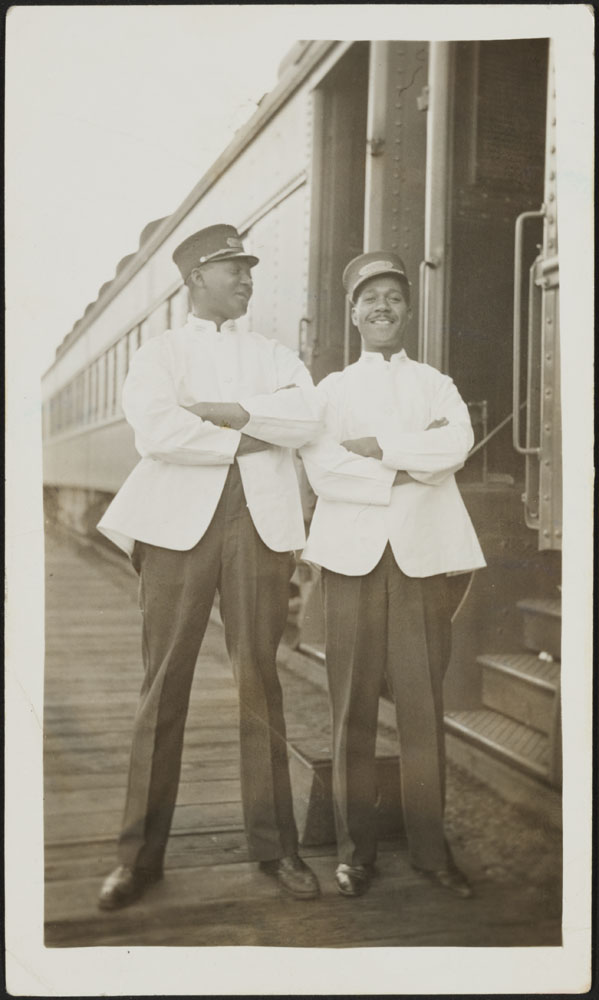
Two Canadian Pacific Railway sleeping car porters standing next to a train.

Left to right, Smitty from Montreal and Albert Budd (e011781983)

Everyday soundscapes also loom large. Radios and televisions wail alongside birds chirping in the background and children playing in neighbouring rooms. The banging of pots and pans reveals the presence of women in nearby kitchens, likely preparing a meal for their esteemed guest. The stomping of feet above the heads of Grizzle and his interviewees alongside the flushing of toilets speak to the substandard tenement housing from which some porters, then retired, were never able to escape.

We hear disability, too, when some stories are relayed. Heavy coughing and wheezing from smoking and its second-hand effects, as well as from years spent on the railcars, which picked up heavy amounts of pollutants through open windows, tell us about interviewees’ life choices in addition to the heavy toll this work took on their bodies. Men spoke of the disability pensions they collected as a result of the damage done to their backs by years of heavy lifting. On more than one occasion, Grizzle and his interviewees seem to be sitting in creaky wooden chairs, rocking back and forth, on creaky wooden floors, as the stories flow. One wonders whether the chairs speak to class, and the ability to own fancier furniture, or to disability, and the need for structure and support for aching bodies.

Group of Canadian Pacific Railway sleeping car porters gathered around a table.

C.P.R. porters, L–R Phil Witt, Jack Davis (e011781985)

The beauty of oral history is being able to listen to a story and take in the surroundings in which it is being created. It helps us process and make sense of the past. The Grizzle Interview Collection speaks to the complexity of understanding history as well as the importance of listening to the soundscapes in which everyday lives were captured and preserved for future listeners.

Additional resources

  • Oral History Off the Record: Toward an Ethnography of Practice, by Anna Sheftel and Stacey Zembrzycki (OCLC 841187000)

Stacey Zembrzycki is an award-winning oral and public historian of immigrant, ethnic and refugee experiences. She is currently doing research for Library and Archives Canada.

The Ladies’ Auxiliary of the Brotherhood of Sleeping Car Porters

By Stacey Zembrzycki

This article contains historical language and content that some may consider offensive, such as language used to refer to racial, ethnic and cultural groups. Please see our historical language advisory for more information.

Stanley Grizzle, citizenship judge, politician, civil servant, labour union activist, and porter of twenty years, travelled across the country in the late 1980s documenting the experiences of Canadian Pacific Railway (CPR) sleeping car porters and their struggle to unionize. His questions about the creation of the Brotherhood of Sleeping Car Porters (BSCP) always went hand in hand with those that documented the important role played by Black women in the BSCP’s Ladies’ Auxiliary.

Ten members of the Toronto Pullman Division’s Ladies Auxiliary posing for a photo.

Ladies Auxiliary, Toronto Pullman Division, Brotherhood of Sleeping Car Porters (e011181016)

While documenting the male “stalwarts,” as he called them, Grizzle was careful to ask about the mothers, sisters, wives, and daughters, who often lingered in this movement’s background, as well as in the background during these recorded sessions. The Stanley Grizzle Interview Collection thereby provides important gendered and generational perspectives into the forces that made unionization possible in Black communities across Canada. It also shows how involvement in the BSCP and its Ladies’ Auxiliary tended to serve as starting points for community mobilization around a broad array of issues and training grounds for community leaders.

Union leaders, inspired by A. Philip Randolph, an American labour unionist and civil rights activist as well as the organizer of the BSCP in the United States, recognized early on that women had integral roles to play in founding and sustaining this union movement. As Essex Silas Richard “Dick” Bellamy recalled:

I shall never forget when Brother Randolph came to Calgary, and Brother Benny Smith, he says, “There is no organization [that] will ever be successful unless the ladies are permitted into that organization.” And I have never forgotten, and I don’t believe you can find very many organizations [where] the ladies are…are not affiliated with the men in these various organizations. They seem to be able to give the men, uh-uh, a little more incentive to…in, in order to help them out. (Interview 417401)

Frank Collins succinctly echoed this sentiment: “…[You] had to have the women behind you before you had a strong union because, if you didn’t have them working with you, you were nowhere.” (Interview 417402)

Women’s solidarity was deeply rooted in the realities of the job. Being a porter required men to be on the road for as long as a month at a time. In their absence, porters’ wives, mothers, sisters, and daughters played principal roles, moving throughout their Black communities to encourage and promote the creation of the BSCP among both men and women, actively recruit and “card” porters at their local train stations and in their churches and community organizations, and, once the union was created, collect union joining fees and dues. Like other women, Velma Coward King, who was active in the Montreal BSCP Ladies’ Auxiliary, recognized the challenges of unionizing these men early on, noting that long stints away from home meant the men could not regularly attend meetings. Given that “[it] was the woman who was the back, uh, backbone in the house of the family,” they needed to step in. This was the only way forward, as she made clear, recognizing that: “Once you had a union to represent you and to speak for you, they knew that they couldn’t treat you as dirt.” (Interview 417383)

The power inherent in this aspect of the collection lies in its ability to tell the story of how upward mobility manifested out of unionization and women’s efforts to make that possible. The collective agreements that resulted from community solidarity led to improved working conditions and higher salaries, which, in turn, gave families the ability to move to suburbs, where they purchased homes. It also meant that there was money left over to help send children to university. Most importantly, as the Winnipeg BSCP’s Ladies’ Auxiliary first President Helen Bailey surmised: “I think men then became to even feel respect for themselves because then they had, uh, they were making a worthwhile living for their families.” (Interview 417400)

Poster advertising the tenth anniversary dance of the Toronto Division of The Brotherhood of Sleeping Car Porters and their Ladies Auxiliary.

Poster for a tenth anniversary dance organized by The Brotherhood of Sleeping Car Porters and their Ladies Auxiliary (e011536972)

The important generational thread that winds through these interviews clearly explains how BSCP Ladies’ Auxiliaries across the country brought women of all ages together to both organize and ultimately fundraise money through various community events, which included teas, socials, and dances. This money helped move union leaders across the country, giving the BSCP strength; funded travel to national and international conventions, giving Canadian labour leaders a voice in the movement; and supplemented education through scholarship funds.

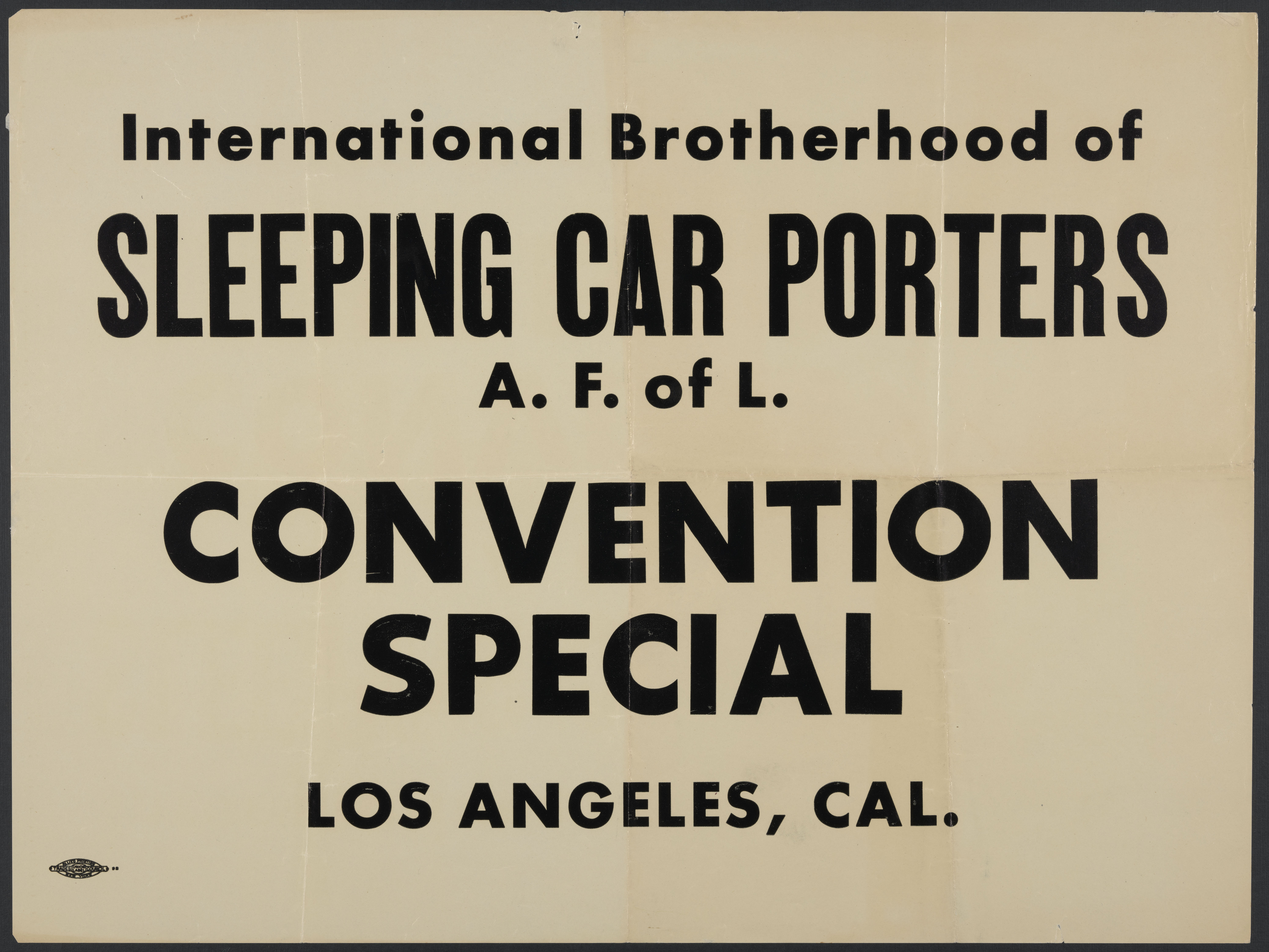
Poster for the International Brotherhood of Sleeping Car Porters’ Convention Special in Los Angeles, California.

International Brotherhood of Sleeping Car Porters poster for a Convention Special in Los Angeles, California (e011536973)

Breaking the generational reality of portering, wherein fathers and their sons were forced into this profession because of the absence of other employment opportunities, was never far from the minds of the women who were involved in the BSCP’s Ladies’ Auxiliaries. Women’s involvement also gave some, like Ivy Lawrence Mayniar/Maynier, glimpses into the systemic racism and discriminatory labour practices that were integral to Black experiences in Canada. In speaking about her father’s career as a porter and her drive to seek out higher education as a result of it, Mayniar shared a powerful memory from while she was a student at McGill University:

[…] I was then going to, to the university. And then I walked down to the…to work at the library for a while. And I walked down to the, uh, uh, station and looked for Dad’s car. And I remember one night, it was bitter. […] It was a bitter night. And I, I, I myself was just so upset about this. And…but I wanted to go down ’cause I knew Daddy was going on standby. He was standing out. And I went down, went to the station, went and looked down the track for Dad. And there he was standing outside. Dad was a short man and this, you know, tight little person. And I looked down there to catch his eye. And there he was standing with snow on top of his cap, and his shoulders pushed…pulled together like this, and the wind was going down that line there, just brutally. It was just awful. And he was just standing there, and, uh…and the snow piled up on him. And, uh, I went and I sat down in the concourse outside from where…from where the trains left…And I just sat on a bench and cried. I’ll never forget that. (Interview 417387)

Mayniar became the first Black woman to graduate from the University of Toronto Law School, but she went on to study in England, where she was called to the bar at the Inns of Court, because she recognized the limitations she would continue to face in Canada as a person of colour. She practiced law in Trinidad and Tobago, where she spent the remainder of her career fighting against the racism and discrimination that she saw exemplified in her father on that cold, wintry day at Windsor Station.

The interviews conducted by Grizzle not only document the history of the fight to unionize CPR sleeping car porters, but also speak to a history that is bound up in the advancement of Black families and their communities throughout Canada. There could not be one without the other. When listening to the voices of these men and women, one hears the power inherent in women’s collective actions, how ever small, and the pride these wives, mothers, sisters, and daughters had in knowing that they effected change on the ground for the men in their lives as well as their children and themselves. When Grizzle asked Evelyn Braxton whether the “Ladies’ Auxiliary lived up to the expectations, uh, of, uh, giving the Brothers the, the maximum support that they, uh, looked forward to,” she wholeheartedly declared: “Oh, they certainly did. The Ladies’ Auxiliary was the support of the Brotherhood men.” (Interview 417386) Women were not only the backbone of their families: they held up their communities and the generations that followed.

Additional resources:

  • My Name’s Not George: The Story of the Brotherhood of Sleeping Car Porters in Canada: Personal Reminiscences of Stanley G. Grizzle, by Stanley G. Grizzle with John Cooper (OCLC 883975589)
  • Deindustrializing Montreal: Entangled Histories of Race, Residence, and Class, Chapter 3: The Black City below the Hill, by Steven High (OCLC 1274199219)
  • North of the Color Line: Migration and Black Resistance in Canada, 1870–1955, by Sarah-Jane Mathieu (OCLC 607975641)

Stacey Zembrzycki is an award-winning oral and public historian of immigrant, ethnic and refugee experiences. She is currently doing research for Library and Archives Canada.

Black porters’ voices and stories: the Stanley Grizzle interview collection

By Stacey Zembrzycki

This article contains historical language and content that some may consider offensive, such as language used to refer to racial, ethnic and cultural groups. Please see our historical language advisory for more information.

The history of the railway in Canada is often narrated in a celebratory manner. It is seen as having united the country from coast to coast, with the last spike coming to symbolize the fruition of Confederation. And yet, this history is deeply rooted in the dispossession of Indigenous peoples from their ancestral lands and territories, the exploitation of Chinese migrant labourers, and the discriminatory labour practices experienced by Black sleeping car porters. The Stanley Grizzle interview collection, which consists of interviews with 35 men and 8 women who were either porters or had loved ones who worked the rails, offers a different account of the railway. The collection is exceptional because of its ability to bring us deep inside this history. It tells it from a new perspective that places Black Canadian and Black migrant labourers’ voices, as well as the stories of the racism that they experienced while employed by the Canadian Pacific Railway (CPR), at its centre. These interviews also offer glimpses into the Depression, the Second World War, the struggle to unionize porters, the creation of the Brotherhood of Sleeping Car Porters (BSCP) and its Ladies’ Auxiliary, and ultimately what life was like inside Black communities across the country. The difficult narratives in this collection speak to the strength and resilience of those who have long been discriminated against simply because of the colour of their skin.

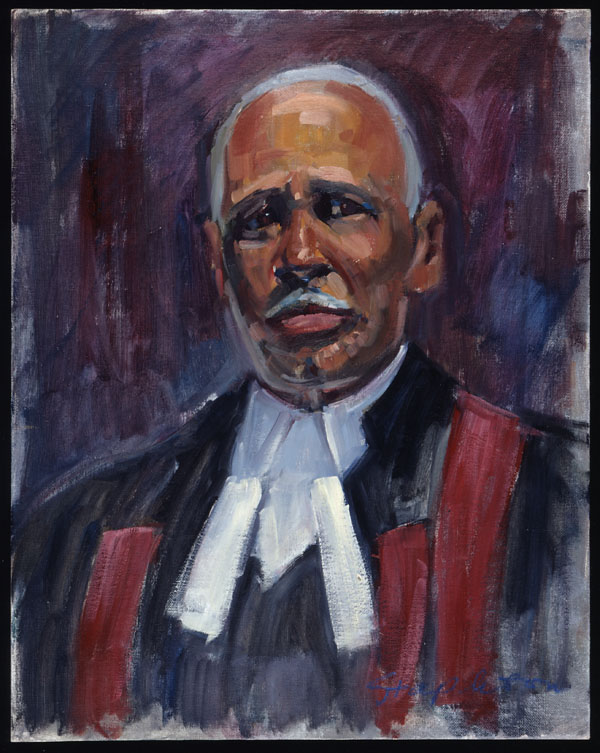
A painted head-and-shoulders portrait showing an older Black man dressed in judge’s robes and a crisp white shirt. His black robes are embellished with a burgundy sash. The man, who looks directly at the viewer, has short grey hair and a grey moustache.

Portrait of Citizenship Judge Stanley Grizzle by William J. Stapleton (c151473k)

In 1986 and 1987, Stanley Grizzle travelled across the country, to the CPR’s major junction points of Montréal, Toronto, Winnipeg, Calgary and Vancouver. There, he documented the experiences of those who were born in the first two decades of the 20th century and went on, in most cases, to have long and storied careers as porters. Grizzle was himself a porter for 20 years, as well as a labour union activist, political candidate, civil servant and citizenship judge. The narratives that he collected informed his 1998 memoir, My Name’s Not George: The Story of the Brotherhood of Sleeping Car Porters in Canada, Personal Reminiscences of Stanley G. Grizzle.

Portering was not a profession of choice. It was one of the only employment options available to Black men in the 1950s and 1960s. As Torontonian Leonard Oscar Johnston recounted:

I applied for jobs, but I was refused because of colour. Well, actually they called me “n….” And I remember one day, I walked from Jane and Bloor to River Street, along King Street, lookin’ for a job as a—I was a machinist. I had a couple of years machine shop, and I was told to shine shoes. Yeah. Now that’s 50, 60 years ago, but—and I decided, “Okay, I’ll shine shoes.” So, I went down the CPR.
(Interview 417394)

For others, being a porter was a way to escape the racial violence of the Deep South or to make a better life for themselves after leaving the Caribbean. Many of these migrant labourers were either university educated or held trade specializations but still could not find jobs in Canada. In desperation, they responded to CPR advertisements and recruitment campaigns, becoming porters. Some men stayed for 10 years, moving to other sectors once they opened up. Others remained for up to 40 years, to collect the pensions they earned for their service.

A crowd of people disembark from a train as railway employees and porters help them with their luggage.

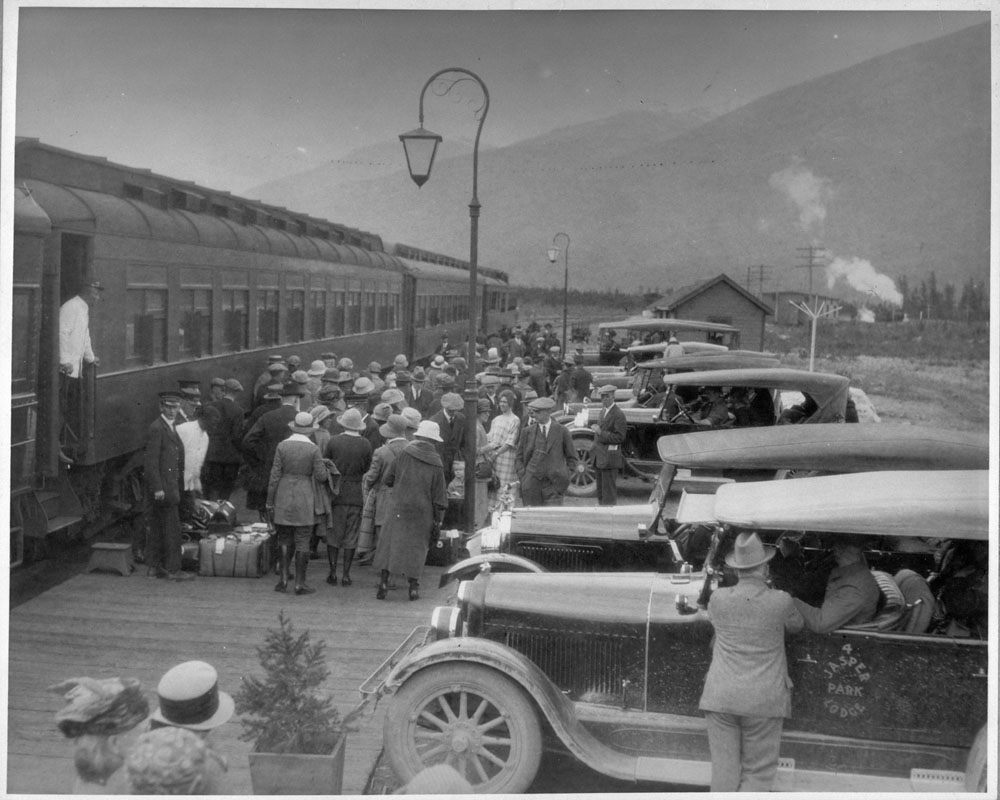
Railway porters help passengers to disembark at a railway station (a058321)

These men were responsible for greeting rail passengers and attending to their every need while in transit. Prior to the creation of the BSCP, which ratified its first collective agreement in 1945, it was typical for porters to be on the road for three to four weeks at a time. While away from their families and communities, porters worked 21-hour days. They were permitted to sleep on the leather sofas in the smoking cars beside the bathrooms for just three hours a night, but only when all of their tasks, such as cleaning bathrooms, shining shoes, making beds, counting linens and attending to passengers’ needs, had been completed. The CPR also monitored porters’ time while on layovers, requiring them to report to the main stations daily, where they were forced to relay their activities and movements. For this work, the CPR paid porters a monthly salary of $75. This flat rate, coupled with the absence of overtime pay, meant that tips were the only way to survive.

The men, many of whom had knowledge of or experience working in other unions, knew that their situation could be improved only through unionization. They aligned themselves with famed American labour unionist, civil rights activist and organizer of the BSCP, A. Philip Randolph. The gains in their first collective agreement not only improved the lives of the men, leading to salary increases, overtime pay, assigned sleeping berths and decent meals, but also those of their families. Upward mobility, signified by purchasing homes, moving to the suburbs, and accessing higher education, were key developments that followed. The interviews in this collection describe the struggles to organize union locals across the country. They also depict the people, including the women participating in the Ladies’ Auxiliary, who made these efforts possible.

The experiences of the porters are still difficult to hear, but the interviews are fascinating, bringing us deep into the world of what Melvin Crump referred to as “porter talk” (Interview 417403). Namely, they give listeners the ability to view these experiences as the porters once did. We hear these men seamlessly move beyond the racism and discrimination that they experienced, spinning their everyday encounters into learning opportunities where fun could be had and power could be taken back. George Forray’s reflections were similar to those of others who recognized the systemic racism they faced:

“Well, I found it quite an education. I found it an education which I couldn’t have got at no university. An education in, uh, all the, uh, practically that we can say the facts of life all through and something I couldn’t have bought or earned or been taught, except when I went experienced it myself.”
(Interview 417383)

At heart, the Stanley Grizzle interview collection preserves voices and stories of survival. It tells us how porters viewed their passengers, themselves, and ultimately the world that worked so hard to beat them down.

Additional resources

  • My Name’s Not George: The Story of the Brotherhood of Sleeping Car Porters in Canada, Personal Reminiscences of Stanley G. Grizzle by Stanley G. Grizzle with John Cooper (OCLC 1036052571)
  • “Chapter 3: The Black City below the Hill,” in Deindustrializing Montreal: Entangled Histories of Race, Residence, and Class by Steven High, pp. 92–128 (OCLC 1274199219)
  • Unsettling the Great White North: Black Canadian History by Michelle A. Johnson and Funké Aladejebi, eds. (OCLC 1242464894)
  • North of the Color Line: Migration and Black Resistance in Canada, 1870–1955 by Sarah-Jane Mathieu (OCLC 607975641)
  • The Sleeping Car Porter by Suzette Mayr (OCLC 1302576764)

Stacey Zembrzycki is an award-winning oral and public historian of immigrant, ethnic and refugee experiences. She is currently doing research for Library and Archives Canada.

Douglass Day featuring Mary Ann Shadd Cary – a Co-Lab challenge

Version française

Born around 1818 as an enslaved person, Frederick Douglass became a leader in the abolitionist movement in the United States. A prolific writer and a masterful speaker who captivated audiences throughout the U.S. and Great Britain, Frederick Douglass contributed to the rise of antislavery sentiment. He is widely considered the most influential civil and human rights advocate of the 19th century.

Like many enslaved people, Douglass never knew his birthdate. He chose to celebrate every year on February 14. In recognition of his birthday and to honour his legacy, Douglass Day is an annual celebration that highlights resources for learning about Black history and makes them more available. Douglass Day focusses frequently on important Black women’s archives. In 2023, the day will highlight the archives of Mary Ann Shadd Cary, a teacher, journalist, lawyer and activist who worked on both sides of the border, and made history when she became the first Black woman in North America to start and publish a newspaper.

A black-and-white photograph of a Black woman looking towards the camera.

Mary Ann Shadd Cary. (c029977)

Mary Ann Shadd Cary was born free in the slave state of Delaware in 1823. Her parents, Abraham and Harriet Parnell Shadd, were abolitionists, and their home was a station on the Underground Railroad. In 1850, Congress passed the Fugitive Slave Act, which compelled Americans to assist in the capture of runaway slaves and levied heavy penalties on those who did not comply. Shadd Cary and her family moved to Canada West (known today as Ontario) in 1851, where she opened a school in Windsor catering to the area’s growing fugitive slave population.

Following her move to Windsor, Shadd Cary gained prominence as an important figure and influential leader within several antislavery societies. In 1853, Shadd Cary was actively involved in founding the weekly newspaper The Provincial Freeman, in which she published content that advocated for equality, integration, and self-education of Black people in Canada and the United States, and promoted emigration to Canada. Shadd Cary continued in her role as a schoolteacher in Chatham, Ontario, and in 1862 became a naturalized citizen of Canada West during the first years of the American Civil War, but returned to the United States thereafter.

A two-tone legal-sized document with print and handwritten text.

Mary Ann Shadd Cary’s naturalization certificate. (e000000725)

Having later moved to Washington, D.C., Mary Ann Shadd Cary pursued law at Howard University, where she reached another historic milestone in 1883 by becoming the second Black woman in the United States to earn a law degree. During this time, she continued to participate in both civil and equal rights movements in the United States, returning to Canada only briefly, to organize a suffragist rally in 1881.

A document with handwritten and text portions, with a crest along with the letter “A” and the number “128” at the top.

Mary Ann Shadd Cary’s passport. (e011536884-004)

LAC received the collection of original material relating to Mary Ann Shadd Cary in 1960 and 1964 from her granddaughter Muriel E. Thompson. This donation included correspondence between Shadd Cary’s family members, her naturalization certificate for Canada West, her passport for the Province of Canada (now Ontario and Quebec), as well as portions of an edition of The Pioneer Press, published in Martinsburg, West Virginia. Most significantly, however, this donation included the only known photograph of Mary Ann Shadd Cary.

Mary Ann Shadd Cary’s archives are found not only at Library and Archives Canada, but also at the Archives of Ontario and Howard University in Washington. This year, Douglass Day will feature virtual and local events to help transcribe, read and teach the papers of Mary Ann Shadd Cary held at LAC and the Archives of Ontario. At the centre of the celebration will be a crowdsourcing transcription project called a transcribe-a-thon. During this event, thousands of participants will transcribe the digitized collections. Once their work is complete, this fascinating and important material will be accessible to researchers around the world.

We invite you to use our Co-Lab tool to transcribe, tag, translate and describe the digitized records that are part of this challenge. You can also make contributions to any image through our Collection Search tool.