Black Porter Perspectives: Giving Voice to Rail Service During and After the Second World War

Version française

By Stacey Zembrzycki

This four-part Black Porter Perspectives blog series is inspired by a striking and haunting set of images found within the Department of National Defence (DND) accession 1967-052. These photographs provide a window into service to country through various vantage points during and after the Second World War, revealing the intersections of class, race and duty.

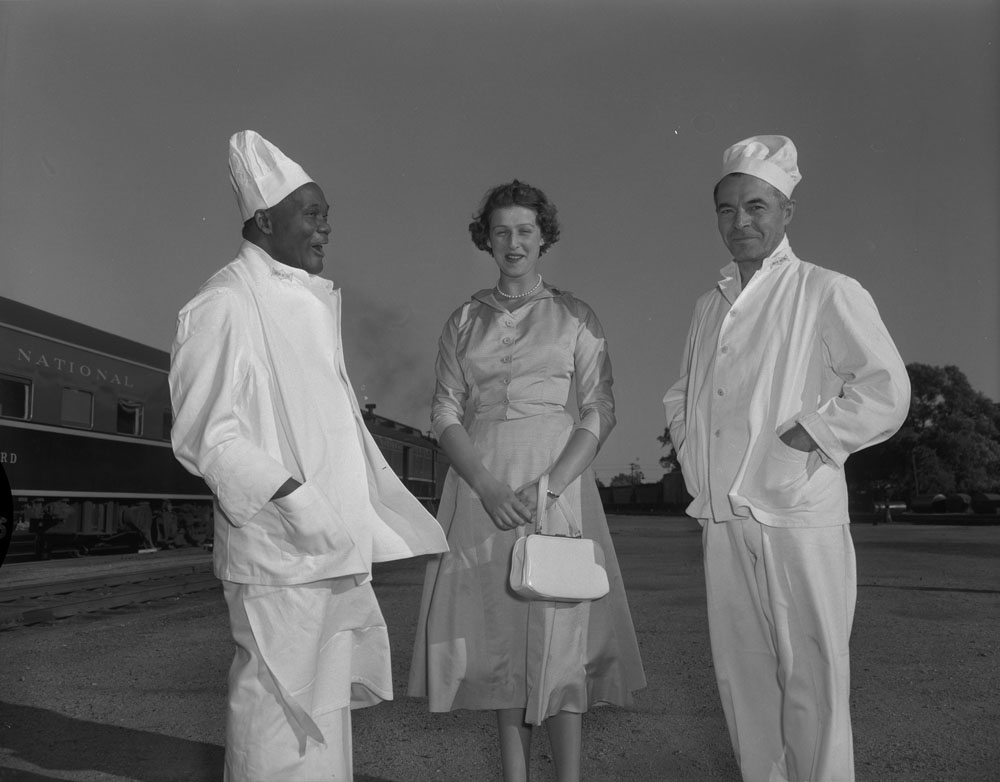
A white woman standing between a black man on the left and a white man on the right.

Princess Alexandra represents the British Crown on Canadian soil during her Royal Tour in 1954. (e011871943)

Volunteer, and in some cases, conscripted servicemen departing for and returning from battle offer us a glimpse into the realities of preparing for war, deploying to distant fronts, and returning home again.

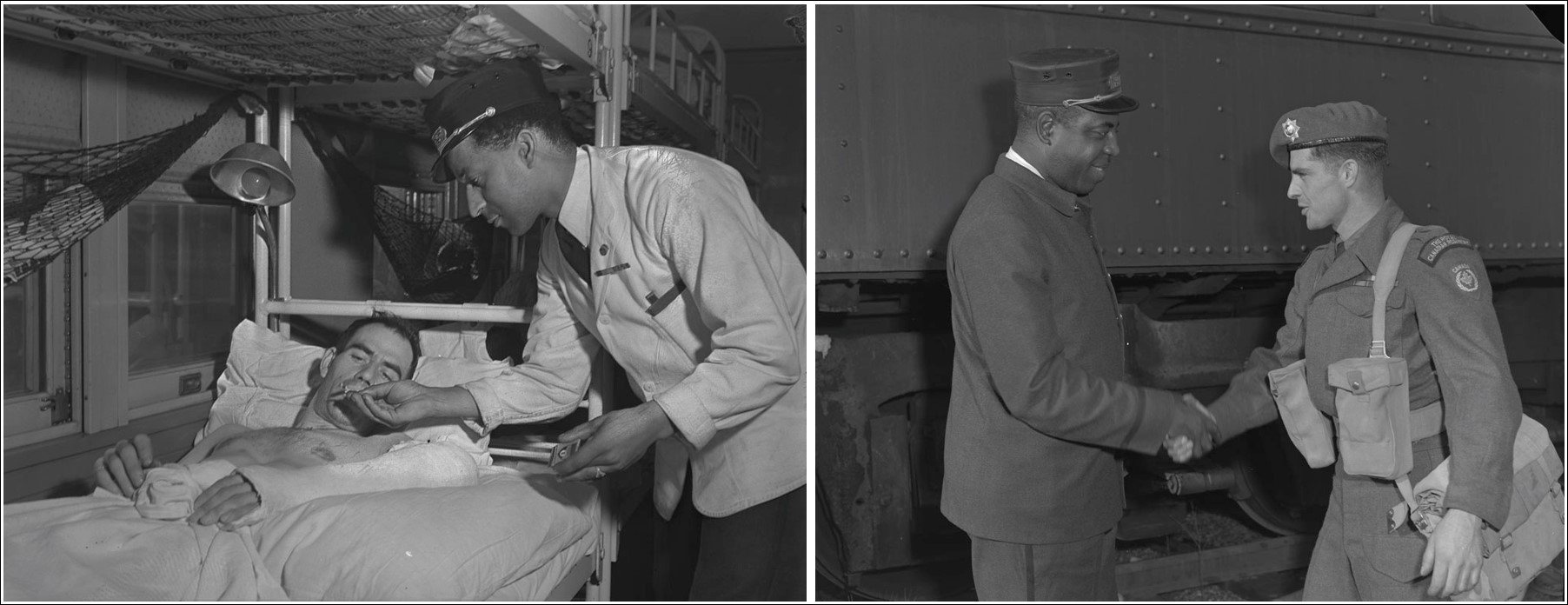
Side-by-side photographs of a Black sleeping car porter lighting a cigarette for an injured white soldier lying in a bed on a train, and of a Black sleeping car porter shaking hands with a white soldier.

Image on left: A sleeping car porter and an injured soldier on the Lady Nelson hospital train. Image on right: Porter Jim Jones of Calgary shakes hands with Private Harry Adams, a Halifax member of the Royal Canadian Regiment, as Canadian Army Special Force units arrive at Fort Lewis, Washington, for brigade-strength training. (e011871940 and e011871942)

Black men, often identified as train staff in the image descriptions, appear in every photograph—serving as the unifying thread in these historical moments. Their essential work, whether as cooks or sleeping car porters, made train travel possible, luxurious even, in times of war and peace. While this labour has often been silenced and overlooked in our national narratives, it is undeniably present in these images.

How can we begin to piece together the experiences that are captured in these images? One way is to turn to the Stanley G. Grizzle collection, particularly the interviews he conducted in 1986 and 1987 with former Canadian National (CN) and Canadian Pacific Railway (CPR) sleeping car porters. Grizzle sought to document the exploitative company culture Black men endured up to the mid-twentieth century and the long and complex struggle that ultimately led to their unionization. At the same time, he also made space for his narrators to recount memorable stories from their time on the rails. These recollections, if listened to closely, allow us to begin piecing together a narrative that enables us to better contextualize some of these DND images. Like the past, however, these moments remain fleeting and fragmentary, with much lost to history.

Five interview clips from Grizzle’s collection provide insight into what portering looked like during the Second World War. While these exchanges provide few details about the images above, they offer glimpses into porters’ working conditions and the added responsibilities they shouldered during wartime. Let’s listen to what these conversational tangents reveal about their experiences:

You can read the transcript from this sound clip here. (ISN 417383, File 1, 34:30)

You can read the transcript from this sound clip here. (ISN 417397, File 2, 9:26)

You can read the transcript from this sound clip here. (ISN 417379, File 1, 17:18)

You can read the transcript from this sound clip here. (ISN 417379, File 1, 5:56)

You can read the transcript from this sound clip here. (ISN 417386, File 1, 32:12)

The experiences of the men, the people they served, and their feelings about the additional duties thrust upon them as a result of the Second World War offer valuable insights that help humanize the role of portering. For George Forray, the demands of wartime rail service provided financial security, allowing him—and many others—to secure full-time employment during this turbulent period. Bill Overton, while recounting the hard-fought union gains he helped achieve, shared a story of being overwhelmed by 83 hungry Air Force cadets needing lunch. While there were white off-duty staff members on the train at the time, he explained the challenges of asking for their assistance. Through his account, we gain a deeper understanding of the intricacies and misunderstandings surrounding overtime pay during this era and the racialized structures that governed and divided rail workers.

In one of the clearest and most concise wartime stories in Grizzle’s collection, an unknown narrator recounts—despite audible breaks in the sound recording—details of transporting German prisoners of war. While he describes the sleeping cars’ physical environment and the meals served, much is left to the imagination, leaving gaps about how porters perceived this service and the potential dangers they faced. These insights are largely lost to history. Eddie Green builds on this discussion while speaking about the evolution of train technology in the early twentieth century. The reintroduction of outdated train cars to meet wartime demands posed significant challenges and physical dangers for porters, who had to navigate these risks while managing increased passenger loads. The stress would have been tremendous.

In many ways, the final interview clip brings the narrative full circle. In it, Joseph Morris Sealy reflects on how the high demand for wartime rail service paved the way for significant union gains. Government-backed wage increases served as a crucial starting point for negotiating the first collective agreement between the International Brotherhood of Sleeping Car Porters and the CPR in 1945. There was no going back to the way things were before the war. The uninterrupted movement of people and goods by rail had proven essential to sustaining a stable and functioning economy. Porters, fully aware of the critical role they played, fought to ensure they were treated fairly and justly compensated.

While piecing together the contextual information behind the images included above may not be possible, these accompanying narratives contain enough information to reveal what may have been happening before and after photographers captured these moments in time. They give a voice to the experiences of porters, shedding light on the complexities of their work during and after the Second World War. Yet, as with all historical sources, this oral and photographic evidence underscores the challenges of reconstructing the past—we must work with the fragments available to us. Despite their limitations, these sources compel us to fundamentally rethink our national narrative and the pivotal role of Black labour within it.

Additional Resources


Stacey Zembrzycki is an award-winning oral and public historian of immigrant, ethnic, refugee, and racialized experiences. She is a faculty member in the Department of History and Classics at Dawson College.

Black Porter Perspectives: Hospital Ships and Hospital Trains

Version française

By Jeff Noakes
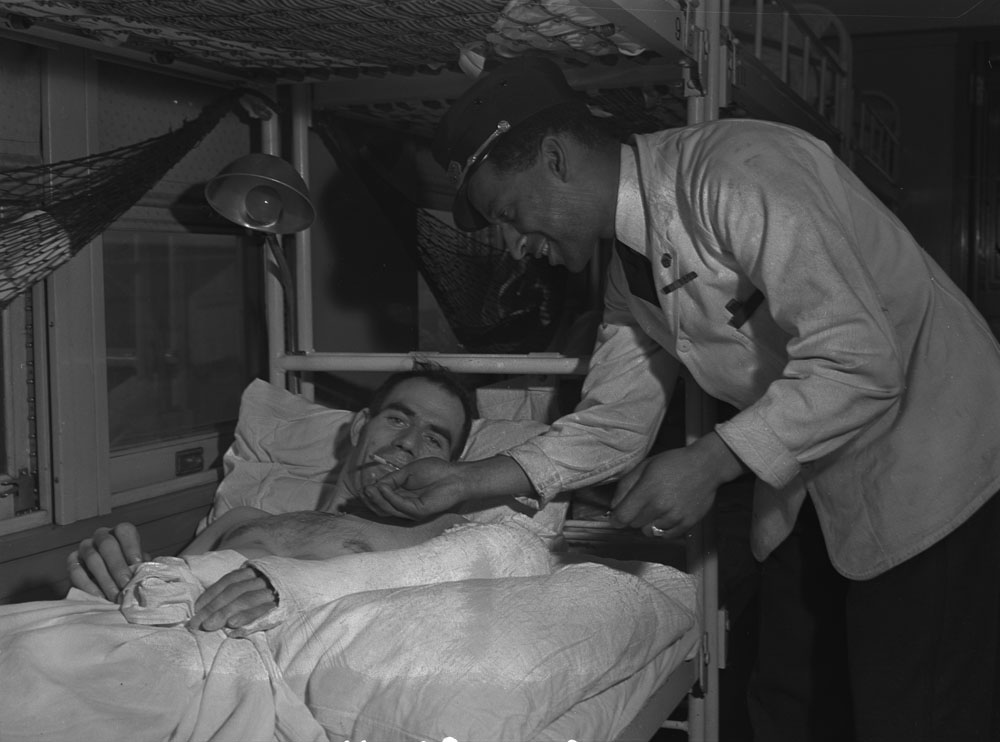
Black-and-white photograph of a porter (on the right, with white jacket and dark cap) leaning over to light the cigarette of a patient lying in the bed on the left.

Porter Jean-Napoléon Maurice (right) leans over to light the cigarette of Private Clarence Towne, a patient on a hospital train, August 20, 1944. (e011871941)

The image above comes from a series of photographs of Black sleeping car porters from during and after the Second World War. This series documents service to country through various vantage points. It also forces us to ponder the backstories to the images. Who appears in these photographs? Why were they taken? Why are they significant? And what stories can they help us uncover?

The date and original cataloguing provide enough information to look further into parts of some of these stories. As a photograph taken for public consumption, this image soon appeared in Canadian newspapers, which identified the two men appearing in the image: Porter Jean-Napoléon Maurice and Private Clarence Towne. Newspaper captions also provided some additional information about both men, noting that Maurice had served with the Royal 22e Régiment and had been wounded in Italy, while Towne had been wounded in fighting at Caen, in Normandy. Not mentioned in some instances is Maurice’s earlier service with Les Fusiliers Mont-Royal, including his participation in the Dieppe Raid.

While Maurice’s military service is explicitly mentioned in the newspaper caption, it is also conveyed through his uniform. Visible on his white jacket are medal ribbons, along with the shield-shaped General Service Badge that he was entitled to wear because of his military service. Both would have been readily recognized by many viewers at the time. Towne’s service, and his wounds, are clearly depicted by his left arm, encased in a plaster cast. In at least one newspaper, the photograph was retouched to make the white cast more clearly visible against the bedsheets.

The photograph was very likely intended as part of a wider publicity campaign relating to hospital trains. Maurice was one of four Canadian Pacific Railway (CPR) porters who were veterans, had been wounded in service and were chosen to work on such trains. Stories about these four men—along with Maurice, they were identified in newspapers as Randolph Winslow, Sam Morgan and James E. Thompson—their military service and their work as porters, including the photograph seen above, appeared in late August 1944.

The date and original caption also furnish enough information to conduct further research into records held by Library and Archives Canada (LAC). While there was no “Lady Nelson Hospital Train,” one of Canada’s Second World War hospital ships was the Lady Nelson. Originally a civilian ocean liner, in 1942 the ship was sunk in the harbour at Castries, Saint Lucia, by a German submarine. After being salvaged, the Lady Nelson was converted into a hospital ship for transporting wounded, injured and sick military personnel; it would later be used to repatriate other military personnel and their dependents. Its voyages included trips from ports in the United Kingdom to Halifax, Nova Scotia. From there, hospital trains, using equipment provided by both the Canadian National Railway (CNR) and the CPR, transported patients to destinations across the country. The photograph, therefore, depicts a scene aboard a hospital car in one of these trains, carrying patients from the Lady Nelson.

During the Second World War, responsibility for many aspects of these operations fell to the Department of National Defence’s Directorate of Movements. Its records form part of the Department of National Defence fonds at LAC [R112-386-6-E, RG24-C-24]. This substantial collection covers the movement of hundreds of thousands of military personnel to and from Canada, as well as the transportation of cargo and military equipment. It also includes extensive records relating to the movement to Canada of military dependents, including war brides and their children, during and after the war. The records, which were microfilmed around 1950, are now available on digitized microfilm at Canadiana by the Canadian Research Knowledge Network.

Advisory: these records are in English only and can include medical information that some people may find disturbing, offensive or potentially harmful, including historical language used to refer to medical diagnoses. The records can also contain other historical language and content that may be considered offensive or potentially harmful, such as language used to refer to racial, ethnic and cultural groups. The items in the collections, their content and descriptions reflect the period in which they were created and the views of their creators.

These records include files relating to the movements of hospital ships and the personnel they repatriated, as well as the planning and operation of the hospital trains and other means of transportation that brought these patients to points across Canada and in Newfoundland. In some cases, these voyages extended even further. This included the repatriation of Americans serving in the Canadian military, as well as members of Allied militaries whose lengthy homeward journeys took them through this country.

Since the cataloguing information notes that this photograph was taken on August 20, 1944, it suggests a connection with an arrival by the Lady Nelson a few days before. A search of the LAC catalogue turns up a Directorate of Movements file [RG24-C-24-a, Microfilm reel number: C-5714, File number: HQS 63-303-713] for such an event on August 18, although the ship may in fact have docked just before midnight on August 17. As a result, the photograph offers an entry point into what the records of this specific voyage contain. It also provides an opportunity to discuss how these sorts of records can be useful, as well as some of their inherent limitations, especially with respect to the experiences of sleeping car porters on these hospital trains.
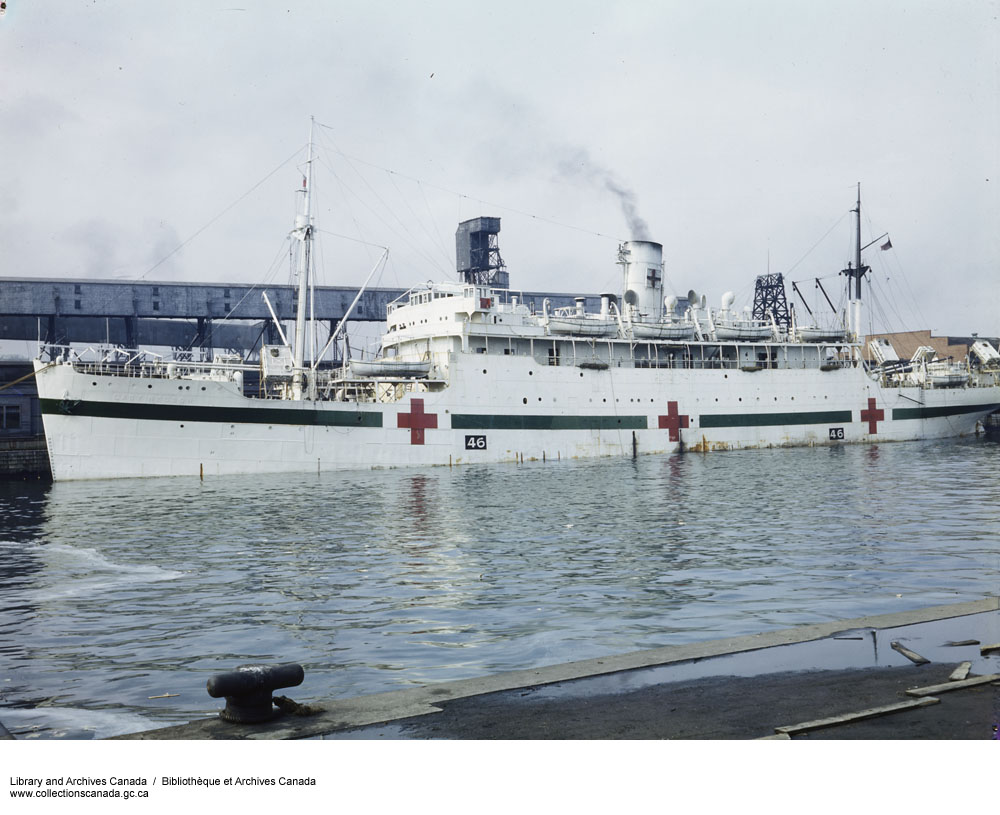
Colour photograph of a hospital ship with a white hull and superstructure and a single funnel, with grey port buildings in the background. A green stripe with three red crosses runs horizontally along the ship’s hull. The number 46 is painted in black rectangles below the green stripe.

The Canadian hospital ship Lady Nelson in Halifax, Nova Scotia. (e010778743)

This particular file’s hundreds of pages of messages, letters, memos and lists of repatriated personnel provide a general outline of these events. When the Lady Nelson left Liverpool shortly before midnight on August 8, 1944, it was carrying a total of 507 personnel to Halifax for medical reasons. Nearly all were members of the Canadian military, with some 90 percent from the Canadian Army. The ship was also transporting two Newfoundlanders who had served in Britain’s Royal Navy, as well as one Royal New Zealand Air Force officer on his lengthy way home via Canada. Two patients died during the trip and were buried at sea: Private George Alfred Maguire on August 11 and Captain Theodore Albert Miller on August 15. Their service files, digitized and available through LAC’s catalogue, help provide some details of their final voyages.

The file for this trip also reflects a number of broader stories, in particular the way that wounded, injured and sick military personnel were being returned to Canada from overseas. In mid-August 1944, this capacity was about 500 at a time aboard the Lady Nelson. The following month, a second Canadian hospital ship, the Letitia, entered service, with the ability to transport around 750 patients. At that point, some 1,000 or more wounded, injured and sick could be repatriated every month across the North Atlantic to Canada.

The need for this augmented capacity speaks to the growing number of repatriations arising from increased combat activity overseas following the D-Day landings on June 6, 1944, and the subsequent campaign in Normandy. The casualties from this fighting added to the ongoing toll of the land campaign in Italy and the war at sea and in the air; a mid-August memorandum refers to a “back log” of casualties in the United Kingdom awaiting repatriation to Canada. The records also make it clear that in addition to those whose wounds, both physical and psychological, were suffered in battle, the patients included those being repatriated for non-combat injuries and for illnesses of various sorts.

The focus of the Directorate of Movements for these voyages was on the personnel returning home, including identifying their medical requirements during their travels and at their destinations. The records consequently provide details of personnel down to the individual level, with lists of those being transported to various locations across Canada, their medical status and their care needs, as well as information about their next of kin.

The records also detail the provision of services to help make these voyages happen, but generally do not discuss those who did this work. Hospital train crews and staff provided by the railways, including porters, do not appear as individuals. While there was one porter assigned to each hospital car in addition to medical staff, as well as porters in other passenger and sleeper cars that made up the trains, the porters themselves and their experiences do not truly speak in these documents. They appear briefly and anonymously in the files as requirements for the hospital trains and indirectly in comments that are made about the train staff and crews more generally. As part of a service being provided by the railways, the porters were an operational requirement, who the military wrote about and recorded in the same way that the remainder of the personnel operating the trains were described.

In the roughly four hundred pages of documents relating to this voyage of the Lady Nelson and the hospital train in Canada, there is only one clear and unambiguous mention of porters. A letter from the Directorate of Movements to the Canadian Pacific Railway in early August 1944 alerted the company to the anticipated arrival of the Lady Nelson on or around August 16. In addition to noting that hospital cars would be required for the movement of patients, the letter also requested that porters be on hand for the train. Four CPR hospital cars were identified, each of which required a porter. Given the railway’s decision to provide hospital car porters who had been wounded during their military service, this would have meant Jean-Napoléon Maurice and his three comrades.
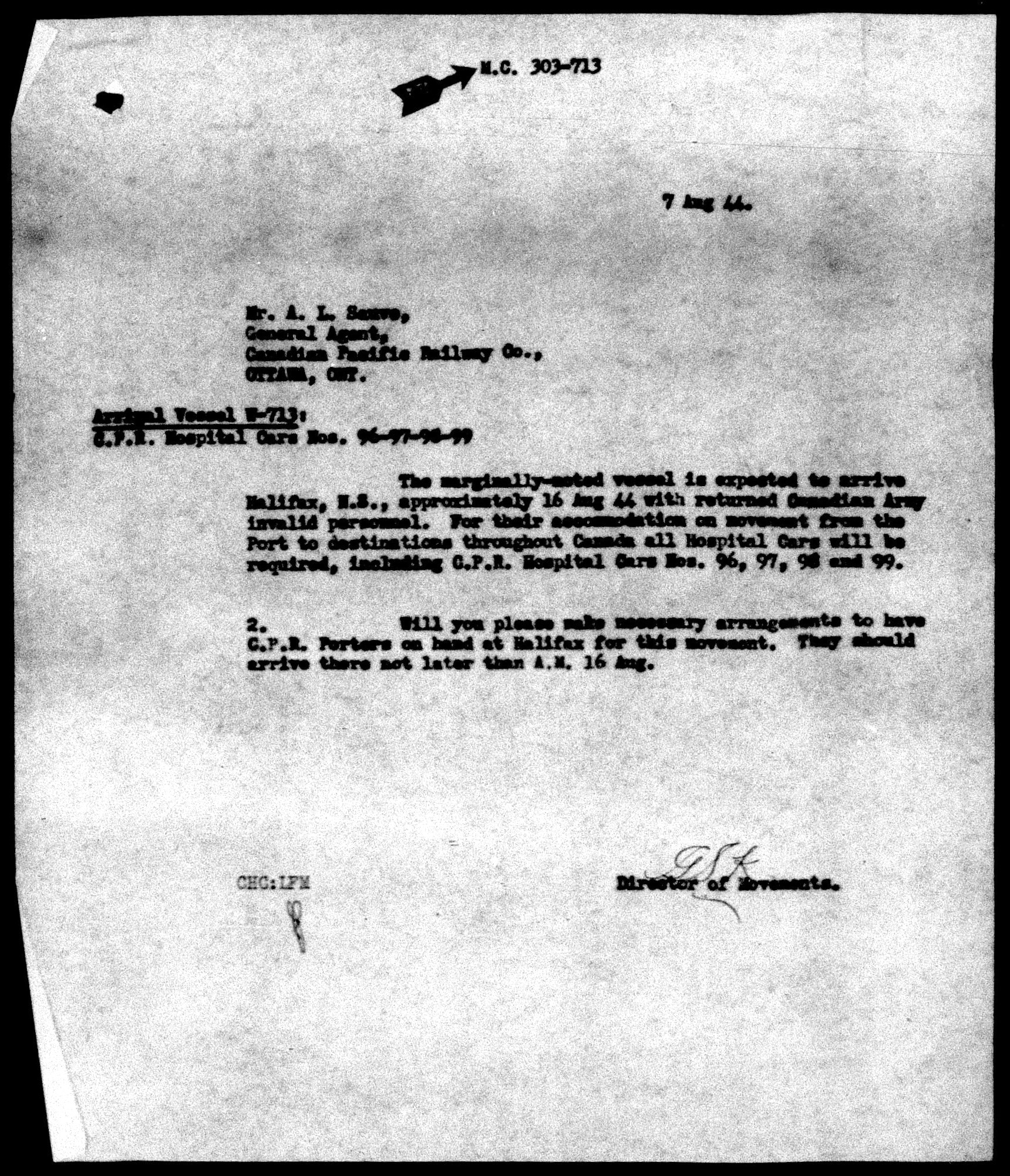
Typed letter from the Director of Movements.

This letter from the Directorate of Movements to the Canadian Pacific Railway Company is the only clear and direct reference to porters in the Directorate of Movements file relating to the arrival of the Lady Nelson in mid-August 1944. (MIKAN 5210694, oocihm.lac_reel_c5714.1878)

Transcript for the letter above:

M.C. 303-713

7 Aug 44.

Mr. A.L. Sauve,
General Agent,
Canadian Pacific Railway Co.,
OTTAWA, ONT.

Arrival Vessel W-713:
C.P.R. Hospital Cars Nos. 96-97-98-99

The marginally-noted vessel is expected to arrive Halifax, N.S., approximately 16 Aug 44 with returned Canadian Army invalid personnel. For their accommodation on movement from the Port to destinations throughout Canada all Hospital Cars will be required, including C.P.R. Hospital Cars Nos. 96, 97, 98 and 99.

2. Will you please make necessary arrangements to have C.P.R. Porters on hand at Halifax for this movement. They should arrive there not later than A.M. 16 Aug.

[Signature]
Director of Movements.

CHC:LFM

Directorate of Movements records are more forthcoming about Clarence Towne. They note that he had served with the North Nova Scotia Highlanders and had been wounded in the left elbow and arm by German machine gun fire. Assigned to one of the beds in hospital car 98, he was travelling home to his wife Jane in St. Catharines, Ontario. Towne might have been chosen as a representative patient because, while he was travelling in a hospital car, his wounds would not have been graphic, disfiguring or unsettling for viewers on the home front. The same could not be said for some of the other personnel being repatriated. Towne’s injuries were safely and indirectly depicted by the cast encasing his left arm. Unlike some of the other patients aboard the train, they were also physical and the direct result of combat, rather than being psychological or the result of accident or illness, which may also have played a role in his selection.

In addition to serving as an entry point for unpacking individual stories using a variety of sources, this photograph makes visible the wider history of the essential service of porters in the functioning of hospital trains during and immediately after the Second World War. At the time of its creation, it also likely served other functions. By showing Jean-Napoléon Maurice lighting Clarence Towne’s cigarette, it may have been intended to build on and reinforce popular perceptions and depictions of Black railway porters, the nature of their jobs and their racial and social status, especially how these were manifested through their role in serving travellers.

The photograph also incidentally serves as a reminder of the prevalence of tobacco and smoking in the 1940s. Among their many features, the specially modified hospital cars were equipped with an ashtray for each of the patient beds—something that would be unbelievable today. By depicting personal interactions such as the lighting of a cigarette, the scene was likewise meant to show the attention being paid to military patients. Images such as this provided an opportunity for the Canadian military and government to demonstrate the care being provided to those being repatriated, an important consideration given that the hospital trains and their passengers were a powerful home front manifestation of the increasing human costs of the Second World War.

Additional Resources


Jeff Noakes is Historian, Second World War, at the Canadian War Museum.

Black Porter Perspectives: Bringing Thomas Nash, a Canadian National Railway Porter, Back to Life

Version française

By Andrew Elliott

In the first post of the Black Porter Perspectives series, Rebecca Murray highlighted a wartime photograph that identified a railway sleeping car porter: Jim Jones of Calgary. In the Canadian National (CN) fonds, with which I work, it is worth noting that finding a porter’s name is rare. This collection (RG30/R231), one of Library and Archives Canada’s (LAC) largest private acquisitions, should logically contain a plethora of records about porters due to their central role in railway service. Sadly, until recently, this has not been the case. A basic keyword search for “porter” often yielded few, if any, results. I am working hard to correct this situation.

Over the last few months, my work has involved sifting through backlogged material relating to the CN Passenger Services Department. I recently found a collection of files from the late 1960s documenting employees who worked for the CN Sleeping, Dining, and Passenger Car Department. These files cover a range of issues, including accidents, insurance claims, thefts of company property, and retirements, as well as provide insight into the lives of cooks, waiters, stewards, and porters. Among these, I discovered an important and interesting personnel file for a Black porter named Mr. Thomas Nash. His file stood out due to his remarkable 42-year career, spanning from his hiring on June 23, 1927, to his retirement in August 1969. This documentation sheds light on who Nash was and offers a deeper understanding of what portering looked like for him and other Black men during this period.

Who was Mr. Thomas Nash?

Nash’s personnel file is rich with details, allowing us to begin to piece together his biography. Raised by his adoptive parents in Antigonish, Nova Scotia, Nash later moved to Montréal, where he worked as a CN porter. The path to learning this information is particularly interesting.

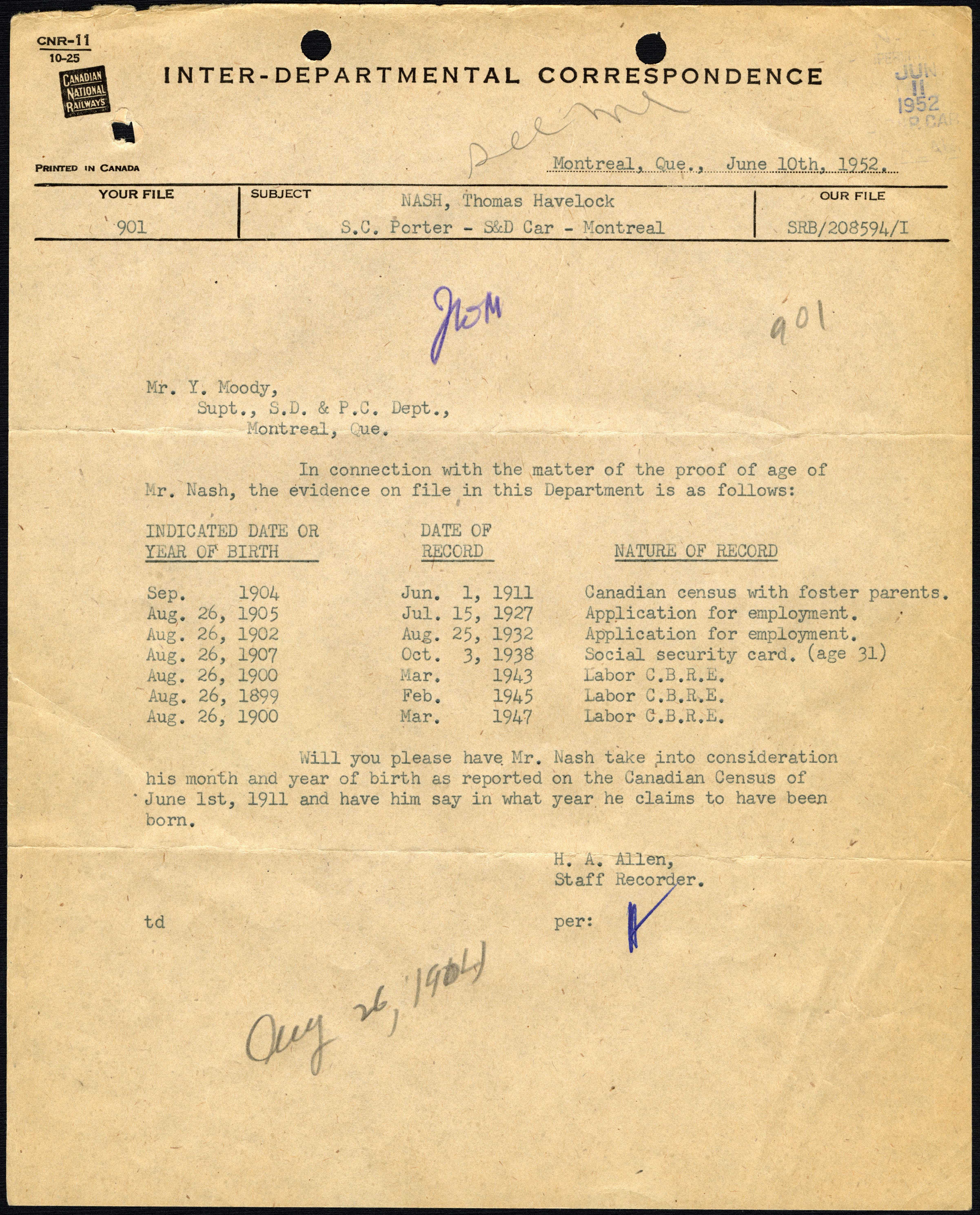
In the late 1940s, CN’s Staff Record Bureau began seeking Nash’s birth date to determine his retirement eligibility. Like many Black citizens in Canada and the United States, Nash faced challenges with recordkeeping, which were compounded by his adoption. He offered several possible birth years, including 1899, 1900, 1902, 1904, 1905, and 1907, which further complicated the Bureau’s task.

Page showing possible birth dates for a CN porter.

Documentation from the CN Staff Record Bureau detailing various possible birth dates for Thomas Nash, dated June 10, 1952. (MIKAN 6480775)

Due to Nash’s inability to provide accurate information about his birth, the CN Bureau contacted the principal of St. Ninian School in Antigonish, Nova Scotia, which Nash had attended as a youth. This inquiry in 1952 proved unsuccessful. The following year, the CN Bureau contacted the Dominion Bureau of Statistics, which confirmed that Nash had actually been born on August 26, 1904. The 1911 Census further revealed that Nash lived with his adoptive parents in Antigonish, a detail that is recorded in his personnel file. Interestingly, while his personnel file does not address the matter explicitly, Nash’s last name appears to have changed between his youth and his move to Montréal. As a child, he went by the surname “Ash,” which later became “Nash” before he began his job with the CN. Was this a recording error? Determining his correct birth details led to Nash’s eligibility for the CN Pension Plan, which went into effect on January 1, 1935.

In addition to learning a little bit about his early life, we also see that upon relocating to Montréal, Nash became part of the city’s tight-knit Black community, living in what was then known as the St. Antoine District. This is unsurprising given the racial segregation in housing and the community’s proximity to the train station.

While his early years in Montréal are undocumented in his personnel file, we see that Nash resided at 729 Seigneurs Street in the 1950s and early 1960s. A 1968 letter he wrote to the CN Staff Record Bureau reveals that he had married and later resided with his wife at 2458 Coursol Street, just a few streets over from his former residence.

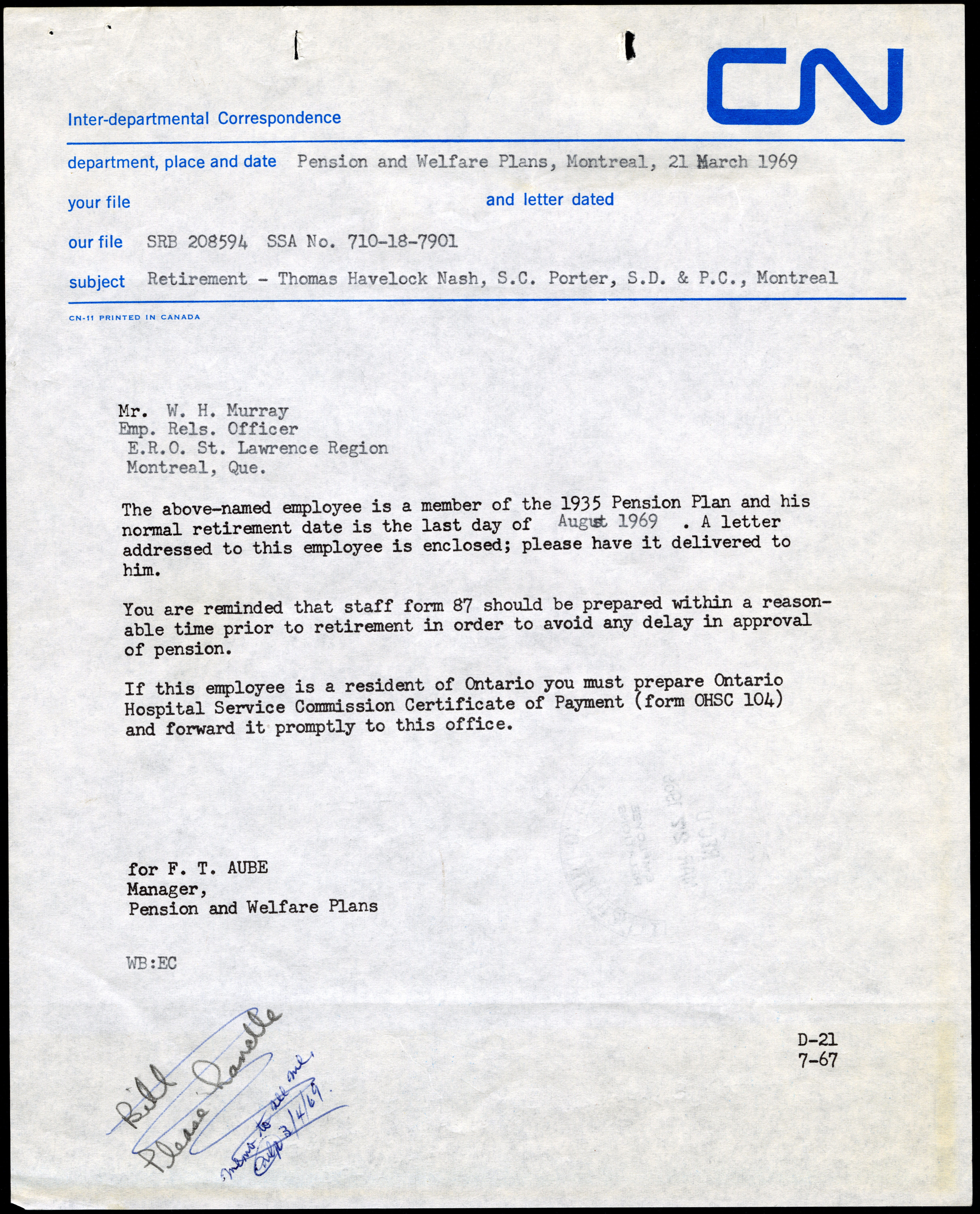
Nearly every household in the St. Antoine District had ties to portering. This profession was deeply respected, as evidenced by a community ritual honouring retiring porters: family, friends, colleagues, and bosses gathered at the train station to welcome these men home from their final runs. The Black Worker, the Brotherhood of the Sleeping Car Porters’ union newsletter, often documented these special moments. Nash undoubtedly experienced such recognition when he retired in 1969.

Letter from CN’s Human Resources Department outlining details relating to a CN porter’s upcoming retirement in August 1969.

Letter detailing Thomas Nash’s upcoming retirement in August 1969. (MIKAN 6480775)

The rights and experiences of porters

Nash’s career began in 1927, a pivotal year for both CN and its employees. That year, CN and its union, the Canadian Brotherhood of Railway Employees (CBRE), created a segregated system dividing employees into two groups. Group 1 included dining car employees and sleeping car conductors (white men), while Group 2 consisted of sleeping car porters. These separate collective agreements restricted seniority and promotion opportunities within each group, effectively locking Black workers into portering and barring them from advancing within CN’s ranks.

Nash would have quickly realized that upward mobility was impossible for him. Dr. Steven High helps us contextualize Nash’s experience, noting that porters in the 1920s and 1930s worked very long hours with a fixed monthly salary, regardless of the actual number of hours worked. On average, porters were allowed just three hours of sleep per day while in transit. Needless to say, their working conditions were difficult and highly exploitative. Unfortunately, Nash’s early years on the job, including his contributions during the Second World War, are undocumented in his personnel file—a troubling omission given the essential nature of his work.

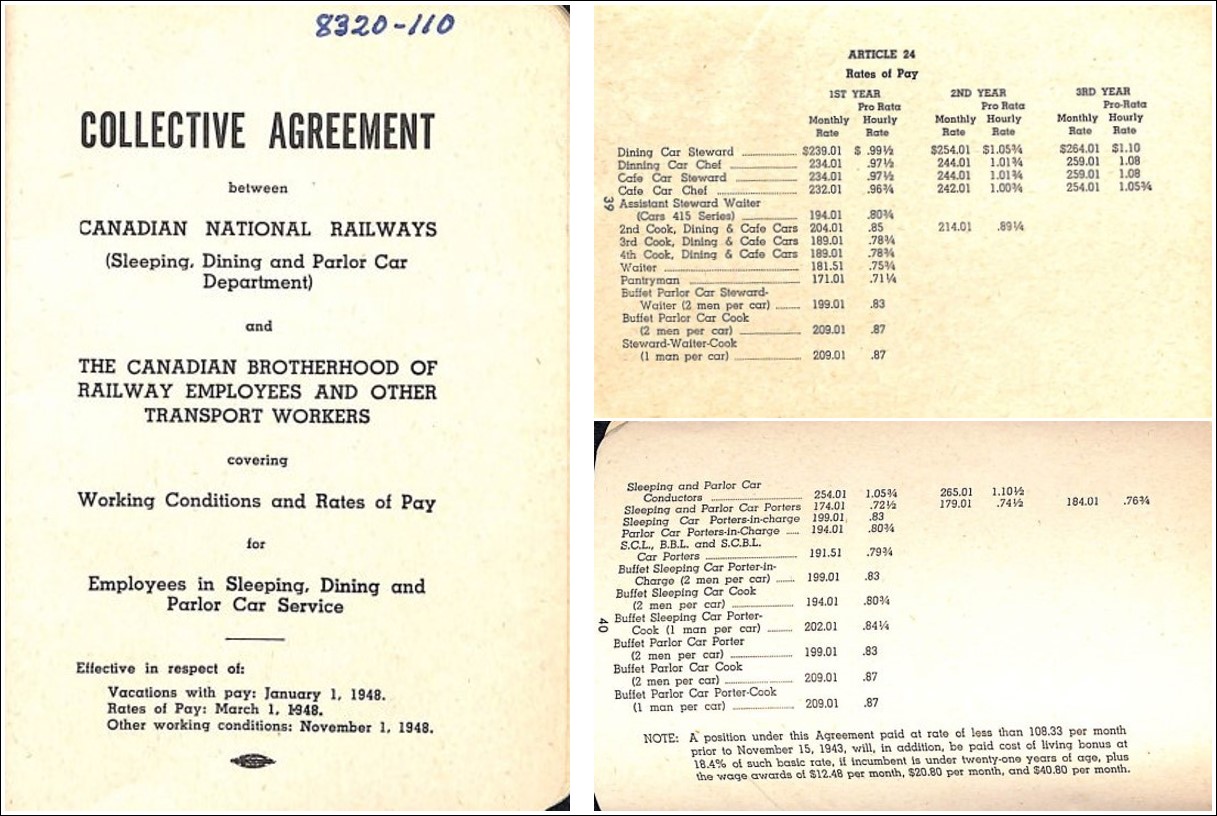
Despite their invisibility in these records, Black porters began agitating for improved conditions. In 1945, Canadian Pacific Railway sleeping car porters successfully negotiated a new collective agreement that including better wages, vacation time, and reduced hours. These union gains, however, did not extend to CN employees who remained bound by CBRE’s more restrictive agreement. The agreement featured below, dated 1948, shows that all porters remained among the lowest-paid employees, second only to pantrymen, with monthly salaries ranging between $174 to $209. Also, unlike some of the other occupations listed, porters’ salaries would not increase in years two or three. In truth, these men saw little improvement to their working conditions until 1964, when the Canadian Brotherhood of Railway, Transport and General Workers came into existence, ending occupational colour barriers and creating a combined seniority list.

(For more information about the long fight for porters’ rights, listen to “Porter Talk: The Long Fight for Porters’ Rights.”)

Cover page of the CBRE Collective Agreement along with details of employee wages.

Pages from the 1948 CBRE Collective Agreement, covering working conditions and rates of pay for employees in sleeping, dining, and parlour car service. (MIKAN 1559408)

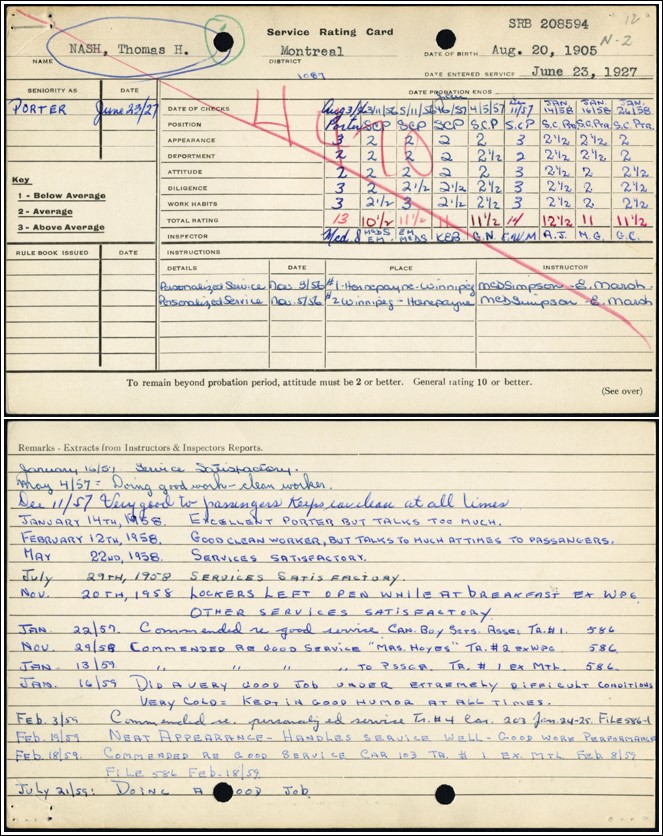
A cursory engagement with the CN fonds might obscure the contribution of porters, but Thomas Nash’s personnel file provides valuable insight into the nature of their work. His employee service rating card, in particular, emphasized the stresses inherent in portering. This card was designed to document and rank the quality of service provided, a reminder that Nash and his colleagues were under constant scrutiny—whether by CN staff or passengers. It is interesting to point out that even minor infractions could result in demerit points, colloquially known as “brownies.” Accumulating 60 demerit points led to automatic termination without the possibility of appeal. Remarkably, Nash’s record stands out: in his 42-year career, he never incurred a single demerit point. The comment card below showcases a passenger’s remark from 1958, providing a vivid anecdote and serving as a testament to Nash’s exceptional service: “Excellent Porter but talks too much.” While seemingly contradictory, this remark sheds light on Nash’s engaging personality and unwavering commitment to his duties.

Cards displaying employee rating numbers and comments on Thomas Nash’s service performance.

Front and back of Thomas Nash’s employee service rating card. (MIKAN 6480775)

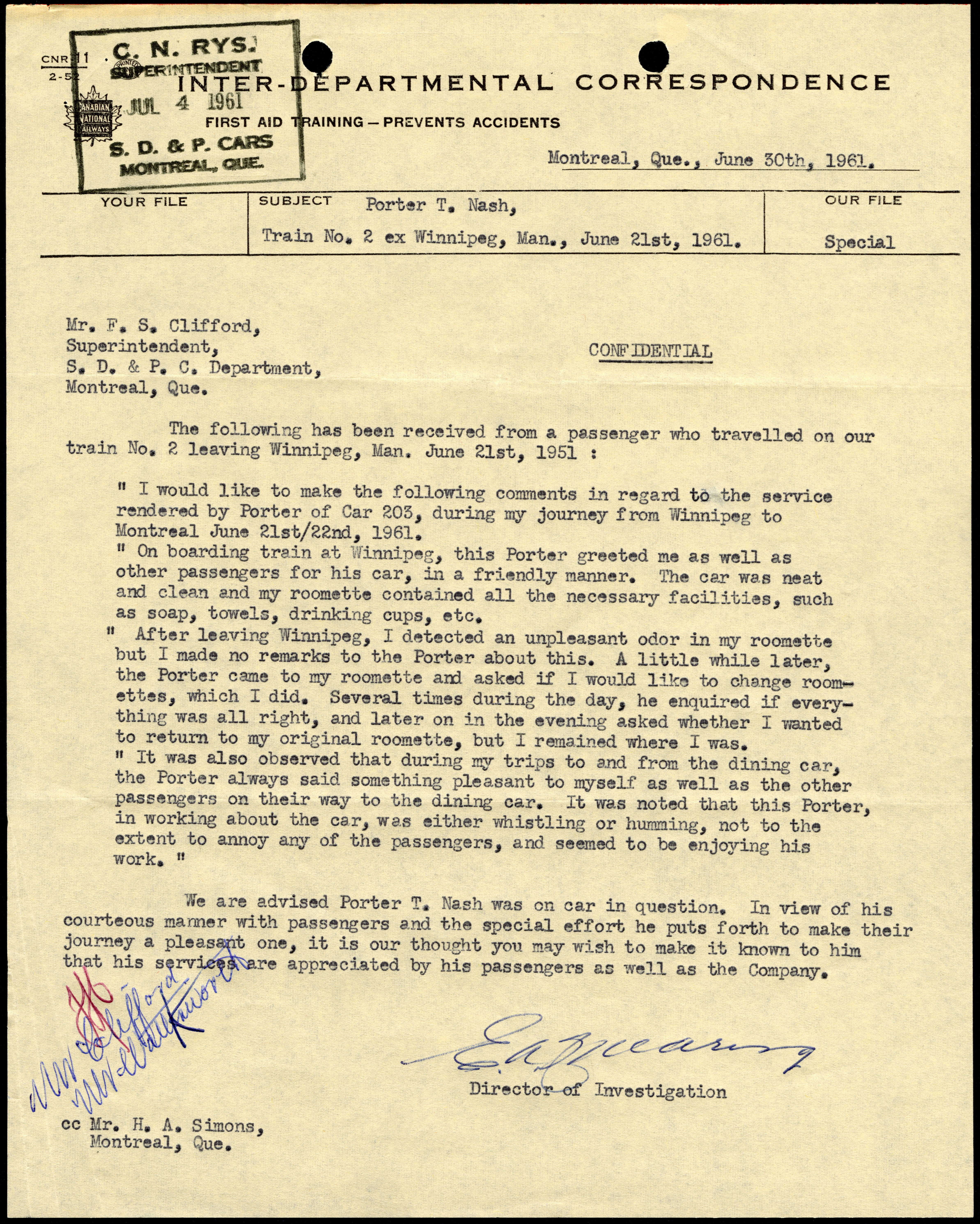
In 1961, another passenger went further, commending Nash for his service:

Typewritten letter detailing a passenger’s compliments on the service provided by CN porter Thomas Nash.

Letter documenting a passenger’s commendation of CN porter Thomas Nash for service excellence, 1961. (MIKAN 6480775)

Making porters’ service visible

My team remains committed to uncovering more information about the lives porters led and the experiences they had on the rails. Since last year, we have uploaded over 21 000 service files related to employees who worked for CN and its predecessor companies—including records for 1 066 porters—to the series entitled Employees’ provident fund service record cards. Slowly but surely, we are uncovering records within the CN fonds that shed light on the invaluable contributions of porters, making their essential service visible. In many ways, this work allows us to honour their legacy and bring their stories back to life, contributing to a new understanding of their profound impact in shaping modern Canada.


Andrew Elliott is an archivist in the Archives Branch at Library and Archives Canada.

Black Porter Perspectives: Through the Lens of Military Records

Version française

By Rebecca Murray

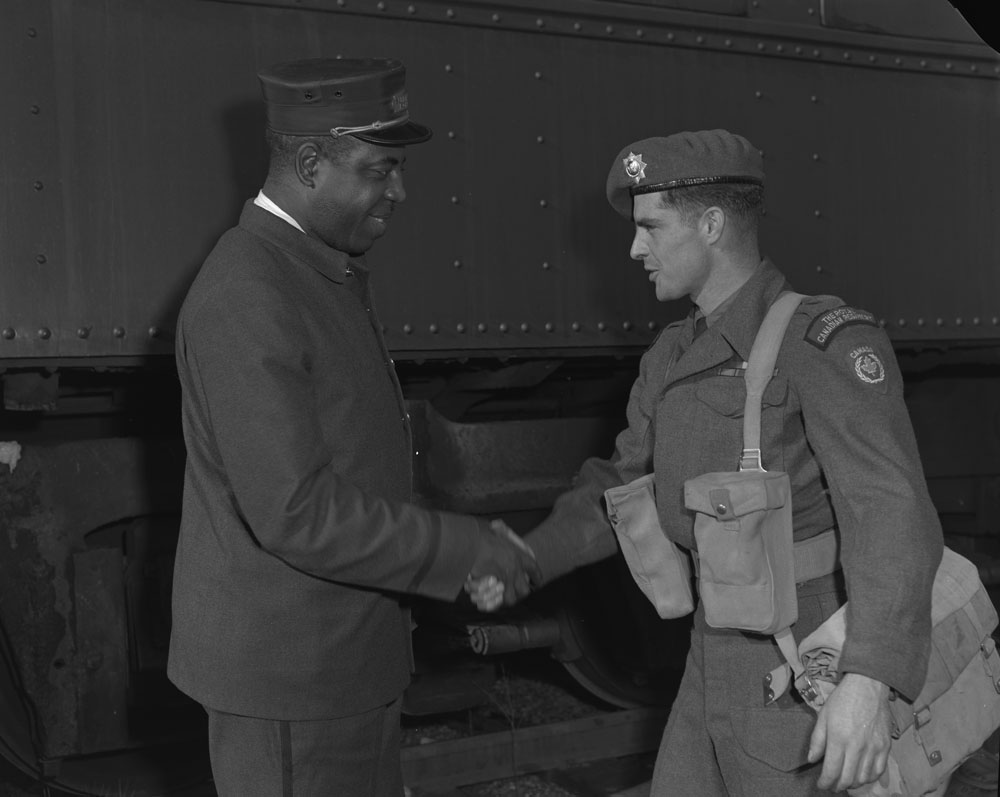
Library and Archives Canada (LAC) holds over 30 million images in various formats, including born digital images, negatives and photographic prints. A single archival photograph can tell us much about the fashion, weather, technology, customs and culture of an era! Yet, much of these secondary, but important, themes found in imagery are often ignored in the archival description process, with more attention given to the primary subjects or those captured by the photographer’s gaze. The popular saying “a picture is worth 1000 words” rings true every time I look at an image from the holdings. Even in this relatively simple image of two figures with little to no visible background, there is a wealth of detail and history to explore. What can the uniforms worn by the two men tell us? If there was a building or landscape in the background, what could we learn about where this image was taken?

Photograph of a sleeping car porter (on the left) shaking hands with a soldier (on the right).

1967-052, item Z-6244-4 “Arrival of RCRs at Fort Lewis: Units of the Canadian Army Special Force having completed their move to Fort Lewis, Wash., will shortly commence training at brigade strength. Among the recent arrivals with the Royal Canadian Regiment was one of many Halifax men serving with the Special Force. He is Pte. Harry Adams, above, seen being wished “Best of luck” by Porter Jim Jones of Calgary. (e011871942)

I first came across this image while reviewing others from the Department of National Defence (DND) accession 1967-052 for servicewomen, none of whom are pictured here. Though my main focus was the depiction of servicewomen, a minority group in these photographs, there are many other secondary or non-traditional narratives that are reflected in visual records, including those of sleeping car porters. Despite holding a degree in Canadian history, I had only recently been introduced to these men and their experiences through various books, including Genevieve Graham’s Bluebird and Suzette Mayr’s The sleeping car porter.

If you were to come to LAC looking for photographs of railway porters, you likely wouldn’t start in the DND photographs. Instead, you’d be drawn to those found in the Department of Transport (RG12) or the Canadian National Railways (RG30) fonds archives. In this instance, neither the porters nor the railway (nor the War in Korea) are mentioned in the description of the “Z prefix – CA” sub-sub-series. This is not entirely surprising, as it’s a large set of photographs — approximately 7 500 images — covering several decades worth of events, including the Second World War. Fewer than 15% of the images in this sub-sub-series are described at the item (photograph) level in the database, but most are described to varying levels of detail in digitized finding aids (item lists) that are attached to the sub-sub-series level description. The full caption for image Z-6244-4, which is available only on the original envelope and must be ordered for in-person consultation, mentions the presence of the porter and — surprisingly to this researcher — identifies him by name: Porter Jim Jones of Calgary. This is a stark contrast to most of the other images identified as part of my research. I wondered why this photograph had been so well described relative to others. Without a complete listing of captions and photographer’s notes, there is only so much we can infer from the limited data that we do have.

Coming across these images and working to pair them with their full descriptions, especially when they include the names of individuals and other identifiers, is an opportunity to press pause on one’s research intentions. The relatively hidden history in these images merits well more than a thousand-word description.

We call this process reparative description: the remediation of practices or data that have excluded, silenced or mischaracterized people or histories in archival records. Whether on a large scale or one photograph at a time, this is an ongoing process. So, when I came across these images of porters and other Black railway staff from the Second World War era, I kept notes and shared them with my colleagues who were working on the Discover Library and Archives podcast, Voices Revealed: “Porter Talk.” We were then able to work with other colleagues who are interested in this period, the presence of porters in the DND photographs and their representation in the collection as a whole.

Keep an eye out for the next piece in this series.


Rebecca Murray is a Literary Programs Advisor in the Outreach and Engagement Branch at Library and Archives Canada.