
 By Rebecca Murray
Who doesn’t love a slice of rich, moist chocolate cake? That’s what I thought when I took on the challenge of trying out a recipe from this Canadian Army Recipe Book from 1961.
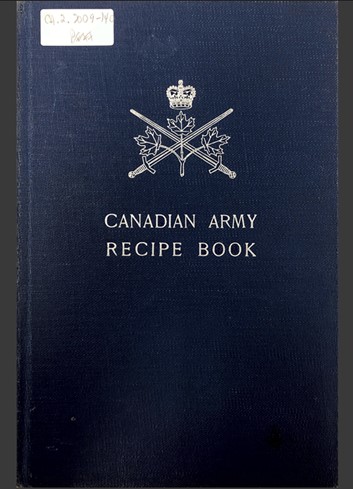
The cover of the Canadian Army Recipe Book by the Department of National Defence circa 1961 (OCLC 299227447).
As I reviewed the recipes, many of which were familiar to me, I remarked three notable trends.
One: the quantities. Most of the recipes are written for 100 servings or more! As a home cook, I’m used to halving or doubling recipes, not trying to figure if I want to make a quarter or a fifth of the recipe at hand. Honestly, my usual deciding factor is the number of eggs; hard to split those in two! In tandem with the expected output of the recipe, the ingredients are all measured here in weight rather than in volume, to which I am much more accustomed. It’s clear that, in comparison with my colleague who looked at army recipes from 1943, this recipe book isn’t concerned at all with rationing!
Two: the organization. I have never encountered such a well laid-out, detailed and descriptive (yet not overly descriptive) cookbook. The first chapter is a general introduction that spells out method particulars (including what “folding” means — a note for Schitt’s Creek fans!), conversion charts and suggestions for choosing cuts of meat and how to prepare other ingredients for best results. As you can see in the particular recipe I tried, it also provides handy references to other recipes in the book so that duplication is minimal. I have, of course, seen this in other cookbooks, but what makes this one different is that everything is numbered for very easy reference.
Three: the simplicity of it all. Maybe I shouldn’t have been surprised, but in this age of new and exciting recipes and an abundance of “how to build a mashed potato mountain complete with gravy lava and dinosaurs” videos online, I was pleasantly surprised to find a selection of recipes that really speak to the basics. There’s a clear link between effort for maximum output!
Chocolate Cake.
Brown Bread.
Baked Beans.
Doughnuts.
The list goes on, and many recipes include variations that might have been appropriate for different seasons or holidays. There’s also a handy section that I copied out about “haversack lunches” because as a mom, you can never have too many ideas for what to put in a lunchbox. But I digress!
Chocolate cake!

Recipe for chocolate cake from the Canadian Army Recipe Book, 1961 (OCLC 299227447).
The first step was to decide on an approximate quantity (output) and adjust the recipe accordingly. If you’ve got an eagle eye, you’ll see that I’ve made a math mistake in my conversions: the original quantities for sugar and flour differ, but I’ve converted and adjusted them to be equal measures.
That said, I didn’t notice this until after having mixed the ingredients and seen the cake pans into the oven — a small mistake that didn’t have an immediate impact on the final dish (or taste). A good reminder to measure twice and mix once!
| Ingredient | Original quantity (full) | Adjusted quantity (quarter) |
| Fat | 3 pounds, 8 ounces | ⅞ pounds (396 grams) |
| Sugar | 7 pounds | 1 ¾ pounds (793 grams) |
| Eggs | 4 ⅔ cups (approximately 24) | 6 eggs |
| Vanilla | 3 tbsp | ¾ tbsp |
| Flour, pastry, unsifted | 6 pounds, 4 ounces | 1 ¾ pounds (793 grams) |
| Cocoa | 1 pound | ¼ pound (113 grams) |
| Baking Powder | 5 ounces | 1 ¼ ounces |
| Salt | 1 ounce | ¼ ounce |
| Milk | 2 ½ quarts | 2 ½ cups |
Next, I assembled the ingredients. This wasn’t too daunting of a task, the ingredients for this cake being part and parcel of the basic pantry of many home cooks. A note for those who might be curious: I chose to use butter as my “fat” in the recipe. Alas, my experience with the butter wrapper was nothing compared to the day that inspired this blog post.

The mise-en-place or preparation of ingredients. From left to right: flour, vanilla, sugar, eggs, butter, cocoa/baking powder/salt, milk. Courtesy of the author, Rebecca Murray.
I mixed ingredients as indicated in the method and then combined them gradually. Confession: I’m not always great at following recipe instructions. I tend to want to rush ahead, and sometimes I don’t take the care suggested in the early stages of many recipes. I also had a sous-chef with me who didn’t appreciate the pauses for photo taking and re-reading of the recipe! That said, with a lot of trial and error, I can now usually muddle through most basic recipes with a good balance of respect for the suggested method and the splash of personality I like to bring to my cooking.
I divided the batter into three (yes, three!) different cake pans and set them to bake at 350 degrees for the suggested 30 to 45 minutes. The cakes smelled SO good! The round cake was ready after approximately 40 minutes and the square one closer to 45, whereas the bundt pan cake needed between 50 and 55 minutes to fully cook. Remember that every appliance is different and that the presence of three cakes rather than just one probably impacted the bake time.

Three cakes baked from this recipe as they cool on the counter. Courtesy of the author, Rebecca Murray.
We chose to ice one of the cakes with a basic homemade recipe of icing sugar, butter, a splash of milk, peppermint extract and food colouring.

A post taste-test cross section shot of the iced cake. Delicious! Courtesy of the author, Rebecca Murray.
The final consensus from those who taste tested the various cakes is that the recipe stands the test of time. As someone who doesn’t usually make cakes from scratch, this was a great reminder of how simple recipes can be so good and that the extra steps didn’t really take too much more time than I might normally need when whipping up something with a mix. Next time, I’d try a more classic icing flavour and colour – but green mint was fun too!
If you try this recipe, please share pictures of your results with us using the hashtag #CookingWithLAC and tagging our social media: Facebook, Instagram, X (Twitter), YouTube, Flickr and LinkedIn.
Rebecca Murray is a Literary Programs Advisor in the Outreach and Engagement Branch at Library and Archives Canada.
 Library and Archives Canada Blog