A Sweet Proposal… for a New Canadian Flag

Version française

By Forrest Pass

February 15, 2025, is the sixtieth birthday of the National Flag of Canada. The media and heritage institutions—including Library and Archives Canada—often mark the flag’s anniversary by sharing some of the “also-rans,” a selection of Canadians’ design submissions in the months and years leading up to the flag’s adoption.

It’s fun to speculate about alternative designs: for example, what would the Canadian Olympic teams’ uniforms look like if we had selected a flag other than the now-iconic red-and-white maple leaf design? What’s more, these rejected designs tell us something about their creators’ values and their ideas about the country’s past, present and future.

Flag enthusiasts often have our favourite “also-rans.”  The story of my favourite runner-up brings together two mid-February fixtures: flags and chocolates.

In 2013, while working as a historian at the Canadian Museum of History, I found a set of ten small fabric flags for sale on eBay that appeared to date from the Great Flag Debate. The seller, sadly, knew nothing about their origins, having bought them as part of a trunk load of miscellaneous bric-a-brac at an estate sale. However, these little flags were noteworthy to me because so few proposed designs made it off the drawing board; it took a rare confidence in one’s own design—and a little bit of disposable income—to produce fabric examples for distribution.
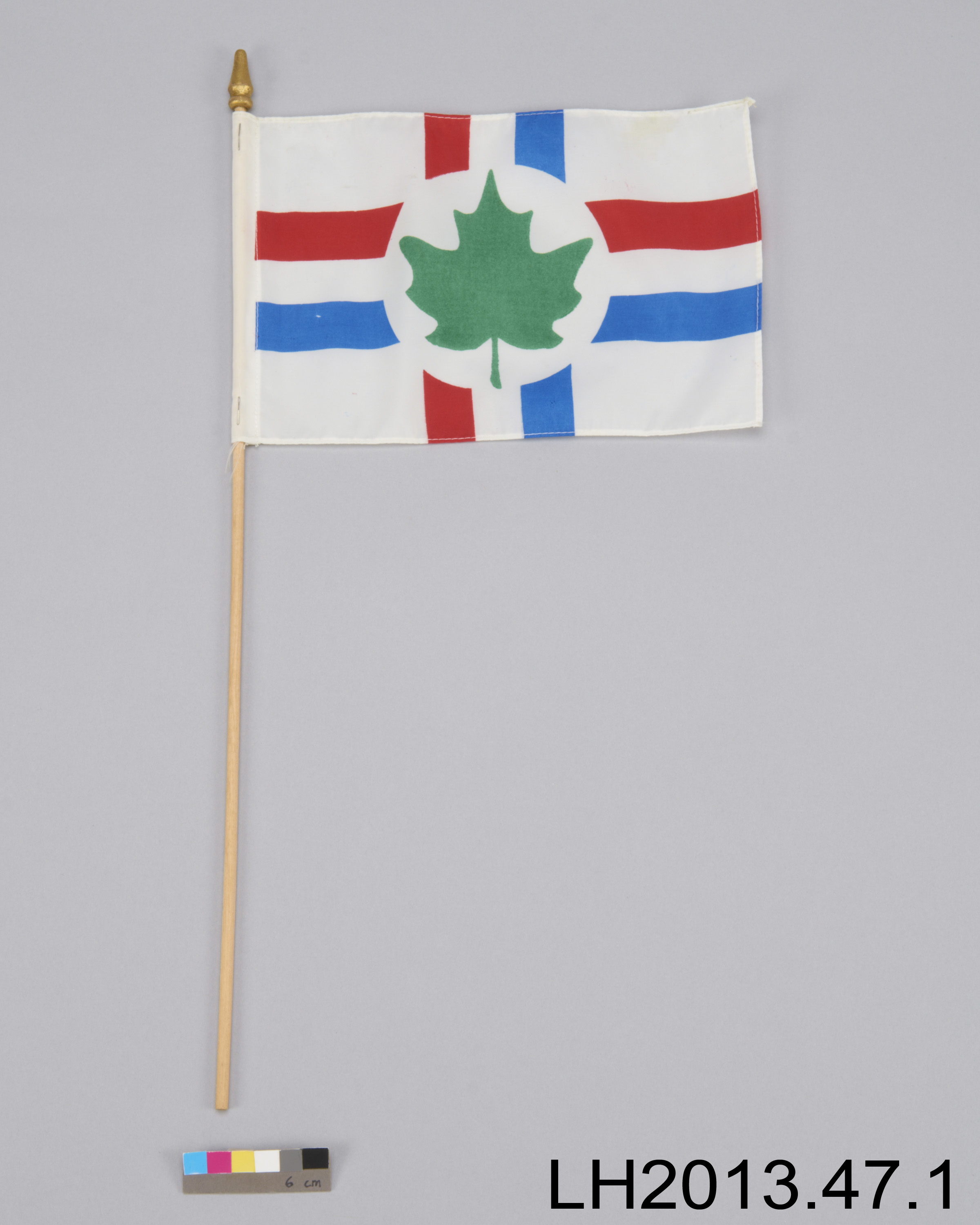
Small white flag with blue and red crosses and a green maple leaf in the middle.

A mysterious Canadian flag proposal. (Canadian Museum of History, 2013.47.1)

I could confirm that the proposal had been submitted to the House of Commons flag committee because it hangs, alongside many others, on the wall of the committee’s meeting room in a 1964 press photo. This was enough to justify the flags’ acquisition for the museum’s collection, but I still hoped to identify the designer and the flags’ intended symbolism.

Black and white photo of seventeen men and one woman sitting or standing around a table surrounded by flag designs.

Members of the House of Commons Flag Committee surrounded by 1200 designs for a new Canadian flag, October 7, 1964. The mystery flag is circled in red. (Library and Archives Canada, a213164)

As luck would have it, a colleague came across a reference to this very flag four years later in the Hansard record of the Great Flag Debate. In a speech on August 26, 1964, Clément Vincent—MP for Nicolet-Yamaska, Quebec—had described both the flag and its symbolism to his fellow parliamentarians. A little more digging in Hansard, and I had the name of the designer: Jean Dubuc. And after some Internet sleuthing, I uncovered a letter to a newspaper, an obituary and a Facebook profile. I was soon corresponding with the designer’s son, Daniel Dubuc, who told me more of his father’s story.

Jean Dubuc (1920–1965) was born in Chandler, Quebec, and grew up in Chicoutimi, where his grandfather was a pulp-and-paper and hydroelectricity magnate. He joined the Quebec public service in 1951 and settled in the Québec City suburb of Sainte-Foy. A lifelong heraldry enthusiast, he conceived his proposed Canadian flag in the late 1950s. In 1959, he sent a copy of it to every senator and member of the House of Commons. He included a printed bilingual cover letter, and his son generously donated a copy to the museum.

Among the thousands of designs submitted before and during the Great Flag Debate, Dubuc’s stands out. For one, he cleverly intertwined the red cross of St. George on a white background, the traditional flag of England, with the pre-revolutionary French merchant ensign, a white cross on a blue background. Thus, the Dubuc flag evoked gave equal status to the two principal settler communities without using the more familiar—and sometimes controversial—Union Jack and fleur-de-lys.

A second intriguing feature was Dubuc’s inclusion of Indigenous people in his flag design, at a time when most designs, including the one finally selected, included no such reference. The white field of the flag, wrote Dubuc, represented “the first occupants of the land,” the First Nations and Inuit, “still in possession of vast expanses of snow and ice of this country.” This comment put Dubuc ahead of his time: even the few mid-century amateur designers who did include Indigenous symbolism rarely acknowledged that Indigenous people were still around, much less that they still owned and occupied these lands. (Dubuc did not mention the third constitutionally recognized Indigenous group in Canada today, the Métis Nation, whose history and continued existence were less well known in the 1950s, particularly in eastern Canada.)

During our conversations, Daniel Dubuc also told me a tantalizing tidbit: his father had produced another piece of ephemera to promote his flag design. It was a foldable model that explained the components of the design and showed how they fit together. Unfortunately, the family did not have a copy, at least not at hand. I made a mental note to keep an eye open for one.

Then in 2022, I found it. I was going through the papers of Guy Marcoux, a Ralliement des créditistes (Social Credit) MP for Québec-Montmorency, not far from Dubuc’s home in Sainte-Foy. In Marcoux’s substantial reference file on the flag question, the Dubuc model stood out among dozens among letters, leaflets and collage flag mock-ups.
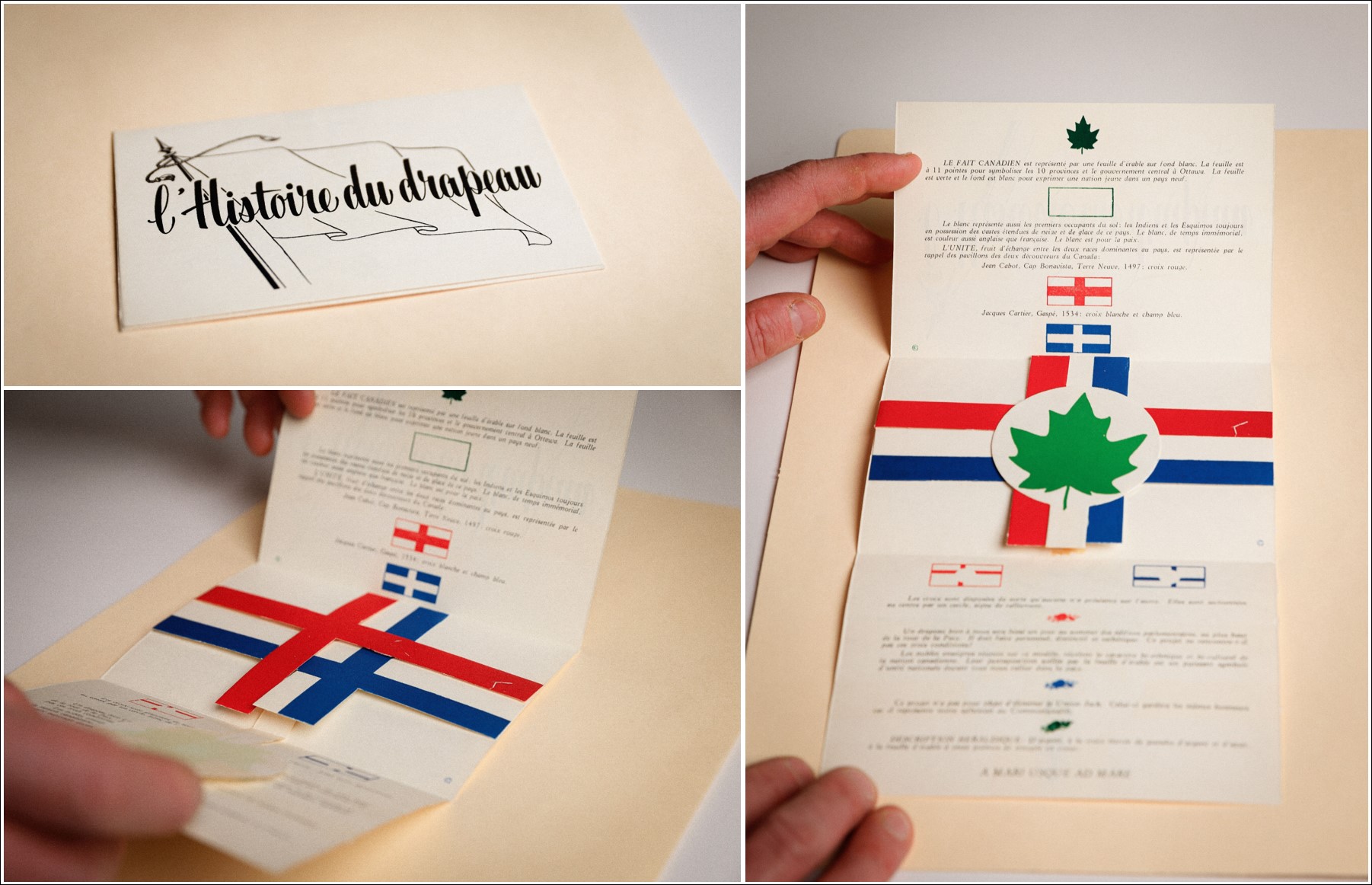
Three images of a pamphlet titled “l’Histoire du drapeau” (English translation: The history of the flag). Printed paper model of a flag with blue and red crosses and a green maple leaf in the middle. The model also includes instructions on how to layer the symbols and the meaning of each symbol.

Jean Dubuc’s folding flag model. (Library and Archives Canada, Fonds Guy Marcoux, MIKAN 110969)

As I had suspected from Daniel Dubuc’s description, Jean Dubuc’s flag model was inspired by a similar model depicting the history of the Union Jack, distributed by Laura Secord as a promotional favour in the 1930s. Like Dubuc’s model, the Laura Secord version illustrated the layers of crosses, colours, and meaning that made up the Union Jack, Canada’s official national flag for domestic purposes until 1946. The concept was popular: Laura Secord adapted its insert to support the war effort, and American sister company, Fanny Farmer Candy Shops, distributed a similar favour explaining the history of the Stars and Stripes.

Three images of a paper model illustrating the history of the Union Jack. Folding flaps representing the crosses of St. Andrew, St. George, and St. Patrick show how the flag is constructed and how it has evolved.

Folding model of the Union Jack produced by Laura Secord Candy Shops to mark the coronation of King George VI, 1937. (Library and Archives Canada. National Archives of Canada Postcard Collection. MIKAN 15178)

In his personal campaign for a distinctive flag, Jean Dubuc adapted a format—the folding paper model—that would have been familiar to decision-makers and ordinary Canadians, especially if they were chocolate lovers. His simple, striking design lent itself to this elegant promotional form. My rediscovery of Dubuc’s flag model reminds us also that although the records of the flag committee have been well publicized, there are other collections at Library and Archives Canada that continue to yield surprising details of the Great Flag Debate sixty years later. When you open an archival box, as when you open a box of chocolates, you never know what you’re going to get.


Forrest Pass is a curator with the Exhibitions team at Library and Archives Canada.

A diplomat, a Prime Minister, and a scholar: remembering Lester B. Pearson

Version française

By Mariam Lafrenie

It goes without saying that the Right Honourable Lester B. Pearson achieved much in his life. Whether you look at his success politically, academically or even athletically—Pearson always excelled. Although Pearson served as Canada’s prime minister from 1963 to 1968, his legacy and indeed his influence began long before his prime ministership: as chairman of the NATO council (1951), as President of the United Nations General Assembly (1952), and as a Nobel Peace prizewinner (1957).

Nevertheless, Pearson’s five-year legacy is very impressive: a new flag, the Canada Pension Plan, universal medicare, a new immigration act, a fund for rural economic development, and the Royal Commission on Bilingualism and Biculturalism which led to the foundation of a bilingual civil service.

A black-and-white photograph of a formally dressed couple. The man is holding a box with a medallion.

Lester B. Pearson and his wife, Maryon at the Nobel Peace Prize Award Ceremony, Oslo, Norway, December 1957. Photograph by Duncan Cameron. (c094168)

A black-and-white photograph of a man standing up and addressing a room of people.

Lester B. Pearson, at the United Nations Conference on International Organization, San Francisco, Calif., USA, 1945. (c018532)

Rising quickly through the ranks and moving from one portfolio to another, Pearson proved himself a worthy and talented diplomat. After a 20-year career in External Affairs, his success did not end there, but followed him throughout the next decade as leader of the Liberal Party (1958-1968). Without a doubt, some of his most exciting—if not his most significant achievements—came during his time as Prime Minister.

A flag for Canada

The quest for a Canadian flag—one that represented everything that Canada had become in the last century and all that Pearson hoped it could become—was fraught with bitter debate and controversy. Indeed, as many may recall, “The Great Flag Debate” raged for the better part of 1964 and saw the submission of approximately 3,000 designs by Canadians young and old.

“Under this flag may our youth find new inspiration for loyalty to Canada; for a patriotism based on no mean or narrow purpose, but on the deep and equal pride that all Canadians will feel for every part of this good land.” – Address on the inauguration of the National Flag of Canada, February 15, 1965

These words, spoken by Lester B. Pearson during the inaugural ceremony of the Red Maple Leaf flag on February 15, 1965 at Parliament Hill, highlight precisely what he aspired to achieve—a uniquely Canadian identity. Few prime ministers can attest to leaving a legacy so great as to have forged an entirely new cultural symbol for their country.

A black-and-white photograph of a man holding an illustration of the Canadian flag.

Lester B. Pearson’s press conference regarding the new flag, December 1964. Photograph by Duncan Cameron. (a136153)

A year of celebration

Not only was Pearson responsible for championing a new Canadian flag, but he was also lucky enough to remain in office during Canada’s centennial year. In his Dominion Day speech on July 1, 1967, Pearson called on Canadians to celebrate their past and their achievements, but also encouraged them to think of the future and of the legacy that they could leave for the next generation of Canadians. Much like this year, when we celebrated Canada’s 150th anniversary of Confederation and were encouraged to think of our future as a nation, 1967 was also a year filled with celebrations.

The aim of the centennial celebrations were twofold: to create memorable events and activities for all Canadians and to create a tangible legacy that current and future generations could enjoy. In fact, both the provincial and federal governments encouraged Canadians to celebrate by creating their own centennial projects—films, parades and festivals, tattoos, recreation centres, stadiums, etc.—and agreed to match their spending. One of the most memorable celebrations was that of the 1967 International and Universal Exposition or Expo 67, as it was nicknamed. Open from April 27 to October 29, Expo 67 is considered one of the most successful World’s Fairs and one of Canada’s landmark moments.

A colour photograph of a group of men standing in front of an enlarged map of New France.

Expo 67’s opening day with its General Commissioner Pierre Dupuy, Governor General of Canada Roland Michener, Prime Minister of Canada Lester Bowles Pearson, Premier of Québec Daniel Johnson and Mayor of Montréal Jean Drapeau. (e000990918)

For many Canadians, 1967 characterized the peak of nostalgia and indeed a year filled with optimism. With this optimism and increased governmental spending, Pearson’s popularity boomed and further solidified his accomplishments as prime minister and widespread support for the Liberal Party amongst Canadians.

Conclusion

Forty-five years ago, on December 27, 1972, after a long and successful political career, Lester B. Pearson passed away. His passing struck a chord with many Canadians as more than 1,200 people attended his funeral service to pay their last respects. Pearson’s legacy and indeed his name are still present today in the numerous awards and buildings named in his honour. Paving the way for what many Canadians and the international community alike have come to love about Canada, Pearson can be said to have shaped and indeed laid the foundation for the Canada we know today.

A black-and-white photo of man standing under an interesting architectural building.

Prime Minister of Canada Lester Bowles Pearson in front of the Katimavik at Expo 67. (e000996593)

The Lester B. Pearson fonds preserved by Library and Archives Canada consists of 435.71 meters of textual records, over 3,500 photographs, 315 audio recordings on various formats, 3 films totalling 47 minutes, 54 items of documentary art, and 98 medals.

Related links


Mariam Lafrenie is an undergraduate student research fellow from Queen’s University who worked in the Private Archives Branch at Library and Archives Canada during the summer of 2017.

Library and Archives Canada releases eighteenth podcast episode, “Canada’s Flag: The Maple Leaf Forever”

Library and Archives Canada (LAC) is releasing its latest podcast episode, Canada’s Flag: The Maple Leaf Forever.

Our flag, with its distinctive maple leaf and bold red-and-white colour scheme has become such a potent symbol for our country that it’s hard to believe it has only been around for 50 years. On February 15, 1965, the new flag flew for the first time on Parliament Hill for all to see, but unveiling the new design was anything but easy. In this episode, we speak to retired LAC archivist Glenn Wright about the history of the flag, and the controversy that almost kept it from coming into being.

Subscribe to our podcast episodes using RSS or iTunes, or just tune in at Podcast – Discover Library and Archives Canada: Your History, Your Documentary Heritage.

For more information, please contact us at podcasts@bac-lac.gc.ca.

Celebrating 50 years of Canada’s national flag!

Canada’s national flag celebrates its 50th anniversary! Approved by Parliament on December 15, 1964, the flag was proclaimed by Queen Elizabeth II to take effect on February 15, 1965.

Colour reproduction of the proclamation of the Canadian flag. It describes the proportions of the flag and states the dates when the flag will come into effect.

The Proclamation of the Canadian Flag (MIKAN 2909612)

The issue of selecting a representative and unique Canadian flag went through waves of debate following the First and Second World Wars, and in 1964 it became a hotly contested government priority for Lester B. Pearson’s Liberal minority government. Announced in May 1964, Pearson’s push to select a Canadian flag by December 1964 was criticized by the Progressive Conservative opposition, headed by John G. Diefenbaker, who wanted to take such a decision to a public plebiscite.

In September 1964, Tommy Douglas, leader of the New Democratic Party, suggested an all-party committee to select this nationally significant symbol through parliamentary consensus. The idea was endorsed by the government and the fifteen-member National Flag Committee was created, chaired by Member of Parliament John Matheson. After reviewing thousands of submissions, the solitary red maple leaf on a white square between two red borders was selected by the Committee as the unifying symbol for Canada. This submission was made by historian George F. Stanley who described the idea as simple, devoid of British and French national symbols, and easily recognizable as being Canadian.

The selection of the red maple leaf was then debated and voted on by Canada’s 26th Parliament. The passion surrounding the debate did not dissipate. By the time the final vote occurred in the House of Commons, the debate had lasted into the early hours of December 15th and it was two o’clock in the morning!

Library and Archives Canada (LAC) has digitized several of the public’s submissions to the National Flag Committee. Some of these proposals can be found on LAC’s Flickr website.

Do you want to know more about this moment in Canadian history? Check out the links below to investigate other parts of LAC’s flag holdings:

Here are some other links from the Internet relating to Canada’s flag debate: