
By Rian Manson
In 1940, following the Dunkirk evacuation, the British situation was grim. The German Navy, operating from the French coast, was sinking cargo ships at a rate of 50 per month. At the start of the Second World War, Canada only had 41 sea-worthy cargo vessels. To keep the supply of war materials and food from being cut off, it was imperative that cargo ships be constructed at phenomenal speed to prevent Britain from starving to death.

To keep up morale, posters like these were displayed at Dominion Bridge and United Shipyards, in Montréal. Canadian Transportation, November 1941, pg. 638-639 C-204-4*C-205-1 (OCLC 1080360026).
With the entire shipbuilding industry gearing up for war production, Canada needed a new and large shipyard to help fulfill the huge order of 200 10,000-ton cargo vessels. For this crucial project, the federal government put every Canadian shipbuilder from Nova Scotia to British Columbia on contract to construct naval craft, tugboats and cargo ships.

A 10,000-ton North Sands-class cargo ship bound for sea, passing under Montréal’s Jacques Cartier Bridge (OCLC 321000549).
Minister of Munitions, C.D. Howe, approached the Dominion Bridge Company of Montréal to ask if they could use its huge plant and machinery to help with shipbuilding. Since 1882, Dominion Bridge had been supplying Canadian railways and provinces with all types of bridges. Its massive workshops were constructing enormous iron and steel components for huge hydroelectric projects, and supplying countless towns and cities with the structural steel beams needed to erect stores, homes and hotels.

Technical drawing of a cast-brass nameplate for marine steam engines of 4700-ton cargo vessels built at the Dominion Bridge’s Lachine workshops, R5607, vol. 2073 (MIKAN 5183995).
Since its first contract with the Canadian Pacific Railway (CPR) in 1882, Dominion Bridge had developed a huge assembly plant with machines specially designed to manufacture heavy steel, iron products and boilers. The Lachine location was a perfect fit: access to water transport; direct rail access from the Canadian National Railway (CNR); and available high-voltage electricity for heavy stick welding. One problem: the company had never considered building a shipyard, let alone ocean-going ships. They needed advice from a trusted source. Fraser Brace Ltd., another respected Canadian company with superior experience in the heavy shipbuilding industry, partnered with Dominion Bridge to help construct and operate the new United Shipyards Ltd., at the Bickerdike Basin in Montréal.

Thanks to a forest of derrick cranes United Shipyards at Bickerdike Basin was able to continue building ships throughout the winter months, even when the St. Lawrence River was frozen over (e000761650).
Work on the shipyard began in January 1942, and only four months later, the keel was laid for the first cargo vessel. Although this was Canada’s newest and largest single-unit shipyard, the shipyard’s machinery—derricks, cranes and locomotives—were on long-term loan from the Harbour Board, Fraser Brace Ltd., Dominion Bridge, and Montreal Locomotive Works. Even the railway trucks were, according to one writer, “skillfully stolen from the CPR and CNR” to make this giant enterprise work.
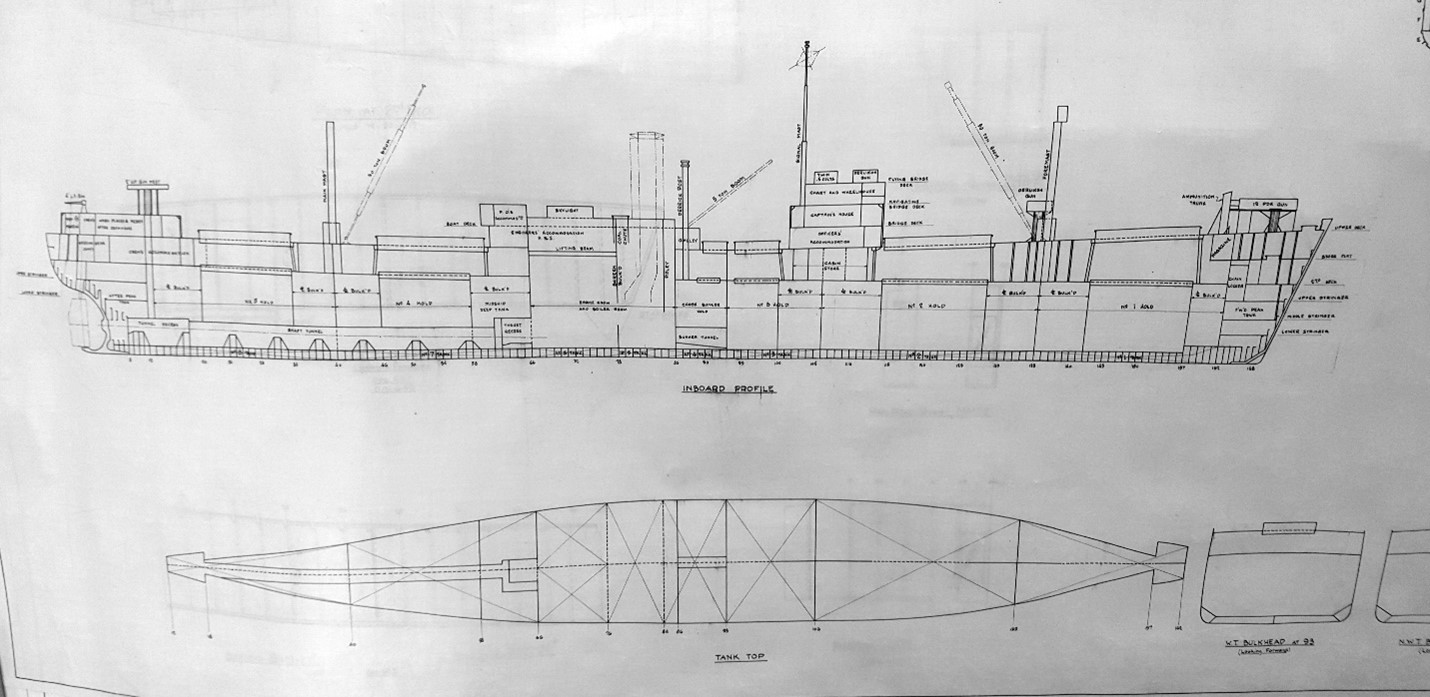
A profile elevation diagram by Dominion Bridge of a 10,000-ton North Sands-class cargo vessel, Lachine, November 1943, R5607, vol. 1612 (MIKAN 5183995).
Dominion Bridge set out a unique prefabrication plan to construct 10,000-ton ships and smaller 4700-ton cargo vessels. In the main shops at Lachine, workers welded the aft section and forepeak of the ship as one piece. These completed sections were delivered by railway flatcars to the Bickerdike Basin, where the custom-built derrick cranes would position the aft sections and forepeak for riveting to the hull.

From the drawing to the dockyard: Dominion Bridge’s pre-fabrication of the aft assembly contributed to the accelerated mass production of ships at United Shipyards, Montréal (photograph: e000761682; drawing: R5607, vol. 1613, MIKAN 5183995).
Dominion Bridge drew on its early bridge and boiler welding experience. All inboard bulkheads, cabins, cargo holds and interior fittings were welded. Welding saved precious time, weight and materials for each vessel.
The savings generated helped United Shipyards set a new Canadian record for shipbuilding speed. From the keel being laid to the final touches of paint, it took 58 days—one month faster than the previous record. The cargo ship arrived in Great Britain fully loaded 86 days after the keel was laid. C.D. Howe praised United Shipyards as the yard where the cheapest 10,000-ton vessels were built in Canada.

View of the christening podium and guests of honour at the launch ceremony of the 10,000-ton cargo ship, the S.S. Fort Esperance, at United Shipyards Ltd. (e000761721).
A Style of Their Own
On a sunny afternoon on July 15, 1944, Dominion Bridge launched a new type of cargo ship, the “Canadian,” from the United Shipyards slipways. Identical in design to the 10,000-ton British North Sands, but with new improvements, such as boilers capable of burning oil or coal with rapid changeover for each fuel; improved crew quarters; and hatches and decks with greater strength to withstand heavier loads.
Virtually all the manufacturing was carried out in Dominion Bridge’s own workshops. Very little outfitting was subcontracted because Dominion Bridge used its creative bridge welding techniques. Special in-house built jigs with attached electric motors rotated to help with complex welding jobs so the welder could operate “downhand,” and the use of welded engine bedplates instead of bolts considerably reduced vibrations and withstood the shocks caused by explosions at sea.
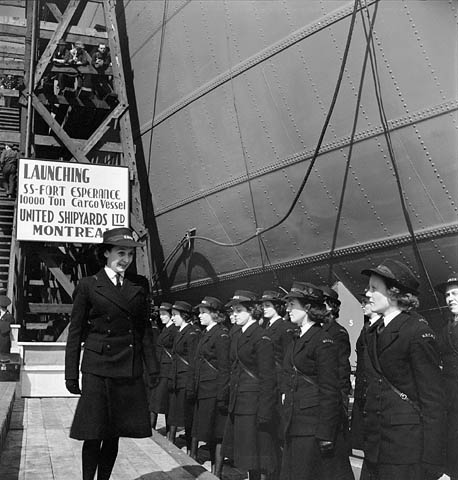
Women’s Royal Canadian Naval Service officers lined up at the walkway to the christening podium during the launch ceremony of the S.S. Fort Esperance at United Shipyards Ltd., Montréal (e000761719).

A welder at the Lachine plant using a special rotating jig for welding the steel bedplate for a marine steam engine that provides the power for the 10,000-ton cargo vessels (OCLC 321000549).
Of the 403 ships built in Canada (including those built by Dominion Bridge), 112 were sunk and 18 were severely damaged by enemy action. Additionally, before the end of the war, 1146 Canadian merchant sailors lost their lives on the high seas and many more endured the trauma of trying to survive in enemy prison camps.
The construction of cargo ships is a forgotten component of Canada’s role in the Second World War. But without the Herculean human effort of the Dominion Bridge Company and other shipbuilders in Canada, one wonders if Britian could have survived the war? Would it have been starved into surrendering to Nazi Germany?
This blog would not have been possible without the remarkable technical drawings of the Dominion Bridge Company fonds at Library and Archives Canada.
Additional resources
- A Bridge of Ships: Canadian Shipbuilding during the Second World War, by Pritchard,James S., Montréal: McGill-Queen’s University Press, 2011 (OCLC 693809715)
- Canadian Transportation, January 1941–December 1945 (OCLC 1080360026)
- Of Tasks Accomplished : The story of the Accomplishments of the Dominion Bridge Company Limited and its Wholly Owned Subsidiaries in World War II, by Dominion Bridge Company Limited, 1945, Montréal: Dominion Bridge Co. (OCLC 321000549)
- Dominion Bridge Company fonds, R5607, vols. 1612, 1613, 2073 (MIKAN 5183995)
- Canadian Merchant Ship Losses, 1939-1945 by Robert C. Fisher, The Northern Mariner
Rian Manson is an Archival Assistant in the Private Archives and Published Heritage Branch at Library and Archives Canada.
 Library and Archives Canada Blog