
 By Ariane Gauthier
The Cook’s Recipe Manual is a collection of 300 recipes designed for military personnel who were part of the navy, army, air force munitions plants, camps, and schools. Printed in 1943, the goal of this cookbook was to make the most of army rations through simple recipes. Each recipe makes 100 or 125 servings, taking care to specify how many ounces should comprise a single serving. The recipes themselves were fitted for modest kitchens, meaning that the cook should still be able to successfully complete the recipe even if they don’t have electric cooking implements at their disposal.
This book is available online on Library and Archives Canada’s published collections catalogue Aurora: OCLC 3231635.
At the time that I picked up this book and undertook this latest challenge, we were well into autumn, and I had just returned home from apple picking with more apples than I could eat myself. I was flipping through the index of the cookbook, hoping to find an attractive recipe in which to funnel most of my apples, when I stumbled upon a recipe for “Dutch apple cake”.
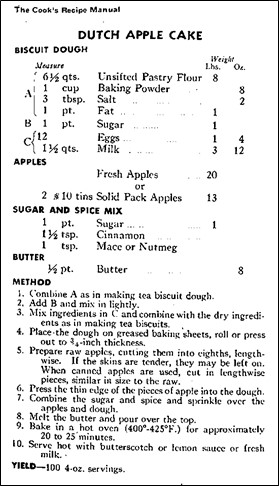
A photo of the recipe for Dutch apple cake from The Cook’s Recipe Manual (OCLC 3231635). Please note the breakdown of recipe ingredients into categories A, B, and C, as well as the yield of 100 four-ounce servings.
Beyond the exorbitant amount of apples required, part of what attracted me to this recipe was that I did not know what a Dutch apple cake was. While it isn’t too difficult to put together, I had no visual image of its modern equivalent to keep in mind as I assembled this recipe and so, unlike the previous two recipes I tried, I went into this challenge ignorant of the expected result. Nevertheless, the first step was to assemble the ingredients.

Ingredients used by the author to make the Dutch apple cake recipe from The Cook’s Recipe Manual. Courtesy of the author, Ariane Gauthier.
The next step was to do a bit of math, as I was not about to make a cake serving 100 portions. Instead, I settled on 10 portions and used the following quantities:
Biscuit dough
- 2.6 cups of flour
- 25 ml baking powder
- 4.5 ml salt
- 50 ml butter
- 50 ml sugar
- 2 eggs
- 150 ml (oat) milk
Apples
- 900 g apples
Sugar and spice mix
- 50 ml sugar
- a pinch of cinnamon and nutmeg
Butter
- 50 ml butter
The ingredients comprising the dough of the Dutch apple cake are divided into three sections, A, B, and C, marking the order in which they will be incorporated. The first step is to mix the dry ingredients and the fat (in this case I opted for butter). The added instruction in the original recipe of “as in making tea biscuit dough” is unclear, so I opted to ignore it. The most it told me was that the recipe was written with a somewhat experienced reader in mind. Similarly, I didn’t quite understand why the sugar needed to be added separately, but I adhered to the order of things all the same.
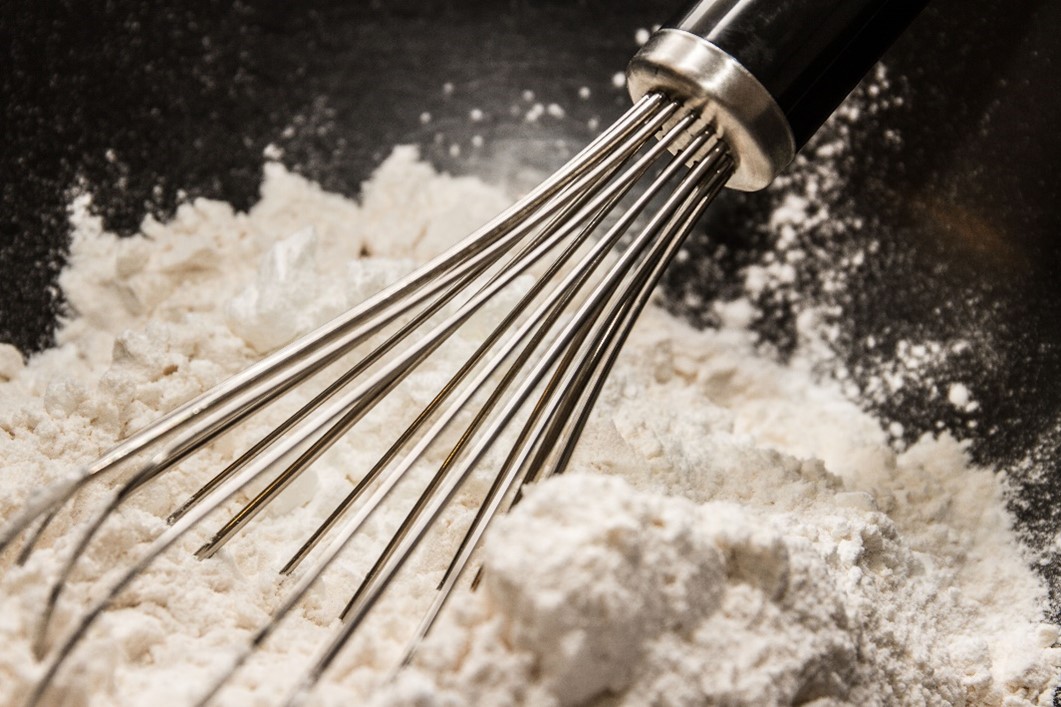
All the dry ingredients from sections A and B mixed with a whisk. Courtesy of the author, Ariane Gauthier.
The last part of the dough recipe called to mix all the wet ingredients (section C) before incorporating them to the dry mix (sections A and B). I do not recommend using a whisk, as I did, because it’s incompatible with the thickness of the dough. I started using my hands before remembering that the cookbook’s author strongly recommended the use of electronic kitchen appliances, which I did possess but neglected during this phase of the process.
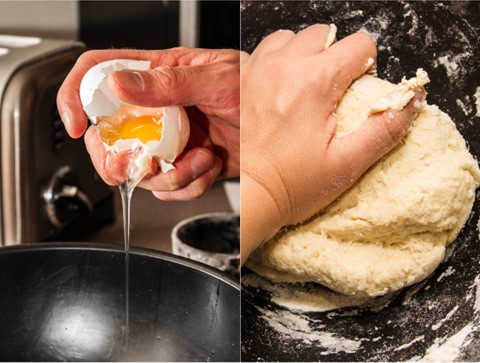
Mixing the wet ingredients from section C with the dry ingredients from sections A and B. While the author used her hands, it’s recommended that you use a stand mixer should you possess one. Courtesy of the author, Ariane Gauthier.
Once the dough was made, it needed to be put onto a baking sheet or baking tray lined with parchment paper. Then it was time to peel and slice 900 g of apples, cut them into eighths and insert them into the cake “thin edge” first. This frankly felt wrong as I was doing it, but I pushed through all the same.
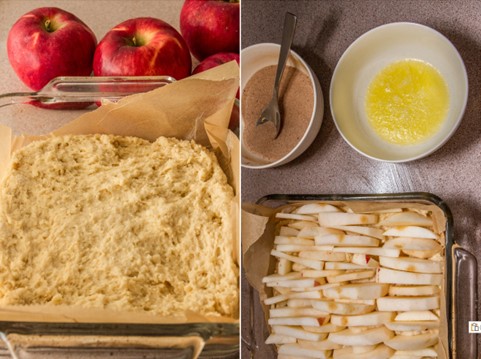
Setting the dough into a baking dish lined with parchment paper. The next step is to then insert the apples. Courtesy of the author, Ariane Gauthier.
The final step was to make the sugar and spice mix and sprinkle it onto the cake as evenly as I could. Then I melted 50 ml of butter, which I drizzled overtop before sending it to the oven for 25 minutes at 400 ⁰F.
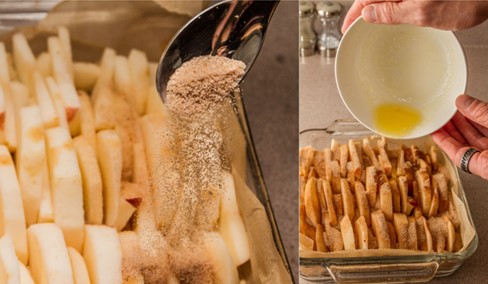
Adding the sugar and spice mix and the butter onto the apple cake. This is the element chiefly responsible for giving the cake any flavour. Courtesy of the author, Ariane Gauthier.
Having never made a Dutch apple cake before, I wasn’t sure what to expect. I felt as though this might very well be my first failure of a recipe, especially when I initially pulled the cake from the oven. It bubbled with butter and apple juice in a way that resembled a classic Québécois dish known as pouding chômeur, which, I was fairly certain, was wrong. For those who are unfamiliar, pouding chômeur is essentially a cake boiled in sweet syrup. However, part of the pleasure of following older recipes is opening the door to failure, and so I brought it to work the next day all the same for my colleagues to try. Here was the final result:
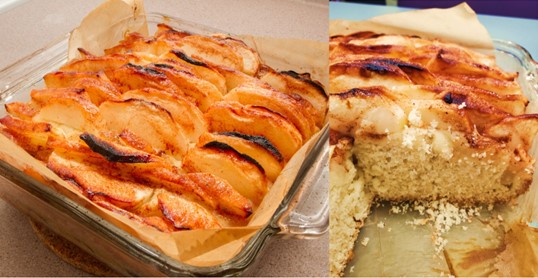
The final product with a view of the cross section. Courtesy of the author, Ariane Gauthier.
What do you think?
I was surprised by how well it turned out, all things considered! The cake was fully cooked through, and the apples became quite jammy. That helped to keep the cake somewhat moist and wasn’t too sweet. I brought it to the Reference Section for another tasting and showed that, once again, these recipes can withstand the test of time!
If you try this recipe, please share pictures of your results with us using the hashtag #CookingWithLAC and tagging our social media: Facebook, Instagram, X (Twitter), YouTube, Flickr and LinkedIn.
Additional resources
- A pumpkin pie from 1840 by Ariane Gauthier, blog post, Library and Archives Canada
- Cream puffs from 1898 by Ariane Gauthier, blog post, Library and Archives Canada
- Twelve Days of Vintage Cooking, YouTube channel, Library and Archives Canada
- Sifting through LAC’s Cookbook Collection, podcast episode, Library and Archives Canada
- Cooking, Flickr album, Library and Archives Canada
- Bakeries, Flickr album, Library and Archives Canada
Ariane Gauthier is a Reference Archivist in the Access and Services Branch at Library and Archives Canada.
 Library and Archives Canada Blog