Puzzling through 1931 Census sub-districts – Part 2

This article contains historical language and content that some may consider offensive, such as language used to refer to racial, ethnic and cultural groups. Please see our historical language advisory for more information.

This is Part 2 of the blog series Puzzling through 1931 Census sub-districts. If not done already, you may want to read Part 1, as it provides tools to help identify the census district that would have included your place of interest in 1931.

As a reminder from Part 1, to find the census returns for a place of interest, we generally need to narrow down, in order, the:

  1. province or territory;
  2. census district or federal electoral district; and
  3. census sub-district

that would have included the place of interest in 1931.

In this blog post, we go over the last step.

STEP 3. Determining the census sub-district

Each 1931 Census district was divided into multiple sub-districts – anywhere from three to 148 – for the purpose of enumeration. The majority of census districts were divided into at least 50 sub-districts.

The hitch is that no maps of 1931 Census sub-district boundaries are known to still exist. Figuring out in which census sub-district one’s place of interest was enumerated requires using one of the following tools:

  1. Street indexes (for 11 major cities)
  2. Finding aid for “Indian Reserves” (First Nations)
  3. Written descriptions of sub-district boundaries.

If your place of interest was in neither a major city nor a First Nations Reserve in 1931, skip directly to the last tool, the written descriptions of sub-district boundaries.

Tool 1: Street indexes

Indexes are available for Halifax (N.S.), Saint John (N.B.), Quebec (Que.), Montréal (Que.), Toronto (Ont.), Hamilton (Ont.), London (Ont.), Winnipeg (Man.), Edmonton (Alta.), Calgary (Alta.) and Vancouver (B.C.). Street indexes list street names and indicate in which census district and sub-district(s) those streets were enumerated.

The indexes for Hamilton and Calgary are specific to the 1931 Census. The indexes for the remaining cities cover multiple census years. In those indexes, for the purposes of locating district numbers for the 1931 Census, consider only entries beginning with “31.” The numbers that follow are the district and sub-district numbers, respectively, for 1931. So, for instance, if we are looking for a place of interest on Montréal’s Chemin de la Côte-des-Neiges in the census district of Mont-Royal (Census District no. 84), we find:

Typewritten entries for “Côte des Neiges” from the Montréal Street Index.

Excerpt from the Montréal Street Index (Finding Aid 31–80)

The numbers in the first line depicted above – “31–84–39, 40, 41, 43, 44, 45” – indicate that, in 1931, Chemin de la Côte-des-Neiges was enumerated in Census District no. 84, in census sub-districts 39 through 41 and 43 through 45.

Note: the street names featured in the indexes are historical; in other words, they are as written by the enumerator at the time, generally speaking.

Beware: the same street may have had its name written in multiple ways and thus appear in separate parts of the alphabetically ordered street index. In the case of Montréal’s Chemin de la CôtedesNeiges, entries are spread across three separate areas of the Montréal index, with the street name written as “Côte-des-Neiges,” “Côte des Neiges” and “Cote des Neiges.”

Tool 2: Finding aid for “Indian Reserves” (First Nations)

A listing of reserves by 1931 Census district and sub-district is available. This unverified finding aid could be useful if your place of interest was (in) a First Nations Reserve in 1931. We are currently working to adapt this pre-existing finding aid to include respectful terminology.

Tool 3: Written descriptions of sub-district boundaries

Written descriptions of sub-district boundaries were compiled by the Dominion Bureau of Statistics. These descriptions have been transcribed into finding aids for each province or territory: P.E.I., N.S., N.B., Que., Ont., Man., Sask., Alta., B.C., Y.T., N.T.

Note: the transcription of sub-district descriptions for select major cities may be forthcoming.

You may choose to begin with a keyword search related to your place of interest in the finding aid for a province or territory. For example, searching the Manitoba sub-district description finding aid for “Birtle” yields three results within the census district “Marquette”: sub-district 25 for “Birtle (Town)”; sub-district 24 for “Township 17 in range 26 west of the principal meridian exclusive of town of Birtle”; and sub-district 63 for the residential school of the same name. Alternatively, you may choose to navigate to a particular census district (like “Marquette”), then browse all sub-district descriptions within that census district.
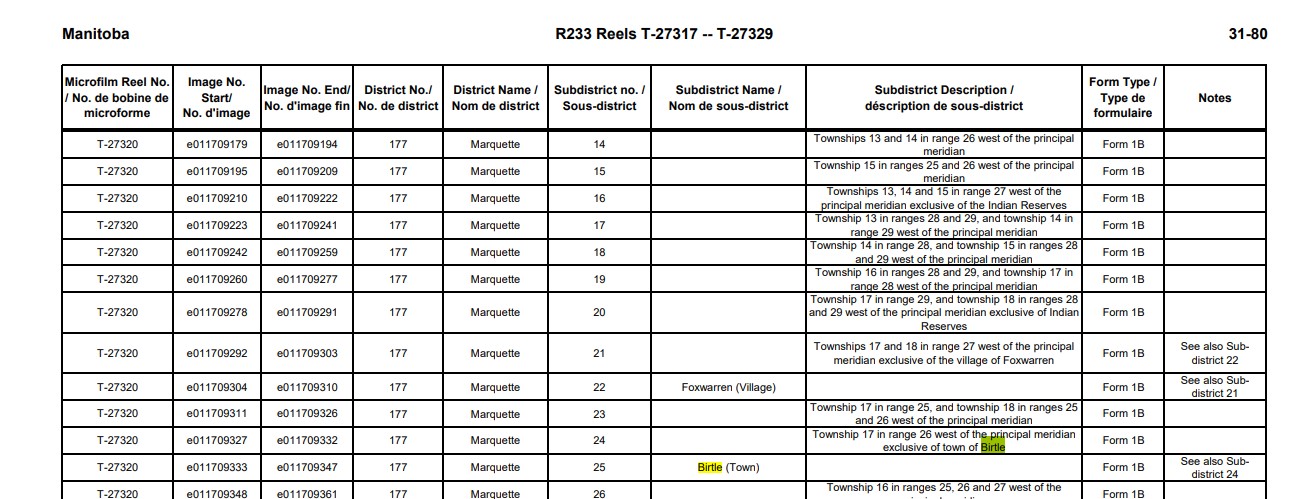
An excerpt of a finding aid for Manitoba. The excerpt features several sub-district names and descriptions for within the Census District “Marquette.” Two instances of the word “Birtle” are highlighted.

Excerpt from the Finding Aid for the 1931 Census Returns for Manitoba (Finding Aid 31–80)

The characterization of census sub-districts varies tremendously. The descriptions may refer to townships, municipalities, city wards, polling divisions, reserves, parishes, meridians, ranges, lots, roads, islands, rivers, etc. Making sense of the descriptions may require consulting local maps from the era or learning about the local, provincial or other federal geographies leveraged for the purposes of the 1931 Census (e.g., municipal boundaries may have been established in contemporary provincial law).

Sometimes the sub-district descriptions do not themselves allow us to narrow things down to a single sub-district. To illustrate what we mean by that, we can look at sub-district descriptions for the census district of Mont-Royal.

A typewritten card listing sub-district ranges for different parts of the Mont-Royal district in Quebec, 1931.

The Dominion Bureau of Statistics’ working description of sub-districts in District 84, Mont-Royal (from material accompanying the transfer of the 1931 Census returns to Library and Archives Canada). Library and Archives Canada/Statistics Canada fonds/District 84, Mont-Royal, Quebec, 1931

The sub-district descriptions for Mont-Royal create a situation in which it is challenging to identify a single sub-district of relevance. If you face this situation, you then have two options:

  1. flip through the census returns for all relevant sub-districts; or
  2. narrow things down using other working tools, such as city directories, which might list wards, or using additional tools such as a Street Index, which is likely the best approach in the case of Montréal.

Sometimes additional sub-district descriptions feature on the title card preceding the sub-district’s census returns. Scans of the original Dominion Bureau of Statistics’ working descriptions of sub-districts are available online and, though cumbersome, may be used for troubleshooting purposes. To view these scans, go to the archival description for the 1931 Census returns in Collections Search, toggle open the details, then toggle open the finding aid section and scroll down.

Additional resources

  • To learn about the system of townships, ranges and meridians used in the three prairie provinces and the railway belt of British Columbia, consult the section titled Western Canada Land System Description on the homepage for our Land Grants of Western Canada database.
  • The blog post “Finding Royalton: Searching the 1921 Census” describes how a staff member locates small rural hamlets or unincorporated villages. It offers insights and ideas about how to overcome stalemates.
  • If you had already found your place of interest among the census returns from the 1921 Census of Canada or 1926 Census of Prairie Provinces, consider viewing the sub-district description in Census Search for that earlier census year. It might assist you in navigating the sub-district descriptions for the 1931 Census.

Again, wishing us all the best in our searches for people and places of the past.

As always, don’t forget that we can help: reach out to our genealogy team by using our Ask genealogy a question online form.
Puzzling through 1931 Census sub-districts – Part 1

This article contains historical language and content that some may consider offensive, such as language used to refer to racial, ethnic and cultural groups. Please see our historical language advisory for more information.

Sometimes we researchers – including staff at Library and Archives Canada – need to navigate the archived census returns according to how the returns themselves are organized: by census sub-district. We don’t usually navigate census returns this way, since we have Census Search, our one-stop-shop database for genealogy. Once every few years, navigation by sub-district is necessary while we work to incorporate new census records into our database.

When we begin our work – and it is often tricky work – of navigating the archived census returns geographically, we often use a “step-wise” approach to narrow them down by

  1. province or territory;
  2. census district or federal electoral district; and
  3. census sub-district

that would have included our place of interest. We use this approach to be more efficient when searching, because there are so many census sub-districts involved: 15,167 sub-districts in the 1931 Census, to be exact.

This blog series offers five tools to help you find your place of interest among the census returns. Get ready to learn how to navigate the 1931 Census returns geographically!

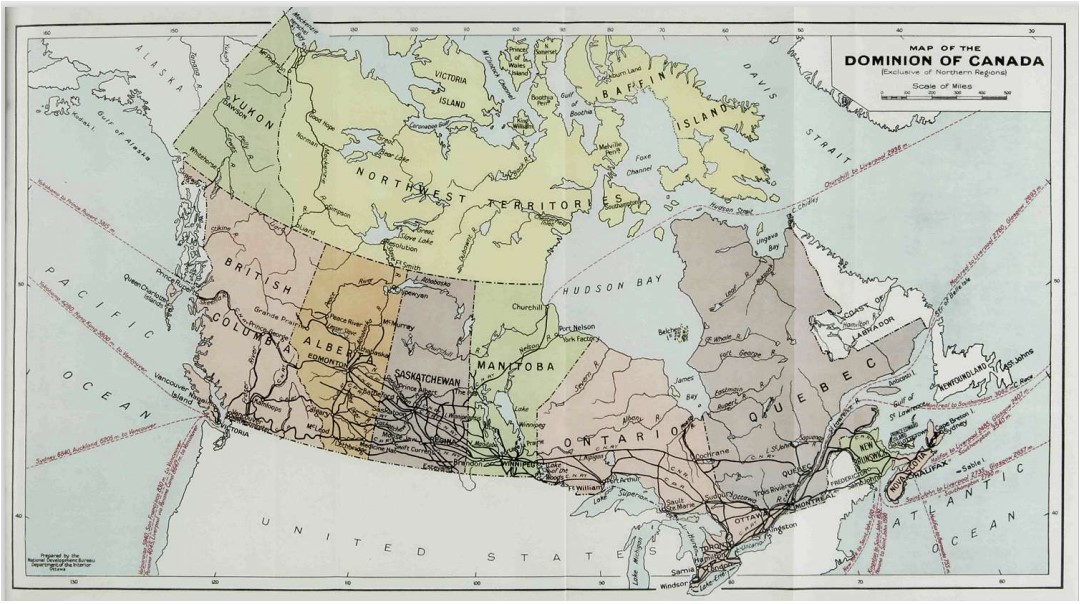
Map of Canada (without some northern regions) in which each province and territory is a different colour. Major railway lines are indicated with a thick black line. Major sea shipping routes are indicated with a dotted red line featuring the name of the two cities linked, and the mileage between them.

“Map of the Dominion of Canada (Exclusive of Northern Regions)” featured in the Dominion Bureau of Statistics The Canada Year Book, 1931 (OCLC 300543070)

STEP 1. Determining the province or territory

Reminders:

  • The Northwest Territories had different boundaries in 1931 than it does today.
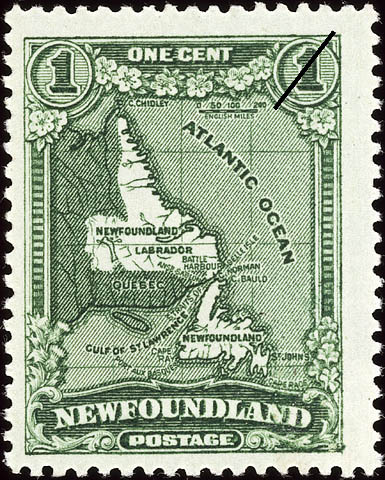
  • Newfoundland and Labrador became a province of Canada in 1949, and so its population is not enumerated in the Seventh Census of Canada. (Information about the separate censuses taken of Newfoundland and Labrador in 1921, 1935 and 1945 can be found on our Newfoundland and Labrador: Census and Enumerations web page.)
Green and white one-cent Newfoundland postage stamp.

Map of Newfoundland and Labrador, July 1931, one-cent Newfoundland stamp, Perkins, Bacon & Company, © Canada Post (s001670k)

STEP 2. Determining the 1931 Census district

Lucky scenarios that let you skip Step 2

There are a few scenarios in which you may go directly to Step 3 (forthcoming in the next blog post); these scenarios include when your place of interest is

  • located on a street in a major city for which Street Indexes have been prepared; or
  • an “Indian Reserve” (First Nations) listed in the relevant finding aid; or
  • included in the description* of sub-district boundaries.

*You can try a quick keyword search of the province-specific finding aids for sub-district descriptions: P.E.I. finding aid, N.S. finding aid, N.B. finding aid, Que. finding aid, Ont. finding aid, Man. finding aid, Sask. finding aid, Alta. finding aid and B.C. finding aid.

If your place of interest is in the territories, note that

  • Yukon was census district no. 241; and
  • the Northwest Territories was census district no. 242,

and go directly to Step 3 (in the next blog post).

If you cannot skip Step 2, your investigation begins with picking your preferred tool.

At Library and Archives Canada, we mainly use five online tools to help us determine in which 1931 Census district our place of interest was enumerated. The online tool that we choose is often a matter of personal preference. Some of us like lists; some of us like scrolling through old maps; some of us like navigating from the present, going backward in time; some of us prefer a quick database search; some of us know county names.

Tool 1: 1931 Census Maps research tool

This research tool lists 1931 Census districts. It also features links to maps approximating each census district. This tool is best used in a situation in which one or two census district names jump out as being likely candidates.

Note: This research tool does not include the census districts of the Northwest Territories, the District of Patricia (northern Ontario) or Unorganized (northern) Quebec.

Tool 2: Atlas of federal electoral district maps, 1924

To get a general sense of the 1931 Census district boundaries within each province, turn to the province-specific overviews in the digitized, 12-volume atlas prepared by the Department of the Interior of federal electoral district maps, 1924.

  • Why federal electoral district? The boundaries of the 1931 Census districts nearly always match the boundaries of a federal electoral district as established by the Representation Act of 1924. (Stay tuned to learn why in our upcoming blog, “Why are the 1931 Census records organized geographically?”)
A map depicting federal electoral districts in British Columbia. The boundaries are indicated by thick blue lines, and the names are indicated in blue type. The map was prepared on a base map of British Columbia featuring mountain ranges, rivers and cities. Additional detail is provided in two inset outline maps, for Vancouver and district, and for the City of Victoria.

“Map of British Columbia showing the federal electoral districts, 1924” from an atlas of federal electoral district maps, 1924, prepared by the Department of the Interior (e011315905)

You can flip through quicker-loading thumbnail-sized images of the atlas maps; the province-specific ones are the first 11 thumbnail images of the atlas. Should you need a higher-resolution image, use the overviews: P.E.I. overview, N.S. overview, N.B. overview, Que. overview, Ont. overview, Man. overview, Sask. overview, southern Alta. overview, northern Alta. overview and B.C. overview. The digitized overview maps are hard to read in some instances, but if they are decipherable for your place of interest, they may help to identify the federal electoral district, and therefore (typically) the census district, of relevance. Should the overview map be too difficult to read, consider browsing through thumbnail images for the entire province volume in the Federal electoral district maps, 1924 atlas. You can consult the thumbnail image range for each provincial atlas in the 1931 Census Maps research tool (“digitized image item no.”). That research tool also provides links to higher-resolution images of individual maps.

Should you want a more detailed sense of the boundaries of a particular federal electoral district (and therefore, usually, census district) in a province or Yukon, consult the map for that individual federal electoral district in the digitized atlas. You can navigate to a higher-resolution image of any particular electoral district in the atlas using the 1931 Census Maps research tool.

A map page from a previously bound atlas featuring a black-and-white map of the electoral district of Mount Royal and a paragraph describing the district.

Electoral district map for the Mont-Royal electoral district in Quebec, from an atlas of federal electoral district maps, 1924 (e011315941)

Note: If you are looking for a place in northern Ontario or Quebec, note that the District of Patricia was census district no. 244, and areas of northern Quebec were enumerated as census district no. 245.

Tool 3: Library of Parliament online list of ridings

This online resource lets you do the following:

  • View a listing of federal ridings as they existed at the time of the 1931 Census. Consult the Library of Parliament’s online resource “Elections and Candidates” for the 17th Parliament, and view the constituency titles listed for the general election of July 28, 1930.
  • Navigate the list of ridings represented in the House of Commons from 1867 to today. You can choose to:
        • Navigate from the current federal riding, going backward in time to 1931. (Note: You can find a current federal riding using Elections Canada’s Voter Information Service database.) From the list of current federal ridings, click on a riding name. From the page for that riding, click through to previous ridings. When you get to a riding that existed in 1931, look for its description under the Information subheader “S.C. 1924, c.63” (referring to the Representation Act of 1924); or
        • Search for historical ridings. On the Library of Parliament landing page for the list of ridings, in the top-right corner of the table, clear the default “currently active” filter by choosing “select all” for active and inactive ridings.

There is usually a very close match between the federal electoral riding that existed in 1931 and the 1931 Census district. You can choose to double-check the correspondence between a federal electoral riding and a census district using the 1931 Census Maps research tool.

Tool 4: Post Offices and Postmasters database

If your place of interest was likely to have had a post office in 1931, investigate what is available in our Post Offices and Postmasters database, which includes electoral districts. Try keyword searching.

Tool 5: Map of counties (and the like)

Try navigating by provincially established county (or the like). Only use this option if your place of interest is in Ontario, Quebec or an Atlantic province.

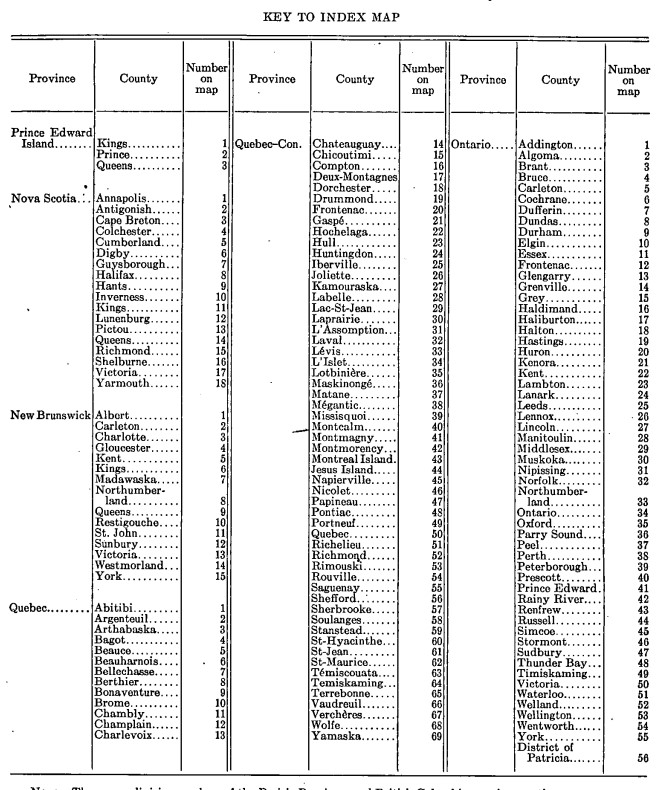
  • Why counties? Ontario and eastward, provincially established counties (and the like) often, but not always, informed the shape of census districts in the early 20th century. Sometimes counties (and the like) were grouped into one census district, and sometimes counties were split into several census districts. Either way, many county names featured in census district names.
An outline map of Canada, its provinces and Yukon. Each province is then divided further, with each division numbered.

“Index map showing the counties and census divisions as organized at the census of 1931,” in the Dominion Bureau of Statistics 1937 Illiteracy and School Attendance, by Murdock C. MacLean, p. 16 (OCLC 1007622268)

First, identify the county name. To do that, consult the “key to index map” provided below or this very high-level index map of counties (if you need to zoom in). Then, pay attention to the county name (numbers are not important for our purpose). If you identify a county name, search by keyword for that county name in 1931 Census Maps research tool. If you get a unique hit in the list of 1931 Census district names, you are now ready to go to Step 3 (in the next blog post). You can always double-check if you have the right census district by using that same research tool to consult the relevant map. If the county index map is tricky to navigate for your place of interest in Ontario or eastward, don’t bother with the county index.

  • Beware: The county map above does not help us to navigate the census districts used to organize the census returns from the Prairie provinces or British Columbia.
  • Beware also: Census districts used to collect the census returns were sometimes different than the census divisions used to tabulate and publish the census results.
A typed table listing county names for Prince Edward Island, Nova Scotia, New Brunswick, Quebec and Ontario, as well as the number on the map corresponding to that county.

Counties, not census districts! Key to Index Map, from the Dominion Bureau of Statistics 1937 Illiteracy and School Attendance, by Murdock C. MacLean, p. 16 (OCLC 1007622268)

Don’t forget that we can help! Reach out to our genealogy team by using our Ask genealogy a question online form.

Stay tuned for Part 2 of this blog. In the meantime, we wish everyone the best in all of our searches for people and places of the past!

Researching early census records

Library and Archives Canada (LAC) is pleased to announce the launch of an expanded version of one of our most popular research guides: Finding Aid 300: Other census and related documents (1640 to 1945).

This tool is a comprehensive guide to early census and related records found at LAC, with references mainly dating from 1640 to the 1800s. There are also some records from the 1900s, including Newfoundland and Labrador from 1921 to 1945.

New to this version of Finding Aid 300 are links to digitized images of most of the documents. Researchers can access numerous digitized records relating to Acadia, Nova Scotia, New Brunswick, Newfoundland and Labrador, Prince Edward Island, Quebec, Ontario, Manitoba, and British Columbia.

We also invite you to visit our updated Censuses page, which includes links to our databases of census returns (1825 to 1921) and other resources.

Newly transcribed finding aids

To help users find material more easily, Library and Archives Canada has transcribed some paper-based finding aids that were previously available only in the Reference Room at 395 Wellington Street. Highlighted below are a few of the finding aids that are now available online. If you want to learn more about finding aids, see this three-part series, Discover finding aids!

Royal Canadian Mounted Police (RCMP) Administrative Records

  • Finding Aid 18-16—Volumes 2511-2647
    Created between 1868 and 1878, these records deal with the administrative expenses of the Frontier and Dominion Police and include some applications for the proposed Mounted Force for the North-West Territories.
  • Finding Aid 18-29—Accession 1985-86/574 boxes 1-32
    This accession consists of registry records pertaining to the administration of the RCMP for the years 1940 to 1970. One group of files concerns the organization, procedures and functions of the Force including headquarters, Criminal Investigation Branch, “S” Directorate, marine and aviation divisions as well as the various divisions across Canada. Another group of records deals with the communications system ranging from the use of car radios to telex equipment. Other subjects include the filing system, RCMP reserves, and management studies. Also included are nine service files for special constables and regular members.
  • Finding Aid 18-30—Accession 1985-86/612 boxes 1-42
    The files deal with the inter-departmental committee on the Marin Commission recommendations, study groups on police associations and sovereignty control, the RCMP College, the Museum, policing in the provinces, northern patrols, memorials and cairns as well as assistance to publishers. Created between 1939 and 1980, most of the files concern routine administrative matters such as personnel, training, courses, supplies, and the band.

Supreme Court Case Files

  • Finding Aid 125-3—Volumes 3009-4067, 4294-4295
    These case files contain the collection of records created by the appellants, the respondents, the Court’s staff and the Justices for all cases brought before the Court. The finding aid is a file list that indicates volume number, case number, name of appellant, name of respondent, and the year in which the case was filed by the Court. Over 6,000 additional file descriptions for 1980–1990 case files have been added to our database.

Canadian Hydrographic Service

  • Registry files—Finding Aid 139-1—Volumes 1-29
    These files were created between 1938 and 1965 and pertain to Canadian Notices to Mariners. The Canadian Hydrographic Service was under the jurisdiction of the Department of Mines and Resources (1936–1948) and the Department of Mines and Technical Surveys (1949–1966) at the time of the creation of these files. The content of these Notices to Mariners include changes made to hydrographic charts; correspondence concerning surveys conducted in different parts of the country; reports, various committees, hydrographic instruments and equipment, and liaison with international organizations on matters concerning oceanography; monthly reports from various vessels of the service, tidal station documentation, and current surveys.
  • Ships Logs—Finding Aid 139-1—Volumes 33-66 (MIKAN 181475)
    These files relate to ships’ logs of various vessels designated for hydrographic operations under the Marine Branch of the Department of Marine and Fisheries (1905–1910, 1922–1936), the Department of Naval Services (1910–1922), the Department of Mines and Resources (1936–1948), the Department of Mines and Technical Surveys (1949–1966) and the Department of Energy, Mines and Resources (1966–1967). The logs contain a diurnal record of activities and observations aboard these vessels. The earlier logs provide succinct four- to eight-line descriptions of weather conditions and ship maintenance. The information in the later logs, for the 1950s and 1960s, pertains to weather, ship maintenance activities, the day’s itinerary, the vessels’ compass course, periodic positions expressed in longitude and latitude, swell and wind conditions, barometric pressure, atmospheric temperature, and visibility. Few details of actual hydrographic work are recorded.

Tips for aviation accident research, part 2

By Mathieu Sabourin

In our previous blog post on civilian aviation accidents, we covered the main search principles for finding files on this topic in our archives. We showed you that records could generally be found in four record groups:

  • Department of National Defence fonds: R112 (1923–1936)
  • Department of Transport fonds: R184 (1936–1984)
  • Canadian Aviation Safety Board fonds: R13086 (1984–1989)
  • Transportation Safety Board of Canada fonds: R1009 (1990–present)

Let’s take a look at the characteristics of the first two record groups so you can better focus your searches.

Department of National Defence fonds

After the First World War, the Royal Canadian Air Force served as a civilian airline for the government and was therefore responsible for investigating aircraft accidents. The Civil Aviation Branch was created for this purpose in 1923.

At the time, the Department used a subject-block numeric classification system. Blocks 1021 and 1100 (all the files starting with these numbers) were reserved for aviation accident records. For example:

Screenshot of the results of an archives search. A big red arrow indicates the reference to Block 1021.

Example of a file from Block 1021.

Continue reading

Tips for aviation accident research

Let’s be honest: Finding information on a civil aviation accident is no small feat. In the federal government, organizational changes involving aviation accident management and the evolution of records classification are making the researcher’s task even harder.

But seek and, generally, ye shall find! So let’s look at how to go about researching an aviation accident effectively.

First, you need to have certain basic information on the accident you’re researching:

  • Aircraft model
  • Accident date and location
  • Aircraft registration number
  • Aircraft type (civilian or military)

This will make things easier, because the finding aids related to aviation accidents are put together based on that basic information.

You must then determine where the records you are looking for might be located, i.e., select the right record group. The following reference table will help guide your first steps:

Years of Responsibility Department Record Group Number
1923–1936 Department of National Defence

Civil Aviation Branch

RG24 / R112
1936–1984 Department of Transport
Air Services Branch (1936-1970)
Canadian Air Transportation Administration (1970-1985)
RG12 / R184
1984–1989 Canadian Aviation Safety Board R13086
1990–present Transportation Safety Board RG156 / R1009

Each record group is divided into series and sub-series. For each of those subdivisions, you will need to consult a finding aid to determine whether a file exists pertaining to your research topic. It is a painstaking process, but some aids are available online (for example, the accession “Aviation Accident Reports 1919-1977“—RG12), which narrows down the research that needs to be done at 395 Wellington Street, Ottawa.

Here are some things to take into consideration:

  • Two types of records pertain to accidents: the accident report and the occurrence investigation. They are not always filed in the same location, so you’ll have to check the entire record group to find them.
  • In the 1920s and 1930s, National Defence had the mandate to investigate accidents. Even if your research is on a civilian aircraft, consult RG24.
  • Your file could be located in the Central Registry (records originally stored in Ottawa) or in the regional registries (stored in the regions: Maritimes, Pacific, etc.).
  • Library and Archives Canada’s (LAC) collection has gaps: we do not have all records pertaining to aviation accidents. Sometimes, a file simply does not exist.
  • Some records are still at the accession stage. They have been transferred to LAC but have not yet been processed by an archivist. If the description in our database contains a note to that effect, consult the links under the heading “Accession” (see “Scope and Content” in connection with the note “Please consult the related accessions”).

For example, here is a screenshot associated with the series Central Registry Files from the Transportation Safety Board fonds:

Screenshot showing that the files have indeed been acquired, but not yet processed.

List of accessions from Central Registry Files (RG156)

Each record group has its own challenges but the basic concepts explained here will help you to conduct your research effectively.

New finding aids available online

Library and Archives Canada has begun an initiative that will see the digitization and transcription of several significant finding aids. Adding these finding aids online will help users find material much more easily. We will continue to add other finding aids throughout the year, but so far, the following finding aids have been transcribed:

Finding Aid 15-25: Colonization Company Money Scrip

After the Hudson’s Bay Company transfer of Rupert’s Land and the North-West Territories to the Dominion of Canada, a few private companies were allowed to buy land to sell it through sponsored settlement schemes.

Finding Aid 15-33: Military Bounty Land Warrants, Riel Rebellion

Officers and men who served in Manitoba during the Riel Rebellion were offered free land grants in the newly opened lands of the North-West. Members could receive scrip (money certificates) equal in value to and in lieu of the land grant.

Finding Aid 9-8: Department of Militia and Defence Pre-Confederation Records – Adjutant General’s Office, United Canada Correspondence

Letters received in the Office of the Adjutant General of Upper Canada. The correspondence relates to the appointment, promotion and retirement of officers, as well as the organization of units.

Finding Aid 9-4: Department of Militia and Defence – Adjutant General’s Office, United Canada Correspondence

Letters received by the Deputy Adjutant Generals of Canada West, Canada East and United Canada, between 1846 and 1869. The letters relate to the Active and Service Militia as well as the Sedentary (Non-Service) Militia. Some of the letters were received by the Premier of the Province of Canada from 1854 to 1856, Sir Allan MacNab.

How to find references

  1. Go to the search screen for Archives Search—Advanced.
  2. In the drop-down menu, select “Finding aid number” and then in the box, enter 15-24.
  3. In the next line, select “Any Keyword” and enter a surname, a place name, or a topic.
  4. Click on the “Submit” button.

Questions or comments? We would love to hear from you!

New Finding Aid Online: Non-Permanent Active Militia

Library and Archives Canada (LAC) is pleased to announce that a new finding aid for the Non-Permanent Active Militia, RG 9 II-B-7, is now available online. View the 8,800 lower level descriptions today!

During the First World War, units of the Non-Permanent Active Militia were called upon to perform a variety of military tasks in Canada, notably to guard strategic sites such as armouries, bridges and canals.

The files are arranged alphabetically and can include a variety of forms dealing with enlistment, medical and dental history, hospitalization, discipline, pay, discharge and subsequent correspondence relating to the individual’s eligibility for war service gratuities and other service-related issues. Attestation papers, which are completed at the time of enlistment, are present in a number of the files. They include the recruit’s name and address, next-of-kin, date and place of birth, occupation, previous military experience and distinguishing physical characteristics.

This sub-series also contains small quantities of exceptional files: for members of the permanent force, for members of the Canadian Expeditionary Force (CEF) prior to embarkation overseas, for members of Royal Flying Corps, and for nursing sisters and other members of the Canadian Army Medical Corps.

Although the outside dates for the records are 1908-1983, the vast majority were created during the period 1914-1919.

Want to learn more about how to use finding aids? Consult our articles “Discover Finding Aids!” and “ Discover Finding Aids – Part Two”.

Be alerted when we have added new finding aids online by subscribing to our RSS feed.

For more information on recent announcements at LAC, visit “News”.