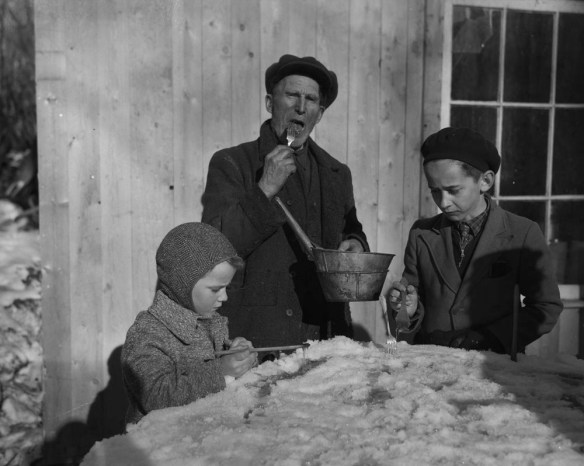
Images of Sugar Shacks now on Flickr

A black-and-white photograph showing three people eating maple taffy on snow.

People tasting maple taffy at a sugar bush.

The collection of maple sap and the production of maple products has evolved from the early practices of First Nations communities, such as the Ojibwa and Iroquois. The bark of a maple tree is pierced, the sweet sap is collected, and then the excess water is boiled off leaving a syrup. The syrup can be used as a sweetener or cooking additive. Neighbouring First Nations communities most likely taught French colonists how to process maple sap. The maple industry has evolved technologically over the years, but its core process of tapping trees and collecting sap has remained basically the same. Today, Quebec provides a majority of the maple syrup products on the global market. Numerous sugar shacks new and old fuel the world’s desire for this tasty treat.

Centre Block: Rising from the Ashes

On February 3, 1916 at 8:37 p.m., the alarm was raised on Parliament Hill that a fire had broken out in the Centre Block. By the next morning, the building had been reduced to a smoking ruin, encrusted in ice. The exact cause of the fire was never determined.

Images for Women’s Suffrage Now on Flickr

Women won the vote in small incremental steps, with the western provinces leading the way. However, it was not until the 1960s that the majority of women in Canada gained the right to vote. Women’s suffrage was a powerful and early expression of women’s rights in Canada.

New Flickr set: Curling in Canada

Curling could be considered the unofficial national sport of Canada. Explore the evolution of the game of Curling; its development as an organized sport; and the creation of a Canadian curling culture.

Canoes

As immigration and settlement expanded across Canada, a variety of travel means were adopted from Aboriginal people’s communities. Many of these methods, like the canoe, are still used today for work and leisure activities.

Images of Georges Philéas Vanier now on Flickr

Born in Montréal on April 23, 1888, Georges Vanier would feel the influence of his bilingual parents throughout his life. After graduating from high school, he attended Loyola College and then the Université Laval where he received a law degree in 1911. He started practicing law thereafter, although priesthood was also on his mind. It was the outbreak of the First World War however, that eventually grabbed his attention and he enlisted in the Canadian Army. He was a strong recruiter and played an important role in the creation of the French-Canadian 22nd Battalion. It was also during the war that he was injured and had to have his right leg amputated.

Photography of Yousuf Karsh now on Flickr

Yousuf Karsh came to Canada as a teenager and pursued his dream to become an internationally renowned photographer.

Images of national parks now on Flickr

Canada’s national parks are protected areas established under federal legislation to preserve Canada’s natural heritage for public understanding, appreciation and enjoyment. The parks are maintained for future generations and have existed in Canada for well over a century.

Images of cottages, cabins and camps now on Flickr

Cottages, cabins and camps are associated with weekend or vacation getaways by Canadians. They are a place to spend holidays with friends and family for a variety of outdoor sporting and leisure pursuits.

Early 20th century railway images now on Flickr

Library and Archives Canada (LAC) preserves a unique collection of railway materials dating from the 1880s to the 1950s. A portion of the collection showcases photographs of railway hotels, stations, trains and travel across the country.