Potato Biscuits from 1917: How the Housekeeper May Help to Save the Country’s Wheat Supply

Version française

Cooking with Library and Archives Canada bannerBy Ariane Gauthier

Canada joined the First World War on August 4, 1914, alongside Great Britain and the rest of the British Empire. What began as a mobile war quickly turned into a static one, with the entrenchment of the Allied and Entente armies. By 1915, the momentum that had previously animated early fighting had vanished, leading to a grueling war of attrition in the trenches across Europe and the Mediterranean.

The devastation of Europe’s countryside reduced accessible food supplies, a situation that was made worse by the arrival of unprecedented numbers of soldiers mobilized from all corners of the world. Great Britain was quick to marshal the resources of its empire, hoping to fuel its war effort. Canada contributed by supporting troops overseas through its agricultural and industrial output, but it wasn’t enough. Soon, all levels of government had to consider other means of bolstering aid, ultimately settling on rationing key resources.

By the third year of the war, wheat was becoming scarce. Anticipating a ration order, the Ontario Department of Agriculture published the pamphlet “War Breads: How the Housekeeper May Help to Save the Country’s Wheat Supply” in August 1917, claiming that “every pound of flour saved means more bread for the army.” However, it admitted that its suggested wheat flour substitutes wouldn’t necessarily yield tasty breads or biscuits: “The constant use of these coarser breads might not agree with some people, but as a rule they will be found more healthful than the finer white bread.”
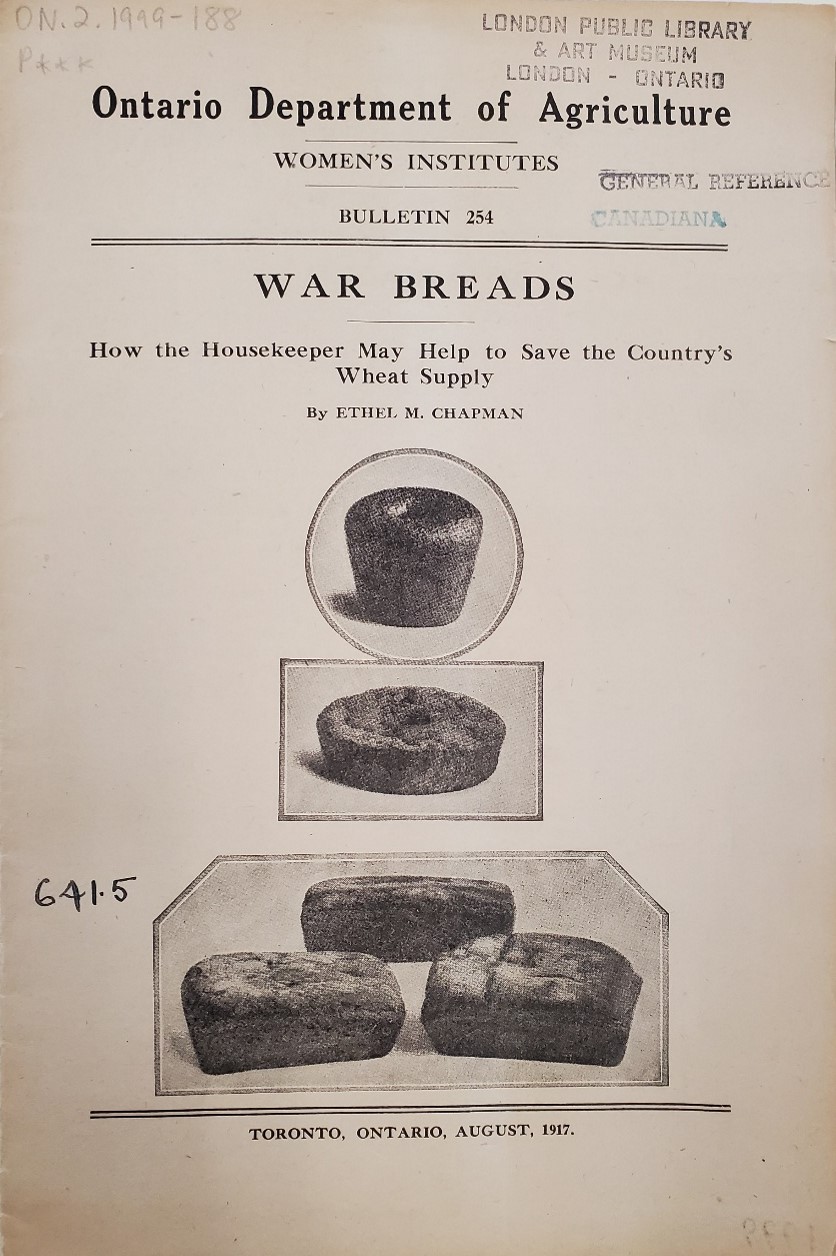
Cover of a pamphlet with photos of different types of breads.

Cover of the pamphlet “War Breads: How the Housekeeper May Help to Save the Country’s Wheat Supply” (OCLC 1007482104).

Intrigued by this unique pamphlet, I chose a recipe that might give me a taste of a housekeeper’s patriotic efforts: potato biscuits. Having enjoyed potato breads and donuts before, I felt hopeful.
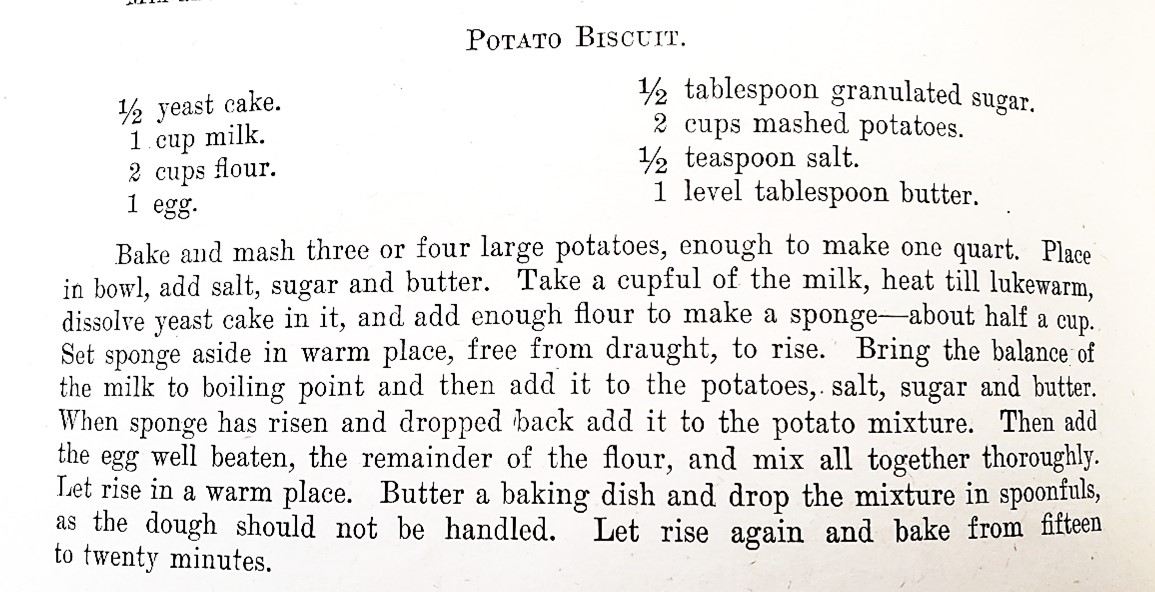
Recipe for potato biscuits including ingredients and instructions.

Recipe for potato biscuits from the pamphlet “War Breads: How the Housekeeper May Help to Save the Country’s Wheat Supply” (OCLC 1007482104).

I only glanced at the recipe’s ingredients initially. They seemed adequate, but as I started assembling the potato biscuits, the meager half tablespoon of granulated sugar and single tablespoon of butter made it clear that these biscuits might end up bland or very yeasty. Given the war-era context, this wasn’t entirely surprising—wheat flour wasn’t the only ingredient being rationed.
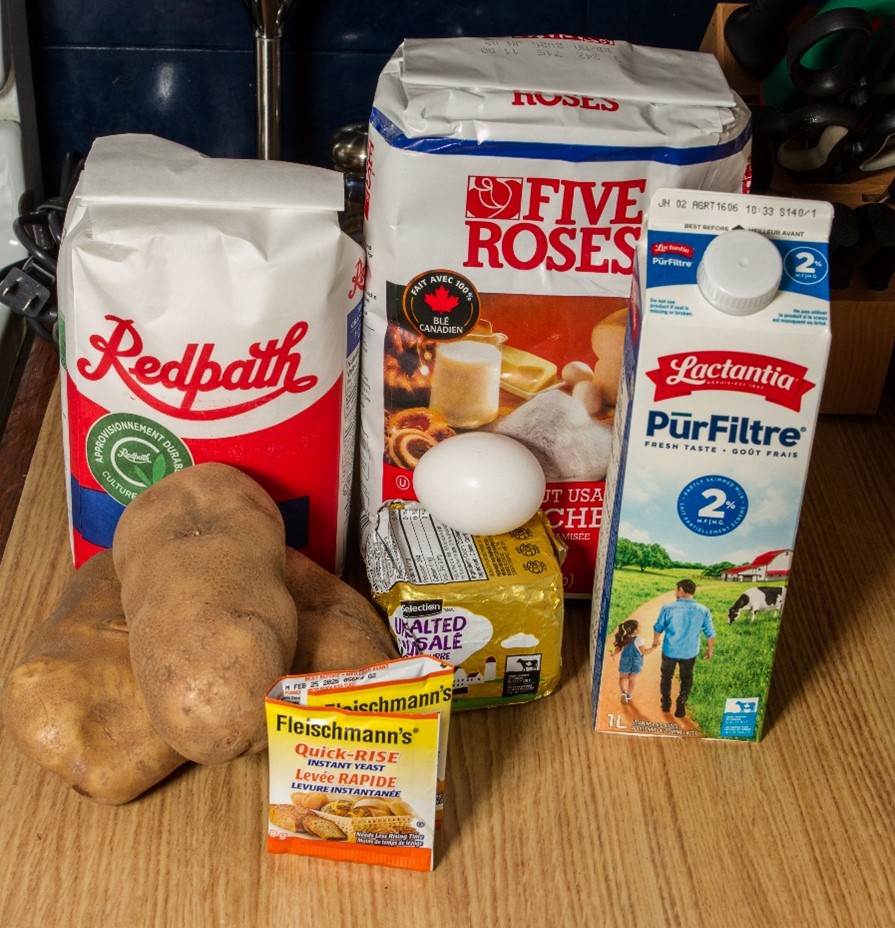
Photo of baking ingredients: yeast, three potatoes, butter, one egg, milk, sugar, and flour.

Ingredients for the potato biscuit recipe. Photographer: Ariane Gauthier.

First, I assembled my ingredients. Strangely, the recipe called for baking the potatoes instead of boiling them. Perhaps this was to control the moisture content. I heated the oven to 400°F and baked the potatoes for 45 minutes to an hour until they were fork-tender.

Top photo shows three potatoes in a pan lined with parchment paper in an oven. Bottom photo shows roughly mashed potatoes in a bowl.

Potatoes baked in the oven and then peeled and mashed. Photographer: Ariane Gauthier.

While the potatoes baked, I prepared the yeast mix. Unable to find cake yeast, I used bread yeast instead. I mixed lukewarm milk with the yeast and some flour, setting it aside until it bubbled and rose.

Photo of yeast, flour and milk mixed in a cooking dish.

Yeast, flour and milk mix. Notice the myriad of bubbles produced by the yeast as it froths. Photographer: Ariane Gauthier.

I mashed the potatoes and mixed them with salt, sugar, butter, and boiling milk until smooth. I added the yeast mixture, the egg, and the remaining flour. By this point, the oven had cooled slightly, making it an ideal spot to let the dough rest and rise.

Five photos illustrating various steps of mixing ingredients together to make dough.

Making the potato biscuit dough. I vigorously mixed the ingredients at every step to ensure everything was as uniform as possible. Photographer: Ariane Gauthier.

The dough was gloopy, much to my surprise. With such little liquid compared to the dry ingredients, I hadn’t expected this. Taking the recipe’s warning to heart, I avoided handling the dough and used spoons to scoop it into a buttered muffin tin.

Four photos of various stages of mixing and handling dough, including picking up the raised mix with a spoon and spooning into a muffin pan.

The dough mixture before and after rising for a few hours in a warm place. As the recipe indicated, it was very gloopy and could not be handled by hand. Photographer: Ariane Gauthier.

As seems to be the custom with these old recipes, the recipe didn’t specify the oven temperature for baking, so I settled on 400°F and watched closely as the potato biscuits baked for 15 to 20 minutes until golden.

Photo of a plate with four potato biscuits. One potato biscuit has strawberry jam spread on it, another one is filled with berries, and the other two are plain.

The completed potato biscuits. The one on the left has been garnished with jam. I decided to add berries to another on the right before baking. Photographer: Ariane Gauthier.

And voilà! What do you think?

The strong yeast smell hit me as soon as I pulled the biscuits from the oven. As for the flavour? Shockingly bland. Luckily, I had some traditional strawberry jam on hand, which saved the day (thanks mom and dad!). These potato biscuits were better as a jam vehicle than a standalone treat.

As per my tradition, I took the biscuits to work and offered them to my colleagues. Never have I made such polarizing food! They either loved it or hated it; no one was neutral. So, if you’re feeling adventurous or just want a taste of history, give these potato biscuits a try—and don’t forget the jam!

If you try this recipe, please share pictures of your results with us using the hashtag #CookingWithLAC and tagging our social media: FacebookInstagramX (Twitter)YouTubeFlickr and LinkedIn.

Additional resources:


Ariane Gauthier is a reference archivist with the Access and Services Branch at Library and Archives Canada.

Cheese and walnut loaf from 1924

Version française

Cooking with Library and Archives Canada bannerBy Ariane Gauthier

In 1924, the Department of Agriculture published the booklet Mangeons du fromage canadien : Recettes et menus. It highlights the health, nutritional and economic benefits of cheese, particularly Quebec cheese. Evidently knowledge of the nutritional value of this food has changed a lot since then. At the time, the booklet stated: [Translation] “There is no meal where cheese has no comfortable place, and he who goes to work fortified by this nutritious food will accomplish, with the same zest, the same amount of work as if he had eaten a hearty meat-based meal.”

I found this book in our online Collection Search tool rather than in our Aurora catalog. I was hoping to find something a little more personalized, like a family recipe slipped into an archived letter! Then I discovered a record from the Department of Agriculture on the export of Canadian cheese. Lo and behold, it was hiding the booklet Mangeons du fromage : Recettes et menus in English and French.

Cover page of a booklet with the inscription "Mangeons du fromage : Recettes et menus" [Translation: Cheese Recipes for Every Day].

Cover page of the booklet Mangeons du fromage : Recettes et menus, [Cheese Recipes for Every Day] published in 1924 (OCLC 937533172). Image courtesy of the author, Ariane Gauthier.

(This booklet can also be found in Aurora, OCLC 937533172. This is the easiest way to access it.)

This little book was tucked away in a pile of interviews, economic reports and photo envelopes about Canadian cheese from 1920 to 1924. It immediately piqued my curiosity.

But that did not stop me from reading the whole file. I learned that at the time, the dairy industry was quite unstable in Canada. Exports to Great Britain remained steady (especially for cheese) thanks to a particularly generous premium, but cheese consumption was declining. The British—our biggest buyers—no longer favoured this food as much, and neither did Canadians.

The Department of Agriculture and the producers were concerned: would Canada lose its place on the international market? In this context, Mangeons du fromage : Recettes et menus was born.

I went through the booklet looking for a recipe. My only criterion was to find something new, so I set my sights on a recipe for cheese and walnut loaf.

Text describing the ingredients and steps for the cheese and walnut loaf recipe.

Photo of the cheese and walnut loaf recipe (OCLC 937533172). Image courtesy of the author, Ariane Gauthier.

Cheese and walnut loaf recipe [translation]

One cup of cheese, one cup of coarsely chopped walnuts, one tablespoon of lemon juice, two tablespoons of hot sauce, three tablespoons of tomato sauce to moisten, one finely chopped onion, one cup of crumb, one tablespoon of olive oil, salt and pepper to taste.
Place in a well-greased baking pan; roast on low heat and leave in the oven until the top is a perfect golden brown.

I began by gathering the ingredients, making sure to choose a Canadian cheese. I chose a local cheddar made near Ottawa.

Ingredients used for the cheese and walnut loaf recipe: tomato paste, hot sauce, cheddar cheese, breadcrumbs, olive oil, lemon, pepper, salt and walnuts. (The onion is not in the photo.)

The ingredients for the recipe. Image courtesy of the author, Ariane Gauthier.

The recipe called for one cup of crumb. This seemed odd to me, and I looked at the English booklet to compare. To my surprise, Cheese Recipes for Every Day featured completely different recipes. Not a single recipe for cheese and walnut loaf! To avoid wasting a good loaf, I chose to use ready-made breadcrumbs.

The first thing I noticed was the lack of instructions. The ingredients are listed, then it simply says to put everything in a well-greased pan and [translation] “roast on low heat.”

All ingredients placed separately in a bowl: cheddar cheese, walnuts, tomato paste, onions, hot sauce and breadcrumbs.

The ingredients in a bowl. The recipe does not say to mix them, but we can guess that this is the next step. Image courtesy of the author, Ariane Gauthier.

In short, the recipe seems to rely on the reader’s common sense, so I stirred the ingredients together. The result was quite dry, probably because of the breadcrumbs. I added a little water, but that did not help much. I stuck with it nonetheless, not daring to change the recipe too much.

Three close-up shots, side by side, showing the ingredients being mixed and transferred to a baking dish.

The ingredients are added and mixed. The result is more-or-less homogenous. Image courtesy of the author, Ariane Gauthier.

I then poured the mixture into a well-greased mould, which I had lined with parchment paper to make the unmoulding easier. Since no baking temperature was specified, I decided to put it in at 400oF and keep an eye on the loaf. After about 15 minutes, it had a nice colour and smelled toasty; I removed it from the oven. Here is the result:

Cheese and walnut loaf on a wooden board.

Cheese and walnut loaf from 1924, which barely stays together in one piece. Image courtesy of the author, Ariane Gauthier.

The loaf barely held together; it was obviously very dry. It did not survive the journey from my home to 395 Wellington Street, turning into a kind of crumble. Nevertheless, I think my colleagues appreciated the surprising taste, which I would compare to that of vegetarian spaghetti meatballs.

What do you think?

If I had to do it again, I would sacrifice a good loaf of bread to use its crumb; it would surely absorb the mixture better than the ready-made breadcrumbs. I would also use a local cheese with a higher moisture content.

If you try this recipe, please share pictures of your results with us using the hashtag #CookingWithLAC and tagging our social media: FacebookInstagramX (Twitter)YouTubeFlickr and LinkedIn.

Additional resources:


Ariane Gauthier is a reference archivist with the Access and Services Branch at Library and Archives Canada.