
By Andrew Elliott
As mentioned in Part 1 of this blog post, Allan Fleming mostly provided background consultancy work to the Canadian National Railway Company (CN) after its new logo was completed. Once the various designs for railway objects had been identified by the visual redesign team and Valkus had found new ways to incorporate the logo onto these objects, the information was then sent to various advertising firms to be turned into publicity for the company.
McConnell Eastman was responsible for the Canadian advertisement market, Canadian Advertising Agency was responsible for the French language market in Quebec and Maclaren Advertising was responsible for the international market. The three came up with the catchy jingles that would be then printed up for posters and advertisements.
Application of the logo
The logo was applied on a variety of products including locomotives, sides of boxcars, tickets, coasters, doggie bags, bookmarks, envelopes, business cards, letterheads, calendars, advertisements and many more.

Examples of a variety of products that highlighted the new CN logo. (MIKAN 6026153)
Logo standardization: the Signs Manual
The visual redesign team also needed to come up with a set of standards that everyone in the company could follow when it came to using the logo on company materials. They started by creating a bilingual booklet (Seeing is Believing/Voir C’est Croire) that could be handed out easily to anyone both inside and outside the company.
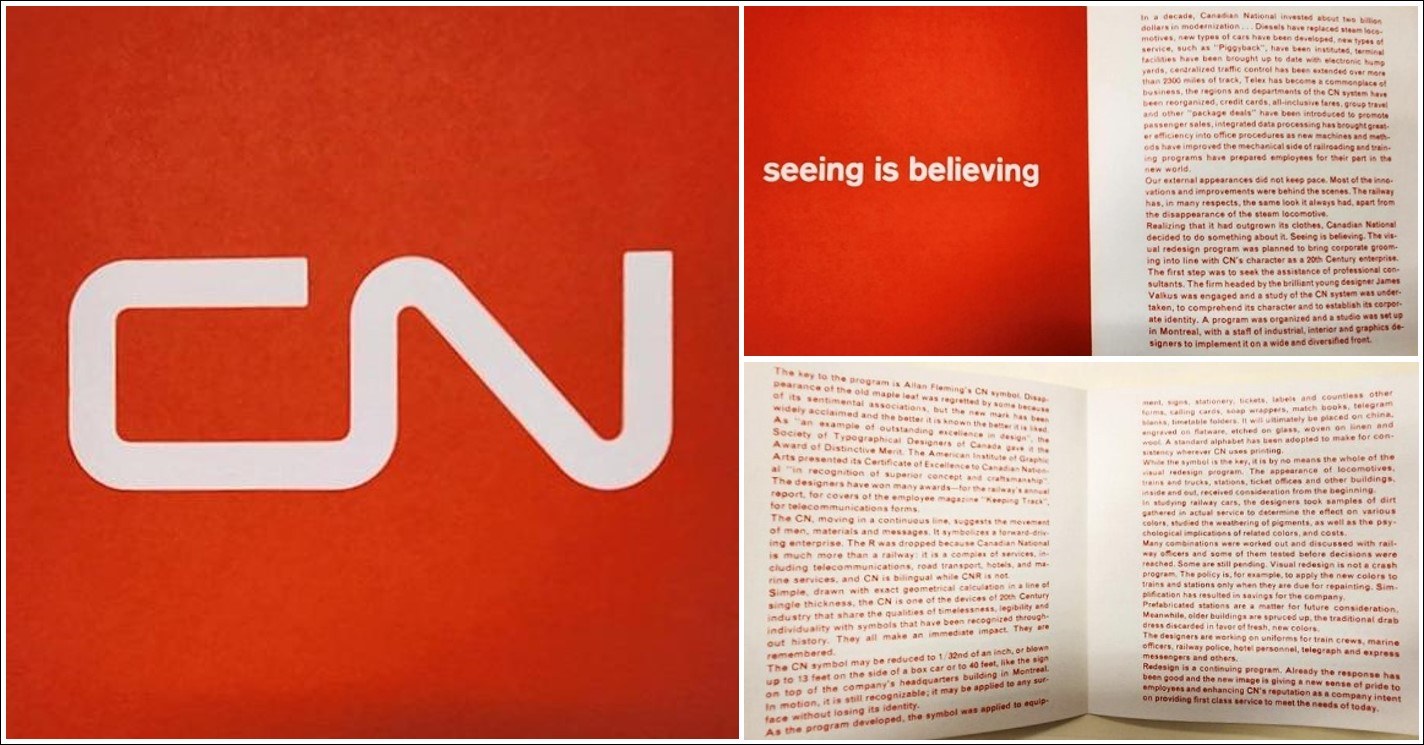
Booklet “Seeing is Believing”. (MIKAN 6026153)
Between 1963 and 1967, CN employed, through Valkus Inc., a talented designer by the name of Jean Morin. Morin was born in Québec on March 2, 1938. He studied advertising art at the École des beaux-arts de Québec from 1956 to 1960. In addition, he was one of the first French-Canadians of his generation to study in the graphic design field that was just beginning to flourish in the early 1960s. He then audited classes at the Kunstgewerbeschule in Zurich, Switzerland during the winter semester of 1960–1961. He was able to visit several Swiss workshops at a time when graphic design was thriving in Europe. Jean Morin’s first job upon returning to Canada in 1961–1962 was with the Canadian Government Exhibition Commission. His later jobs—including with CN—related to corporate identity. In this capacity, Morin created a signage standards manual, a first of its kind in Canada.
This Signs Manual (dating from 1965) can be found within the Jean Morin fonds (MIKAN 189534) at LAC, located in volume 1 of R2725. The manual is set up in an amazingly simple format, with the focus primarily on design aesthetics, particularly in regard to the relationship for colour and typography.

First page of a CN’s Signs Manual. (MIKAN 189541)
The manual notes clearly and succinctly what the visual redesign program is all about at CN and what the manual is for. There is guidance on how to properly create the letters C and N on a grid so that they can be expanded or minimized to still look the same to viewers. The use of standard colours, and in what combinations, are provided; the kind of font to use and the spacing of letters is specified in order to allow for maximum visual effect; and there are various examples of layouts for printing on stationary, offices and building exteriors. There are even codes for employees to use to be able to order specific templates, specific letters and specific colours from the CN Store Department.

Excerpts from the CN’s Signs Manual. (MIKAN 189541)
A remarkable feature of Morin’s manual is that it translates the aesthetic ideal of corporate identity drafted by the graphic designers into a language that anyone (particularly CN employees) can understand.
In the spring of 1968, Valkus’ firm and CN parted ways after an unresolved dispute over payments for services done in the previous year. CN subsequently hired ARC Corporation, another design firm from Montréal. Luckily, this firm consisted of former employees of the Valkus firm. These employees brought a certain amount of design consistency, and the records within the CN fonds tells of a stable relationship with that company until the late 1970s.
It is worth noting that since the 1960s, no one has dared tinker with either the logo or the standards manual. In fact, in 1996, some years after Lorne Perry had retired, he was asked to arrange for the standards manual to be reviewed: the basics would not be changed, but the identity would be clarified and any extraneous elements would be removed. “I chose consultants who were direct corporate descendants of the creators. Everything was updated, simplified, standardized and enshrined in manual form. The CN symbol itself remained its simple, unadorned, powerful self.”
The updated Basic Elements manual was published in 2001 and can be found online. This manual states that “Colour is a key factor in ensuring rapid recognition of the logo. Like other elements of the design system, colour must be used consistently if it is to serve this purpose. The CN corporate colour is red (Pantone 485). Whenever the application method or the medium itself permits it, the logo should appear red on white, or white on red. If red is not available, the logo may be black on white, or white on black. Contrast must always be sufficient. Special situations may arise where the logo is used in a more commercial context and a background other than a solid colour is permitted. Any such departure from the corporate colours must, however, be justified, and will be decided upon case by case by Public Affairs.”
Evolution of the Visual Redesign Program
Another key factor in the consistency of the Visual Redesign Program was that Lorne Perry, who was around from the beginning, stayed in his position of influence (and as translator-in-chief) for a number of decades. He was the bridge between the designers and the rest of the corporation. In the 1970s, CN renamed the Visual Redesign Program to the Corporate Identification Program.
A few years later in the mid 1970s, CN’s Passenger Services Department had a $70 million annual deficit, and CN was looking for a strategy to have the Government pay the shortfall as a public service. A new identity was needed to dramatize this need, and Corporation Arc was commissioned by CN to take it on. They only presented one logo, one blue-and-yellow colour scheme, and one name: VIA. Lorne Perry remembers “presenting to the Executive Committee of CN, chaired by CEO Robert Bandeen. We were surprised and pleased when he announced at the end that we had chosen the school colours of his old Alma Mater, Duke University; “old gold, and sapphire blue”. The program was an easy sell.”
Today, some 65 years after its initial unveiling, the CN logo continues to be an enduring part of the CN corporate identity.
For further information about the CN logo, please check out the Allan Fleming Project by Martha Fleming:
The following resources also provide some further reading on the subject:
- CN logo evolution (Canadian National Rail) | Logo Design Love
- The CN Brand | cn.ca
- CN Logo Designed by Allan Fleming & CN Brand Guidelines & History (imjustcreative.com)
- The CN Logo: A Masterpiece in Corporate Design, by Andrew Elliott, Library and Archives Canada Blog
- The CN Logo: Drawing Board to On-Board – Part 1, by Andrew Elliott, Library and Archives Canada Blog
Andrew Elliott is an archivist in the Archives Branch at Library and Archives Canada.
 Library and Archives Canada Blog