All “aboat” searching for ship registries in LAC’s collections

Version française

By Elaine Young

Did you know that Canadian vessels over a certain size have had to be registered with government authorities as far back as the 18th century? Library and Archives Canada (LAC) holds various types of records related to the registration of vessels and has recently transcribed and made searchable almost 84,000 of these records. The transcriptions include the ship’s name, port of registry, registration number and year of registration, all key fields for researching the rich (and sometimes surprising!) histories of the vessels. These records are a vast resource for researching maritime history across Canada and are also a genealogical tool for tracing the family lineages tied to those ships.

This transcription project is part of LAC’s effort to improve research into the records in its collection. LAC took custody of these records, many of them ledger books, in prior years as Transport Canada (the regulator) moved increasingly towards digital recordkeeping. To support digital access to the records, LAC took digitized copies of some of these ledgers and worked with researchers in the field to identify the best information to transcribe.

The transcribed material relates to ships that were operated then de-registered (closed out) between 1838 and 1983. It includes vessels from the Atlantic, Pacific and inland waterways.

These registries contain a wealth of information about each vessel, including a description, the type of ship, its size, the ownership and when it was built. The registries offer valuable insights for anyone researching shipbuilding, shipping or coastal and open ocean industries. For example, over time these records illustrate the transition from wind to steam-powered ships, as well as the introduction of fibreglass and composite hulls. The records also contain information relevant for genealogical research, as many ships were passed down within families.

Example of a typical ship registration:
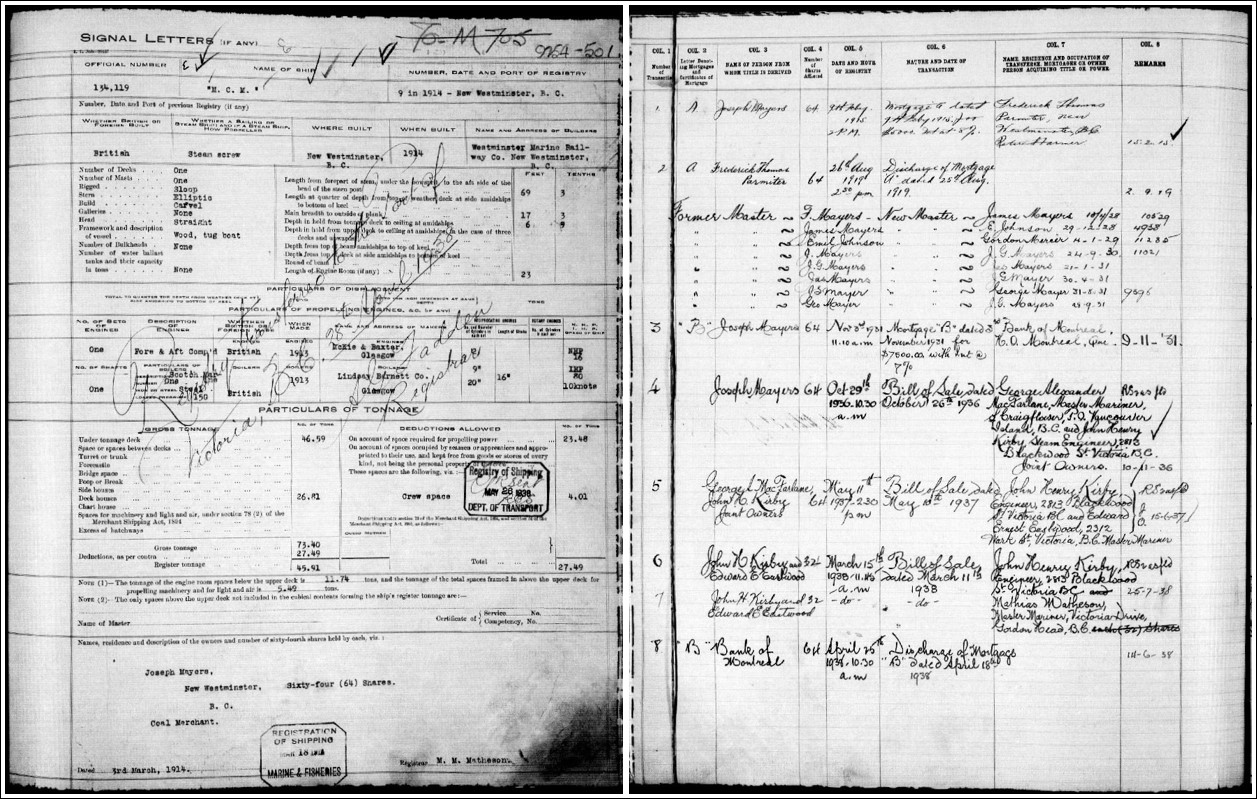
Page one and page two of the registration document for the ship M.C.M. The document has been filled out using both a typewriter and by hand in cursive writing.

[M.C.M., Port of Registry: NEW WESTMINSTER, BC, 9/1914] R184, RG12-B-15-A-i, Volume Number: 3041. (e011446335_355)

The first page of this register for M.C.M., a ship registered in 1914 in New Westminster, British Columbia, contains details about the ship such as its construction, size and so on. The second page includes the names of the vessel’s owners over time.

The caption above demonstrates the naming convention that users will see in Collection search: Vessel name / port of registry / a consecutive number assigned for each vessel newly registered at that port in a year / year of registration.

To find the records on LAC’s website using Collection search:

1. Go to advanced search
2. Select “Collections and Fonds” under Collection
3. Select “Ship Registration” under Subset of Collections and Fonds
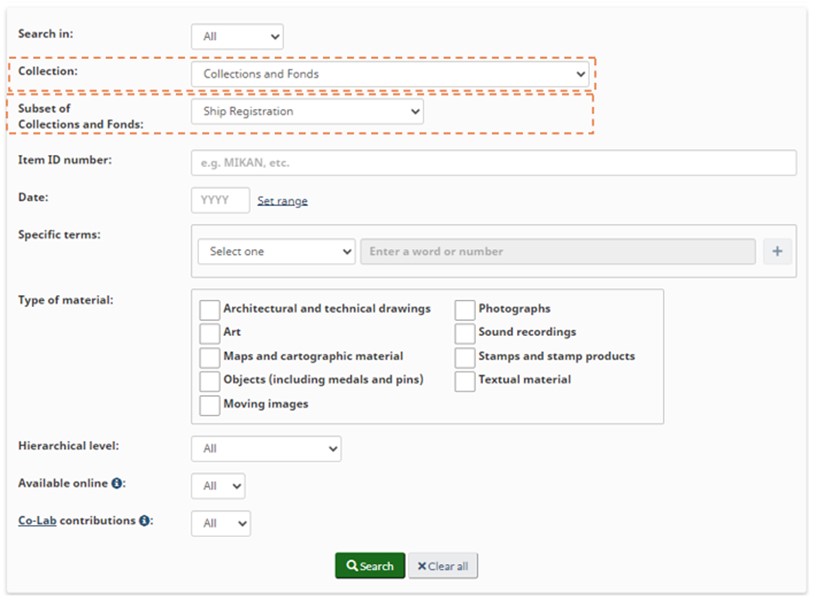
Screenshot of the Collection search advanced search page. The “Collection” and “Subset of Collections and Fonds” drop down menus are marked with orange boxes.

How to locate Ship Registrations in Collection search. (Library and Archives Canada)

4. To search specific word(s) in the database, enter them in the search bar at the top. You may also enter a date or date range in the Date field (this will reflect when the ship was closed out). If you prefer to browse all ship registrations, leave the fields blank and click “Search.”

Screenshot of the Collection search advanced search page. The search term “Dora Mae” is entered in the “All of these words” search box, and the date range of 1940 to 1950 has been entered in the date range boxes. These fields are highlighted with orange boxes.

How to narrow down your vessel search using keywords and date ranges. (Library and Archives Canada)

For a more specific search, use the “All of these words” field at the top to search by name, port of registry, official number and year of registration.

Name:

  • The name is assigned by the owner at the time of initial registration and usually lasts the lifetime of the vessel, but it can be changed (often when there is a change of ownership).
  • Once a vessel has been closed out, there is a waiting period before that ship’s name can be used again. Two vessels cannot have the same name at the same time.
  • Vessels may have similar, but different names (for example, Karen Dawn, Karen and Dawn, and Karen & Don). Adding a Roman numeral after a name that had been taken remains a common way to create a new name (for example, Dora-Mae II).

Port of registry:

  • The port where the vessel was registered.
  • Vessels may be registered in ports close to where they were built or operated.
  • This can be useful in identifying shipbuilding activity in a specific area.
  • Vessel registration may have passed to different ports over time, as owners were expected to update their ship registration to the closest port of registry when they moved or if the ship was sold and transferred to another region.

Official number:

  • The unique number assigned to a vessel when it was registered—no other vessel will ever have this number.
  • The number remains the same for that vessel’s life, even if it is no longer in service or destroyed.
  • The official number can help you find information on that vessel in other record types:
    • Appropriation books: books that include the inventory of official numbers assigned to various ports of registry
    • Transaction books: books documenting supplemental transactions when the two pages per vessel in a registry book were filled
    • Construction books: books documenting ships under construction
    • Ship dockets: individual files opened by port of registry offices for specific ships

Year of registration

  • The consecutive number, starting from 1, assigned to each ship that was newly registered / (slash) the year that the vessel was registered. For example, 22/1883 would mean the 22nd vessel registered at a particular port of registry in 1883.

The closed-out ship registries can also be accessed via LAC’s staff research list, which provides direct access to the records at the series level. From there, you can navigate to individual ship registration records.

The new searchable ship registries transcriptions make tens of thousands of records accessible in a way that was not possible before. Users can now more easily research information on family histories, shipbuilding, shipping and many other areas. This valuable resource illuminates the complex and varied histories of Canadian shipping and shipbuilding, the communities built around these trades and the lives of the individuals and families who owned these vessels.

The team and LAC wish to thank Don Feltmate residing in Nova Scotia and John MacFarlane residing in British Columbia, who have been tireless advocates for the importance of these records and for making them more accessible.

Additional resources


Elaine Young is an analyst in the Partnerships and Community Engagement Division at Library and Archives Canada.

The Ships of Dominion Bridge: A Second World War Story of Teamwork, Technology and Innovation

Version française

By Rian Manson

In 1940, following the Dunkirk evacuation, the British situation was grim. The German Navy, operating from the French coast, was sinking cargo ships at a rate of 50 per month. At the start of the Second World War, Canada only had 41 sea-worthy cargo vessels. To keep the supply of war materials and food from being cut off, it was imperative that cargo ships be constructed at phenomenal speed to prevent Britain from starving to death.

Posters from the Second World War featuring cargo ships.

To keep up morale, posters like these were displayed at Dominion Bridge and United Shipyards, in Montréal. Canadian Transportation, November 1941, pg. 638-639 C-204-4*C-205-1 (OCLC 1080360026).

With the entire shipbuilding industry gearing up for war production, Canada needed a new and large shipyard to help fulfill the huge order of 200 10,000-ton cargo vessels. For this crucial project, the federal government put every Canadian shipbuilder from Nova Scotia to British Columbia on contract to construct naval craft, tugboats and cargo ships.

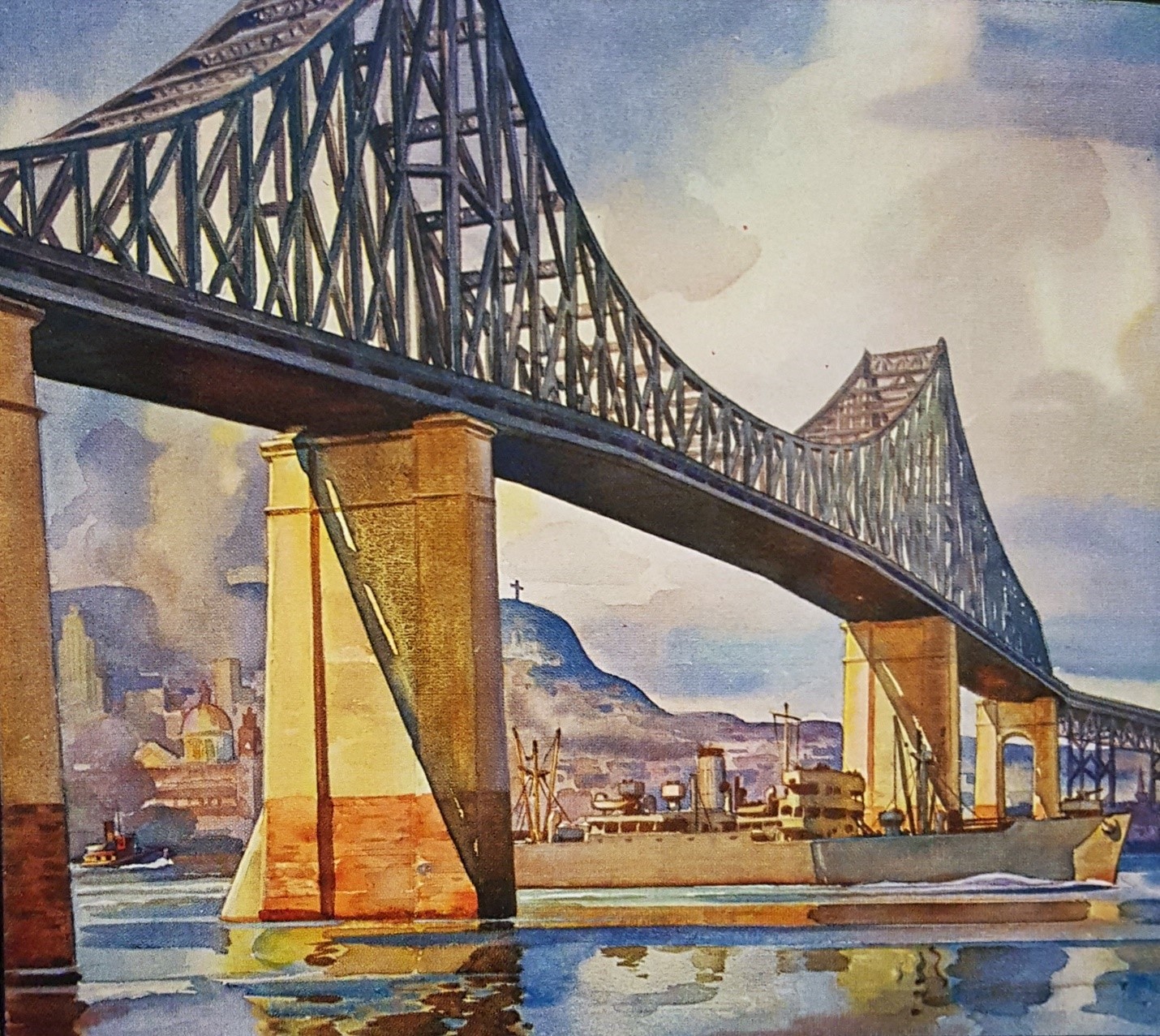
A bridge over water with a city in the background and a cargo ship passing underneath.

A 10,000-ton North Sands-class cargo ship bound for sea, passing under Montréal’s Jacques Cartier Bridge (OCLC 321000549).

Minister of Munitions, C.D. Howe, approached the Dominion Bridge Company of Montréal to ask if they could use its huge plant and machinery to help with shipbuilding. Since 1882, Dominion Bridge had been supplying Canadian railways and provinces with all types of bridges. Its massive workshops were constructing enormous iron and steel components for huge hydroelectric projects, and supplying countless towns and cities with the structural steel beams needed to erect stores, homes and hotels.

A technical drawing showing dimensions and measurements for a cast-brass nameplate.

Technical drawing of a cast-brass nameplate for marine steam engines of 4700-ton cargo vessels built at the Dominion Bridge’s Lachine workshops, R5607, vol. 2073 (MIKAN 5183995).

Since its first contract with the Canadian Pacific Railway (CPR) in 1882, Dominion Bridge had developed a huge assembly plant with machines specially designed to manufacture heavy steel, iron products and boilers. The Lachine location was a perfect fit: access to water transport; direct rail access from the Canadian National Railway (CNR); and available high-voltage electricity for heavy stick welding. One problem: the company had never considered building a shipyard, let alone ocean-going ships. They needed advice from a trusted source. Fraser Brace Ltd., another respected Canadian company with superior experience in the heavy shipbuilding industry, partnered with Dominion Bridge to help construct and operate the new United Shipyards Ltd., at the Bickerdike Basin in Montréal.

A group of people standing on a dock with a shipyard and cranes in the background.

Thanks to a forest of derrick cranes United Shipyards at Bickerdike Basin was able to continue building ships throughout the winter months, even when the St. Lawrence River was frozen over (e000761650).

Work on the shipyard began in January 1942, and only four months later, the keel was laid for the first cargo vessel. Although this was Canada’s newest and largest single-unit shipyard, the shipyard’s machinery—derricks, cranes and locomotives—were on long-term loan from the Harbour Board, Fraser Brace Ltd., Dominion Bridge, and Montreal Locomotive Works. Even the railway trucks were, according to one writer, “skillfully stolen from the CPR and CNR” to make this giant enterprise work.

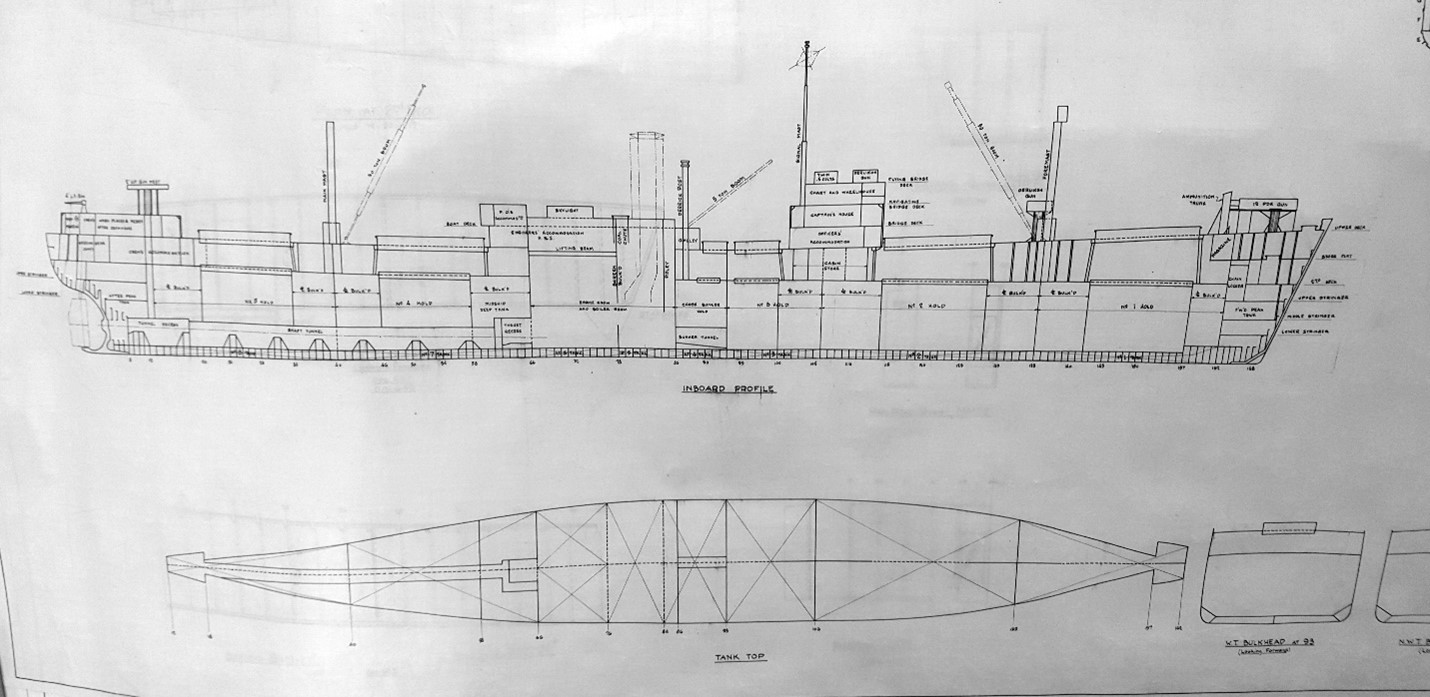
A profile elevation diagram illustrating the location of various parts of the cargo ship.

A profile elevation diagram by Dominion Bridge of a 10,000-ton North Sands-class cargo vessel, Lachine, November 1943, R5607, vol. 1612 (MIKAN 5183995).

Dominion Bridge set out a unique prefabrication plan to construct 10,000-ton ships and smaller 4700-ton cargo vessels. In the main shops at Lachine, workers welded the aft section and forepeak of the ship as one piece. These completed sections were delivered by railway flatcars to the Bickerdike Basin, where the custom-built derrick cranes would position the aft sections and forepeak for riveting to the hull.

Side-by-side of a close-up photo and technical drawing of a ship’s stern and propeller.

From the drawing to the dockyard: Dominion Bridge’s pre-fabrication of the aft assembly contributed to the accelerated mass production of ships at United Shipyards, Montréal (photograph: e000761682; drawing: R5607, vol. 1613, MIKAN 5183995).

Dominion Bridge drew on its early bridge and boiler welding experience. All inboard bulkheads, cabins, cargo holds and interior fittings were welded. Welding saved precious time, weight and materials for each vessel.

The savings generated helped United Shipyards set a new Canadian record for shipbuilding speed. From the keel being laid to the final touches of paint, it took 58 days—one month faster than the previous record. The cargo ship arrived in Great Britain fully loaded 86 days after the keel was laid. C.D. Howe praised United Shipyards as the yard where the cheapest 10,000-ton vessels were built in Canada.

Bow of ship with naval officers at attention.

View of the christening podium and guests of honour at the launch ceremony of the 10,000-ton cargo ship, the S.S. Fort Esperance, at United Shipyards Ltd. (e000761721).

A Style of Their Own

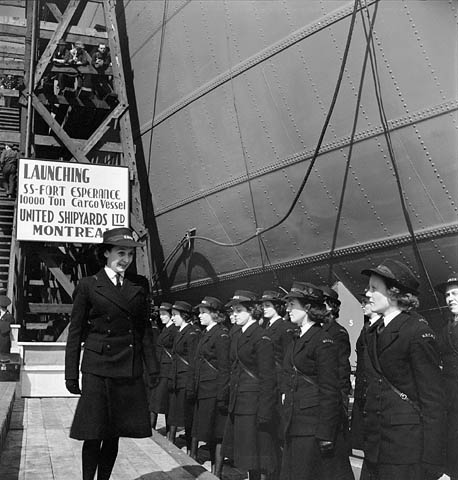
On a sunny afternoon on July 15, 1944, Dominion Bridge launched a new type of cargo ship, the “Canadian,” from the United Shipyards slipways. Identical in design to the 10,000-ton British North Sands, but with new improvements, such as boilers capable of burning oil or coal with rapid changeover for each fuel; improved crew quarters; and hatches and decks with greater strength to withstand heavier loads.

Virtually all the manufacturing was carried out in Dominion Bridge’s own workshops. Very little outfitting was subcontracted because Dominion Bridge used its creative bridge welding techniques. Special in-house built jigs with attached electric motors rotated to help with complex welding jobs so the welder could operate “downhand,” and the use of welded engine bedplates instead of bolts considerably reduced vibrations and withstood the shocks caused by explosions at sea.

A group of women standing at attention next to the hull of a cargo ship.

Women’s Royal Canadian Naval Service officers lined up at the walkway to the christening podium during the launch ceremony of the S.S. Fort Esperance at United Shipyards Ltd., Montréal (e000761719).

A person welding a large piece of metal.

A welder at the Lachine plant using a special rotating jig for welding the steel bedplate for a marine steam engine that provides the power for the 10,000-ton cargo vessels (OCLC 321000549).

Of the 403 ships built in Canada (including those built by Dominion Bridge), 112 were sunk and 18 were severely damaged by enemy action. Additionally, before the end of the war, 1146 Canadian merchant sailors lost their lives on the high seas and many more endured the trauma of trying to survive in enemy prison camps.

The construction of cargo ships is a forgotten component of Canada’s role in the Second World War. But without the Herculean human effort of the Dominion Bridge Company and other shipbuilders in Canada, one wonders if Britian could have survived the war? Would it have been starved into surrendering to Nazi Germany?

This blog would not have been possible without the remarkable technical drawings of the Dominion Bridge Company fonds at Library and Archives Canada.
Additional resources

  • A Bridge of Ships: Canadian Shipbuilding during the Second World War, by Pritchard,James S., Montréal: McGill-Queen’s University Press, 2011 (OCLC 693809715)
  • Canadian Transportation, January 1941–December 1945 (OCLC 1080360026)
  • Of Tasks Accomplished : The story of the Accomplishments of the Dominion Bridge Company Limited and its Wholly Owned Subsidiaries in World War II, by Dominion Bridge Company Limited, 1945, Montréal: Dominion Bridge Co. (OCLC 321000549)
  • Dominion Bridge Company fonds, R5607, vols. 1612, 1613, 2073 (MIKAN 5183995)
  • Canadian Merchant Ship Losses, 1939-1945 by Robert C. Fisher, The Northern Mariner

Rian Manson is an Archival Assistant in the Private Archives and Published Heritage Branch at Library and Archives Canada.