Pineapple-cheese salad from the 1950s

Version française

Cooking with Library and Archives Canada banner

By Ariane Gauthier

The 1950s were a decisive decade for consumerism in the western world, particularly in the Americas. Economic growth, technological advancements and mass media have a central role in shaping a consumer-oriented culture that emerged in the post-war period. This transformation laid the foundations for the modern consumer society and the global economy that would continue to evolve in the following decades.

In the 1950s, the rise of canned food in the United States marked a key change in American food culture and, by extension, Canadian food culture. As more and more women entered the labour market and busy family schedules became the norm, canned products like vegetables, soups and meats offered a quick and reliable solution for meal preparation. This boom was fuelled by advances in food preservation technologies, which made canned products affordable and accessible to the average household. With the added benefit of a long shelf life, these products have helped redefine home cooking, making it simpler and more efficient, while meeting consumers’ growing appetite for convenient products.

It is in this historical context that Kraft Foods Limited published the 40 Famous Menus from O.K. Economy & Shop-rite booklet, from which comes the recipe of this blog post.

The cover of 40 Famous Menus from O.K. Economy & Shop-rite. It shows images of certain dishes prepared according to the recipes in the booklet.

40 Famous Menus from O.K. Economy & Shop-rite. (OCLC 1006679567)

The booklet includes a multitude of recipes showcasing various Kraft products, but I was mainly interested in aspic or gelatin-based recipes. What fascinated me, among other things, was that the primary goal of many recipes with gelatin was not so much to be appetizing, but rather to be impressive. Originally, gelatin recipes were primarily intended to showcase the beauty of the molds that could be obtained and the aesthetic art of arranging raw vegetables in them. In the 1950s, things changed a bit; there was a desire to eat aspic for its taste, but the idea of impressing remained, as we can see with the recipe I chose.
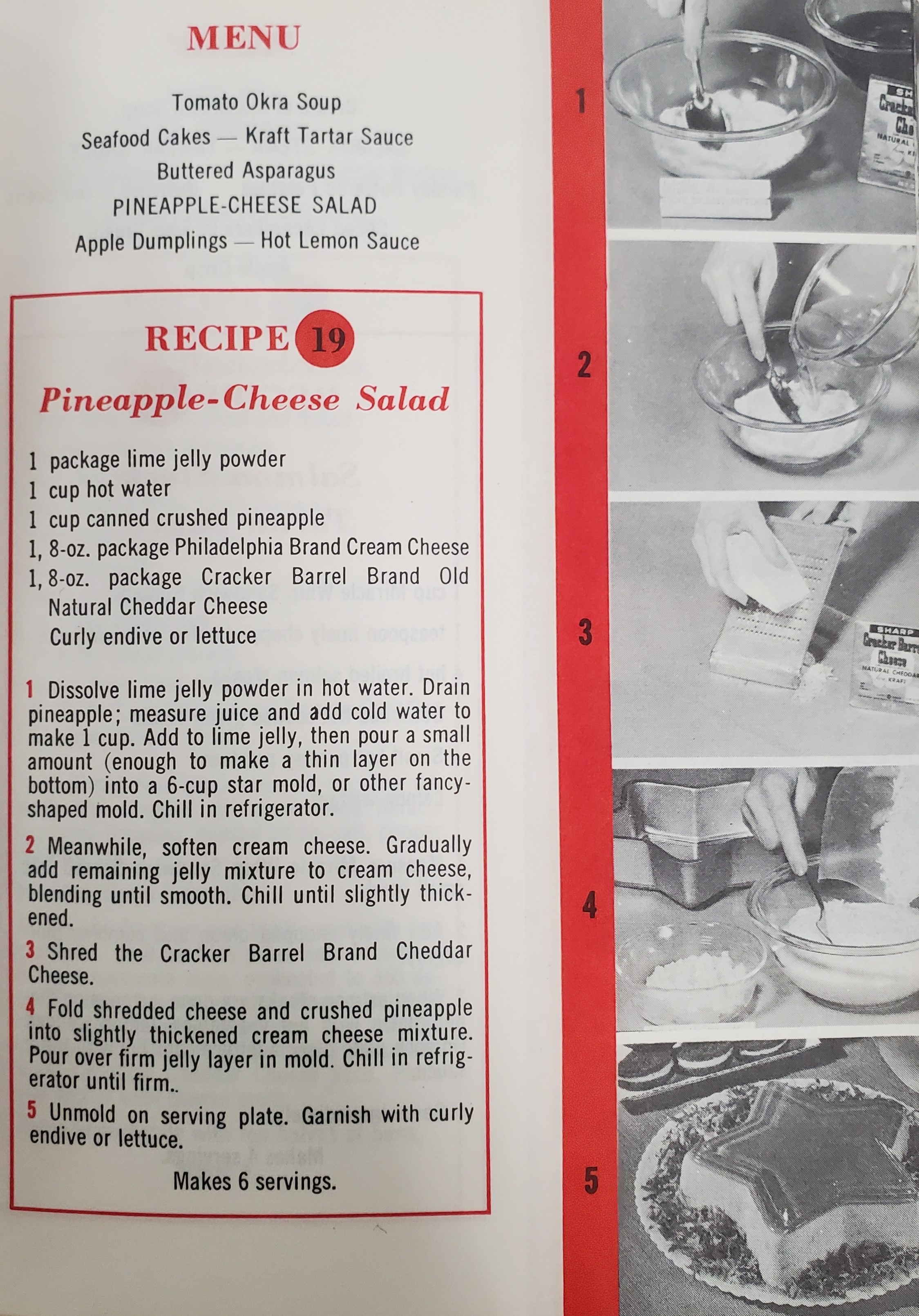
The recipe includes images of the cooking steps on the right and a menu suggestion at the top of the page.

Recipe for pineapple-cheese salad. (OCLC 1006679567)

The ingredients attest to a sincere desire to create a tasty dish. In theory, the flavours should blend well. The only somewhat suspicious intruder is the grated cheddar cheese. That said, we notice, in the penultimate sentence of the first step, the desire to impress that I mentioned earlier: Add to lime jelly, then pour a small amount (enough to make a thin layer on the bottom) into a 6-cup star mold, or other fancy-shaped mold.”

The detail regarding the mold style betrays, to some extent, the intention to create something impressive.

On that note, I embarked on making this recipe, hoping to have found something that would be tasty.

The ingredients are canned crushed pineapple, a package of lime jello powder, a brick of cream cheese and a block of cheddar cheese.

The ingredients for the pineapple-cheese salad recipe, with the mold. (Photo by Ariane Gauthier)

Once the ingredients are gathered, the recipe comes together quite quickly. To start, you had to dissolve the lime jello in a cup of hot water, then mix it with the pineapple juice and pour a thin layer of the liquid into the mold. Once done, the mold had to be left in the refrigerator so that the jello solidifies a little.
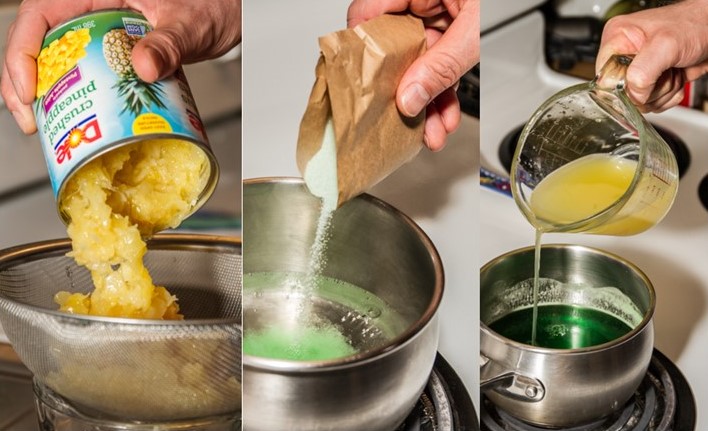
Start by draining the crushed pineapples to extract the juice. Then, mix the packet of jello powder in a cup of hot water and add the reserved juice.

The first step of the recipe, preparing the lime jelly. (Photos by Ariane Gauthier)
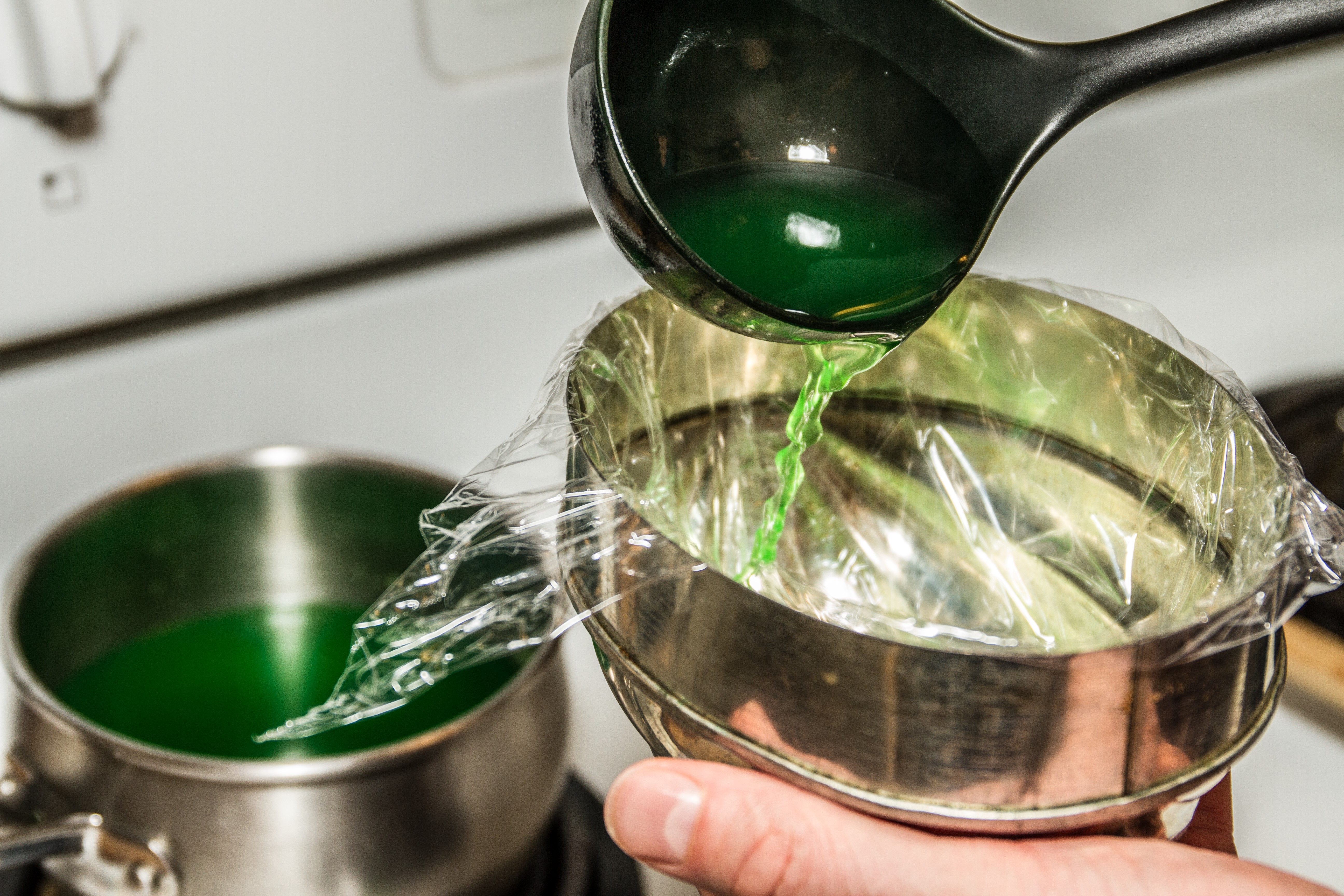
Once the first step is completed, you need to pour a thin layer of liquid jello into the mold and let it solidify in the refrigerator.

Pour in a ladle of the first layer of jello into the mold. (Photo by Ariane Gauthier)

In the meantime, I moved on to the next step. I combined the remaining liquid jello mixture with the lime and pineapple juice with the cream cheese. I blended it all until it was smooth, then I put the bowl in the refrigerator for about 30 minutes.

Combine the remaining jello-juice mixture with the cream cheese. Once completely incorporated, leave it in its bowl and put it in the fridge to thicken.

The second step of the pineapple-cheese salad recipe. (Photos by Ariane Gauthier)

This made it possible to thicken the liquid and incorporate the crushed pineapples and grated cheddar cheese evenly.  Afterwards, this mixture was added to the mold and left to rest in the fridge for a few hours.

Once the mixture has thickened, you need to add the pineapple and grated cheddar before placing everything in the mold.

The fourth step of the pineapple-cheese salad recipe. (Photos by Ariane Gauthier)

The next day, I brought the finished product to work and had the pleasure of unveiling the dish to my colleagues. Here is the result:
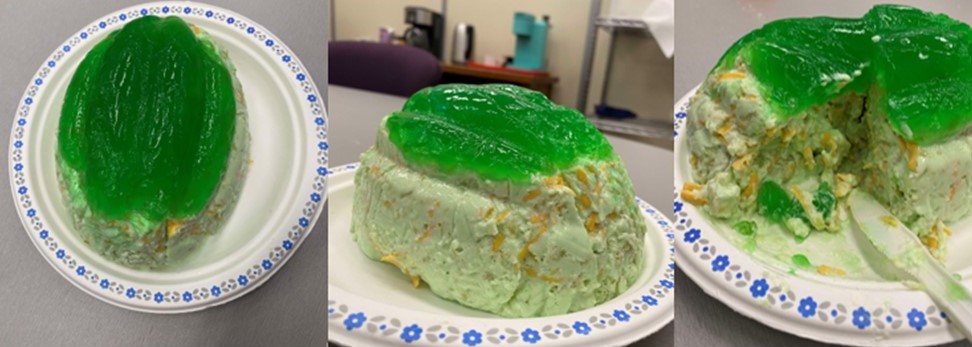
Pineapple-cheese salad in three steps.

Pineapple-cheese salad. (Photos by Mélanie Gauthier)

The moment the mold was flipped onto a plate, the reveal was met with the sound of worried, and even a little disgusted, “oohs” and “aahs.” I don’t know why, but I expected the final product to be more yellowish than green. I took the first bite in front of my colleagues and was able to encourage another person to try the so-called “salad.” His comment perfectly captured my own impressions. He said, “it is the unholy trinity: disgusting temperature, texture, and taste.”

In the end, only five of us dared to try the dish. The others simply endured the intense smell of cream cheese and the wretched experience of cutting through the gelatin.

This is the first recipe that I do not recommend you try. However, despite this failure, I still believe that it is possible to create a delicious jelly or aspic recipe.

Feel free to share your creations in the comments or by using the hashtag #CookingWithLAC and tagging our social media: FacebookInstagramX (Twitter)YouTubeFlickr and LinkedIn.

Additional resources


Recipe – Pineapple-cheese salad

1 packet of lime-flavoured powdered jelly
1 cup of hot water
1 cup of crushed canned pineapple
1 8 oz package of Philadelphia Cream Cheese
1 8 oz package of Cracker Barrel Old Cheddar Cheese
Curly endive or lettuce

  1. Dissolve the lime jelly powder in hot water. Drain the pineapple; measure the juice and add cold water to obtain 1 cup. Add to the lime jelly, then pour a small amount (enough to make a thin layer at the bottom) into a 6-cup star-shaped mold, or any other fancy-shaped mold. Leave to cool in the refrigerator.
  2. Meanwhile, soften the cream cheese. Gradually add the remaining jelly mixture to the cream cheese, stirring until smooth. Refrigerate until the mixture thickens slightly.
  3. Grate the Cracker Barrel brand cheddar cheese.
  4. Add the grated cheese and crushed pineapple to the slightly thickened cream cheese mixture. Pour over the firm jelly layer in the mold. Let cool in the refrigerator until the jelly is firm.
  5. Unmold onto a serving dish. Garnish with curly endive or lettuce.

Serves 6 portions.


Ariane Gauthier is a reference archivist in the Access and Services Branch at Library and Archives Canada
Snow Whirl Chocolate Roll from the 1930s

Version française

Cooking with Library and Archives Canada banner
By Ariane Gauthier

Alberta Sugar Makes Delicious Things to Eat is a booklet created by Canadian Sugar Factories some time in the 1930s to promote its production of “pure” Alberta beet sugar. This sugar is refined from thousands of sugar beet farms in the province, and the booklet includes a two-page exposé on the nuances of this farming culture. A great emphasis is put on what was then the most modern of mass-farming technology, likely to legitimize sugar beet farming, which was new and in fierce competition with the very popular (and largely preferred) cane sugar.

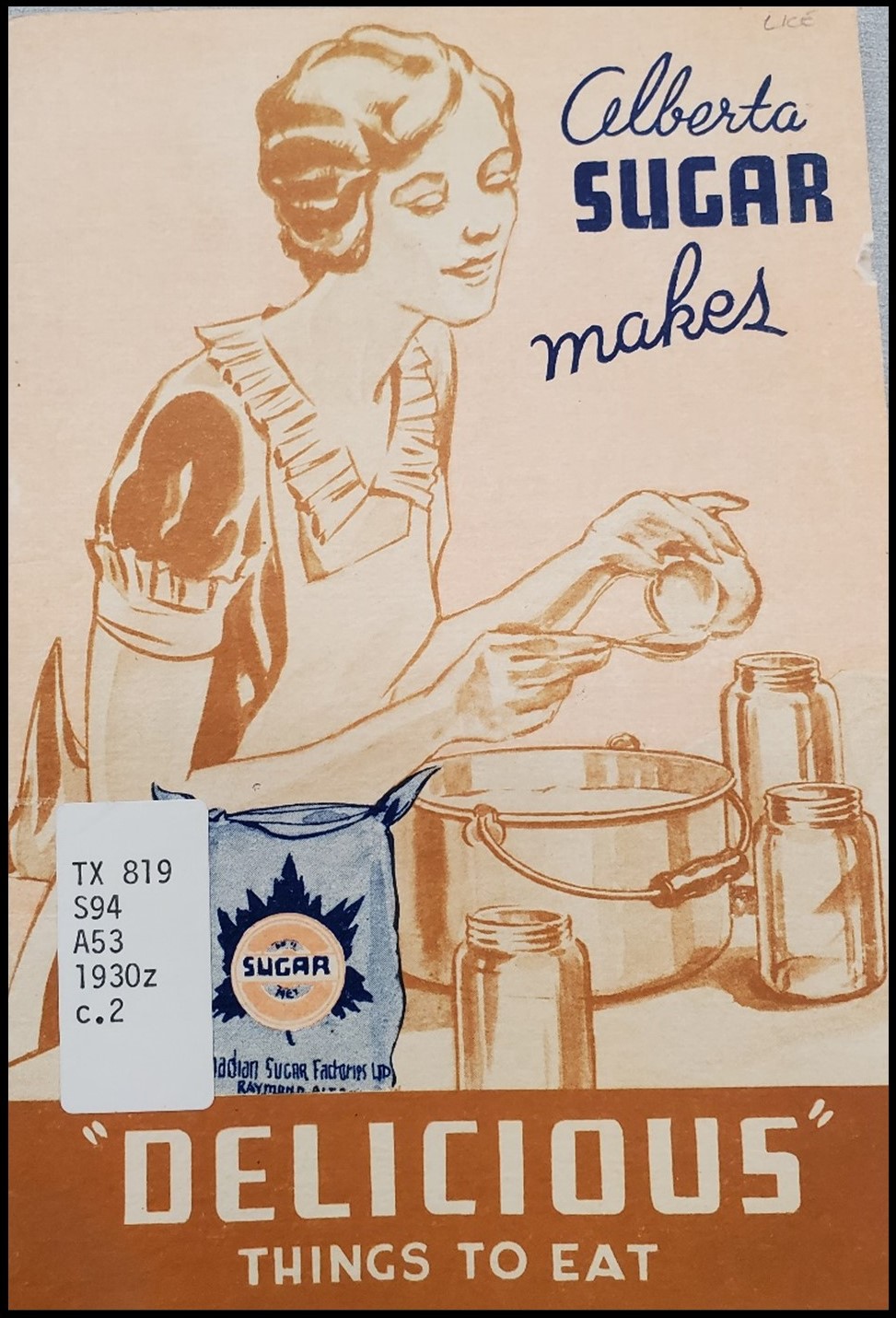
Booklet cover with image of a woman pouring sugar in a spoon over a pot. Three mason jars surround the pot on a counter and a bag of sugar is at the front of the image.

The booklet cover of Alberta Sugar Makes Delicious Things to Eat. (OCLC 1007785982)

This booklet is available in Library and Archives Canada’s published collections catalogue Aurora: OCLC 1007785982.

While the history of sugar in Alberta is quite interesting, what attracted me to this booklet was the historical context surrounding the publication of this book: the Great Depression. The booklet mentions that Canadian Sugar Factories started business in 1925, which means they only had about five years before the economic collapse derailed production and profitability. Perhaps this is why there is such a sense of desperation or defensiveness in dispelling misconceptions surrounding beet sugar at the end of its biographical exposé:

Page of booklet with seven points explaining why “beet sugar is the same as cane sugar” and two drawings of a train and a factory.

The cropped second page of The Story of Alberta Sugar, specifically the subsection “Beet sugar is the same as cane sugar,” from the booklet Alberta Sugar Makes Delicious Things to Eat. This is the note on which this corporate “biography” leaves the reader. Notice how points 1, 3, 4 and 7 essentially argue the same thing: that it is impossible to distinguish beet sugar from other types of sugar. (OCLC 1007785982)

Like many cookbooks published during the Great Depression, the recipes have an important emphasis on affordability and longevity: food had to be cheap, and it had to last. However, with this booklet emphasizing Alberta sugar, most of the recipes reflect sweets and pastries, which are decidedly neither of those things.

Nevertheless, I chose this booklet for its aesthetics and because the snow whirl chocolate roll recipe seemed tasty!

The image lists the ingredients and steps to follow for the snow whirl chocolate roll recipe.

The recipe for the snow whirl chocolate roll from Alberta Sugar Makes Delicious Things to Eat. Remarkably, it lists the oven temperature and cooking duration! (OCLC 1007785982)

As I flipped through the pages of the booklet, I noticed there was a section on frosting and icing. In keeping with the spirit of vintage cooking, I decided to pick one of each to pair with the cake: I chose the mountain cream icing for the filling and the fudge frosting for the exterior.

A blue outline indicates the mountain cream icing and fudge frosting recipes that were used for the snow whirl chocolate roll.

Frostings and Icings page from Alberta Sugar Makes Delicious Things to Eat. (OCLC 1007785982)

In both instances I was pleasantly surprised by the number of details that would guide the recipes I planned to undertake. Not only was I given oven temperatures, I was also given cooking times! The only thing I was truly missing was a Fahrenheit or Celsius indication of the “soft-ball” stage, but my handy-dandy candy thermometer filled in the blanks (the answer is about 240 ⁰F or 115 ⁰C). I was then off to the races!

I started by gathering all my ingredients.

Three side-by-side photos of the ingredients from all three recipes, including sugar, flour, cocoa, eggs, milk, etc.

All the required ingredients for the snow whirl chocolate roll (image on the left), the fudge frosting (image in the middle) and the mountain cream icing (image on the right). Photo credit: Ariane Gauthier.

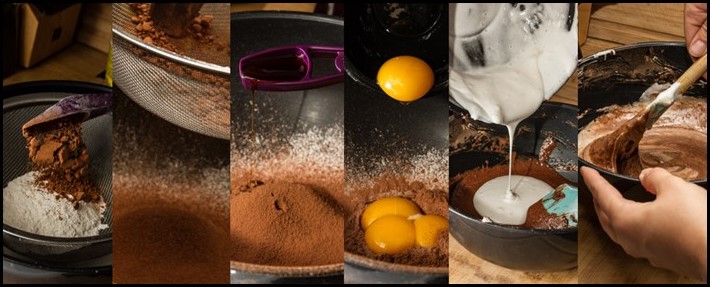
I decided to begin with the snow whirl chocolate roll as it required time to cool down, during which time I would work on the frosting and icing. The first step was sifting all dry ingredients thrice. After, I separated the egg yolks and whites, whipping the whites into soft peaks. Here’s where I went a little rogue: rather than fold the sugar into the egg whites after whipping, I incorporated it during whipping, as this helps to give them more volume.

Four photos of the steps to follow to make the snow whirl chocolate roll.

I carefully cracked all four eggs and used the eggshells to separate the egg yolks from the egg whites. Once this was done, I used an electric beater to whip the egg whites with the sugar until it formed soft peaks. Photo credit: Dylan Roy.

I then made a little mistake: I mixed the egg yolks and vanilla with the dry ingredients rather than the egg white mixture. This ultimately negated the sifting of the dry ingredients, but here’s how I fixed it: I added about half of the egg white mixture and mixed it all together vigorously until no clumps remained. What this effectively did was somewhat defeat the whole point of whipping the egg whites, which was to have an airy and light cake mixture. However, since I only used some of the egg white mixture, I was able to gently fold in what remained and maintain some of the lightness I had previously built.

Six side-by-side photos of all the ingredients being incorporated into a bowl to make a snow whirl chocolate roll.

Negating the whole point of sifting the dry ingredients by prematurely mixing in some of the wet ingredients. The steps in order from left to right of how I mixed the dry and wet ingredients together. The last two images show how I salvaged the mix: I used half of the egg white mixture and vigorously mixed it with the dry ingredients until no clumps remained, and then I gently folded in what remained. Photo credit: Ariane Gauthier.

Once this step is done, a cooking sheet with edges is required to cook the cake. This may appear a little thin at first, but you must remember that the cake will eventually be rolled. And so off it went into a 400 ⁰F oven for 13 minutes. Now, it was time for filling and garnish!

Every vintage cooking recipe is a new experience where I’ve at least done one thing I’ve never done before. In this case, I’d never used a candy thermometer, despite owning one for many years. It’s complex and stressful, but in times like these it’s best to just trust the process and believe that Canadian Sugar Factories knew what it was doing in the 1930s!

Two side-by-side images of a thermometer being used while making the mountain cream icing and the fudge frosting. A third image shows the fudge frosting being mixed with a whisk.

Using a candy thermometer to make mountain cream icing and fudge frosting. The candy thermometer had to be held in both instances as the end could not touch the bottom of the pan; otherwise, it would provide a false reading of the temperature. In both cases, the steam produced by both mixtures obscured the reading of the thermometer, making what was already a difficult step even harder. Photo credit: Dylan Roy.

I regret to say that I didn’t do great with the mountain cream icing. I’m unsure whether I pulled it from the heat too early or if I simply let too much water evaporate, but I was ultimately left with a dry and crumbly icing that did not spread well. However, it did taste fairly good on its own.

Comparatively, the fudge frosting fared much better, as I had learned from my mistakes. Though I admit to having been unpleasantly surprised with two unlisted ingredients: butter and vanilla. I advise that any who attempt this recipe have both measured and on hand.

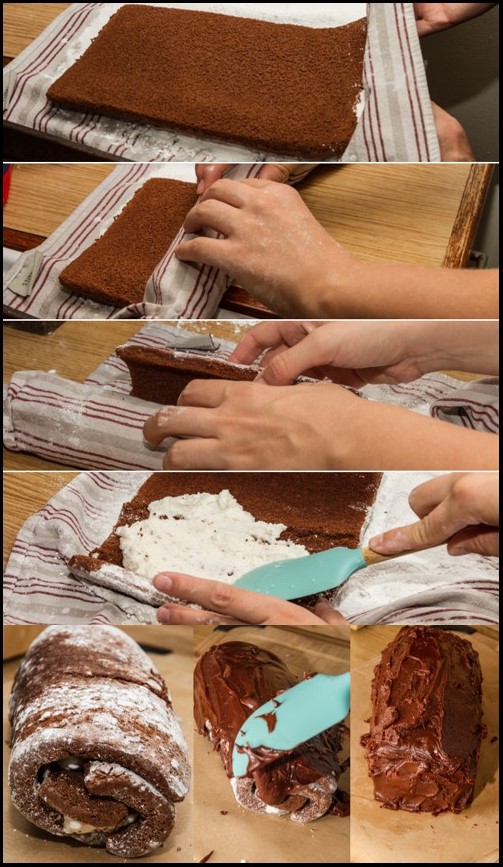
Thirteen minutes later, the cake sheet was ready. Here, again, I must admit to having strayed from the instructions. I’ve made Yule logs before for the holidays and the instructions are very clear: immediately roll the cake sheet tightly in a clean dish cloth sprinkled with powdered sugar and wait for it to cool. Do not add your frosting immediately as the heat of the cake will cause it to melt. You will be left with a gooey mess! I heeded my previous experience and waited for the cake to cool down before frosting.

Seven photos of the steps to roll the cake, add the icing and add the frosting.

Cake rolling and cake frosting. Rolling the cake is easier than one might think; the challenge is knowing how long to let it cool down. While I let it get a tad too dry, the beauty of frosting is that it hides the cracks! Photo credit: Dylan Roy.

The trick with these kinds of cakes is that they have to cool enough to not melt the icing but not so much that they dry out. Unfortunately for me, I waited a little too long, and the cake cracked when I unrolled it. I was able to smear some icing to patch the cracks and was fortunately able to cover the rest up with the fudge frosting. As we say in French: ni vu, ni connu (literally: unseen, unknown)!

Two side-by-side photos of a cross-section of the snow whirl chocolate roll.

Cross-section of the snow whirl chocolate roll cake. As you can see, I didn’t quite have enough icing to fill out the inside completely. Photo credit: Ariane Gauthier.

What do you think?

The cake, icing and frosting were delicious! I brought it into the office and my colleagues were pleasantly surprised. Everyone was more or less in agreement that the best part was the fudge frosting—it could almost have been a dessert on its own!

If you try this recipe, please share pictures of your results with us using the hashtag #CookingWithLAC and tagging our social media: FacebookInstagramX (Twitter)YouTubeFlickr and LinkedIn.

For more content on historical cooking, please consider the following links:


Ariane Gauthier is a Reference Archivist in the Access and Services Branch at Library and Archives Canada.

Potato Biscuits from 1917: How the Housekeeper May Help to Save the Country’s Wheat Supply

Version française

Cooking with Library and Archives Canada bannerBy Ariane Gauthier
Canada joined the First World War on August 4, 1914, alongside Great Britain and the rest of the British Empire. What began as a mobile war quickly turned into a static one, with the entrenchment of the Allied and Entente armies. By 1915, the momentum that had previously animated early fighting had vanished, leading to a grueling war of attrition in the trenches across Europe and the Mediterranean.

The devastation of Europe’s countryside reduced accessible food supplies, a situation that was made worse by the arrival of unprecedented numbers of soldiers mobilized from all corners of the world. Great Britain was quick to marshal the resources of its empire, hoping to fuel its war effort. Canada contributed by supporting troops overseas through its agricultural and industrial output, but it wasn’t enough. Soon, all levels of government had to consider other means of bolstering aid, ultimately settling on rationing key resources.

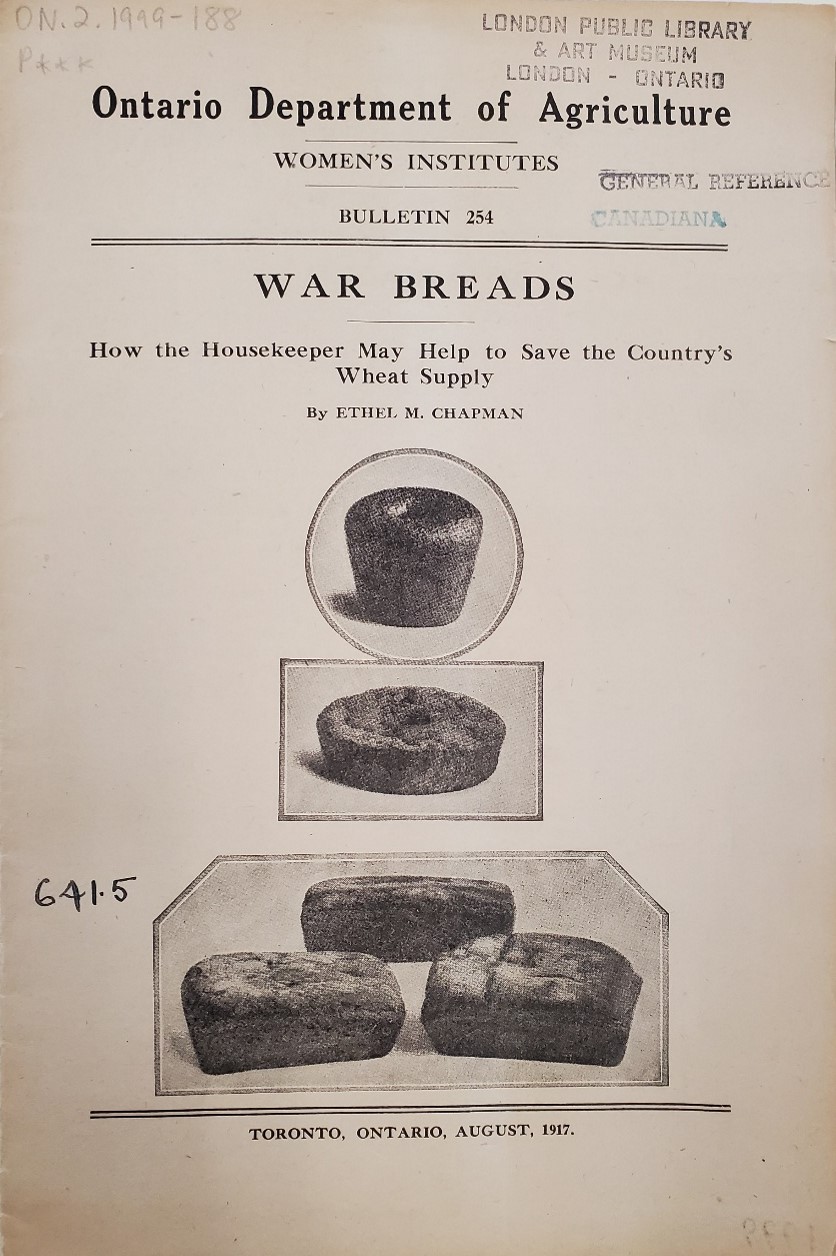
By the third year of the war, wheat was becoming scarce. Anticipating a ration order, the Ontario Department of Agriculture published the pamphlet “War Breads: How the Housekeeper May Help to Save the Country’s Wheat Supply” in August 1917, claiming that “every pound of flour saved means more bread for the army.” However, it admitted that its suggested wheat flour substitutes wouldn’t necessarily yield tasty breads or biscuits: “The constant use of these coarser breads might not agree with some people, but as a rule they will be found more healthful than the finer white bread.”

Cover of a pamphlet with photos of different types of breads.

Cover of the pamphlet “War Breads: How the Housekeeper May Help to Save the Country’s Wheat Supply” (OCLC 1007482104).

Intrigued by this unique pamphlet, I chose a recipe that might give me a taste of a housekeeper’s patriotic efforts: potato biscuits. Having enjoyed potato breads and donuts before, I felt hopeful.

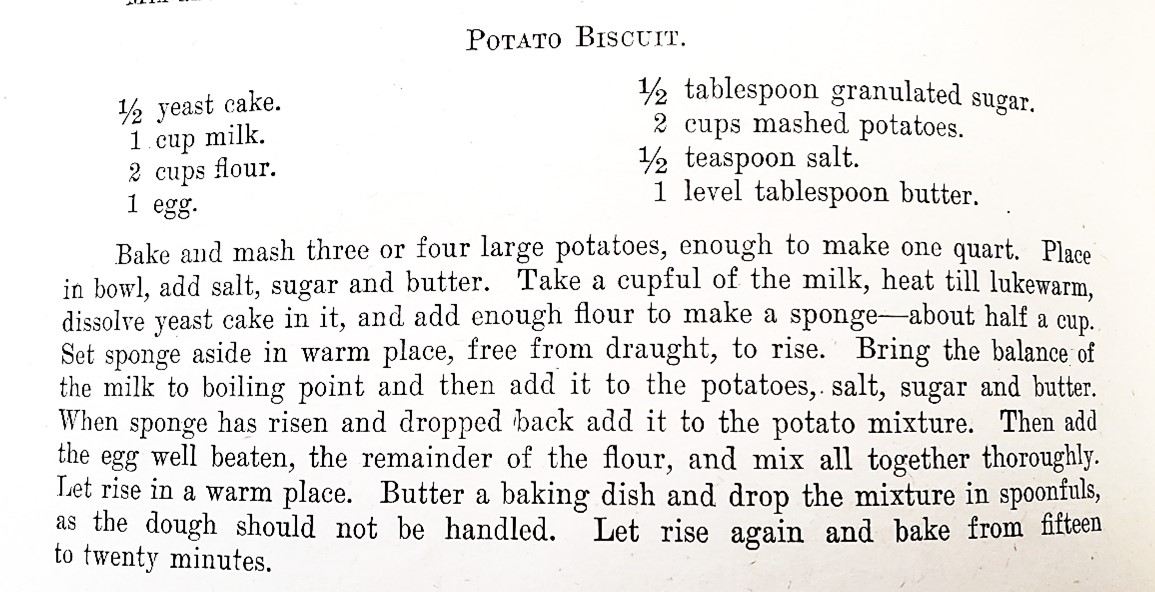
Recipe for potato biscuits including ingredients and instructions.

Recipe for potato biscuits from the pamphlet “War Breads: How the Housekeeper May Help to Save the Country’s Wheat Supply” (OCLC 1007482104).

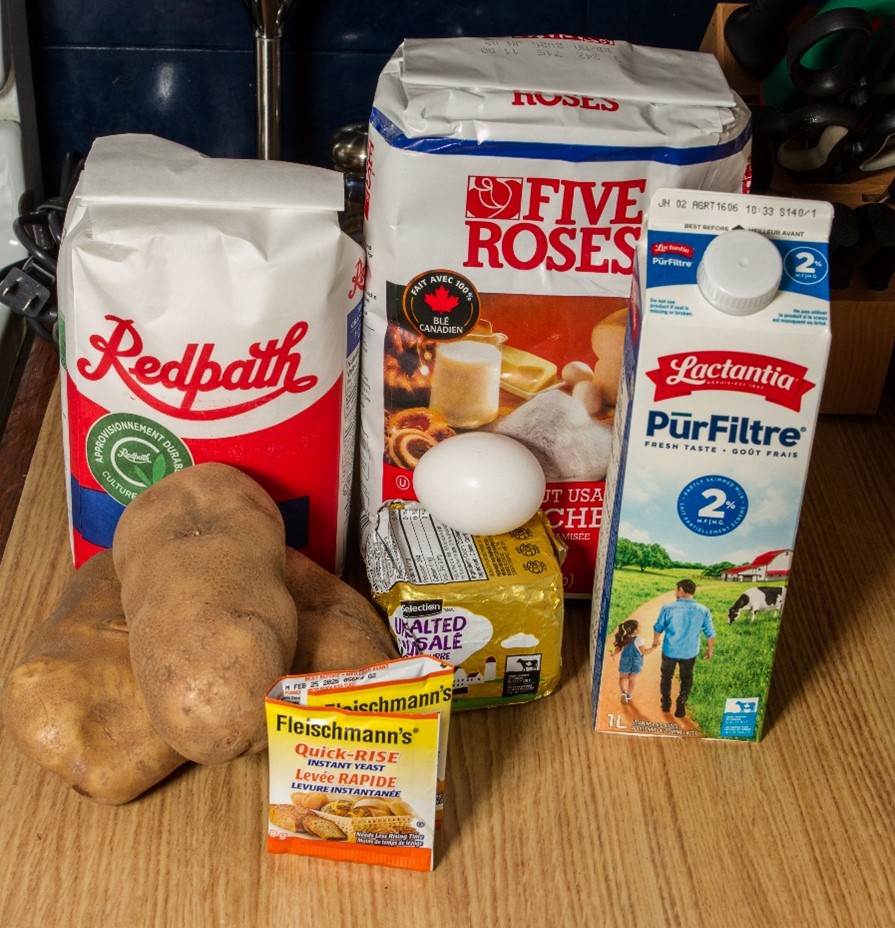
I only glanced at the recipe’s ingredients initially. They seemed adequate, but as I started assembling the potato biscuits, the meager half tablespoon of granulated sugar and single tablespoon of butter made it clear that these biscuits might end up bland or very yeasty. Given the war-era context, this wasn’t entirely surprising—wheat flour wasn’t the only ingredient being rationed.

Photo of baking ingredients: yeast, three potatoes, butter, one egg, milk, sugar, and flour.

Ingredients for the potato biscuit recipe. Photographer: Ariane Gauthier.

First, I assembled my ingredients. Strangely, the recipe called for baking the potatoes instead of boiling them. Perhaps this was to control the moisture content. I heated the oven to 400°F and baked the potatoes for 45 minutes to an hour until they were fork-tender.

Top photo shows three potatoes in a pan lined with parchment paper in an oven. Bottom photo shows roughly mashed potatoes in a bowl.

Potatoes baked in the oven and then peeled and mashed. Photographer: Ariane Gauthier.

While the potatoes baked, I prepared the yeast mix. Unable to find cake yeast, I used bread yeast instead. I mixed lukewarm milk with the yeast and some flour, setting it aside until it bubbled and rose.

Photo of yeast, flour and milk mixed in a cooking dish.

Yeast, flour and milk mix. Notice the myriad of bubbles produced by the yeast as it froths. Photographer: Ariane Gauthier.

I mashed the potatoes and mixed them with salt, sugar, butter, and boiling milk until smooth. I added the yeast mixture, the egg, and the remaining flour. By this point, the oven had cooled slightly, making it an ideal spot to let the dough rest and rise.

Five photos illustrating various steps of mixing ingredients together to make dough.

Making the potato biscuit dough. I vigorously mixed the ingredients at every step to ensure everything was as uniform as possible. Photographer: Ariane Gauthier.

The dough was gloopy, much to my surprise. With such little liquid compared to the dry ingredients, I hadn’t expected this. Taking the recipe’s warning to heart, I avoided handling the dough and used spoons to scoop it into a buttered muffin tin.

Four photos of various stages of mixing and handling dough, including picking up the raised mix with a spoon and spooning into a muffin pan.

The dough mixture before and after rising for a few hours in a warm place. As the recipe indicated, it was very gloopy and could not be handled by hand. Photographer: Ariane Gauthier.

As seems to be the custom with these old recipes, the recipe didn’t specify the oven temperature for baking, so I settled on 400°F and watched closely as the potato biscuits baked for 15 to 20 minutes until golden.

Photo of a plate with four potato biscuits. One potato biscuit has strawberry jam spread on it, another one is filled with berries, and the other two are plain.

The completed potato biscuits. The one on the left has been garnished with jam. I decided to add berries to another on the right before baking. Photographer: Ariane Gauthier.

And voilà! What do you think?

The strong yeast smell hit me as soon as I pulled the biscuits from the oven. As for the flavour? Shockingly bland. Luckily, I had some traditional strawberry jam on hand, which saved the day (thanks mom and dad!). These potato biscuits were better as a jam vehicle than a standalone treat.

As per my tradition, I took the biscuits to work and offered them to my colleagues. Never have I made such polarizing food! They either loved it or hated it; no one was neutral. So, if you’re feeling adventurous or just want a taste of history, give these potato biscuits a try—and don’t forget the jam!

If you try this recipe, please share pictures of your results with us using the hashtag #CookingWithLAC and tagging our social media: FacebookInstagramX (Twitter)YouTubeFlickr and LinkedIn.

Additional resources:


Ariane Gauthier is a reference archivist with the Access and Services Branch at Library and Archives Canada.

Cheese and walnut loaf from 1924

Version française

Cooking with Library and Archives Canada bannerBy Ariane Gauthier

In 1924, the Department of Agriculture published the booklet Mangeons du fromage canadien : Recettes et menus. It highlights the health, nutritional and economic benefits of cheese, particularly Quebec cheese. Evidently knowledge of the nutritional value of this food has changed a lot since then. At the time, the booklet stated: [Translation] “There is no meal where cheese has no comfortable place, and he who goes to work fortified by this nutritious food will accomplish, with the same zest, the same amount of work as if he had eaten a hearty meat-based meal.”

I found this book in our online Collection Search tool rather than in our Aurora catalog. I was hoping to find something a little more personalized, like a family recipe slipped into an archived letter! Then I discovered a record from the Department of Agriculture on the export of Canadian cheese. Lo and behold, it was hiding the booklet Mangeons du fromage : Recettes et menus in English and French.

Cover page of a booklet with the inscription "Mangeons du fromage : Recettes et menus" [Translation: Cheese Recipes for Every Day].

Cover page of the booklet Mangeons du fromage : Recettes et menus, [Cheese Recipes for Every Day] published in 1924 (OCLC 937533172). Image courtesy of the author, Ariane Gauthier.

(This booklet can also be found in Aurora, OCLC 937533172. This is the easiest way to access it.)

This little book was tucked away in a pile of interviews, economic reports and photo envelopes about Canadian cheese from 1920 to 1924. It immediately piqued my curiosity.

But that did not stop me from reading the whole file. I learned that at the time, the dairy industry was quite unstable in Canada. Exports to Great Britain remained steady (especially for cheese) thanks to a particularly generous premium, but cheese consumption was declining. The British—our biggest buyers—no longer favoured this food as much, and neither did Canadians.

The Department of Agriculture and the producers were concerned: would Canada lose its place on the international market? In this context, Mangeons du fromage : Recettes et menus was born.

I went through the booklet looking for a recipe. My only criterion was to find something new, so I set my sights on a recipe for cheese and walnut loaf.

Text describing the ingredients and steps for the cheese and walnut loaf recipe.

Photo of the cheese and walnut loaf recipe (OCLC 937533172). Image courtesy of the author, Ariane Gauthier.

Cheese and walnut loaf recipe [translation]

One cup of cheese, one cup of coarsely chopped walnuts, one tablespoon of lemon juice, two tablespoons of hot sauce, three tablespoons of tomato sauce to moisten, one finely chopped onion, one cup of crumb, one tablespoon of olive oil, salt and pepper to taste.
Place in a well-greased baking pan; roast on low heat and leave in the oven until the top is a perfect golden brown.

I began by gathering the ingredients, making sure to choose a Canadian cheese. I chose a local cheddar made near Ottawa.

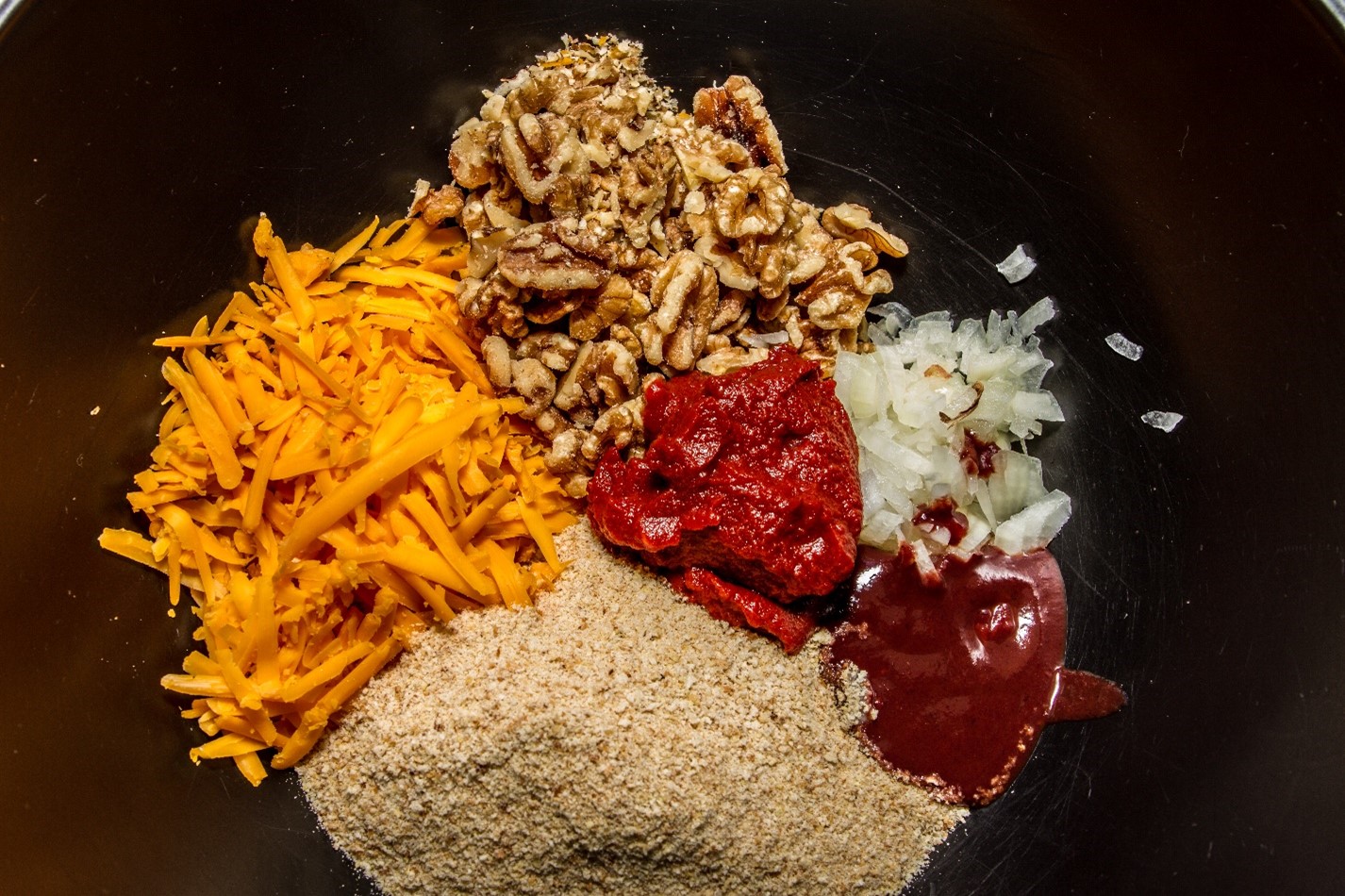
Ingredients used for the cheese and walnut loaf recipe: tomato paste, hot sauce, cheddar cheese, breadcrumbs, olive oil, lemon, pepper, salt and walnuts. (The onion is not in the photo.)

The ingredients for the recipe. Image courtesy of the author, Ariane Gauthier.

The recipe called for one cup of crumb. This seemed odd to me, and I looked at the English booklet to compare. To my surprise, Cheese Recipes for Every Day featured completely different recipes. Not a single recipe for cheese and walnut loaf! To avoid wasting a good loaf, I chose to use ready-made breadcrumbs.

The first thing I noticed was the lack of instructions. The ingredients are listed, then it simply says to put everything in a well-greased pan and [translation] “roast on low heat.”

All ingredients placed separately in a bowl: cheddar cheese, walnuts, tomato paste, onions, hot sauce and breadcrumbs.

The ingredients in a bowl. The recipe does not say to mix them, but we can guess that this is the next step. Image courtesy of the author, Ariane Gauthier.

In short, the recipe seems to rely on the reader’s common sense, so I stirred the ingredients together. The result was quite dry, probably because of the breadcrumbs. I added a little water, but that did not help much. I stuck with it nonetheless, not daring to change the recipe too much.

Three close-up shots, side by side, showing the ingredients being mixed and transferred to a baking dish.

The ingredients are added and mixed. The result is more-or-less homogenous. Image courtesy of the author, Ariane Gauthier.

I then poured the mixture into a well-greased mould, which I had lined with parchment paper to make the unmoulding easier. Since no baking temperature was specified, I decided to put it in at 400oF and keep an eye on the loaf. After about 15 minutes, it had a nice colour and smelled toasty; I removed it from the oven. Here is the result:

Cheese and walnut loaf on a wooden board.

Cheese and walnut loaf from 1924, which barely stays together in one piece. Image courtesy of the author, Ariane Gauthier.

The loaf barely held together; it was obviously very dry. It did not survive the journey from my home to 395 Wellington Street, turning into a kind of crumble. Nevertheless, I think my colleagues appreciated the surprising taste, which I would compare to that of vegetarian spaghetti meatballs.

What do you think?

If I had to do it again, I would sacrifice a good loaf of bread to use its crumb; it would surely absorb the mixture better than the ready-made breadcrumbs. I would also use a local cheese with a higher moisture content.

If you try this recipe, please share pictures of your results with us using the hashtag #CookingWithLAC and tagging our social media: FacebookInstagramX (Twitter)YouTubeFlickr and LinkedIn.

Additional resources:


Ariane Gauthier is a reference archivist with the Access and Services Branch at Library and Archives Canada.

Cream puffs from 1898

Version française

Cooking with Library and Archives Canada bannerBy Ariane Gauthier

The New Galt Cook Book (1898) is a revised edition of a book that was popular in English Canada, particularly in the Galt region in southwestern Ontario. The publishers claimed that copies were sent to the United States, Egypt, South Africa, India, Australia and China. Like many early cookbooks, this collection offered recipes as well as hints for simplifying domestic chores, and a list of cures for common illnesses.

The book is available online on Library and Archives Canada’s published collections catalogue, Aurora: OCLC 1049883924.

As an amateur cook fascinated by old recipes and the history of cooking, I once again put my skills to the test, and this time I tried to make cream puffs. For my previous attempt at recipes from yesteryear, see my “A pumpkin pie from 1840” blog post.

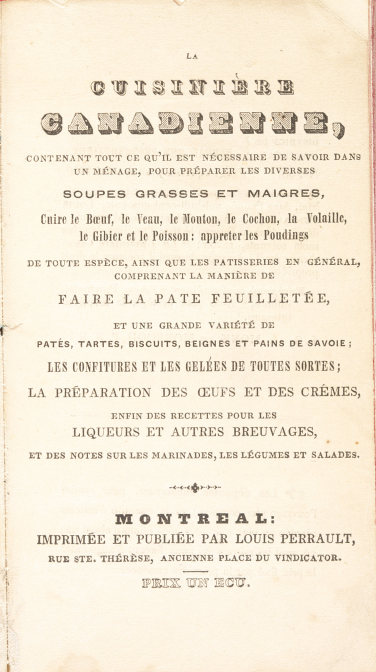
Now, what needs to be understood when attempting to follow recipes as old as this one is that they differ greatly from the modern recipe format. Much like La cuisinière canadienne, a French-language cookbook first published in 1840, each recipe section begins with a text explaining the overall basics of the recipe type. In the case of cream puffs, authors Margaret Taylor and Frances McNaught decided to include their recipe in the Cookies section.

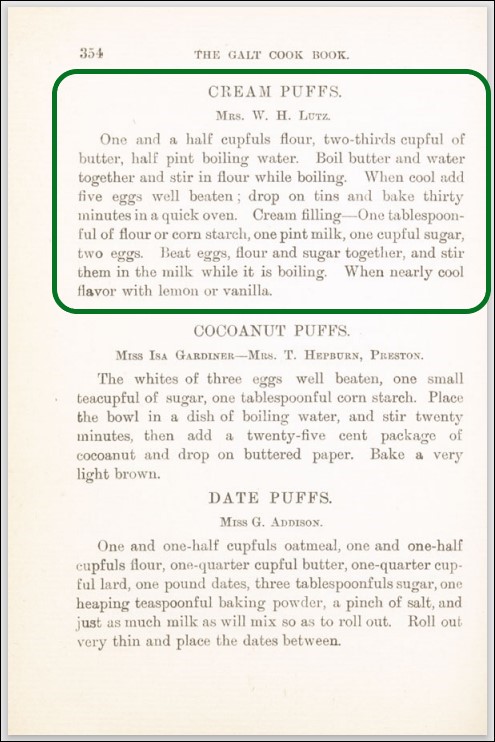
Page from The New Galt Cook Book with the cream puffs recipe followed by two other recipes.

Page 354 from The New Galt Cook Book by Margaret Taylor and Frances McNaught, Toronto: G.J. McLeod, 1898 (OCLC 5030366).

In the more than 50 years separating the publication of La cuisinière canadienne from that of The New Galt Cook Book, much about Canadian cooking had changed. This is evident in the required ingredients. The recipe for cream puffs calls for flour, butter and eggs for the pastry, and flour or corn starch, milk, sugar and more eggs for the cream filling. The final line in the recipe suggests adding either lemon or vanilla to flavour the cream.

There are two things of note here. The first is the inclusion of granulated sugar, which in 1840 was inconceivable for the lower classes. It was an expensive commodity, largely due to import tariffs that inflated the price. In my blog post about pumpkin pie from 1840, I mention that La cuisinière canadienne offered several alternatives as sweeteners, including syrup and molasses. These were the go-to sweeteners for Canadian cooks in the 1800s, until the 1885 Tariff Act came into effect and lifted the import tariffs on cane sugar. In the subsequent five years, the cost of sugar gradually became comparable to the cost of syrup and molasses. After 1890, sugar became the most popular sweetener because it was the cheapest.

The second item of interest is lemon as a flavouring option. In my pumpkin pie from 1840 blog post, I mention that La cuisinière canadienne suggested the inclusion of orange in the pumpkin filling. This was somewhat strange, as oranges were not imported as widely across Canada as they are today. However, given that La cuisinière canadienne was published in Montréal, which was the major commercial port of Canada at the time, access to this then-elusive ingredient was understandable. In comparison, Toronto was just at the start of its development. In the 50 years that followed the publication of La cuisinière canadienne, Toronto boomed into a metropolis, fueled by railway developments linking it to important North American cities like Montréal and New York City. As more railways connected Toronto more fully to the world, its commerce also diversified. In this case, lemon as a flavouring option is reflective of Toronto’s and Canada’s overall development. The lemon became a fruit accessible to cities located inland as transportation technology improved. This allowed for its distribution across greater distances, in climates not suited for local production.

With these interesting facts in mind, I gathered my ingredients and got to work.

Eggs, vanilla extract, milk, sugar, flour, margarine and lemon.

The ingredients for the recipe. Courtesy of the author, Ariane Gauthier.

I started with the cream puff pastry. Fortunately, unlike for the pumpkin pie, there was much less guessing this time around, as The New Galt Cook Book gives fairly precise measurements: “One and a half cupfuls flour, two-thirds cupful of butter, half pint boiling water. Boil butter and water together and stir in flour while boiling. When cool add five eggs well beaten; drop on tins and bake thirty minutes in a quick oven.”

Six photos showing the steps in making the dough: breaking eggs in bowl, stirring flour in another bowl, adding flour to boiling water and butter in saucepan, stirring saucepan ingredients, adding beaten eggs to cooled batter in saucepan, and stirring batter in saucepan.

Creating the cream puff pastry as described in The New Galt Cook Book. Courtesy of the author, Ariane Gauthier.

I needed to pipe the dough onto a lined baking sheet. Since I lacked a piping bag, I settled on the trick of using a reusable bag and snipping off the end. To transfer the dough more easily into the reusable bag, I used my coffee maker as a receptacle. Unsure of what exactly qualified as a “quick oven,” I settled for 400°F on convection and, as with the pumpkin pie, used my eyes and nose to determine when the pastry was done.

Three photos showing the steps in making the puffs: filling a reusable bag with batter, consolidating batter, and piping batter onto baking sheet.

Piping the cream puffs and getting them ready for the oven. Courtesy of the author, Ariane Gauthier.

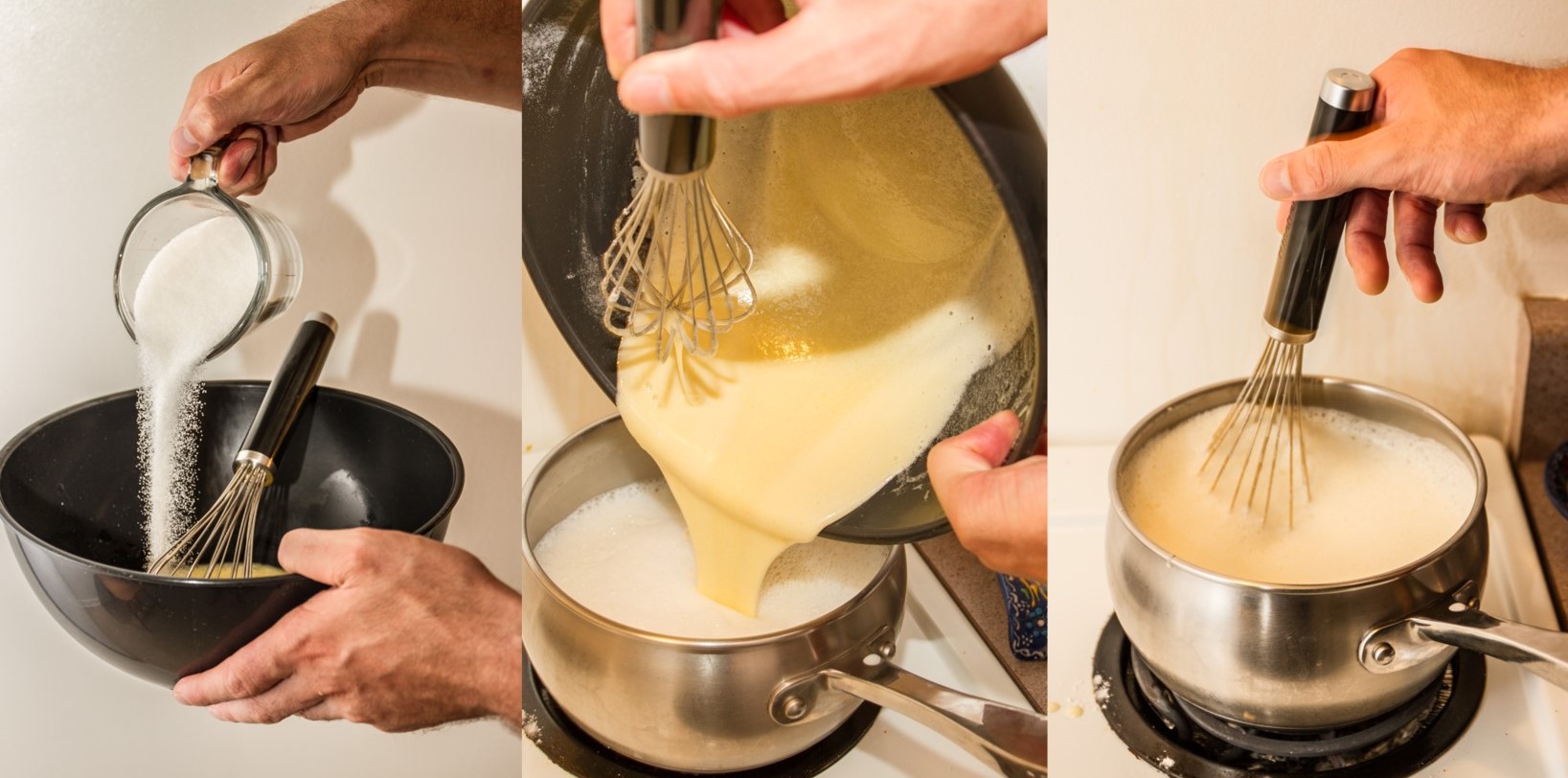
Once the anxiety of baking the cream puff pastry was settled, I worked on the custard. Having made custard previously, I felt much more comfortable with this procedure. Once again, The New Galt Cook Book is precise: “Cream filling – One tablespoonful of flour or corn starch, one pint milk, one cupful sugar, two eggs. Beat eggs, flour and sugar together, and stir them in the milk while it is boiling. When nearly cool flavor with lemon or vanilla.”

Three photos showing the steps in making the cream filling: adding sugar to eggs and flour in bowl, pouring mixture in bowl into saucepan containing milk, and stirring filling in saucepan.

Preparing the cream filling as described in The New Galt Cook Book. Courtesy of the author, Ariane Gauthier.

The only piece of advice that I would add, based on my previous experience, is to be careful once you combine the egg, flour and sugar mixture with the milk. It is best to temper the mixture by adding a little of the boiling milk, whisking vigorously as you do so. This elevates the temperature of the mixture and allows for a smoother transition to the whole of the boiling milk as opposed to simply shocking it. Once the mixture is added to the boiling milk, it is important to whisk it constantly until it thickens; otherwise, you will wind up with sweetened scrambled eggs!

As for the flavouring, I chose to divide the custard, and flavoured one with vanilla extract and the other with lemon zest.

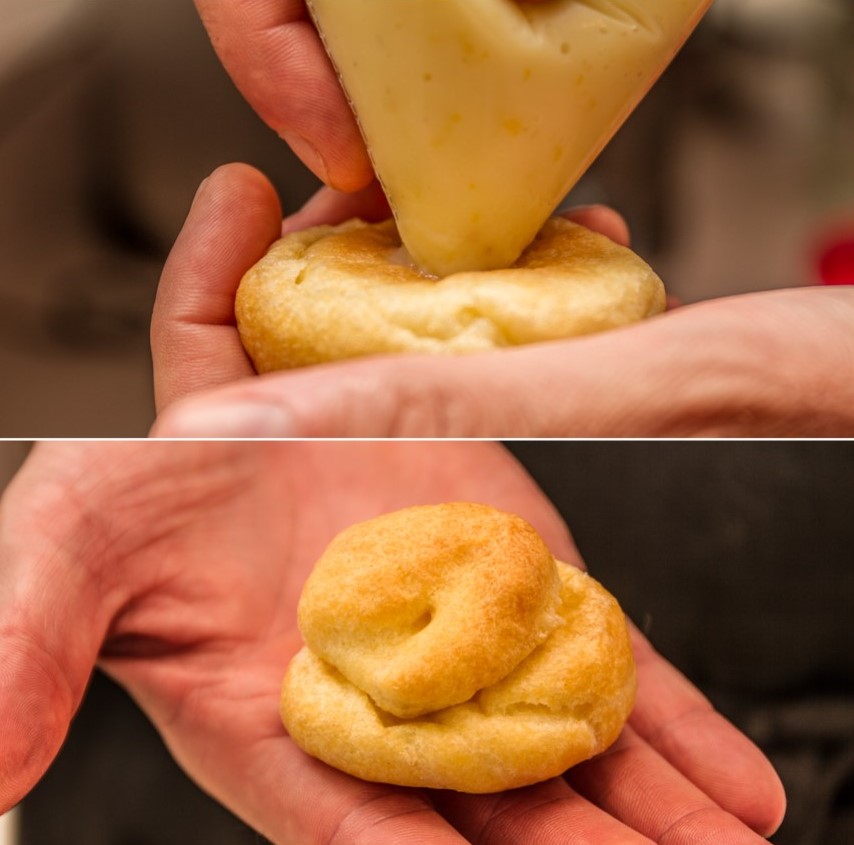
Finally, The New Galt Cook Book abandons the cook in the final phase of the recipe: the assembly. Knowing what a cream puff is supposed to be was extremely helpful here. The pastry is meant to be filled with the custard, so I put the custard in a reusable bag and snipped off one of the edges, since I do not own a piping bag. Before inserting the custard, I made an X-shaped incision at the bottom of each cream puff pastry to make the insertion easier.

One photo showing the cream filling being added to a puff, and another of the final product: a cream puff.

A filled cream puff. Courtesy of the author, Ariane Gauthier.

What do you think?

I was surprised by how well the cream puffs turned out, all things considered! These puffs are much lighter than contemporary cream puffs and allow for ample filling. I brought them to a Reference Section gathering, and my colleagues quite enjoyed them. This shows that, once again, these old recipes can stand the test of time!

If you try this recipe, please share pictures of your results with us using the hashtag #CookingWithLAC and tagging our social media: Facebook, Instagram, X (Twitter), YouTube, Flickr and LinkedIn.

Additional resources


Ariane Gauthier is a Reference Archivist in the Access and Services Branch at Library and Archives Canada.

A pumpkin pie from 1840

Version française

Cooking with Library and Archives Canada banner

By Ariane Gauthier

La cuisinière canadienne, published in 1840, is one of the first cookbooks—perhaps even the very first—written and published in Canada. Its author wrote it for both professional cooks and the general public. This book marks the beginning of French-Canadian cuisine as such. In terms of style and content, it is intended to be efficient, seeking to encourage “wise home economics […] suited to the budgets of Canadian families.”

This book is available online (in French only) through Library and Archives Canada’s Aurora catalogue (OCLC 1140071596). Simply click on the “Access Online” button on the right side of the page in the “Retrieval Options” box.

The title page of La cuisinière canadienne (OCLC 1140071596).

To accompany the book, I found Yannick Portebois’s review of La cuisinière canadienne (which can be read for free on Érudit, in French only) very useful. It helps modern readers understand the measurements used at the time and the technical language that is no longer used today. It also presents the historical context in which this book was written. It was a key moment for the formation of Quebec’s cultural identity, with one foot in its French past and the other in the new reality of an ever-growing Anglophone population. Yannick Portebois noted the francization of certain English words and the use of bourgeois terms that would mark the vocabulary of Quebec’s emerging cuisine.

The challenge

As an amateur cook, I decided to take on the challenge of cooking a vintage recipe proposed in this book.

The first thing to understand is that recipes of the past, especially those that date back to the mid-19th century, are not written as they are in books today. There is no complete list of ingredients, quantities are approximate and recipes are presented in essay form. La cuisinière canadienne provides alternative ingredients, as needed. The goal was not to create recipes like the ones readers of today want, but to communicate the basic principles so that cooks can manage on their own. In a way, La cuisinière canadienne determines the destination, but it is up to us to choose how to get there—that is, the ingredients, quantities and technique.

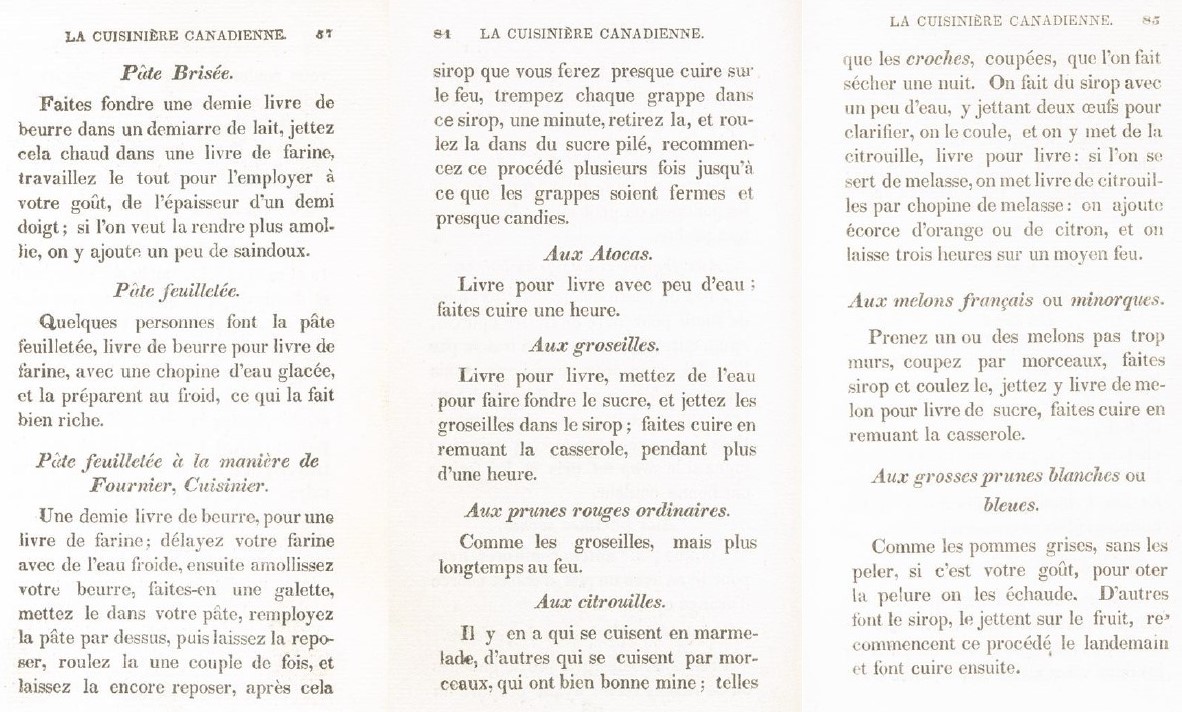
Three pages of La cuisinière canadienne explaining certain cooking terms.

The pages of La cuisinière canadienne that were most helpful to me in preparing my recipe (OCLC 1140071596).

My first challenge was to write the recipe, because La cuisinière canadienne does not provide a complete recipe for pumpkin pie. Chapter X contains a recipe for pie dough (or shortcrust pastry) with only the vague indication of adding the jam of our choice to bake a pie.

To do so, it was necessary to read chapter XI on jams. Originally, I was hoping to make a good sugar pie, but La cuisinière canadienne does not provide any recipe for cream sugar or maple filling. So I settled for a pumpkin pie, which I thought was a good substitute.

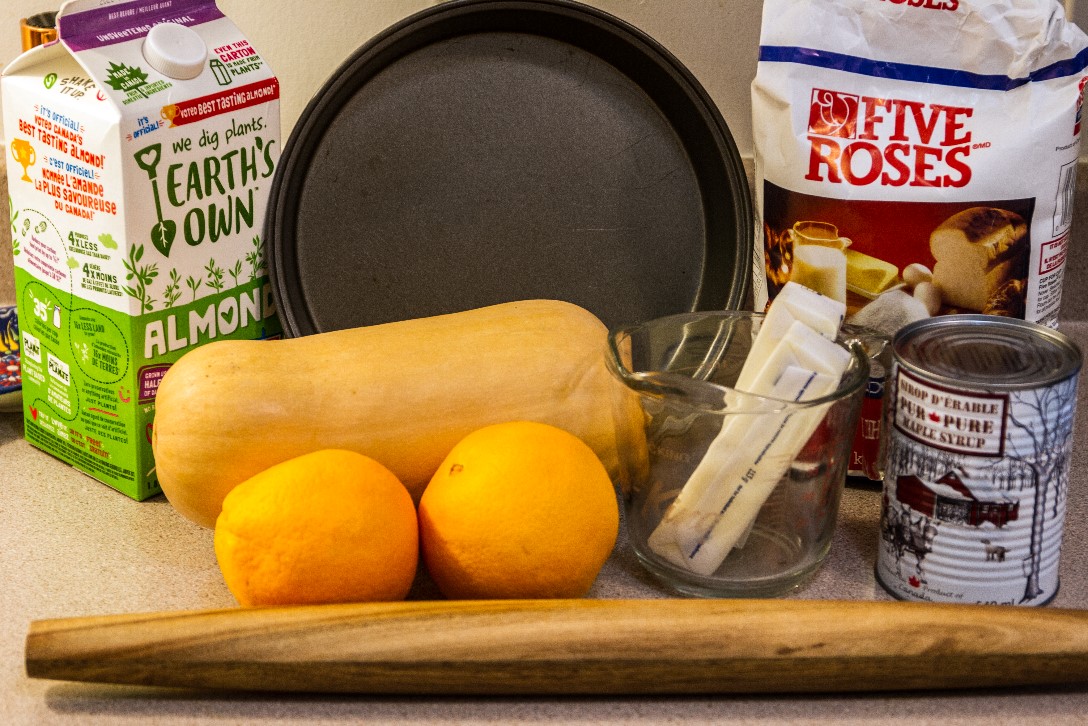
Almond milk, squash, oranges, butter, flour, maple syrup, measuring cup, pie plate and rolling pin.

Ingredients and materials used by the author to make the pumpkin pie from La cuisinière canadienne. Credit: Ariane Gauthier.

Once the recipe was written, the ingredients had to be gathered. The pie dough required flour, butter (melted) and milk (hot). La cuisinière canadienne says to mix everything until a dough is formed. Given the lack of more specific information, I relied on my existing knowledge. In recipes that I’ve followed before, the pie dough was very dry. Therefore, I added flour to a cup of melted butter and a cup of hot milk until I had a dry dough.

I confess that I did not measure the quantity. The idea is that the dough should barely hold together.

Then, I worked the dough so that everything was fully incorporated. I laminated it—that is, flattened it with a rolling pin before folding it on itself—and I repeated this over and over again until the dough became smooth and uniform. After that, I delicately placed the dough in a pie plate and cut off the excess. Usually, the dough should be perforated to make sure it does not inflate and baked a little to prevent the filling from soaking it. That is what I did before baking it for five minutes at 350°F.

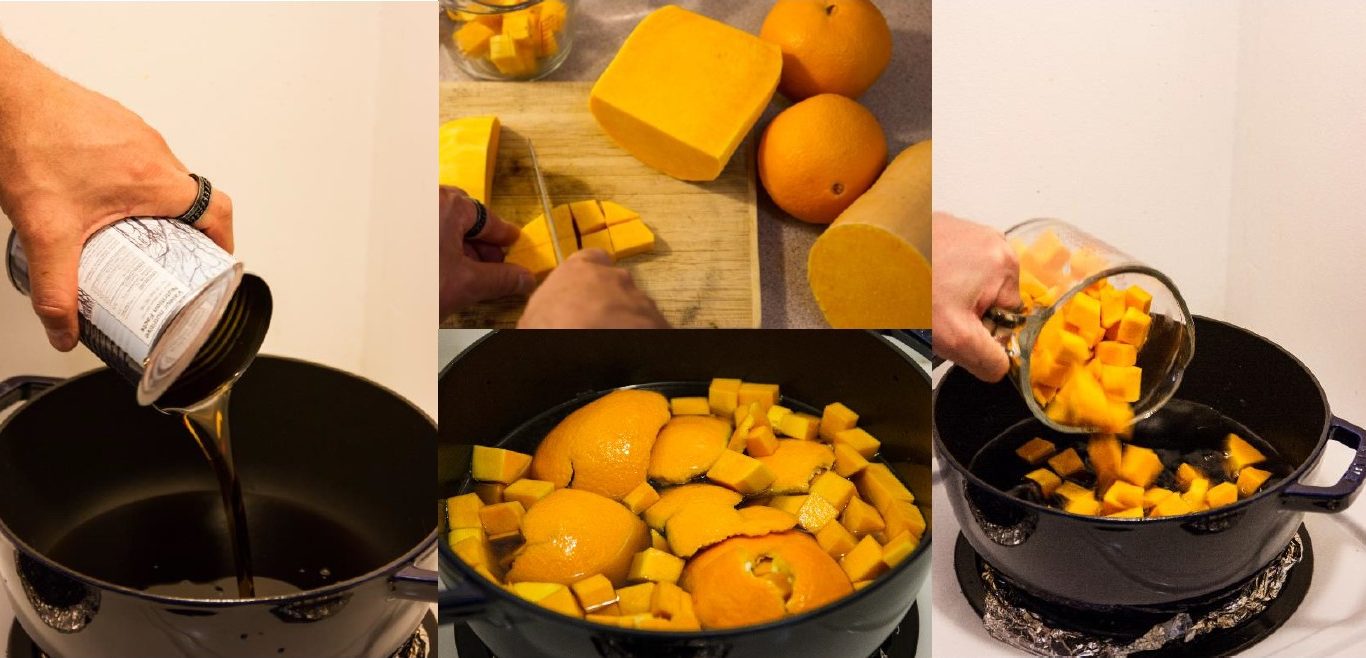
Maple syrup, diced squash and orange peels in a pot on the stove.

Combining ingredients for pumpkin jam. Pumpkin cubes are boiled in syrup with orange peel for three hours. Credit: Ariane Gauthier.

In the meantime, I followed La cuisinière canadienne’s instructions for pumpkin jam. Basically, I had to stew pumpkin in an equal amount of syrup (or molasses) for three hours. I could also add orange or lemon peel to enhance the taste. Unfortunately, because it was not pumpkin pie season, I had to settle for a butternut squash. I chose maple syrup because it was the affordable option for cooks of the time. It was only after 1885 and the passage of the Tariff Act that maple syrup became a luxury product, with the price of cane sugar suddenly falling. In subsequent years, laws and measures protecting the maple products industry and the purity and quality also affected the price of syrup.

Due to the technological advances that have taken place since the publication of La cuisinière canadienne, I only had to wait about an hour and a half before the butternut squash was tender. I blended everything to obtain a more uniform jam, keeping the orange peel for taste. It was for better or worse, depending on taste, because this choice made the pie taste more of orange than anything else. Warning for the intrepid bakers who will try to cook their own pumpkin pie from 1840: it may be better to remove the peels!

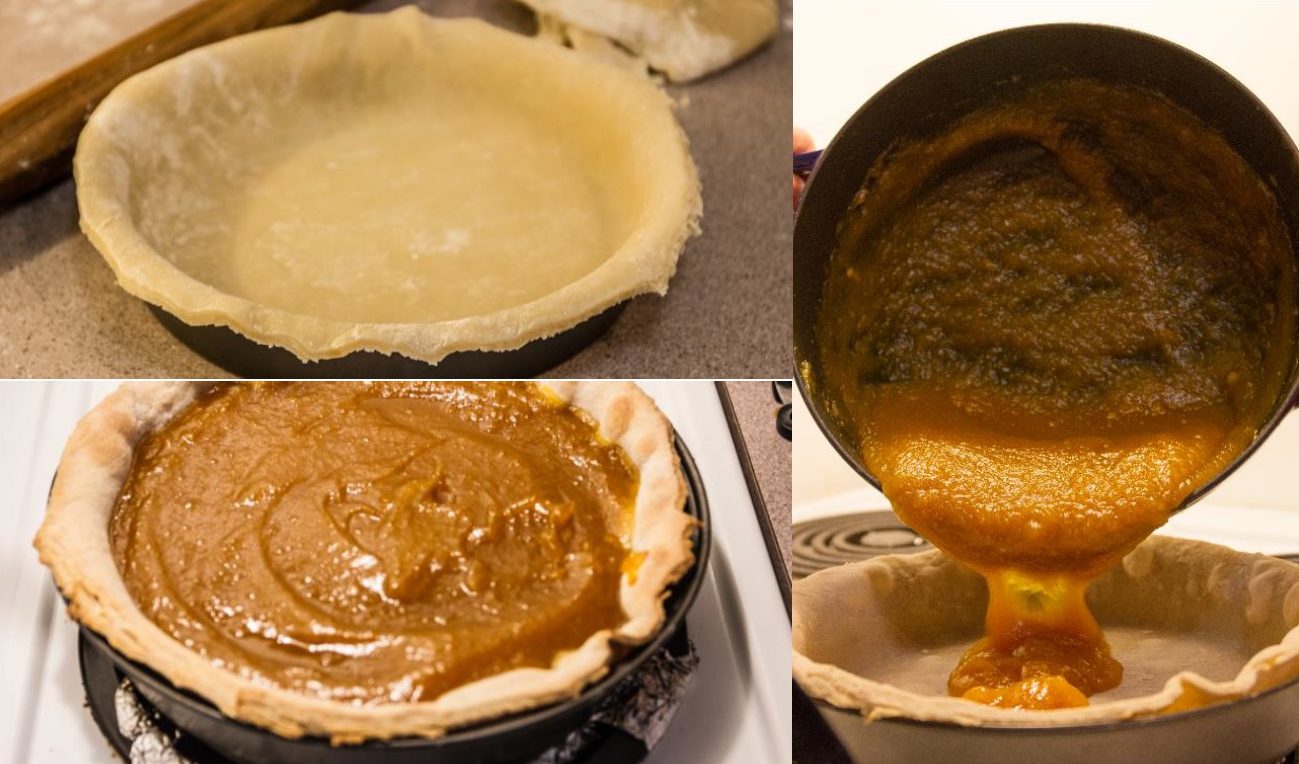
Three photographs showing the pie being put together: the dish with the dough only, the filling being poured onto the dough and the final dish before cooking.

Putting the pie together. Once the dough has been pre-cooked for a few minutes, the pumpkin jam is added, and the whole thing is put back in the oven to finish cooking. Credit: Ariane Gauthier.

Finally, I poured the jam onto the dough and baked the pie, still at 350°F. To determine when the dough was baked, I relied on my nose and my eyes. Here is the final result. What do you think?

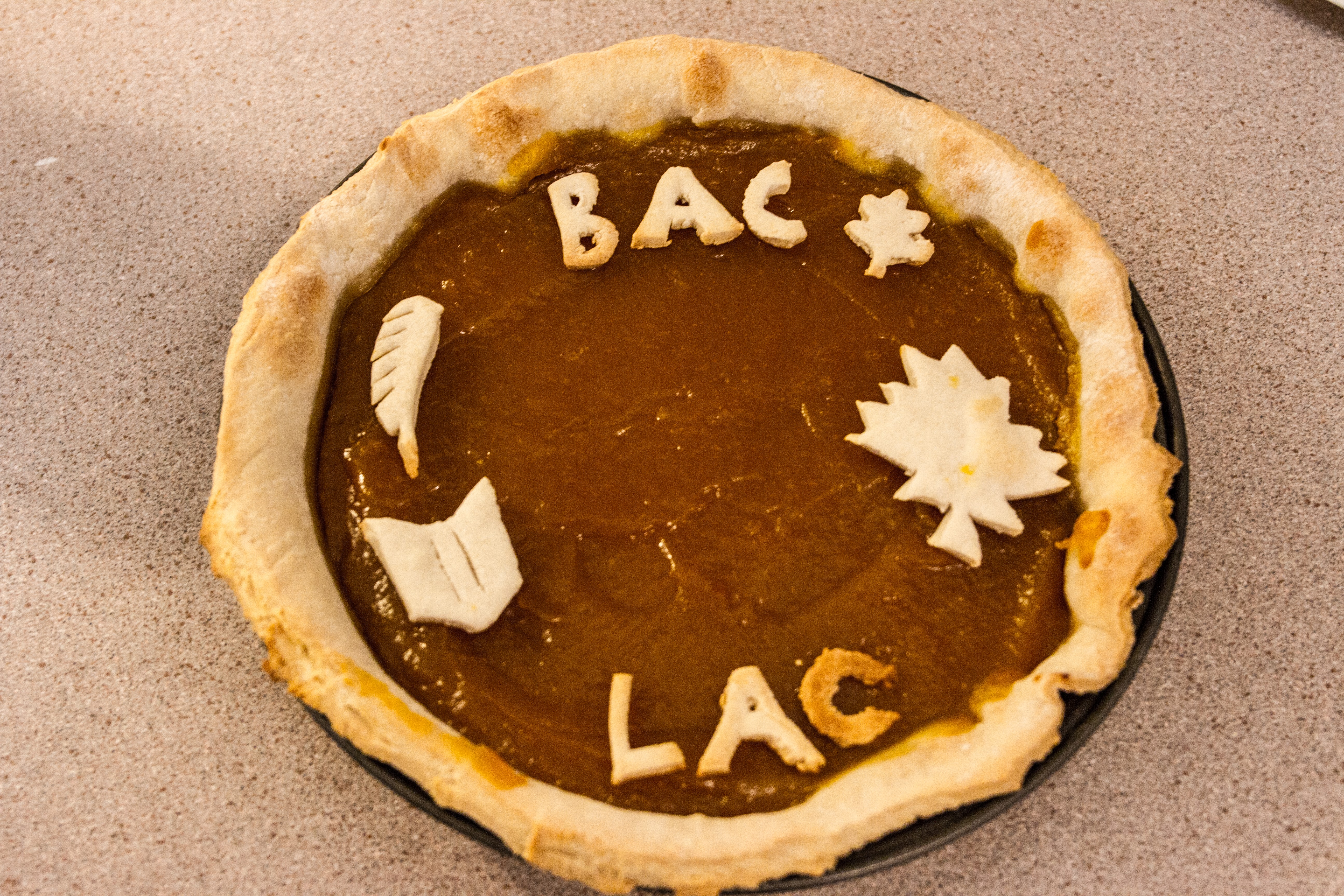
Photograph of the pie fresh out of the oven. Leaves, a feather, a book and the words BAC and LAC in dough are placed on the top of the pie.

The pie after it finished baking. After it visited Reference Services the next day, not a crumb was left. Credit: Ariane Gauthier.

My colleagues obviously loved it, especially my supervisor, who ate three slices. This recipe, although very different from our contemporary recipes, still seems to be appreciated!

The New Galt Cook Book – 1898

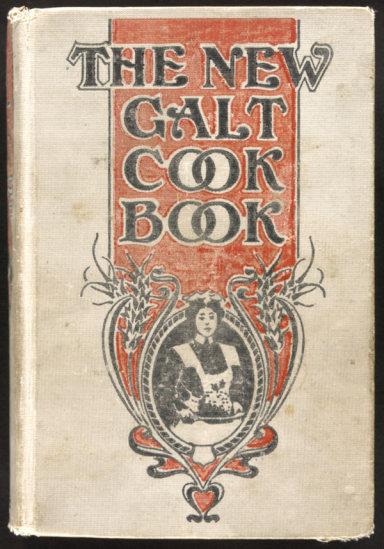
Cover page with the title The New Galt Cook Book and an illustration of a woman with an apron holding a dish containing food.

Cover page of the cookbook The New Galt Cook Book (OCLC 1049883924).

Although I have discussed a recipe from La cuisinière canadienne, its Canadian English equivalent is also noteworthy. The New Galt Cook Book was essential in English-Canadian kitchens. This is a new edition of a popular book, especially around Galt, in southwestern Ontario. The publishers said that copies of the book were sent to China, Egypt, India, South Africa, Australia and the United States. Like many old cookbooks, this book includes recipes, suggestions for simplifying household work and a list of remedies for common diseases.

If you try your luck with the pumpkin pie from 1840 or any other recipe from La cuisinière canadienne, please share your results on Library and Archives Canada’s social media accounts: Facebook, Instagram, X (Twitter), YouTube, Flickr or LinkedIn, using the hashtag #CookingWithLAC and tagging our social media.

Other Library and Archives Canada resources


Ariane Gauthier is a Reference Archivist in the Access and Services Branch at Library and Archives Canada.