What is MIKAN?

The blog post “Ordering documents: what numbers do I need?” helps clients locate the right reference numbers among all the choices in a descriptive record. But what about the MIKAN number? What is that all about?

MIKAN is a computer system for searching, creating, and modifying information about archival materials. The name is based on an Algonquin word, meaning “road,” “path” or “discovery.”

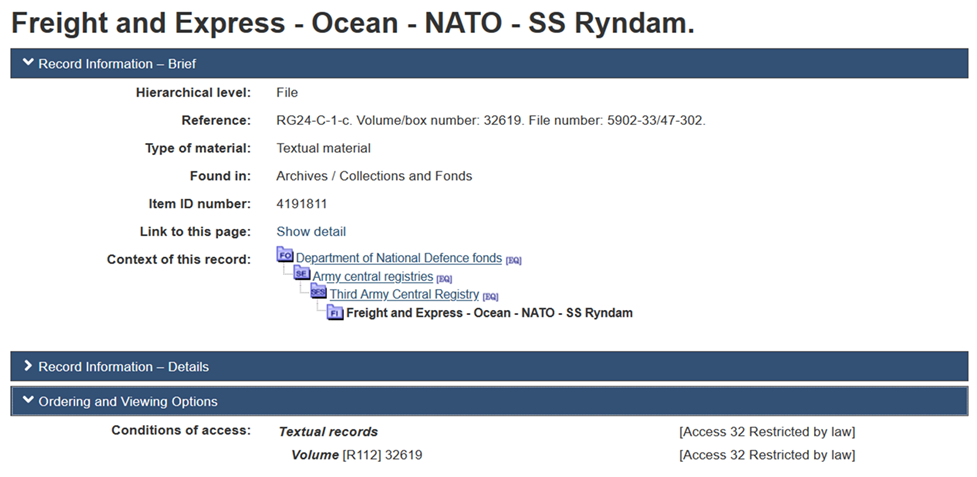
The MIKAN number is a unique record number automatically assigned by the MIKAN system to a record at all levels of description (fonds, series, accession, file, item). Because it is a mandatory field in the MIKAN system, the number appears on each archival descriptive page – at the very bottom – in our Archives Search database. See example below.

Example of a MIKAN number.

Although it can be used to locate and order material, it is not an archival reference number per se and will not show up on our examples of reference numbers page. Therefore, it is best to always include the full archival reference and not just the MIKAN number.

Patent of Invention Applications at Library and Archives Canada

A patent of invention application (for a patent) is a document that usually includes “an abstract, a specification, and drawings.” This type of application is important as it often becomes the official patent document once it is approved. Like the patent process itself, the structure of and type of information in each application is highly regulated. Here’s an overview of what Library and Archives Canada (LAC) holds in terms of patent applications. A subsequent blog post will detail the steps to follow when searching for a specific application.

The Canadian Intellectual Property Office fonds is one of the first places to look if you’re trying to get an idea of what LAC holds in terms of patents. You’ll find relevant holdings in the Patent Branch and the Industrial Design Division series within that fonds. Both series encompass the pre- and post-Confederation periods and include documentation that demonstrates the various stages of the patent application process. Please note that many of these are searchable through the Canadian Patents, 1869–1919 database. Continue reading

How to access Orders-in-Council preserved at Library and Archives Canada

The article “How to find Orders-in-Council at Library and Archives Canada” explains how to find complete references to these Orders-in-Council (OICs). But then how do you access the OICs that interest you?

You have several choices: consult the originals on site, search in the Canada Gazette, consult the OICs on microfilm, or request a reproduction.

For OICs that are discoverable and accessible online, see the article on “Orders-in-Council: What you can access online.” Continue reading

How to find Privy Council Orders at Library and Archives Canada

In the article “Orders-in-Council: What you can access online” we learn that Library and Archives Canada holds the Privy Council Orders-in-Council published between 1911 and November 1, 2002. However, many of them are not available online. You must therefore do your research on site to find the full references.

Can’t come in person? You can send a reference request using the form Ask Us a Question, or you can hire a freelance researcher. Please note that our research services are limited.

Privy Council Office fonds

Orders-in-Council are part of the Privy Council Office fonds, series “Orders-in-Council,” sub-series “Minutes, Annexes and Reports.” The entire group is identified by the document group number RG2-A-1-a, an essential part of the reference number.

Indexes and registers

It is important to first consult the annual registers and indexes, which list all the Orders-in-Council submitted by the Privy Council Office and provide details to be included in the references (including order numbers and approval dates). Most registers are bound to their respective indexes.
A number of indexes and registers are on microfilm; please see the list in finding aid FA 2-6. Continue reading

Self-serve photography

It used to be that the only way of getting copies of archival documents was a bit of a tedious process. Flagging the pages you wanted copied, filling out the form, handing in the information to the Consultation staff, and then waiting the 30 business days for the copies to be made. If you were not someone who was from the Ottawa-Gatineau area, you would then have to wait for the copies to be mailed out to you. If you were in the National Capital Region, but not a regular visitor, you might have to make a special trip to 395 Wellington Street to pick up your copies. Now the process can be much quicker if you choose. If you have a camera or a smartphone, you can now take digital images of our collection, rights and restrictions permitting. Once you have the material you wish to copy, simply check in with the Consultation staff, who will provide you with a quick form to fill out. You will need to provide the full reference number for the box or volume, along with your user card number and your name. The staff will verify restrictions of the documents and provide you with a green copy of the approved form. Here are some of the key points to remember about what is required from a technical standpoint of your camera or smartphone.

  • You must have a wrist strap, neck strap or tripod.
  • No flash can be used.
  • Photos cannot be taken before permission is given.
  • Your green permission slip must be visible at all times.
  • You can request a weight or book wedges to help you photograph larger items instead of forcing the items open.

There are also a few tripods available with either a camera mount or a smartphone mount, but they are loaned out on a first-come, first-served basis. You can see the Consultation staff for these as well. If you cannot come in during service hours and still wish to take photos, you can either fax in your filled out form (613-992-5921) or scan and email it to the following address: consultationtext@bac-lac.gc.ca, indicating your date of visit and which lockers have been assigned to you. You can get a copy of the form in person during service hours or by contacting the Consultation staff at the above mentioned email address. This service is also available in Genealogy and Reference Services during their service hours.

Ordering documents: what numbers do I need?

Trying to find the right reference number when you want to request documents from the Library and Archives Canada (LAC) collection can be a little daunting to a newcomer and sometimes even to the seasoned researcher. With titles such as Item ID number, archival reference no., former archival reference no., related control no., and other system control no., it can be difficult to know which number is required to place your request.

In general, the complete archival reference information that you need to request documents for consultation (or reproduction) can be found in the Reference field in the “Record Information – Brief” section of the online description for files, items and accessions, etc, available through our Collection Search database.

In the case where some information is missing from the reference field, it is always worth looking at the “Ordering and Viewing Options” section.

A sample record description in the Library and Archives Canada Collection Search database. Note the Reference field near the top of the page and the Conditions of access at the bottom of the page.

You will need to make note of the following information (if available), in the order indicated (1 to 6), in addition to the document title (located at the top of the description page):

  1. Archival Reference number – e.g., R112
  2. Former archival reference no. – e.g., RG, MG, LMS, MUS. It is also important to transcribe all of the information that follows the letter identification.
  3. An accession or BAN number – e.g., 2003-00459-9
  4. A volume or box number—without a volume or box number, nothing can be ordered.
  5. File no. (creator) or Item no. (creator)
  6. File title

It is important to note that the Item ID number found in Collection Search (formerly known as Mikan number) is not an accepted reference number. This number is a system number for Collection Search. It refers to the descriptive record, not the document itself. While useful for searching online, this number, unlike complete references, will likely change

That said, for the preceding example the following information would be needed for document retrieval:

RG24-C-1-c, Volume 32619, File no. 5902-33/47-302

Here are other examples of reference numbers and titles organized by media type.

Please note that the “Conditions of access” field, available under the header “Ordering and Viewing Options” also contains important information on access restrictions (identified by an access code) that apply to the records described and that indicate whether documents may or may not be freely consulted for research and reproduction purposes. For more information about access codes, please consult the following blog posts: Introduction and Part II.

Important considerations:

  • Retrieval times for archival documents are between 36 and 48 hours as the documents are kept offsite and must be brought to 395 Wellington for viewing.
  • Pay close attention to the restriction codes on the documents, which may require you to provide additional information if the files happen to be restricted.
  • Some documents have already been microfilmed and are available for immediate viewing in the consultation room. If you see a record with a microfilm reel number, you can go directly to the microfilm room and pull the reel from the shelf for viewing.
  • In addition, some microfilm reels starting with the letters C-, T- and H-, have been digitized through our collaboration with Canadiana and are available on the Héritage website.

If all else fails, feel free to ask the Orientation or Consultation staff for help to find the correct reference number, or complete the Ask Us a Question form.

New Books in the Genealogy Services Collection at 395 Wellington—January 2015

Below is a list of our recently acquired genealogy publications. You can consult these publications in the Genealogy and Family History Room located on the 3rd floor at 395 Wellington. The link takes you to the AMICUS record which gives the call number to help you find the book on the shelves.

If you’re just starting out in genealogy, you should check out our Genealogy and Family History pages.

Happy exploring!

Family Histories

De nos ancêtres Houallet en France aux descendants Ouellet-te en Nouvelle-France, de François Houallet et Isabelle Barré, à leur fils René et son rêve américain by Jeannine Ouellet (AMICUS 43057598)

Généalogie ascendante de Maurice Fortier by Lise Lefebvre (AMICUS 42357176)

La descendance de Pierre Gilbert, capitaine de vaisseau: Petite-Rivière-Saint-François à partir de 1756 by Jules Garneau (AMICUS 42913904)

André Marsil dit Lespagnol: l’ancêtre des Marcil et Mercille d’Amérique (1642-1725) by Denis Marsil (AMICUS 42507286)

La famille Miville-Dechêne, Julie: l’arrivée en Nouvelle-France et les pérégrinations à Québec et dans les environs du 17e au 21e siècle by Michel Émond (AMICUS 42421839)

Larocque family by Charles G. Clermont (AMICUS 42544482)

L’histoire de la famille acadienne des Lejeune dit Briard: les sept premières générations et plus by André-Carl Vachon (AMICUS 43023469)

Looking back: a history of the Robert and Hannah (Swinton) Williamson family, 2013-1783 by M. Yvonne Brown (AMICUS 42487533)

The Amos B. Weber family history by Tim Campbell (AMICUS 42624120)

The legacy of Peter Martin by Tim Campbell (AMICUS 43040697)

The Noah B. Martin family history by Tim Campbell (AMICUS 42624089)

The scent of oil: a Nicklos/Perkins family saga by Gary May (AMICUS 39274484)

Ethnic and Local Histories

Atlas généalogique de la France ancestrale: pays des migrants vers la Nouvelle-France by Micheline Perreault (AMICUS 42213484)

Dictionnaire des souches allemandes et scandinaves au Québec by Claude Kaufholtz-Couture and Claude Crégheur (AMICUS 42651679)

Irish presence: the protestant religious history, volume 1: Villages et visages en Lotbinière (includes cemetery transcriptions), research and writing by Sylvie Bernard; translation by Claude Crégheur and Mélanie St-Jean (AMICUS 38820935)

La colonie nantaise de Lac-Mégantic: une implantation française au Québec au XIXe siècle by Marcel Fournier (AMICUS 41526971)

Le pays des filles du Roy… au confluent du Saint-Laurent et de la Richelieu by Louise Biron, Danielle Mailloux and Louise Pelletier (AMICUS 42139559)

Les Filles du roi au XVIIe siècle: orphelines en France, pionnières au Canada by Yves Landry (AMICUS 42011241)

Les sépultures du coteau des Cèdres, 1750-1780 by Jean-Luc Brazeau and Isabelle Aubuchon (AMICUS 43036058)

Patriotes, reformers, rebels & raiders: tracing your ancestors during the troublous times in Upper and Lower Canada, 1820-1851 by Kenneth Cox (AMICUS 42726565)

Pour que rien ne s’efface: Notre-Dame-de-Lourdes, 2014 by Robert Charbonneau, Mario Cyr and Huguette Plourde (AMICUS 43043082)

Répertoire des naissances, des mariages et des décès de la paroisse de Saint-Émilien, Desbiens, 1926-1941 by Société d’histoire du Lac-Saint-Jean (AMICUS 42654710)

The Irish Catholic families of Puslinch Township, Wellington County, Ontario: a genealogy by Marjorie Clark (AMICUS 42756767)

Building a case for the Proclamation of the Constitution Act 

It was raining on Parliament Hill as Queen Elizabeth II and Prime Minister Pierre Elliot Trudeau signed the Proclamation of the Constitution Act on April 17, 1982. Marks left by the raindrops, as they smudged the ink, can still be seen as physical reminders of the rich history of the Act.

The Proclamation of the Constitution Act is a fundamental document for all Canadians as it symbolizes Canada’s journey from colony to independent country. Like many of history’s most valued documents, it has spent most of its time sealed in a vault for preservation reasons.

As with the display of all collection materials, a balance must be struck. Exhibiting materials involves exposing items to potentially damaging light, while not exhibiting means restricting access to the collection. The loan of the Proclamation of the Constitution Act to the new Canadian Museum of Human Rights in Winnipeg presented an exciting challenge to the Library and Archives Canada (LAC) Preventative Care and Conservation staff—to make the document accessible to Canadians.

So, what does it take to prepare one of Canada’s most significant documents for display?

Studies conducted in 2012 by the Canadian Conservation Institute concluded that the signature inks on the Act are extremely light sensitive. In an effort to prolong its life, the document is allowed only a limited number of display hours per year. LAC staff designed and created a state-of-the-art encasement and display case to protect the Act from harmful light, vandalism and theft.

First, the Act was housed in a custom case that allows the control of humidity, UV exposure, and oxygen levels which will help to further reduce deterioration of the document. A display case was then designed to help limit the total amount of light exposure during exhibition.

Conservators fitting the interior of the case with an an activated carbon cloth which filters the air, absorbing atmospheric pollutants.

Conservators fitting the interior of the case with an an activated carbon cloth which filters the air, absorbing atmospheric pollutants.

The display case incorporates a special layer of opaque black glass (which protects the document from 97% of visible light) but, at the press of a button, it can quickly become translucent as the document is illuminated. The whole system runs on a timer, controlling the length of time the document is visible and records the total exposure over an entire loan period. This will help LAC to monitor the amount of light exposure the Act receives over the course of its life.

This project enhances public access to our country’s heritage without compromising the long-term preservation of the Proclamation of the Constitution Act, and ensures that Canadians will be able to see this national treasure, including generations to come.

Visit the Canadian Museum of Human Rights in Winnipeg for this rare opportunity to see the Proclamation of the Constitution Act and other significant documents from LAC’s collections during the museum’s inaugural exhibitions.

An Arpent, a Toise, a Perche, a League… Understanding Old French Measurements

When looking through old French records, you will frequently come across old measurements that are rather mysterious nowadays. These measurements are found in records originating in France, Quebec and Louisiana. Below is a table showing the equivalencies, but many online sites offer conversion calculators, even for these old standards.

Conversion Table for Old French Units of Measurement

Old French Units of Measurement Conversion to Other Units of Measurement
1 pied 0.324 837 81 metres

1.065 740 34 feet (English measure)

1 toise 6.0 pieds

1.949 026 87 metres

6.394 442 03 feet (English measure)

1 perche 3.0 toises

18.0 pieds

5.847 080 62 metres

19.183 326 1 feet (English measure)

1 arpent 10.0 perches

30.0 toises

180.0 pieds

58.470 505 4 metres

191.833 261 feet (English measure)

63.944 420 3 yards (English measure)

1 lieue 84.0 arpents

840.0 perches

2 520.0 toises

15 120.0 pieds

4 911.547 72 metres

4.911 547 72 kilometres

16 114.0 feet (English measure)

5 371.333 33 yards (English measure)

3.051 893 94 miles (English measure)

1 arpent carré 32 400.0 pieds carrés

3 418.80 square metres

0.341 88 ares

36 800.0 square feet (English measure)

0.844 803 06 acres (English measure)

Access to Information and Privacy requests can now be made online

Library and Archives Canada (LAC) is launching a form that will enable Access to Information and Privacy (ATIP) requests and payments to be made online. Processing of credit card payments will be made through the Government of Canada’s secure Receiver General Buy Button (RGBB). The request form is located on the LAC website under Transparency. With this feature, LAC joins 25 other federal government institutions who can now accept ATIP requests online.