The Mountain Legacy Project: An Archive-Based Scientific Project

Beginning in 1871, the Dominion Lands Branch had been surveying and mapping Canada from East to West. By 1886, the Dominion Lands Survey had extended to the Rocky Mountains, but the rugged terrain made traditional survey methods impractical. Édouard-Gaston Deville, Surveyor General of Canada, devised a new methodology called “phototopography,” (also known as photogrammetry) based on the use of survey photography from hot-air balloons in France and Italy. A special camera was constructed for surveyors, who ascended thousands of peaks in Alberta, British Columbia and the Yukon. They rotated and levelled their cameras on tripods to create 360-degree views of the surrounding terrain. Between 1887 and 1958, more than 100,000 glass plate negatives were used to create the first topographic maps of the Canadian Rockies, of which 60,000 are now part of the Library and Archives Canada (LAC) collection.

Since 2002, LAC has been a major participant in the Mountain Legacy Project, an ongoing partnership led by the University of Victoria, which includes stakeholders in universities, archives, government, and non-governmental organizations.

LAC identifies, describes and digitizes the original negatives. These photographic records are the foundation of this multidisciplinary project, which uses “repeat” photography. It consists of re-photographing the landscape from the precise original locations to provide information about environmental changes that have occurred over the last 120 years.

To search LAC holdings of original photographs, follow these easy steps:

  1. Go to the Basic Archives Search.
  2. Enter the archival reference number R214-350-0-E in the search box.
  3. From the Type of material drop-down menu, select Photographic material and then click on Submit. Your search will generate a list of results.
  4. Select an underlined title to access the full description of a photograph. The descriptive records display images of photographs that have been digitized.

For more information about how to search for photographs at LAC, consult our articles “How to Find Photographs Online” and “How to Search for Images Online.”

If you wish to narrow your search:

  1. Go to the Archives Advanced Search.
  2. Select Photographic material from the drop-down menu labelled Type of material
  3. Use one or a combination of the following options as keywords in the Any Keyword search box:
    1. Name of the surveyor (e.g., Bridgland, McArthur or Wheeler).
    2. Year of the survey (must be used along with another keyword to limit search).
    3. Name of a survey (e.g., Crowsnest Forest Reserve, or Interprovincial Boundary Survey, although these may have taken place over several years, by various surveyors).
    4. Name of a particular landscape feature, such as mountain peak, river, creek, or valley (often the views are identified by the station/peak they were taken from, rather than by the peak or landscape featured in the photograph).
    5. Name of the park (Note: The LAC collection does not contain reproductions of the images from Jasper and Banff National Parks).
  4. Limit your search results by selecting a decade under the label “Date” on the right side of the screen.

For more information about the Project, and to compare the archival images with the repeat photography, visit the Mountain Legacy Project website. To view a sampling of paired photographs, visit our Flickr Set. To view some images of the surveyors, visit our Facebook Album.

Questions or comments? We would love to hear from you!

The Korean War

In the wake of the Second World War, the Korean Peninsula was divided into two zones along the 38th parallel, with the North occupied by the Soviet Union and the South by the United States. Soon after the election of a northern communist government in 1948, open war broke out on June 25, 1950, when North Korean troops invaded the South.

Given the situation, the United Nations Security Council passed a resolution to approve sending troops to defend South Korea; a number of countries, including Canada, contributed by supplying armed forces.

The Royal 22e Regiment mortar platoon ready to fire, (left to right) Private Daniel Primeau, Private Raymond Romeo, and Private Julien Blondin, all of Montreal, Quebec.

The Royal 22e Regiment mortar platoon ready to fire, (left to right) Private Daniel Primeau, Private Raymond Romeo, and Private Julien Blondin, all of Montreal, Quebec. Source

More than 26,000 Canadian soldiers fought in the Korean War. They battled communist troops on the ground, while the Royal Canadian Navy—with eight warships—helped control the Korean coasts. The Royal Canadian Air Force did its part transporting troops and equipment. A few pilots saw combat at the controls of American fighter planes.

 Black-and-white photo of two Canadian snipers aiming at an unknown target..

Two snipers. Source

On July 27, 1953, an armistice agreement was signed at Panmunjom, bringing three years of fighting to an end.

In all, 516 Canadians lost their lives during this armed conflict. Their names are entered in The Books of Remembrance… The Korean War, exhibited at the Peace Tower in Ottawa and available online. These registers remind us of the important contribution and tremendous sacrifice of these Canadians.

The Library and Archives Canada collection contains many documents about this war, which marks the 60th anniversary of its armistice in 2013. Here are a few examples:

Part of the war diaries (War Diary, 1951) of the Commonwealth troops, including Canadian troops:

The war diary (1950–1951) of the advance party:

For more photos, visit our Flickr album.

For more information about ordering military service files, please read our blog article on this topic.

The Canadian Arctic Expedition—100th anniversary

At the beginning of the 20th century the Canadian government, led by Sir Robert Borden, wanted to strengthen Canada’s sovereignty in the Arctic, in response to the presence of the United States and Russia in the North. The Canadian Arctic Expedition was established by Order-in-Council 406, dated February 22, 1913, under the responsibility of the Ministry of Naval Services and other government bodies.

The expedition was comprised of two groups, each with its own objective: the Northern Party, led by Vilhjalmur Stefansson, was responsible for geographic exploration of the Arctic to ensure Canadian sovereignty in the western part, while the Southern Party, led by Dr. Rudolph M. Anderson, focused on scientific discovery.

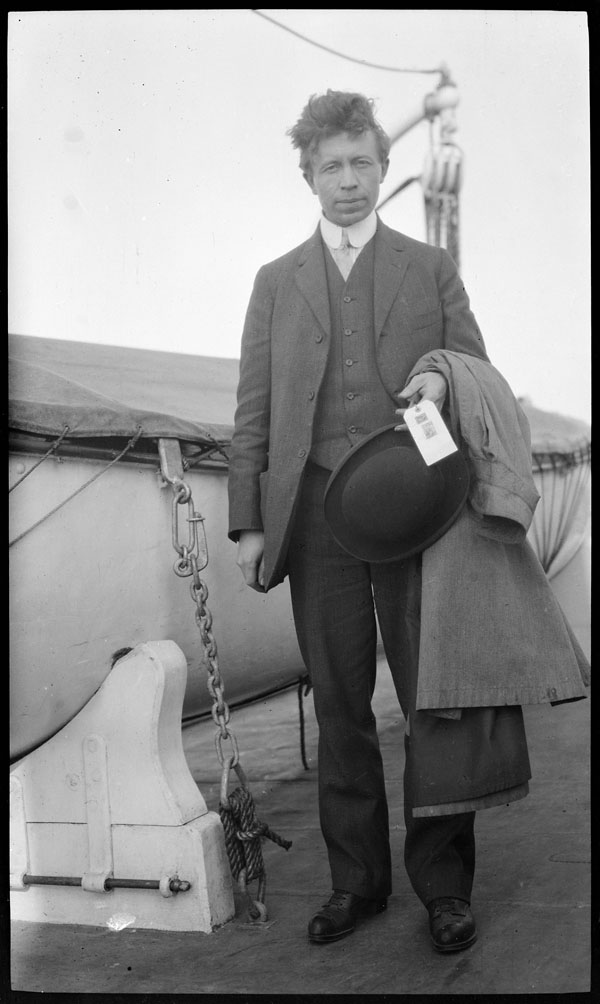
V. Stefansson on board the Karluk.

V. Stefansson on board the Karluk. Source

Rudolph Martin Anderson.

Rudolph Martin Anderson. Source

An expedition fraught with challenge

On June 17, 1913, the expedition set sail from Esquimalt Harbour in British Columbia aboard the Karluk headed for Herschel Island in the Beaufort Sea. In August, the ship became trapped in ice and drifted for over four months, eventually sinking in Siberia. The ship’s captain, Robert Bartlett, describes the final days of the voyage in his book Northward ho! The last voyage of the Karluk. Stefansson’s decision to leave the ship on September 19, 1913, to continue his exploration occurred in a climate of crisis. Stefansson’s departure remains a source of controversy and debate among historians.

The Karluk sails near Esquimalt Harbour.

The Karluk sails near Esquimalt Harbour. Source

To find out more

The following are some of the archival documents and government reports that constitute the information resources related to this expedition.

For consultation on-site at Library and Archives Canada:

Available online from Library and Archives Canada:

Other sources:

Please note that the majority of the documents are available in English only.

For more information, be sure to visit the virtual exhibition at the Canadian Museum of Civilization: Northern People, Northern Knowledge: The story of the Canadian Arctic Expedition 1913-1918.

Visit our Flickr album for more photographs.

Sir John Franklin Expedition

On May 19, 1845, HMS Erebus and HMS Terror left England under the command of Sir John Franklin in search of the Northwest Passage. This expedition was without a doubt a most ill-fated venture, as not a single member returned alive.

An iceberg, HMS Terror and some walruses near the entrance of Hudson Strait.

An iceberg, HMS Terror and some walruses near the entrance of Hudson Strait
Library and Archives Canada, Acc. No. 1979-49-1. Source

Major search efforts were launched to find the missing men, including three expeditions to the Arctic in spring 1848. Rewards were also offered in 1849 and 1850 for any information about Franklin’s expedition. These searches did produce results: in 1850, the first relics—the graves of three crewmen who died in 1846—were found at Beechey Island, west of Devon Island.

In July 1857, Lady Franklin also financed an expedition under the command of Francis McClintock aboard the ship Fox. On May 5, 1859, William Hobson, Lieutenant of the Fox, found a document placed beneath a cairn containing two messages. The first, written by Franklin on May 28, 1847, indicated that the crew of the two ships had spent the winter of 1845–46 off Beechey Island, and that all was well. The second message, dated April 25, 1848, indicated that the Erebus and Terror had been trapped in ice since September 1846, west of King William Island, and that 24 men had died, including Franklin on June 11, 1847.

In the wake of expeditions undertaken to find Franklin, numerous maps were drawn, including the Discoveries in the Arctic Sea, 1616-1927 and the Chart showing the vicinity of King William Island. These identified the sites Franklin visited, the places where his group wintered and the site in which his ships were abandoned. The second map also mentions the diverted courses the two wrecks may have followed.

Although we now know the fate of the members of this expedition, every attempt to find the wrecks of the Erebus and the Terror has been unsuccessful, despite the magnitude of the searches and modern technologies deployed.

For more information about the period prior to the expeditions:

For more information about the periods prior to and following the expeditions:

For more information about the period following the expeditions:

Publications, bibliographies and guides held at Library and Archives Canada:

Please visit our Flickr album for more photographs.

The Battle of the Atlantic (1940–1943)

Although the waters of the Atlantic witnessed many a naval battle throughout the Second World War, the longest and most important, the Battle of the Atlantic, reached its height between 1940 and 1943, pitting the Allies against the German navy and its formidable fleet of submarines, known as U-boats.

$90 Killed this U-BOAT! War savings stamps drive, 1943.

$90 Killed this U-BOAT! War savings stamps drive, 1943. Source

The Battle of the Atlantic’s crucial struggle was to protect the convoys of merchant ships against enemy German naval forces, which tried to block their way. Most of these convoys set out from North American ports and were bound for Great-Britain.

Convoy in the Bedford Basin, near Halifax, Nova Scotia, April 1, 1942.

Convoy in the Bedford Basin, near Halifax, Nova Scotia, April 1, 1942. Source

The Battle of the Atlantic saw U-boats penetrate deep into Canadian waters: the Royal Canadian Navy was actively involved in the battle, fighting fiercely to protect its merchant navy.

Freighter SS ROSE CASTLE, in convoy, torpedoed by U-boat, November 2, 1942, near Wabana, Newfoundland.

Freighter SS ROSE CASTLE, in convoy, torpedoed by U-boat, November 2, 1942, near Wabana, Newfoundland. Source

However, despite all efforts, enemy forces sunk over 70 merchant vessels, claiming the lives of over 1,600 Canadian crew members. Nevertheless, the Allies are considered to have prevailed in the Battle of the Atlantic since the Germans failed to stem the flow of merchant shipping convoys bound for Great Britain, which helped provide the supplies essential to the allied victory. Be sure to visit the Canadian War Museum for more information about this Second World War battle.

The Royal Canadian Navy’s contribution to this effort is well documented in the collection of Library and Archives Canada. Some suggestions and references for further research are provided below.

Since most convoys setting out from Canada departed from Halifax harbour, a large volume of records were produced by the Naval Control Service in Halifax. Documents available for consultation include the following:

Please visit our Flickr album for more photographs.

PS 8000 collection of early 20th-century digitized Canadiana

To mark Canada Book Day, we take a closer look at the PS 8000 collection of early 20th-century Canadian publications available in the Electronic Collection of Library and Archives Canada. PS 8000 is the standard classification for Canadian literature, one of the core strengths of our holdings.

To browse this collection

• Click “Search the Electronic Collection” on the left side of the screen
• Choose “Any keyword” from the drop-down menu in the first search box
• Enter “PS 8000” in the second field as the search term

This search produces a list of pre-1926 Canadian publications that have been digitized and are accessible online. Other key terms can be used to further refine the search (e.g. world war and poetry).

Figure 1: Search screen for Electronic Collection

Figure 1: Search screen for Electronic Collection

For other online resources, consult our blog articles on how to find digitized publications Part I and Part II.

Also, explore our Flickr album for a selection of cover images of these publications.

Battle of Vimy Ridge – April 9 to 12, 1917

For Canadians, the Battle of Vimy Ridge brings to mind the joint effort of all of the Canadian units that fought together for the first time to achieve victory. In a way, it was our very first national military victory, and, as such, a tremendous source of pride.

In spring 1917, Allied Command tasked Canadians with the difficult mission of taking Vimy Ridge and driving back the Germans, who had controlled it almost continuously since the beginning of the First World War.

Barrage map [cartographic material]: [Vimy Ridge region, France]

Barrage map [cartographic material]: [Vimy Ridge region, France] (e000000540)

The Canadian officers spent weeks developing their tactical attack down to the last detail. The soldiers rehearsed their attack behind the lines using a model to represent the battlefield so they would be familiar with the terrain where they would be fighting. The role of the artillery was also meticulously planned in preparation for its famous “creeping barrage,” an artillery bombardment that pressed forward against the enemy at a timed pace as a curtain of fire ahead of the advancing troops.

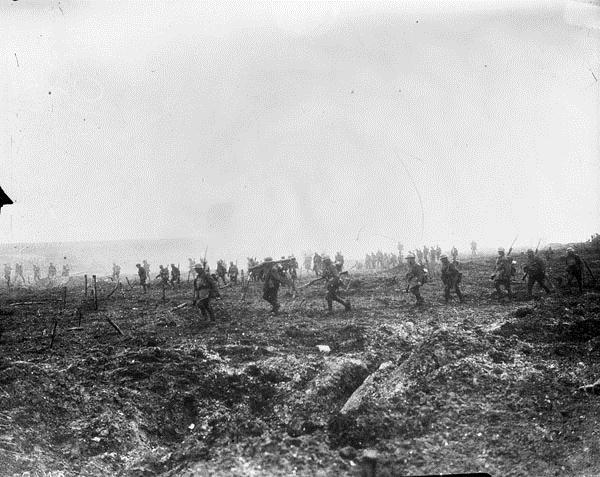
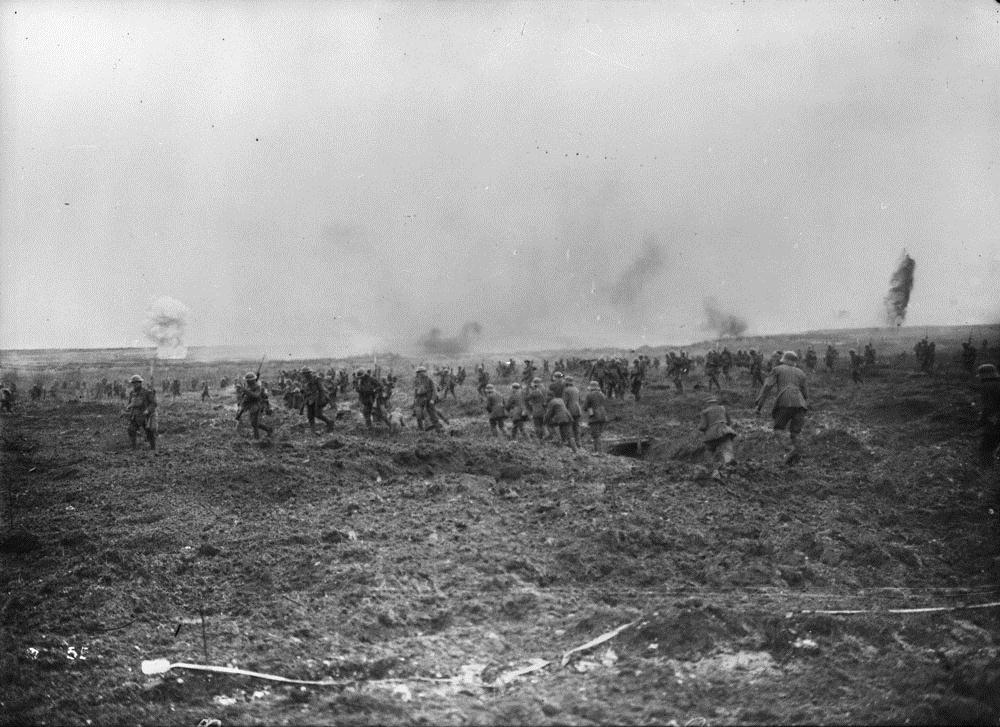
29th Infantry Battalion advancing into “No Man’s Land” through German barbed wire and heavy fire during the Battle of Vimy Ridge.

29th Infantry Battalion advancing into “No Man’s Land” through German barbed wire and heavy fire during the Battle of Vimy Ridge. (a001086)

The attack that ignited the Battle of Vimy Ridge was launched on Easter Monday, April 9, 1917, at 5:30 a.m. Four Canadian divisions overran the German positions, with three achieving their primary objectives in less than an hour. The highly-trained men were able to advance rapidly, thanks to the formidably effective heavy artillery fire. Nevertheless, the Germans offered fierce resistance: it took four days of heavy combat for the Canadians to finally seize full control of the famed Vimy Ridge.

The battle claimed the lives of 3,598 Canadian soldiers, with over 7,000 more wounded.

(W.W. I – 1914-1918) As the Canadians advanced, parties of Huns left their dug-outs, only too glad to surrender – Vimy Ridge. April 1917.

(W.W. I – 1914-1918) As the Canadians advanced, parties of Huns left their dug-outs, only too glad to surrender – Vimy Ridge. April 1917. (a001123)

Visit our Flickr album for more photographs.