Subscribe to the Society of Young Artists’ 1815-1816 theatre season

At the turn of the 19th century, the theatre scene was languishing in Canada. Some plays were a huge success, such as Colas et Colinette, which was performed between 1790 and 1807 and was written by Joseph Quesnel, one of the first playwrights in the country. However, it was often too expensive to maintain theatre companies on a permanent basis. Moreover, the companies faced the disapproval of the Church, which did not like these types of performances.

Most often, it was theatre lovers—members of the social elite composed of French Canadians, military members and British merchants—who arranged venues and presented shows. American actors on tour also entertained audiences in major Canadian cities. When the Theatre Royal opened in Montreal in November 1825, the dramatic arts in Lower Canada were given a new boost.

This watercolour painting of a street scene depicts a four-storey neoclassical building. In the distance, more modest buildings can be seen.

Mansion House Hotel (Theatre Royal), St. Paul Street, Montreal, by Henry Bunnett (1888). (MIKAN 2878039)

Support for the Society of Young Artists

Under these circumstances, shortly after the War of 1812, a company called the Society of Young Artists was formed. Driven by the revival of the theatre scene and the English Theatre’s move to the United States, it launched its first season in fall 1815, performing shows mostly in Montreal. The company promoted its season by printing a bilingual leaflet advertising its first play, Voltaire’s The Death of Caesar.

The leaflet’s main goal was to seek funding from the public through subscribers who committed to paying for tickets each month. For its part, the company promised to give four performances a month, under the best possible conditions, from November 15, 1815, to May 15, 1816. The ticket price was set at one dollar, for a monthly total of one louis (or one Halifax pound).

The Canadian newspapers at that time, such as the Spectateur Canadien dated November 20, 1815 (in French only), also promoted the Society’s shows.

Text printed in French explaining the subscription’s conditions and the company’s commitment to its audience.

Subscription in French for the Society of Young Artists’ 1815-1816 theatre season. (MIKAN 4814815)
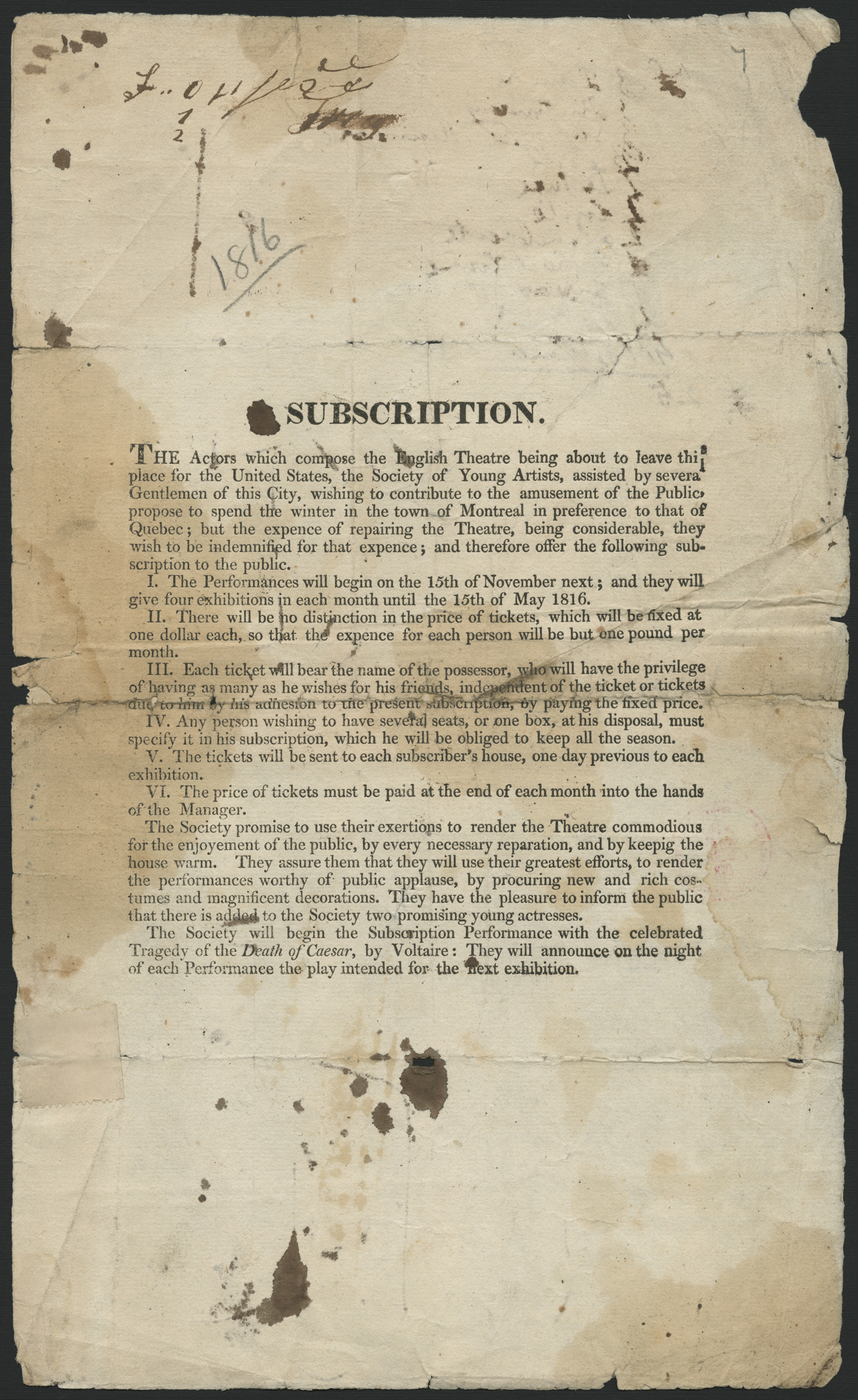
Text printed in English explaining the subscription’s conditions and the company’s commitment to its audience.

Subscription in English for the Society of Young Artists’ 1815-1816 theatre season. (MIKAN 4814828)

An intriguing list

Interesting fact: a list of items was written on the back of the English leaflet. Valued at 25 pounds (Halifax rating), these items could have been used either on stage or to meet the Society’s needs. The list is very difficult to read, but the following items can be identified: millwork, cloth, a pulley, rope, green flannel, white iron and costumes—in short, the items needed for the company’s activities.

A list of items written in ink that is very difficult to read.

List of items on the back of the English subscription for the 1815-1816 theatre season (MIKAN 4814828)

Repertoire: Molière, Shakespeare and company

Unfortunately, we do not know all the plays performed by the Society of Young Artists. However, in his book L’activité théâtrale au Québec (1765-1825), Baudoin Burger gives us an idea of the repertoire on the French stage at that time. From 1814 to 1819, the Montreal and Quebec City audiences could enjoy the plays of Molière, Beaumarchais, Voltaire, Regnard, Bruyes and Dancourt. On the English stage, the artists performed Molière, James Kenney, and of course Shakespeare, who remained the most popular.

A unique record

Very few archival records remain that document the beginnings of Canadian theatre under the English regime. The leaflets from the Society of Young Artists are therefore important and even unique records of our theatre heritage. They also show the love of art that pushed the Society to take the stage despite financial difficulties and varying levels of attendance. These people are, in a way, pioneers who believed in artistic development in Canada.


Oscar Peterson

Version française

By Dalton Campbell

These photographs of Oscar Peterson and his family were taken in 1944. He was in his late teens and already an experienced professional musician. He had been playing regularly with the Johnny Holmes Orchestra since 1942, a popular swing band that played to the dance crowd in and around Montreal. Oscar left the orchestra in 1947 and began a residency at the Alberta Lounge, a club near Windsor Station, leading a trio there for two years.

A black-and-white photograph showing Oscar Peterson playing the piano in a lounge.

Oscar Peterson, photographed by D.C. Langford [1944]. (e010752610)

Given the vibrant jazz scene in the city, Oscar had lots of opportunities to play: he performed professionally, played live for CBC Radio broadcasts, attended jam sessions, and met and jammed with visiting musicians performing in town. He earned praise from Count Basie, Woody Herman, Ella Fitzgerald, Coleman Hawkins, Dizzy Gillespie and others. Oscar was based in Canada until 1949 when Norman Granz convinced him to join the “Jazz at the Philharmonic” concert series in Los Angeles. This marked the beginning of his international career.

Oscar’s parents were immigrants to Canada. Daniel Peterson, Oscar’s father, was from the British Virgin Islands and worked as a boatswain on a merchant ship. His mother, Kathleen Olivia John, was from St. Kitts, British West Indies, and worked as a cook and housekeeper. They met and married in Montreal, settling in Little Burgundy/St-Henri, a predominately Black neighbourhood. Like many men living there, Daniel got a job at Windsor Station as a porter on passenger trains for the Canadian Pacific Railway.

A black-and-white photograph showing Oscar Peterson with his father, Daniel. Both men are sitting at a piano, with their hands on the keyboard, smiling and looking up at the camera.

Oscar Peterson and his father, Daniel, at the piano [1944]. (e011073129)

With instruction and encouragement from their parents, the Peterson children became accomplished musicians.

Fred, the eldest child, introduced Oscar to ragtime and jazz when he played it on the family piano. Fred died in the 1930s while still a teenager. Oscar said Fred was the most talented musician of the family.

A black-and-white photograph showing Oscar Peterson seated, playing piano. His brother Charles, dressed in the uniform of the Canadian Army, stands next to him playing the trumpet.

Oscar Peterson on piano, with his brother, Chuck, accompanying him on trumpet [1944]. (e011073128)

Another brother, Charles, who served with an artillery battery in the Canadian Army during the Second World War, played in the regimental band. After the war, he continued as a professional trumpet player, doing studio work and performing at various Montreal nightclubs through the 1950s and 1960s. Like his siblings, he also played the piano, but was forced to give it up after suffering an industrial accident while working in a factory in Montreal after the war.

A black-and-white photograph of Oscar Peterson and his sister Daisy seated at the piano with their hands on the keyboard. They are looking at the camera and smiling.

Oscar Peterson with his sister, Daisy, at the piano [1944]. (e011073127)

Daisy, Oscar’s oldest sister, was also a virtuoso pianist. She earned a degree in music from McGill University and had a lengthy and influential career as a music teacher in Montreal. She was her siblings’ first piano teacher and introduced Oscar to her own piano teacher, Paul de Marky, a concert pianist who played in the Franz Liszt tradition. Daisy taught for many years in Montreal; her students included future jazz musicians Milton Sealey, Oliver Jones, Reg Wilson and Joe Sealy.

Related Resources


Dalton Campbell is an archivist in the Science, Environment and Economy Section of the Private Archives Division.

Library and Archives Canada releases latest podcast episode, “Celia Franca: Shall we dance?”

Library and Archives Canada (LAC) is releasing its latest podcast episode, Celia Franca: Shall we dance?

Discover the story of Celia Franca, a woman who introduced Canada to world-class dance performances, pioneered the internationally famous National Ballet of Canada and devoted her entire life to dance. In this episode we are joined by LAC archivists Michel Guénette, Théo Martin and assistant archivist Judith Enright-Smith who will speak to us about who Celia Franca was, and the dance-related resources available to researchers at Library and Archives Canada.

Subscribe to our podcast episodes using RSS or iTunes, or just tune in at Podcast–Discover Library and Archives Canada: Your History, Your Documentary Heritage.

On Pointe–A Dancing Force to be Reckoned With

Celia Franca—dancer, teacher, choreographer, founder and artistic director of the National Ballet of Canada—has been described as beautiful, graceful, talented, determined, a powerhouse and a tour de force. Other descriptions have been more pointed, alluding to Ms. Franca’s no-nonsense teaching methods as well as her drive and tenacity in her successful attempt to establish a Canadian classical ballet company in only ten months while at the same time working as a file clerk in a Toronto department store.

A black-and-white publicity portrait of Celia Franca facing the camera

Portrait of Celia Franca (MIKAN 3803233)

Celia Franca was born Celia Franks in London, England in 1921. Her parents were Polish Jewish immigrants, her father a tailor in London’s East End. She surprised her family when at a very young age, she announced that she wanted to be a dancer. After earning scholarships, she studied at London’s Guildhall School of Music and the Royal Academy of Dance. Franca made her London stage debut at the age of 14, after which there was no turning back. By the age of 20, Franca was considered to be one of the most accomplished ballerinas with the Sadler’s Wells Ballet Company (a forerunner of the Royal Ballet) and by the age of 26, Franca was ballet mistress, choreographer and soloist with the London-based Metropolitan Ballet.

A black-and-white studio portrait of Celia Franca as a young girl. She is dressed in a tutu and is on pointe.

Portrait of Celia Franca on pointe (MIKAN 3803737)

In 1950, a new national Canadian ballet company was being contemplated by some Toronto arts patrons and members of that city’s business community. When it was time to choose a director, Franca was approached and accepted the job. She was not only director of the newly formed National Ballet of Canada, but also principal dancer with the company until 1959. Under her direction, the National Ballet of Canada flourished and became recognized and applauded internationally. As a result of Franca’s tenacity and teaching style, “Canadian dancers now had no need to leave Canada to become world-renowned artists.”

In 1959, Celia Franca along with Betty Oliphant, founded the National Ballet School of Canada as a training institution for aspiring dancers and teachers. It was also a very ingenious way to provide definitive dancers for the National Ballet of Canada. Franca resigned from the National Ballet in 1974, and in 1978 co-founded The School of Dance in Ottawa with Merilee Hodgins.

Throughout her lifetime, Celia Franca was the recipient of many awards and honours. In 1968, she was invested as an Officer of the Order of Canada and later promoted to Companion. Celia Franca died in Ottawa in 2007, but her dancing legacy lives on.

Celia Franca’s legacy at Library and Archives Canada:

Library and Archives Canada releases twelfth podcast episode: Between the Sheets

Library and Archives Canada (LAC) is releasing its latest podcast episode, Between the Sheets.

Archival assistant Gilles Leclerc joins us to talk about LAC’s sheet music collection. We explore what sheet music is, what’s included in LAC’s collection and how the collection came about. We also discuss the historical value of sheet music and why it’s still relevant today.

Subscribe to our podcast episodes using RSS or iTunes, or just tune in at: Podcast – Discover Library and Archives Canada: Your History, Your Documentary Heritage.

For more information, please contact us at podcasts@bac-lac.gc.ca.

Library and Archives Canada releases tenth podcast episode, “The Virtual Gramophone: Early Canadian Sound Recordings”

Library and Archives Canada (LAC) is releasing its latest podcast episode, The Virtual Gramophone: Early Canadian Sound Recordings. LAC’s Virtual Gramophone is a multimedia website devoted to the early days of Canadian recorded sound, providing an overview of the 78-rpm era in Canada.

Gilles Leclerc, Archival Assistant, and Gilles St-Laurent, Head Audio Conservator from LAC join us to explore the Virtual Gramophone website and music collection. They discuss the different aspects of the collection and bring to light some incredible stories about maintaining the collection for future generations.

Subscribe to our podcast episodes using RSS or iTunes, or just tune in at: Podcast – Discover Library and Archives Canada: Your History, Your Documentary Heritage.

For more information, please contact us at podcasts@bac-lac.gc.ca

Sheet music from Canada’s past

Did you know that Library and Archives Canada (LAC) has one of the most comprehensive sheet music collection in the country? Thanks to Helmut Kallmann, the founding Chief of the Music Division at the National Library of Canada (now part of LAC), who collected any early Canadian sheet music he could find.

Recently, over a thousand pieces of sheet music from this collection were digitized and are now available online. These titles were published before 1918 and include a wide variety of patriotic and parlour songs, piano pieces, sacred music, etc.

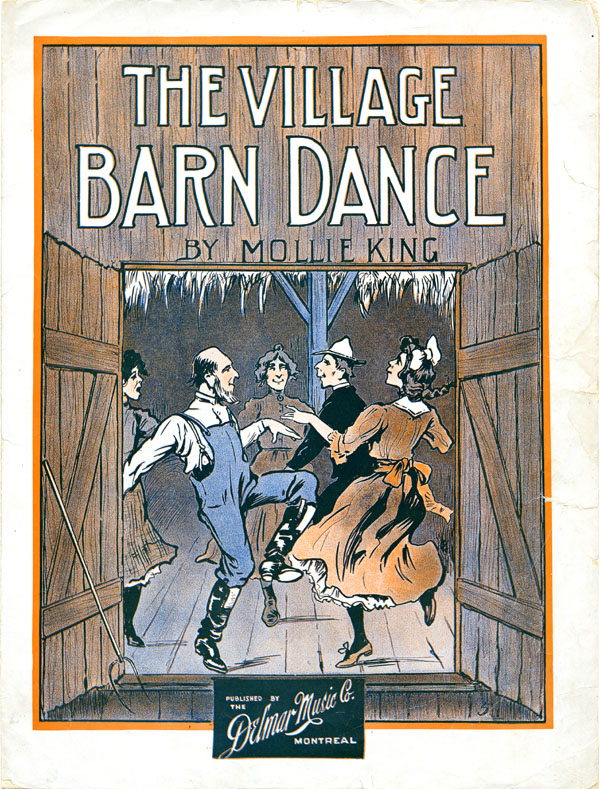
Colour image depicting people dancing in a barn.

Sheet music cover image of a musical piece entitled, “The Village Barn Dance” by Mollie King. Source

Visit LAC’s Sheet Music from Canada’s Past website to learn more or to search for music sheets. Here’s how:

  1. Click on Search Sheet Music located in the left menu.
  2. In the first box, click the down arrow and choose the time period you would like to search, e.g. “1900-1913.”
  3. In the second box, click the down arrow and choose the type of search, e.g. Title keyword (song title).
  4. In the third box, you can enter a search term, e.g. “barn”.
  5. Click the “Submit” button at the bottom.

The browsing options in the fourth box allows you to limit your search to digitized music for which there is either printed music or audio files available. Please note that default searching has been set at “All Time Periods”, “Any Keyword” but you can modify these settings by following the above steps.

Once you have found a piece of sheet music, you will see some or all of the following information:

  1. A description of the music.
  2. A small colour image of the front cover.
  3. A large colour image of the cover.
  4. A “View sheet music” icon.
  5. An “Audio” icon

As the sheet music is available as PDFs, you can print the music on letter size paper.

How anonymous or little-known portrait sitters tell the Canadian story

No names are recorded on this 1913 photograph of an Ontario boys’ band.

Boy’s Brass Band Community Movement Pembroke, circa 1913.

Boy’s Brass Band Community Movement Pembroke, circa 1913. Source

Although the leader, “Bandmaster Wheeler,” is identified in a second photograph of this same group, we have found little information about him or the group of boys that he taught.

Bandmaster Wheeler and Boy’s Brass Band Community Movement Pembroke, circa 1913

Bandmaster Wheeler and Boy’s Brass Band Community Movement Pembroke, circa 1913 Source

A surprising number of portraits in Library and Archives Canada’s (LAC) collection are anonymous or little–known men, women and children. We may never know the identity of these people or discover more about their lives, yet these portraits are as important to LAC’s collection as portraits of well-known people.

These boys’ band photographs document an interesting social movement at the beginning of the 20th century. Community organizations concerned about the morals and manners of their children sponsored bands for young boys. Participation in these bands was seen as a way of learning community service and developing local and national pride.

Viewed together, these photographs illustrate this idea. We know that the first photograph was taken slightly earlier because the boys wear suits rather than band uniforms. Local records of the time show that they were still raising money through performances to earn their uniforms. The second photograph shows the group in uniform — the reward for learning this lesson in personal responsibility and hard work.

These group photographs probably helped to cement the band’s unity and team spirit. Membership in this band looks as though it might have been a lot of fun too, judging by Bandmaster Wheeler’s slightly loosened tie in one photograph, and the jaunty angle of his hat in the other. Wheeler is an interesting figure, being an early Black bandmaster in small-town Ontario. LAC holds few portraits of Black Canadians from this period. Wheeler’s presence in these photographs provides us with an important record.

We continue to research the identity of unknown portrait sitters. If you can help, please contact us.

To view other examples of anonymous or little-known sitters in LAC’s portrait collection, visit our Flickr Album.