To be the best on snow and ice: Documenting Canada’s achievements at the Olympics

The Sochi 2014 Games mark 90 years of Canadian athletes representing their country on the Winter Olympic stage. Canadians have competed in all Winter Olympics, starting with the first Games in Chamonix in 1924. Canada is also part of a handful of countries that have won medals at every Winter Games.

Library and Archives Canada holds a rich collection documenting memorable Canadian performances at the Games, the athletes behind these achievements, and the historical development of winter Olympic sports disciplines in Canada.

The Canadian Olympians site provides a visual history of Canada’s participation in the Games. It consists of more than 10,000 images of athletes who participated in the Winter and Summer Olympics, from the early 1900s through 2004.

Find out more about the following winter sports:

Use the Archives Search tool to discover many historical documents and images by using keywords such as athletes, sports, Olympics or medals. Here are some examples of what you may find on our website:

Canada's Nancy Greene (top) celebrates her gold medal win in the giant slalom alpine ski event at the 1968 Grenoble winter Olympics. (CP Photo/COA).

Canada's Marc Gagnon competes in the speed skating event at the 1994 Lillehammer Winter Olympics. (CP PHOTO/ COA).

See also:

  • Our Flickr album on this subject
  • The Fitness and Amateur Sport records, which contain over 40,000 photographs documenting the performance of Canadian athletes at national and international competitions, including the Olympics

Enjoy the Sochi Games!
Library and Archives Canada releases ninth podcast episode

Library and Archives Canada (LAC) is releasing its latest podcast episode: Pulp Canada: between the covers. Pulps, with their screaming story titles and attention-grabbing cover art, already began to capture the public interest by the turn of the 20th century.

Professor Carolyn Strange, author of True Crime True North: The Golden Age of Canadian Pulp Magazines, and author Ian Driscoll join us to talk about LAC ’s pulp fiction collection. They discuss the different aspects of the collection and bring to light some of the incredible stories surrounding this literature form.

Subscribe to our podcast episodes using RSS or iTunes, or just tune in at: Podcast – Discover Library and Archives Canada: Your History, Your Documentary Heritage.

For more information, please contact us at podcast@bac-lac.gc.ca.

Sheet music from Canada’s past

Did you know that Library and Archives Canada (LAC) has one of the most comprehensive sheet music collection in the country? Thanks to Helmut Kallmann, the founding Chief of the Music Division at the National Library of Canada (now part of LAC), who collected any early Canadian sheet music he could find.

Recently, over a thousand pieces of sheet music from this collection were digitized and are now available online. These titles were published before 1918 and include a wide variety of patriotic and parlour songs, piano pieces, sacred music, etc.

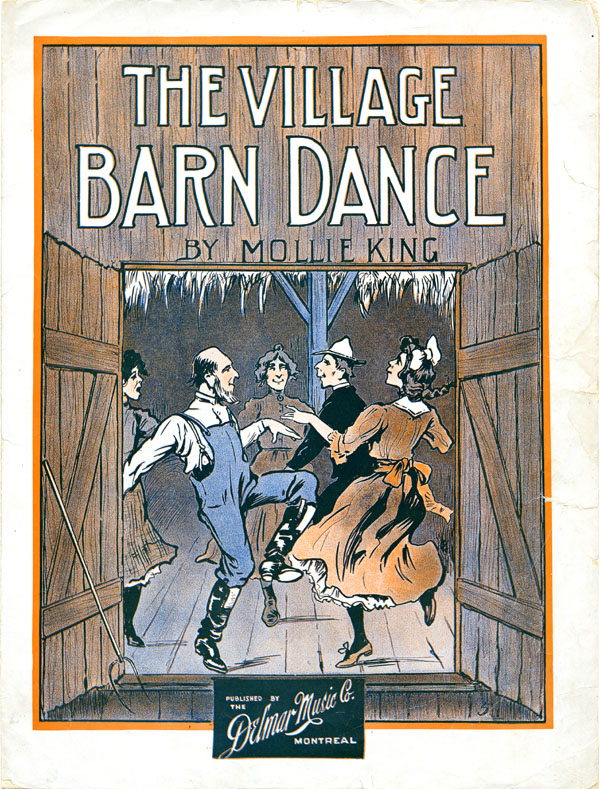
Colour image depicting people dancing in a barn.

Sheet music cover image of a musical piece entitled, “The Village Barn Dance” by Mollie King. Source

Visit LAC’s Sheet Music from Canada’s Past website to learn more or to search for music sheets. Here’s how:

  1. Click on Search Sheet Music located in the left menu.
  2. In the first box, click the down arrow and choose the time period you would like to search, e.g. “1900-1913.”
  3. In the second box, click the down arrow and choose the type of search, e.g. Title keyword (song title).
  4. In the third box, you can enter a search term, e.g. “barn”.
  5. Click the “Submit” button at the bottom.

The browsing options in the fourth box allows you to limit your search to digitized music for which there is either printed music or audio files available. Please note that default searching has been set at “All Time Periods”, “Any Keyword” but you can modify these settings by following the above steps.

Once you have found a piece of sheet music, you will see some or all of the following information:

  1. A description of the music.
  2. A small colour image of the front cover.
  3. A large colour image of the cover.
  4. A “View sheet music” icon.
  5. An “Audio” icon

As the sheet music is available as PDFs, you can print the music on letter size paper.

Historical Debates of the Parliament of Canada (Hansard) now online!

Congratulations to the Library of Parliament and Canadiana: the Historical Debates of the Parliament of Canada portal is now live!

This new portal contains the historical debates in both official languages from 1867 to the mid-1990s. This means you can now search and browse all published debates of both the Senate and the House of Commons from Parliament 1, Session 1, until the coverage begins on parl.gc.ca.

As mentioned above, the portal was developed by the Library of Parliament, in collaboration with Canadiana.org, a membership alliance dedicated to building Canada’s digital preservation infrastructure and providing wide-ranging access to Canadian documentary heritage. Library and Archives Canada is pleased to have provided support by producing the digital page images.

You can consult our blog Looking for the Debates of the House of Commons (Hansard) online? of June 2012 to help you find information on the House of Commons debates.

Validating your ancestor’s arrival in Canada before 1865

So you have searched the immigration records prior to 1865, and still no trace of your ancestor? If you didn’t find your ancestor’s arrival before 1865, Library and Archives Canada (LAC) has other genealogical resources that can assist in confirming an ancestor’s arrival in Canada.

Where did he or she settle?
Is he or she listed in census returns? LAC’s collection of census databases, which can be searched by a person’s name, can confirm an individual’s presence as early as 1825. Perhaps a reference exists for one of the parents (recorded as the head of the family) or for a sibling.

Many early settlers submitted petitions to obtain land where they could establish their family in Upper Canada or Lower Canada. LAC’s databases provide references to land transactions that give the person’s name, the date of the application and the county or township within a province.

Perhaps he served in the military?
Muster rolls, pay lists and various registers can reveal useful information when tracing former military personnel. Have a look at the Military page where many finding aids are searchable by name. For example, the RG8, C Series (British Military and Navy Records) includes records about Loyalist regiments, the War of 1812, and the Canadian militia. The documents for the RG8, C Series have been digitized and are searchable by name on our website. Refer to the Help pages for explanations of the records.

Life events in records
The date of arrival in Canada can be estimated by searching birth, marriage, and death records for first occurrences such as the birth of a child to confirm the presence of the family in a location. Consult our previous blog on how to search for Birth, Marriage and Death Records.

Published sources
Family histories, historical atlases and other published works can be searched in AMICUS, LAC’s online catalogue. It is also possible that your ancestor lived in a location that published a city directory.

The genealogical community
Many genealogical societies have resources specific to where your ancestor settled. Finding aids that describe a location are valuable tools when searching for ancestors.

Happy discoveries!

Indigenous Heritage Portal

Library and Archives Canada (LAC) is pleased to announce updates to the Indigenous Heritage portal. Representing Canada’s three Aboriginal groups: the First Nations, Métis and Inuit, the portal offers material organized by cultural group and subject, as well as resources for Indian residential school research.

Whether you are a first-time or experienced researcher, the portal will be the starting point for anyone interested in Indigenous Heritage. It offers a wealth of resources held by LAC, ranging from archival and published materials, to research guides, tools and databases. These resources include existing material, such as the Indian Affairs Annual Reports, 1864-1990, as well as a new resource called the Guide to the Indian and Northern Affairs Canada “File History Cards, 1872-1984″.

Over the coming months, new research tools will be added to the portal as they become available.

The Battle of Ortona

December 1943. While the Allied offensive in Italy stagnated on the Western Front outside Cassino, the British Eighth Army, which included the 1st Canadian Division, was advancing on the Eastern Front. The Canadians received orders to push forward and liberate the port town of Ortona.

From December 6 to December 8, Canadian regiments crossed the Moro River. Only three kilometres from the road to Ortona, they encountered a huge obstacle: a gully running parallel to the road. Canadian units would suffer extensive casualties in repeated attempts to cross the gully. On December 13, “C” Company of the Royal 22e Régiment, supported by the Ontario Regiment’s Sherman tanks, made it across the gully and advanced toward the road between Rome and Ortona. Under German fire, the survivors withdrew to Casa Berardi and fiercely defended their position. Captain Paul Triquet, commander of “C” Company, would be awarded the Victoria Cross for his courageous and determined leadership throughout this engagement.

Despite the breach, Canadian forces met strong German resistance from the many entrenched positions along the length of the gully. However, the capture of a strategic crossroads by the Royal Canadian Regiment on December 19 paved the way for the final push to Ortona.

On December 21, troops from the Loyal Edmonton Regiment and the Seaforth Highlanders of Canada, supported by tanks from the Régiment de Trois-Rivières, launched an assault on the town of Ortona. Canadian Command had expected the German paratroopers to retreat as soon as the Allies struck; instead, they put up a stubborn defence of the town.

The Canadians finally took Ortona on December 27. The ruined town was dubbed “Little Stalingrad.” With the Italian winter setting in, it was here their advance was halted. Canadian troops left the Adriatic front at the end of April and moved south of Cassino in preparation for the Liri Valley offensive.

Library and Archives Canada’s collection contains numerous textual, photographic, audiovisual and published materials relating to the Battle of Ortona. You can also consult Mark Zuehlke’s book, Ortona: Canada’s Epic World War II Battle, to learn more about the topic.

Be sure to view our Battle of Ortona photo set on Flickr, and read our previous post, “Understanding the Italian Campaign,” if you haven’t already!