Project Naming: The first ten years and beyond

Initiated in 2002, Project Naming is a community engagement and photo identification project that aims to reconnect Inuit with their past by identifying the people and events portrayed in photographs held at Library and Archives Canada (LAC). We have added the names of individuals and descriptions of activities to our database, which you can search online.

Over the last ten years, we have digitized more than 8,000 of those photographs and have received identifications for approximately 1,900 individuals. New information about these pictures is gathered through a variety of methods, including an online form, community slide shows and other social gatherings, weekly features in local newspapers, social media and on-site research visits.

Quite often, identifications come as a result of intergenerational conversations that take place in person or virtually—or both. Such was the case when Nunavut News/North published a photograph of Rhoda Qaqsauq, and her daughters, Lucy Evo and Janet Tagoona, on February 11, 2013; upon discovering this picture, Deborah Kigjugalik Webster shared it on Facebook, thus sparking a lively conversation between her and other family members.

An example of a successful on-site visit occurred in June 2012 when a group of Elders and youth from Arviat, Nunavut, located on the southwest coast of Hudson Bay, made a trip to Ottawa. They looked through hundreds of photographs and negatives taken between the 1920s and the 1970s.

This enabled them to identify 31 family members in 17 images. Louisa Gibbons discovered her mother, Catherine Kopak, and her grandmother, Yarat, in a picture taken in Kingayualik, near Padlei.
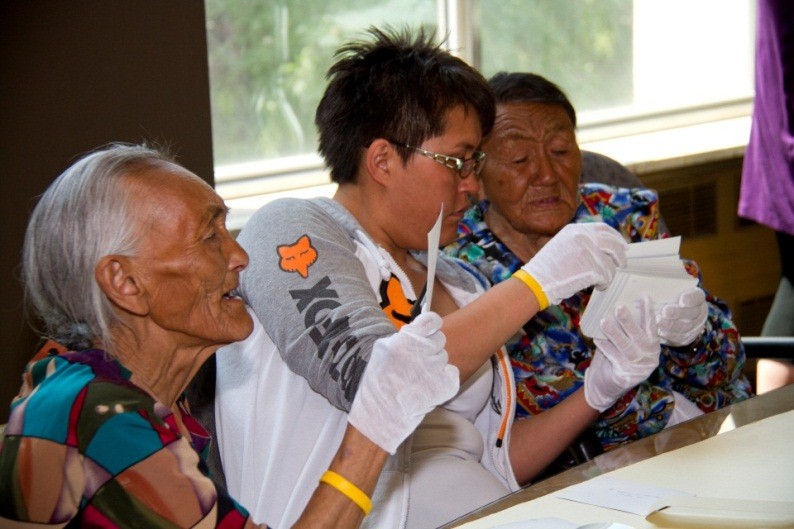
Elder Eva Muyunaganiak (left), Louisa Gibbons (centre) and Elder Mary Nowtalik (right).

Elder Eva Muyunaganiak also discovered a photograph of her mother, Uyaupiak, dating from the late 1960s. Today, the remaining 22 Elders in the community of Arviat are the only ones able to recognize people and describe what life was like in photographs taken more than 50 years ago. Elder Muyunaganiak passed away in September 2012; her death reminds us of how time-sensitive an initiative Project Naming is.

Project Naming has now evolved into a broader community engagement initiative that has expanded beyond the territory of Nunavut to other Aboriginal communities in the Yukon, the Northwest Territories, Nunavik (northern Quebec) and Labrador. We hope to build upon this dialogue with members of Northern communities using new technologies and social media.

To learn more, listen to our Project Naming and Canada’s North podcast.

The Battle of the Atlantic (1940–1943)

Although the waters of the Atlantic witnessed many a naval battle throughout the Second World War, the longest and most important, the Battle of the Atlantic, reached its height between 1940 and 1943, pitting the Allies against the German navy and its formidable fleet of submarines, known as U-boats.

$90 Killed this U-BOAT! War savings stamps drive, 1943.

$90 Killed this U-BOAT! War savings stamps drive, 1943. Source

The Battle of the Atlantic’s crucial struggle was to protect the convoys of merchant ships against enemy German naval forces, which tried to block their way. Most of these convoys set out from North American ports and were bound for Great-Britain.

Convoy in the Bedford Basin, near Halifax, Nova Scotia, April 1, 1942.

Convoy in the Bedford Basin, near Halifax, Nova Scotia, April 1, 1942. Source

The Battle of the Atlantic saw U-boats penetrate deep into Canadian waters: the Royal Canadian Navy was actively involved in the battle, fighting fiercely to protect its merchant navy.

Freighter SS ROSE CASTLE, in convoy, torpedoed by U-boat, November 2, 1942, near Wabana, Newfoundland.

Freighter SS ROSE CASTLE, in convoy, torpedoed by U-boat, November 2, 1942, near Wabana, Newfoundland. Source

However, despite all efforts, enemy forces sunk over 70 merchant vessels, claiming the lives of over 1,600 Canadian crew members. Nevertheless, the Allies are considered to have prevailed in the Battle of the Atlantic since the Germans failed to stem the flow of merchant shipping convoys bound for Great Britain, which helped provide the supplies essential to the allied victory. Be sure to visit the Canadian War Museum for more information about this Second World War battle.

The Royal Canadian Navy’s contribution to this effort is well documented in the collection of Library and Archives Canada. Some suggestions and references for further research are provided below.

Since most convoys setting out from Canada departed from Halifax harbour, a large volume of records were produced by the Naval Control Service in Halifax. Documents available for consultation include the following:

Please visit our Flickr album for more photographs.

PS 8000 collection of early 20th-century digitized Canadiana

To mark Canada Book Day, we take a closer look at the PS 8000 collection of early 20th-century Canadian publications available in the Electronic Collection of Library and Archives Canada. PS 8000 is the standard classification for Canadian literature, one of the core strengths of our holdings.

To browse this collection

• Click “Search the Electronic Collection” on the left side of the screen
• Choose “Any keyword” from the drop-down menu in the first search box
• Enter “PS 8000” in the second field as the search term

This search produces a list of pre-1926 Canadian publications that have been digitized and are accessible online. Other key terms can be used to further refine the search (e.g. world war and poetry).

Figure 1: Search screen for Electronic Collection

Figure 1: Search screen for Electronic Collection

For other online resources, consult our blog articles on how to find digitized publications Part I and Part II.

Also, explore our Flickr album for a selection of cover images of these publications.

Yesterday Once More: Canada’s Music Industry in Portraits

Do you have a favourite popular musician or rock group from the last three or four decades of the 20th century? There’s a good chance you’ll be able to find their photographs documented in the Library and Archives Canada (LAC) Portrait Portal.

The Portal contains photographs taken between 1963 and 2000, selected from LAC’s RPM fonds, an archive that includes thousands of Canada’s and the world’s most popular artists and bands. It also features actors, music and entertainment executives, broadcasters, politicians and sports figures rubbing shoulders with music industry greats. These portraits have been digitized and added to the Portrait Portal as part of LAC’s ongoing digitization initiatives.

What is the significance of the RPM archive to the Canadian music industry?

Founded in Toronto in 1964, RPM was a Canadian weekly trade publication that focused on the Canadian music recording and radio industries. In 1964 it established the RPM Gold Leaf Awards (also referred to as the Maple Leaf Awards), which would soon evolve into the JUNO Awards. RPM was among the parties that lobbied for Canadian content regulations in the broadcast media, and it inaugurated the RPM MAPL logo (with MAPL standing for music, artists, production, lyrics) that has been widely used to identify the Canadian content of commercial sound recordings. The periodical ceased publication in 2000.

According to Cheryl Gillard, a Library and Archives Canada music specialist, the collection of RPM photographs, now available online through the Portrait Portal, “allows anyone, anywhere to take a behind-the-scenes look at the inner workings of the music industry. Also, for the first time, the Portal’s collection of RPM photos allows less high-profile but historically important Canadian music professionals to be documented and honoured.” This collection showcases Canadian popular culture and reflects the interconnection between the music industries in Canada and the United States.

You can search for photographs of popular musicians in the LAC Portrait Portal simply by entering the name of your favourite band or musician into the keyword search field.

For more information about Canada’s music industry, check out LAC’s RPM database, which contains the digitized versions of the music charts in RPM Weekly from 1964 to 2000. The Canadian Academy of Recording Arts and Sciences (CARAS) website is also a great place to search for a list of past JUNO award recipients—and more!

Battle of Vimy Ridge – April 9 to 12, 1917

For Canadians, the Battle of Vimy Ridge brings to mind the joint effort of all of the Canadian units that fought together for the first time to achieve victory. In a way, it was our very first national military victory, and, as such, a tremendous source of pride.

In spring 1917, Allied Command tasked Canadians with the difficult mission of taking Vimy Ridge and driving back the Germans, who had controlled it almost continuously since the beginning of the First World War.

Barrage map [cartographic material]: [Vimy Ridge region, France]

Barrage map [cartographic material]: [Vimy Ridge region, France] (e000000540)

The Canadian officers spent weeks developing their tactical attack down to the last detail. The soldiers rehearsed their attack behind the lines using a model to represent the battlefield so they would be familiar with the terrain where they would be fighting. The role of the artillery was also meticulously planned in preparation for its famous “creeping barrage,” an artillery bombardment that pressed forward against the enemy at a timed pace as a curtain of fire ahead of the advancing troops.

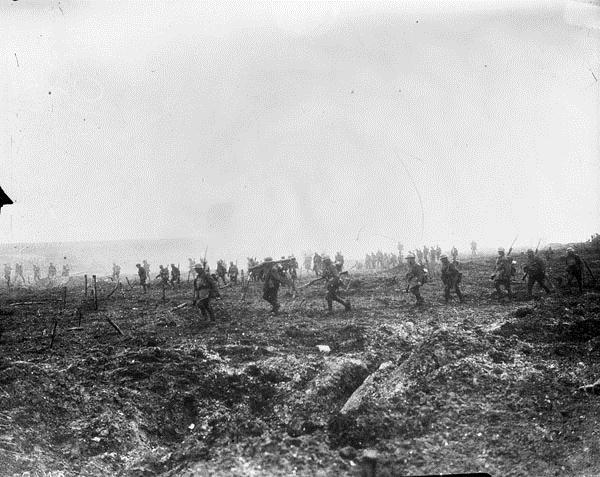
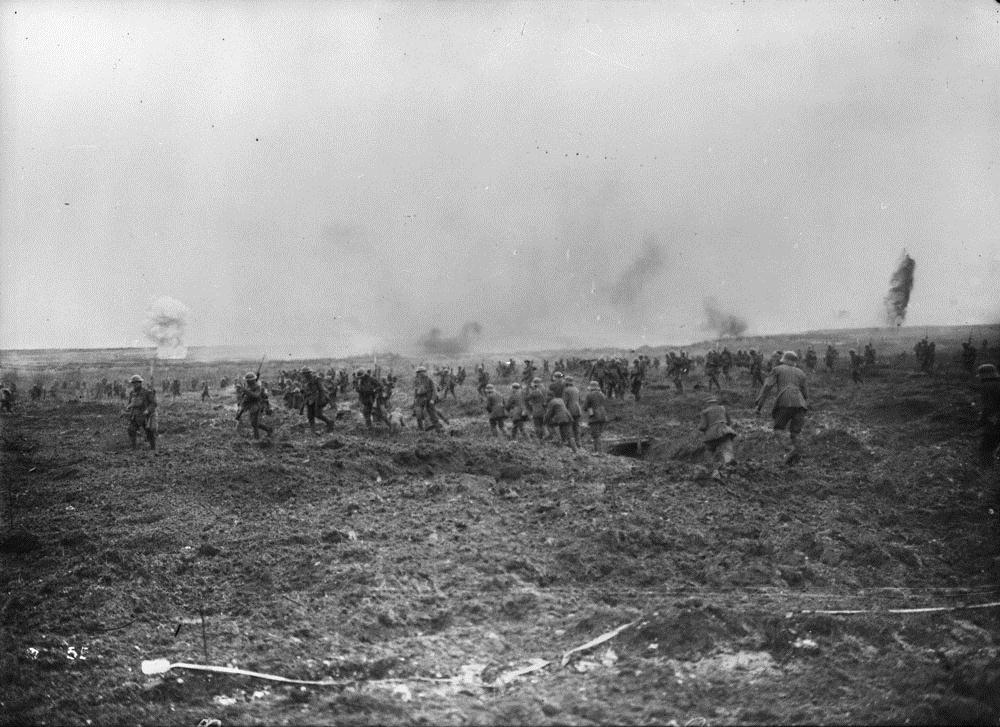
29th Infantry Battalion advancing into “No Man’s Land” through German barbed wire and heavy fire during the Battle of Vimy Ridge.

29th Infantry Battalion advancing into “No Man’s Land” through German barbed wire and heavy fire during the Battle of Vimy Ridge. (a001086)

The attack that ignited the Battle of Vimy Ridge was launched on Easter Monday, April 9, 1917, at 5:30 a.m. Four Canadian divisions overran the German positions, with three achieving their primary objectives in less than an hour. The highly-trained men were able to advance rapidly, thanks to the formidably effective heavy artillery fire. Nevertheless, the Germans offered fierce resistance: it took four days of heavy combat for the Canadians to finally seize full control of the famed Vimy Ridge.

The battle claimed the lives of 3,598 Canadian soldiers, with over 7,000 more wounded.

(W.W. I – 1914-1918) As the Canadians advanced, parties of Huns left their dug-outs, only too glad to surrender – Vimy Ridge. April 1917.

(W.W. I – 1914-1918) As the Canadians advanced, parties of Huns left their dug-outs, only too glad to surrender – Vimy Ridge. April 1917. (a001123)

Visit our Flickr album for more photographs.

Library and Archives Canada Announces the Opening of Two Exhibitions

Library and Archives Canada continues to display the richness and diversity of its collections with the opening of two exhibitions.

In Saskatchewan, the Mendel Art Gallery in Saskatoon is hosting the I Know You by Heart: Portrait Miniatures exhibition until June 2, 2013. The exhibition highlights the intimate, personal nature of portrait miniatures, and the reasons that such images are commissioned and created. Find out more about the conservation of these portraits on Library and Archives Canada’s YouTube video.

In Quebec, the Canadian Museum of Civilization in Gatineau is presenting the exhibition Double Take: Portraits of Intriguing Canadians until October 14, 2013. Discover portraits of Canadians who have left—and are still leaving—their mark on our country and our culture. Tune in to Library and Archives Canada’s podcast for an overview of the featured works and the stories behind them.

By presenting exhibitions such as these, Library and Archives Canada is able to make original works of documentary heritage accessible in galleries, museums and other community venues to Canadians across the country.

Keep following this blog to stay informed about upcoming events.

Access to Information and Privacy legislation or Donor restrictions and how they affect your access to our collections

Did you know that both government and non-government records held in the archival collections of Library and Archives Canada (LAC) are subject to access restrictions?

For federal government records, the Access to Information Act gives Canadian citizens the right to access information. It is also important to note that, in Canada, there is no “30-year rule” that applies to government documents, even if such rules exist in other countries.

For archival fonds or collections donated by private individuals, there will often be restrictions on research access. These are sometimes called “Donor restrictions.”

For access to both federal government records and documents donated by private individuals, legal mechanisms are involved and must be respected without exception.
So when you need to consult restricted material at LAC, you must factor into your project deadlines the time required to process your request. Processing time will vary based on the request and the materials involved.

For more information on restrictions and how to request access, please consult the Discover the Access Codes for Archival Records at Library and Archives Canada Part I and Part II pages on our blog.

Jehane Benoît, grande dame of Canadian cuisine

Long before the arrival of specialty channels and “trend” gourmet publications, Jehane Benoît, grande dame of Canadian cuisine, helped train whole generations of cooks through her books and radio and television programs.

With training from the Cordon Bleu in Paris and a degree in food chemistry from la Sorbonne under her belt by the age of 21, Jehane Benoît didn’t take long to make her mark on the food scene in her native Montreal. Around 1933, she founded Montreal’s Salad Bar, one of the first vegetarian restaurants in Canada, and she opened the very first secular cooking school in Quebec, Le Fumet de la vieille France, where she taught thousands of students over nearly ten years.

In 1941, she published her first cookbook, Chocolate Around the Clock, which was followed by more than thirty other publications throughout her career, including the iconic Encyclopedia of Canadian Cooking, which to date has sold over two million copies. Starting in 1943, Ms. Benoît also became a well-known radio personality by appearing on various successful programs, including Radio-Canada’s Fémina. Her fame spread with her television debut around 1952, as she become a regular on various shows such as Femme d’aujourd’hui on Radio-Canada and Take 30 on CBC.

A woman ahead of her time, Ms. Benoît readily integrated new technologies in her cooking, becoming an early adopter of the microwave oven. She was a long-time promoter and spokesperson for microwave cooking, and wrote a series of cookbooks with specially adapted recipes. For her contribution to the culinary arts in Canada, Ms. Benoît was awarded the Order of Canada in 1973.

Library and Archives Canada invites you to read the article on Jehane Benoît in the Bon appétit! virtual exhibit (archived website) to learn more about this remarkable woman. And be sure to find out about the published works of this grande dame of Canadian cuisine!

Bon appétit!

Spotlight on theatre posters

Library and Archives Canada (LAC) has an extraordinary collection of posters promoting theatre in Canada from the 19th century to the present day. These posters are found in a wide variety of private and public archives and collections, including those of Vittorio, Theo Dimson, Guy Lalumière et Associés Inc., Normand Hudon and Robert Stacey.

Theatre posters also feature in the archives of such Canadian personalities as Marshall MacLuhan and Sydney Newman, and even in collections of old documents—for example, the theatre playbills printed on board the ships in the expedition in search of Sir John Franklin (around 1850-1853).

In addition, we must mention the archives of various theatre and stage artists and professionals (Gratien Gélinas, Jean Roberts and Marigold Charlesworth, John Hirsch and others), and of artistic and cultural institutions such as the National Arts Centre, Theatre Canada, the Magnetic North Theatre Festival, the Globe Theatre and the Stratford Festival.

But the real treasure trove of theatre posters can be found in the “Posters” series of the performing arts collection, which comprises about 750 posters and programs, and in the miscellaneous poster collection, which includes about 3,170 posters.

You might say that theatre posters play a starring role at LAC!

For sample posters, please see our Flickr album.

Questions or comments? We would love to hear from you!

Journée internationale de la Francophonie

March 20 is an important date for both Francophones and Francophiles, as it marks the birth of the International Organisation of La Francophonie (IOF)—originally the Agency of Cultural and Technical Cooperation (ACTC)—at the Niamey Conference in Niger, in 1970.

Some 21 countries were involved in the founding of this institution, whose members include the federal government and the governments of Quebec and New Brunswick. In addition to its language-related activities, the intergovernmental organization also promotes cultural and technical cooperation among its members.

The 1987, 1999 and 2008 summits, the 2006 Ministerial Conference and the 2001 Games of La Francophonie*—all held in Canada—clearly demonstrate the importance our country places on La Francophonie and the IOF. A number of archival documents from the collection of Library and Archives Canada (LAC) are further evidence of this support. For example:

• Several philatelic records highlight the significance of La Francophonie. The collection includes 14 commemorative postage stamps created in its honour, 9 of which can currently be viewed online. One of the stamps marks the 25th anniversary of the ACTC, the first international Francophonie organization;

• The Fonds Jean-Louis Roy at LAC contains several ACTC-related records, including speeches and media clippings, administrative records and administrative correspondence. These documents must be consulted on-site, at 395 Wellington St., Ottawa.

*These are available in French only.