Guide to DIY personal military displays

Version française

By Sacha Mathew

Did you know that you can easily make your own military heritage display by using the tools and digitized records found on the Library and Archives Canada website? Using the display we presented at a recent event as an example, I’ll show you step-by-step how you can make your very own display at home or at school.

Library and Archives Canada held a hugely successful Open House event in May, welcoming more than 3000 visitors to our Gatineau facilities and allowing them to enjoy an opportunity to view treasures in our vaults.

This small display of photographs and textual documents from our military collection was very popular. It had a personal touch, and many visitors asked us how we selected the records to display.

Overhead view of glass display case containing military photos and textual documents.

Military display used during LAC Open House event. Image courtesy of Alex Comber, archivist.

Your display can easily be tailored to present a person, an anniversary or a specific military unit. In our case, we wanted to highlight the 100th anniversary of the Royal Canadian Air Force (RCAF) taking place this year. That was our starting point.

Next, we needed to narrow our focus to make it easier to tell a story. Records give facts, but they don’t tell a story — that’s where interpreting the records comes in. Since the event was in Gatineau, we thought the public would be interested in exploring the personal stories of servicemen from the local area. We started by choosing the 425 “Alouette” Squadron, an RCAF unit. This is a French-Canadian bomber squadron established at the outbreak of the Second World War. By researching the 425 Squadron personnel roster and cross-referencing it with a list of RCAF casualties provided by the RCAF Association, we were able to find two local airmen: one from Montreal and the other from Ottawa.
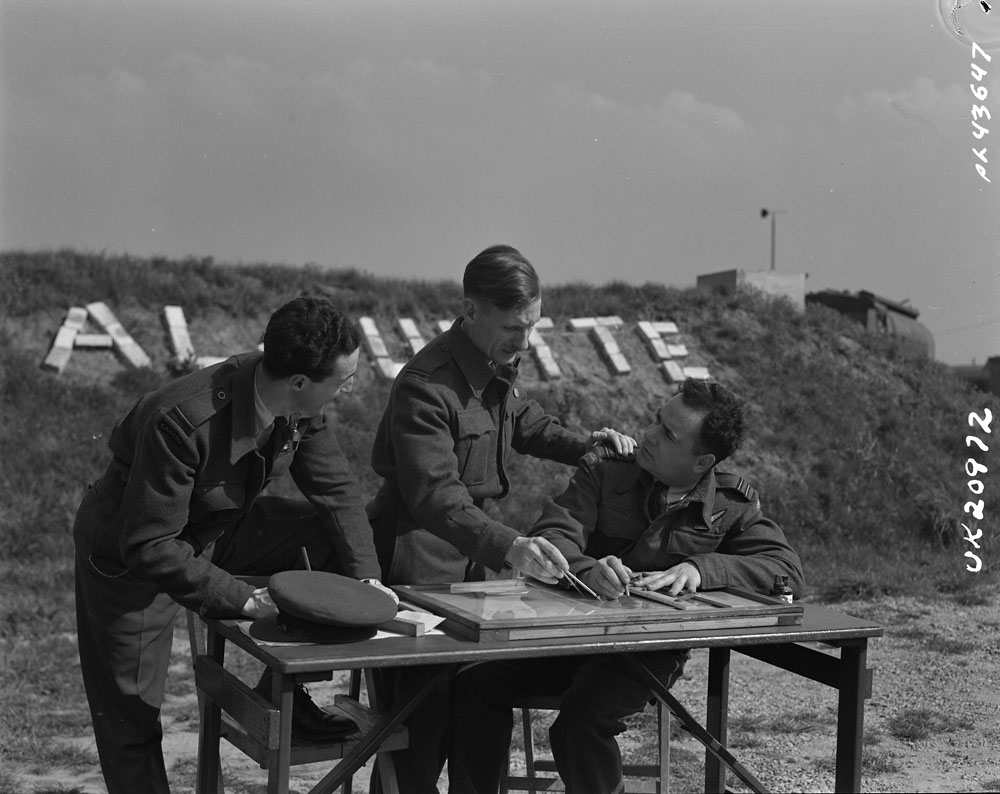
By an English airstrip, three Air Force officers planning while looking over a table with maps.

Pilot Officer J.W.L. Tessier; Pilot Officer J.A. Longmuir, DFC (Distinguished Flying Cross) of the Royal Air Force, attached to the Alouette squadron as Bomber Section Training Officer; and Flight Lieutenant Claude Bourassa, DFC, Commander of the French-Canadian squadron’s bomber section. 425 Squadron. 24 April 1945, PL-43647, e011160173.

For our display, we looked for specific individuals to feature in our display, which can also be done for local service members from your community or school. Choosing an individual is even easier if you are making a display for a family member, since you may already have someone in mind.

Once you’ve chosen an individual, you may look for their military personnel file. This file provides a tremendous amount of information and includes personal details (ever wonder what your great-grandfather’s address was in 1914?). The file can be easily found on the LAC website. However, it should be noted that not all records are open to the public and available online. All personnel files for the First World War are open and have been digitized (First World War Personnel Records), but only “War Dead” files are available online for the Second World War. “War Dead” refers to members that died during the war (Second World War Service Files – War Dead). Other Second World War and post-Second World War service files can still be obtained, but they must be requested through an Access to Information and Privacy request (Records you may request).
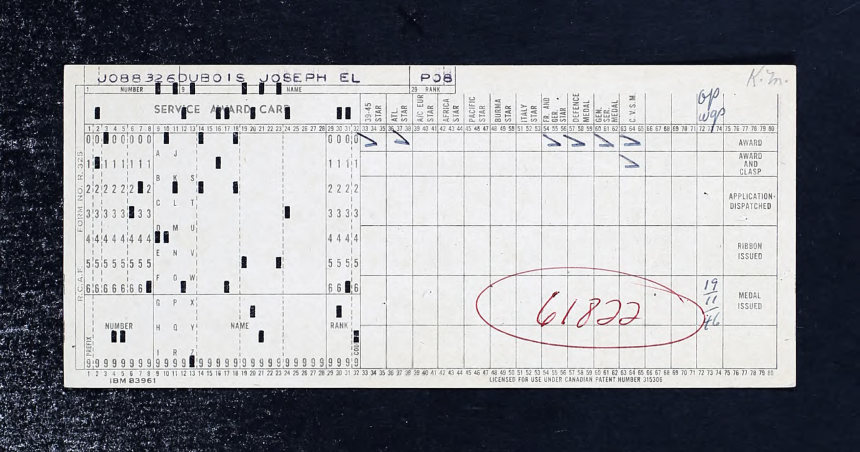
Now that you have the service file, you can decide what you want to display. For our display, we were limited by the size of the display case. If you have more space, you can pick as many documents as you like. You’ll find a variety of documents in the service file. For our airman, Pilot Officer (PO) J. Dubois, we selected a few documents that we found interesting: a letter of recommendation from his employer (T. Eaton & Co), his attestation papers, his medal card, his pay book, official correspondence with his parents in French and the report on his death. You can scroll through and read the digitized service file, then choose what you’d like to feature. Please remember to cite your sources, including reference numbers for archival documents.

As mentioned, interpreting the records you find can help you tell a story rather than just display your research. In the case of PO Dubois, we looked to his squadron records from the day he died, and we were able to better understand the circumstances of his final flight. Each of the three services has an official unit journal of their daily actions. They are called “War Diaries” for the Army, “Ship’s Logs” for the Navy and “Operations Record Books” for the RCAF. The personnel file gives you biographical information, and the unit journal gives you the context. The journal allows you to understand how the individual fits into the unit’s operations. You would interpret the documents by examining them together, giving you a much broader picture. That picture is the story, which you could write up or present orally.

The only thing remaining is to add some photos to make the display more visually compelling. You may find the member’s photo in the service file, but this is not common for files from the World Wars. To find photos, I suggest setting Collection Search to “Images”. Here you can search by the unit designation and choose a few photos that are appropriate to the time frame that you are looking at. For our display, we easily found a few photos of 425 Squadron in England during the 1940s. Like the textual documents, it is important to give accurate photo credits for any photographs used in your display.
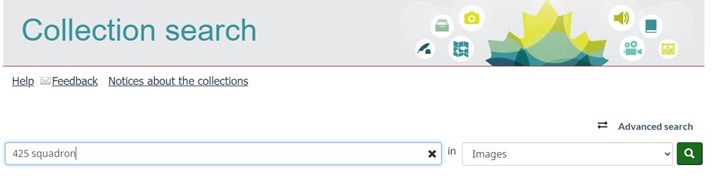
A screen capture from the LAC website showing the search bar set to “Images”.

Collection Search, LAC website.

By using the tools and resources from LAC’s online collection, you can make your own custom display for an individual or for a unit. It’s your choice how you’d like to present your display: you can print copies of documents and photos to make a framed display or scrapbook, or you can make a digital presentation. Making a display is an excellent way to connect with ancestors by learning about their lives, and it allows people to explore Canadian military heritage in a personal way. It is also an excellent research exercise and would prove a wonderful Remembrance Day project for young students.


Sacha Mathew is an archivist in the Government Archives Division at Library and Archives Canada.
The Ancient Art of Archery

Version française

By Dylan Roy

This article contains historical language and content that may be considered offensive, such as language used to refer to racial, ethnic and cultural groups. Please see our historical language advisory for more information.

Archery, like most other sports or physical endeavours, can teach an individual many things, including discipline, perseverance, patience and focus.

I began my archery saga very recently and, despite my obvious inadequacies in the sport, I have had a great time learning about its various intricacies. This newfound hobby led me to scour the published and archival collection at Library and Archives Canada (LAC) to see what could be found about the bow and arrow.

Lo and behold, there was a plethora of books to read and many interesting archival materials to choose from. Like Robin Hood of yore, I shall share some precious gems from the rich resources we have at LAC.

First, if you were ever stuck on where to start for archery, there are many beginner guides and archery club-endorsed publications available. One of my personal favourites, due to its charm and whimsical cartoon art style, is the book Archery is fun! This book is mainly geared towards children, but it can also teach adults the basics of archery. With this swell book, you’ll be shooting arrows like Katniss in no time!

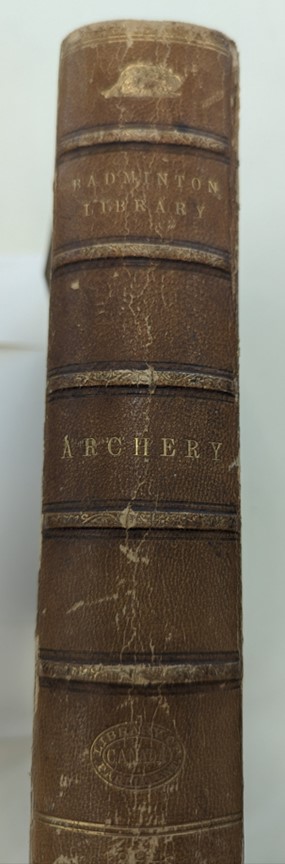
Second, as noted in the title of this blog, archery is an ancient art. To learn about the history of archery, why not use a book that was written over a century ago? Archery, by C.J. Longman and Henry Walrond (published in 1894), is a wonderful piece of literature to learn about archery’s ancient roots. Moreover, the book can enable you to understand the shifting thought patterns and language of authors writing over a hundred years ago.

The spine of an old-fashioned book with the title “Archery” printed in the middle.

Spine of the book Archery by C.J. Longman and Henry Walrond. (OCLC 342853)

According to Longman and Walrond, only hunting “can lay greater antiquity than archery.” The archaic allure of archery is one of the things that attracted me to the sport. It’s fun to think that, long ago, our far-distant ancestors were most likely taking part in archery in much the same way as we do today. This intriguing sport connects us with the past through actions in the present.

Longman and Walrond also included a quote in their book from a Hindu poet, which can be seen below:

“May the bow bring us spoils and oxen, may the bow be victorious in the heat of the fight; the bow fills the foe with terrible fear, may the bow give us victory over the world.”

This poem demonstrates the importance of archery and the impact that it has had on human civilization. The unknown poet declares that with the bow, humans may ultimately be victorious over the earth itself—thus indicating the sheer power associated with archery.

The book also provides lovely illustrations of some prehistoric arrowheads, which can be seen below:

Black-and-white illustrations of five arrowheads with a description under each of the drawings.

Five different prehistoric arrowheads found on page 19 of the book Archery. (OCLC 342853)

Many societies have held archery in high regard and many deities have been associated with it, especially in relation to hunting, such as the Greek goddess Artemis.

With the history of archery behind us, I will now share some sources that provide insight on how to get in shape for archery. You’ll be looking buff like Hawkeye in no time!

Floyd W. Johnson’s Fitness for Archery is a wonderful read for anybody looking for some pointers on the types of exercises that facilitate archery. Johnson advises that there are four main criteria needed for fitness as an archer: aerobic capacity (or stamina), flexibility, strength and relaxation.

According to Johnson, “aerobic capacity is the maximum amount of oxygen that can be taken into the blood and delivered to the muscle. Flexibility is the range of movement in a joint or series of joints (spinal column). Strength is the capacity of a muscle to exert force against a resistance.” Finally, relaxation is important because “archery is a sport which demands full mental and physical concentration at all times.” Therefore, if one wishes to practice archery, it is crucial to address all four of these fitness priorities.

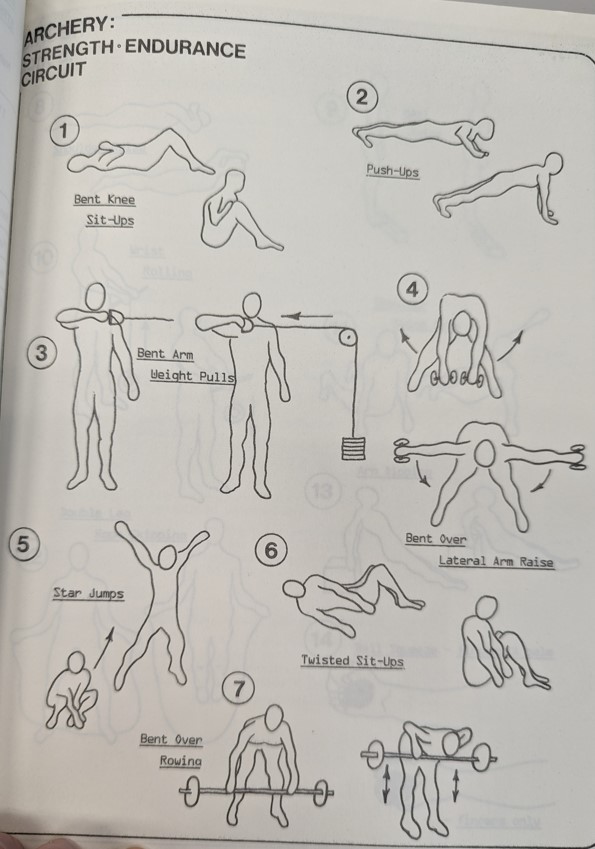
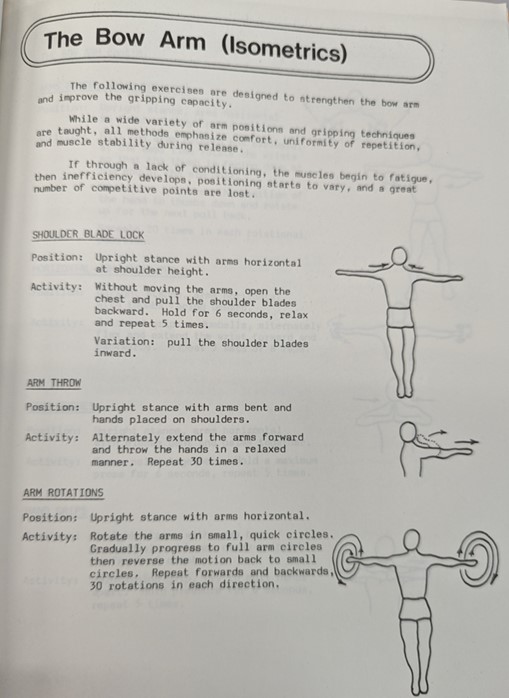
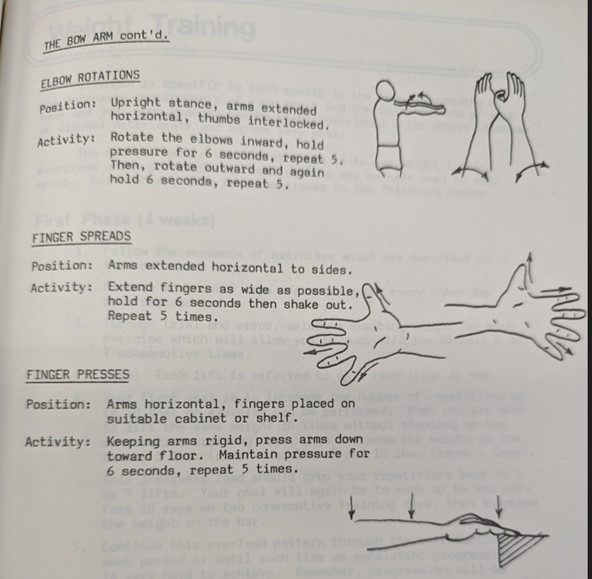
Johnson also supplies the reader with several exercises to enhance one’s fitness, which you can see in the images below:

Page titled “Archery: Strength–Endurance Circuit” with illustrations of figures showing how to do seven exercises.

Seven different exercises for building strength and endurance, including bent-knee sit-ups, push-ups, bent-arm weight pulls, bent-over lateral arm raise, star jumps, twisted sit-ups and bent-over rowing. (OCLC 15918112)

Page titled “The Bow Arm (Isometrics)” with instructions and illustrations of figures doing the exercises described.

Three different exercises for bow arm isometrics: shoulder blade lock, arm throw and arm rotations. (OCLC 15918112)

Page titled “The Bow Arm cont’d” with instructions and illustrations of figures doing the exercises described.

Three other exercises for bow arm isometrics: elbow rotations, finger spreads and finger presses. (OCLC 15918112)

By including these exercises in your regimen, you’ll be fit enough to surf down a flight of stairs on a shield while shooting arrows, just like Legolas!

Although our published section provides a vast array of content concerning archery, we also hold many records about archery in our archival holdings.

A good fonds to consult is the Federation of Canadian Archers fonds. This fonds contains a multitude of records concerning the federation. Researchers can garner a wide array of information by consulting the sections found under “Record information – Details.” For example, the “Scope and content” section conveys the following information:

Fonds consists of publications, bulletins, minutes and correspondence; competition records; finances, membership, history; instructional programmes, rules; scrapbooks; athletes’ files; president’s files.

Photographic material depicts various Canadian archery championships and activities of the Federation of Canadian Archers, 1949–1972. Medallic objects consist of six competition medals (1966–1971), and one 1969 Federation of Canadian Archers pendant. Maps contain plans of the competition sites in Montréal and Joliette during the 1976 Summer Olympic Games.

Something interesting I learned from the “Biography/Administrative history” section—also located under the “Record information – Details” header—was the fact that the first time Canada competed internationally in archery was in 1963 at the world championships in Helsinki!

Aside from this fonds, I located many photographs of archery that are available entirely online in our archival holdings. You won’t need to scour the physical records for these!

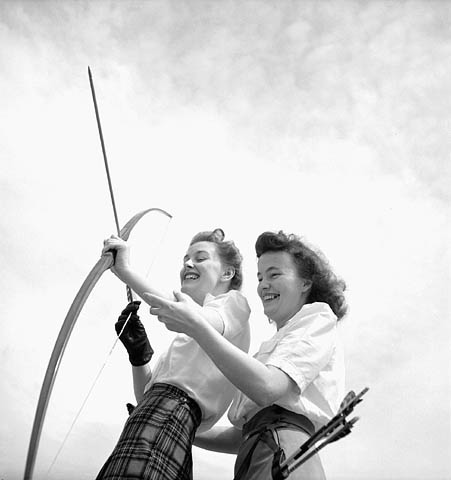
Some of our photographs show how much a delight archery can be, such as the photograph below:

One woman holding a bow and arrow while another woman with arrows in her pocket helps her with her form.

Two women participating in archery while smiling. (e000762820)

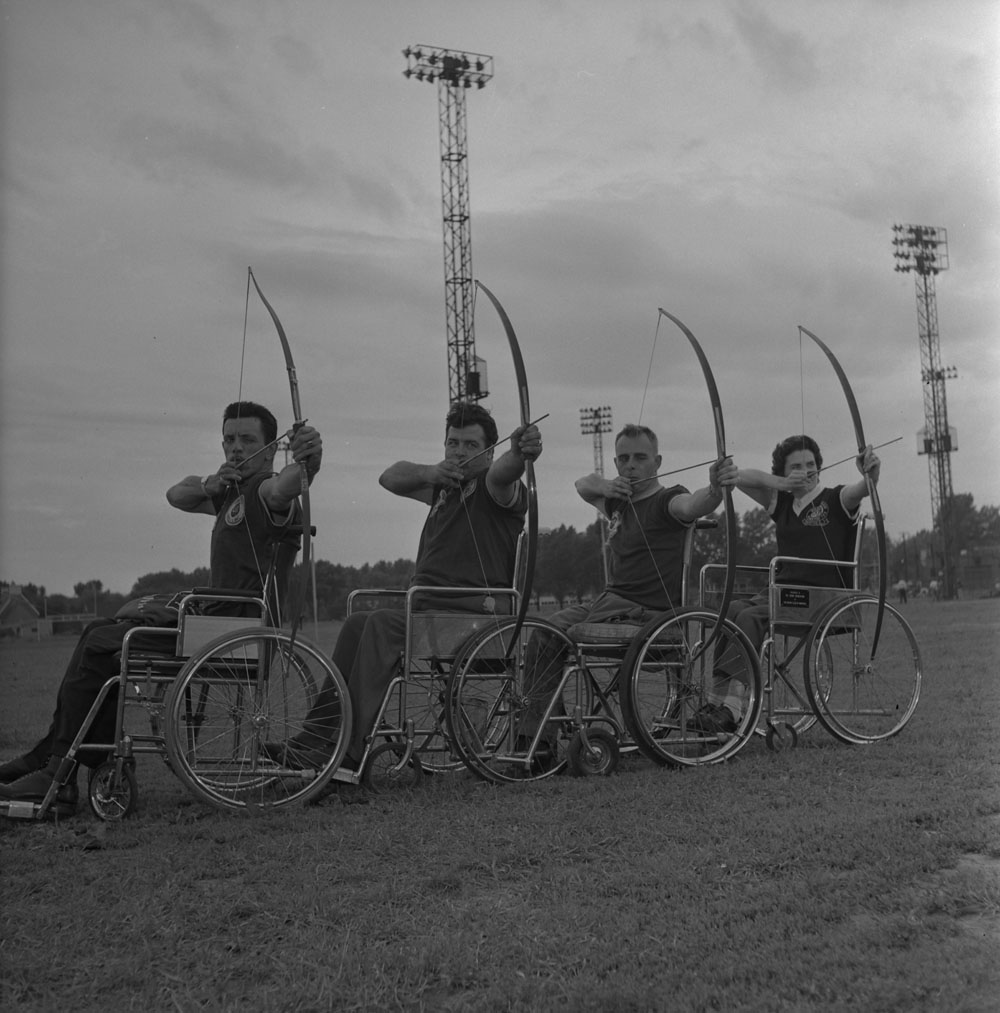
Other photographs demonstrate that archery is practiced by a wide variety of individuals—for example, wheelchair archery is a prominent part of the Paralympics:

Three men and one woman in wheelchairs in position to shoot their arrows.

Four Canadian Paralympic archers in a field. Left to right: Pierre Brousseau, Roch Poirier, Jean Rochon, Thérèse Tourangeau. (e011176636)

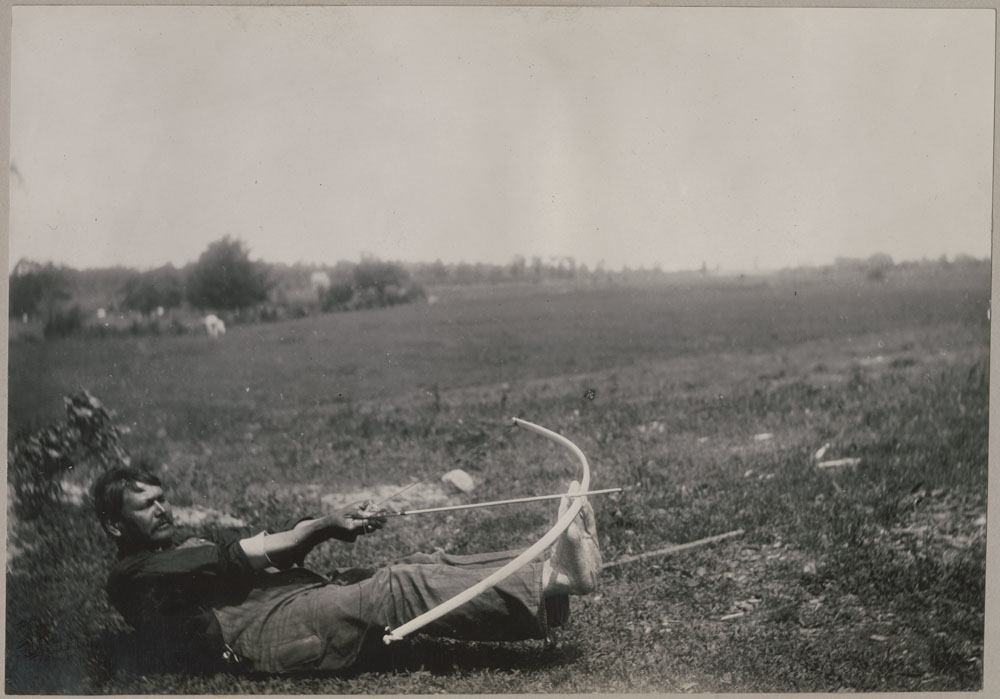
Some of our photographs demonstrate some remarkable archery techniques, like the one below wherein the archer is drawing the bow while holding it with his feet—let’s see Robin Hood do that!

A man preparing to shoot an arrow holding the bow string with his hands and bracing the bow with his feet.

Archer John Jamieson Jr. drawing a bow with his feet while lying down. (e011310538-037_s3)

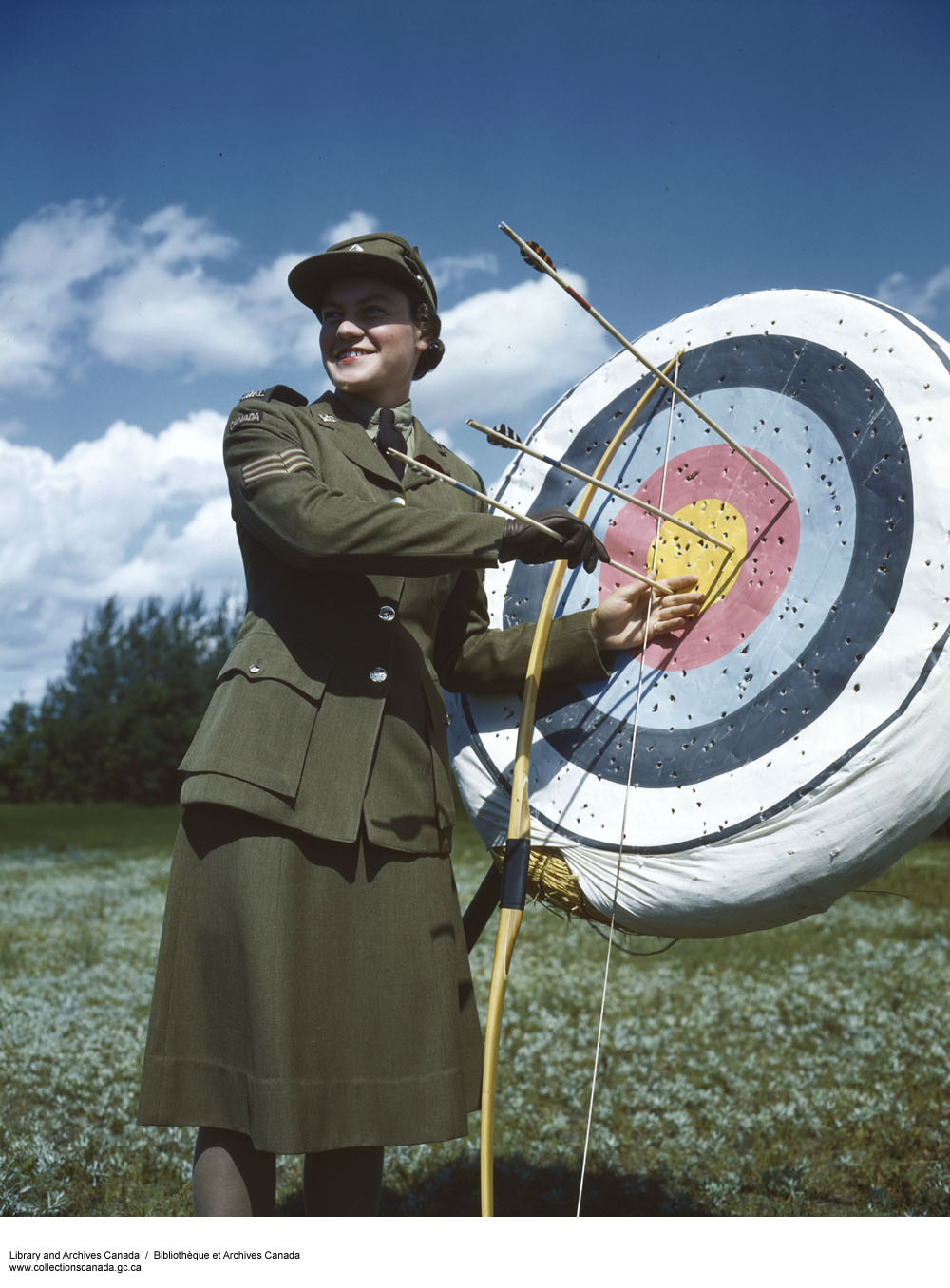
During my search, I noticed that we had several pictures of military service women practicing archery. The photograph below shows a Canadian Women’s Army Corps (CWAC) member next to a target, demonstrating that they were indeed a force to be reckoned with!

A woman in military uniform taking an arrow out of a target while holding her bow.

CWAC archer in front of target. (e010778805)

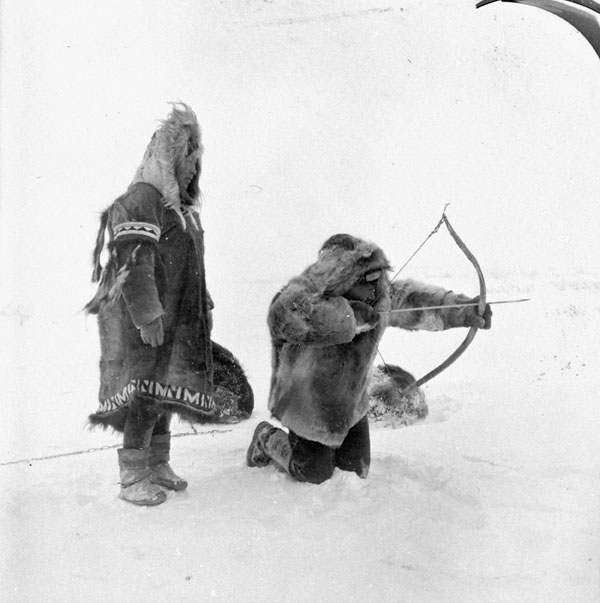
Throughout my hunt for archery photographs, I came across some offensive language that I think is important to highlight as it is an unfortunate part of LAC’s archival history, such as the original title of the photograph below:

Man kneeling on snow in position to shoot his bow and arrow, with a woman standing behind him.

Inuk man using a bow made of muskox horn as his wife watches. (a211284)

Archival descriptions such as the one above reflect historical language and content that may be considered offensive—for example, language used to refer to racial, ethnic and cultural groups.

Items in the collection, their content and their descriptions reflect the time when they were created and the views of their creators. The items retain their original descriptions to ensure that attitudes and viewpoints are not erased from the historical record. LAC provides additional descriptive information to give background on such records. This is an ongoing process.

If you see records with inappropriate language or content that you think LAC should review, please contact us at reference@bac-lac.gc.ca.

Archery is a sport that requires many faculties to perform well. Although it can be frustrating at times, it is so rewarding to see the arrow strike the centre of a target and to hear that triumphant *thump* as the arrow penetrates its target.

I hope you enjoyed looking through some of the archery-focused holdings we have at LAC, and I hope it inspires you to get out there and try your hand at the ancient art of archery.


Dylan Roy is a Reference Archivist in the Access and Services Branch at Library and Archives Canada.

Potato Biscuits from 1917: How the Housekeeper May Help to Save the Country’s Wheat Supply

Version française

Cooking with Library and Archives Canada bannerBy Ariane Gauthier

Canada joined the First World War on August 4, 1914, alongside Great Britain and the rest of the British Empire. What began as a mobile war quickly turned into a static one, with the entrenchment of the Allied and Entente armies. By 1915, the momentum that had previously animated early fighting had vanished, leading to a grueling war of attrition in the trenches across Europe and the Mediterranean.

The devastation of Europe’s countryside reduced accessible food supplies, a situation that was made worse by the arrival of unprecedented numbers of soldiers mobilized from all corners of the world. Great Britain was quick to marshal the resources of its empire, hoping to fuel its war effort. Canada contributed by supporting troops overseas through its agricultural and industrial output, but it wasn’t enough. Soon, all levels of government had to consider other means of bolstering aid, ultimately settling on rationing key resources.

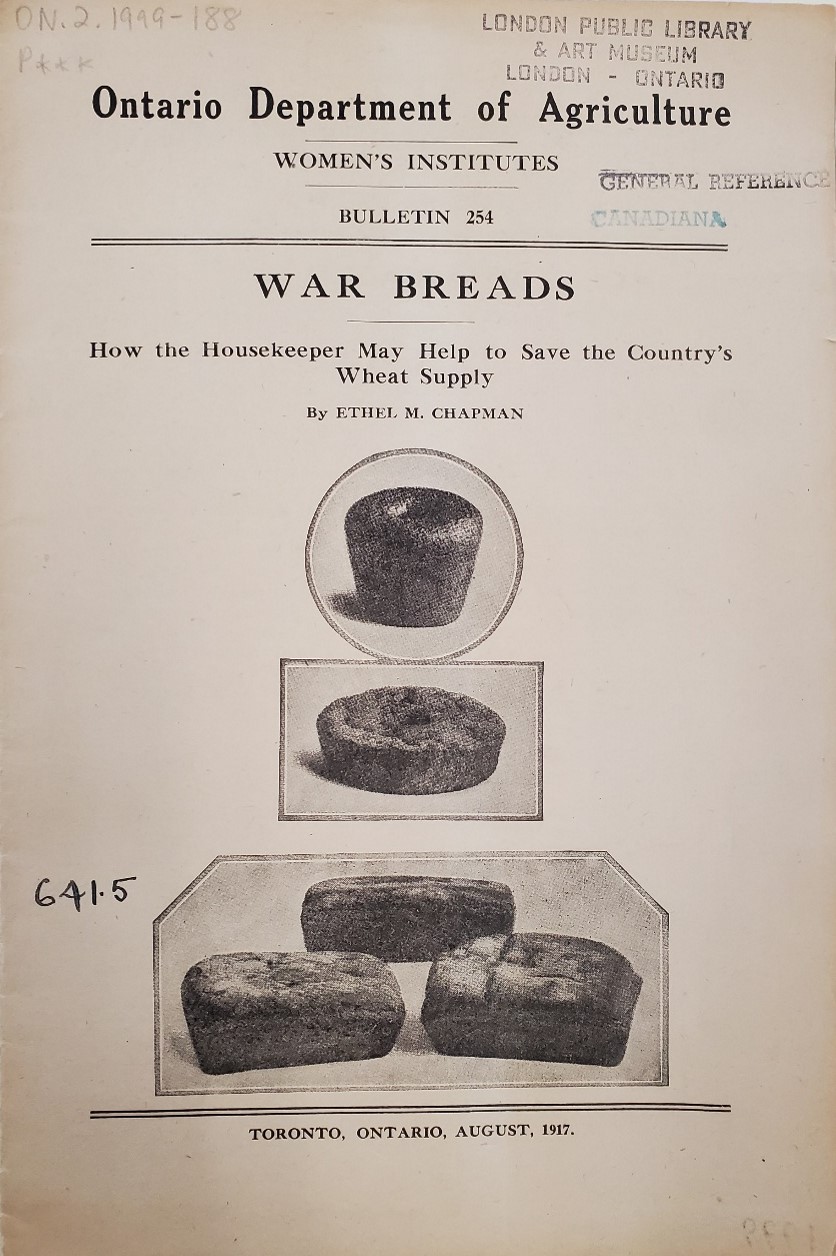
By the third year of the war, wheat was becoming scarce. Anticipating a ration order, the Ontario Department of Agriculture published the pamphlet “War Breads: How the Housekeeper May Help to Save the Country’s Wheat Supply” in August 1917, claiming that “every pound of flour saved means more bread for the army.” However, it admitted that its suggested wheat flour substitutes wouldn’t necessarily yield tasty breads or biscuits: “The constant use of these coarser breads might not agree with some people, but as a rule they will be found more healthful than the finer white bread.”

Cover of a pamphlet with photos of different types of breads.

Cover of the pamphlet “War Breads: How the Housekeeper May Help to Save the Country’s Wheat Supply” (OCLC 1007482104).

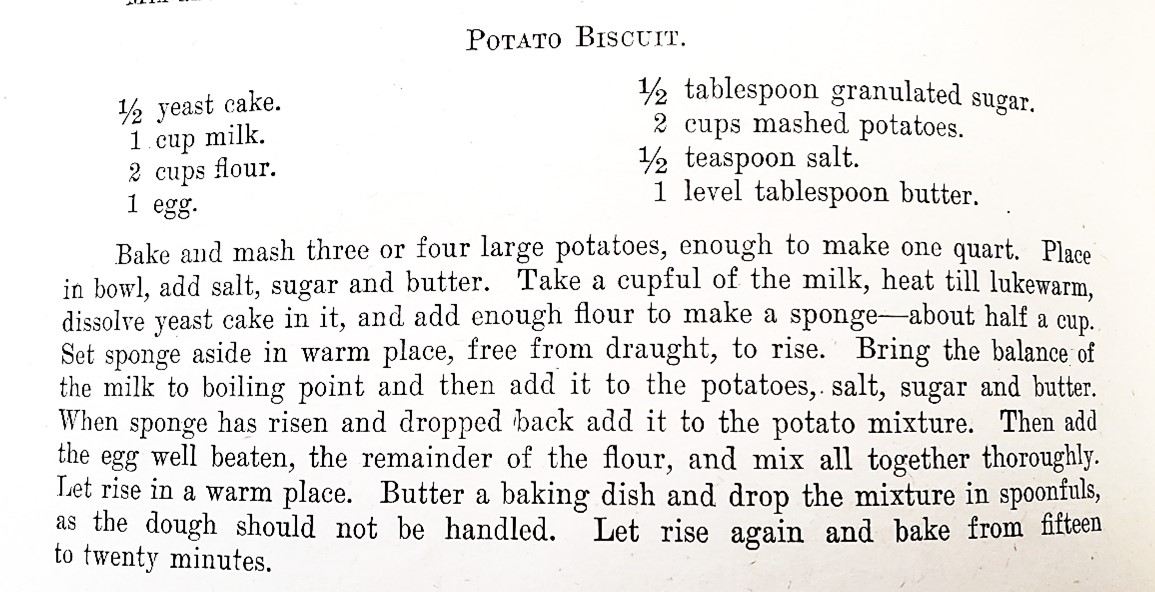
Intrigued by this unique pamphlet, I chose a recipe that might give me a taste of a housekeeper’s patriotic efforts: potato biscuits. Having enjoyed potato breads and donuts before, I felt hopeful.

Recipe for potato biscuits including ingredients and instructions.

Recipe for potato biscuits from the pamphlet “War Breads: How the Housekeeper May Help to Save the Country’s Wheat Supply” (OCLC 1007482104).

I only glanced at the recipe’s ingredients initially. They seemed adequate, but as I started assembling the potato biscuits, the meager half tablespoon of granulated sugar and single tablespoon of butter made it clear that these biscuits might end up bland or very yeasty. Given the war-era context, this wasn’t entirely surprising—wheat flour wasn’t the only ingredient being rationed.

Photo of baking ingredients: yeast, three potatoes, butter, one egg, milk, sugar, and flour.

Ingredients for the potato biscuit recipe. Photographer: Ariane Gauthier.

First, I assembled my ingredients. Strangely, the recipe called for baking the potatoes instead of boiling them. Perhaps this was to control the moisture content. I heated the oven to 400°F and baked the potatoes for 45 minutes to an hour until they were fork-tender.

Top photo shows three potatoes in a pan lined with parchment paper in an oven. Bottom photo shows roughly mashed potatoes in a bowl.

Potatoes baked in the oven and then peeled and mashed. Photographer: Ariane Gauthier.

While the potatoes baked, I prepared the yeast mix. Unable to find cake yeast, I used bread yeast instead. I mixed lukewarm milk with the yeast and some flour, setting it aside until it bubbled and rose.

Photo of yeast, flour and milk mixed in a cooking dish.

Yeast, flour and milk mix. Notice the myriad of bubbles produced by the yeast as it froths. Photographer: Ariane Gauthier.

I mashed the potatoes and mixed them with salt, sugar, butter, and boiling milk until smooth. I added the yeast mixture, the egg, and the remaining flour. By this point, the oven had cooled slightly, making it an ideal spot to let the dough rest and rise.

Five photos illustrating various steps of mixing ingredients together to make dough.

Making the potato biscuit dough. I vigorously mixed the ingredients at every step to ensure everything was as uniform as possible. Photographer: Ariane Gauthier.

The dough was gloopy, much to my surprise. With such little liquid compared to the dry ingredients, I hadn’t expected this. Taking the recipe’s warning to heart, I avoided handling the dough and used spoons to scoop it into a buttered muffin tin.

Four photos of various stages of mixing and handling dough, including picking up the raised mix with a spoon and spooning into a muffin pan.

The dough mixture before and after rising for a few hours in a warm place. As the recipe indicated, it was very gloopy and could not be handled by hand. Photographer: Ariane Gauthier.

As seems to be the custom with these old recipes, the recipe didn’t specify the oven temperature for baking, so I settled on 400°F and watched closely as the potato biscuits baked for 15 to 20 minutes until golden.

Photo of a plate with four potato biscuits. One potato biscuit has strawberry jam spread on it, another one is filled with berries, and the other two are plain.

The completed potato biscuits. The one on the left has been garnished with jam. I decided to add berries to another on the right before baking. Photographer: Ariane Gauthier.

And voilà! What do you think?

The strong yeast smell hit me as soon as I pulled the biscuits from the oven. As for the flavour? Shockingly bland. Luckily, I had some traditional strawberry jam on hand, which saved the day (thanks mom and dad!). These potato biscuits were better as a jam vehicle than a standalone treat.

As per my tradition, I took the biscuits to work and offered them to my colleagues. Never have I made such polarizing food! They either loved it or hated it; no one was neutral. So, if you’re feeling adventurous or just want a taste of history, give these potato biscuits a try—and don’t forget the jam!

If you try this recipe, please share pictures of your results with us using the hashtag #CookingWithLAC and tagging our social media: FacebookInstagramX (Twitter)YouTubeFlickr and LinkedIn.

Additional resources:


Ariane Gauthier is a reference archivist with the Access and Services Branch at Library and Archives Canada.
A Grave Mistake

Version française

By James Bone

French inscription on Canadian postage stamps began in July 1908, appropriately in time for a series of stamps commemorating the three-hundredth anniversary of the founding of Quebec by Samuel de Champlain. However, bilingual postage stamps were not consistently issued until the commemorative series of June 1927, depicting subjects such as the Fathers of Confederation and the then not-yet opened new Centre Block of the Parliament Buildings, with equal prominence given to the French language. As the former federal Translation Service (now the Translation Bureau) provided translations for the text used on stamps, there was usually no problem with the French used. All that was to change with a small error in 1946, producing the first Canadian postage issued with a spelling mistake.

As aviation and air mail were still relatively new innovations at the time, air mail stamps were issued for customers willing to pay a premium for the service. Additionally, one could pay for special delivery service to expedite their mail. In July 1942, a stamp combining both air mail and special delivery services was issued, depicting a plane flying over Drummondville, Quebec. In September 1946, a new special delivery service air mail stamp was issued, this time depicting the brand-new Douglas DC-4M airplane flying over the Plains of Abraham and the Saint Lawrence River in Quebec City, with a tiny flaw that was about to make Canadian philatelic history.

Page of 3 columns by 5 rows of stamps with an airplane.

Detail of approved pane of Special Delivery stamps with spelling error (MIKAN 2222196).

Like with all postage stamps of the era, engravers working at a printing company, in this case Canadian Bank Note Company (CBNC) in Ottawa, adapted the design for this issue into a postage stamp-sized printing die. Prior to printing, proofs of the die and a sample pane of stamps were approved by both the printer and by the Post Office Department. The stamp was released to customers on September 16, 1946. As found in the archival records of the Post Office Department, only a few days later on October 1, Postmaster General Ernest Bertrand received a letter from J. A. Boissonneault of Quebec City. Boissonneault advised Bertrand that there was an error on the stamp: the French word exprès had been engraved with the wrong accent, the circumflex instead of the accent grave, rendered as “exprês” instead.

Close up of plane and the words below it: SPECIAL DELIVERY, EXPRÊS.

Detail of approved die proof with spelling error (MIKAN 2222194).

Boissonneault’s letter set off a storm of activity at the office of the Deputy Postmaster General (DPMG) under acting DPMG H. E. Atwater, who inquired after the stamp translator from the Translation Service, a certain Mr. Marier, to confirm if Boissonneault was correct. Marier inspected an enlargement of the die proof and confirmed the error. Atwater then wrote to CBNC Vice-President P. J. Wood for an explanation of how this happened, given that previous Special Delivery stamps were issued with the correct French. In turn, Wood replied to Atwater, apologizing for the error but also reminding him that the die proof had been approved by both CBNC and by the Post Office Department; the error escaping notice was, in fact, a shared responsibility. Wood suggested to Atwater that the die be altered to correct the error but also cautioned Atwater of the possible danger should the change be noticed and publicized. On October 5, Atwater authorized the modification of the die to correct the error, agreeing that, doubtless, it will be noticed by stamp collectors. On the same day, a reply was sent to Boissonneault, thanking him for drawing attention to the matter and assuring him that a correction would be made.

News of the error surfaced first in an article in the Ottawa Journal issue of October 7, 1946. In the article, A. Stanley Deaville, superintendent of the Postage Stamp Division, acknowledged awareness of the error and indicated that stamps with the error already printed and released for sale would not be withdrawn. Given that some 300 000 stamps had been printed with the error, it may have been too difficult to recall them. He also speculated that the left half of the offending circumflex may actually be part of the first e in the word delivery that appears above exprès – a statement which upon inspection does not stand up to scrutiny.

By October 8, CBNC had altered the engraved die and sent a new proof for approval to Atwater, which was accepted and returned on October 10. The corrected stamps went out for sale on December 3, 1946, with 900 000 eventually being printed.

Close up of plane and the words below it: SPECIAL DELIVERY, EXPRÈS.

Detail of approved die proof with corrected spelling (MIKAN 2222203).

Library and Archives Canada recently acquired the printer’s index copy of the die proof for the corrected stamp that was kept by CBNC and confirms the specific change that was made.

Card with die proof of stamp with plane in the middle, typed writing above and below, and INDEX COPY stamped on its upper right.

Printer’s index copy of the die proof for the Special Delivery air mail stamp with corrected spelling (MIKAN 6221976).

Our philatelic holdings also include the copy of the die proof that was approved by Atwater. Interestingly, perhaps in their haste to settle the matter, the approval date written by hand on the proof “(9/9/46)” is clearly incorrect, early by an entire month, as the proof would have gone to the Post Office Department for approval on October 9, 1946.

Card with die proof of stamp with plane in the middle and writing below.

Die proof approved for the Special Delivery air mail stamp with corrected spelling, but with an incorrect date (MIKAN 2222203).

While rare, this would not be the last time Canadian postage was issued with spelling mistakes. In January 2012, as part of the “Canadian Pride” series, the bobsled athlete Pierre Lueders was featured on a stamp that had two spelling mistakes. In microprinting on the stamp, as well as on the text of the series booklet cover, souvenir sheets and prepaid postal cards, Lueders’s name was misspelled as “Leuders.” Additionally, in the tagging, an anti-counterfeiting security feature visible under ultraviolet light, Lueders name is again misspelled, as is the word Permanent, written as “Permanant.” Like with the Special Delivery air mail stamp of 1946, both of these errors were corrected in later reprintings but remain popular among collectors.


James Bone is an archivist with the Visual and Sound Archives section of the Private Archives and Published Heritage Branch of Library and Archives Canada.

Teamwork makes the dream work

Version française

By Ellen Bond

I walked up to Tanya Talaga at a Know History conference in June 2023, after her keynote speech about her search for her great-great-grandmother, Annie Carpenter, and said, “I work with a lot of photos of First Nation, Inuit and Métis Nation peoples at Library and Archives Canada (LAC), and I can help you.” “Send me an email,” she said. Thus began the teamwork between the two of us.

I found Tanya’s email address at The Globe and Mail and emailed her an explanation of Project Naming, the program I manage at LAC, as well as how I could help her. In her return email, Tanya explained more of her search for Annie and what little she knew of her. She gave me her birthdate, her maiden name, her married names, her children’s names and where she was in 1905.

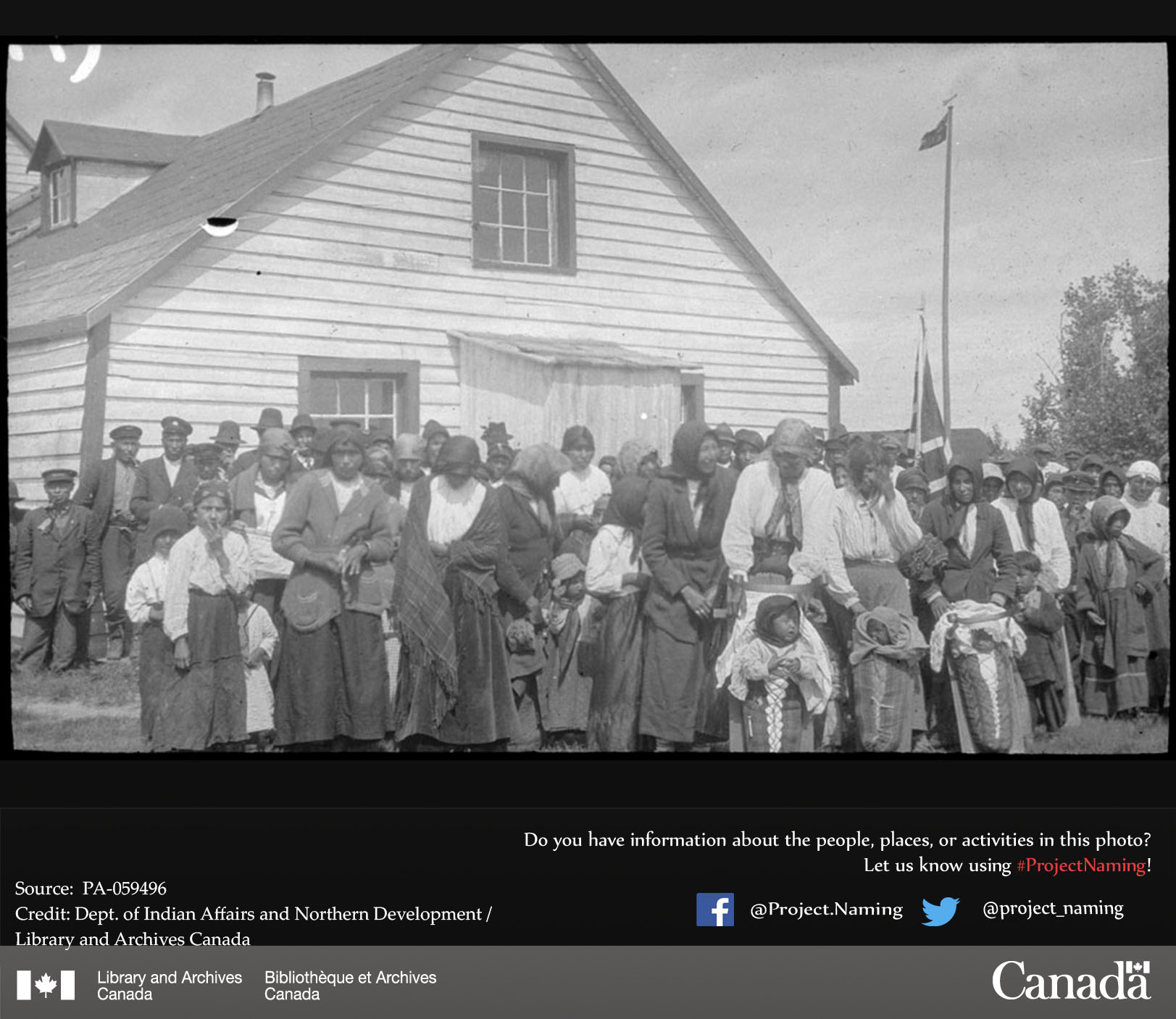
Large group of people standing in front of a building.

Photo was posted during Project Naming’s “Finding Kin,” December 6, 2023. We know Annie was in Osnaburgh House in 1905 when this photo was taken. Could Annie be in this photo? Credit: Canada. Dept. of Indian Affairs and Northern Development / Library and Archives Canada / a059496-v8.

Tanya knew nothing of where Annie or her children had gone after 1905, but she did know where Annie had spent the last eight years of her life and where she is buried in an unmarked grave. I shared Tanya’s search with Elizabeth Montour, LAC Archivist in the Government Archives Division. Within 24 hours, Elizabeth had found Annie’s grandson, Private Peter Rupert Chappise, who fought and died in the First World War (WW1). As I had worked on the massive digitization project to make available the files for everyone who fought for Canada in WW1, I searched Peter’s name and found his file. That file referenced Peter’s brother’s son, Flying Officer Richard Robert Chappise, who died in action in the Second World War. Since LAC has digitized all of the files from soldiers killed in action, I found Richard’s file. I sent all of this information to Tanya, who was thrilled. It felt so satisfying to work with Elizabeth to uncover part of Annie’s mystery. Teamwork!

In a future blog, I will explain more of the process of our teamwork and the usefulness of LAC’s documentary heritage collection. Tanya’s newest book, The Knowing, makes the dream work as she details her many collaborations with people, including me, as she researched Annie’s story. It was published on August 27, 2024. On September 30, 2024, the National Day for Truth and Reconciliation, Tanya will be talking about her search for Annie in depth at an event hosted by LAC and organized by Ottawa Public Library and the Ottawa Writers Festival. I’m looking forward to hearing the story of Tanya’s search and what she found.

More to come.


Ellen Bond is a Project Manager with the Online Content team at Library and Archives Canada.

Collecting e-Books at Library and Archives Canada

Version française

By Michelle Foggett-Parker

International Read an e-Book Day, celebrated on September 18, serves as a reminder of the transformative impact digital books are having on reading habits worldwide. As readers delve into the immersive world of e-books, behind-the-scenes efforts ensure that these digital treasures are collected and preserved for future generations.

Library and Archives Canada (LAC) plays a pivotal role in safeguarding Canada’s many histories through its legal deposit program. Since 2007, Canadian publishers have been mandated by law to submit to LAC one copy of every e-book they publish. In that time, more than 3000 Canadian publishers, trade and self-published, have submitted over 60 000 e-books for permanent preservation. This collection underscores the commitment of publishers and LAC to collect and preserve the documentary heritage of Canadians as it continues to evolve.

In recent years, LAC has made significant strides in modernizing its processes for receiving and preserving e-books. One year ago, LAC embarked on advancing the automation of how publishers can submit their e-books and related metadata. LAC observed that most publishers use the ONIX standard to distribute electronic information about their books to booksellers. We understood that it would be easier for publishers to use the same workflow for LAC.

Through strategic partnerships with ONIX distributors, publisher associations and book industry groups, LAC has successfully onboarded 35 Canadian publishers onto a new, more automated workflow using ONIX. As a result, over 7000 eBooks, representing 10% of the total e-book collection, have been received and permanently preserved, enriching LAC’s digital collection and ensuring the accessibility of Canada’s many histories for generations to come.

The method employed by LAC for receiving and preserving digital monographs is both secure and efficient. Publishers can submit their ONIX metadata and e-books via a secure file transfer protocol (SFTP), ensuring the integrity and confidentiality of their submissions. Once received, e-books and metadata are stored in Preservica, the secure digital preservation software used by LAC, and made discoverable through Aurora, LAC’s online catalogue.

While the automated submission process via ONIX streamlines the submission process for publishers, LAC continues to offer manual submission options for those who prefer it. Publishers can still submit digital monographs through LAC’s single or bulk submission forms and spreadsheets, ensuring flexibility in the acquisition process.

The legal deposit program not only serves to collect and preserve digital publications, but also to make them accessible to users, today and in the future. By collaborating with publishers, LAC can build a comprehensive repository of Canada’s literary heritage, providing invaluable resources for historians, researchers, students, creators and the general public.

We have received some terrific new digital additions to the national collection because of the ONIX workflow.

Here are just a few highlights:

  • Jessie’s Island by Sheryl McFarlane, read-along version: A children’s audiobook about life in British Columbia from Orca Book Publishers. The digital audiobook format is a growing area, and we are now receiving more audiobooks through the ONIX workflow.
  • Black Activist, Scientist, Icon: The autobiography of Dr. Howard D. McCurdy: Nimbus Publishing, Atlantic Canada’s largest publisher, has sent us their entire back catalogue of digital books using the ONIX workflow. There are many gems, but we now have more digital titles representing Black history, including this particular title.
  • Glass Beads by Dawn Dumont: We received this title and the entire back catalogue of published titles from independent publisher Thistledown Press in Saskatoon, Saskatchewan.
  • The Paper Bag Princess by Robert Munsch: We did not have a digital edition of this Canadian classic, and now we do thanks to Annick Press sending in their entire back catalogue of eBooks.
  • Cora : l’ordinaire endimanché by Cora Tsouflidou: Published by Libre Expression, this collection of 50 letters from the founder of Cora restaurants reveals the reflections of the renowned entrepreneur and restaurant-owner.
  • L’homme de la Saskatchewan by Jacques Poulin: A novel by a celebrated Quebec author, published by Leméac.

As we mark International Read an e-Book Day, let’s celebrate the joy of digital reading and acknowledge the publishers, libraries and partners that safeguard our digital heritage. Through innovative initiatives like the legal deposit program, LAC remains at the forefront of collecting and preserving Canada’s rich cultural legacy in the digital age.

Did you know LAC published two e-Books of its own?

Additional resources:


Michelle Foggett-Parker is an acquisitions librarian with the Digital Legal Deposit team at Library and Archives Canada.
The Desmarais et Robitaille fonds: a testimony to religious practice in the 20th century

Version française

By François Larivée

Library and Archives Canada has recently acquired a fonds related to religious heritage: the Desmarais et Robitaille fonds. The Desmarais et Robitaille company specialized in the sale of liturgical items, as well as in the renovation and furnishing of churches. This family-owned company, which operated between 1909 and 2021, had long been a fixture in Old Montréal, with branches in Ottawa and Toronto. Its archives include the many documents created and received by the company over more than a century. They testify to the importance of religious practice in Canada during the 20th century and its profound changes from the 1960s onwards.

The sale of religious items

The archival fonds documents the company’s main activities, namely the import, manufacture and sale of various types of items related to Christian liturgy: altars, stoups, chalices, candles and candlesticks, chasubles, stations of the cross, ciboria, confessionals, crosses, incense burners, baptismal fonts, church furniture, monstrances, statues, tabernacles, etc. The fonds contains a large number of photographs, mainly used to illustrate the company’s annual catalogue. It also contains many drawings, mainly by Jean-Charles Charuest, a renowned designer of liturgical arts. In this role, Mr. Charuest worked for the company from 1945 to 1960, producing the drawings presented to clients and artisans for the sale and production of the items. The many drawings and photographs help us understand the importance of religious practice at a particular time, thanks to the wide variety of models offered for each religious item. For example, for items such as altars, baptismal fonts, chalices and candlesticks, clients could choose from dozens of different models (at a wide range of prices).

Four drawings showing the high altar of the Christ-Roi church in Amos from different angles. The fourth drawing shows a tabernacle on the altar, candlesticks in front of the altar and the silhouette of a priest celebrating Mass.

High altar designed by Jean-Charles Charuest for the Christ-Roi church, Amos, Quebec [195-]. (e011783145, MIKAN 5758370)

The renovation of churches

The Desmarais et Robitaille fonds is a testament to another branch of the company’s activities: the renovation, furnishing and decoration of churches and chapels. This specialization developed mainly towards the end of the 1960s, following the Second Vatican Council (1962–1965), which profoundly transformed the way Mass and the Eucharist were celebrated, causing an equivalent transformation of liturgical space.

Several photos and architectural drawings reflect the many projects undertaken by the company in this regard. These projects were carried out for churches in Canada (Quebec, Ontario and the Maritimes) as well as in the Northeastern United States (notably New York and Vermont). The chapels to be renovated were located both in religious sites (such as convents or monasteries) and in secular sites (such as hospitals or military bases).

The majority of the architectural designs for these projects are the work of the company’s liturgical arts designers, the Reverend Toby McGivern and Rob McDonnell, who were very active in the 1980s and 1990s.

Drawing showing the interior of the Notre-Dame-du-Rosaire church, from the front and from a bird’s-eye view, as well as various pieces of furniture (altar, ambo, baptistery and tabernacle).

The Notre-Dame-du-Rosaire church, Bathurst, New Brunswick: renovation of the sanctuary and furnishings. Drawing by the Reverend Toby McGivern, 1987. (e011783151, MIKAN 5758372)

Drawing showing the interior of the Blessed Sacrament Parish, from the front and from a bird’s-eye view.

Blessed Sacrament Parish, Cornwall, Ontario: proposed renovations to the sanctuary. Designed by Rob McDonnell, 1989. (e011783152, MIKAN 5758372)

The workshop of silversmith Gilles Beaugrand

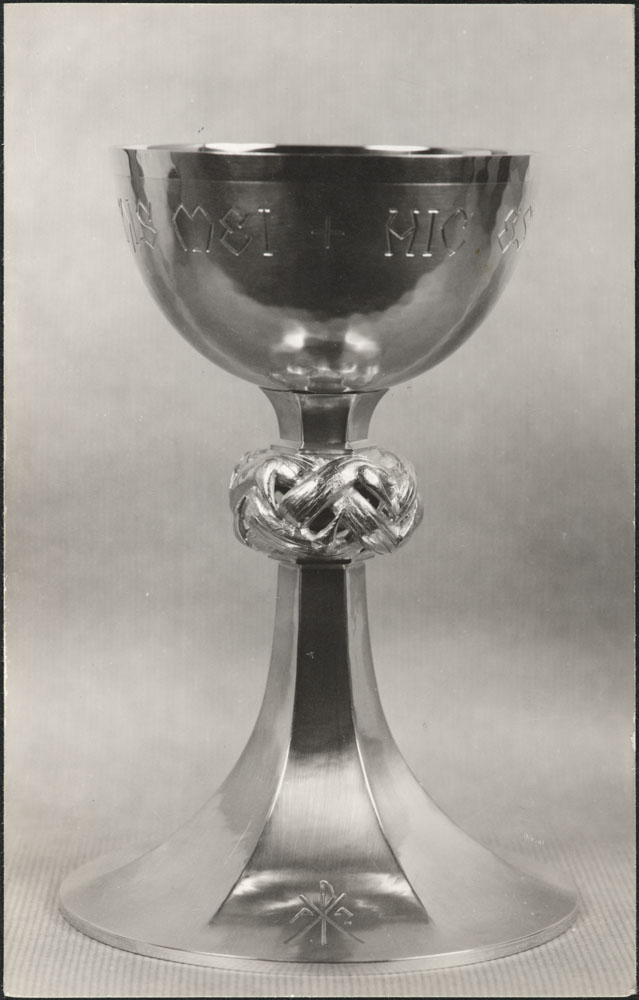
The year 1983 marks an important milestone in the company’s history. It was at this time that the company acquired the workshop of the renowned silversmith Gilles Beaugrand, known for his production of top-quality chalices. (The chalice is the sacred cup in which the wine of the Mass is consecrated.)

The chalices designed by Gilles Beaugrand were primarily ordination chalices, with each new priest acquiring his own on ordination. Designed by Gilles Beaugrand, they were then crafted by the artisans in his silversmith’s workshop, who specialized in stamping, plating, polishing, engraving, chiselling, crimping and sculpting.

The Desmarais et Robitaille fonds contains all the original drawings by this great silversmith, over 7,000 drawings produced between 1943 and 2006. They were made with extreme care, and although they were intended for production, their artistic quality is undeniable.

Each original drawing is accompanied by a copy containing the specifications and measurements required to craft the chalice. All drawings were classified by number, and the same chalice number may have been ordered more than once. These were recorded in documents (called contracts) that were transferred to the Desmarais et Robitaille fonds.

These contracts contain a wealth of information for researchers interested in religious history. Reflecting the workings of a 20th century silversmith’s workshop dedicated to religious art, they also bear indirect witness to the major changes that affected religious practice from the 1950s onwards. A brief examination of the documents reveals, among other things, an increase in chalice orders until the mid-1950s, followed by a gradual decrease that becomes more marked in the late 1960s.

Design of a chalice and paten.

Drawing by Gilles Beaugrand: chalice no. 404 [194-]. (e011783271, MIKAN 5882654)

Photo of a chalice.

Chalice made by the artisans of Gilles Beaugrand’s silversmith workshop, no. 404 [194-]. (e011783270, MIKAN 5882481)

The creation of stained glass

Finally, the Desmarais et Robitaille archival fonds illustrates one of the company’s major activities: the production of stained-glass windows. A stained-glass studio was established in 1971. Many drawings and photographs show that the company produced stained-glass windows for several churches in Canada and the Northeastern United States. Interesting fact: Desmarais et Robitaille manufactured the stained-glass windows for the St. Joseph Cathedral in Gatineau.

Photo of the interior of St. Joseph Cathedral. The church pews can be seen in the foreground, followed by the church choir and, in the background, the stained-glass windows on the rear wall.

Stained-glass windows, St. Joseph Cathedral, Gatineau, Quebec, 1996. (e011783272, MIKAN 5879559)

The decrease in activities and closing

Unfortunately, due to the significant decline in religious practice, the company had to gradually scale back its activities during the 2000s. It closed its Ottawa branch in 2000 and left Old Montréal in 2008. By 2016, it was only able to offer its services by catalogue, until it finally closed its doors in 2021. Fortunately, the archival fonds preserved at Library and Archives Canada will help us share its important achievements with future generations.


François Larivée is an archivist in the Science, Environment and Economy Section of the Archives Branch at Library and Archives Canada.

First on the Lakes: HMCS Griffon

Version française

By Dylan Roy

Sometimes you come across a record that doesn’t necessarily make sense at first glance. This was my experience when I first looked at the archival description of the series HMCS Griffon. HMCS stands for “His/Her Majesty’s Canadian Ship” (you can find this and other military abbreviations used in service files on Library and Archives Canada’s website—this page is a wonderful tool for those not familiar with military abbreviations). Therefore, it shouldn’t be a surprise that I assumed these files were about a ship.

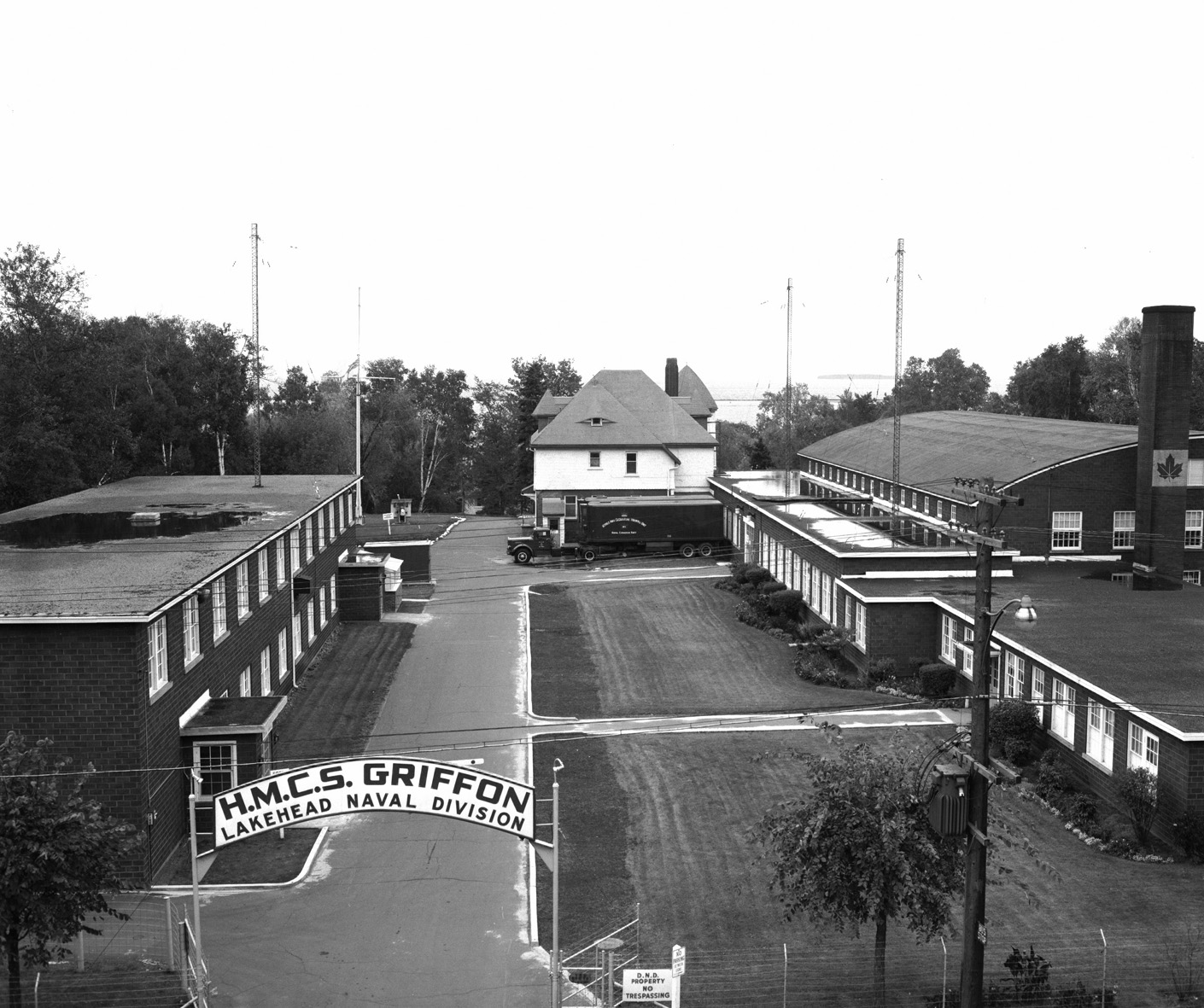
But lo and behold, me mateys, upon consulting the files I discovered that the “ship” turned out to be a facility in Port Arthur (now Thunder Bay).

Black-and-white photograph of two long buildings facing each other, separated by a street. At the far end of the street, a truck is passing in front of a house-like building.

Photo of HMCS Griffon. Source: Government of Canada, National Security and Defence, Ships’ Histories: HMCS Griffon. Credit: Courtesy of The Royal Canadian Navy.

As the series relates, “[a] vacant garage was leased by naval reservists at the beginning of the Second World War, and, with the establishment of a policy of commissioning all ‘stone frigates,’ the garage became HMCS Griffon in 1941.” This led me down a rabbit hole of secondary sources to learn about stone frigates.

A stone frigate, to put it simply, is a naval vessel established on land. The British first employed this informal term: to bypass legal obligations that prevented them from ruling “over land,” they decided to commission the island Diamond Rock as a ship during one of their many wars with the French. This is a good way of understanding HMCS Griffon and its seemingly confusing title.

Badge in the form of a ring with a crown on top, the word GRIFFON at the base of the crown, and a griffin (mythical creature) inside the ring facing left.

The official badge of HMCS Griffon. Source: Government of Canada, National Security and Defence, List of Extant Commissioned Ships: HMCS Griffon. Credit: Courtesy of Department of National Defence.

From the Ships’ Histories on the Canadian government’s National Security and Defence web page, I learned that HMCS Griffon’s creation was based on several factors, most notably its relationship with the Sea Cadet program and the influence of the shipping industry in the Great Lakes region. HMCS Griffon was commissioned in 1940 and moved to its current location in Thunder Bay in 1944. During the Second World War, HMCS Griffon guided newly recruited sailors eastward as they made their way out of the prairies, thus indicating the importance of the facility’s geographic location in Canada.

Once I read up on these facts, I could better contextualize the records we have in our archival collection at Library and Archives Canada—this just goes to show how secondary source work can help researchers gain a better understanding of archival records (primary sources).
As mentioned, the first record I stumbled upon concerning HMCS Griffon was its series-level archival description. Reading through the series, I learned that it only contained five file-level descriptions as well as a linked accession.

Save for the accession, all the files were open, so I decided to peruse their contents. As luck would have it, all the files are found in the same archival box, Volume 11469 (an archival box is equivalent to an archival volume).

With the volume ordered, I was able to delve into the archival treasures found therein, which I shall share below.

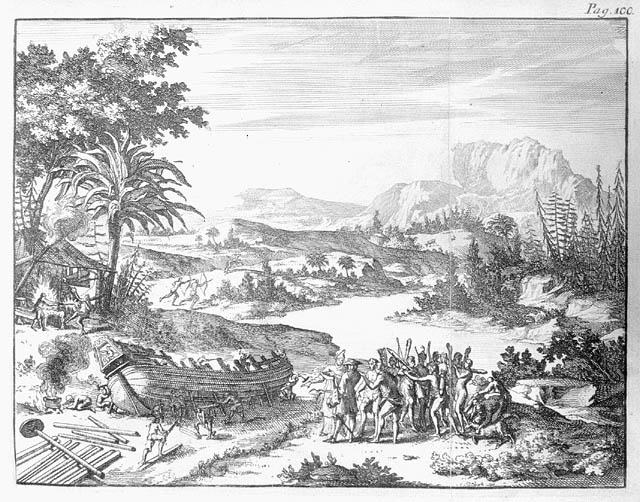
The first file, HMCS GRIFFON: Ceremonies and functions, Official opening of HMCS GRIFFON, is a good file to start with as it shares some interesting discussions on the opening of the facility in 1944 and on its namesake. HMCS Griffon was named after a ship dubbed Le Griffon, which was constructed by storied French explorer René-Robert Cavelier, Sieur de La Salle.

Print of people building a ship near a body of water surrounded by trees, with a mountain in the background.

The building of La Salle’s Le Griffon (c001225).

Black-and-white drawing of a man with long curly hair falling to his shoulders.

René-Robert Cavelier, Sieur de La Salle (c007802).

Le Griffon set sail in 1679 to take part in the burgeoning fur trade. Notably, it was the first full-sized sailing ship on the upper Great Lakes—this is the source of HMCS Griffon’s motto PRIMA IN LACUBUS (First on the Lakes). On its maiden voyage, Le Griffon set sail from an island near Green Bay, Wisconsin, and the ship was never seen again. This mystery intrigued many, including the commanding officer of HMCS Griffon, H.S.C. Wilson.

Wilson had received a bolt from a wreck, supposedly Le Griffon, that had been discovered in 1931 in the Mississagi Strait, near Manitoulin Island. Contrarily, a story surfaced about an Indigenous oral story of the real wreck of Le Griffon being close to Birch Island, near “Lescheneaux” or “Les Cheneaux.” C.H.J. Snider, of the Toronto Evening Telegram, returned a telegram to Wilson refuting the assertions of the latter wreck. This exchange shows the interest that some HMCS Griffon servicemen and women had in the history of their namesake. The location of the wreckage of Le Griffon remains a mystery to this day.

This exchange of telegrams was just part of the file. There were other notable entries, such as the invitation lists for the inauguration of HMCS Griffon and the various preparations made for the event.

Another fascinating file found in the series is HMCS GRIFFON: Reports of proceedings. Reports of proceedings are truly remarkable files as they demonstrate the day-to-day activities within a military establishment via various departments. For example, I was able to determine from the Sports Department that the popular sports at HMCS Griffon included basketball, volleyball and badminton. From a report in May 1955, I learned that baseball was less popular, as “[a]ttempts have been made to organize baseball games but insufficient interest was shown.”

Moreover, we can see the impact that marriage had on some servicewomen in a quote from a report posted by the Medical Department dated February 1955: “Wren Kingsley of the Medical Branch has been discharged following her recent marriage … Lt. Reta Pretrone was married this month resulting in absenteeism from several drills.”

These reports can shed light on both the operational management of the naval establishment as well as the more mundane happenings of HMCS Griffon.

As HMCS Griffon saw many men and women serve at the facility, accidents were bound to happen. The next excerpt, from the file HMCS GRIFFON: General information, RN personnel, shows us, in gruesome detail, a Board of Inquiry in 1945 about an unfortunate accident that occurred in the installation:

Board: What were you doing, that is, just what happened?

Answer: Machinist work, wood-cutting grooving some pieces of wood for boxes. It was a two inch mechanical saw and wood was brought across the bench and off about three feet from the side with about one foot space between the end of the wood and the wall. Most of the wood was wet, this piece was quite wet on the grain and dry on the end. As I was sawing this piece a young boy was trying to get around behind me, I turned my head to see that he did not shove me when at that moment the saw hit the dry end of the wood and it went through the wood very quickly taking my hand with it and cutting my fingers.

Following the inquiry, the board concluded:

It is the opinion of the board that Stoker BLACKMORE E suffered this accident while on leave and that it was not due to Naval Service. The Canadian Naval Authorities permit ratings to work whilst on leave thus alleviating the shortage of manpower. It is felt that this rating was justified in taking up this employment as it is his vocation in civilian life and the accident was primarily due not to inexperience on his part but to the fact that no guard or safety arrangements were supplied for this machine.

The Board of Inquiry process provides a glimpse into some of the practices that the Naval Service employed, such as employing a rating (a junior enlisted serviceman) instead of active servicemen when faced with shortages of manpower. It also illustrates some of the safety precautions, or lack thereof, on HMCS Griffon.

The files of HMCS Griffon series yielded some interesting facts about the stone frigate. Moreover, it gave me some broad and vivid descriptions of multiple events that transpired over time at the installation. It also shows how we can meld secondary sources with the primary sources themselves. All that said, HMCS Griffon will be remembered, in my mind, as the First on the Lakes.


Dylan Roy is a Reference Archivist in the Access and Services Branch at Library and Archives Canada.