Discover a sampling of photos of the Residential Schools of Manitoba and Saskatchewan.
Photos of Manitoba and Saskatchewan Residential Schools on Flickr
Reply

Discover a sampling of photos of the Residential Schools of Manitoba and Saskatchewan.
War diaries—records held at Library and Archives (LAC)—are daily accounts of First World War units’ “actions in the field.” They provide the most complete, first-hand record of how and where individual units were deployed and the wartime experiences of their members.

A page from the war diaries of the 22nd Canadian Infantry Battalion (MIKAN 2004664)
To search the war diaries, use Image Search, a great, fast and easy way to view and consult these digitized records. Tips for searching specific diaries are available on our How to Search for War Diaries section; using keywords will also help you narrow down your search. For example, here are the search results for the diaries of the famous “Van Doos,” better known as the 22nd Battalion. We used the search terms war diaries 22nd battalion and selected “Textual material” in the “Type of material” drop-down menu.
After consulting a unit’s diaries, redo the search you just performed, but this time leave out war diaries, and in the “Type of material” drop-down menu, select the default “All.” Here are the search results for the 22nd Battalion. Your results will still include the war diaries, but you will also see photographs, works of art and other documents related to your search term, provided that it appears in the title of these documents.
Enjoy searching and exploring the digitized materials that we have to offer!
Library and Archives Canada is releasing its latest podcast episode, Sign Me Up: CEF Files, 1914–1918.
Archivist Marcelle Cinq-Mars and genealogy consultant Sara Chatfield from Library and Archives Canada join us to talk about the service files of over 640,000 enlisted men and women of the Canadian Expeditionary Force. We explore the service files of these men and women to find out the types of documents that are found in them, their research value, and how they ended up at Library and Archives Canada.
Subscribe to our podcast episodes using RSS or iTunes, or just tune in at: Podcast – Discover Library and Archives Canada: Your History, Your Documentary Heritage.
For more information, please contact us at podcasts@bac-lac.gc.ca.
The convenience of the sticky note cannot be beat… the variety of sizes and colours allows us to organize and place our notes and thoughts exactly where we want them. They are used in offices, homes, schools—I only wish I held the patent!
There are strong arguments, however, against their use in libraries and archives. Between 1988 and 1989, when conservation scientists at the U.S. National Archives and Records Administration first tested sticky notes, they found that an adhesive residue remains on the surface of the paper that comes into contact with the note (even if the note is placed and removed immediately), that the adhesive can remove electrostatic images (that is, printing ink), and that the dye in the note can run if exposed to water. A more recent repeat of the testing confirmed these findings, showing that most of the note adhesives will stain over time.
The following images show the results of a highly unscientific test conducted at Library and Archives Canada. Although the results are startling, they are not surprising.
1. This is a good book—I will need to reference this chapter later…

A sticky note showing colour fading from the sun
2. “Goodness, I’ve heard about what light can do to colours. That really faded in a short time.”

A sticky note is used as a bookmark
3. “Uh oh… I was not expecting THAT… this didn’t even get wet.”

Evidence of glue residue on a page after a sticky note is removed
So, that’s why sticky notes are not approved for use with collection materials, not even for temporary use!
Remember, please keep sticky notes away from collection materials, and continue to contribute to the long-term preservation of Canada’s documentary heritage.
Most of today’s digital cameras come with a simple, point-and-shoot mode for creating panoramic images.
But back in the days of film cameras, creating a panoramic photograph meant either spending hours in the darkroom, painstakingly stitching images together by overlapping exposures onto the finished photo paper or buying an expensive panoramic format camera.

Possibly members of the Benjamin Low family on a passenger steamer showing various types of cameras, including a panoramic camera, 1904 (MIKAN 3191854)
Today marks the 200th birthday of one of Canada’s most important historical figures, Sir George-Étienne Cartier, a leading Father of Confederation. Cartier was born on September 6, 1814 in Sainte-Antoine-sur-Richelieu, Lower Canada. He studied law and started practising in 1835; however, politics soon became his passion. His entrance into the world of politics was anything but uneventful, as he played a role in the Lower Canadian Rebellion of 1837 and fought in the Battle of Saint-Denis. Cartier subsequently spent a year in exile in Vermont but pled for leniency and returned to Montreal in 1839.
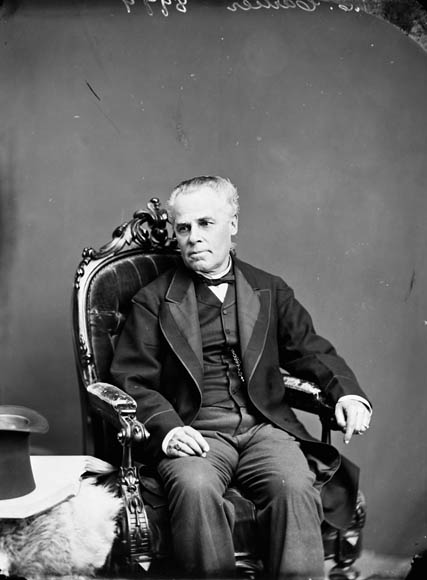
The Honourable Sir George-Étienne Cartier, Baronet (MIKAN 3476630)
In 1848 Cartier was elected to the Legislative Assembly of the Province of Canada and shortly after was appointed to Cabinet. From 1857 to 1862 he served as co-premier of the Province of Canada with Sir John A. Macdonald following his coalition with the Upper Canadian Conservatives. It was in this period that Macdonald and Cartier started working together and began to garner support for Confederation in an attempt to put an end to political instability.

Sir George-Étienne Cartier (MIKAN 3213760)
Cartier played a pivotal role in gaining French-Canadian support for Confederation. He argued that francophone interests would be best preserved in a federation of provinces. When Confederation finally came about on July 1, 1867, John A. Macdonald became the first Prime Minister and Cartier the first Minister of Militia and Defence.
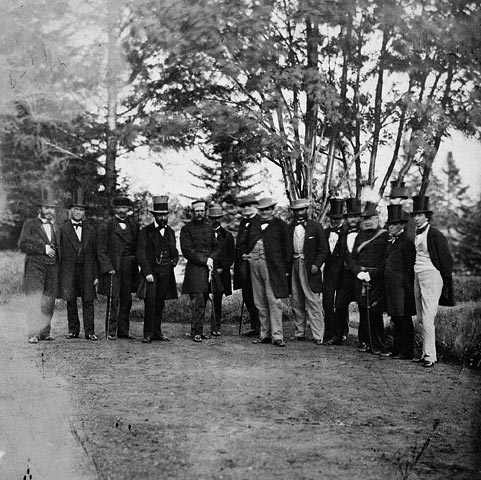
Shown among their peers are the Honourable Sir John A. Macdonald, the Honourable Sir George-Étienne Cartier and Lieutenant-Colonel John G. Irvine (MIKAN 3192010)
Cartier passed away on May 20, 1873. His death deeply affected his close friend, John A. Macdonald, who proposed that a statue be erected in Cartier’s honour. It was sculpted by Louis-Philippe Hébert and unveiled in 1885. This was the first statue to be placed on Parliament Hill and it can still be seen today. Cartier left his mark on generations of Canadians. The centenary of his birthday in 1914 was marked by large celebrations and another monument was erected, this time in Montreal. Cartier’s Montreal home was designated a National Historic Site.
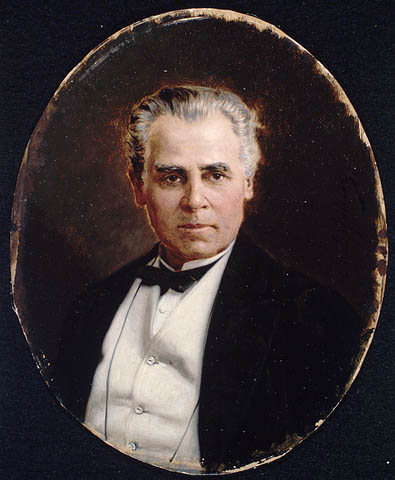
Sir George-Étienne Cartier (MIKAN 2837680)
While the majority of Cartier’s papers were destroyed, Library and Archives Canada does have several important records, including a family photo album, postcards, and some correspondence that took place during his period as Minister of Militia and Defence. We also have several letters written by Cartier to Macdonald, found in the Sir John A. Macdonald collection (archived).
Library and Archives Canada (LAC) is releasing its latest podcast episode, William Redver Stark: The Soldier and the Artist.
Art Archivist Geneviève Morin and Conservator Lynn Curry from LAC discuss the William Redver Stark fonds. They explore William Redver Stark’s background, his time as a soldier during the First World War, and the artwork he produced, specifically the 14 sketchbooks included in his fonds.
Subscribe to our podcast episodes using RSS or iTunes, or just tune in at: Podcast – Discover Library and Archives Canada: Your History, Your Documentary Heritage.
For more information, please contact us at podcasts@bac-lac.gc.ca.
One of the most popular collections at Library and Archives Canada is the William James Topley photograph collection, acquired in 1936. The Topley collection is comprised of over 150,000 glass plate and nitrate negatives, in addition to 68 studio proof albums, daily assignment logs and account books.
Dating from 1868 to 1923, the large collection illustrates the prolific career of Topley, a Montréal-area native, who began his solo career by opening a branch of the William Notman studio on Ottawa’s Wellington Street. Having worked in Montréal for a number of years as an apprentice to the well-known photographer, William James Topley, would eventually drop the Notman name and run his own studio from a series of Ottawa addresses, moving from Wellington Street to the corner of Metcalfe and Queen, and finally to two separate addresses on Sparks Street.
The photographs produced during Topley’s lengthy career serve as a fascinating visual reference to life in Ottawa, as well as other Canadian cities and towns. His images include street scenes documenting daily life, commissioned photographs of store fronts, Parliament Hill before, during, and after the 1916 fire, and perhaps most compelling, his portraits of citizens, both famous and otherwise.
By 1872, the Topley studio was attracting more than 2,300 sitters a year, including prime ministers, governors general, members of Ottawa’s high society, businessmen, and average citizens. He created his famous composite image of the first major Canadian fancy dress ball, hosted by the Earl of Dufferin and his wife, in 1876.
Many of Topley’s clients were the families of Ottawa’s movers and shakers. Being the capital city, it was common for relatives of politicians, land owners and lumber barons to make their way to Topley’s studio at some point, to sit for a portrait. In the early nineteenth century, it was still a somewhat prestigious event to have your portrait taken, and wives, children, and even pets were photographed at the studio, some of them multiple times over the years.
In viewing these wonderful portraits, it is fascinating to see the clothing, hairstyles, and expressions of Ottawa’s earlier citizens, and interesting to see the faces of people for whom some of Ottawa’s streets, parks and schools are named.

Miss Powell, 1870 (MIKAN 3479280)

Miss E. Pattie and cat, 1873 (MIKAN 3461227)

Mr. Brewer, 1875 (MIKAN 3433630)

Miss Sparks and Miss Magee, 1889 (MIKAN 3448969)

Mrs. Bronson, 1869 (MIKAN 3478860)
Wars are tragic events but they sometimes have an unexpected silver lining. During the First and Second World Wars, Canadian soldiers often found love overseas, got married and brought back their loved ones to Canada.
We are happy to advise you that we have added a new page to our Military Heritage section about the foreign women who married Canadian soldiers, the war brides. They shared a common experience of leaving their country and heading for Canada on long journeys, first by ship and then by train. They faced many challenges as they settled into a new country, a different culture and sometimes even a new language.

War brides, en route to Canada aboard S.S. Letitia, waving goodbye to families and friends. (Source Mikan 3352285)
On this new page, you will find records from a variety of sources. The majority are found in the records of National Defence, Department of Employment and Immigration, Department of External Affairs, the Directorate of Repatriation, and the Canadian Wives′ Bureau, but many also come from private organizations.
Visit the War Brides page to explore the printed and archival resources available at Library and Archives Canada.
Would you like to know more about the daily lives of your New France and Quebec ancestors? Then you might be interested in looking at notarial records, where you can find a wealth of information about your ancestors’ goods and properties, and any transactions they may have entered into with others. The oldest known notarial record dates back to 1635.
A notarial record is a private agreement written by a notary in the form of a contract. Some of the most common ones are marriage contracts, wills, estate inventories, leases, and sales contracts.
Notarial records are held by the Bibliothèque et Archives nationales du Québec (BAnQ), but Library and Archives Canada holds copies of some records in the collection, Fonds des greffes de notaires du Québec. You can also use the advanced search to look up the name of an individual or a notary.

Sale made by Nicolas Réaume and Charles-Noël Réaume to their brother Alexis. Notary F. Le Guay, May 9, 1781. Library and Archives Canada, MG18, H-44, vol. 8, 4 pages. (e000102246)
You can use a variety of tools to search for notarial records. For the oldest records from 1635 to 1784, consult the Parchemin database, developed by the Archiv-Histo historical research society (French only), which provides an abstract of each notarial record (date of the record, name of the notary, names of the parties, etc.). Parchemin is available at BAnQ, and in some public libraries, and archives.
You can also consult several name indexes (French only) for various regions in Quebec. Through a large-scale digitization project, you also have access to online directories and indexes of notaries from all regions of Quebec up to 1933 through BAnQ’s Archives des notaires du Québec (French only).
Once you have found a reference, you can consult the original record on paper or on microfilm. You may even be able to consult it online as BAnQ, in collaboration with FamilySearch, will eventually have all the records available online.
 Library and Archives Canada Blog