A paradise for genealogists: Quebec’s civil registers

As any genealogist will tell you, researchers whose ancestors lived in Quebec are fortunate. The sheer volume of surviving civil registers and the manner in which both Catholic and Protestant registers were kept make them a valuable resource. In fact, Quebec has been called “a genealogist’s paradise!”

The careful recording of vital statistics in Quebec is largely due to a series of religious and civil ordinances and regulations originating under French rule.

The historical influence of France

The year 2014 marks the 475th anniversary of the Ordonnance de Villers-Cotterêts [Ordinance of Villers-Cotterêts] (in French only), signed in August 1539 by the King of France, Francis I, in what is now the department of Aisne. Under this edict, priests were required to register baptisms and burials. In 1579, another ordinance signed at Blois required that marriages be registered.

With the Council of Trent (1545–1563) and the publication of the Rituale Romanum de 1614, [Roman Ritual of 1614], the Roman Catholic Church further emphasized the importance of civil registration, specifying how to record the names of the godfather and godmother, witnesses, parents, etc.

Finally, in 1667, the Ordonnance de Saint-Germain-en-Laye [Ordinance of Saint-Germain-en-Laye] introduced the practice of keeping duplicate copies; one copy was kept by the priest and the second was filed with civil authorities at the end of the year. This ensured the preservation of innumerable registers that could have been destroyed or lost forever had only one copy existed.

Applications in New France and modern Quebec

These regulations took effect in New France in 1621 and were enforced by local authorities. Following the Conquest of 1760, the British authorities chose to retain it, recognizing the value of this system.

In Quebec, civil status registers have the following characteristics:

  • There are three types of acts: baptism, marriage and burial.
  • The acts are drawn up by parish priests.
  • They are presented chronologically, usually within a single register.
  • They are subject to two separate regulations: ecclesiastical and civil.

See Vital Statistics: Births, Marriages and Deaths to learn more about these documents and how to consult them.

Happy searching!

Images of Princess Patricia’s Canadian Light Infantry now on Flickr 

The Princess Patricia’s Canadian Light Infantry is one of three Permanent Force infantry regiments of the Canadian Army.

Images of Cats now on Flickr

The domestic cat, a mammal belonging to family Felidae, order Carnivora, is a small, lithe, intelligent, soft-furred animal. About 4.8 million domestic cats inhabit Canada, averaging 2.4 per cat-owning household (just over 1 in every 2 households).

William Redver Stark: Restoring the Sketchbooks

Different approaches have been tried over the years for conserving sketchbooks or bound volumes. For a long time, the works were simply detached in order to remove the binding. Nowadays, the historical and archival value of the binding is widely recognized. Library and Archives Canada (LAC) is no exception in this regard, and conservation treatments are now designed to preserve the work in its entirety, including the binding.

In a previous article, we introduced you to the work of soldier William Redver Stark. The sketchbooks that are part of the William Redver Stark fonds were never repaired or preserved, and were beginning to show signs of wear:

  • Tears and holes
  • Pages detached, missing or in the wrong order
  • Broken binding threads
  • Covers weakly bound to pages or completely detached

The sketchbooks therefore are undergoing various conservation treatments, undertaken by a team of LAC’s highly specialized conservators in the field of book conservation and restoration. These conservators worked with the collection managers and archivists to respect the integrity of Stark’s work, and to give him his full moment of glory.

The drawings and watercolours in this collection are in very good condition. Some even look like they might have been completed only a few days ago. It should be noted that the sketchbooks remained closed for nearly a hundred years, and that the pages were rarely exposed to air or light. Thus, to study a Stark work is to travel through time, to see the work of an artist exactly as it was created a hundred years ago, during one of the most deadly and crucial wars of our time.

In sum, the restoration work done by LAC‘s conservation and restoration team will make it possible to stabilize the condition of the sketchbooks in order to ensure that they will withstand the ravages of time, and will allow future generations to have access to an important part of our history.

Example of a required restauration treatment: the adhesive tape must be removed.

Another example of a required restauration treatment : the cover must be sewn back on.

See Also:

Summary of comments received in French between July 1, 2014 and September 30, 2014

  • A reader from Wimereux (France) thanks LAC for its work on the restauration of William Stark’s sketchbooks. It turns out that William Stark was stationed in Wimereux and made a lot of sketches of the surroundings. The reader was able to identify some of the sketches and he is offering his work to LAC.

William Redver Stark, the Soldier and the Artist

Version française

Canada’s experience of the First World War was captured by officially commissioned artists such as A.Y. Jackson and David Milne from 1916 onwards through the Canadian War Memorials Fund. However, many other artists—amateur and professional—captured their experiences of the war while they were busy fighting, building roads, transporting goods or providing care to others, but still creating vivid imagery of the world around them.

The William Redver Stark fonds at Library and Archives Canada (LAC) is a rare illustrated record of one of these undeclared artists’ lives in the military. Through 14 sketchbooks of remarkably well-preserved drawings and watercolours, we discover the life of a soldier through his eyes, which were closer to the action than those of his official counterparts, and which provide a more spontaneous, intimate perception of how day-to-day activities may have looked.

In these sketchbooks, we find images of soldiers at work and at rest, captured German prisoners and artillery, landscapes through which battalions moved, and sights at the London Zoo where Stark went while on leave. The illustrations serve as a rich and indispensable complement to the artist’s military file, to his battalion’s history, and to our visual understanding of a serviceman’s experience during the First World War.

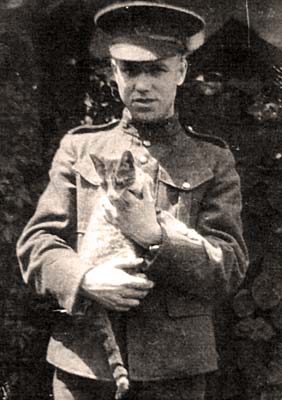
William Redver Stark with cat. Courtesy of Veterans Affairs Canada.

William Redver Stark with cat.
Courtesy of Veterans Affairs Canada.

The William Redver Stark fonds was donated to Library and Archives Canada in 2005 by his nephew, Douglas Mackenzie Davies and his family: his wife, Sheila Margaret Whittemore Davies, and their two sons, Kenneth Gordon Davies and Ian Whittemore Davies.

How to search the sketchbooks

All 14 sketchbooks of the William Redver Stark fonds have been individually described and digitized, making it easier to search for themes or types of scenes. For example, you can search the fonds for all images that contain bridges or construction.

To search the sketchbooks, go to the Advanced search and in the drop-down menu under “Any of these words,” enter either the archival reference number (R11307) or the MIKAN number (616998). If you want to narrow down your search even more, enter a keyword such as “bridges” in the second box.

Other related materials:

Be sure to read William Redver Stark: Restoring the Sketchbooks to learn more about the work done by LAC’s conservators to restore the sketchbooks.

What Is Heraldry?

Heraldry has been defined by the Royal Heraldry Society of Canada as the “…study, design, regulation and use of armorial bearings, commonly known as coats of arms.” The first example of heraldry in Canada occurred at Gaspé, on July 24, 1534, when Jacques Cartier raised a cross that bore the arms of Francis I, King of France.

More than 450 years later, on June 4, 1988, Canada’s Governor General was made head of the Canadian Heraldic Authority and was given the power to grant armorial bearings in Canada. The Authority’s mandate is to issue coats of arms, flags and badges to Canadians and to Canadian entities. Before 1988, Canadians wishing to obtain armorial bearings had to petition the College of Arms in London, England, or the Court of the Lord Lyon in Edinburgh, Scotland.

Molson coat of arms (MIKAN 2946047)

Molson coat of arms (MIKAN 2946047)

Learn more about heraldry from the following reference works:

  • A Canadian Heraldic Primer, written by Kevin Greaves and illustrated by Bruce Patterson and Gordon Macpherson (AMICUS 22962127)
  • Beddoe’s Canadian Heraldry, by Alan Beddoe (AMICUS 11514059)
  • Granting and Registering Armorial Bearings in Canada: Coats of Arms, Flags and Badges – Procedure Guide, by the Canadian Heraldic Authority (AMICUS 25541152)
  • Heraldry in Canada (AMICUS 120587)
  • Flagscan (AMICUS 6865457)

Library and Archives Canada holds the following fonds that pertain to this fascinating tradition:

Interested in knowing more about Canada’s emblems and symbols?

To learn more about Canada’s emblems and symbols, such as the beaver, the fleur-de-lys and the maple leaf, consult the Canadian Identity pages of the Canadian Heritage website.

Images of heraldry now on Flickr

Heraldry is a form of identification using emblems. It started in 12th-century Europe when knights painted their shields to identify themselves while wearing armour. These coats of arms displayed the individual’s identity on the battlefield. The administration and tracking of coats of arms eventually transitioned to monarchies. The granting of these heraldic identification became an honour or reward for individuals or groups.

The Canadian Heraldic Authority, overseen by the Governor General’s office, grants coats of arms to Canadians. Canada is the first Commonwealth country to patriate the practice of this heraldic authority.

View the heraldry images on Flickr.

Newspaper Collection website launched

Library and Archives Canada (LAC) is pleased to announce the release of a new version of its Newspaper Collection website. The website provides an overview of LAC’s newspaper collection, including a list of newspapers available on microfilm, an index to the Canadian newspapers in its collection and a sampling of online Canadian news resources available from third-party websites.

Highlights of the new version include links to other websites offering free online digitized copies of newspapers, direct links to the AMICUS descriptions, and other improvements that make the website easier to navigate.

Are we related? Discover your French-Canadian roots through a family association

A family association is an organization formed of people who share one or more ancestors with the same surname. In most cases, these are French-Canadian families. The main goal of a family association is to perpetuate the memory of these ancestors and preserve the cultural heritage associated with them, such as the land that was granted to them in New France, or the ancestral house, if it still exists.

The association members organize meetings and reunions, small or large, and publish newsletters; many also have a website. A grouping such as this of people sharing the same surname can be very helpful when doing genealogical research. Many associations have published the findings of their searches in their newsletters or in the form of a “genealogical dictionary.” If you are having trouble tracing one of your ancestors, we strongly recommend that you contact an association.

The first family associations

The Trudel-Trudelle family appears to have been one of the first to create a family association, in 1909. In the early 1940s, numerous family associations were created to mark the 300th anniversary of the arrival of the ancestors of the Poulin, Gravel, Bellemare and Gagnon families, among others. On the occasion of the 300th anniversary of Île d’Orléans in 1979, 19 family associations were created and the phenomenon really began to spread. In February 1983, the Asselin, Cloutier, Dion, Langlois and Lemieux family associations founded the Fédération des familles souches du Québec, now known as the Fédération des associations de familles du Québec, a service co-operative with over 200 member associations. Certain family associations have not joined the Fédération.

To find out more

To find out whether a family association exists for your surname, visit Centre de généalogie francophone d’Amérique or do an internet search using keywords like your surname combined with the words “association” and/or “family.” For Acadian families, visit Fédération des Associations de familles acadiennes.

William James Topley’s Fancy Dress Ball Photographs

One of the most celebrated and well-known photographs by Ottawa photographer William James Topley (1845–1930) is his composite image of the first major Canadian fancy dress ball, hosted by the Earl of Dufferin and his wife on February 23, 1876. This composite, which was constructed in the months following the event by cutting out individual photographs and pasting them onto a painted backdrop of the Rideau Hall ballroom, recreates a moment from this prestigious social affair. Look closely and see if you can make out the different costumes…

Composite image of the Dufferin Grand Fancy Ball at Rideau Hall on February 23, 1876. The image was created in the months following the event, and was probably finished in May or June.

Composite image of the Dufferin Grand Fancy Ball at Rideau Hall on February 23, 1876. The image was created in the months following the event, and was probably finished in May or June. (Source: MIKAN 3260601)

The fancy dress ball was a private costumed event that grew in popularity over the course of the nineteenth century in Canada. Those who were invited to a fancy ball would often portray characters from history, literature, Shakespearean plays, mythology, legends, nursery rhymes, or fairy tales, or even ones from “exotic” lands. While guests at fancy balls were expected to conform to certain societal expectations, they could also exercise a few liberties.

For example, women were permitted to wear their hair loose and flowing at the ball (normally it would have been worn up). They could also dress in outfits that revealed more of their legs than a typical ball gown of the day. Miss Minnie Smart, who came dressed in uniform as a heroic “vivandière” for the Dufferin Grand Ball, is certainly revealing a fair amount of her stockings in this photographic portrait!

Miss Minnie Smart dressed as a “vivandière,” originally a type of female auxiliary in the French army who sold food and drink to the soldiers.

Miss Minnie Smart dressed as a “vivandière,” originally a type of female auxiliary in the French army who sold food and drink to the soldiers. (Source: MIKAN 3421162)

Many of the costumes that men wore required tight leggings. This undoubtedly resulted in a few of the guests feeling self-conscious about their bodies, which were normally hidden under conventional dark suits.

Mr. Newby dressed as a “Court Jester.” He wore this same costume again for a skating carnival that took place in 1881.

Mr. Newby dressed as a “Court Jester.” He wore this same costume again for a skating carnival that took place in 1881. (Source: MIKAN 3477362)

There were also those who dressed as characters from other lands. These individuals often acted out their roles in very stereotypical ways, and their costumes did not necessarily reflect the identity that they were appropriating. Mr. Waddell, who came dressed as a “Heathen Hindoo,” apparently had his face painted brown with iodine, leaving a stain that lasted for days after the event.

Mr. Waddell dressed as a “Heathen Hindoo.”

Mr. Waddell dressed as a “Heathen Hindoo.” (Source: MIKAN 3477518)

Not only do these photographs serve as entertaining records of the men and women who attended this exclusive event, but they are also important visual remnants of the past that reflect the social, political and economic contexts in which they were created.

For further research