The Life of Private Marcel Gauthier (Part 1)

Version française

By Ariane Gauthier

I learned about Marcel Gauthier a few years ago when I was visiting the Canadian cemetery in Beny-sur-Mer in France. Although we have the same last name, Marcel is not my ancestor. However, I have always kept a memory of this young man—the only Gauthier buried in this large cemetery. With the release of the 1931 census, I finally had the opportunity to learn more about him. Now, I would like to demonstrate how the many resources of Library and Archives Canada (LAC) can help piece together the life of a person, such as an ancestor or a soldier!

This first part of the blog will cover Marcel Gauthier’s life from his childhood to his military enlistment.

A black and white picture of a young man in his military uniform.

Photograph of Private Marcel Gauthier, age 21, published in an Ottawa newspaper to announce his death overseas (Canadian Virtual War Memorial).

Private Marcel Gauthier (Joseph Jean Marcel Gauthier)

  • C/102428
  • Le Régiment de la Chaudière, R.C.I.C.
  • Date of birth: November 18, 1922
  • Date of death: July 15, 1944
  • Age at time of death: 21 years old

His military service file is available in LAC’s War Dead database, 1939 to 1947.

Born on November 18, 1922, in Ottawa, Ontario, Marcel Gauthier is the seventh child of a large French-Canadian family of nine. When we look at the Gauthiers in the censuses, we learn that Henri, the father of the family, is from Rigaud, Quebec. When he arrived in Ottawa, he settled in Lowertown with his family. This is where Marcel built his life before enlisting.

At that time, Ottawa’s Lowertown attracted many Franco-Ontarians. The 1931 Census shows that the homes and dwellings of the By Ward – St. George’s Ward sub-district were largely inhabited by French Canadians. Some of them were born in Ontario, others came from Quebec. Several historical studies indicate that the population of Lowertown was mainly Francophone, with a significant Irish population as well. This is one of the reasons why this area has been the site of many language issues in the history of Franco-Ontarians, particularly on the issue of Regulation 17 (available in French only), adopted in 1912. Additional resource: https://www.thecanadianencyclopedia.ca/en/article/ontario-schools-question.

Screenshot of the 1931 Census, with an arrow indicating where Marcel Gauthier’s information is found.

Screenshot of the 1931 Census. Marcel Gauthier’s name is found on the 48th line of the By Ward – St. George’s Ward sub-district, No. 74 (Lowertown), on the 7th page of the document (record 8 of 13). He was nine years old at the time (MIKAN 81022015).

Lowertown was considered a disadvantaged neighborhood with a predominantly working-class population. We can therefore assume that Marcel was not born into wealth. His large family lived in close quarters, first at 199 Cumberland Street, with at least seven children (1921 Census), then at 108 Clarence Street, with nine children (1931 Census).

The absence of his mother, Rose Blanche Gauthier (née Tassé), from the 1931 Census indicates that she had probably died by this time. We can assume, by referring to the 8th page of the document (or record 9 of 13), that she died between 1928 and 1931. This theory is based on the registration of the youngest family member, Serge Gauthier, three years old at the time. Marcel’s military record validates this theory and confirms Mrs. Gauthier’s death on October 6, 1928, possibly due to complications arising from the birth of her last child. She is buried in the Notre-Dame Cemetery in Carleton Place, Ontario, where she was born.

In 1931, Marcel’s father and eight of his children lived in a nine-bedroom apartment at 108 ½ Clarence Street. If it had not been for the help of the older children, Henri’s mail carrier salary would not have been sufficient to support his children and cover their tuition. We can therefore assume that Yvette (24 years old and single), the oldest in the household, looked after the home and the younger siblings. We also know that Léopold (22 years old) worked as a driver and that Marie-Anne (21 years old) was a salesperson. It is very likely that they were helping their father financially, just as their older sister, Oraïda (27 years old), had more than likely done ten years earlier. She had now moved out and married a Mr. Homier.

In 1931, Marcel became a student and learned to read, write and communicate in English. At 16, he completed his education. He entered the workforce as a cook and then moved alone to 428 Rideau Street.

Photograph of a two-storey building. Bowles Lunch restaurant is located on the first floor.

Bowles Lunch restaurant where Marcel Gauthier worked before enlisting in the army in 1943 (a042942).

In Europe, tensions with Hitler’s Germany escalated and led to the outbreak of World War II in 1939. Unlike many young men, Marcel did not immediately feel the need to join the fight, likely because he was satisfied with his job as a cook at Bowles Lunch. He waited until January 11, 1943, before reporting to Enlistment Office No. 3 in Ottawa. We can theorize that, like many, he wanted to help change the course of the war or that he wanted to follow the example of two of his brothers, Conrad and Georges Étienne.

Shortly after, on January 29, 1943, he left Ottawa to begin training in Cornwall, unaware that he was leaving his hometown forever.

Additional resources


Ariane Gauthier is a reference archivist in the Access and Services Branch at Library and Archives Canada.

Bilingual census data: a better search experience for all Canadians

Web banner for The 1931 Census series. On the right, typed text: "The 1931 Census". On the left, moving train going by a train station.By Julia Barkhouse

This article contains historical language and content that some may consider offensive, such as language used to refer to gender, racial, ethnic and cultural groups. Please see our historical language advisory for more information.

Library and Archives Canada (LAC) is the guardian of Canada’s distant past and recent history. It holds the historical census returns for Canada, including some dating back to New France and some for Newfoundland. We have indexed some dating from 1825 to 1926, and these are available online through Census Search.

Before Confederation, censuses were generally collected in either English or French, depending on the location. The Dominion Bureau of Statistics (now Statistics Canada) phased in bilingual forms after Confederation in 1867.

Example of a bilingual Census 1921 form enumerated in English and French:

A census-taking sheet from Census 1921. This particular image is page 6 for the sub-district of Scots Bay in Kings District, Nova Scotia.

Census 1921 form enumerated in English (e002910991).

A census-taking sheet from Census 1921. This particular image is page 19 for the sub-district of Wolfestown (Township) in Richmond-Wolfe District, Quebec.

Census 1921 form enumerated in French (e003096782).

The language used to record answers to census questions may reflect the language preference of the enumerator or the language in which the answers were provided. The historical census data that we have reflects our linguistic duality as a nation. Census returns from Quebec and some parts of New Brunswick and Manitoba are written (or, enumerated) in French, while the rest of Canada was enumerated in English.

When our partners, including Ancestry and FamilySearch, indexed the censuses from 1825 to 1926, we produced a wealth of data with names of individuals, their gender, marital status, etc. However, we were faced with a serious challenge: census data could be collected in either English or French depending on the personal preference of the enumerator. So how did we handle this?

Life as an Enumerator

Let us detour for a moment and describe the journey of the enumerator. Enumerators were Canadians hired by the Dominion Bureau of Statistics to collect census data in one or more sub-districts. They received a book of instructions (such as this one for Census 1921) that detailed what they were supposed to write on the form depending on what people answered. They were given a booklet of census return forms and instructions on which sub-districts to enumerate. Then this person had a timeframe to enumerate a number of sub-districts and mail these forms back to the government department. You can imagine this person going from door to door in a horse-drawn carriage or perhaps an early automobile (maybe a Ford Model T) by 1921.

The enumerator knocked on the door and asked to speak to the head of the household (typically the father and/or husband). They might be invited in to sit at the kitchen table as they asked questions. If the family was not home, there might be a notice or calling card left on the door with contact details to follow up and meet the enumerator by a given date to be counted in the census.

Depending on the province in Canada, the enumerator either wrote down information in the language of the person speaking or in their personal language preference. Therefore, it is possible that French regions of Canada around Quebec, New Brunswick and Manitoba were enumerated in one or both languages depending on the enumerator’s personal preference.

Fast forward: the data captured on the forms was transcribed by our partners around 92 years after the census taking and put online.

Language Barriers

When LAC put these databases online, we noticed that we had data in both languages. If you wish to search for your ancestor, you have to search in the language of the enumerator. Did the enumerator write your grandmother’s information in English or French? Does your name have an accent (é, è …) that might have been misheard (or not captured) by the enumerator? Does your uncle’s name have a silent “h” that might have been omitted? This creates a language barrier for our researchers, who want to find people but do not speak the language used at the time. Some of our Francophone researchers have to search in English to find their French-speaking ancestors. This is an unbalanced search experience for Canadians who access our Census Search interface in French.

Creation of Census Search

When the Digital Access Agile Team reorganized and consolidated the 17 census databases into Census Search last November, we wanted to deliver a better search experience for all Canadians. Our aim was to provide the same search experience for Francophones as for Anglophones, so that any of our clients who use the French Census Search interface can search and get the same results as if they were searching in English.

So how do you do this? How do you translate information like gender, marital status, ethnic origin and occupation for over 44 million individuals to offer an equal experience for all Canadians? It’s actually very simple. The solution? Data cleanup.

A Peek Under the Hood

Let’s go behind the scenes for a moment to look at how census data is saved. Census Search is the public interface that LAC clients can use to search. The census data for each individual in Census Search is saved in one master table called EnumAll.

Census data saved in a table in SQL Management Server.

Screenshot of Census.EnumAll from SQL Management Server (Library and Archives Canada).

In this table, each line represents an individual person. The data captured about that person is separated into columns. If we do not have data in a particular column, it says NULL.

Creation of Common Data Pools

Census.EnumAll acts as the master data table. From this, we created common data groups (or, pools). What do I mean by this? We copied all of the data for one of the columns (Gender, Marital Status, Ethnic Origin, Religion, etc.) into a separate table. The only information in this separate table is a list of Genders or options for Marital Status, etc. We call this a common data pool, meaning that all the data in this table (or, pool) relates to one piece of information.

The common data table separates the data (e.g., “Male” or “Female”) from the individual person. If you look at 44 million individuals, you see the same data repeated, such as the number of times the enumerator wrote “Male” or “Married.” In a common table, you see “Male” only once, with a value count for the number of people with this information (which we call an attribute).

This is where the magic happens.

The Gender table in the back end of Census Search. Of note, there are variances (Male and M, Female and F) and two columns titled TextLongEn (English display) and TextLongFr (French display).

Screenshot of T_Gender from SQL Management Server (Library and Archives Canada).

As you can see in this separate common data table, we can do more things. With codes, we establish one way to write each Gender (in this example). This is called an authority. We then perform cleanup so all the variants point to this one authority. In the screenshot above, you’ll notice a variance between “Male” and “M.”

Once we have this authority, we create columns for how we want to display the information in Census Search. We create an English (TextLongEn) and a French (TextLongFr) display. We then add the bilingual translation once and it applies to everything. In this case, we translated “Male” to “Homme,” and it applies to all 20,163,488 people who identified as “Male” across 17 censuses.

We then put all the tables back together and index the records to display in Census Search. So depending on the language of your choice, the interface and the data itself will now translate for you.

English Census Search interface showing Gender drop-down with values for Female, Male and Unknown alongside the French Census Search interface showing the same drop-down with Gender values for Femme, Homme and Inconnu.

Screenshots of Census Search in English and French (Library and Archives Canada).

Now, when I search for my great-grandfather, Henry D. Barkhouse, and display any of his census entries, the data translates as well.

Two screenshots, one in English and one in French, of a Census 1911 record for Henry D. Barkhouse, with arrows pointing out where the data translates.

English and French display of Census 1911 record for Henry D. Barkhouse (e001973146).

Progress Check-in

As you can imagine, this work takes time as we diligently clean up and translate our data. Our first priority was to create drop-down menus on Census Search for Gender and Marital Status. Now, if you wish to search by either of these fields, you will see a short list of terms that are translated and available in both official languages. As we continue this work, our next priorities are Ethnic Origin and Place of Birth. We are about 60–70% finished with these two, and our clients should see new options coming to Census Search in 2024. After these two priority fields, we will continue to translate other fields like Religion, Relationship to head of household, Occupation, etc.

Conclusion

Consolidating all 17 censuses into one platform, Census Search, gave us the opportunity to create a bilingual display for our census data by cleaning up the data. Since its launch, our platform delivers a more equal search experience in the language of your choice. I encourage you to try it out and tell us if your search experience has improved.

As always, we love to read your feedback and ideas via our email or you can sign up for a 10-minute feedback session with us.


Julia Barkhouse has worked at Library and Archives Canada in data quality, database management and administration for the last 14 years. She is currently the Collections Data Analyst on the Digital Access Agile Team.

The 1931 Census: a reading list

Banner for The 1931 Census series.

In preparation for the release of the 1931 Census returns, some of us at Library and Archives Canada have done a lot of reading. We thought we’d share a few census publications that piqued our interest.

Instructions to Commissioners and Enumerators, Seventh Census of Canada, 1931, and Instructions to Enumerators, Census of the Northwest Territories [and certain other northern areas], 1931

Ready to read cursive handwriting? Although these instructions don’t help us decipher cursive (alas!), they do help us understand some abbreviations used in the census returns. Enumerators were instructed to use certain abbreviations, such as “(ab)” for “absent.” The instructions also detail what enumerators were told to record and how; for instance, who was to be considered part of the family for the purpose of enumeration. Sara Chatfield’s recent blog, “How to conduct a census – in 1931,” highlights elements new to the instructions in 1931.

Note that the Dominion Bureau of Statistics issued separate Instructions to Enumerators for the 1931 Census of the Northwest Territories, certain parts of Yukon, eastern shore of Hudson Bay north of Great Whale River, and southern shore of Hudson Strait and Ungava Bay. This separate set of instructions was issued because the census of population in these areas was recorded using a separate form (Form I-N.W.T.), and also because the census in these northern areas was taken earlier—at any convenient time between October 1, 1930, and June 1, 1931, rather than as of June 1, 1931—for logistical reasons.

A printed page with titles and a crest.

Screenshot of cover page of Instructions to Enumerators, Census of the Northwest Territories [and certain other northern areas], 1931 (Library and Archives Canada/CS98-1931I-1-eng, title page)

The Administrative Report on the Seventh Census of Canada (Seventh Census of Canada, 1931, Volume I, Summary)

The Administrative Report on the Seventh Census of Canada provides good reading for those of us who are curious about what the Dominion Bureau of Statistics did with the handwritten census returns after they arrived in Ottawa from across the country.

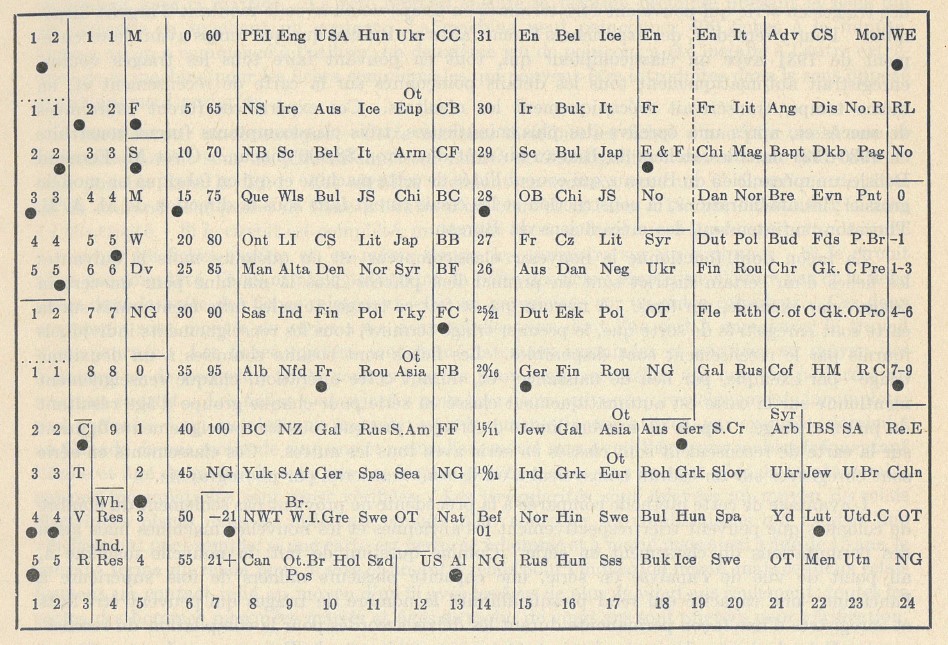
The “New Census Machines—Sorter-Tabulator and Verifier” section (pages 58–62) provides insight into how the information in the handwritten census returns was processed at the Dominion Bureau of Statistics. This section explains what the Bureau did with the census returns that we preserve at Library and Archives Canada. For the purposes of sorting and tabulating results, Bureau employees punched a general card for each individual listed in the census returns, meaning that the Bureau must have punched over 10 million general cards. Can you decipher the information recorded on the following general card? For an answer, see page 59 of the report.

A rectangular card with 20 irregular divisions, each featuring numbers or letters, some of which are punched, and numbers 1 through 24 along the bottom of the card.

A general card used by the Dominion Bureau of Statistics for sorting and tabulating activities during the 1931 Census (OCLC 796971519)

A second type of card, the family and occupation card, “was used for the purpose of compiling statistics relating to the Canadian home and family” (page 59).

A rectangular, 80-column Hollerith Card (punch card), featuring column headers such as household, private family, personal, occupations and earnings, and unemployment.

A family and occupation card used by the Dominion Bureau of Statistics for sorting and tabulating activities during the 1931 Census (OCLC 796971519)

Sorting, counting and recording proceeded mechanically. The Dominion Bureau of Statistics had developed, in-house, a new sorter-tabulator for the 1931 Census, increasing possibilities for cross-analysis “several thousands of times” (page 60). The Administrative Report describes how this new sorter-tabulator worked and features a photograph—admittedly grainy—of the machine as well as of others, such as the verifier and the gang-puncher, on pages 72–73.

A black-and-white photograph of a large, high-ceilinged room in which approximately 80 employees (mostly women) sit at machines, punching in information recorded on a large roll in front of each machine. The employees sit in six columns, each of about a dozen rows, facing the photographer. The rows of employees are so numerous that they seem to extend into the distance. In the foreground, drawers of cards are lined up carefully on desks. In the middle ground, a woman stands observing a woman sitting at a punching machine. At the far right and in the background, additional personnel (mostly men) sit at additional rows of desks or are walking about.

Employees working on the 1931 Census in the punching room at the Dominion Bureau of Statistics (from Statistics Canada’s 2018 online HTML version of Standing on the shoulders of giants—History of Statistics Canada: 1970 to 2008, by Margaret Morris)

Another section in the Administrative Report, “The Field Work” (pages 51–56), describes the task of enumerating each person within the borders of Canada at that time. Additionally, in this section, the Bureau reports not only the number of enumerators involved but also the enumerators’ regular occupations. Among the 13,886 people working temporarily as enumerators, their regular occupations were most frequently the following:

A screenshot of text from a printed document.

A listing of the “most numerously represented occupations” of 1931 Census enumerators, from the Administrative Report on the Seventh Census of Canada (OCLC 796971519)

The Administrative Report was republished as Part I of the Dominion Bureau of Statistics report on the Seventh Census of Canada, 1931, Volume I, Summary (Ottawa, King’s Printer: 1936).

“Radio sets in Canada, 1931”

New for the census of population in 1931 was a question about radio sets. The Dominion Bureau of Statistics 1932 bulletin “Radio sets in Canada, 1931” provided a preliminary count of the result. The bulletin tabulated radio sets by province, census division and urban centre of more than 5,000. People in Montréal—listed as the biggest urban centre, with a population of 818,577—owned a total of 70,164 radio sets. However, Toronto—listed as the second-biggest urban centre, with a population of 631,207—reported the highest total of radio sets owned: 91,656.

A photograph of a man in a cardigan with a pipe in his mouth sitting at a typewriter; his surroundings include a bookshelf, a lantern and a radio.

A radio features in the background of this January 1931 photograph of Richard Finnie typing notes in Kugluktuk, Nunavut (a100695)

Not all of our reading was pleasant. Reading through publications from the 1930s is a reminder of the varied ways in which racism, sexism and colonialism were manifest at that time. Those attitudes shaped the taking of the census and have had enduring legacies into the present.

We’ve mentioned just a few examples of what we’ve been reading from among the many publications that preceded or resulted from the 1931 Census of Population. Generally speaking, the Dominion Bureau of Statistics released preliminary counts and summaries as soon as possible after the 1931 Census, as it did with “Radio sets in Canada, 1931.” The Bureau subsequently published definitive findings and analyses in the multi-volume official report of the 1931 Census. Statistics were published in volumes I through XI during the years 1933 to 1936, and additional thematic analyses on topics such as “housing in Canada” and the “lengthened dependency of youth” were published as volumes XII and XIII in 1942. These publications and many more are found in the library collections at Library and Archives Canada. Many such publications have been digitized by Statistics Canada and made available on the Internet Archive and the Government of Canada Publications catalogue.

If you’re interested, we invite you to browse some of the published heritage from the 1931 Census of Canada. And good luck interpreting cursive handwriting in the census returns!

How to conduct a census – in 1931

By Sara Chatfield

This article contains historical language and content that some may consider offensive, such as language used to refer to racial, ethnic and cultural groups. Please see our historical language advisory for more information.

I have a confession to make: the Instructions to Commissioners and Enumerators is my favourite part of a census. My enthusiasm for these directions was documented in my previous blog post about the instructions for the 1926 Census. When I learned that the 1931 Census was going to be released, my first thought was, “What new questions did they ask that year?” Luckily, there is a 108-page document digitized by Statistics Canada that was full of information for me to examine.

A printed page with titles and a crest.

The cover page from the Instructions to Commissioners and Enumerators (OCLC 1007621746)

The document has a cover page declaring that it is the Instructions to Commissioners and Enumerators for the Seventh Census of Canada, 1931 by the Dominion Bureau of Statistics.

The first section of the document, titled “General Provisions,” is administrative in nature. In this section, you can learn more about the employment side of enumerating the 1931 Census. There is information about the date on which the census enumeration began, the daily earnings of the commissioners, the enumerators’ rights, and how to handle refusals to answer. In the case of refusals to answer, the enumerator was cautioned that “… it is of the utmost importance that his manner should, under all circumstances, be courteous and conciliatory. In no instance should he lose his temper or indulge in disputation or threats. Much can be accomplished by tact and persuasion. Many persons will give information after a night’s reflection which they refused to give when first visited.”

There is also an entry in the General section stating: “No employee can farm out his work. It is not permitted to a commissioner, enumerator or other employee of the Census to engage a substitute or to farm out his work to another.”

A screenshot of text from a printed document.

A portion from the Instructions to Commissioners and Enumerators stating that “No employee can farm out his work.” (OCLC 1007621746)

Beyond learning more about the job conditions of the enumerators (the individuals who collected information for the census) or the commissioners (the individuals who trained and supervised the enumerators, and checked their work), the General section is worth reading because it gives vital information like “Indian Reserves shall not form part of any enumeration area; their enumeration will be made by officials of the Indian Department.” It is very important to know this if you are researching Indigenous communities or ancestors.

The next section of the document is titled “Instructions Relating to the Population Schedule.” This section will give researchers clear indications about who was enumerated as a member of the family, who was not to be enumerated as a family member, and how the enumerator noted the information given by the respondent. This is helpful if your family of interest includes a student, a visitor, a domestic servant or a labourer, a sailor or fisher away at sea, or a member of a railroad or construction camp. The Population section also gives the enumerator clear instructions on how to populate each of the columns, for example, column 7 (class of house) and column 8 (materials of construction).

A screenshot of text from a printed document.

A portion of the instructions listing how houses and construction materials should be noted in the census (OCLC 1007621746)

Compared with the instructions to the enumerator for the 1921 Census, it appears that more information was provided in 1931 about who should be enumerated as family members. The 1931 instructions to the enumerator give more options and more detailed descriptions. As well, a new column was added in 1931 to determine how many families had a radio. This was the dawn of telecommunications! We can speculate that respondents were asked whether they had a radio in the home as a measure of how quickly and broadly information could be disseminated. The 1931 Census is a way to track this then-new form of pop culture on the rise!

A screenshot of text from a printed document.

The 1931 Census asked how many Canadian families had a radio (OCLC 1007621746)

Another part of the 1931 instructions that was expanded was about people who were born outside Canada. The 1921 instructions were that “if a person says he was born in Austria-Hungary, Germany, Russia, or Turkey, as they were before the war, enter the name of the Province (State or Region) in which born, as Alsace-Lorraine, Bohemia, Bavaria, German or Russian Poland, Croatia, Galicia, Finland, Slovakland, etc.; or the name of the city or town in which born, as Berlin, Prague, Vienna, etc.” The 1931 instructions include border changes and new geopolitical realities, now that the world was more than 10 years from the end of the First World War.

A screenshot of text from a printed document.

Detailed instructions on how to enter the place of birth if the person was born outside Canada (OCLC 1007621746)

These are just a few of the instructions from the document that stood out for me. We would love to hear which parts of the instructions you found the most interesting or helpful!


Sara Chatfield is a project manager in the Access and Services Branch at Library and Archives Canada.

Why are the 1931 census returns organized geographically?

At Library and Archives Canada (LAC), we receive questions about why materials in our collections are organized the way they are.

When it comes to the census returns, typically we explain that, as an archive, we acquire the census returns as they are—even when the writing is blurry or unreadable—as historical records. We also strive to maintain the records’ original order and context.

For the 1931 census returns, maintaining the records’ original order is not difficult. Rather than receiving 234,678 pieces of paper, we received 187 microfilm reels. On the microfilm, the imaged census returns are organized, overall, by province (east-to-west) and then by northern area (west-to-east). This is because the Dominion Bureau of Statistics imaged the census returns in order of census district number, and, within each census district, in order of census sub-district number. When we digitized the archival records here at LAC, we worked to ensure that the digital access copies would reflect the archival records’ original order and context to the extent possible. For instance, we grouped digitized images according to the title cards used in the microfilmed images. To each group of digitized images, we added additional metadata, extracted from the Dominion Bureau of Statistics’ listings accompanying the census returns.

A handwritten index card.

Example of a title card used to organize 1931 census returns on microfilm. This title card is for the eight pages of returns from Prince Edward Island, census district 3 (Queens), sub-district 10 (MIKAN 5744023)

But this explanation does not answer the original question: why are the returns from the 1931 census of population organized geographically—by census district and sub-district—in the first place?

For answers to this original question, we turn to the Administrative Report included in the Dominion Bureau of Statistics’ 1936 publication Seventh Census of Canada, 1931, Volume 1, Summary.

Answer 1: Because of the original purpose of the census of Canada. The census returns are organized geographically because of the decennial census’ role in shaping representation in the House of Commons.

“In Canada the immediate, legal raison d’être of the census is to determine representation in the […] House of Commons. Under the [Constitution], the province of Quebec is given a fixed number of seats[…] while the number assigned to the other provinces is pro rata on a population basis as determined by the census[….] The Canadian Census is thus taken primarily to enable a redistribution bill to be passed through Parliament” [Page 32; emphasis added]

It is worth getting a bit technical here. In the early part of the 20th century, redistribution bills updated the number and boundaries of federal electoral districts based on changes in population—as established by the previous decennial census—among other considerations established by law.

A map depicting federal electoral districts in the prairie provinces—the boundaries are indicated by thick blue lines, and the names are indicated in blue type. The map was prepared on a base map featuring rivers and lakes, railways, cities and grid lines.

“Map of Federal electoral districts of Manitoba, Saskatchewan & Alberta” from an atlas created in 1924, prepared by the Department of the Interior (e011315903)

The updated boundaries of federal electoral districts informed the census districts used for enumeration purpose in the subsequent decennial census. In other words, the relationship between federal electoral district and census district had elements of a chicken-and-egg scenario.

Egg: Federal electoral district boundaries, as established in the Representation Act of 1924.

The Representation Act of 1924, sometimes referred to as the Redistribution Act, established the electoral districts to be used in subsequent federal elections. This redistribution of electoral districts was based, in part, on the population count and distribution established by the previous decennial census, namely, the Sixth Census of Canada in 1921.

The Representation Act established the official boundaries of federal electoral districts in form, not in maps.

  • To view transcriptions of these descriptions of electoral districts, consult the Library of Parliament’s online resource “Elections and Candidates” for the 17th parliament; the description of each electoral district can be viewed by clicking on a constituency title listed for the general election of July 28, 1930, and then scrolling below the header “Information” to the description under the subheader “S.C. 1924, c.63,” which refers to the Representation Act.
  • Although the Representation Act did not include maps, the Department of the Interior prepared an atlas with maps depicting the updated federal electoral district boundaries. To view digitized images of the maps in the 12-volume atlas, there are two options. The catalogue record for the Federal electoral district maps, 1924 displays thumbnail images. A 1931 Census Maps research tool supplies links to individual, higher-resolution maps.

Chicken: Census districts used for 1931 census.

1931 census districts used in enumeration mostly corresponded to the federal electoral districts established in the Representation Act of 1924, because

“[f]or the purposes of the census, the Statistics Act requires that the country be first divided into “census districts” corresponding as nearly as possible with the federal electoral divisions or constituencies for the time being—this in view of the association of the census with parliamentary representation.” [Page 51]

Nevertheless, at least eight electoral districts were “too large or too varied in physical or economic character” for the purposes of census work, and so each was split into two or three census districts (in Quebec, Charlevoix–Saguenay, Gaspé, Labelle and Pontiac; in Ontario, Port Arthur–Thunder Bay; in Alberta, Peace River; and in British Columbia, Cariboo and Comox–Alberni). Other areas to be enumerated fell outside a federal electoral district (e.g., Northwest Territories, Royal Canadian Navy ships).

The population established by the Seventh Census of Canada in 1931 was then used to inform the next redistribution of federal electoral districts.

Egg: Federal electoral districts, as established in The Representation Act, 1933

This chicken-and-egg scenario is why, at LAC, we often use federal electoral district maps as working stand-ins for census district maps to help us navigate the census returns from the early part of the 20th century. To navigate the 1931 census returns, we use maps depicting the federal electoral districts as established in the Representation Act of 1924. In the year 2028, we will likely be using the maps depicting federal electoral districts according to The Representation Act of 1933 to help us navigate the 1936 census returns from the prairie provinces after those census returns are transferred to LAC.

Answer 2: Logistics was another reason why the census returns were organized geographically.

The 1931 Census of Canada, like most population censuses, was meant to enumerate each person within the boundaries of the Dominion of Canada once, and only once. For this purpose, land within the borders of Canada, and navy ships, were divided into 15,167 units of enumeration. Each geographical unit of enumeration—called a census sub-district—was assigned to a single enumerator (more or less), tasked with recording each person residing within the census sub-district.

Four people interacting in a sub-zero-degree landscape.

Enumeration proceeding in 1961: An R.C.M.P. member talks to three people from an Inuit community to collect census information (e011177562)

“The census enumerator is the only census official coming into direct contact with the general public; [s/he] is who makes the house-to-house and farm-to-farm canvass and who is primarily responsible for the details collected on the census schedules. The necessity of providing that no more or no less than a suitable amount of work should be assigned to each enumerator (experience has demonstrated this to be a population of 600–800 in ordinary rural districts, and of 1,200–1,800 in urban) […] renders departure necessary in many cases from the electoral boundaries; […] and the polling subdivisions are not always convenient as census sub-districts. In all such cases, however, the division is effected in a way that permits compilation of the results in the form required for the purposes had in mind by the Act.” [Page 51]

Establishing the geographical boundaries to be used in the census was no minor feat:

“The drawing up of the scheme of census districts and sub-districts is a task of considerable magnitude; it is put in hand about two years in advance of the census date, and is carried out not only in the light of conditions revealed in the preceding census, but in consultation with local officials, so that no inhabited area may be overlooked or left unprovided with the organization best suited.” [Page 51]

Ninety-two years later, the task of finding a particular census return among the 1931 census returns that are organized geographically—organized according to census district and sub-district—may seem a little overwhelming. The blog posts Puzzling through 1931 Census sub-districts – Part 1 and Part 2 describes the approaches we use at LAC to navigate the 15,167 sub-districts used for enumeration in the 1931 census.

Puzzling through 1931 Census sub-districts – Part 2

This article contains historical language and content that some may consider offensive, such as language used to refer to racial, ethnic and cultural groups. Please see our historical language advisory for more information.

This is Part 2 of the blog series Puzzling through 1931 Census sub-districts. If not done already, you may want to read Part 1, as it provides tools to help identify the census district that would have included your place of interest in 1931.

As a reminder from Part 1, to find the census returns for a place of interest, we generally need to narrow down, in order, the:

  1. province or territory;
  2. census district or federal electoral district; and
  3. census sub-district

that would have included the place of interest in 1931.

In this blog post, we go over the last step.

STEP 3. Determining the census sub-district

Each 1931 Census district was divided into multiple sub-districts – anywhere from three to 148 – for the purpose of enumeration. The majority of census districts were divided into at least 50 sub-districts.

The hitch is that no maps of 1931 Census sub-district boundaries are known to still exist. Figuring out in which census sub-district one’s place of interest was enumerated requires using one of the following tools:

  1. Street indexes (for 11 major cities)
  2. Finding aid for “Indian Reserves” (First Nations)
  3. Written descriptions of sub-district boundaries.

If your place of interest was in neither a major city nor a First Nations Reserve in 1931, skip directly to the last tool, the written descriptions of sub-district boundaries.

Tool 1: Street indexes

Indexes are available for Halifax (N.S.), Saint John (N.B.), Quebec (Que.), Montréal (Que.), Toronto (Ont.), Hamilton (Ont.), London (Ont.), Winnipeg (Man.), Edmonton (Alta.), Calgary (Alta.) and Vancouver (B.C.). Street indexes list street names and indicate in which census district and sub-district(s) those streets were enumerated.

The indexes for Hamilton and Calgary are specific to the 1931 Census. The indexes for the remaining cities cover multiple census years. In those indexes, for the purposes of locating district numbers for the 1931 Census, consider only entries beginning with “31.” The numbers that follow are the district and sub-district numbers, respectively, for 1931. So, for instance, if we are looking for a place of interest on Montréal’s Chemin de la Côte-des-Neiges in the census district of Mont-Royal (Census District no. 84), we find:

Typewritten entries for “Côte des Neiges” from the Montréal Street Index.

Excerpt from the Montréal Street Index (Finding Aid 31–80)

The numbers in the first line depicted above – “31–84–39, 40, 41, 43, 44, 45” – indicate that, in 1931, Chemin de la Côte-des-Neiges was enumerated in Census District no. 84, in census sub-districts 39 through 41 and 43 through 45.

Note: the street names featured in the indexes are historical; in other words, they are as written by the enumerator at the time, generally speaking.

Beware: the same street may have had its name written in multiple ways and thus appear in separate parts of the alphabetically ordered street index. In the case of Montréal’s Chemin de la CôtedesNeiges, entries are spread across three separate areas of the Montréal index, with the street name written as “Côte-des-Neiges,” “Côte des Neiges” and “Cote des Neiges.”

Tool 2: Finding aid for “Indian Reserves” (First Nations)

A listing of reserves by 1931 Census district and sub-district is available. This unverified finding aid could be useful if your place of interest was (in) a First Nations Reserve in 1931. We are currently working to adapt this pre-existing finding aid to include respectful terminology.

Tool 3: Written descriptions of sub-district boundaries

Written descriptions of sub-district boundaries were compiled by the Dominion Bureau of Statistics. These descriptions have been transcribed into finding aids for each province or territory: P.E.I., N.S., N.B., Que., Ont., Man., Sask., Alta., B.C., Y.T., N.T.

Note: the transcription of sub-district descriptions for select major cities may be forthcoming.

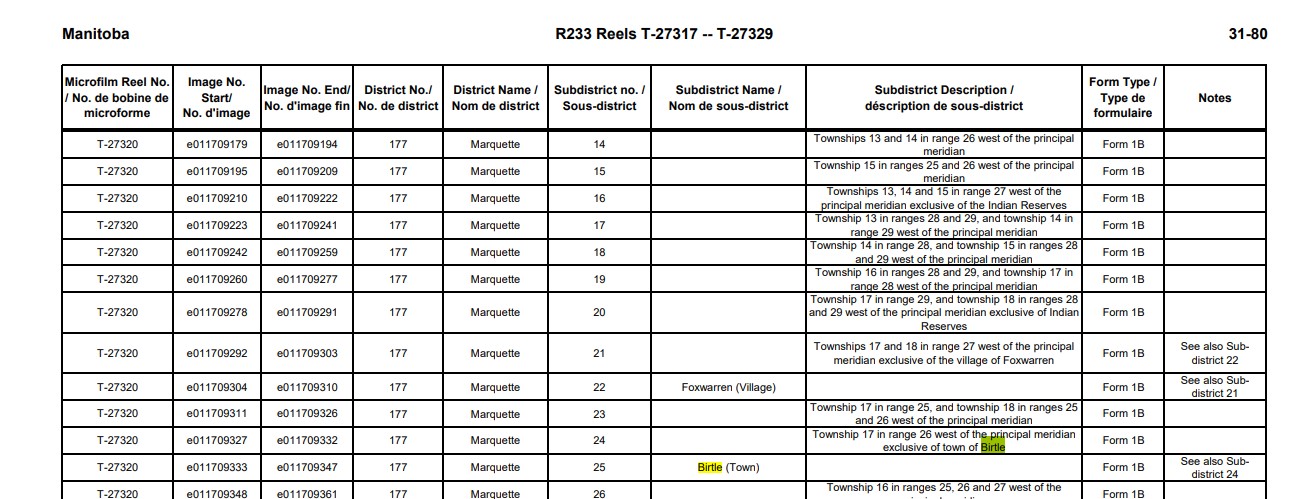
You may choose to begin with a keyword search related to your place of interest in the finding aid for a province or territory. For example, searching the Manitoba sub-district description finding aid for “Birtle” yields three results within the census district “Marquette”: sub-district 25 for “Birtle (Town)”; sub-district 24 for “Township 17 in range 26 west of the principal meridian exclusive of town of Birtle”; and sub-district 63 for the residential school of the same name. Alternatively, you may choose to navigate to a particular census district (like “Marquette”), then browse all sub-district descriptions within that census district.

An excerpt of a finding aid for Manitoba. The excerpt features several sub-district names and descriptions for within the Census District “Marquette.” Two instances of the word “Birtle” are highlighted.

Excerpt from the Finding Aid for the 1931 Census Returns for Manitoba (Finding Aid 31–80)

The characterization of census sub-districts varies tremendously. The descriptions may refer to townships, municipalities, city wards, polling divisions, reserves, parishes, meridians, ranges, lots, roads, islands, rivers, etc. Making sense of the descriptions may require consulting local maps from the era or learning about the local, provincial or other federal geographies leveraged for the purposes of the 1931 Census (e.g., municipal boundaries may have been established in contemporary provincial law).

Sometimes the sub-district descriptions do not themselves allow us to narrow things down to a single sub-district. To illustrate what we mean by that, we can look at sub-district descriptions for the census district of Mont-Royal.

A typewritten card listing sub-district ranges for different parts of the Mont-Royal district in Quebec, 1931.

The Dominion Bureau of Statistics’ working description of sub-districts in District 84, Mont-Royal (from material accompanying the transfer of the 1931 Census returns to Library and Archives Canada). Library and Archives Canada/Statistics Canada fonds/District 84, Mont-Royal, Quebec, 1931

The sub-district descriptions for Mont-Royal create a situation in which it is challenging to identify a single sub-district of relevance. If you face this situation, you then have two options:

  1. flip through the census returns for all relevant sub-districts; or
  2. narrow things down using other working tools, such as city directories, which might list wards, or using additional tools such as a Street Index, which is likely the best approach in the case of Montréal.

Sometimes additional sub-district descriptions feature on the title card preceding the sub-district’s census returns. Scans of the original Dominion Bureau of Statistics’ working descriptions of sub-districts are available online and, though cumbersome, may be used for troubleshooting purposes. To view these scans, go to the archival description for the 1931 Census returns in Collections Search, toggle open the details, then toggle open the finding aid section and scroll down.

Additional resources

  • To learn about the system of townships, ranges and meridians used in the three prairie provinces and the railway belt of British Columbia, consult the section titled Western Canada Land System Description on the homepage for our Land Grants of Western Canada database.
  • The blog post “Finding Royalton: Searching the 1921 Census” describes how a staff member locates small rural hamlets or unincorporated villages. It offers insights and ideas about how to overcome stalemates.
  • If you had already found your place of interest among the census returns from the 1921 Census of Canada or 1926 Census of Prairie Provinces, consider viewing the sub-district description in Census Search for that earlier census year. It might assist you in navigating the sub-district descriptions for the 1931 Census.

Again, wishing us all the best in our searches for people and places of the past.

As always, don’t forget that we can help: reach out to our genealogy team by using our Ask genealogy a question online form.

Puzzling through 1931 Census sub-districts – Part 1

This article contains historical language and content that some may consider offensive, such as language used to refer to racial, ethnic and cultural groups. Please see our historical language advisory for more information.

Sometimes we researchers – including staff at Library and Archives Canada – need to navigate the archived census returns according to how the returns themselves are organized: by census sub-district. We don’t usually navigate census returns this way, since we have Census Search, our one-stop-shop database for genealogy. Once every few years, navigation by sub-district is necessary while we work to incorporate new census records into our database.

When we begin our work – and it is often tricky work – of navigating the archived census returns geographically, we often use a “step-wise” approach to narrow them down by

  1. province or territory;
  2. census district or federal electoral district; and
  3. census sub-district

that would have included our place of interest. We use this approach to be more efficient when searching, because there are so many census sub-districts involved: 15,167 sub-districts in the 1931 Census, to be exact.

This blog series offers five tools to help you find your place of interest among the census returns. Get ready to learn how to navigate the 1931 Census returns geographically!

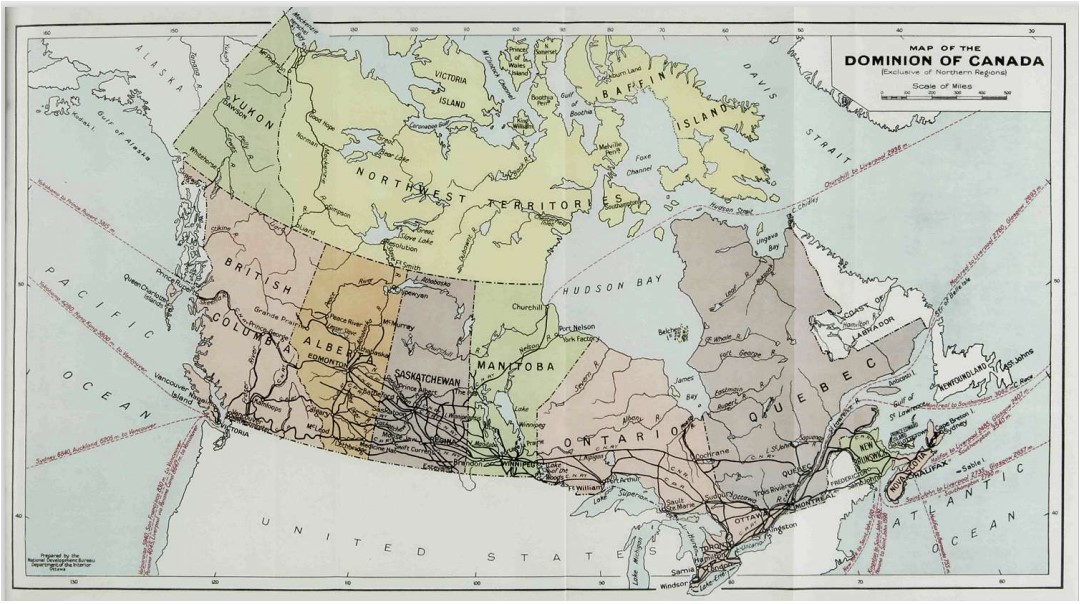
Map of Canada (without some northern regions) in which each province and territory is a different colour. Major railway lines are indicated with a thick black line. Major sea shipping routes are indicated with a dotted red line featuring the name of the two cities linked, and the mileage between them.

“Map of the Dominion of Canada (Exclusive of Northern Regions)” featured in the Dominion Bureau of Statistics The Canada Year Book, 1931 (OCLC 300543070)

STEP 1. Determining the province or territory

Reminders:

  • The Northwest Territories had different boundaries in 1931 than it does today.
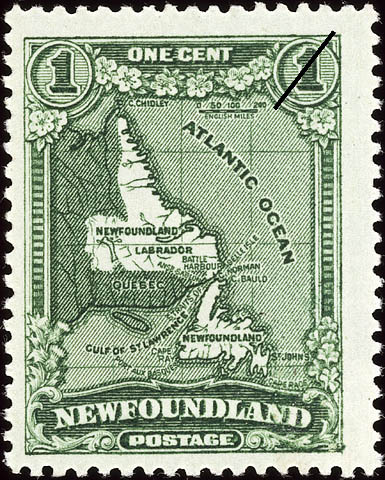
  • Newfoundland and Labrador became a province of Canada in 1949, and so its population is not enumerated in the Seventh Census of Canada. (Information about the separate censuses taken of Newfoundland and Labrador in 1921, 1935 and 1945 can be found on our Newfoundland and Labrador: Census and Enumerations web page.)
Green and white one-cent Newfoundland postage stamp.

Map of Newfoundland and Labrador, July 1931, one-cent Newfoundland stamp, Perkins, Bacon & Company, © Canada Post (s001670k)

STEP 2. Determining the 1931 Census district

Lucky scenarios that let you skip Step 2

There are a few scenarios in which you may go directly to Step 3 (forthcoming in the next blog post); these scenarios include when your place of interest is

  • located on a street in a major city for which Street Indexes have been prepared; or
  • an “Indian Reserve” (First Nations) listed in the relevant finding aid; or
  • included in the description* of sub-district boundaries.

*You can try a quick keyword search of the province-specific finding aids for sub-district descriptions: P.E.I. finding aid, N.S. finding aid, N.B. finding aid, Que. finding aid, Ont. finding aid, Man. finding aid, Sask. finding aid, Alta. finding aid and B.C. finding aid.

If your place of interest is in the territories, note that

  • Yukon was census district no. 241; and
  • the Northwest Territories was census district no. 242,

and go directly to Step 3 (in the next blog post).

If you cannot skip Step 2, your investigation begins with picking your preferred tool.

At Library and Archives Canada, we mainly use five online tools to help us determine in which 1931 Census district our place of interest was enumerated. The online tool that we choose is often a matter of personal preference. Some of us like lists; some of us like scrolling through old maps; some of us like navigating from the present, going backward in time; some of us prefer a quick database search; some of us know county names.

Tool 1: 1931 Census Maps research tool

This research tool lists 1931 Census districts. It also features links to maps approximating each census district. This tool is best used in a situation in which one or two census district names jump out as being likely candidates.

Note: This research tool does not include the census districts of the Northwest Territories, the District of Patricia (northern Ontario) or Unorganized (northern) Quebec.

Tool 2: Atlas of federal electoral district maps, 1924

To get a general sense of the 1931 Census district boundaries within each province, turn to the province-specific overviews in the digitized, 12-volume atlas prepared by the Department of the Interior of federal electoral district maps, 1924.

  • Why federal electoral district? The boundaries of the 1931 Census districts nearly always match the boundaries of a federal electoral district as established by the Representation Act of 1924. (Stay tuned to learn why in our upcoming blog, “Why are the 1931 Census records organized geographically?”)
A map depicting federal electoral districts in British Columbia. The boundaries are indicated by thick blue lines, and the names are indicated in blue type. The map was prepared on a base map of British Columbia featuring mountain ranges, rivers and cities. Additional detail is provided in two inset outline maps, for Vancouver and district, and for the City of Victoria.

“Map of British Columbia showing the federal electoral districts, 1924” from an atlas of federal electoral district maps, 1924, prepared by the Department of the Interior (e011315905)

You can flip through quicker-loading thumbnail-sized images of the atlas maps; the province-specific ones are the first 11 thumbnail images of the atlas. Should you need a higher-resolution image, use the overviews: P.E.I. overview, N.S. overview, N.B. overview, Que. overview, Ont. overview, Man. overview, Sask. overview, southern Alta. overview, northern Alta. overview and B.C. overview. The digitized overview maps are hard to read in some instances, but if they are decipherable for your place of interest, they may help to identify the federal electoral district, and therefore (typically) the census district, of relevance. Should the overview map be too difficult to read, consider browsing through thumbnail images for the entire province volume in the Federal electoral district maps, 1924 atlas. You can consult the thumbnail image range for each provincial atlas in the 1931 Census Maps research tool (“digitized image item no.”). That research tool also provides links to higher-resolution images of individual maps.

Should you want a more detailed sense of the boundaries of a particular federal electoral district (and therefore, usually, census district) in a province or Yukon, consult the map for that individual federal electoral district in the digitized atlas. You can navigate to a higher-resolution image of any particular electoral district in the atlas using the 1931 Census Maps research tool.

A map page from a previously bound atlas featuring a black-and-white map of the electoral district of Mount Royal and a paragraph describing the district.

Electoral district map for the Mont-Royal electoral district in Quebec, from an atlas of federal electoral district maps, 1924 (e011315941)

Note: If you are looking for a place in northern Ontario or Quebec, note that the District of Patricia was census district no. 244, and areas of northern Quebec were enumerated as census district no. 245.

Tool 3: Library of Parliament online list of ridings

This online resource lets you do the following:

  • View a listing of federal ridings as they existed at the time of the 1931 Census. Consult the Library of Parliament’s online resource “Elections and Candidates” for the 17th Parliament, and view the constituency titles listed for the general election of July 28, 1930.
  • Navigate the list of ridings represented in the House of Commons from 1867 to today. You can choose to:
        • Navigate from the current federal riding, going backward in time to 1931. (Note: You can find a current federal riding using Elections Canada’s Voter Information Service database.) From the list of current federal ridings, click on a riding name. From the page for that riding, click through to previous ridings. When you get to a riding that existed in 1931, look for its description under the Information subheader “S.C. 1924, c.63” (referring to the Representation Act of 1924); or
        • Search for historical ridings. On the Library of Parliament landing page for the list of ridings, in the top-right corner of the table, clear the default “currently active” filter by choosing “select all” for active and inactive ridings.

There is usually a very close match between the federal electoral riding that existed in 1931 and the 1931 Census district. You can choose to double-check the correspondence between a federal electoral riding and a census district using the 1931 Census Maps research tool.

Tool 4: Post Offices and Postmasters database

If your place of interest was likely to have had a post office in 1931, investigate what is available in our Post Offices and Postmasters database, which includes electoral districts. Try keyword searching.

Tool 5: Map of counties (and the like)

Try navigating by provincially established county (or the like). Only use this option if your place of interest is in Ontario, Quebec or an Atlantic province.

  • Why counties? Ontario and eastward, provincially established counties (and the like) often, but not always, informed the shape of census districts in the early 20th century. Sometimes counties (and the like) were grouped into one census district, and sometimes counties were split into several census districts. Either way, many county names featured in census district names.
An outline map of Canada, its provinces and Yukon. Each province is then divided further, with each division numbered.

“Index map showing the counties and census divisions as organized at the census of 1931,” in the Dominion Bureau of Statistics 1937 Illiteracy and School Attendance, by Murdock C. MacLean, p. 16 (OCLC 1007622268)

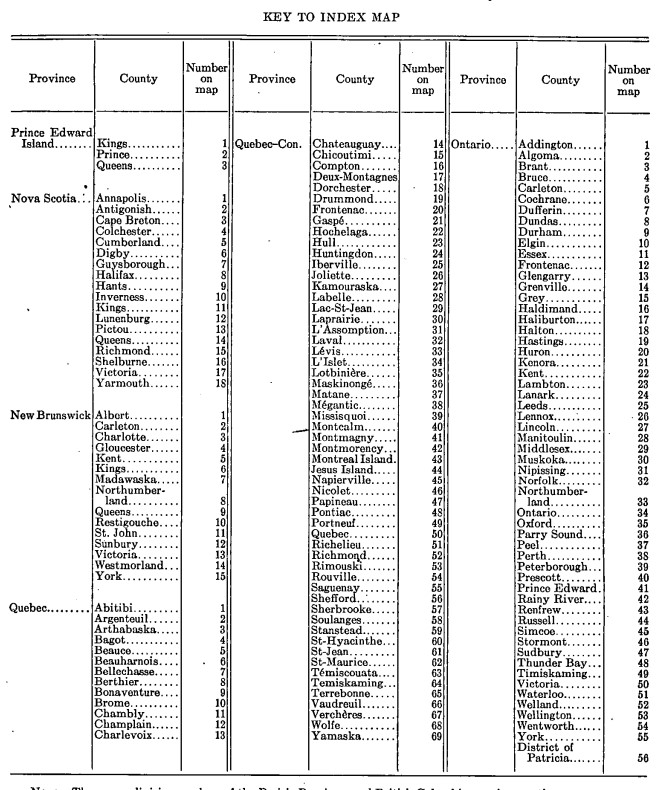
First, identify the county name. To do that, consult the “key to index map” provided below or this very high-level index map of counties (if you need to zoom in). Then, pay attention to the county name (numbers are not important for our purpose). If you identify a county name, search by keyword for that county name in 1931 Census Maps research tool. If you get a unique hit in the list of 1931 Census district names, you are now ready to go to Step 3 (in the next blog post). You can always double-check if you have the right census district by using that same research tool to consult the relevant map. If the county index map is tricky to navigate for your place of interest in Ontario or eastward, don’t bother with the county index.

  • Beware: The county map above does not help us to navigate the census districts used to organize the census returns from the Prairie provinces or British Columbia.
  • Beware also: Census districts used to collect the census returns were sometimes different than the census divisions used to tabulate and publish the census results.
A typed table listing county names for Prince Edward Island, Nova Scotia, New Brunswick, Quebec and Ontario, as well as the number on the map corresponding to that county.

Counties, not census districts! Key to Index Map, from the Dominion Bureau of Statistics 1937 Illiteracy and School Attendance, by Murdock C. MacLean, p. 16 (OCLC 1007622268)

Don’t forget that we can help! Reach out to our genealogy team by using our Ask genealogy a question online form.

Stay tuned for Part 2 of this blog. In the meantime, we wish everyone the best in all of our searches for people and places of the past!

Creation of Census Search

By Julia Barkhouse

We all love the Census. It’s the number one genealogical resource for finding ancestors because it gives reliable information on every Canadian, where they lived, how old they were, whether they worked, and other useful tidbits. It provides a snapshot of our population at a given time and place.

I love the Census for making it possible to track the movements of my great-grandfather, Henry D. Barkhouse. He was the inspiration for the recent work that my team, the Digital Access Agile Team, did to consolidate and release Census Search Beta in November 2022.

I want to take you through my journey in researching Henry D.’s life in the Census. He was born in 1864 and died in 1947 in Nova Scotia. My father never knew him, as he passed before my father was born. A very tall man, he married my great-grandmother, Samantha Udora (Dora) Butler, in 1899 in Scots Bay, Nova Scotia. They had eight children. He was a farmer, and his homestead has been passed down in my family to the present day. Other than this basic information, I know very little about him.

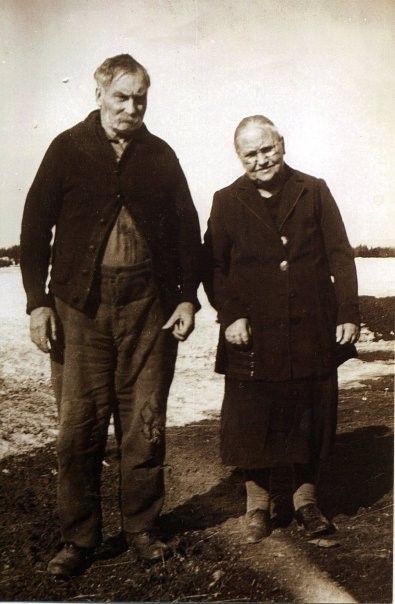
Photo of Henry D. Barkhouse and Samantha Udora (Dora) Butler at their homestead.

Henry D. Barkhouse (1864–1947) and Samantha Udora (Dora) Butler at the Barkhouse homestead in Scots Bay, Nova Scotia (c. 1930–1947). Image courtesy of the author, Julia Barkhouse.

Before starting my research, I record the information that I know about Henry D.:

  • Last name: Barkhouse
  • First name: Henry D.
  • Gender: Male
  • Dates: 1864–1947
  • Occupation: Farmer
  • Province: Nova Scotia (I didn’t know the district or sub-district)

Armed with this information, I expect to find Henry D. in the censuses from 1871 to 1921. The 1931 and 1941 censuses are not yet available.

The research journey begins, and I find him in the 1871 Census.

A page from the 1871 Census of Canada featuring Henry Barkhouse’s information.

Page of Census of Canada, 1871 (Item Number: 3150873)

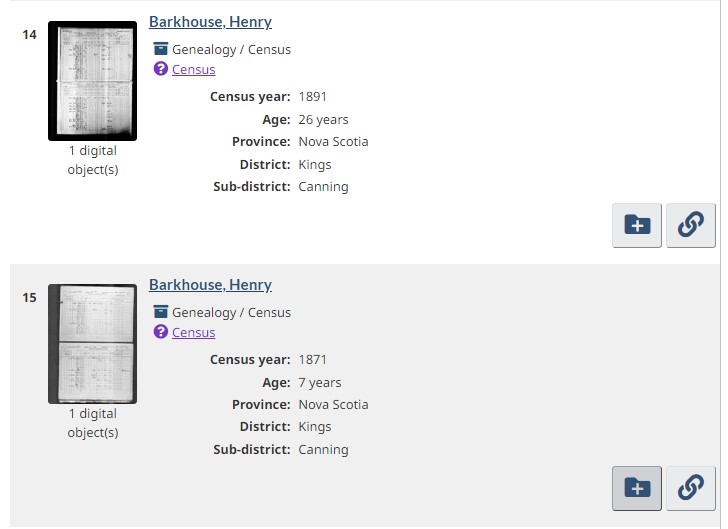
With the first hit, I learn more about him. The census record confirms that he was born in 1864 and that he was seven at the time of the Census in 1871. Now, I can fill in the gaps with the district and sub-district names for Scots Bay. I also learn his religion. I can view the image and get more information about his education and whether he had any infirmities. I can also connect to his parents (James and Rebecca) and his brothers and sisters. Now, I have more information that I can use to find him in other censuses, and I can update my family tree.

At this point, I realize that I have to replicate this search in other Census of Canada databases. I decide to perform the same search in the 1881, 1891, 1901, 1911 and 1921 censuses. Performing the same search five more times will be long and (dare I say) frustrating.

Inspiration strikes: What if I could consolidate all the censuses into one master database of census records? This would allow me to use the same search parameters, search Henry D.’s name once, and get all the hits from all Census databases. I could view the results from 1871 to 1921 on one screen and use our built-in tools to save these results to MyResearch in order to come back to them later. This would shorten the time it takes to do research on each ancestor.

This idea required some quality thinking. Each census is slightly different. While it appears that all censuses capture similar information, the early ones (before Confederation) differ greatly from those conducted after 1867. As well, there were censuses of individual provinces (Ontario and Manitoba) and the Prairie Provinces (formerly “the Territories”). The search raised a number of questions, the biggest of which was: What happens when you put that amount of data in one database?

Conducting the search was a daunting task. Library and Archives Canada has 17 Canadian censuses comprising almost 44 million names. Each name is a record in our database. The search started with a detailed analysis of each census to compare and contrast the data captured in our databases. In this analysis, my team came up with a workplan and identified several improvements or questions to address after the launch. Our first release is Census Search Beta, which combines the 17 Census databases into a single interface. We call it “Beta” to indicate that our product is nearly complete and is being improved every two weeks. Our acceptance criteria before releasing the Beta product to the public were the following:

  • A search interface with all the fields currently available in our standalone databases plus a few more based on feedback from our clients (for example, gender, ethnic origin, place of birth, religion, occupation);
  • Search results with filters for province, census year, district and sub-district;
  • An item display that shows the digital object in our harmonized viewer and the full list of available fields (such as name, gender, age).

Once the censuses were migrated and available in Census Search, we were able to improve the overall search experience for our clients. Now, you can zoom the images with our harmonized viewer or view in fullscreen. You can also download and export your search results in a variety of formats (HTML, XML, CSV or JSON). You can save records to MyResearch and come back to them later. You can add transcriptions or comments to Co-Lab to tag or translate the images. You can suggest a correction to a record and help us improve the Census data.

Screenshot of Census Search with Julia Barkhouse’s great-grandfather’s information by first name, last name, and province limited to Nova Scotia.

Screenshot of Census Search (Library and Archives Canada website)

The first release for Census Search was a considerable task, and we are very happy with our achievement. We also have a blueprint for improvements moving forward. Following our initial launch, we have a number of questions and issues that we want to investigate and for which we want to come up with viable solutions. You will see these released as improvements to Census Search as we move out of the Beta phase. The purpose of this work is to:

  • bundle the images so users can navigate to the next page and view persons or families who may have been enumerated at the bottom of one page and whose information is continued on the next;
  • program the search interface to adjust itself with greyed-out text or pop-up messages for instances where not all censuses have data for all fields (for example, ethnic origin, place of birth, religion)
  • track the geographical changes to the country over time. Once the data was put together, we wanted to track the changes to provinces, territories, districts and sub-districts;
  • find a way to isolate one person and connect this person in each census, or to connect a person and their relationships to other people;
  • add any additional schedules (for example, agricultural schedules) to Census Search, and identify whether a person has additional information there;
  • clean up the data, and create historical data dictionaries that contextualize the terms used at the time (for example, “ethnicity”);
  • sort the search results to group together people by census year or in alphabetical order (ascending or descending).

As for my great-grandfather? Now, when I search for Henry D. in Census Search, I get his results from 1871 to 1921. I can save them to a list in MyResearch and come back to them to trace other family members as well. As we add more enhancements to Census Search, I will be able to page through the Census and view his family if they are enumerated over two pages. I will be able to see whether Henry D. has an entry in the agricultural schedules, since he was a farmer. I might learn how large his farm was and whether he kept chickens, pigs or cows.

Screenshot of Census Search results saved in MyResearch.

Screenshot of Census Search results saved in MyResearch (Library and Archives Canada website)

Creating Census Search has been a journey, and we have only just begun. As you can see, we have many enhancements and features coming to make the experience more enjoyable for you, our clients. Consolidating 17 datasets into one database was only the first step. We hope you will join us as we develop this free resource for you. You can send us your feedback via our email. You can also sign up for a 10-minute feedback session with us.


Julia Barkhouse has worked at Library and Archives Canada in data quality, database management and administration for the last 14 years. She is currently the Collections Data Analyst on the Digital Access Agile Team.

Census 1931, a peek into digitization

Version française

By Melissa Beckett and François Deslauriers

A glimpse into the microfilm room

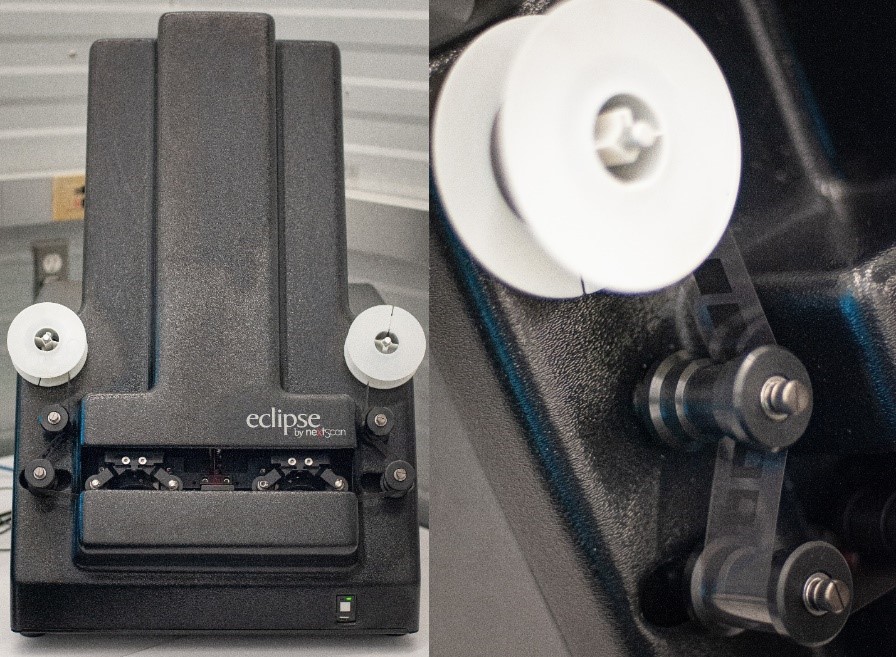
Two photographs of the Eclipse Rollfilm scanner by nextScan; on the left, a view showing the full scanner, and on the right, a close-up of the reel with some film threading past two of the rollers.

The Eclipse Rollfilm scanner by nextScan. Credit: François Deslauriers

In a dimly lit room, two imaging specialists sit in opposite corners. Each stares at their screen, where a series of images is constantly flowing from one side to the other. The rhythmic mechanical sounds of the microfilm scanners are occasionally interrupted by the high-pitched whine of the rewind, and a clunk as the last of the film winds back around its reel. With white-gloved hands, a specialist removes the reel from her scanner and places it back into its round metallic canister, which she returns to its archival box. She removes the next canister and slices around the taped edge with a pocket knife. She takes out the reel and mounts it on the scanner, winding the film around a series of rollers and then onto another plastic reel.

Meanwhile, the other specialist has stopped the process on his scanner. He needs to readjust some settings because the images in this section of the reel are much brighter than the earlier ones. He adjusts the exposure values in the software until he is satisfied with the appearance of the images in the preview window. The specialist scans a short section of film and opens it in the auditing software to double-check. He views one of the documents at full size, examining it closely. He then rewinds the film to the beginning, starting the scanning process all over again.

The project

For the Census 1931 project, the Digitization Services team digitized 187 microfilm reels, for a total of 234,678 images. At this time, by law, the reels were still subject to statistical secrecy, and a security procedure/protocol had to be followed. Only “deemed employees” who had taken the Statistics Canada Oath or Affirmation of Office and Secrecy were authorized to view the material. Reels were kept locked in a secure room, and all digitization was performed completely off-line.

The Census 1931 microfilm reels contain about 1200 images of census documents on each reel of 35-mm black-and-white polyester film. The imaging specialist digitizes from the print master, a copy of the archival master reel, in order to prevent any deterioration of the original.

Microfilm is an effective means of preserving information for long periods of time (reels can last for 500 years). Microfilm stores vast quantities of information in a small amount of space and supports preservation of the documents contained by removing the necessity of handling them. Digitizing microfilm reels provides another level of preservation as well as of accessibility to the public, who are then able to view the images from anywhere with an Internet connection.

The scanning process

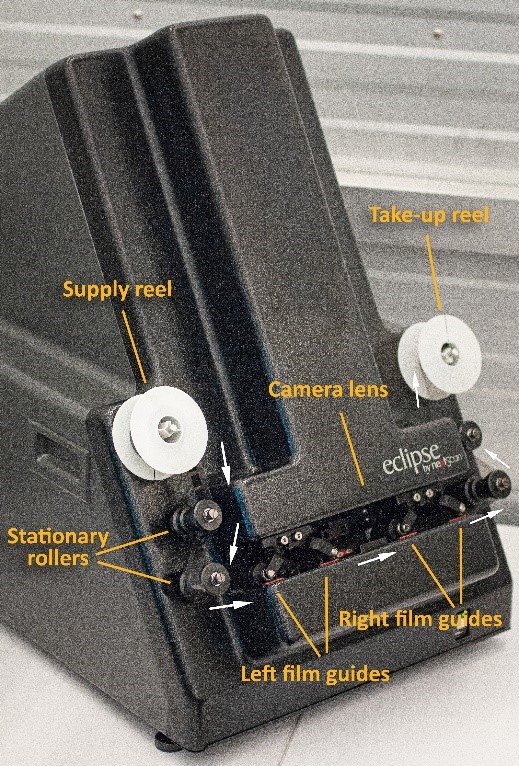
A photograph of the Eclipse Rollfilm scanner by nextScan, with labelled supply reel, stationary rollers, film guides, camera lens and take-up reel.

The Eclipse Rollfilm scanner by nextScan, with main components labelled. Credit: François Deslauriers

For this project, the digitization of the 1931 Census was performed with the use of the Eclipse Rollfilm scanner by nextScan, a dedicated microfilm scanner designed to digitize both 16-mm and 35-mm reels, in conjunction with an off-network computer. Film is threaded from the supply reel past stationary rollers and film guides to a take-up reel. The pinch rollers lower to hold the film in place on the film guides, automatically adjusting the tension of the film. The film is guided past a macro lens and digital sensor above, while lit from below through the film emulsion by a strip of red light. The reel is digitized as one long, uncompressed, grey-scale image file, referred to as a ribbon.

The imaging specialist handles the film using cotton gloves, being careful to touch the edges only. With the NextStarPLUS® Capture software, the reduction ratio (which is noted on the film and allows images to be reproduced at a 1:1 ratio) must be set, in addition to the resolution, film type (16-mm or 35-mm) and polarity (negative or positive). Before scanning, the specialist must also ensure that the exposure of the images is correct and that the lens is focused so the image is sharp.

With a live view on the screen, the specialist makes adjustments to the exposure and the focus. The specialist may zoom in on a focusing chart, as well as on the manufacturer’s information, printed along the edge of the film at regular intervals. The appearance of scratches or dust on the film can also be useful for determining sharpness. While the documents can be used to focus, this is only reliable if they were originally photographed with perfect sharpness.

A preview window during scanning allows the specialist to see when it is necessary to readjust settings over the course of scanning. When the documents were initially photographed, there may have been changes in lighting and exposure settings over the course of the reel. This results in some images appearing brighter or darker. The goal in digitizing each reel is to ensure that most of the documents will be legible, since adjustments in tonal values can only be made for the entire length of the film and not for each individual document.

After scanning is complete, the specialist rewinds the film and returns the reel to its canister.

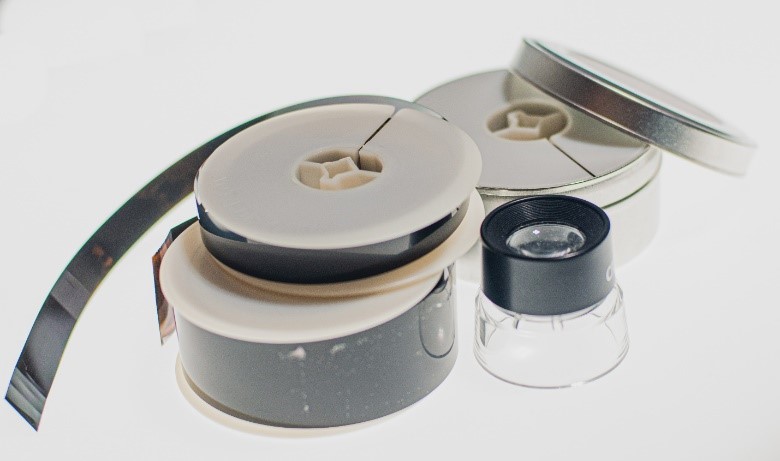
A photograph of a 16-mm microfilm reel stacked on top of a 35-mm microfilm reel, next to a loupe, in front of a 35-mm microfilm reel in its canister.

16-mm and 35-mm microfilm reels. Credit: François Deslauriers

The auditing process

After scanning the reels, the imaging specialist uses the NextStarPLUS® Auditor software to process the ribbons (the long image files associated with each reel). The software is used to detect and select each individual document within the ribbon so that they can be exported as separate image files. According to its detection settings, the software generates coloured rectangles around the documents. The specialist scrolls past rows of documents to select those that were not detected by the software and to adjust any rectangles that do not contain the whole document. On a second scroll through, a blackout setting changes the contents of the rectangles to black. This leaves any unselected white parts visible, making it easier to spot anything that may have been missed on the first pass, for additional quality control.

Each digitized document in the census is assigned an e-number, a unique identifying number used in this project to sort the images by place.

The images were initially exported as 10-megabyte TIFF files. TIFF is a “lossless” file format, meaning that there is no image compression. For the purposes of the project, JPEG derivatives (a “lossy” file format that requires less storage space and is more accessible) were created to aid in matching the digitized images to the census geographic districts and sub-districts, as well as for external partners working in artificial intelligence (AI). Information Technology created a script to efficiently turn the TIFF files into JPEGs.

Yesterday and tomorrow

Working in digitization at Library and Archives Canada means constantly improving processes and exploring new techniques and technology, to create the best-quality images possible. The 1931 Census was no different. As imaging specialists, we have been glad to play a small part in keeping Canada’s history alive and making it accessible to the public.


Melissa Beckett is an acting Imaging Specialist in the Digitization Services Division at Library and Archives Canada.

François Deslauriers is an acting Manager of Reprography in the Digitization Services Division at Library and Archives Canada.
Why we are excited about the 1931 Census

By Sara Chatfield

Welcome to Library and Archives Canada’s blog series on the 1931 Census! This was the seventh census in Canadian history. The release of the 1931 Census records is an excellent opportunity to learn more about ourselves as a country. The lives of over 10 million people who were living in Canada in 1931 will be unveiled very soon. By law, personal information in a census cannot be made public until 92 years after the census was completed. We have been waiting a long time for this, and the date of the release is fast approaching.

A typed page with the words “Dominion Bureau of Statistics” and “Canada” written at the top, a crest, and a stamp with an x over it.

The cover page of the official publication of the Seventh Census of Canada, 1931 (OCLC 796971519)

There are quite a few steps that must be completed to provide the 234,678 images of the 1931 Census online. These are briefly mentioned in Preparing the 1931 Census. This blog series will fill in some of the blanks and help in bringing the census to life. It will answer questions about how the census was compiled, the questions that were asked, how we are making it available, and other topics that will widen our collective appreciation of just how important censuses are to present and future generations.

Census returns are extremely valuable research tools for genealogists, historians, scholars and all Canadians who want to explore the past. The original purpose of the census was to help determine parliamentary representation based on population. But censuses are so much more than that! These documents provide information about the makeup of Canada, the history of Canadian families and societal changes that were happening at the time.

A census entry for a household is a snapshot into Canadians’ lives in that era. Each page tells two stories. First, it tells the story of a family: their names, ages, religion and other elements of their identity. Second, the entry gives the context of their story within Canada: their neighbours, home, occupation, employment status and community. The 1931 Census delves into not only where people lived, but also how: in homes with extended families, within their immigrant communities, in rooming houses, and in institutions.

A map of Canada showing different-sized black dots.

A map from the administrative report of the Seventh Census of Canada, 1931 (OCLC 1007482727)

Even if you have not been bitten by the genealogy bug, the 1931 Census can still be of interest. You can learn more about your city or province, such as the industries or patterns of employment in given areas. Census returns can even help researchers to find more information about particular communities. They can give us hints about who lived at an address and when, and provide some information about their circumstances, including whether they spoke English or French, could read and write, or went to school. The 1931 Census also asked a new question: “Has this family a radio?” This will be fascinating to those who are interested in the emergence of telecommunications in Canada. It is also a measure of how quickly and broadly information could be disseminated. You can witness the early days of a new form of popular culture on the rise. Exciting, right?

We suspect that there will be many prominent Canadians in this census. But we will not know for sure until we have the completed index. Later this year, when the index is released, you will be able to search by name for people such as labour union activist and citizenship judge Stanley Grizzle, Kanien’kehá:ka activist Mary Two-Axe Earley, actors William Shatner and Gordon Pinsent, artist Pauline Julien, singer La Bolduc, painter Kazuo Nakamura, and Black activist Viola Desmond. You may be able to learn more about their early lives!

Join us in our journey to learn what Canadian households looked like on Monday, June 1, 1931!

And stay tuned for upcoming blog posts about this significant census release.


Sara Chatfield is a project manager in the Client Services division at Library and Archives Canada.