About Face: Library and Archives Canada portrait exhibition at Queen’s Park

Three original works of art and over 30 high-quality reproductions from the Library and Archives Canada (LAC) portrait collection are on display in the Lieutenant Governor’s Suite at Queen’s Park in Toronto until March 31, 2014. The portraits are part of About Face: Celebrated Ontarians Then and Now, an exhibition developed by the Office of the Lieutenant Governor of Ontario in collaboration with LAC. These historical and modern portraits represent men and women from a wide range of cultural backgrounds and walks of life, who helped shape the Ontario of today.

This rare portrait of Maun-gua-daus, for example, is one of the earliest photographs of an Indigenous person in LAC’s collection. A member of the Ojibway nation, Maun-gua-daus was educated by Methodist missionaries and served as a mission worker and interpreter in Upper Canada (now Ontario). From 1845 to 1848, he took part in a tour of England, France and Belgium, demonstrating the ritual, dance and sport found in Ojibway culture. This photograph was probably taken during that tour, in about 1846. It was made using the daguerreotype process, the first method widely used for producing photographic images.
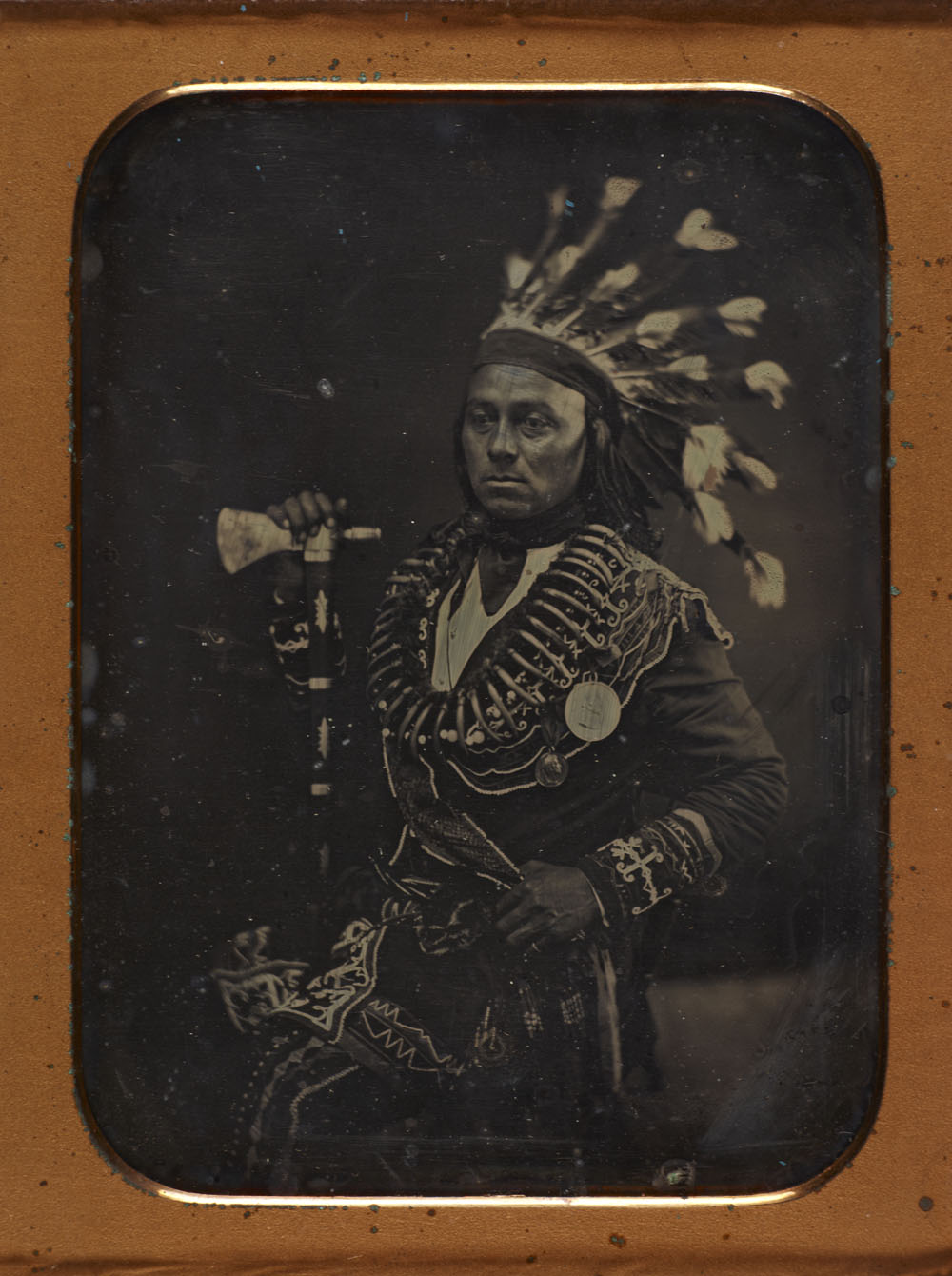
Maun-gua-daus (or Maun-gwa-daus), alias George Henry, original chief of the Ojibway nation of Credit (Upper Canada)

Maun-gua-daus (or Maun-gwa-daus), alias George Henry, original chief of the Ojibway nation of Credit (Upper Canada) (Source: MIKAN 3198805)

An iconic portrait of figure skater Barbara Ann Scott was taken in 1946 by another notable Ontarian, Yousuf Karsh. At the time, the young lady from Ottawa was a Canadian national champion, but had yet to win a European championship and a world figure-skating title. Scott became “Canada’s sweetheart” and Olympic gold-medal champion in 1948, at the age of 19. In this photograph, Karsh frames the skater’s youthful face in what appears to be a saintly halo.

Barbara Ann Scott

Barbara Ann Scott (Source: MIKAN 3192044)

Come see for yourself! Contact the Office of the Lieutenant Governor of Ontario, Queen’s Park to arrange a viewing of the exhibition.
The “ghost” Colonel…and other “spooky” portraits in Library and Archives Canada’s collection

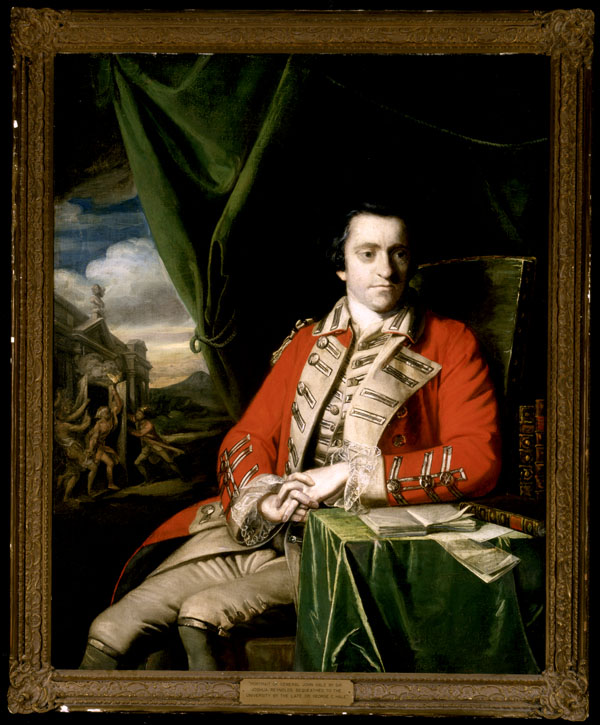
One of the most beautiful and rare oil paintings in Library and Archives Canada’s collection is this portrait of Colonel John Hale (1728–1806). After returning to England as a hero of the Battle of the Plains of Abraham (1759), Hale had this portrait painted by Sir Joshua Reynolds (1723–1792), a famous portrait artist, who is also renowned for his experiments with paint materials and for his stubborn attitude towards the use of one particular colour.

Portrait of Colonel John Hale, circa 1763-1764.

Portrait of Colonel John Hale, circa 1763-1764. Source

In the portrait, the lapels of Hale’s uniform are edged in black in honour of the death of General James Wolfe (1727–1759), a reminder of the most recent and significant battle in Colonel Hale’s career. The unusually pale colour of Hale’s face and hands fits well with this serious subject matter. It also seems appropriate for a portrait of a man who lived a long time ago — as modern viewers might expect, Hale appears to be a ghost out of the past.

But Hale’s otherworldly appearance is really a complete accident. To create a flesh colour for faces and hands, Reynolds mixed white pigment with carmine, a dark red pigment made from crushed South American beetles. Unfortunately, early carmine was “fugitive” — it disappeared quickly when exposed to light. This is especially true when, as in this portrait, carmine is mixed with white. White is a colour pigment that is less able to protect carmine from light exposure. Carmine fades away, and white is the main colour that remains behind.

Even within Reynolds’ lifetime, the pale faces in many of his early portraits were noticed. Yet Reynolds is famous for refusing to use vermilion, the more stable but less natural shade of red. He is said to have responded to the suggestion by looking at his own hand and saying: “I can see no vermilion in flesh.”

For more “spooky” portraits, visit our Flickr album.

Patrolling the French Shore with Louis Koenig

Newfoundland in the summer, completely inaccessible because of its winged garrison. Library and Archives Canada. (Source)

Did you know that thanks to the collection of Library and Archives Canada (LAC) it is possible to patrol the French Shore of the island of Newfoundland with Lieutenant Louis Koenig and discover this particular area where the French had cod fishing rights for almost 200 years, because of two treaties signed between France and England? Accompany Koenig and the crew of the French frigate La Clorinde during a campaign that brought them to Newfoundland, Cape Breton Island and Saint-Pierre and Miquelon in 1885.

Recognized by the French Navy for his artistic talents, Koenig created the 145 drawings and watercolours, the hand-drawn maps and the logbook, which are found in the Louis Koenig fonds and Louis Koenig Collection. The illustrations, most of which were done on site, show the landscapes and military installations he observed, as well as daily activities on board La Clorinde. The maps give three views of the French Shore and include notes by the artist.The logbook, also written by Koenig, documents the voyage, the places visited and gives his candid impressions of his experiences; devoting particular attention to the mosquitoes, which were apparently delighted to welcome the French sailors! The collection also includes a small sketchbook containing an illustrated, much more personal, account of the voyage, full of humour and whimsy presented by Koenig as a gift to La Clorinde’s commander, Félix-Auguste Le Clerc. Koenig also wrote an article Le « French Shore » (souvenirs de campagne à Terre-Neuve) (The “French Shore”, Memoirs of a Newfoundland Campaign), embellished with his maps and illustrations and published in 1890 in the periodical Tour du monde.

To order published documents that are unavailable online, use our online Request for Retrieval of Documents, or call 613-996-5115, or toll-free 1-866-578-7777, to consult them in person at 395 Wellington Street in Ottawa.

Enjoy the discoveries and view the Flickr set of images from Koenig’s albums!

Questions or comments? We would love to hear from you!