Air Marshal William Avery Bishop, VC

By Emily Monks-Leeson

The subject of today’s post in our blog series, First World War Centenary: Honouring Canada’s Victoria Cross recipients, is one of the best-known Canadians of the First World War: flying ace William “Billy” Bishop.
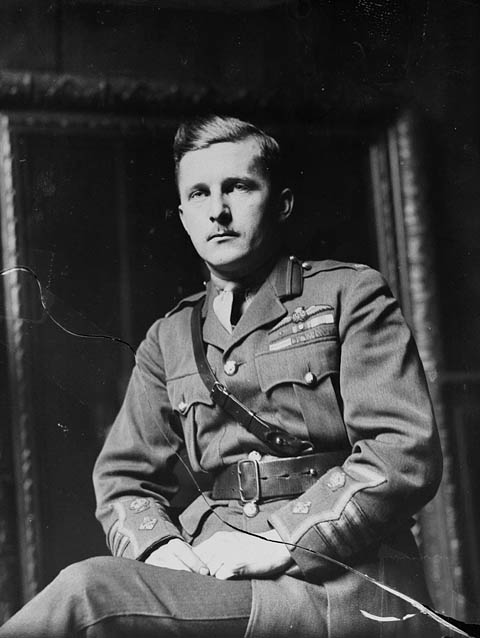
A black-and-white photograph of a military officer seated with his hands in his lap. He is wearing the characteristic Sam Browne belt, which is a wide leather belt with a narrower strap that passes diagonally across the body over the right shoulder.

Lieutenant-Colonel W.A. Bishop, VC, in Lieutenant Quinn’s studio, undated, London, England (MIKAN 3191874)

William Avery Bishop was a cadet in the Royal Military College of Canada when he enlisted with the Canadian Expeditionary Force on September 30, 1914. After briefly serving in the trenches, Bishop transferred to the Royal Flying Corps. He received his wings in November 1916, and shot down a total of 12 planes in April 1917 alone, which won him the Military Cross and saw his promotion to Captain. By the end of the First World War, Billy Bishop had been promoted to Lieutenant-Colonel and was credited with 72 victories.
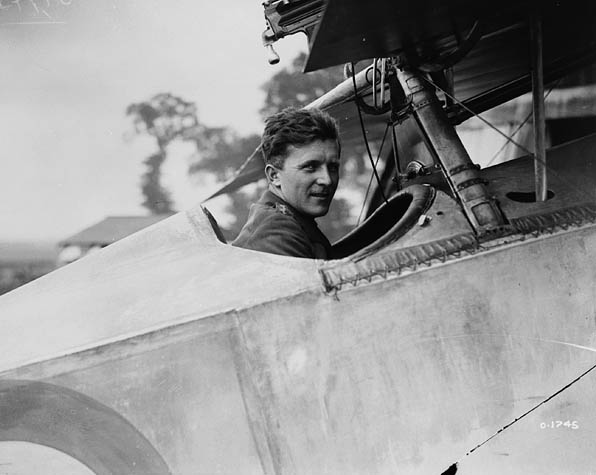
A black-and-white photograph of a man sitting in the open cockpit of an airplane looking at the viewer.

Captain W.A. Bishop, VC, Royal Flying Corps, August 1917. Photographer: William Rider-Rider (MIKAN 3191873)

Bishop was the first Canadian airman to be awarded the Victoria Cross for his single-handed attack on a German airfield near Cambrai, France, on June 2, 1917. According to his citation in The London Gazette:

Captain Bishop, who had been sent out to work independently, flew first of all to an enemy aerodrome; finding no machine about, he flew on to another aerodrome about three miles south-east, which was at least twelve miles the other side of the line. Seven machines, some with their engines running, were on the ground. He attacked these from about fifty feet, and a mechanic, who was starting one of the engines, was seen to fall. One of the machines got off the ground, but at a height of sixty feet Captain Bishop fired fifteen rounds into it at very close range, and it crashed to the ground.

A second machine got off the ground, into which he fired thirty rounds at 150 yards range, and it fell into a tree.

Two more machines then rose from the aerodrome. One of these he engaged at the height of 1,000 feet, emptying the rest of his drum of ammunition. This machine crashed 300 yards from the aerodrome, after which Captain Bishop emptied a whole drum into the fourth hostile machine, and then flew back to his station (The London Gazette, no. 30228, Saturday, 11 August, 1917).

Air Marshal William Avery Bishop died on September 11, 1956 in Palm Beach, Florida. He is interred in the Bishop family plot in Greenwood Cemetery in Owen Sound, Ontario.

Library and Archives Canada holds the CEF service file of William Avery Bishop.

Related Resources


Emily Monks-Leeson is an archivist in Digital Operations at Library and Archives Canada.

Lieutenant Robert Grierson Combe, VC

Today in the series First World War Centenary: Honouring Canada’s Victoria Cross recipients, we remember Lieutenant Robert Grierson Combe of the 27th Battalion, Canadian Expeditionary Force (CEF). In this series, we profile each of Canada’s Victoria Cross recipients 100 years to the day in action for which they were awarded this prestigious military medal.

Born August 5, 1880 in Aberdeen, Scotland, Combe enlisted in the CEF as a Lieutenant, a rank he resumed at his own request, despite having qualified as a Major.

A black-and-white image (blended photograph and sketch) of a soldier with close cropped hair and a mustache.

Lieutenant Robert Grierson Combe, VC, undated (MIKAN 3645669)

While the Canadian Divisions had been successful in securing Vimy Ridge, the British and Commonwealth forces continued to push against German lines to provide a diversionary assault to draw the German Army away from the Aisne sector and allow the French Army to make a breakthrough. On May 3, 1917, at Acheville, France, Lieutenant Combe was leading his company forward against an intense barrage of enemy artillery. Having reached the German position with only five men, Combe inflicted heavy casualties and, gathering small groups of men to join him, managed to capture his objective and take eighty prisoners. His citation in The London Gazette, no. 30154, Wednesday, 27 June, 1917 reports:

….He repeatedly charged the enemy, driving them before him, and, whilst personally leading his bombers, was killed by an enemy sniper. His conduct inspired all ranks, and it was entirely due to his magnificent courage that the position was carried, secured and held.

Lieutenant Robert Grierson Combe was awarded the Victoria Cross posthumously for his leadership and courage under fire. He was buried near Acheville, France. Ongoing fighting in the area resulted in the destruction of the military cemetery and the loss of his gravesite. For this reason, his name appears on the Vimy Memorial, along with the names of 11,000 other Canadian soldiers who have no known graves.

Library and Archives Canada holds the service file of Lieutenant Robert Grierson Combe.

Related Resources

Captain Thain Wendell MacDowell, Private William Johnstone Milne and Lance-Sergeant Ellis Wellwood Sifton

A banner that changes from a black-and-white photograph of a battle scene on the left to a colour photograph of the Vimy Memorial on the right.The Discover Blog returns to the First World War Centenary: Honouring Canada’s Victoria Cross recipients series, in which we profile each of Canada’s Victoria Cross recipients on the 100th anniversary of the day that the actions took place for which they were awarded the Victoria Cross. Today we present the story of three Canadian soldiers who were awarded the Victoria Cross for their actions on the first day of the Battle of Vimy Ridge.

On April 9, 1917, Captain Thain Wendell MacDowell of Lachute, Quebec, and two runners, Private James T. Kobus and Arthur James Hay, became separated from their unit while storming a German position. MacDowell destroyed one machine gun and put another out of action. With Kobus and Hay, MacDowell entered a dugout, where he convinced the German soldiers he encountered that the three were part of a much larger force. Two officers and 75 soldiers surrendered to MacDowell, Kobus and Hay. The three men held the position for five days until relieved (London Gazette, 8 June 1917, no. 30122, p. 5702). MacDowell, a previous recipient of the Distinguished Service Order, was promoted to the rank of Major and later became Lieutenant-Colonel of the Frontenac Regiment in Napanee, Ontario. He died in Nassau, Bahamas, on March 29, 1960, and is buried in Brockville, Ontario.

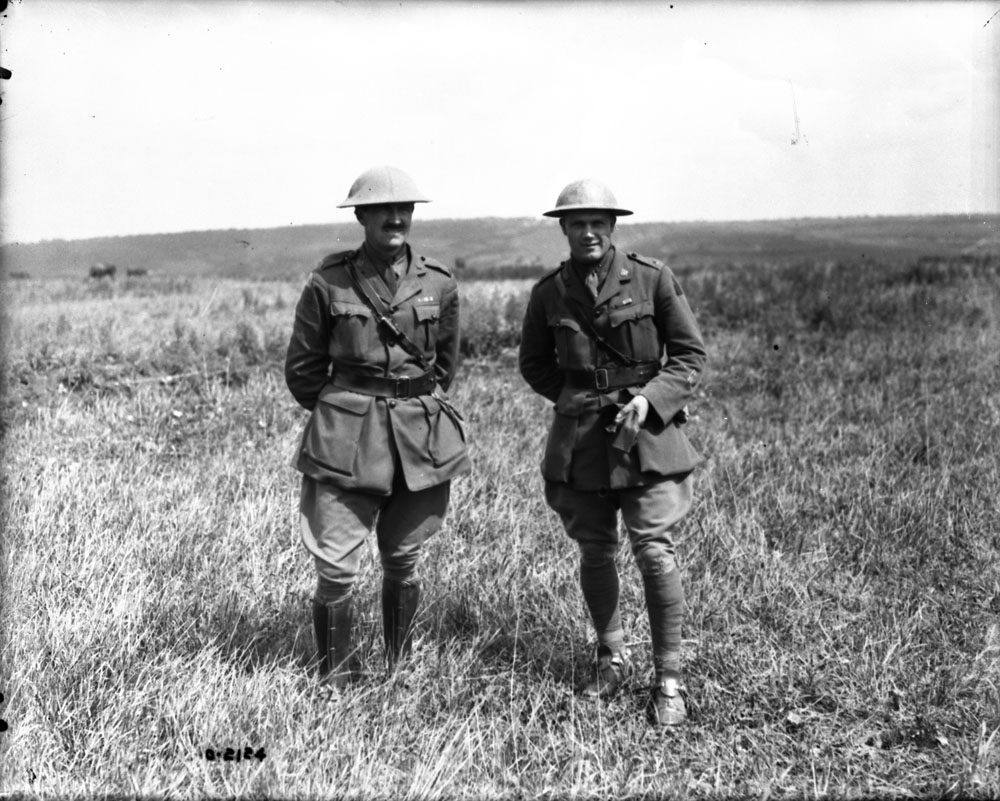
A black-and-white photograph of two men in uniform standing in a field.

Lieutenant-Colonel C.M. Edwards, D.S.O., and Major T.W. MacDowell, V.C., D.S.O., 38th Battalion, October 1917 (MIKAN 3521126)

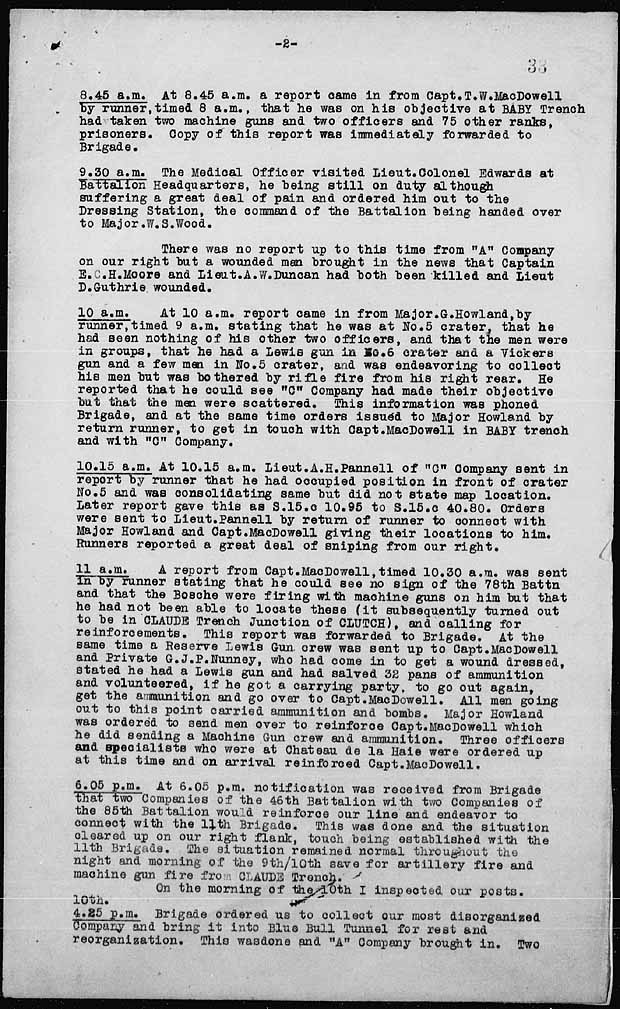
A typewritten page of the accounts of the day, from 8:45 a.m. to 6:05 p.m. The account starting at 11 a.m. states the following: “A report from Capt.MacDowell, timed 10.30 was sent in by runner stating that he could see no sign of the 78th Battn and that the Bosche were firing with machine guns on him but that he had not been able to locate these (it subsequently turned out to be in CLAUDE Trench Junction of CLUTCH), and calling for reinforcements. This report was forwarded to Brigade. At the same time a Reserve Lewis Gun crew was sent up to Capt. MacDowell and Private G.J.P. Nunney, who had come in to get a wound dressed, stated he had a Lewis gun and had salved 32 pans of ammunition and volunteered, if he got a carrying party, to go out again, get the ammunition and go over to Capt. MacDowell. All men going out to this point carried ammunition and bombs. Major Howland was ordered to send men over to reinforce Capt. MacDowell which he did sending a Machine Gun crew and ammunition. Three officers and specialists who were at Chateau de la Haie were ordered up at this time and on arrival reinforced Capt. MacDowell.”

Second page of the “Report on the operations of 38th Canadian Infantry Battalion, April 9th to 13th, 1917” from the War Diaries, 38th Canadian Infantry Battalion, April 1917, page 34 (MIKAN 1883252)

Private William Johnstone Milne was born in Cambusnethan, Scotland, and immigrated to Moose Jaw, Saskatchewan, in 1910. He enlisted in the 16th (Scottish) Battalion and was serving near Thelus, France, on the first day of the Battle of Vimy Ridge. That day, as the advance of Milne’s company was held up by a German machine gun, Milne crawled forward and captured the gun. When his company was on the move again, Milne targeted another machine gun in the German line and succeeded in silencing it. His citation for the Victoria Cross states that his “wonderful bravery and resource on these two occasions undoubtedly saved the lives of many of his comrades” (London Gazette, 8 June 1917, no. 30122, p. 5705). Private Milne was killed shortly after destroying the second German machine gun. His body was never recovered. He is commemorated on the Vimy Memorial, along with 11,000 other Canadians who died in France and have no known graves.

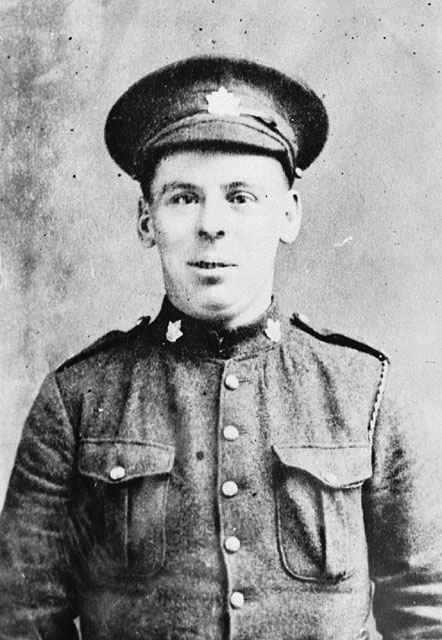
A black-and-white photograph of a man in uniform. His cap and collar are adorned with maple leaves, and he is looking directly at the photographer.

Private W.J. Milne, undated photograph (MIKAN 3357327)

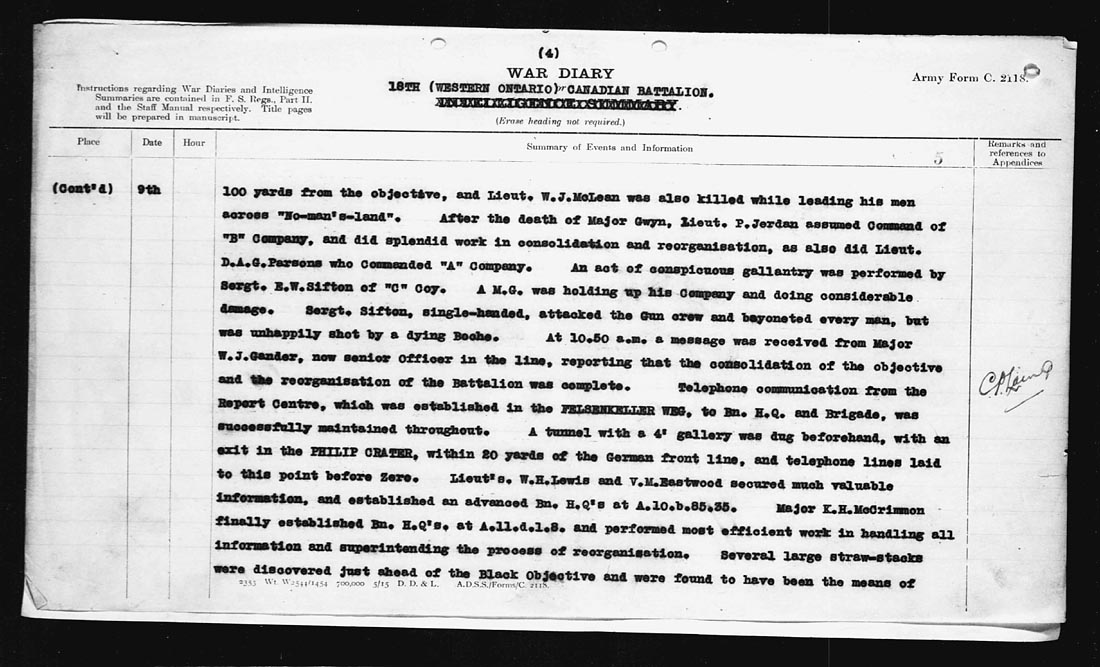
Lance-Sergeant Ellis Wellwood Sifton of Wallacetown, Ontario, enlisted with the 18th (Western Ontario) Battalion to serve as a battalion driver. Before the attack on Vimy Ridge, Sifton was asked to “take a chance with the boys in the front line,” a challenge he accepted. With his company under heavy machine-gun fire near Neuville-St. Vaast, France, Sifton located the German machine gun nest. He went through a gap in the wire, ran across open ground, charged the gun crew and managed to knock over the gun before fighting the gunners. As others in his company came forward, Sifton held off a German counter-attack (London Gazette, 8 June 1917, no. 30122, p. 5704). Just as he was about to be relieved, he was killed by a wounded German soldier.

A black-and-white photograph of two men adorning a makeshift grave with white stones in a desolate landscape that has patches of snow and frost on the ground. The grave is marked by a cross with the words “L.S. [Lance-Sergeant] E.W. Sifton, VC” and adorned with a maple leaf. Beside the grave is a larger cross with the words “RIP Canadian soldiers killed in action 9-4-17.”

Two comrades of the late Lance-Sergeant E.W. Sifton, V.C., 18th Battalion, visit his grave, February 1918 (MIKAN 3194451)

A typewritten account of the actions that led to Lance-Sergeant Sifton’s Victoria Cross medal: “An act of conspicuous gallantry was performed by Sergt. E.W.Sifton of ‘C’ Coy [Company]. A M.G. [machine gun] was holding up his Company and doing considerable damage. Sergt. Sifton, single-handed, attacked the Gun crew and bayoneted every man, but was unhappily shot by a dying Boche.”

War Diaries, 18th Canadian Infantry Battalion, April 9, 1917, page 6 (MIKAN 1883227)

Lance-Sergeant Ellis Wellwood Sifton of Wallacetown, Ontario, enlisted with the 18th (Western Ontario) Battalion to serve as a battalion driver. Before the attack on Vimy Ridge, Sifton was asked to “take a chance with the boys in the front line,” a challenge he accepted. With his company under heavy machine-gun fire near Neuville-St. Vaast, France, Sifton located the German machine gun nest. He went through a gap in the wire, ran across open ground, charged the gun crew and managed to knock over the gun before fighting the gunners. As others in his company came forward, Sifton held off a German counter-attack (London Gazette, 8 June 1917, no. 30122, p. 5704). Just as he was about to be relieved, he was killed by a wounded German soldier.

Library and Archives Canada holds the military service files for Captain Thain Wendell MacDowell, Private William Johnstone Milne and Lance-Sergeant Ellis Wellwood Sifton.

Launch of First World War personnel records database

We are pleased to announce an updated version of our “Service Files of the First World War, 1914-1918 – CEF” database. The new database, now called “Personnel Records of the First World War”, provides access to the service files of members of Canadian Expeditionary Force (CEF) along with records for other First World War personnel.

The new database includes records for the following groups:

Canadian Expeditionary Force

  • Imperial War Service Gratuities recipients
  • Non-Permanent Active Militia
  • Rejected CEF volunteers
  • Royal Newfoundland Regiment and Forestry Corps

Discover the Personnel Records of the First World War collection today!

And be sure to visit the First World War page of the Military Heritage section of our website for an overview of all our First World War records.

We wish to acknowledge the participation of the Provincial Archives Division of The Rooms corporation of Newfoundland and Labrador for access to its digitized personnel files.


Private John Chipman Kerr, VC

By Emily Monks-Leeson

As part of the First World War Centenary: Honouring Canada’s Victoria Cross recipients series, today we remember the life and military service of Canadian Victoria Cross recipient John Chipman “Chip” Kerr of Fox River, Nova Scotia.

A black-and-white photograph of two soldiers in uniform sitting on a bench. The man on the right is looking directly at the camera with a slight smile.

Private J.C. Kerr, VC, on the right. (MIKAN 3217379)

Prior to the war, Kerr worked as a lumberjack near Kootenay, British Columbia, and homesteaded in Spirit River, Alberta, with his brother, Charles Roland “Rollie” Kerr. When war was declared in 1914, the Kerr brothers, Chip and Rollie, went to Edmonton to enlist, leaving a note tacked to the door of their cabin that declared: “War is Hell, but what is homesteading?”

A black-and-white collage of three typewritten pages with the date September 15 in the margin and an hour-by-hour account of the actions taking place.

Account of the operations of the 49th Canadian Infantry Battalion from September 15–18, 1916. (MIKAN 1883261)

On September 16, 1916, Kerr was serving with the 49th Infantry Battalion of the Canadian Expeditionary Force (CEF) near Courcelette, France, not far from where Leo Clarke of the 2nd Battalion (Eastern Ontario Regiment) won the Victoria Cross the week before. Kerr’s actions on that day would earn him his own Victoria Cross. During a grenade attack carried out by his battalion, Kerr was the first bayonet man in a bombing party advancing on German positions. Recognizing that his unit’s bombs were running out, Kerr ran along the back ridge of the trench under heavy fire until he was close enough to the German troops to fire on them at point-blank range. Thinking they were surrounded, the German troops surrendered. Kerr’s citation in the London Gazette provides the details:

Sixty-two prisoners were taken and 250 yards of enemy trench captured. Before carrying out this very plucky act one of Private Kerr’s fingers had been blown off by a bomb. Later, with two other men, he escorted back the prisoners under fire, and then returned to report himself for duty before having his wound dressed. (London Gazette, No. 29802, October 26, 1916)

Chip Kerr survived the war, while his brother Rollie, also serving in the 49th Battalion, was killed in late December 1917. Kerr rejoined the army at the beginning of the Second World War, transferring to the Royal Canadian Air Force with the rank of Sergeant. He died in Port Moody, British Columbia, on February 19, 1963.

Mount Kerr, a 2,600-metre peak in Jasper National Park, is named after him, as is Chip Kerr Park in Port Moody, British Columbia.

Library and Archives Canada holds the CEF service file for Private John Chipman Kerr and his brother, Private Charles Roland Kerr.


Emily Monks-Leeson is an archivist in Digital Operations at Library and Archives Canada.

The Battle of Flers-Courcelette

By Alex Comber

Far from achieving their objectives, the Battles of the Somme, continuing into August 1916, had accomplished little, at enormous expenditure of lives and resources. The Battle of Flers-Courcelette, which took place September 15 to 22, 1916, was another attempt to achieve a decisive result on the Somme Front. Fighting as part of the British Reserve Army, the Canadian Corps, commanded by Sir Julian Byng, would contribute two of its infantry divisions to the left wing of a wider attack.

This was the first major offensive operation for the Canadians, and their first experience of the devastating human toll of combat in 1916. The battle began by a massive artillery bombardment of enemy positions, similar to the earlier Somme battles. This “creeping barrage” was better timed with the pace of advancing soldiers, and kept just ahead of them. Most enemy units did not have time to recover and prepare their defences before the Canadian infantry battalions were upon them.

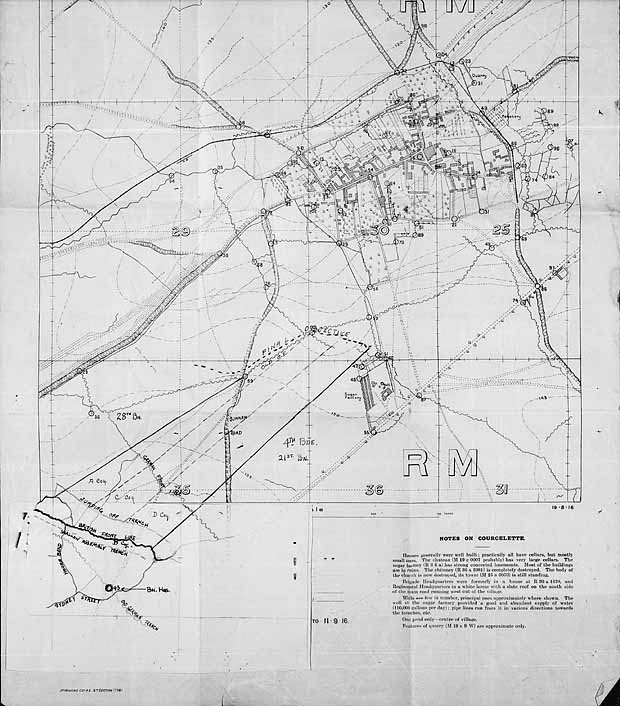
An image of a trench map, dated September 1916, showing the planned line of advance for the 27th Battalion near Courcelette, France.

This trench map, part of the War Diary of the 27th Battalion (City of Winnipeg), shows the planned lines of advance of this Battalion’s leading companies, from jumping-off trenches near Pozières (bottom left) toward the “final objective” just to the north of the sugar factory. Trench maps offer a wealth of detail, and this one shows the village of Courcelette at the top, and information about the other units that would advance on either flank of the 27th Battalion. (MIKAN 1883247)

Highlights of the successful advance of Canadian units included the capture of the village of Courcelette by Lt. Col. T.L. Tremblay’s 22nd Battalion (French Canadians) and the 25th Battalion (Nova Scotia Rifles) as well as the capture of the heavily fortified sugar factory east of the village by the 21st Battalion (Eastern Ontario). Elsewhere, the attack stalled, and hopes for a decisive success faded, as the Germans launched strong counterattacks or withdrew to fortified positions. Canadian units suffered approximately 24,000 wounded and killed soldiers during the operation.

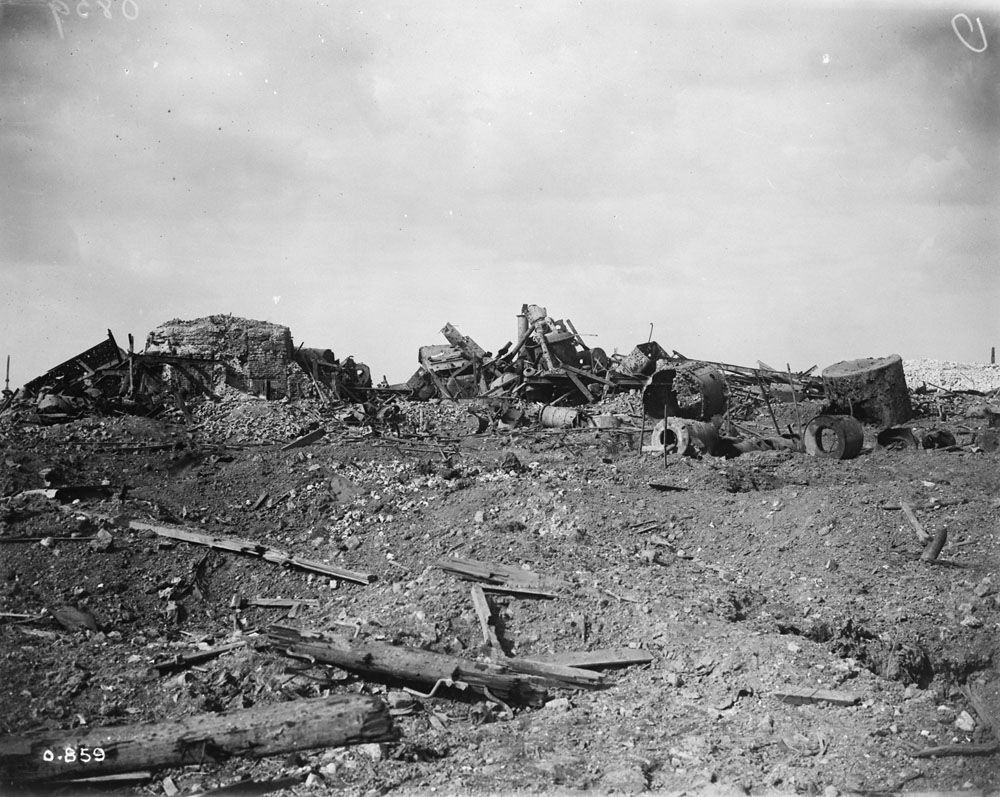
A black-and-white photograph of a ruined industrial building in a destroyed landscape.

This Canadian War Records Office official photograph of October 1916 shows the remnants of what was originally a sugar factory before the War following the bombardment and Canadian advance on the fortified German position. (MIKAN 3403776)

The first tanks, called “Land ships” appeared on the battlefields of Flers-Courcelette. They were slow, cumbersome, and mechanically unreliable, and most were put out of action or broke down before they could help the advancing soldiers. However, the few that remained operational destroyed fortified pillboxes and caused chaos in enemy lines. Lt. William Ivor-Castle, an official photographer working for the Canadian War Records Office, filmed tanks advancing to their starting positions, and these caused a sensation when published in England as the first photos of tanks “in combat.”

A black-and-white photograph of a British heavy tank advancing through a shell-cratered landscape.

This Mark 1 tank, named “Crème de Menthe,” was one of the most successful of those supporting the Canadian attack at Courcelette on September 15, 1916. Early tanks were painted with colourful “Solomon-style” camouflage. (MIKAN 3397296)


Alex Comber is a Military Archivist in the Government Archives Division at Library and Archives Canada.

Sergeant Leo Clarke, VC

By Emily Monks-Leeson

We continue our series First World War Centenary: Honouring Canada’s Victoria Cross recipients with the story of Sergeant Leo Clarke, Canada’s seventh First World War Victoria Cross recipient.

A black-and-white newspaper clipping of a photograph of a young man in uniform

Sergeant Leo Clarke, VC, died of wounds, c.1915-1916 (MIKAN 3214037)

Leo Clarke, born in Waterdown, Ontario, on December 1, 1892, was a surveyor for the Canadian National Railway. He enlisted in February of 1915 at Winnipeg with the 27th Battalion and transferred to the 2nd (Eastern Ontario Regiment) Battalion after arriving in England.

On September 9, 1916, Leo Clarke and the 2nd Battalion took part in an Allied assault on a network of German trenches stretching from Martinpuich to Courcelette in northern France. Clarke’s battalion was to capture a 50-yard area between Mouquet Farm, a Canadian-held position, and Courcelette. An Acting-Corporal at the time of the attack, Clarke led a party to clear the left flank of a German trench and create a “block” to fortify the Canadian position. The trench was heavily defended and, following bitter hand-to-hand combat, Clarke was the only member of his unit not killed or wounded. Alone he fought off a counter-attack of twenty German soldiers and officers.

A black-and-white handwritten page describing the day to day actions of the battalion.

War diary extract from the 2nd Canadian Infantry Battalion from September 1-9, 1916 describing the days leading up to and including the offensive (MIKAN 1883206)

Clarke’s citation from the London Gazette recounts that:

After most of his party had become casualties, he was building a “block” when about twenty of the enemy with two officers counter-attacked. He boldly advanced against them, emptied his revolver into them and afterwards two enemy rifles which he picked up in the trench.

One of the officers then attacked him with the bayonet, wounding him in the leg, but he shot him dead. The enemy then ran away, pursued by Acting Corporal Clarke, who shot four more and captured a fifth. Later he was ordered to the dressing-station, but returned next day to duty. (London Gazette, no. 29802, 26 October 1916).

Leo Clarke died in action a month later, on October 19, 1916. His Victoria Cross, posthumously awarded in the spring of 1917, was presented to his father by the Duke of Devonshire, Governor General of Canada, before a crowd of 30,000 gathered at Portage and Main in Winnipeg.

A black-and-white photograph of a group of soldiers in uniform in a field.

Bombing Platoon (2nd Battalion, Canadian Expeditionary Force) at Scottish Lines near Poperinghe not far from Ypres. This photo was taken by Henry Edward Knobel – an Official War Photographer – while the 2nd Battalion was out in rest billets after fighting at Sanctuary Woods, Maple Copse (Battles of the Somme). Leo Clarke, VC, is in the front row on the far right. June 16, 1916 (MIKAN 34005888)

Sergeant Leo Clarke lived on Pine Street in Winnipeg, Manitoba, as did two other Victoria Cross recipients: Frederick William Hall and Robert Shankland. Pine Street was renamed Valour Road in 1925 in honour of the three men.

Library and Archives Canada holds the service file for Sergeant Leo Clarke.


Emily Monks-Leeson is an archivist in Digital Operations at Library and Archives Canada.
Lieutenant Thomas Orde Lawder Wilkinson, VC

Today our series First World War Centenary: Honouring Canada’s Victoria Cross recipients remembers Lieutenant Thomas Lawder Wilkinson of the 7th Battalion, Loyal North Lancashire Regiment, British Expeditionary Force, who was awarded the Victoria Cross for his actions on the Somme battlefields one hundred years ago today on July 5, 1916.

Lieutenant Wilkinson was born in Shropshire, England, and immigrated with his family to Canada prior to the First World War. On September 23, 1914, he enlisted with the 16th Battalion, Canadian Scottish, Canadian Expeditionary Force (CEF), later transferring to the Loyal North Lancashire Regiment, to serve as a Gunnery Officer. It was with this unit that Wilkinson found himself fighting in the Battle of the Somme.

A black-and-white photograph of a young man wearing a cap and uniform and gazing beyond the photographer.

Lieutenant Thomas Orde Lawder Wilkinson, VC, undated (AMICUS 2715209)

Four days after the most devastating single day in the history of the British forces, Wilkinson and two other men were fighting their way to a forward machine gun, recently abandoned by a retreating party of British soldiers. On their own they succeeded in holding up advancing German soldiers until another unit was able to reach and reinforce them. Later that day, Lieutenant Wilkinson reached several men of different units trapped at a wall of earth over which German troops were throwing bombs. His citation in the London Gazette recounts how:

With great pluck and promptness [Wilkinson] mounted a machine gun on the top of the parapet and dispersed the enemy bombers. Subsequently he made two most gallant attempts to bring in a wounded man, but at the second attempt he was shot through the heart just before reaching the man. Throughout the day he set a magnificent example of courage and self-sacrifice (London Gazette, 26 September 1916).

A black-and-white photograph of four soldiers carrying a stretcher with a shrouded body on it through a devastated landscape.

Bringing in the Dead on the Somme Battlefields, July 1916, Canadian War Records Office (MIKAN 3520928)

The body of Lieutenant Thomas Orde Lawder Wilkinson was never recovered. He is commemorated on the British Memorial to the Missing at Thiepval, France.

Library and Archives Canada holds the CEF service file for Lieutenant Thomas Orde Lawder Wilkinson.

Honouring Canada’s Victoria Cross recipients: Lieutenant Frederick William Campbell, VC

Frederick William Campbell, a lieutenant in the 1st (Western Ontario) Battalion, Canadian Expeditionary Force (CEF), was awarded the Victoria Cross for his actions on June 15 1915, 100 years ago today. This also happened to be Campbell’s 48th birthday.

Black and white photograph of a man in uniform looking directly at the camera

Portrait of Lieutenant Frederick William Campbell, VC, undated. Note the superimposition of another photograph in the lower right corner (MIKAN 3213625)

Stationed at the front line near Givenchy, France, Lieutenant Campbell led an assault on a heavily fortified German trench line. Under heavy fire, he held his place in the assault as nearly all of his men became casualties. Intent on covering the withdrawal of those men still able to escape, Campbell and another soldier moved up with two Colt machine guns to an exposed position and successfully held back a German counter-attack.

Black and white copy of a handwritten page describing the events of June 15, 1915

Page from the war diaries of the 1st Canadian Infantry Battalion on June 15, 1915 (MIKAN 1883204)

His citation in the London Gazette tells of how Campbell:

“… arrived at the German first line with one gun, and maintained his position there, under very heavy rifle, machine-gun, and bomb fire, notwithstanding the fact that almost the whole of his detachment had then been killed or wounded.

When our supply of bombs had become exhausted, this Officer advanced his gun still further to an exposed position, and, by firing about 1,000 rounds, succeeded in holding back the enemy’s counter-attack” (London Gazette, no. 29272, August 23, 1915).

As he retreated, Lieutenant Campbell’s right thigh bone was hit and shattered. He died in hospital from an infection of his wound four days later.

Frederick William Campbell was born in Mount Forest, Ontario on June 15, 1869. He also served in both the Canadian Militia and the Machine Gun section of the 2nd Battalion, The Royal Canadian Regiment, during the South African War. He is buried at Boulogne Eastern Cemetery, Boulogne, France.

Library and Archives Canada holds the CEF service file for Lieutenant Frederick William Campbell.

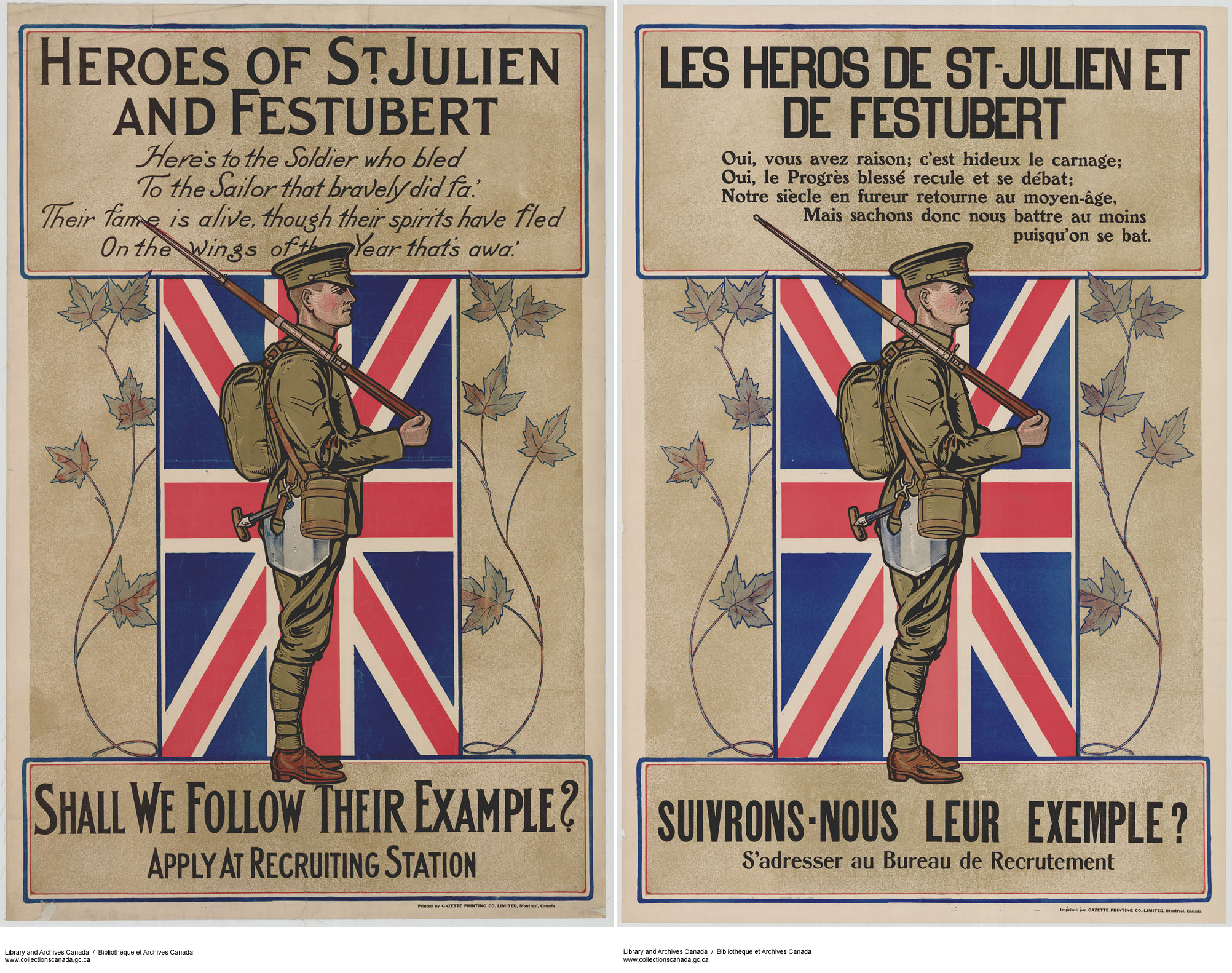
1915: Would you follow this example?

The recruiting posters below are part of a remarkable collection of more than 4,000 posters from many combatant nations, acquired under the guidance of Dominion Archivist Dr. Arthur Doughty as part of a larger effort to document the First World War.

Image of two posters side by side, one in English and one in French. The imagery shows a soldier standing sideways, in front of the Union Jack, with a rifle balanced on his shoulder. He is wearing the uniform and equipment of the 1915 Canadian soldier: Ross rifle, pack, cap, puttees, and MacAdam shield-shovel (also known as the Hughes shovel).

An English and French version of a poster using the same imagery, but with text conveying very different motivations. (MIKAN 3667198 and MIKAN 3635530)

As the deadly stalemate on the Western Front continued through 1915, warring nations were forced to organize recruitment drives to raise new divisions of men for the fighting. The two battles referenced in the poster were certainly not great victories for the Canadian Expeditionary Force, which had only recently commenced military operations. The desperate defence at St. Julien, an action during the Second Battle of Ypres, along with the inconclusive May 1915 Battle of Festubert, were all that authorities had to draw upon to raise fresh troops for service overseas.

The sentimental verse and patriotic imagery was conventional for this type of poster. It would appeal to Canadians with strong ties to Britain, but would offer little encouragement to French Canadians, First Nations’ communities, or to other groups to sign up. One interesting element is that the text is not a simple translation: in English the theme is heroic sacrifice, whereas in French it is about ending the carnage and restoring “progress.”

These posters offer a realistic depiction of a soldier early on in the war. This lance-corporal is armed with the Ross rifle, whose serious defects have featured in Canadian histories of the First World War. He is wearing short ankle boots and puttees (long lengths of cloth wrapped around his calves), which were cheaper to manufacture than knee-length boots but offered less protection from cold or wet. Steel helmets had not yet been developed, leaving his head and upper body vulnerable to any flying debris or shrapnel.

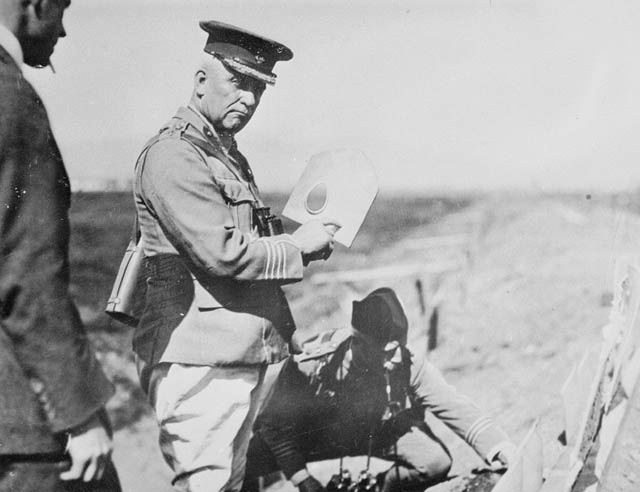
He is also burdened by the MacAdam shield-shovel (hanging at his hip). This invention was the result of a collaboration between Minister of Militia Sir Sam Hughes, and his secretary, Ena MacAdam. It attempted to combine a personal shield with a shovel. The shovel blade had a sight hole in it that was supposed to allow a soldier lying on the ground to aim and fire his rifle through the hole while shielded behind its protection. However, the shovel was too heavy and dirt would pour through the hole. Also, the shield was too thin to stop German bullets! Thankfully, this failed multi-tool quietly disappeared from the standard equipment issued before the First Division crossed from England to France. This poster is an important artifact of its time. It shows that in 1915, Canadians soldiers fighting overseas still had a very long road ahead of them.

Black-and-white photograph showing three men, two are clearly in uniform. One officer (Minister of Militia Sam Hughes) is holding the MacAdam shield-shovel which is a spade-shaped piece of metal with a hole on one side, while the other officer is kneeling on the ground doing something indiscernible. The third is looking at the spade.

Sam Hughes holding the McAdam shield-shovel (MIKAN 3195178)

Related resources