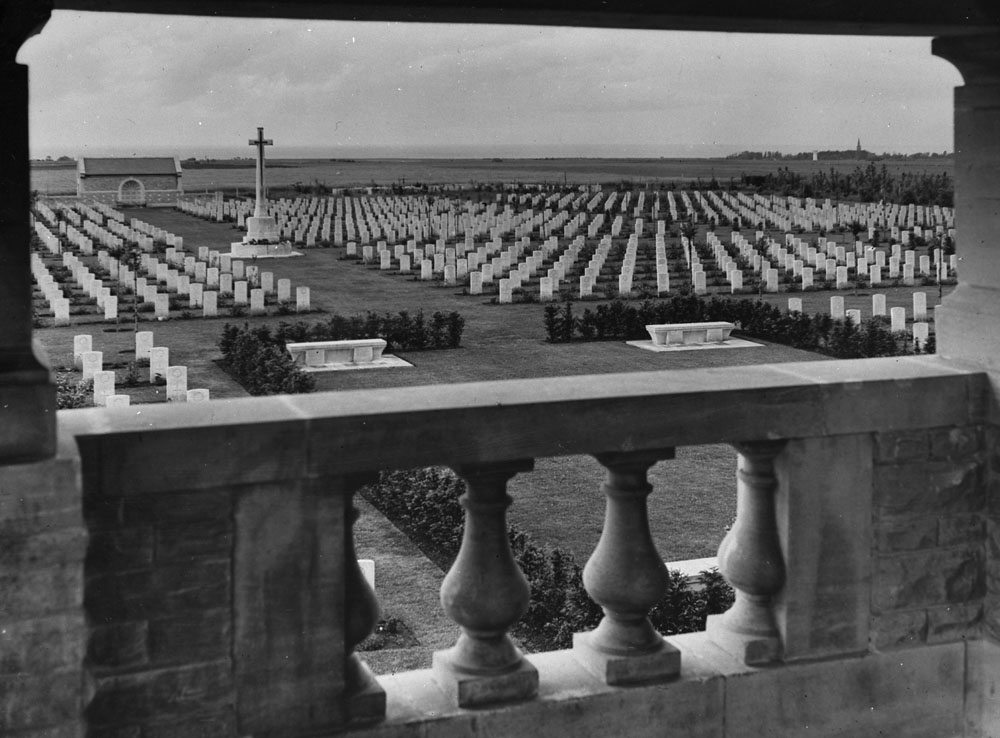
My Dear Friend: Letters from Normandy to our Canadian Soldiers

Version française

By Ariane Gauthier

As part of my work as a reference archivist at Library and Archives Canada (LAC), I often find myself delving into the many documents in the Second World War collection. Many people around the world are interested in the history of Canadians in this conflict and, more specifically, in the experiences of our soldiers. What I find even more fascinating is how the quest begins for the researchers I am lucky enough to work with. The starting point is often a personal story, passed down in a family or a small community: “I found out that my mother served in the Royal Canadian Air Force” or “I heard that my village hid a Canadian spy during the Second World War.” This is enough to fuel the fire of researchers, who then dig to find evidence or fill in these stories with new details.

My colleagues and I participate in this quest on an ad hoc basis, mainly to facilitate access to documents from LAC’s vast collection. When circumstances allow, we delve into the information in these documents in search of relevant details that can help researchers piece together the story they seek to understand.

That is how I found three letters from Normandy addressed to our Canadian soldiers. Unfortunately, the context of the letters, including the identity of the recipient, remains a mystery. I found these letters in a file from Royal Canadian Air Force headquarters (Reference: R112, RG24-G-3-1-a, BAN number: 2017-00032-9, Box number: 30, File number: 181.009 (D0624)). This file documents the experiences of Canadian soldiers who were captured and interned in prison camps during the Second World War. It also contains transcripts of interviews about the soldiers’ experiences.

In this case, the three letters are not linked to specific interviews and are included in this file as loose sheets. There is no correspondence explaining why they were placed in this file. Nor is it known whether these were letters addressed to soldiers who had been taken prisoner during the war. The information in these letters is truly the only information we have. In reality, though it may not seem like much, these three letters tell us a great deal about the experience of soldiers in Normandy and of the French, especially the risks faced by those who resisted the Germans.

Here are the letters in question:
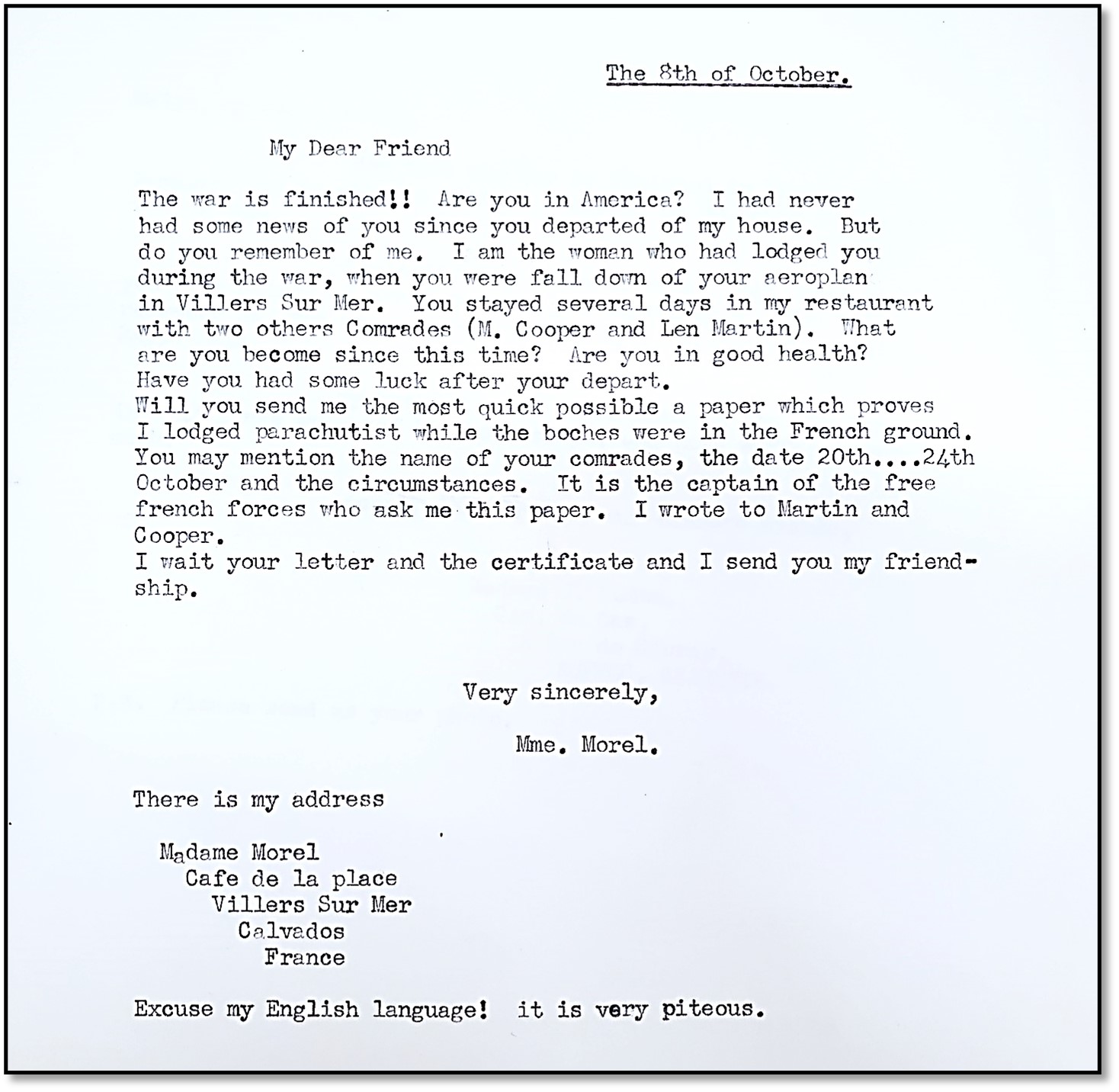
Letter to a Canadian soldier from Mrs. Morel, written on October 8. The year is not indicated on the letter. We only know that it was written and sent once the war was over.

Letter to a Canadian soldier from Mrs. Morel, dated October 8 (MIKAN 5034948)

In this first letter, we discover part of the story of Mrs. Morel, who apparently sheltered one of our soldiers after he jumped from a plane near Villers-sur-Mer. We learn that this soldier was a paratrooper and that he had taken refuge in Mrs. Morel’s restaurant with two of his fellow soldiers, M. Cooper and Len Martin, while the village was still under German occupation.

Letter written by Mrs. J. Cottu, expressing her desire to receive news of the soldier she sheltered in November 1943.

Letter to a Canadian soldier from Mrs. J. Cottu (MIKAN 5034948)

This second letter gives us a glimpse into the story of Mrs. J. Cottu and could possibly be related to that of the paratrooper mentioned in Mrs. Morel’s letter. Without more specific information, it is difficult to confirm this hypothesis, but the second letter refers to a Sergeant Martin (possibly Len Martin?) and places his departure in November. Mrs. Morel stated that she had taken in the soldier at the end of October, without specifying the year, so everything could fit together chronologically.

Mrs. J. Cottu mentions having housed three soldiers in her house in Ruffec in November 1943: the recipient of the letter, Sergeant Martin and Captain Ralph Palm. Although this story seems to have gone well, she said that she was arrested by the Gestapo in 1944 because of her husband’s activities. The seriousness of the situation is clear from this confession: “I was arrested by the Gestapo, and have suffered very much.”
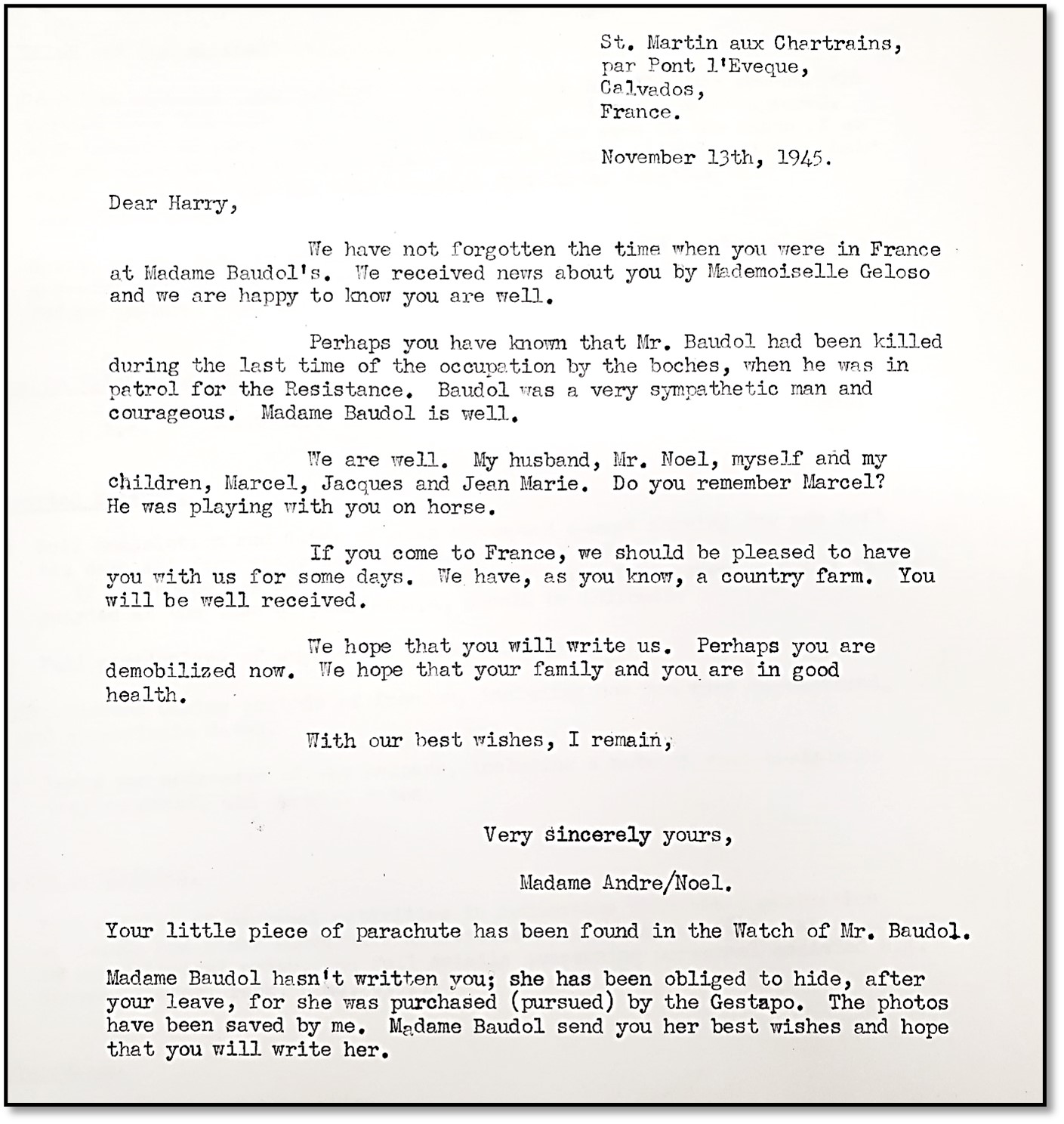
Letter written by Mrs. Noel to check on Harry and give him news about the French people he met during his stay in Saint-Martin-aux-Chartrains.

Letter to Harry from Mrs. Andre Noel, dated November 13, 1945. (MIKAN 5034948)

In this third letter, Mrs. Noel clearly illustrates the dangers that members of the Resistance faced. She bears the burden of announcing the death of Mr. Baudol, a member of the Resistance, who was killed while on patrol. She also shows us the strong bonds that Harry seems to have formed with the residents of Saint-Martin-aux-Chartrains. Although this letter expresses suffering, grief and fear, it also highlights the bravery and sacrifice of three families who came to the aid of a Canadian soldier.


Ariane Gauthier is a reference archivist with the Access and Services Branch at Library and Archives Canada.

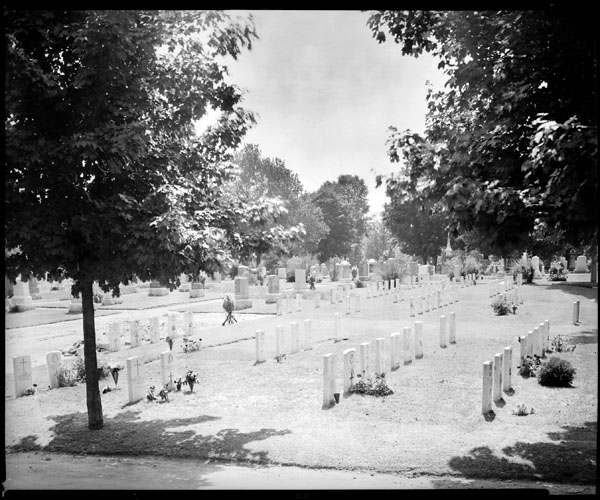
Far in distance, but near at heart: the thorny issue of Canadian war graves

By Ariane Gauthier

Many Canadian war graves and military cemeteries have been established around the world, as a result of the conflicts in which Canada has been involved since Confederation (1867), from the Boer War (1899–1902) in South Africa to the conflict in Afghanistan (2001–14).

Three graves of Canadian soldiers who died in the Boer War (1899–1902).

The graves of soldiers Elliott, Laming and Devereaux, killed in the South African War (e006610211).

Photo of military cemetery in Ottawa, Ontario, taken by renowned photographer Yousuf Karsh on August 13, 1934.

Colonel H.C. Osborne, war graves (e010679418_s1).

The Canadian cemetery at Bény-sur-Mer in France, where Canadian soldiers who lost their lives during D-Day and the Battle of Normandy in 1944 are buried.

Canadian military cemetery at Bény-sur-Mer, France (e011176110).

The Canadian cemetery in Agira, Italy, where Canadian soldiers who died during the Sicily campaign in 1943 are buried.

Canadian cemetery in Agira, Sicily (e010786150).

War cemetery in Japan, where Canadian soldiers who were killed during the Korean War (1950–53) are buried.

Mrs. Renwick lays a wreath on behalf of Canadian mothers and wives on Remembrance Day in Japan (a133383).

Have you ever wondered why so many Canadian families allowed for the final resting place of their loved ones to be where they fell in combat?

Quite simply, because it was the only option—at least, initially.

To understand, we must delve into the context of the First World War, the first mass industrial war. The technological and military advances of the modern era caused skyrocketing mortality rates. As a result, the British Empire had to manage the rapid recruitment of reinforcements in addition to the thousands of deaths in a war where the repatriation of bodies was practically impossible if not discouraged. It was dangerous to search for remains in active combat zones, and moving so many corpses could easily have led to worldwide epidemics. That said, the door remained open to changing the status quo once hostilities were over. On May 10, 1917, the Imperial War Graves Commission was created by Royal Charter, with a mandate to look into the issues of deceased soldiers and war cemeteries for the entire British Commonwealth.

Text document dated May 10, 1917, written by J.C. Ledlie, from “At the Court at Buckingham Palace, Present, The King’s Most Excellent Majesty in Council.”

War Office (United Kingdom) – Imperial War Graves Commission – Charter (MIKAN 1825922).

There was no consensus among families regarding the question of cemeteries being maintained in perpetuity. Lively debates about the war graves issue took place in many parliamentary institutions. Speakers appealed to the humanity and compassion of politicians, so that the families of fallen soldiers could bring home the bodies of their fathers, brothers, husbands or sons, and in some cases, their sisters and daughters. However, no petition could change the verdict issued by the Imperial War Graves Commission:

Two-page text document explaining that the repatriation of soldiers’ bodies is not permitted.

War Office (United Kingdom) – Imperial War Graves Commission – Refusal to permit removal of bodies from countries in which they are buried (MIKAN 1825922).

“To allow removal [of war dead] by a few individuals (of necessity only those who could afford the cost) would be contrary to the principle of equality of treatment; to empty some 400,000 identified graves would be a colossal work, and would be opposed to the spirit in which the Empire had gratefully accepted the offers made by the Governments of France, Belgium, Italy and Greece to provide land in perpetuity for our cemeteries and to “adopt” our dead. The Commission felt that a higher ideal than that of private burial at home is embodied in these war cemeteries in foreign lands, where those who fought and fell together, officers and men, lie together in their last resting place, facing the line they gave their lives to maintain. They felt sure (and the evidence available to them confirmed the feeling) that the dead themselves, in whom the sense of comradeship was so strong, would have preferred to lie with their comrades. These British cemeteries in foreign lands would be the symbol for future generations of the common purpose, the common devotion, the common sacrifice of all ranks in a united Empire. […]”

This decision ensured that Canadians who had died overseas during the First World War remained on those fields of honour. The cemeteries that were built in their memory can still be visited today; they are maintained by the Imperial War Graves Commission, now the Commonwealth War Graves Commission. On July 15, 1970, Canada’s policy on the repatriation of soldiers who had died overseas changed. Order in Council P.C. 1967-1894 stated that the family of a soldier killed in action on or after that date could request his or her repatriation for a funeral. The loved ones of deceased service members can now have them brought home.

Additional resources


Ariane Gauthier is a reference archivist in the Access and Services Branch at Library and Archives Canada.