Porter Talk

By Stacey Zembrzycki

This article contains historical language and content that some may consider offensive, such as language used to refer to racial, ethnic, and cultural groups. Please see our historical language advisory for more information.

Stanley Grizzle was born in Toronto in 1918, to parents who had immigrated separately from Jamaica in 1911. His mother laboured as a domestic servant while his father found work as a chef with the Grand Trunk Railway (Grizzle, My Name’s Not George, p.  31). The eldest of seven children, Grizzle became a porter for the Canadian Pacific Railway (CPR) at the age of 22, pulled away from school to help his parents meet their dire financial obligations. “Porters,” as he puts it in his memoir My Name’s Not George: The Story of the Brotherhood of Sleeping Car Porters in Canada, “were well respected, and looked up to by many in the community because they had steady employment. In essence, they were the aristocrats of African-Canadian communities. They were the most eligible bachelors and parents often encouraged their daughters to marry a porter” (p. 37).

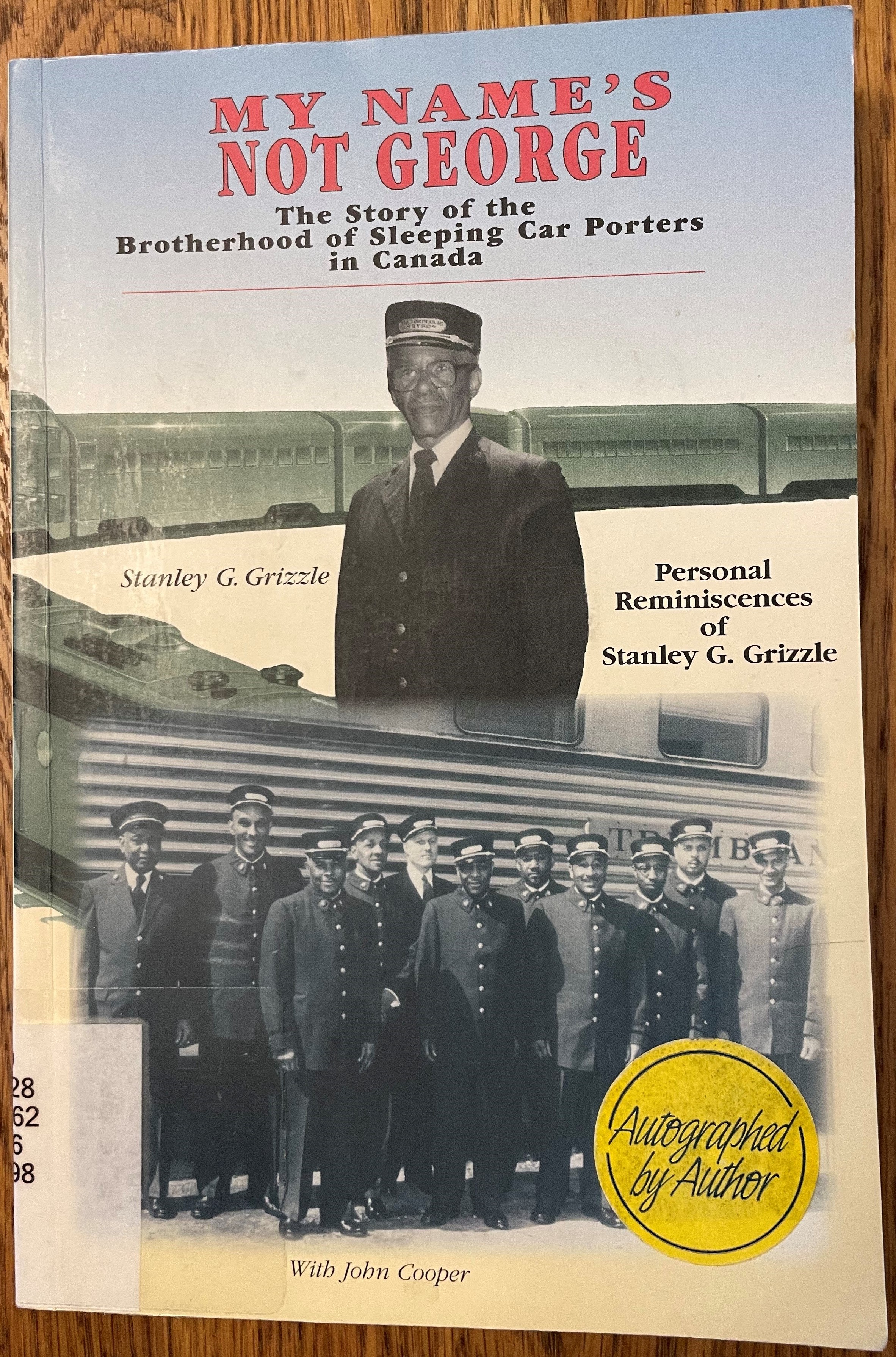
Book cover featuring a man with a train behind him, and a group of men below, all dressed in uniforms.

Book cover of My Name’s Not George: The Story of the Brotherhood of Sleeping Car Porters in Canada: Personal Reminiscences of Stanley G. Grizzle (OCLC 1036052571). Image courtesy of the author, Stacey Zembrzycki.

Grizzle’s early life began to follow this well-established trajectory, especially since portering was one of the only employment options available to Black men in the mid-twentieth century, until it was interrupted by the realities of the Second World War. Conscripted into the Canadian Army in 1942—legislation he firmly opposed throughout his life—Grizzle spent an extended amount of time away from the family he had only just started. In fact, his first child, Patricia, arrived on the very day he departed for Europe and did not have the opportunity to meet her father until he returned home, when she was three years old (Grizzle, My Name’s Not George, p. 57).

Grizzle’s early experiences with poverty, and the racism he encountered as a porter and a soldier, went on to dictate the new career path he paved for himself. First, as a celebrated labour union activist with the Toronto division of the Brotherhood of Sleeping Car Porters (BSCP), then as the first Black Canadian to be employed by the Ontario Ministry of Labour as a clerk with the Ontario Labour Relations Board, and later as the first Black Canadian to be appointed as a judge in the Court of Canadian Citizenship. There is no doubt that these experiences also informed the interviews he conducted in 1986 and 1987, now held by Library and Archives Canada (LAC).

As I mentioned in a previous blog, these 53 informal conversations among friends and acquaintances constituted what many, including Melvin Crump, referred to as “porter talk.” Meeting in Crump’s Calgary living room on November 1, 1987, the two men spent the afternoon discussing the intricacies of what it meant to be a porter. Not only did they describe what the job signified for them as Black men, they also explained how it shaped their identities and the larger Black communities that supported them.

Having been born in Edmonton in 1916 after his parents immigrated in 1911 as homesteaders from Clearview, Oklahoma, Crump’s early circumstances were much different from Grizzle’s. However, the men had both experienced the abject racism that was central to Black experience in Canada, which ultimately led them to a career with the CPR. Like Grizzle, Crump went to work for the company because it offered stable employment, away from the meatpacking plants and farms in the region that provided little stability and paid poor wages. In fact, Crump knew that this would be the only way to get ahead, so he lied about his age to obtain a job when he was just nineteen years old, thereby defying the age restriction that limited employment to those over twenty-one.

Like Grizzle, Crump spent about twenty years working for the CPR before seeking employment beyond the rails. The move from steam to diesel engines, coupled with automation, drastically changed the size, shape and appearance of this labour force, as well as passenger experience forever. As they had always done, the men moved toward a secure future. Regardless of their similar but divergent histories, both men prided themselves on having done their jobs well, and continued to stress the inherent value of unionization, regardless of the risks, nearly thirty years after leaving portering.

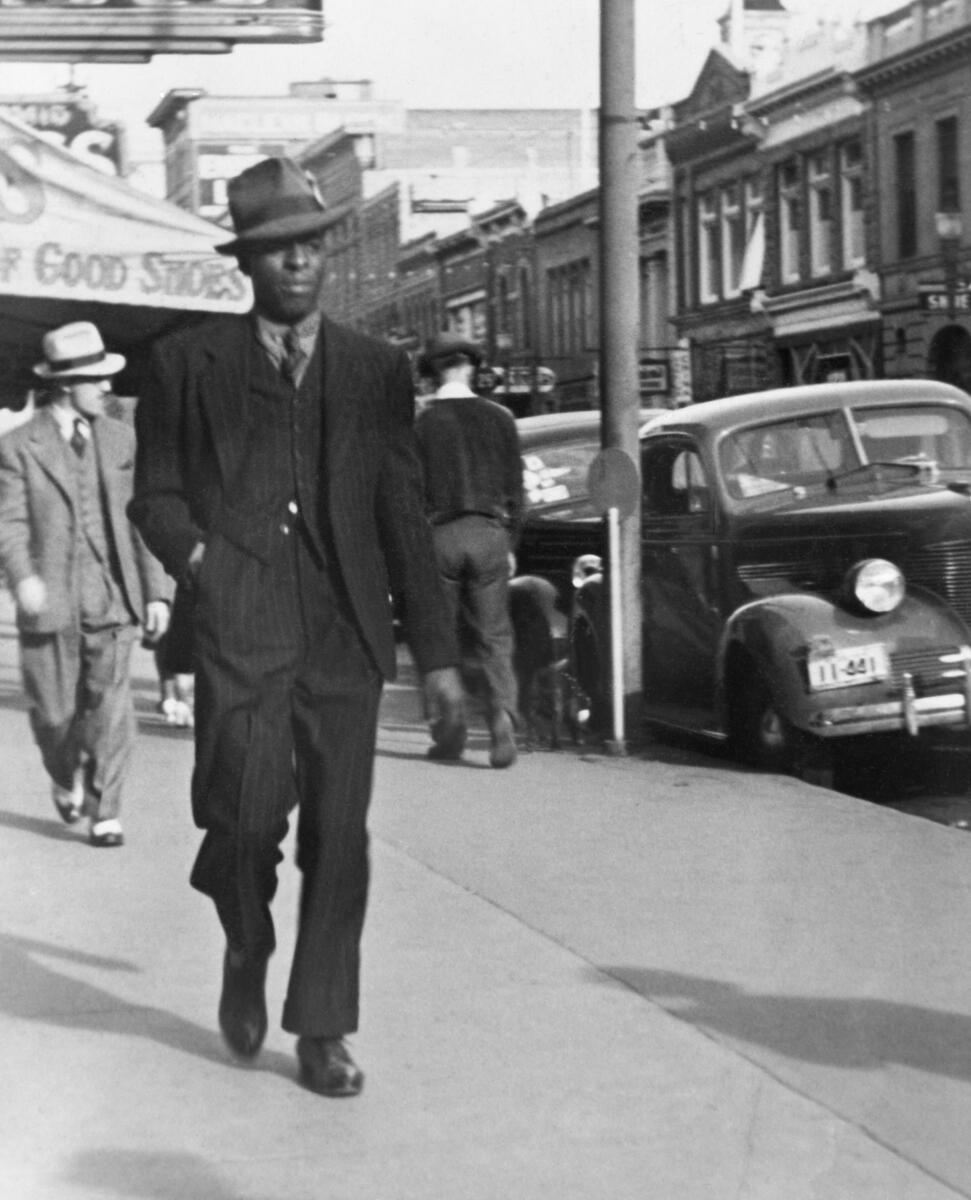
A man in a suit and hat walking down a sidewalk lined with cars and buildings.

Melvin Crump on 8th Avenue, Calgary, Alberta, ca. 1940, (CU1117465).
Photograph: Collection, Libraries and Cultural Resources Digital Collections, University of Calgary.

There is a coded language to this conversation. It is implicit, organic and almost impossible to understand without having lived through the institutional racism and systemic segregationist policies that guided nearly every aspect of these men’s lives, on and off the rails (Mathieu, North of the Color Line). The conversation is warm, the laughter is heartfelt, and the experiences intersect in complex ways. There is no need for detailed explanations between the men. These conversations were meant to support the writing of Grizzle’s memoir. While he was committed to documenting and preserving the history of portering in Canada, one wonders if these conversations were meant to be heard by others. And yet, here we are, listening in, translating their meaning and breaking the coded nature of these exchanges nearly forty years later.

By pushing Crump to articulate the particular circumstances that defined his experiences in Calgary—the friendships that were made, nurtured and even broken there, the specifics of unionization within that branch and the role of the wider community in fighting for change and supporting porters and their families—Grizzle highlighted the similar ways in which porters across the country were bound together by this demanding and often degrading profession.

And yet these intersections, which we hear across the collection, quickly become more complex when Grizzle asks Crump, as he did with all interviewees, to recount memorable railroad anecdotes. Porter talk offers insight into how each man put one foot in front of the other and built a life around portering. We get brief but powerful glimpses of who these men were, how they saw the world and why they tolerated and overcame the abuse they endured daily. As we gain a superficial understanding of each man’s personality, we also hear about resilience. Stories about memorable passengers naturally shift to stories about the other Black men with whom they shared railcars and responsibilities. The sense of community among porters and the conversations that started on the trains and flowed over into these interviews are what make these recordings so special. The laughter, reinforced by years of hindsight, reflection, recognition of service and a job well done, fuels the jovial exchanges that lead us into the realm of porter talk.

When Grizzle asked Crump to tell him about the prominence of nicknames between porters, Crump let out a roaring laugh, declaring:

Oh nicknames used between porters? Oh-oh-oh-oh, yes. Yeah, I know what you mean. You mean porter talk? You mean porter talk? Well, uh, uh, some of the porter talk names I wouldn’t wanna mention on tape, because if I did uh, it would shock some of the readers or some of the listeners, but they had a language all of their own, I’ll tell you. And some of the conversations that they would get in between themselves. I couldn’t dare, I wouldn’t dare to start to-to mention none of those things. (Interview 417403, File 2 [22:33])

And yet, porter talk is exactly what he, and nearly all of Grizzle’s other interviewees, transmit on these recordings. He couldn’t dare and yet he does. We are offered a seat at the proverbial table to listen, learn and take in a world that no longer exists, and yet remains central to who we are as Canadians.

It is this passing reference that inspired Discover Library and Archives Canada’s new miniseries Porter Talk. This will be the first in a new podcast production entitled Voices Revealed, which will delve into the vast and rich oral history holdings at LAC. While porters have figured prominently in popular culture in recent years, this will be the first time that these men, along with their wives and children, will speak for themselves. It is not enough to write about their exceptional experiences. Readers must hear these narratives. They must be able to differentiate accents, listen to laughter alongside rage, pause to ponder the challenges of portering and the resilience of Black communities in Canada, and grasp the power in these men’s voices and the history they convey.

Grizzle, Crump and all those who graciously agreed to be interviewed, will guide us through this history on their own terms, revealing why it is imperative for us to keep listening, to keep remembering, and to keep porter talk alive, especially as we continue to navigate the many challenges posed by institutional and systemic racism and discrimination in this country and beyond. The structures that these men, alongside their wives and children, worked so hard to dismantle, continue to matter. These voices remind us of the work that remains to be done.

To listen to this miniseries, you can subscribe to Discover Library and Archives Canada for free wherever you get your podcasts.

Additional resources


Stacey Zembrzycki is an award-winning oral and public historian of immigrant, ethnic, and refugee experiences. She is currently employed as a Podcast Development Specialist in the Outreach and Engagement Branch at Library and Archives Canada.
The Ladies’ Auxiliary of the Brotherhood of Sleeping Car Porters

By Stacey Zembrzycki

This article contains historical language and content that some may consider offensive, such as language used to refer to racial, ethnic and cultural groups. Please see our historical language advisory for more information.

Stanley Grizzle, citizenship judge, politician, civil servant, labour union activist, and porter of twenty years, travelled across the country in the late 1980s documenting the experiences of Canadian Pacific Railway (CPR) sleeping car porters and their struggle to unionize. His questions about the creation of the Brotherhood of Sleeping Car Porters (BSCP) always went hand in hand with those that documented the important role played by Black women in the BSCP’s Ladies’ Auxiliary.

Ten members of the Toronto Pullman Division’s Ladies Auxiliary posing for a photo.

Ladies Auxiliary, Toronto Pullman Division, Brotherhood of Sleeping Car Porters (e011181016)

While documenting the male “stalwarts,” as he called them, Grizzle was careful to ask about the mothers, sisters, wives, and daughters, who often lingered in this movement’s background, as well as in the background during these recorded sessions. The Stanley Grizzle Interview Collection thereby provides important gendered and generational perspectives into the forces that made unionization possible in Black communities across Canada. It also shows how involvement in the BSCP and its Ladies’ Auxiliary tended to serve as starting points for community mobilization around a broad array of issues and training grounds for community leaders.

Union leaders, inspired by A. Philip Randolph, an American labour unionist and civil rights activist as well as the organizer of the BSCP in the United States, recognized early on that women had integral roles to play in founding and sustaining this union movement. As Essex Silas Richard “Dick” Bellamy recalled:

I shall never forget when Brother Randolph came to Calgary, and Brother Benny Smith, he says, “There is no organization [that] will ever be successful unless the ladies are permitted into that organization.” And I have never forgotten, and I don’t believe you can find very many organizations [where] the ladies are…are not affiliated with the men in these various organizations. They seem to be able to give the men, uh-uh, a little more incentive to…in, in order to help them out. (Interview 417401)

Frank Collins succinctly echoed this sentiment: “…[You] had to have the women behind you before you had a strong union because, if you didn’t have them working with you, you were nowhere.” (Interview 417402)

Women’s solidarity was deeply rooted in the realities of the job. Being a porter required men to be on the road for as long as a month at a time. In their absence, porters’ wives, mothers, sisters, and daughters played principal roles, moving throughout their Black communities to encourage and promote the creation of the BSCP among both men and women, actively recruit and “card” porters at their local train stations and in their churches and community organizations, and, once the union was created, collect union joining fees and dues. Like other women, Velma Coward King, who was active in the Montreal BSCP Ladies’ Auxiliary, recognized the challenges of unionizing these men early on, noting that long stints away from home meant the men could not regularly attend meetings. Given that “[it] was the woman who was the back, uh, backbone in the house of the family,” they needed to step in. This was the only way forward, as she made clear, recognizing that: “Once you had a union to represent you and to speak for you, they knew that they couldn’t treat you as dirt.” (Interview 417383)

The power inherent in this aspect of the collection lies in its ability to tell the story of how upward mobility manifested out of unionization and women’s efforts to make that possible. The collective agreements that resulted from community solidarity led to improved working conditions and higher salaries, which, in turn, gave families the ability to move to suburbs, where they purchased homes. It also meant that there was money left over to help send children to university. Most importantly, as the Winnipeg BSCP’s Ladies’ Auxiliary first President Helen Bailey surmised: “I think men then became to even feel respect for themselves because then they had, uh, they were making a worthwhile living for their families.” (Interview 417400)

Poster advertising the tenth anniversary dance of the Toronto Division of The Brotherhood of Sleeping Car Porters and their Ladies Auxiliary.

Poster for a tenth anniversary dance organized by The Brotherhood of Sleeping Car Porters and their Ladies Auxiliary (e011536972)

The important generational thread that winds through these interviews clearly explains how BSCP Ladies’ Auxiliaries across the country brought women of all ages together to both organize and ultimately fundraise money through various community events, which included teas, socials, and dances. This money helped move union leaders across the country, giving the BSCP strength; funded travel to national and international conventions, giving Canadian labour leaders a voice in the movement; and supplemented education through scholarship funds.

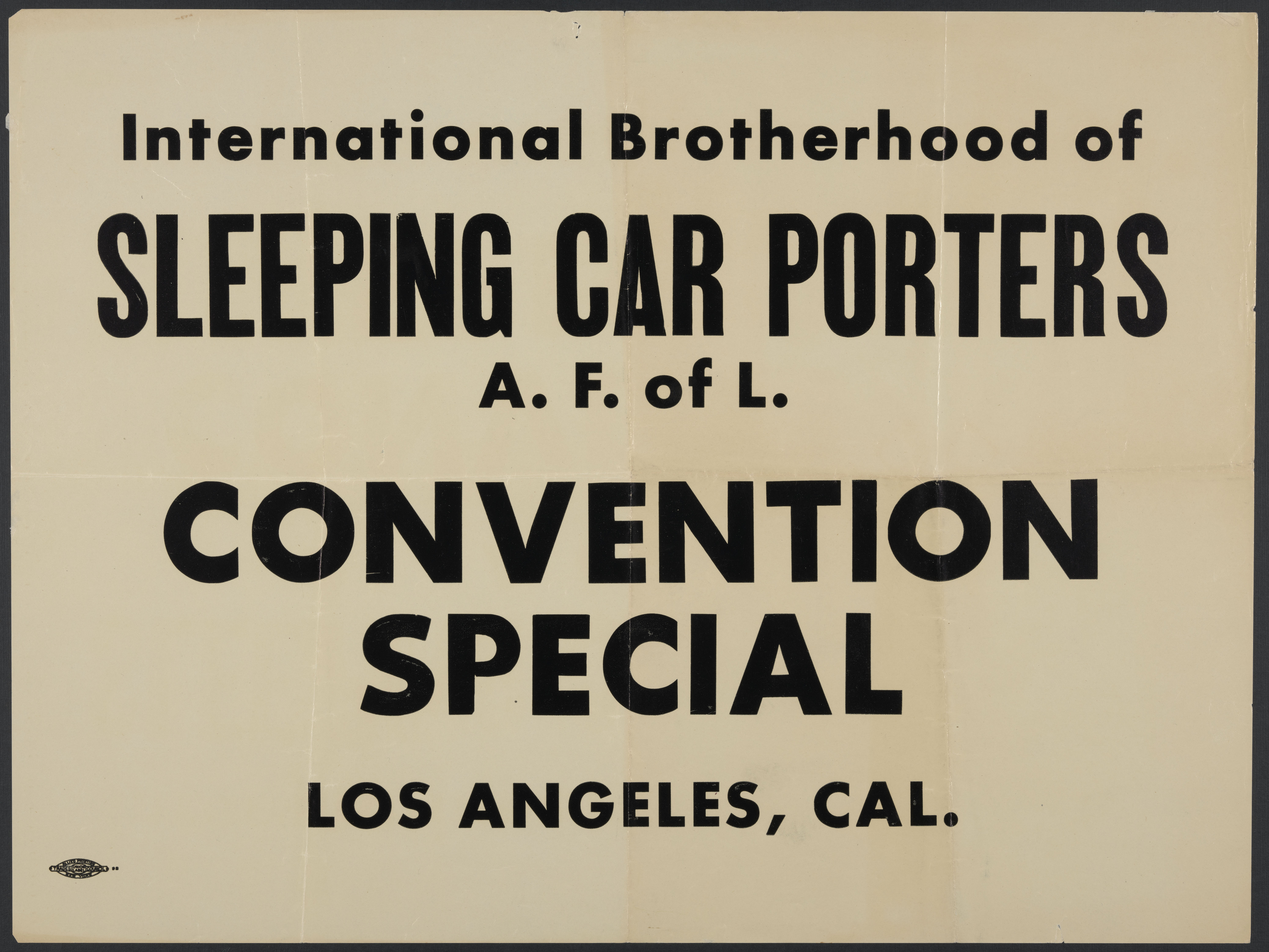
Poster for the International Brotherhood of Sleeping Car Porters’ Convention Special in Los Angeles, California.

International Brotherhood of Sleeping Car Porters poster for a Convention Special in Los Angeles, California (e011536973)

Breaking the generational reality of portering, wherein fathers and their sons were forced into this profession because of the absence of other employment opportunities, was never far from the minds of the women who were involved in the BSCP’s Ladies’ Auxiliaries. Women’s involvement also gave some, like Ivy Lawrence Mayniar/Maynier, glimpses into the systemic racism and discriminatory labour practices that were integral to Black experiences in Canada. In speaking about her father’s career as a porter and her drive to seek out higher education as a result of it, Mayniar shared a powerful memory from while she was a student at McGill University:

[…] I was then going to, to the university. And then I walked down to the…to work at the library for a while. And I walked down to the, uh, uh, station and looked for Dad’s car. And I remember one night, it was bitter. […] It was a bitter night. And I, I, I myself was just so upset about this. And…but I wanted to go down ’cause I knew Daddy was going on standby. He was standing out. And I went down, went to the station, went and looked down the track for Dad. And there he was standing outside. Dad was a short man and this, you know, tight little person. And I looked down there to catch his eye. And there he was standing with snow on top of his cap, and his shoulders pushed…pulled together like this, and the wind was going down that line there, just brutally. It was just awful. And he was just standing there, and, uh…and the snow piled up on him. And, uh, I went and I sat down in the concourse outside from where…from where the trains left…And I just sat on a bench and cried. I’ll never forget that. (Interview 417387)

Mayniar became the first Black woman to graduate from the University of Toronto Law School, but she went on to study in England, where she was called to the bar at the Inns of Court, because she recognized the limitations she would continue to face in Canada as a person of colour. She practiced law in Trinidad and Tobago, where she spent the remainder of her career fighting against the racism and discrimination that she saw exemplified in her father on that cold, wintry day at Windsor Station.

The interviews conducted by Grizzle not only document the history of the fight to unionize CPR sleeping car porters, but also speak to a history that is bound up in the advancement of Black families and their communities throughout Canada. There could not be one without the other. When listening to the voices of these men and women, one hears the power inherent in women’s collective actions, how ever small, and the pride these wives, mothers, sisters, and daughters had in knowing that they effected change on the ground for the men in their lives as well as their children and themselves. When Grizzle asked Evelyn Braxton whether the “Ladies’ Auxiliary lived up to the expectations, uh, of, uh, giving the Brothers the, the maximum support that they, uh, looked forward to,” she wholeheartedly declared: “Oh, they certainly did. The Ladies’ Auxiliary was the support of the Brotherhood men.” (Interview 417386) Women were not only the backbone of their families: they held up their communities and the generations that followed.

Additional resources:

  • My Name’s Not George: The Story of the Brotherhood of Sleeping Car Porters in Canada: Personal Reminiscences of Stanley G. Grizzle, by Stanley G. Grizzle with John Cooper (OCLC 883975589)
  • Deindustrializing Montreal: Entangled Histories of Race, Residence, and Class, Chapter 3: The Black City below the Hill, by Steven High (OCLC 1274199219)
  • North of the Color Line: Migration and Black Resistance in Canada, 1870–1955, by Sarah-Jane Mathieu (OCLC 607975641)

Stacey Zembrzycki is an award-winning oral and public historian of immigrant, ethnic and refugee experiences. She is currently doing research for Library and Archives Canada.

Travel posters in the Marc Choko collection—a Co-Lab challenge

By Andrew Elliott

The Marc Choko collection of travel posters represents a fantastic cross-section of Canadian travel poster art during the period from 1900 to the 1950s. “One’s destination,” wrote Henry Miller, as he travelled through Greece in the 1930s, “is never a place, but a new way of seeing things.” In fact, the entire Modernist movement of the era was about seeing old things in new ways. For railway companies, and later airlines, the posters helped market companies to as wide an audience as possible. While promoting their fast and efficient services, they also projected to travellers a stylish, romantic vision of travel to and within Canada.

Between 1900 and 1930, and particularly in the 1920s, there was a shift in the way people travelled. During this period, middle-class tourists rivalled immigrant travellers for space on trains. Tourism became a kind of mass culture theatrical experience, and as a result, leisure time was commodified. The publicity departments of both Canadian National Railways (CN) and Canadian Pacific Railway (CPR) developed close ties with Canadian (and American) artists to create poster art (and art for other types of marketing and publicity, including magazines and timetable booklets). In 1927, for example, CN commissioned members of the Group of Seven to create a 33-page scenic guide advertising the wild, natural and romantic beauty of Jasper National Park. (This guide, with a couple of digitized pages, can be found in the Museum Train Collection series of the Canadian National Railway Company fonds.) Neither the railway companies nor the artists operated in a vacuum; they were influenced by the travel and artistic movements that were spreading across the world in the early 20th century. There was a remarkable convergence: cars, trains, airplanes, zeppelins and ocean liners were all competing for customers. To sell their services, the various companies turned to posters that suggested, among other things, speed and experience.

The Marc Choko collection at Library and Archives Canada (LAC) features a collection of travel posters by various artists who were commissioned by transportation companies. The collection was donated to LAC in the early 1990s by Marc Choko, a professor emeritus with the School of Design at the Université du Québec à Montréal. Choko taught courses on design from 1977 to 2018 and has also published numerous books on design (website in French only), including Destination Québec; Une histoire illustrée du tourisme (2013), Canadian Pacific Posters 1883–1963 (2004) and Canadian Pacific; Creating a Brand, Building a Nation (2016).

Two of the best-known artists who created the posters were Peter Ewart and Roger Couillard. Ewart (1918–2001) was born in Kisbey, Saskatchewan, but grew up in Montréal. Upon completing his formal education, he studied art in Montréal, and later in New York. His paintings were exhibited by the Royal Academy (London, England), the Royal Canadian Academy, the Canadian National Exhibition and the Mid-Century Exposition of Canadian Painting. To learn more about Peter Ewart and his life and work, visit the comprehensive website petermaxwellewart.com.

In the late 1940s, Ewart helped to establish and then solidify a memorable advertising campaign for CPR as the “World’s Greatest Travel System.” His corporate commissions included a wide array of organizations and some events, such as Canadian Pacific Airlines, Bank of Montreal, Imperial Oil Company, B.C. Telephone Company, Calgary Winter Olympic Games, Ocean Cement and many more.

Some striking examples of Ewart’s work in the Choko collection include the following posters for CPR.

Moose in water with trees in the distance and a small company crest.

CPR poster “Hunt This Fall—Travel Canadian Pacific” (e000983752-v8) Credit: CRHA/Exporail, Canadian Pacific Railway Company Fonds

Large fish in water and a small company crest.

CPR poster “Full Information from Canadian Pacific—World’s Greatest Travel System” (e000983750-v8) Credit: CRHA/Exporail, Canadian Pacific Railway Company Fonds

The artist Roger Couillard (1910–1999) is also well represented in the Marc Choko collection. Couillard was born in Montréal and studied at the École des Beaux-arts de Montréal (School of Fine Arts in Montréal; EBAM). In 1935, the Institute of Foreign Travel organized a poster competition on the theme of “See Europe Next.” One of his posters was chosen and exhibited in Ogilvy’s department store in Montréal. Couillard opened a studio in the Drummond Building on the city’s St. Catherine Street in 1937. He later worked for the Quebec Ministry of Tourism from 1966 to 1975. (There is very little biographical information about Couillard available online. The information listed here was gleaned from a Canadian Design History/Theory course web page at the Emily Carr University of Art + Design. For further details about Couillard’s art, see Artnet.)

The following striking examples of Couillard’s work show his versatility. He was able to work for a variety of organizations, such as CPR, CN, Trans-Canada Air Lines and Canada Steamship Lines. The posters capture the essence of what travel represented for voyagers at the time.

An arrow points to the sky and has a telegram on it.

Canadian National Telegraphs, “Telegraph—When Speed Is a Factor” (e010780461-v8)

A plane flying above the message “Costs only 3¢ more to all parts of Canada.”

Trans-Canada Air Lines—Air Mail (e010780458-v8)

These less well-known artists are also represented in the Choko collection:

The collection contains some striking work by unknown artists as well. For example, one notable poster for CN has been reprinted for numerous postcards, yet the artist has not been identified. Can you help to identify this artist?

This is where the Co-Lab challenge comes in! The challenge in Co-Lab is not only to tag and describe the posters, but also to identify some of the artists. Check out the Travel Poster Co-Lab Challenge to see more posters in the Marc Choko collection.


Andrew Elliott is an archivist in the Archives Branch at Library and Archives Canada.