Teamwork makes the dream work

Version française

By Ellen Bond

I walked up to Tanya Talaga at a Know History conference in June 2023, after her keynote speech about her search for her great-great-grandmother, Annie Carpenter, and said, “I work with a lot of photos of First Nation, Inuit and Métis Nation peoples at Library and Archives Canada (LAC), and I can help you.” “Send me an email,” she said. Thus began the teamwork between the two of us.

I found Tanya’s email address at The Globe and Mail and emailed her an explanation of Project Naming, the program I manage at LAC, as well as how I could help her. In her return email, Tanya explained more of her search for Annie and what little she knew of her. She gave me her birthdate, her maiden name, her married names, her children’s names and where she was in 1905.

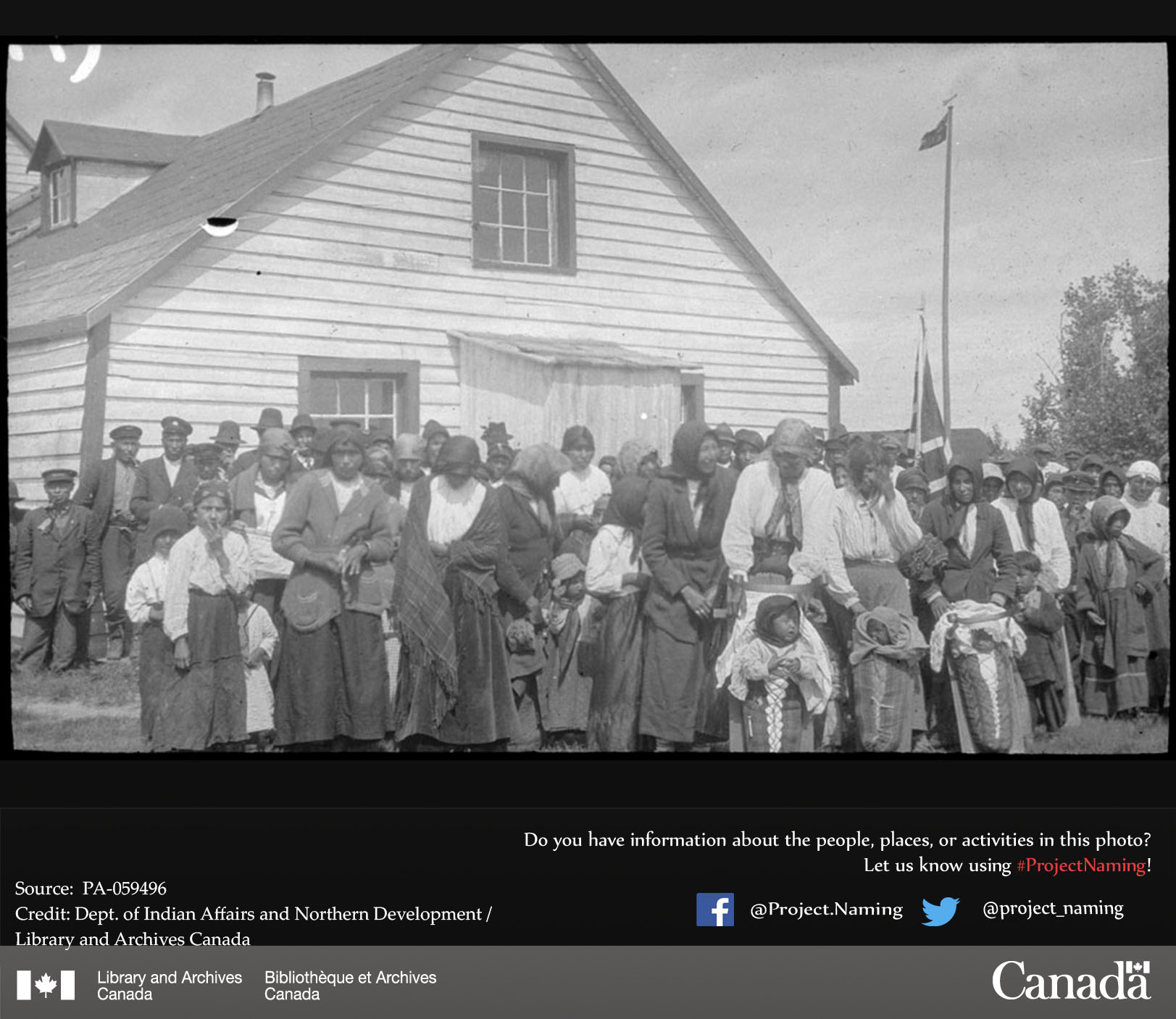
Large group of people standing in front of a building.

Photo was posted during Project Naming’s “Finding Kin,” December 6, 2023. We know Annie was in Osnaburgh House in 1905 when this photo was taken. Could Annie be in this photo? Credit: Canada. Dept. of Indian Affairs and Northern Development / Library and Archives Canada / a059496-v8.

Tanya knew nothing of where Annie or her children had gone after 1905, but she did know where Annie had spent the last eight years of her life and where she is buried in an unmarked grave. I shared Tanya’s search with Elizabeth Montour, LAC Archivist in the Government Archives Division. Within 24 hours, Elizabeth had found Annie’s grandson, Private Peter Rupert Chappise, who fought and died in the First World War (WW1). As I had worked on the massive digitization project to make available the files for everyone who fought for Canada in WW1, I searched Peter’s name and found his file. That file referenced Peter’s brother’s son, Flying Officer Richard Robert Chappise, who died in action in the Second World War. Since LAC has digitized all of the files from soldiers killed in action, I found Richard’s file. I sent all of this information to Tanya, who was thrilled. It felt so satisfying to work with Elizabeth to uncover part of Annie’s mystery. Teamwork!

In a future blog, I will explain more of the process of our teamwork and the usefulness of LAC’s documentary heritage collection. Tanya’s newest book, The Knowing, makes the dream work as she details her many collaborations with people, including me, as she researched Annie’s story. It was published on August 27, 2024. On September 30, 2024, the National Day for Truth and Reconciliation, Tanya will be talking about her search for Annie in depth at an event hosted by LAC and organized by Ottawa Public Library and the Ottawa Writers Festival. I’m looking forward to hearing the story of Tanya’s search and what she found.

More to come.


Ellen Bond is a Project Manager with the Online Content team at Library and Archives Canada.

Collecting e-Books at Library and Archives Canada

Version française

By Michelle Foggett-Parker

International Read an e-Book Day, celebrated on September 18, serves as a reminder of the transformative impact digital books are having on reading habits worldwide. As readers delve into the immersive world of e-books, behind-the-scenes efforts ensure that these digital treasures are collected and preserved for future generations.

Library and Archives Canada (LAC) plays a pivotal role in safeguarding Canada’s many histories through its legal deposit program. Since 2007, Canadian publishers have been mandated by law to submit to LAC one copy of every e-book they publish. In that time, more than 3000 Canadian publishers, trade and self-published, have submitted over 60 000 e-books for permanent preservation. This collection underscores the commitment of publishers and LAC to collect and preserve the documentary heritage of Canadians as it continues to evolve.

In recent years, LAC has made significant strides in modernizing its processes for receiving and preserving e-books. One year ago, LAC embarked on advancing the automation of how publishers can submit their e-books and related metadata. LAC observed that most publishers use the ONIX standard to distribute electronic information about their books to booksellers. We understood that it would be easier for publishers to use the same workflow for LAC.

Through strategic partnerships with ONIX distributors, publisher associations and book industry groups, LAC has successfully onboarded 35 Canadian publishers onto a new, more automated workflow using ONIX. As a result, over 7000 eBooks, representing 10% of the total e-book collection, have been received and permanently preserved, enriching LAC’s digital collection and ensuring the accessibility of Canada’s many histories for generations to come.

The method employed by LAC for receiving and preserving digital monographs is both secure and efficient. Publishers can submit their ONIX metadata and e-books via a secure file transfer protocol (SFTP), ensuring the integrity and confidentiality of their submissions. Once received, e-books and metadata are stored in Preservica, the secure digital preservation software used by LAC, and made discoverable through Aurora, LAC’s online catalogue.

While the automated submission process via ONIX streamlines the submission process for publishers, LAC continues to offer manual submission options for those who prefer it. Publishers can still submit digital monographs through LAC’s single or bulk submission forms and spreadsheets, ensuring flexibility in the acquisition process.

The legal deposit program not only serves to collect and preserve digital publications, but also to make them accessible to users, today and in the future. By collaborating with publishers, LAC can build a comprehensive repository of Canada’s literary heritage, providing invaluable resources for historians, researchers, students, creators and the general public.

We have received some terrific new digital additions to the national collection because of the ONIX workflow.

Here are just a few highlights:

  • Jessie’s Island by Sheryl McFarlane, read-along version: A children’s audiobook about life in British Columbia from Orca Book Publishers. The digital audiobook format is a growing area, and we are now receiving more audiobooks through the ONIX workflow.
  • Black Activist, Scientist, Icon: The autobiography of Dr. Howard D. McCurdy: Nimbus Publishing, Atlantic Canada’s largest publisher, has sent us their entire back catalogue of digital books using the ONIX workflow. There are many gems, but we now have more digital titles representing Black history, including this particular title.
  • Glass Beads by Dawn Dumont: We received this title and the entire back catalogue of published titles from independent publisher Thistledown Press in Saskatoon, Saskatchewan.
  • The Paper Bag Princess by Robert Munsch: We did not have a digital edition of this Canadian classic, and now we do thanks to Annick Press sending in their entire back catalogue of eBooks.
  • Cora : l’ordinaire endimanché by Cora Tsouflidou: Published by Libre Expression, this collection of 50 letters from the founder of Cora restaurants reveals the reflections of the renowned entrepreneur and restaurant-owner.
  • L’homme de la Saskatchewan by Jacques Poulin: A novel by a celebrated Quebec author, published by Leméac.

As we mark International Read an e-Book Day, let’s celebrate the joy of digital reading and acknowledge the publishers, libraries and partners that safeguard our digital heritage. Through innovative initiatives like the legal deposit program, LAC remains at the forefront of collecting and preserving Canada’s rich cultural legacy in the digital age.

Did you know LAC published two e-Books of its own?

Additional resources:


Michelle Foggett-Parker is an acquisitions librarian with the Digital Legal Deposit team at Library and Archives Canada.

Improving your online experience: What to expect at LAC’s new online home

Image of fingers on a keyboard

By Andrea Eidinger

Here at Library and Archives Canada (LAC), we take user feedback very seriously. Over the years, one point has come through loud and clear: our existing website is not meeting the needs of the public. This is why we are proud to announce that we will be launching a completely new website later this summer—library-archives.canada.ca. In this blog post, I will go over what LAC’s new web presence will involve and how these changes will impact your experience.

New website

So, what does this mean in practical terms? We spent a lot of time gathering feedback from members of the public, expert researchers and members of our staff to make our website user-centric. This involved creating several working groups as well as user-testing different possibilities for the new website. We also incorporated the latest research on how people actually use websites.

A major part of this work has been to ensure that all our users can easily find and understand the information on our website. Two very important components of the new website are consistent web navigation and plain language. All our new web content is organized in the same way so that users always know where to go, and the language has been simplified to make it clearer and easy to understand, no matter your skill level.

Finally, our website is dynamic. Our goal was to create a website that lives and breathes. Gone are the days of web pages being posted and then never touched again. Part of renewing our web presence is a commitment to continually update the website with new material and make improvements based on user feedback. We are also taking what is called an “iterative approach.” Essentially, we will start with a scaled-back version of the new website. This will be a launching pad for us. Our work will build on this initial version to develop the new website.
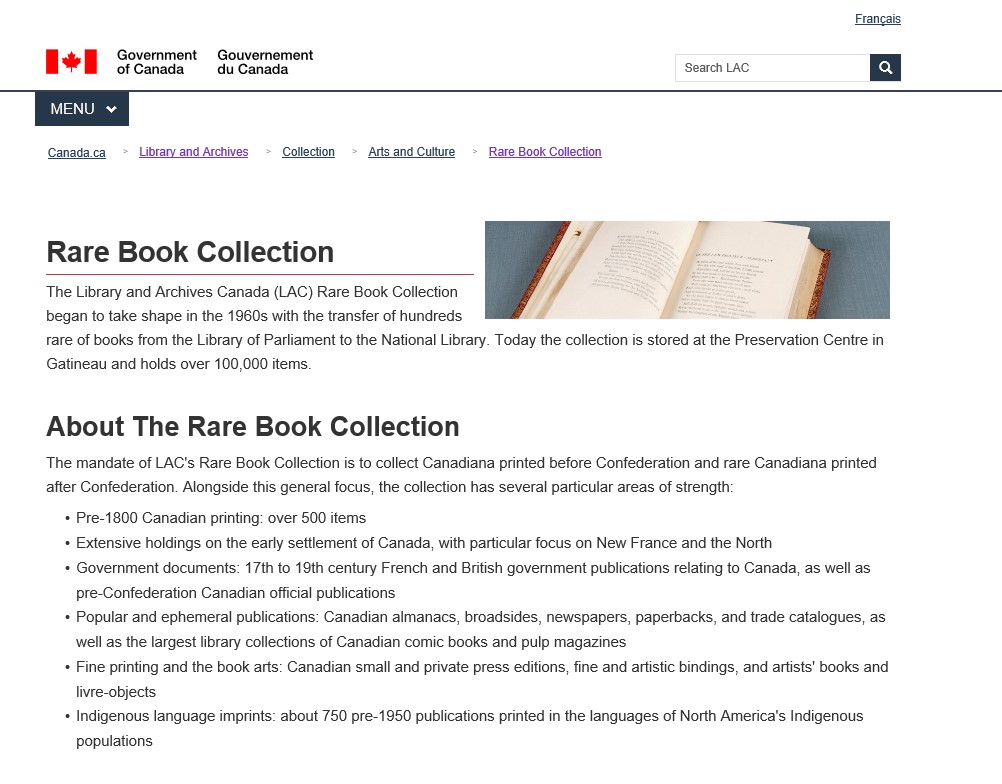
Screenshot of the Rare Book Collection webpage on the LAC website.

An example of the new template for subject guides for the new LAC website.

New structure

One of the biggest changes users will notice is the look and feel of the website. To make the information on the website more easily accessible to the public, we have developed a new structure for the website based on tasks, topics and themes that align with our users’ needs. In other words, we looked closely at how members of the public were using our existing website and what they were looking for (tasks). We then grouped those tasks into broad categories (topics). Finally, we grouped these topics into themes.

These themes are the basis for the website’s new structure and align with the Government of Canada’s design system. This system provides a more practical, consistent and reliable online experience for people who access Government of Canada digital services.

The first theme, Corporate, contains all of the institutional information relating to LAC. This includes information about our mandates, policies, initiatives and partners. This is where you will also find information about transparency at LAC and be able to read reports and plans about our activities.

The second theme, Services, is self-explanatory. It is where users can access our services or complete a task related to one of our programs. Under this theme, users will find information on how to visit us, how to order material, how to apply for ISBN numbers, how to make an ATIP request, and more. Also under this theme is information about the various services that we offer for gallery, library, archives and museum (GLAM) professionals, publishers, public servants, and Indigenous communities and individuals. This section will also contain information about our different funding programs.

Finally, there is the Collection theme. Our goal in rethinking how we present the Collection theme was to build user autonomy and discovery. This section will be home to all kinds of materials that will help Canadians access the documentary heritage under LAC’s care. In this section, you will find our databases, guides on researching various topics, publications, and podcast episodes, as well as a basic introduction to research. This section also includes many of LAC’s more interactive features, such as Co-Lab, our transcription program.

New navigation

One of the biggest challenge that users faced on our website was finding the information they were looking for. This was a problem particularly for material included under the Collection theme. Often, users would travel down rabbit holes and never be able to find their way back again. We have corrected this problem with a completely new navigational system based on tables. The new navigational table will include all pages listed by topic, sub-topic and type. For example, a web page on the First World War personnel files we have available would be appear as follows:

First World War Personnel Files – Military History – First World War (1914-1919) – subject guide

Even more important: this table will be filterable and searchable. This means users can easily see all of the resources that we have on a particular topic and find their way back without difficulty.

New content

The last exciting change to tell you about is the new content on our website. The existing site is enormous: it consists of 7,000 pages. Much of the information it contains is no longer up to current web and historical standards. We also know that many of the pages are hard to read, especially for beginners, and sometimes confusing. In preparation for our new website, we have systematically reviewed every single one of those 7,000 pages. Anything outdated or no longer up to current standards was archived (and will be available to the public), and the rest of the pages were reworked. All of the information on LAC’s new website is presented in plain language and is therefore clear and easy to understand. We hope this approach will attract an entire new wave of users interested in learning about Canada’s documentary heritage.

Since there is so much content, we focused on preparing material for the three most popular and most consulted topics for the launch: genealogy and family history, Indigenous history, and military history. Please note that, in the weeks and months ahead, we will add more material to these and other topics. We will be updating our material regularly in response to user feedback and to reflect the latest available information.

We’re so excited to show you all of the new material we’ve been working on! So, while this does mean that your URLs will change, we’re hoping that these changes will make your online experience at LAC a more positive one. Since this work is only beginning, the best is yet to come!

We look forward to your feedback. Please send us your comments and thoughts when we go live.


Andrea Eidinger is a team lead in the Online Experience Division at Library and Archives Canada.

What’s New? The Launch of the Library and Archives Canada Podcast Series

We are pleased to announce the release of the new podcast series, Discover Library and Archives Canada: Your History, Your Documentary Heritage.

With new episodes released monthly, the podcasts will guide you through our many services and introduce you to the people who acquire, safeguard and make known Canada’s rich documentary heritage.

Subscribe to episodes using RSS or iTunes, or just tune in at:

www.bac-lac.gc.ca/eng/news/podcasts/Pages/podcasts.aspx

The series, developed and produced by the Resource Discovery Sector at LAC, showcases treasures from our vaults and explores topics such as Aboriginal peoples, transportation, immigration, genealogy, government, as well as military and peacekeeping.

For more information, please contact us at podcast@bac-lac.gc.ca.

For more information on recent announcements at LAC, visit “News”.