Sergeant Leo Clarke, VC

By Emily Monks-Leeson

We continue our series First World War Centenary: Honouring Canada’s Victoria Cross recipients with the story of Sergeant Leo Clarke, Canada’s seventh First World War Victoria Cross recipient.

A black-and-white newspaper clipping of a photograph of a young man in uniform

Sergeant Leo Clarke, VC, died of wounds, c.1915-1916 (MIKAN 3214037)

Leo Clarke, born in Waterdown, Ontario, on December 1, 1892, was a surveyor for the Canadian National Railway. He enlisted in February of 1915 at Winnipeg with the 27th Battalion and transferred to the 2nd (Eastern Ontario Regiment) Battalion after arriving in England.

On September 9, 1916, Leo Clarke and the 2nd Battalion took part in an Allied assault on a network of German trenches stretching from Martinpuich to Courcelette in northern France. Clarke’s battalion was to capture a 50-yard area between Mouquet Farm, a Canadian-held position, and Courcelette. An Acting-Corporal at the time of the attack, Clarke led a party to clear the left flank of a German trench and create a “block” to fortify the Canadian position. The trench was heavily defended and, following bitter hand-to-hand combat, Clarke was the only member of his unit not killed or wounded. Alone he fought off a counter-attack of twenty German soldiers and officers.

A black-and-white handwritten page describing the day to day actions of the battalion.

War diary extract from the 2nd Canadian Infantry Battalion from September 1-9, 1916 describing the days leading up to and including the offensive (MIKAN 1883206)

Clarke’s citation from the London Gazette recounts that:

After most of his party had become casualties, he was building a “block” when about twenty of the enemy with two officers counter-attacked. He boldly advanced against them, emptied his revolver into them and afterwards two enemy rifles which he picked up in the trench.

One of the officers then attacked him with the bayonet, wounding him in the leg, but he shot him dead. The enemy then ran away, pursued by Acting Corporal Clarke, who shot four more and captured a fifth. Later he was ordered to the dressing-station, but returned next day to duty. (London Gazette, no. 29802, 26 October 1916).

Leo Clarke died in action a month later, on October 19, 1916. His Victoria Cross, posthumously awarded in the spring of 1917, was presented to his father by the Duke of Devonshire, Governor General of Canada, before a crowd of 30,000 gathered at Portage and Main in Winnipeg.

A black-and-white photograph of a group of soldiers in uniform in a field.

Bombing Platoon (2nd Battalion, Canadian Expeditionary Force) at Scottish Lines near Poperinghe not far from Ypres. This photo was taken by Henry Edward Knobel – an Official War Photographer – while the 2nd Battalion was out in rest billets after fighting at Sanctuary Woods, Maple Copse (Battles of the Somme). Leo Clarke, VC, is in the front row on the far right. June 16, 1916 (MIKAN 34005888)

Sergeant Leo Clarke lived on Pine Street in Winnipeg, Manitoba, as did two other Victoria Cross recipients: Frederick William Hall and Robert Shankland. Pine Street was renamed Valour Road in 1925 in honour of the three men.

Library and Archives Canada holds the service file for Sergeant Leo Clarke.


Emily Monks-Leeson is an archivist in Digital Operations at Library and Archives Canada.

Stelco archives now acquired

By Lucie Paquet

Library and Archives Canada is proud to announce that it has acquired the archives of The Steel Company of Canada, more commonly known as Stelco. These archives are now part of our national heritage. They include more than 100 metres of textual records, thousands of photographs, technical and architectural drawings, and over 200 film and sound recordings. The Steel Company of Canada (Stelco) fonds, currently in archival processing, documents all aspects of the evolution of the steel industry from the beginning of its mechanization in the 1880s through to the 1980s.

Black and white photograph showing an industrial complex for steel production and processing.

Aerial view of The Steel Company of Canada Limited (Stelco) mills in Hamilton, circa 1952. (MIKAN 4915715)

The Steel Company of Canada Limited was formed in 1910 as a merger of five companies that had previously taken over some 40 smaller ones, operating in various areas of Quebec and Ontario: Hamilton Steel and Iron Company Ltd., Montreal Rolling Mills Company, Canada Screw Company, Dominion Wire Manufacturing Company, and Canada Bolt and Nut Company. Each one had its own speciality, from the primary production of steel for the rail, agricultural and marine sectors to consumer products. This new, large company enabled the Canadian steel industry to keep pace with strong American and European competition.

The account ledgers, correspondence, management minutes, patents and photographs provide a detailed account of the beginnings of this industry, its development and its challenges.

Black and white photograph showing a mill beside a canal. Other factories and railway tracks for transporting steel materials can be seen in the background.

Saint-Henri steel mill, one of Stelco’s departments in Montreal, May 17, 1946. (MIKAN 4915716)

The archives not only document the company’s expansion, but also the development of several entire cities, towns and neighbourhoods.

Black and white photograph showing a close-up of blast furnaces on an industrial site.

Blast furnaces of The Steel Company of Canada Limited (Stelco) in Hamilton, circa 1948. (MIKAN 4915717)

Cities like Hamilton quickly became major industrial centres referred to as “steel towns.”

Black and white photograph showing men in a plant. A large number of workers manually operating the first mechanical machines can be seen in the background.

Interior view of workers at one of the steel processing plants in Hamilton, circa 1920. (MIKAN 4915719)

In the mid-twentieth century, the plants attracted many immigrants and the population in urban centres doubled in just a few short decades.

Black and white photograph showing employees packing products inside a plant.

Interior view of workers in the finishing and packing department in Hamilton, circa 1920. (MIKAN 4915720)

The Stelco archives bear witness to the working conditions of men and women who spent their whole lives in the plants.

Black and white photograph showing a group of people holding a flag with a V for victory.

Parade of Stelco managers and employees not long after the end of the Second World War, in 1945. In the foreground can be seen Stelco directors H.G. Hilton and H.H. Champ, and a military officer, among others. (MIKAN 4915722)

Stelco and its workers had important responsibilities during the First and Second World Wars, responding to the demand for military materiel from the Canadian and British governments and contributing to the Allied victory.

But success did not stop there. The phenomenal growth of urban centres during the 1950s, real estate, energy resources, means of transportation and various consumer products created strong demand for steel.

Black and white photograph showing workers operating a machine used to roll the steel and make it into panels.

Interior view of a more modern plant from the 1960s for producing steel in rolls and panels. (MIKAN 4915723)

There followed the creation of large industrial complexes and the introduction of a high-tech research centre, which enabled Stelco to develop new steel products and increase operations and production in all areas, both residential and commercial.

Black and white photograph of a man in a white lab coat taking a photomicrograph.

Engineer from the metallurgical laboratory testing the quality of the steel structure by means of “photomicrography,” circa 1960. (MIKAN 4915724)

A collage of coloured advertisements. The first image shows different residential products, including a wood fireplace for the living room, the second shows the manufacturing of steel panels, and the third shows several architectural drawings for building construction.

Collage of three advertisements from Steel in Homes (1967), Stelco Plate Products (November 1969) and Expanding the Markets for Stelco Steel, circa 1970. (MIKAN 4915725)

The Steel Company of Canada Limited (Stelco) exported its products worldwide, becoming one of the largest steel companies in North America. As an example, it was actively involved in the design and construction of the Expo 67 Steel Pavilion.

Black and white photograph showing several modern architectural structures.

In the background, the Canadian Steel Pavilion at the Montreal World Fair in 1967. This pavilion was built by the four largest Canadian steel companies: Algoma, Stelco, Dofasco and Dosco. They reproduced in miniature all the components associated with steel manufacturing. In the centre of the image, the Canadian Pulp and Paper Industry Pavilion can be seen. (MIKAN 4915727)

Over the coming months, we will introduce you to the world of Stelco—its plants, directors, employees, operations, innovations, products and challenges, as well as its social, sports and cultural activities.


Lucie Paquet is an archivist with the Science, Governance and Political Division of Library and Archives Canada.
Lieutenant Thomas Orde Lawder Wilkinson, VC

Today our series First World War Centenary: Honouring Canada’s Victoria Cross recipients remembers Lieutenant Thomas Lawder Wilkinson of the 7th Battalion, Loyal North Lancashire Regiment, British Expeditionary Force, who was awarded the Victoria Cross for his actions on the Somme battlefields one hundred years ago today on July 5, 1916.

Lieutenant Wilkinson was born in Shropshire, England, and immigrated with his family to Canada prior to the First World War. On September 23, 1914, he enlisted with the 16th Battalion, Canadian Scottish, Canadian Expeditionary Force (CEF), later transferring to the Loyal North Lancashire Regiment, to serve as a Gunnery Officer. It was with this unit that Wilkinson found himself fighting in the Battle of the Somme.

A black-and-white photograph of a young man wearing a cap and uniform and gazing beyond the photographer.

Lieutenant Thomas Orde Lawder Wilkinson, VC, undated (AMICUS 2715209)

Four days after the most devastating single day in the history of the British forces, Wilkinson and two other men were fighting their way to a forward machine gun, recently abandoned by a retreating party of British soldiers. On their own they succeeded in holding up advancing German soldiers until another unit was able to reach and reinforce them. Later that day, Lieutenant Wilkinson reached several men of different units trapped at a wall of earth over which German troops were throwing bombs. His citation in the London Gazette recounts how:

With great pluck and promptness [Wilkinson] mounted a machine gun on the top of the parapet and dispersed the enemy bombers. Subsequently he made two most gallant attempts to bring in a wounded man, but at the second attempt he was shot through the heart just before reaching the man. Throughout the day he set a magnificent example of courage and self-sacrifice (London Gazette, 26 September 1916).

A black-and-white photograph of four soldiers carrying a stretcher with a shrouded body on it through a devastated landscape.

Bringing in the Dead on the Somme Battlefields, July 1916, Canadian War Records Office (MIKAN 3520928)

The body of Lieutenant Thomas Orde Lawder Wilkinson was never recovered. He is commemorated on the British Memorial to the Missing at Thiepval, France.

Library and Archives Canada holds the CEF service file for Lieutenant Thomas Orde Lawder Wilkinson.

Newfoundland and the 100th Anniversary of the Battle of the Somme

Among the most infamous battles of the First World War and the most emblematic of its horrific slaughter, the Battle of the Somme began on July 1, 1916.

A black-and-white photograph of a pastoral landscape.

General view of the battlefield looking towards Contalmaison (Battle of the Somme). July, 1916 (MIKAN 3520937)

The attack was launched along a 30-kilometre front in northern France. Initially planned by the Allies as a French-British assault, it was intended to divert German forces from their ongoing siege at Verdun. The expectation was that an eight-day preliminary artillery bombardment would destroy the German wire and the forward German lines, allowing advancing forces to simply walk in and take possession of the territory. The artillery, however, failed to destroy either of these targets and at 7:30 a.m. on July 1, 1916, when the bombardment lifted, German infantry emerged from their bunkers to aim their machine guns at the gaps in the otherwise intact wire. An estimated 60,000 British and Allied troops, including close to 800 Newfoundlanders, were killed or wounded on that one day alone. The Battle of the Somme lasted until November 18, 1916. Only 12 kilometres of ground were gained, with 420,000 British, 200,000 French, and 500,000 German casualties.

A black-and-white photograph of a devastated forest, only a few tree trunks are left standing

Scene in Maple Copse (Battle of the Somme). July, 1916 (MIKAN 3520908)

Continue reading

Canadians at the Naval Battle of Jutland, May 31–June 1, 1916

By Alex Comber

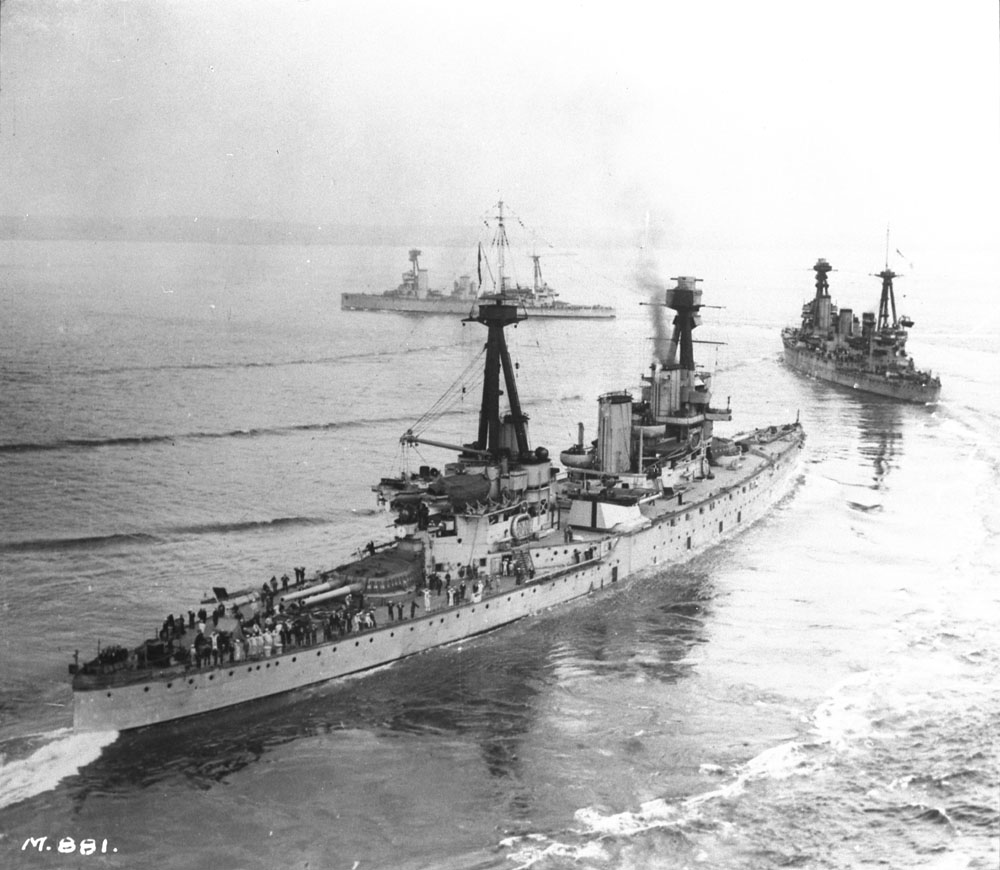
A century ago, the largest naval battle of the First World War took place off the coast of Denmark’s Jutland peninsula. More than 250 warships of the Royal Navy and the Imperial German Navy manoeuvred to get ready for action.  The first salvoes of long-range cannon fire were discharged at 14:30 on May 31, 1916, and the ensuing clash lasted into the morning of June 1. With three British battle cruisers and 11 other ships destroyed, and more than twice as many sailors killed and injured, British naval power seemed to have suffered a setback. However, in a strategic sense, the smaller German fleet could not afford its more modest losses, and Kaiser Wilhelm II’s military commanders avoided a similar fleet battle for the duration of the War, focusing instead on submarine attacks.

A black-and-white photograph showing three large warships.

HMAS AUSTRALIA, HMS NEW ZEALAND, HMS INDOMITABLE, Second Battle cruiser Squadron ca. 1917–1919. This unit was at Jutland, where one of its ships, HMS INDEFATIGABLE, was destroyed (MIKAN 3400004)

In many regions of Canada, there were very strong pro-imperial sentiments and cultural ties to Britain. Many had recently emigrated, and still had family back in the “old country.” Though there was a small Canadian Navy (created in 1910), many residents of Canada and of the Dominion of Newfoundland volunteered to serve with the Royal Navy in a variety of roles. With ports across the British Empire and the prospect of an alternative to a soldier’s life in the trenches of the Western Front, there was much to appeal to recruits.

A black-and-white recruitment poster showing the silhouette of a sailor with ship’s guns and the following words: Royal Naval Canadian Volunteer Reserve – Overseas Division wants men ages 18 to 38, seamen & stokers. Join today. No previous experience necessary. Apply at nearest recruiting office.

Recruitment poster for the Royal Naval Canadian Volunteer Reserve Overseas Division, appealing to Canadians to serve in British ships overseas (MIKAN 3635562)

Careful searching of the Commonwealth War Graves Commission’s online casualty database reveals that at least a dozen of the approximately six thousand sailors killed serving in the British Fleet at Jutland came from Canada or Newfoundland. Stanley de Quetteville, a member of the Royal Canadian Navy, was attached to the Royal Navy and served in the massive battle cruiser HMS INDEFATIGABLE. He was originally from the English Channel island of Jersey and had emigrated to Canada in the years before the First World War in search of opportunities. A qualified engineer, he enlisted in 1910 and had served on the cruiser HMCS NIOBE, one of Canada’s first ships. He married Phyllis Fisher of Halifax, Nova Scotia, in Edinburgh, Scotland, in 1915.

A black-and-white photograph showing a group of men sitting or standing on the deck of a ship. The photo is mounted on a black background with the words “Gun Room” written at the top and a list of names at the bottom.

Members of the Gunroom, HMCS NIOBE, Halifax, N.S. Taken 1910–1911. Several of these young men went on to become important figures in the Royal Canadian Navy. Stanley Nelson De Quetteville is shown standing, the third officer from the right (MIKAN 3398852)

De Quetteville died at 16:03 on May 31, when HMS INDEFATIGABLE exploded after being hit by accurate shellfire from the German Dreadnought VON DER TANN. Of the crew of 1,019 men, there were only two survivors. The Minister of the Naval Service, J. D. Hazen, sent his widow a letter of condolence, which reads: “I wish to express to you not only my personal sympathy, but that of the whole Canadian Naval Service, which, in his death, has lost an Officer of undoubted ability and great promise. That he died a sailor’s death, in action against the King’s enemies, and in defence of the Empire, must be to you some consolation in your great sorrow.” Today, Mount Indefatigable in the Canadian Rockies stands as a tribute to de Quetteville and his fellow crew members.


Alex Comber is a Military Archivist in the Government Archives Division.

John Boyd

As Canadians we appreciate discovering stories about our country through the works of our painters and photographers, past and present. Canadian archives hold many collections, and sometimes the collection of a particular artist or photographer may contain literally thousands of images for us to explore. This is the case with photographer John Boyd whose collection at Library and Archives Canada (LAC) boasts 28,959 black-and-white photographs.

John Boyd (1865–1941) was born in Emyvale, Ireland. His family immigrated to Toronto in the late 1860s. He was a railway official as well as a photographer. His work with the railroad gave him ample opportunities to take photographs as he travelled across Ontario.

These photographs represent Boyd’s amateur work from 1898 to 1926. A large collection in itself, it is nonetheless dwarfed by the collections held at the City of Toronto Archives. One collection in particular is that of The Globe and Mail, which contains 140,000 of Boyd’s photographic negatives taken from 1922 to before his death in 1941.

The collections at LAC and the City of Toronto Archives complement each other in their dates of creation and subject matter.

The John Boyd fonds consists of photographs portraying all manner of Canadian life, all worth exploring. There are images of towns and cities, royal visits, military life, modes of transportation, industry and agriculture, social conditions, pastimes, and nature.

During the First World War, Boyd focused mainly on the home front, photographing recruiting campaigns, training exercises, and the manufacture of munitions, airplanes and ships. He also photographed everyday Canadians who contributed to the war effort at home as soldiers fought overseas. The following selection of images provides a glimpse of the activities during that time.

A black-and-white photograph of well-dressed men, women and children looking at and exploring an outdoor exhibit of a reconstructed Canadian military trench.

Visitors to a reconstructed 35th Battalion trench, Canadian National Exhibition, Toronto, Ontario, 1915 (MIKAN 3395547)

A black-and-white photograph of women, soldiers and children gathered outside a train. Other soldiers on the train are leaning out of the windows, presumably saying goodbye to their families.

Personnel of the Cycle Corps leaving Exhibition Camp for overseas service, Toronto, Ontario, May 15, 1915 (MIKAN 3194471)

A black-and-white photograph of two soldiers descending the steps of a train car. They are both looking down at the photographer and one is holding a kitten.

Volunteers for war and cat mascot with the 28th Regiment, Toronto, Ontario, August 22, 1914 (MIKAN 3403478)

A black-and-white photograph of soldiers re-enacting how they move out from their trenches for a crowd of spectators at an exhibition.

Soldiers moving out from their trenches, Exhibition Grounds, Toronto, Ontario, September 11, 1915 (MIKAN 3403554)

A black-and-white photograph of two soldiers stopped on a dirt road. One is taking a compass reading as the other takes notes.

Soldiers taking a compass traverse on the intelligence course at Camp Borden, Ontario, September 26, 1916 (MIKAN 3403628)

A black-and-white photograph of a soldier standing in a field holding a large wrench.

Private Vasili Salivarsky, D Company, 123rd Battalion, Toronto, Ontario, March 30, 1916 (MIKAN 3220871)

You can view a selection of Boyd’s images in this Flickr album. To explore the entire collection, start your exploration in the John Boyd fonds, and select “Lower-level descriptions.”

Happy searching!

Jeremiah “Jerry” Jones

This Black History Month, Library and Archives Canada highlights the service of Black Canadians during the First World War. While all Canadians were equally caught up in the patriotism of the early part of the war and the opportunities offered by military service, Black Canadians had difficulty enlisting due to the racism of the era. Although there was no official or explicitly stated policy of exclusion, the Canadian military left recruitment decisions to the discretion of individual commanding officers. Black Canadian volunteers along with those from other minority groups were left to enlist in whichever regiments would accept them. A special unit, the No. 2 Construction Battalion, was formed by members of the Black community in Nova Scotia. The battalion, whose members weren’t allowed to fight, dug trenches, repaired roads, and attracted hundreds of recruits from across Canada and even the United States.

A sepia-coloured photograph of a man in uniform wearing an officer’s belt and cap holding a baton in both hands across his upper thighs.

Jeremiah “Jerry” Jones, First World War private taken by an unknown photographer, from the personal collection of the Jones family (Wikipedia).

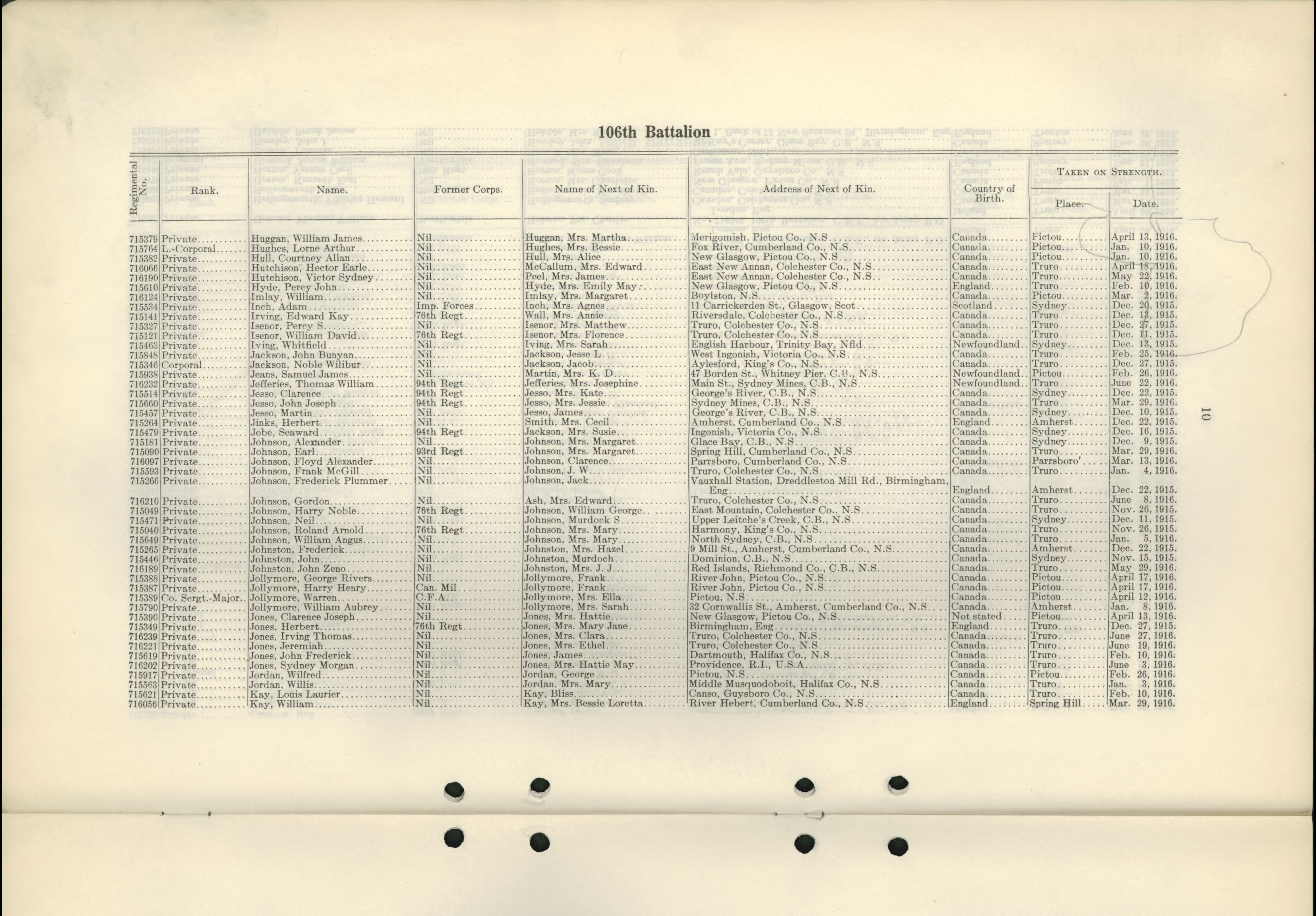
Among those Black Canadians who volunteered and served was Jeremiah “Jerry” Jones, a Nova Scotian soldier who enlisted with the 106th Battalion (Nova Scotia Rifles) in June 1916. Born in East Mountain, Nova Scotia on March 30, 1858, Jones was over 50 years old when he enlisted and lied about his age in order to join the army. Jones was sent overseas, where he transferred to the Royal Canadian Regiment and saw combat on the front lines in France, including the Battle of Vimy Ridge in April 1917. During the battle, with his unit pinned down by machine gun fire, Jones moved forward alone to attack the German gun emplacement. He reached the machine gun nest and threw a grenade that killed several German soldiers. The survivors surrendered to Jones, who had them carry the machine gun back to the Canadian lines and present it to his commanding officer. It is reported that Jones was recommended for a Distinguished Conduct Medal for his actions, though no record exists to show that he ever received the medal. In the decades following the war, the Truro Daily News and Senator Calvin Ruck highlighted Jones’ bravery and lobbied to have the Canadian government formally recognize his actions. Ruck in particular argued that the racist sentiment of the time had prevented Jones and other Black soldiers from being properly recognized for their heroism.

A nominal list showing the regimental number, rank, name, former corps, name of next of kin, address of next of kin, country of birth, and the place and date on which they were taken on strength.

Entry for Jeremiah Jones in the “Nominal Roll of Officers, Non-Commissioned Officers and Men” of the 106th Battalion (e011092698).

Jones was injured at the Battle of Vimy Ridge. He was formally discharged in Halifax in early 1918 after being found medically unfit. He died in November 1950. Jeremiah Jones was posthumously awarded the Canadian Forces Medallion for Distinguished Service on February 22, 2010.

Hockey Marching as to War – the 228th Battalion

Library and Archives Canada (LAC) currently has an exhibition at 395 Wellington Street in Ottawa, which runs until January 22, 2016. Hockey Marching as to War engages viewers in the many stories of hockey players’ involvement in Canada’s First World War effort—from the men who enlisted and served overseas to the women who took up sticks at home.

A particularly fascinating story is the emergence of highly successful military hockey teams. In 1916, Winnipeg’s 61st Battalion won the prestigious Allan Cup—the senior amateur hockey championship—and Montreal’s 87th Battalion was good enough to play an exhibition game against Montreal professionals, including players from the Canadiens.

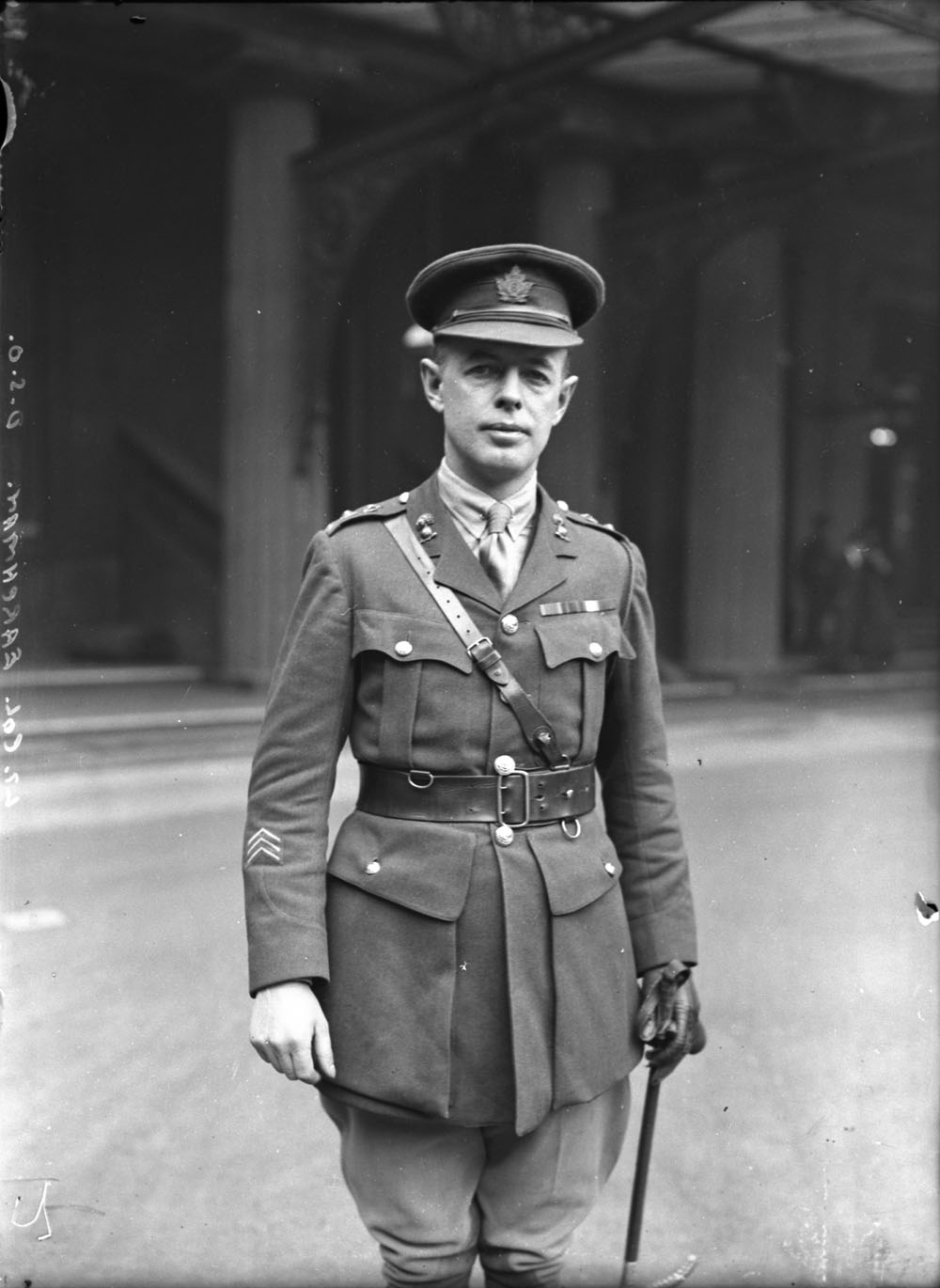
No military team was more famous than the 228th Battalion, whose history is there for all to see in LAC’s rich collection of government records. Known as the Northern Fusiliers, the 228th mustered in North Bay, Ontario, under the command of Lt.-Col. Archie Earchman, and was so successful recruiting talented hockey players that in the fall of 1916 it was invited to join the National Hockey Association (NHA), the main professional league and forerunner of the National Hockey League.

A black-and-white photograph of a man standing. He is wearing a uniform, a cap and a Sam Browne belt, and holding a baton.

Lieutenant Colonel Earchman, D.S.O., Toronto, Ontario, undated (MIKAN 3215233)

Continue reading

Searching for the Service Files of Soldiers of the First World War

Database

You can find references to the service files of soldiers who served in the Canadian Expeditionary Force in our database Soldiers of the First World War: 1914–1918.

However, it is sometimes difficult to find a soldier for several reasons:

  • His given name or surname may be written in a variety of ways
    The information in the indexes is what was written in the archival records, which were often written by hand. There may also be an error in the database. The database search engine may find words with the same root. For example, “Worth*” will lead to a search for “Worth”, “Worthing” and “Worthington.”
  • Several soldiers had the same name
    To identify your soldier, you need to check the attestation papers (enlistment forms) because they contain personal information about him.
  • He gave an incorrect date of birth
    To be able to enlist in the army during the First World War, a recruit had to be between the ages of 18 and 45.

Continue reading

Born to Serve: Georges P. Vanier

Born in Montréal on April 23, 1888, Georges Vanier would feel the influence of his bilingual parents throughout his life. After graduating from high school, he attended Loyola College and then the Université Laval where he received a law degree in 1911. He started practicing law thereafter, although priesthood was also on his mind. It was the outbreak of the First World War however, that eventually grabbed his attention and he enlisted in the Canadian Army. He was a strong recruiter and played an important role in the creation of the French-Canadian 22nd Battalion. It was also during the war that he was injured and had to have his right leg amputated.

A black-and-white photograph showing a man smiling broadly in an officer’s uniform with cap.

Major Georges P. Vanier of the 22nd Battalion, June 1918 (MIKAN 3192070)

Continue reading