First Canadian casualties of the First World War

It is well documented that George Lawrence Price, who was killed by a sniper two minutes before the Armistice on November 11, 1918, was the last Canadian soldier to die in combat during the First World War. But who was the first?

It turns out, the answer is a bit complicated. On August 4, 1914, Britain declared war on Germany. As a dominion of the British Empire, Canada automatically entered the war. Members of the Canadian Expeditionary Force only arrived at the battlefields of France and Belgium in early 1915; however, some Canadians who were overseas when war broke out joined British forces and saw active service more quickly. British units were fighting in Belgium and France as early as August 1914, with intense combat at Mons, the Marne and Ypres, resulting in 500,000 casualties by October 1914.

Canada’s Books of Remembrance, along with the Canadian Virtual War Memorial, contain the names of more than 118,000 Canadians who fought and died in wars since Confederation. While primarily commemorating soldiers killed within Canadian units, the Books of Remembrance also commemorate those killed serving with British regiments. They include the names of Canadians who died in service of other causes—disease, illness, accident, or injury—as well as those killed in action and as the direct result of injuries received in or related to combat.

Death in service, but not in combat

Private Harry B. Little of the Princess Patricia’s Canadian Light Infantry enlisted on August 10, 1914, at the age of 26. He died four days later from heart failure while on a troop train in Alberta. Little was buried in Czar Cemetery, Alberta.

Death in battle, but not for Canada

Corporal Charles Raymond served with the British infantry, 2nd Battalion, King’s Royal Rifle Corps. Raymond was born in Windsor, Ontario, and was killed in combat on September 14, 1914, at the age of 32. He is buried in La Ferté-sous-Jouarre Memorial cemetery, Seine-et-Marne, France.

Death in battle and for country

Finally, the first Canadians to die in combat while serving with a Canadian unit during the First World War were Malcolm Cann, John Hatheway, William Palmer, and Arthur Silver, on the Pacific Ocean, approximately 80 kilometres off the coast of Chile in the Battle of Coronel. They were in the first class of the newly created Royal Naval College of Canada. Under the command of British Rear Admiral Sir Christopher Cradock of the Royal Navy’s North American and West Indies station, Cann, Hatheway, Palmer, and Silver were taken as midshipmen on the HMS Good Hope, part of a squadron of ships that set out to defend British commerce from German naval aggression in the eastern Pacific. They engaged a German squadron commanded by Admiral Graf Maximilian von Spee on November 1, 1914, off the coast of Chile. In what would be the worst British naval defeat in a century, more than 1,600 Allied sailors were killed in the battle, including the four Canadian midshipmen, whose ship was sunk with all hands on board.

Related resources

Images of the 22nd (French Canadian) Battalion, CEF now on Flickr

At the beginning of the First World War in 1914, French Canadian volunteers were initially posted across several battalions in the Canadian Expeditionary Force.

The 100th anniversary of the Royal 22e Régiment

Version française

Canada’s entry into the war on August 4, 1914, was shortly followed by the first efforts to mobilize volunteers. Then Minister of Militia, Sir Sam Hughes, set up a direct recruitment program for volunteers who would be sent to large training camps—the first being Valcartier, located northwest of Québec City. Volunteers would then be deployed to new numbered units, without their traditions or geographic origins being taken into account. The first Canadian contingent sent to Great Britain in October 1914 was made up of more than 30,000 men, including 1,200 French Canadians.

As early as September 1914, the Francophone elite expressed a desire to create a battalion composed entirely of French Canadians. With Dr. Arthur Mignault providing $50,000 for the cause, the Canadian government authorized the formation of such a battalion on October 15, 1914. It was to be under the command of Colonel Frédéric Mondelet Gaudet, an officer in the Permanent Militia who had graduated from the Royal Military College of Canada.

Black and white photograph of three men (two officers and a private), a horse and a dog. The soldier is giving the horse a pail of grain.

Officers of the 22nd Battalion watering a horse, First World War. (MIKAN 3517227)

The 22nd Battalion—36 officers and 1,097 troops—left Halifax for England on May 20, 1915, on the RMS Saxonia, a passenger ship launched in 1899. On September 15, 1915, after training for a few months in England, they were sent to France to take part in several battles during 38 months of intense fighting. They received honours for 18 feats of arms, the most famous being the Battle of Flers-Courcelette in September 1916. The battalion was disbanded on September 15, 1920, at the end of the First World War.

Canada’s defence system needed reorganization when the war ended and it was then that the only Francophone military unit in Canada was revived. The famous 22nd Battalion, now the 22e Régiment, was housed at the Citadelle in Québec City. On June 1, 1921, the regiment received the title of Royal, awarded by the reigning British monarch to deserving military units. Over the years, different traditions took hold, such as the regiment’s colours, its mascot goat—Batisse, and its music. Note that the Royal 22e Régiment was extremely active in the Second World War as part of Operation Husky in Sicily, the Italian Campaign, and the liberation of the Netherlands.

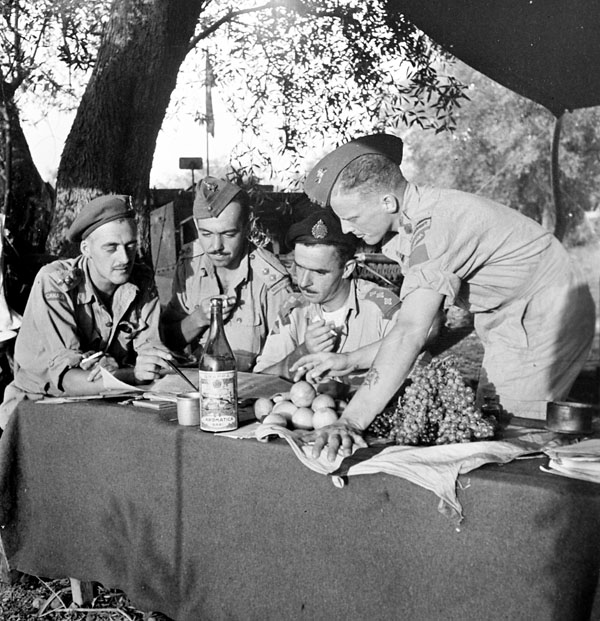
Black and white photograph of four men at a table—three sitting and one standing—intently examining documents, each with a cigarette in hand; a wine bottle and different fruits are prominently displayed on the table.

Unidentified officers of the Royal 22e Régiment reviewing plans during the advance on Busso, Italy, October 1943. (MIKAN 3521116)

Searching Library and Archives Canada for materials on the 22nd Battalion and the Royal 22e Régiment

Library and Archives Canada has many records on the 22nd Battalion (French-Canadian). Consult pages 115 to 121 of the Guide to Sources Relating to Units of the Canadian Expeditionary Force for a list of First World War records about the 22nd Battalion (French-Canadian). The war diaries of the 22nd Canadian Infantry Battalion are also available online.

To find material pertaining to the Royal 22e Régiment, carry out an advanced Collection search by entering RG24 in the first search box and 22e Régiment in the second search box. View the Flickr album on the 22nd (French Canadian) Battalion.

For more information, visit the Royal 22e Régiment website (available in French only).

Images of First World War posters now on Flickr

The outbreak of the First World War in 1914 marked the first large-scale use of posters to bolster support for a military action.

War Diaries of the First World War and Image Search

War diaries—records held at Library and Archives (LAC)—are daily accounts of First World War units’ “actions in the field.” They provide the most complete, first-hand record of how and where individual units were deployed and the wartime experiences of their members.

A page from the war diaries of the 22nd Canadian Infantry Battalion

A page from the war diaries of the 22nd Canadian Infantry Battalion (MIKAN 2004664)

Searching War Diaries

To search the war diaries, use Image Search, a great, fast and easy way to view and consult these digitized records. Tips for searching specific diaries are available on our How to Search for War Diaries section; using keywords will also help you narrow down your search. For example, here are the search results for the diaries of the famous “Van Doos,” better known as the 22nd Battalion. We used the search terms war diaries 22nd battalion and selected “Textual material” in the “Type of material” drop-down menu.

Finding Related Materials

After consulting a unit’s diaries, redo the search you just performed, but this time leave out war diaries, and in the “Type of material” drop-down menu, select the default “All.” Here are the search results for the 22nd Battalion. Your results will still include the war diaries, but you will also see photographs, works of art and other documents related to your search term, provided that it appears in the title of these documents.

Enjoy searching and exploring the digitized materials that we have to offer!

Library and Archives Canada releases fourteenth podcast episode, “Sign Me Up: CEF Files, 1914-1918”

Library and Archives Canada is releasing its latest podcast episode, Sign Me Up: CEF Files, 1914–1918.

Archivist Marcelle Cinq-Mars and genealogy consultant Sara Chatfield from Library and Archives Canada join us to talk about the service files of over 640,000 enlisted men and women of the Canadian Expeditionary Force. We explore the service files of these men and women to find out the types of documents that are found in them, their research value, and how they ended up at Library and Archives Canada.

Subscribe to our podcast episodes using RSS or iTunes, or just tune in at: Podcast – Discover Library and Archives Canada: Your History, Your Documentary Heritage.

For more information, please contact us at podcasts@bac-lac.gc.ca.

Library and Archives Canada releases thirteenth podcast episode, William Redver Stark: The Soldier and the Artist

Library and Archives Canada (LAC) is releasing its latest podcast episode, William Redver Stark: The Soldier and the Artist.

Art Archivist Geneviève Morin and Conservator Lynn Curry from LAC discuss the William Redver Stark fonds. They explore William Redver Stark’s background, his time as a soldier during the First World War, and the artwork he produced, specifically the 14 sketchbooks included in his fonds.

Subscribe to our podcast episodes using RSS or iTunes, or just tune in at: Podcast – Discover Library and Archives Canada: Your History, Your Documentary Heritage.

For more information, please contact us at podcasts@bac-lac.gc.ca.

War Brides of the First and Second World Wars

Wars are tragic events but they sometimes have an unexpected silver lining. During the First and Second World Wars, Canadian soldiers often found love overseas, got married and brought back their loved ones to Canada.

We are happy to advise you that we have added a new page to our Military Heritage section about the foreign women who married Canadian soldiers, the war brides. They shared a common experience of leaving their country and heading for Canada on long journeys, first by ship and then by train. They faced many challenges as they settled into a new country, a different culture and sometimes even a new language.

War brides, en route to Canada aboard S.S. Letitia, waving goodbye to families and friends.

War brides, en route to Canada aboard S.S. Letitia, waving goodbye to families and friends. (Source Mikan 3352285)

On this new page, you will find records from a variety of sources. The majority are found in the records of National Defence, Department of Employment and Immigration, Department of External Affairs, the Directorate of Repatriation, and the Canadian Wives′ Bureau, but many also come from private organizations.

Visit the War Brides page to explore the printed and archival resources available at Library and Archives Canada.

Images of Princess Patricia’s Canadian Light Infantry now on Flickr 

The Princess Patricia’s Canadian Light Infantry is one of three Permanent Force infantry regiments of the Canadian Army.

William Redver Stark: Restoring the Sketchbooks

Different approaches have been tried over the years for conserving sketchbooks or bound volumes. For a long time, the works were simply detached in order to remove the binding. Nowadays, the historical and archival value of the binding is widely recognized. Library and Archives Canada (LAC) is no exception in this regard, and conservation treatments are now designed to preserve the work in its entirety, including the binding.

In a previous article, we introduced you to the work of soldier William Redver Stark. The sketchbooks that are part of the William Redver Stark fonds were never repaired or preserved, and were beginning to show signs of wear:

  • Tears and holes
  • Pages detached, missing or in the wrong order
  • Broken binding threads
  • Covers weakly bound to pages or completely detached

The sketchbooks therefore are undergoing various conservation treatments, undertaken by a team of LAC’s highly specialized conservators in the field of book conservation and restoration. These conservators worked with the collection managers and archivists to respect the integrity of Stark’s work, and to give him his full moment of glory.

The drawings and watercolours in this collection are in very good condition. Some even look like they might have been completed only a few days ago. It should be noted that the sketchbooks remained closed for nearly a hundred years, and that the pages were rarely exposed to air or light. Thus, to study a Stark work is to travel through time, to see the work of an artist exactly as it was created a hundred years ago, during one of the most deadly and crucial wars of our time.

In sum, the restoration work done by LAC‘s conservation and restoration team will make it possible to stabilize the condition of the sketchbooks in order to ensure that they will withstand the ravages of time, and will allow future generations to have access to an important part of our history.

Example of a required restauration treatment: the adhesive tape must be removed.

Another example of a required restauration treatment : the cover must be sewn back on.

See Also:

Summary of comments received in French between July 1, 2014 and September 30, 2014

  • A reader from Wimereux (France) thanks LAC for its work on the restauration of William Stark’s sketchbooks. It turns out that William Stark was stationed in Wimereux and made a lot of sketches of the surroundings. The reader was able to identify some of the sketches and he is offering his work to LAC.