Major-General George Randolph Pearkes, Victoria Cross recipient

By Emily Monks-Leeson

Major-General George Randolph Pearkes was born in Watford, England, in 1888, and immigrated to Alberta in 1906. In 1915, he enlisted with the 2nd Regiment, Canadian Mounted Rifles, and from September 1916 onward commanded the 5th Battalion, Canadian Mounted Rifles. He was awarded the Victoria Cross at the Battle of Passchendaele.
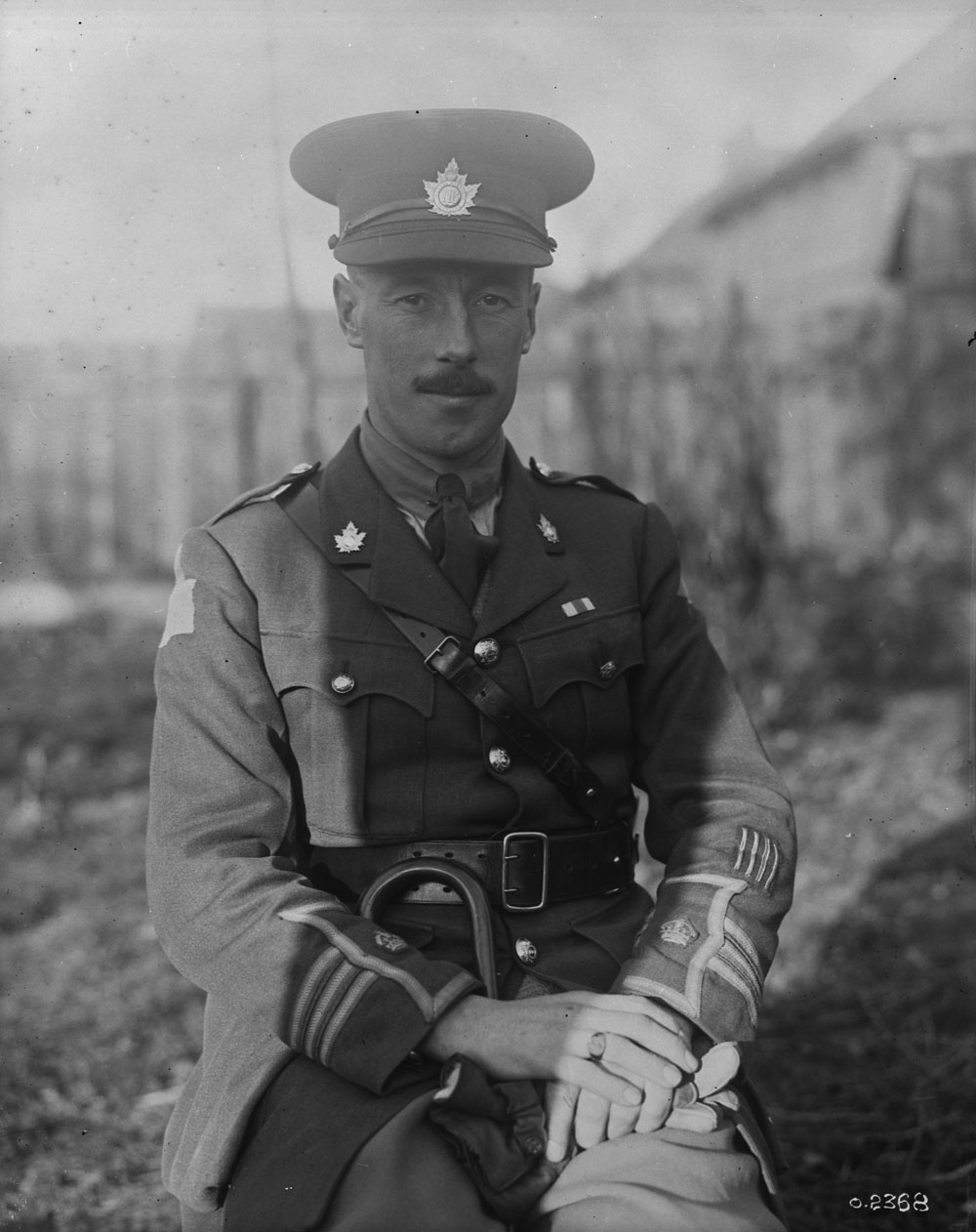
A black-and-white photograph of a seated officer wearing a cap, a Sam Browne belt (a wide leather strap around the waist with another narrower strap passing diagonally over the right shoulder) and arm stripes.

Major George Randolph Pearkes, VC, wearing the Military Cross service ribbon (he had not yet received the ribbon for the Victoria Cross). Note the four wound stripes on his sleeve. Photograph taken in December 1917 by William Rider-Rider (MIKAN 3219828)

Pearkes, then a major, was awarded the Victoria Cross in recognition of his skillful command during the capture and consolidation of his unit’s objectives and further ground in Passchendaele, Belgium, from October 30 to 31, 1917. Major Pearkes, who had been wounded in the thigh prior to his troops’ advance, led his unit throughout their attack. His citation in the London Gazette states that, when his unit’s advance was halted by a strongpoint, which a unit to his left had failed to capture, Pearkes himself captured and held the point, thus allowing the continued advance of Canadian troops.

It was entirely due to his determination and fearless personality that he was able to maintain his objective with the small number of men at his command against repeated enemy counter-attacks, both his flanks being unprotected for a considerable depth meanwhile.

London Gazette, no. 30471, 11 January 1918.

Before the end of the war, Pearkes would be wounded five times, promoted to lieutenant-colonel, and awarded the Victoria Cross, the Military Cross and the Distinguished Service Order. Following the armistice, he became a career officer, was appointed to Princess Patricia’s Canadian Light Infantry, and served as a staff officer at the Royal Military College of Canada. During the Second World War, Brigadier Pearkes commanded the 2nd Canadian Infantry Brigade, later becoming the general officer commanding in Chief, Pacific Command, where he oversaw defences on Canada’s west coast. He entered federal politics upon retiring from the army and was elected as the MP, Progressive Conservative Party, for Nanaimo, British Columbia in 1945. He was Minister of National Defence from 1957 to 1960, and became Lieutenant Governor of British Columbia in October 1960.

Major-General George Pearkes died in Victoria, British Columbia on May 30, 1984. The George R. Pearkes Building housing the Department of National Defence in Ottawa is named in his honour, as is Mount Pearkes on British Columbia’s mainland south coast. The complete digitized service file for Major-General George Pearkes is now available in Library and Archives Canada’s Personnel Records of the First World War.


Emily Monks-Leeson is an archivist in Digital Operations at Library and Archives Canada.

Private Kinross, Lieutenant McKenzie and Sergeant Mullin, VCs

By Emily Monks-Leeson

Private Cecil John Kinross was born in the village of Harefield, England, in 1896. He moved with his family to Lougheed, Alberta, in 1912. Kinross served with the 49th (Edmonton) Battalion during the Battle of Passchendaele.

A black-and-white photograph of a man wearing a cap with a grey wool cardigan, white shirt and dark tie.

Private Cecil John Kinross, VC, undated (MIKAN 3217741)

On October 30, 1917, Kinross and his company came under heavy German artillery and machine-gun fire. As casualties in his unit increased, Kinross advanced alone over open ground with only his rifle and a bandolier of ammunition, and destroyed a German machine-gun nest. His citation in the London Gazette states that his “superb example and courage instilled the greatest confidence in his company, and enabled a further advance of 300 yards to be made and a highly important position to be established.”

For his actions, Kinross was awarded the Victoria Cross. Seriously wounded in the arm and head, he was sent to Orpington Hospital, England, and later returned to Alberta. Kinross died in 1957. Mount Kinross in Jasper National Park is named in his honour.

Lieutenant Hugh McKenzie was born in 1885 in Inverness, Scotland. He immigrated to Canada in 1911. McKenzie enlisted with the Princess Patricia’s Canadian Light Infantry as a private in August 1914. By January 1917, he had been commissioned as a second lieutenant. On October 30, 1917, McKenzie was in command of a machine-gun section accompanying infantry in an attack against German positions. When all officers and most non-commissioned officers of the company were killed or wounded, McKenzie took command of the remaining infantry. Using flanking and frontal attacking parties, McKenzie captured a machine-gun pill box that had inflicted heavy casualties. His actions saved the lives of many men, but he himself was killed leading the frontal attack.

A black-and-white photograph of a uniformed soldier with a small moustache.

Lieutenant Hugh McKenzie, VC, undated (MIKAN 3218971)

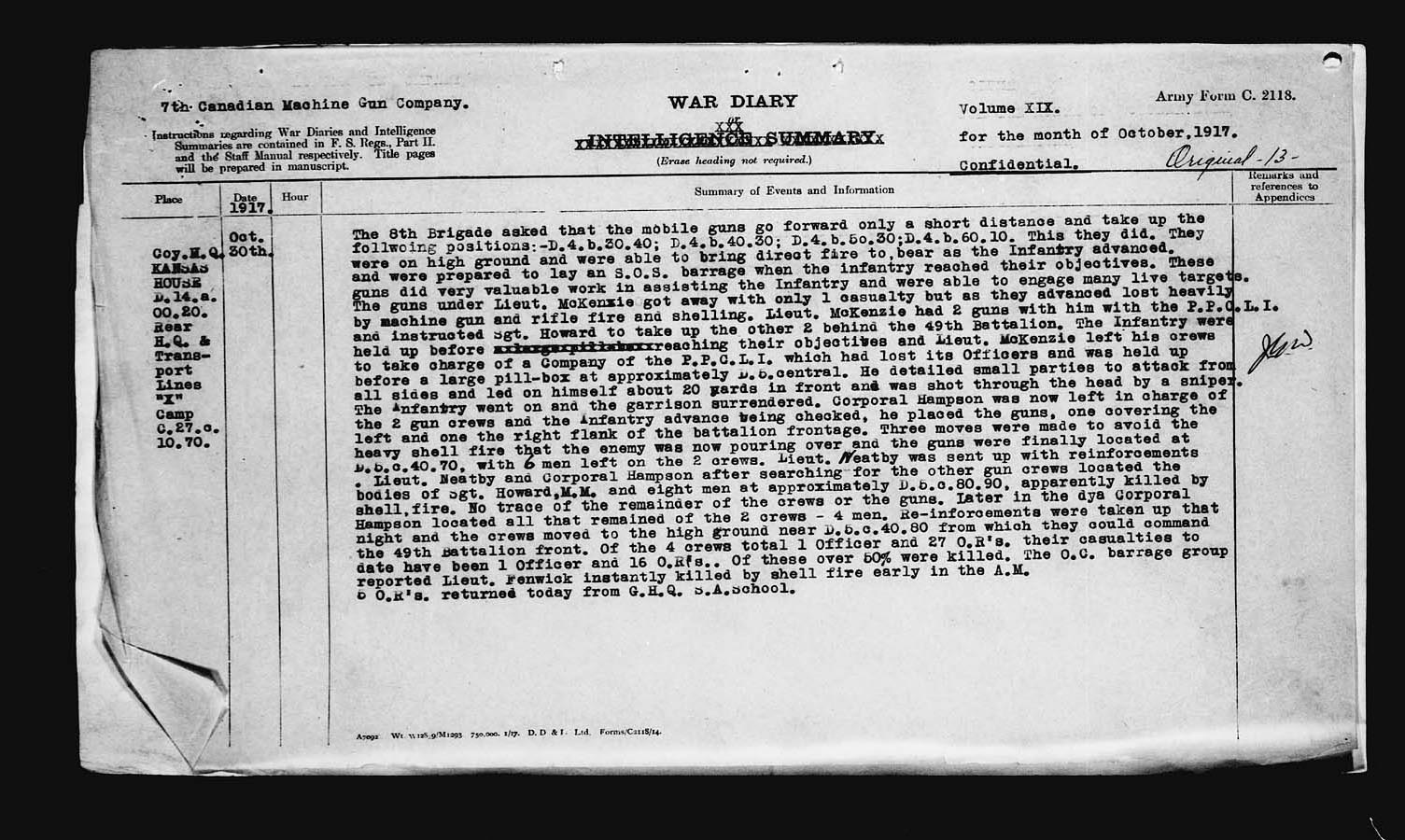
A typed detailed account of the events of October 30, 1917.

War diary of the 7th Canadian Machine Gun Company, October 30, 1917, page 16 (MIKAN 2004833)

Lieutenant McKenzie received the Victoria Cross and the French Croix de guerre for his actions. His body was never recovered. McKenzie’s name appears, along with the names of 56,000 other soldiers from Britain, Australia, Canada, and India with no known graves, on the Menin Gate memorial. In his citation in the London Gazette , his name is misspelled as “Mackenzie.”

Major George Harry Mullin was born in Portland, Oregon, in 1892. He immigrated with his family to Moosomin, Saskatchewan, at the age of two. Mullin enlisted in December 1915 and served in the scout and sniper section of the Princess Patricia’s Canadian Light Infantry. As a sergeant at the Battle of Passchendaele, Mullin single-handedly captured a German pill box that had caused heavy casualties among the Canadian troops. His citation in the London Gazette recounts how Mullin:

… rushed a sniper’s post in front, destroyed the garrison with bombs, and, crawling on to the top of the “Pill-box,” he shot the two machine-gunners with his revolver. Mullin then rushed to another entrance and compelled the garrison of ten to surrender. … [Mullin] not only helped to save the situation, but also indirectly saved many lives.

London Gazette, no. 30471, 11 January 1918

Sergeant Mullin was awarded the Victoria Cross for his actions, finishing the war as a lieutenant. He was appointed as Sergeant-at-Arms of the Saskatchewan legislature in 1934. He served in the Veterans Guard during the Second World War. Major Mullin died in Regina, Saskatchewan, in 1963.

A black-and-white photograph of a smiling soldier wearing a helmet and a leather jerkin.

Sergeant Mullin, VC, Princess Patricia’s Canadian Light Infantry, January 1918 (MIKAN 3219321)

Library and Archives Canada holds the Canadian Expeditionary Force (CEF) service files for Private Cecil John Kinross, Lieutenant Hugh McKenzie and Major George Harry Mullin. Complete digital copies are available in the Personnel Records of the First World War database.


Emily Monks-Leeson is an archivist in Digital Operations at Library and Archives Canada.

Sergeant Holmes, Major O’Kelly and Lieutenant-Colonel Shankland, Victoria Cross recipients

By Emily Monks-Leeson

Sergeant Thomas William Holmes is Canada’s youngest recipient of the Victoria Cross (VC). Born in Montreal on October 14, 1898, Holmes gave his date of birth as August 17, 1897, when he enlisted with the 147th Grey Overseas Battalion, making himself out to be older than he was. He served with the Canadian Mounted Rifles and was part of the first assault against the German defences at Passchendaele 100 years ago. When the right flank of the Canadian force was halted and heavy casualties inflicted by machine-gun and rifle fire from a German pillbox, Holmes repeatedly ran forward alone and bombed the machine gun crew, eventually taking the pillbox’s 19 occupants prisoner. Sergeant Holmes survived the war and returned to Canada. He died on January 4, 1950, and is buried at Greenwood Cemetery in Owen Sound, Ontario.

A black-and-white photograph of a smiling young man in uniform with his cap slightly askew.

Private Thomas William Holmes, VC, dated January 1918 (MIKAN 3216873)

Major Christopher Patrick John O’Kelly, born on November 18, 1895, in Winnipeg, Manitoba, was commissioned as a second lieutenant in the Canadian Expeditionary Force (CEF). At the age of 21 he was an acting captain in the 52nd Battalion (96th Lake Superior Regiment), leading his men against the German defences at Bellevue Spur near the Passchendaele Ridge. Captain O’Kelly led his unit almost a kilometer into German-held territory without artillery support and successfully captured the German positions. He then organized and led attacks against German pillboxes, capturing 100 prisoners and 10 machine guns. For his leadership, Captain Christopher O’Kelly was awarded the Victoria Cross. He later achieved the rank of major. O’Kelly survived the war, but died a few years after in a boating accident near Red Lake, Ontario, on November 15, 1922.

A black-and-white photograph of a muddied soldier leaning on the wall of a trench, smoking a cigarette and looking directly at the photographer.

Captain Christopher Patrick John O’Kelly, VC, MC, dated December 1917 (MIKAN 3219566)

A densely typed page carefully describing the events of the day and mentioning both Captain O’Kelly and Lieutenant Shanklin [sic].


War diary of the 52nd Canadian Infantry Battalion, dated October 26, 1917, Page 19 of the war diary (MIKAN 1883263)

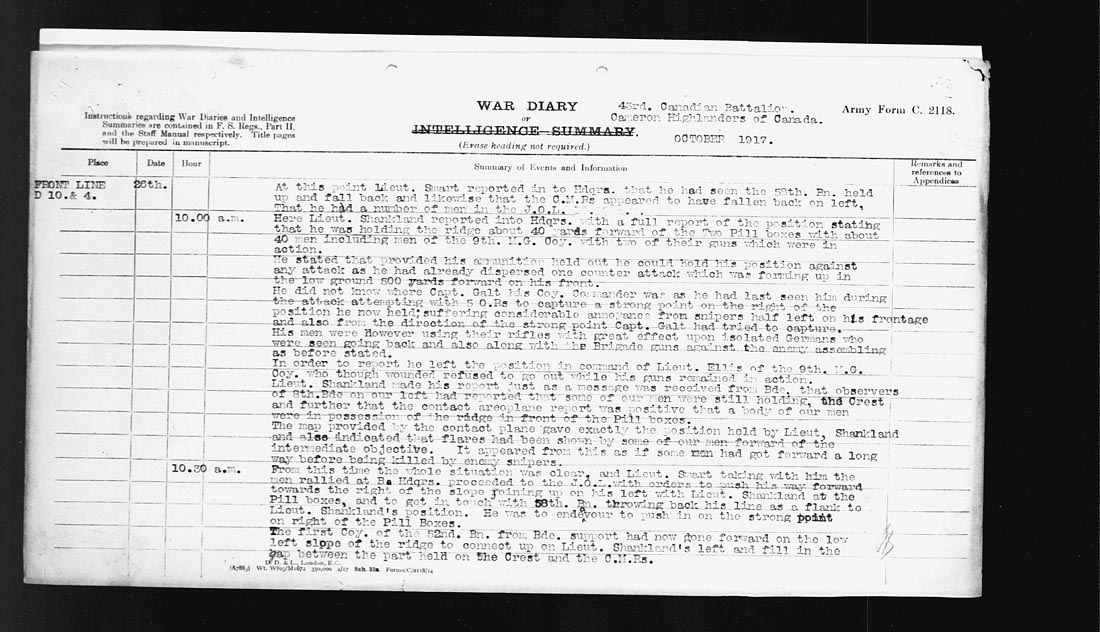
Lieutenant-Colonel Robert Shankland, born in Ayr, Scotland in 1887, immigrated to Canada in 1910 and settled in Winnipeg, Manitoba. He enlisted as a private with the 43rd Battalion and earned the Distinguished Conduct Medal at Sanctuary Wood in June 1916, after which he received a battlefield commission. On October 26, 1917, Shankland and a platoon of 40 men captured and held the crest of Bellevue Spur in the face of heavy fire and the collapse of the Allied line. With both flanks exposed, Shankland turned over command to another officer and set out alone to reach battalion headquarters, where he gave a plan for counter-attack. He then returned with reinforcements to carry out the attack. His citation in the London Gazette from December 14, 1917, reads:

Having gained a position he rallied the remnants of his own platoon and men of other companies, disposed them to the command the ground in front, and inflicted heavy casualties upon the retreating enemy. Later, he dispersed a counter-attack, thus enabling supporting troops to come up unmolested.

A typed list of the events of October 26, 1917; specifically, what was happening to the 43rd Canadian Infantry Battalion between 10 and 10:30 a.m.

War diary of 43rd Canadian Infantry Battalion from October 1917, Page 14 of the War diary (MIKAN 1883254)

LieutenantColonel Shankland survived the war and served overseas during the Second World War as camp commandant of the Canadian Army Headquarters in England. He lived on Pine Street in Winnipeg, Manitoba, along with two other Victoria Cross recipients: Leo Clarke and Frederick William Hall. Pine Street was renamed Valour Road in 1925 to honour the three men.

Library and Archives Canada holds the CEF service file for Sergeant Holmes, Major O’Kelly and Lieutenant-Colonel Shankland.


Emily Monks-Leeson is an archivist in Digital Operations at Library and Archives Canada.

Canada and the 3rd Battle of Ypres: Passchendaele

“I died in hell. They called it Passchendaele.”

Siegfried Sassoon

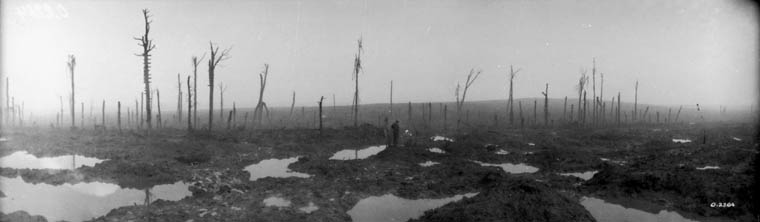
A black-and-white photograph of a bombed landscape. The ground is muddy with water-filled craters and a burned out forest.

Passchendaele, now a field of mud. Photo taken by William Rider-Rider in November 1917 (MIKAN 3194937)

The town of Ypres, Belgium and its surrounding countryside has special significance to the history of the Canadian Corps. In 1917, this area was the last portion of Belgium that remained outside German control. Little had changed in the region since Second Ypres in April 1915; the British held the city of Ypres while the Germans held the high ground of the Messines-Wytschaete Ridge to the south, the lower ridges to the east, and the flat terrain to the north.

On July 31, 1917, British, Australian, and New Zealand forces launched an offensive that would be known as the Third Battle of Ypres. As heavy rains poured down on the thick clay soil, shell holes created by a massive artillery barrage filled with water. Attacking soldiers struggling in deep mud offered easy targets for German gunners, and by some accounts as many soldiers drowned in the heavy mud as died from their wounds. Casualty estimates for the battle, which lasted from July 31 to November 20, 1917, range from 300,000 to 400,000 for the Allies and a roughly equal number for the Germans.

A black-and-white photograph of a soldier walking in a field of mud and puddles.

Mud and barbed wire through which the Canadians advanced during the Battle of Passchendaele. Photo taken by William Rider-Rider in November 1917 (MIKAN 3194807)

In early October, the four divisions of the Canadian Corps were transferred to the Ypres salient and tasked with the near impossible: capturing Passchendaele and the ridge. The offensive, to be executed in three stages, began on October 26, 1917. In the first stage, the 3rd Canadian Division captured Wolf Copse before reconnecting with the British 5th Army line. In the second stage, beginning on October 30, Canadian units secured a number of objectives and sent patrols into Passchendaele itself. In the final stage, from November 3 to 5, troops of the 1st and 2nd Divisions captured the village of Passchendaele in less than three hours. A final push on November 10 ended the campaign as the Canadians captured the remaining high ground north of the village.

While the Canadian Corps had achieved what no other Allied force had been able to, over 4,000 men died in the effort and 12,000 were wounded. The Third Battle of Ypres bolstered the Canadians’ reputation as storm troops, one of the best fighting forces on the western front. Nine Canadians were recognised with the Victoria Cross for their extraordinary actions in one of the most horrific battlefields ever known.

Library and Archives Canada’s series, First World War Centenary: Honouring Canada’s Victoria Cross recipients will profile each of them over the next three weeks.


Emily Monks-Leeson is an archivist in Digital Operations at Library and Archives Canada.

Sergeant Filip Konowal, VC

By Emily Monks-Leeson

The final soldier from the Battle of Hill 70 to be profiled on our series, First World War Centenary: Honouring Canada’s Victoria Cross recipients, is Sergeant Filip Konowal, a highly decorated Ukrainian-Canadian who was born on September 15, 1888, in Kutkivtsi, Ukraine.

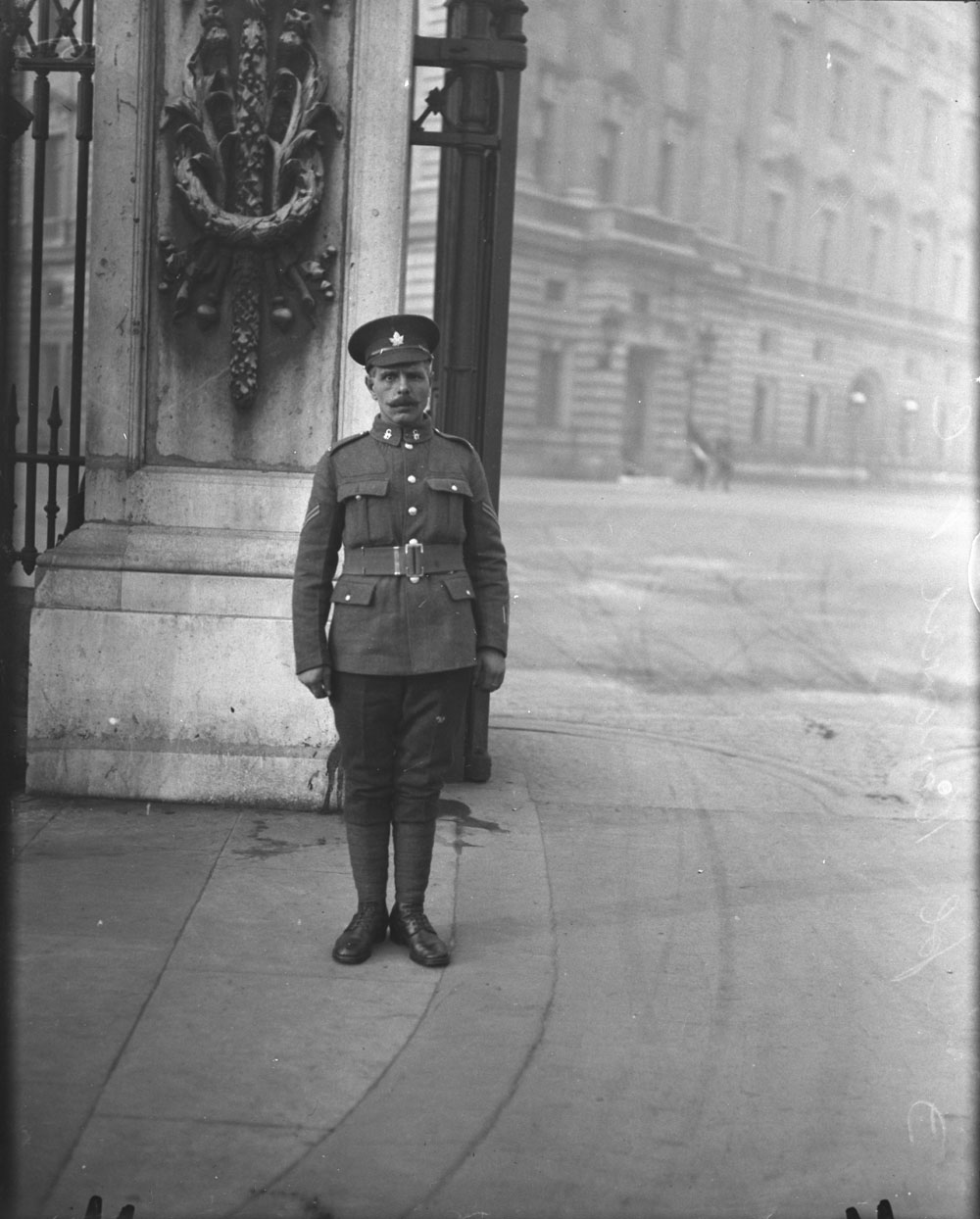
A black-and-white photograph of a soldier wearing a peaked hat adorned with a maple leaf. He is standing at attention in front of a large gate leading into palace grounds.

Corporal Filip Konowal at Buckingham Palace for presentation of his VC medal (MIKAN 3217851)

Konowal served in the Imperial Russian Army before immigrating to Canada in 1913. A trained bayonet instructor, he joined the Canadian Expeditionary Force in 1915 and served with the 47th (British Columbia) Battalion, where he was promoted to corporal. Konowal was with his battalion at Hill 70, near Lens, France, when his bravery and determination over the three days of the battle, from August 22 to 24, earned him the Victoria Cross.

While leading his section through the German defenses by clearing cellars, craters and machine gun emplacements, Corporal Konowal both protected his troops and personally fought a number of German soldiers. His efforts did not end there. His citation in the London Gazette tells that:

On reaching the objective, a machine-gun was holding up the right flank, causing many casualties. Cpl. Konowal rushed forward and entered the emplacement, killed the crew, and brought the gun back to our lines. The next day he again attacked single-handed another machine-gun emplacement, killed three of the crew, and destroyed the gun and emplacement with explosives. This non-commissioned officer alone killed at least sixteen of the enemy, and during the two days’ actual fighting carried on continuously his good work until severely wounded.

London Gazette, No. 30400, November 26, 1917

Konowal was presented with the Victoria Cross by King George V and was promoted to sergeant. After recovering from his wounds, he was assigned to serve as a military attaché at the Russian Embassy in London. He later enrolled with the Canadian Siberian Expeditionary Force.

Sergeant Filip Konowal died in Hull, Quebec, in 1959. He is buried at Notre Dame de Lourdes Cemetery in Ottawa.

Library and Archives Canada holds the service file for Filip Konowal.


Emily Monks-Leeson is an archivist in Digital Operations at Library and Archives Canada.

Lieutenant Robert Hill Hanna, VC

By Emily Monks-Leeson

Today our blog series First World War Centenary: Honouring Canada’s Victoria Cross recipients marks the anniversary of the Battle of Hill 70, a decisive victory for the Canadian Corps and site of mourning for many thousands of Canadian and German families. Six Canadians were awarded the Victoria Cross (VC) for their actions during and immediately following Hill 70. Among them was Robert Hill Hanna, born in Kilkeel, Ireland, on August 6, 1887, and an immigrant to Canada in 1905.

A black-and-white photograph of a young man in uniform standing on a balcony outside.

Cadet R. Hanna, VC, date unknown (MIKAN 3216531)

Hanna enlisted with the 29th Battalion (British Columbia Regiment) and was a 30-year-old company sergeant-major on August 21, 1917. His company, which was fighting to capture a heavily protected German strongpoint near Hill 70 at Lens, France, had suffered heavy casualties, including every one of Hanna’s ranking officers. In the face of this, Hanna rallied a party of men and led them in a forward attack on the German strongpoint, rushing the barbed wire and killing the German soldiers manning a machine gun.

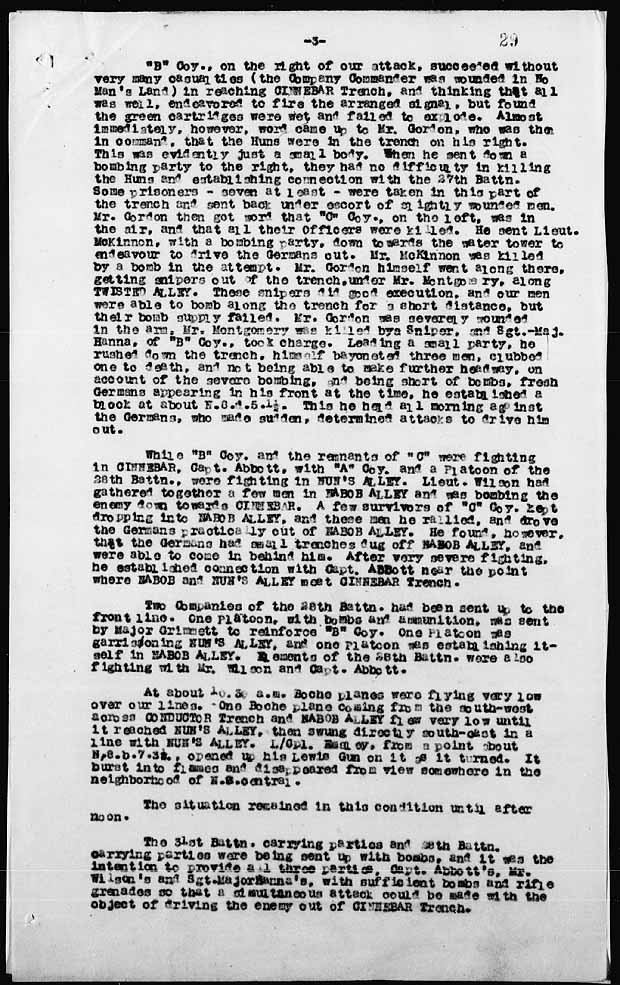
A typed description of the events leading to Hanna’s VC medal.

Second page of appendix No. 6 of the report on operations describing the actions of Sergeant-Major Hanna (MIKAN 1883249)

His citation in the London Gazette states:

This most courageous action, displaying courage and personal bravery of the highest order at this most critical moment of the attack, was responsible for the capture of a most important tactical point, and but for his daring action and determined handling of a desperate situation the attack would not have succeeded.

London Gazette, No. 30372, November 8, 1917

Hanna later achieved the rank of lieutenant. He survived the war and returned to Canada. Lieutenant Robert Hill Hanna died in Mount Lehman, British Columbia, on June 15, 1967.

Library and Archives Canada holds the Canadian Expeditionary Force service file for Lieutenant Robert Hill Hanna.


Emily Monks-Leeson is an archivist in Digital Operations at Library and Archives Canada.

Sergeant Frederick Hobson and Major Okill Massey Learmonth, VCs

By Emily Monks-Leeson

Two Canadian soldiers who fought at the Battle for Hill 70 in France are the subject of today’s blog series, First World War Centenary: Honouring Canada’s Victoria Cross recipients.

Sergeant Frederick Hobson, V.C., a veteran of the South African War (1899–1902), was living in Galt, Ontario, when recruitment started for the Canadian Expeditionary Force. Born in 1873, Hobson claimed his birth year to be 1875 in order to be eligible to serve.

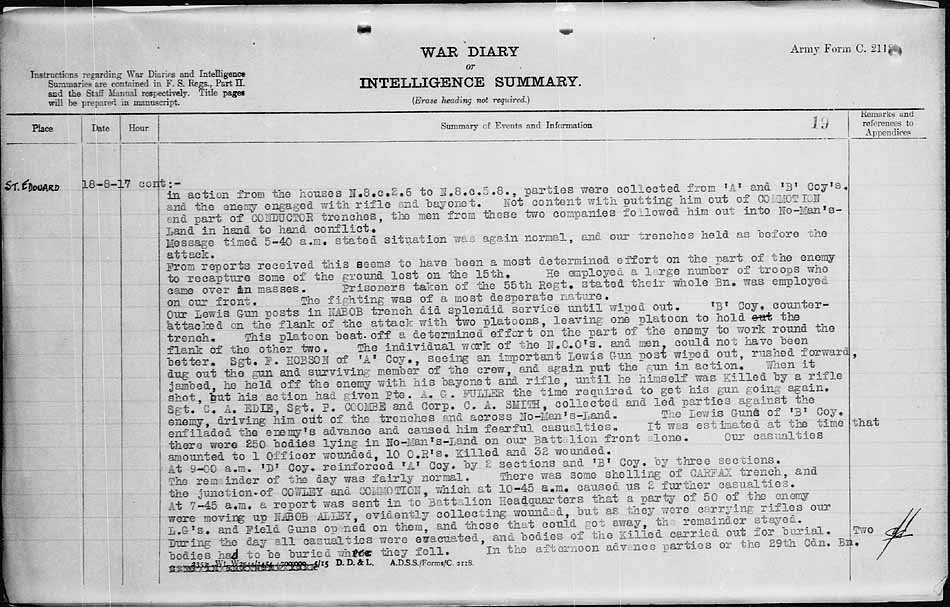
On August 18, 1917, Sergeant Hobson’s company of the 20th Battalion was repelling a strong German counterattack at Hill 70. When an artillery shell buried a Lewis gun in a forward post and killed most of its crew, Hobson left his trench, dug out the gun, and turned it against the German infantry advancing towards his position. His citation for the Victoria Cross tells that when a jam caused the gun to stop firing, a wounded Hobson “left the gunner to correct the stoppage, rushed forward at the advancing enemy and, with bayonet and clubbed rifle, single handed, held them back until he himself was killed by a rifle shot. By this time however, the Lewis gun was again in action and reinforcements shortly afterwards arriving.” (London Gazette, no. 30338, October 17, 1917)

A typewritten description of the events of the day, including a description of Sergeant Frederick Hobson’s actions.

War diary of the 20th Canadian Infantry Battalion, dated August 18, 1917, Page 20 (MIKAN 205918)

Sergeant Frederick Hobson’s body was never recovered. He is honoured alongside 11,000 other Canadian soldiers at the Vimy Memorial in France.

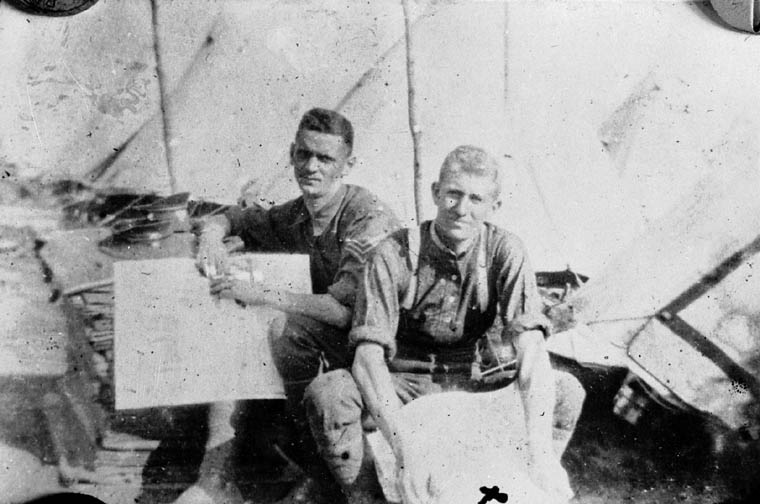
Major Okill Massey Learmonth, V.C., was born in Quebec City in 1894. On August 18, 1917, he was an acting Major with the 2nd (Eastern Ontario) Battalion at Hill 70 near Lens, France. When a German counter-attack on their newly consolidated positions surprised Learmonth’s company, he charged and, according to his citation in the London Gazette, “personally disposed” of the attackers. Though under heavy bombardment and seriously wounded, Major Learmonth stood at the parapet of his trench and threw bombs at advancing Germans while directing his men’s defence of their position. His citation for the Victoria Cross tells that Learmonth actually caught several bombs thrown at him by the enemy and threw them back, and refused to be evacuated after being wounded. He died later that day in a field hospital.

A black-and-white photograph of two young men sitting down in a camp, looking at maps. Behind them can be seen several tents.

Major Okill Massey Learmonth (right) with unidentified soldier (MIKAN 3628686)

A typewritten description of the events of the day. It mentions that Learmonth and another officer died of their wounds.

War diaries of the 2nd Canadian Infantry Battalion, dated August 18, 1917, Page 7 (MIKAN 2005884)

Major Okill Massey Learmonth is buried at Noeux-les-Mines Communal Cemetery in France. Learmonth Street in his hometown of Quebec City is named in his honour.

Library and Archives Canada holds the service files for Sergeant Frederick Hobson and Major Okill Massey Learmonth.


Emily Monks-Leeson is an archivist in Digital Operations at Library and Archives Canada.

Private Harry W. Brown, VC

By Emily Monks-Leeson

In today’s profile for Library and Archives Canada’s blog series First World War Centenary: Honouring Canada’s Victoria Cross recipients, we remember Private Harry Brown, who was awarded the Victoria Cross for his actions during the Battle for Hill 70 on August 16, 1917, in France.

Private Brown, born May 10, 1898, was a farmer from Gananoque, Ontario. On August 18, 1916, he enlisted with the Depot Regiment of the Canadian Mounted Rifles, Canadian Expeditionary Forces (CEF), at London, Ontario. Private Brown transferred to the 10th Battalion upon arrival in England, and was serving with the battalion on August 16, 1917, when, having advanced to a position near Hill 70 at Lens, France, his unit was struggling to repel repeated German counterattacks on their position. All communications with the rear had been cut, and the company’s right flank was exposed. Brown and a fellow soldier were tasked with breaking through the surrounding enemy lines to reach battalion headquarters with a desperate message for reinforcements. Under an intense artillery barrage and gunfire, Brown’s arm was hit and shattered, and his companion was killed. Nevertheless, as his citation in the London Gazette reads, Brown:

…continued on through an intense barrage until he arrived at the close support lines and found an officer. He was so spent that he fell down the dugout steps, but retained consciousness long enough to hand over his message, saying, ‘Important message.’ He then became unconscious, and died in the dressing station a few hours later.

(London Gazette, No.30338, October 17, 1917)

A typed list of men who played significant roles in the Battle for Hill 70.

A page from the war diaries of the 10th Canadian Infantry Battalion describing the men who “rendered valuable and exceptional service”, including Private Harry W. Brown; from Appendix 29, Page 5 (MIKAN 2005896)

Due to Brown’s courage and determination, his message was delivered and reinforcements were sent. He is credited as saving both the unit’s position on Hill 70 and the lives of many of his fellow soldiers. Private Harry Brown was awarded the Victoria Cross posthumously. He is buried at Noeux-les-Mines Communal Cemetery, near the towns of Lens and Béthune, France.

Library and Archives Canada holds the service file for Private Harry Brown.

Related Resources


Emily Monks-Leeson is an archivist in Digital Operations at Library and Archives Canada.

Private Michael James O’Rourke, VC

By Emily Monks-Leeson

On the 100th anniversary of the first day of the Battle of Hill 70 in France during the First World War, we are profiling Victoria Cross (VC) recipient Private Michael James O’Rourke.

Born in Limerick, Ireland, and a resident of British Columbia, Michael O’Rourke was a 39-year-old private serving as a stretcher-bearer with the 7th (1st British Columbia) Battalion. Over a three-day period, from August 15 to 17, 1917, Private O’Rourke worked without rest to bring wounded men to safety as the Canadian Corps fought to capture and hold Hill 70. Through heavy German shelling and gunfire, Private O’Rourke repeatedly reached wounded soldiers, treated their injuries, and ensured they had food and water until they could be brought to safety.

His citation for the Victoria Cross tells that:

During the whole of his period the area in which he worked was subjected to very severe shelling and swept by heavy machine gun and rifle fire. On several occasions he was knocked down and partially buried by enemy shells. Seeing a comrade who had been blinded stumbling around ahead of our trench, in full view of the enemy who were sniping him, Pte. O’Rourke jumped out of his trench and brought the man back, being himself heavily sniped at while doing so. Again he went forward about 50 yards in front of our barrage under very heavy and accurate fire from enemy machine guns and snipers, and brought in a comrade. On a subsequent occasion, when the line of advanced posts was retired to the line to be consolidated, he went forward under very heavy enemy fire of every description and brought back a wounded man who had been left behind. ()

The citation notes that O’Rourke’s actions “undoubtedly saved many lives.”

A black-and-white photograph of a seated soldier with a bandaged hand smiling at the photographer.

Private Michael James O’Rourke, VC, November 1917 (MIKAN 3219606)

Michael James O’Rourke survived the war and returned to Canada, where he spent years working odd jobs in Vancouver and surviving on a disability pension of $10 per month. He led a protest march during a dockworkers’ strike in 1935 and was attacked by police in the Battle of Ballentyne Pier.

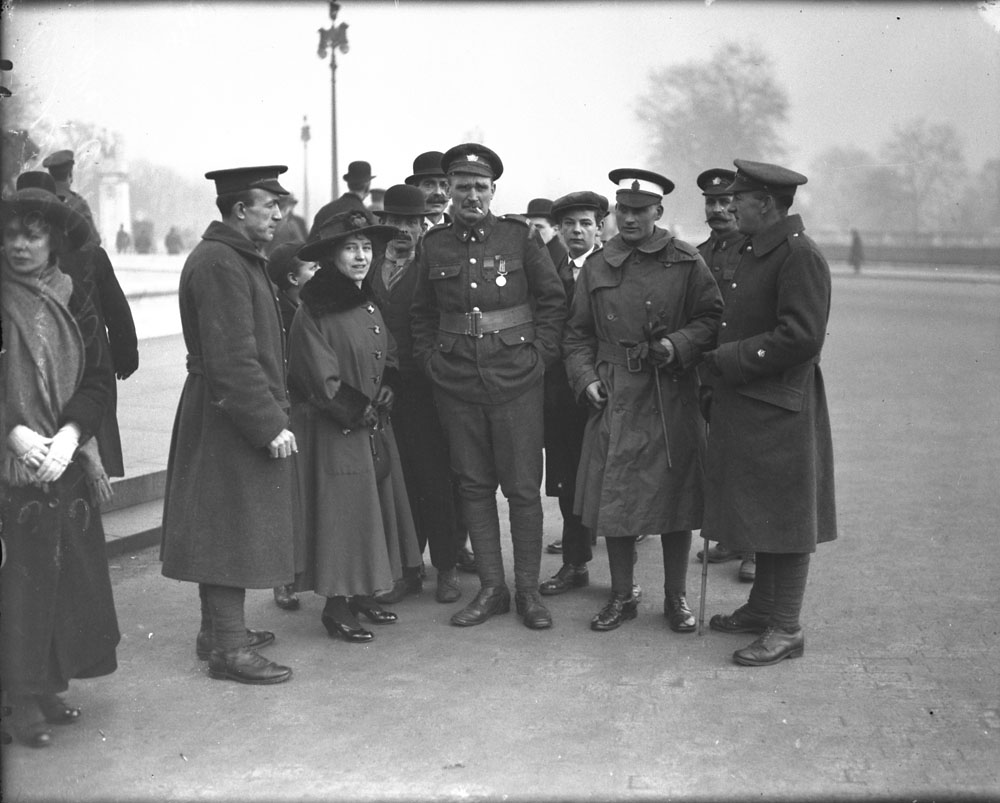
A black-and-white photograph of a group of people gathered around two soldiers.

Private Michael James O`Rourke, VC, 7th Battalion, with Cadet Robert Hanna, VC, to his right (MIKAN 3219607)

Private Michael James O’Rourke died in Vancouver on December 6, 1957, and is buried in Forest Lawn Memorial Park in Burnaby, British Columbia.

Library and Archives Canada holds the Canadian Expeditionary Forces service file for Private Michael James O’Rourke.

Related resources


Emily Monks-Leeson is an archivist in Digital Operations at Library and Archives Canada.

The Canadian Corps and the Battle of Hill 70

By Emily Monks-Leeson

Today marks a significant anniversary in Canada’s First World War history. Though overshadowed in popular memory by the Battle of Vimy Ridge, the Battle of Hill 70 in August 1917 was planned, fought and won almost exclusively by the Canadian Corps.

Following the victory at Vimy, Lieutenant-General Julian Byng, long-time commander of the Canadian Divisions, took command of the British Third Army, and Canadian-born Lieutenant-General Sir Arthur Currie became the new battlefield commander. In July 1917, Sir Douglas Haig ordered Currie to launch an attack on the German-held town of Lens. Currie insisted, instead, on capturing Hill 70 to the north, giving the Allies the advantage of higher ground and forcing German troops to counterattack from their heavily fortified and well-hidden urban defences.

Preparations for the assault were extensive. On the evening of August 14, Canadian artillery began an intense bombardment of the hill. The following morning, ten Canadian Expeditionary Force assault battalions drawn from the four Canadian divisions attacked. Canadian soldiers took their first objectives within twenty minutes, while low-flying aircraft helped to direct artillery against concentrated points of German resistance.

Thrown off the hill, the German army immediately counterattacked. Both sides used chemical gas and soldiers fought nearly blind through fogged-up respirators. Over four days, the Germans counterattacked 21 times, but, in the end, the Canadians held the hill overlooking Lens. Haig characterized the battle as “one of the finest minor operations of the war,” while Currie described it as among the hardest battles fought and won by the Canadian Corps.

The attack on Hill 70 left an estimated 9,000 Canadians dead or wounded and 41 taken prisoner. The Germans, who had committed five divisions to defend Hill 70, suffered an estimated 25,000 casualties, with 970 taken prisoner.

A black-and-white photograph of two men on stretchers. A group of medical personnel is attending to one of the men, while the other man lies on his side. Several soldiers are standing to the left of the stretchers, while others are sitting in the background. The scene is a bombed-out building with only the chimney still standing.

Dressing the wounds of Canadian soldiers during advance to Hill 70. August 1917 (MIKAN 3395845)

A black-and-white photograph of a convoy of carts moving down the road. A group of Scottish soldiers in full kilt pulls the last cart.

13th Battalion Machine Gunners going out to rest after Hill 70. August 1917 (MIKAN 3406033)

A black-and-white photograph of a column of soldiers marching through a town. Onlookers include some officers as well as children and other civilians.

General Sir Arthur Currie watching his men who took Hill 70 marching to camp after being relieved. August 1917 (MIKAN 3404812)

Six Victoria Crosses were awarded to soldiers of the Canadian Corps for their actions during and immediately following the Battle of Hill 70. Over the next week, Library and Archives Canada’s blog series, First World War Centenary: Honouring Canada’s Victoria Cross recipients, will profile each of the winners, one hundred years to the day that their actions took place.


Emily Monks-Leeson is an archivist in Digital Operations at Library and Archives Canada.