Sir John Franklin Expedition

On May 19, 1845, HMS Erebus and HMS Terror left England under the command of Sir John Franklin in search of the Northwest Passage. This expedition was without a doubt a most ill-fated venture, as not a single member returned alive.

An iceberg, HMS Terror and some walruses near the entrance of Hudson Strait.

An iceberg, HMS Terror and some walruses near the entrance of Hudson Strait
Library and Archives Canada, Acc. No. 1979-49-1. Source

Major search efforts were launched to find the missing men, including three expeditions to the Arctic in spring 1848. Rewards were also offered in 1849 and 1850 for any information about Franklin’s expedition. These searches did produce results: in 1850, the first relics—the graves of three crewmen who died in 1846—were found at Beechey Island, west of Devon Island.

In July 1857, Lady Franklin also financed an expedition under the command of Francis McClintock aboard the ship Fox. On May 5, 1859, William Hobson, Lieutenant of the Fox, found a document placed beneath a cairn containing two messages. The first, written by Franklin on May 28, 1847, indicated that the crew of the two ships had spent the winter of 1845–46 off Beechey Island, and that all was well. The second message, dated April 25, 1848, indicated that the Erebus and Terror had been trapped in ice since September 1846, west of King William Island, and that 24 men had died, including Franklin on June 11, 1847.

In the wake of expeditions undertaken to find Franklin, numerous maps were drawn, including the Discoveries in the Arctic Sea, 1616-1927 and the Chart showing the vicinity of King William Island. These identified the sites Franklin visited, the places where his group wintered and the site in which his ships were abandoned. The second map also mentions the diverted courses the two wrecks may have followed.

Although we now know the fate of the members of this expedition, every attempt to find the wrecks of the Erebus and the Terror has been unsuccessful, despite the magnitude of the searches and modern technologies deployed.

For more information about the period prior to the expeditions:

For more information about the periods prior to and following the expeditions:

For more information about the period following the expeditions:

Publications, bibliographies and guides held at Library and Archives Canada:

Please visit our Flickr album for more photographs.

The Battle of the Atlantic (1940–1943)

Although the waters of the Atlantic witnessed many a naval battle throughout the Second World War, the longest and most important, the Battle of the Atlantic, reached its height between 1940 and 1943, pitting the Allies against the German navy and its formidable fleet of submarines, known as U-boats.

$90 Killed this U-BOAT! War savings stamps drive, 1943.

$90 Killed this U-BOAT! War savings stamps drive, 1943. Source

The Battle of the Atlantic’s crucial struggle was to protect the convoys of merchant ships against enemy German naval forces, which tried to block their way. Most of these convoys set out from North American ports and were bound for Great-Britain.

Convoy in the Bedford Basin, near Halifax, Nova Scotia, April 1, 1942.

Convoy in the Bedford Basin, near Halifax, Nova Scotia, April 1, 1942. Source

The Battle of the Atlantic saw U-boats penetrate deep into Canadian waters: the Royal Canadian Navy was actively involved in the battle, fighting fiercely to protect its merchant navy.

Freighter SS ROSE CASTLE, in convoy, torpedoed by U-boat, November 2, 1942, near Wabana, Newfoundland.

Freighter SS ROSE CASTLE, in convoy, torpedoed by U-boat, November 2, 1942, near Wabana, Newfoundland. Source

However, despite all efforts, enemy forces sunk over 70 merchant vessels, claiming the lives of over 1,600 Canadian crew members. Nevertheless, the Allies are considered to have prevailed in the Battle of the Atlantic since the Germans failed to stem the flow of merchant shipping convoys bound for Great Britain, which helped provide the supplies essential to the allied victory. Be sure to visit the Canadian War Museum for more information about this Second World War battle.

The Royal Canadian Navy’s contribution to this effort is well documented in the collection of Library and Archives Canada. Some suggestions and references for further research are provided below.

Since most convoys setting out from Canada departed from Halifax harbour, a large volume of records were produced by the Naval Control Service in Halifax. Documents available for consultation include the following:

Please visit our Flickr album for more photographs.

PS 8000 collection of early 20th-century digitized Canadiana

To mark Canada Book Day, we take a closer look at the PS 8000 collection of early 20th-century Canadian publications available in the Electronic Collection of Library and Archives Canada. PS 8000 is the standard classification for Canadian literature, one of the core strengths of our holdings.

To browse this collection

• Click “Search the Electronic Collection” on the left side of the screen
• Choose “Any keyword” from the drop-down menu in the first search box
• Enter “PS 8000” in the second field as the search term

This search produces a list of pre-1926 Canadian publications that have been digitized and are accessible online. Other key terms can be used to further refine the search (e.g. world war and poetry).

Figure 1: Search screen for Electronic Collection

Figure 1: Search screen for Electronic Collection

For other online resources, consult our blog articles on how to find digitized publications Part I and Part II.

Also, explore our Flickr album for a selection of cover images of these publications.

Battle of Vimy Ridge – April 9 to 12, 1917

For Canadians, the Battle of Vimy Ridge brings to mind the joint effort of all of the Canadian units that fought together for the first time to achieve victory. In a way, it was our very first national military victory, and, as such, a tremendous source of pride.

In spring 1917, Allied Command tasked Canadians with the difficult mission of taking Vimy Ridge and driving back the Germans, who had controlled it almost continuously since the beginning of the First World War.

Barrage map [cartographic material]: [Vimy Ridge region, France]

Barrage map [cartographic material]: [Vimy Ridge region, France] (e000000540)

The Canadian officers spent weeks developing their tactical attack down to the last detail. The soldiers rehearsed their attack behind the lines using a model to represent the battlefield so they would be familiar with the terrain where they would be fighting. The role of the artillery was also meticulously planned in preparation for its famous “creeping barrage,” an artillery bombardment that pressed forward against the enemy at a timed pace as a curtain of fire ahead of the advancing troops.

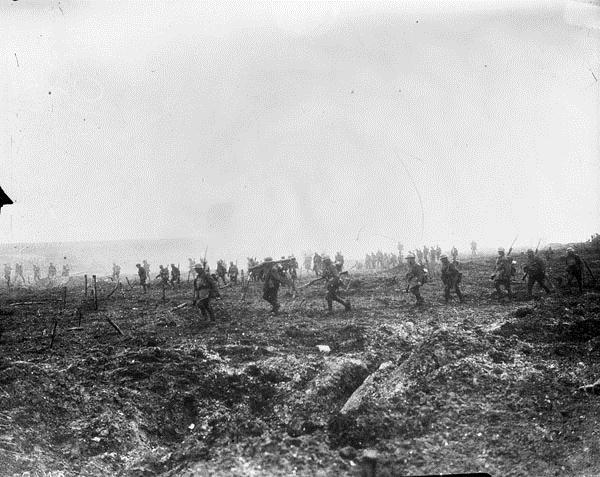
29th Infantry Battalion advancing into “No Man’s Land” through German barbed wire and heavy fire during the Battle of Vimy Ridge.

29th Infantry Battalion advancing into “No Man’s Land” through German barbed wire and heavy fire during the Battle of Vimy Ridge. (a001086)

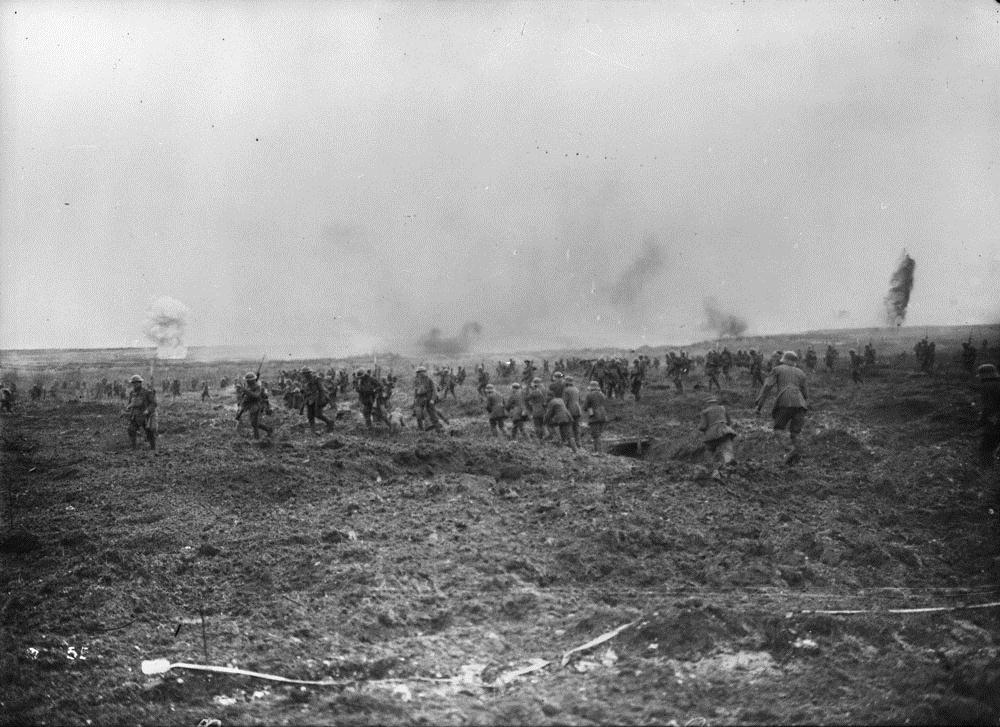
The attack that ignited the Battle of Vimy Ridge was launched on Easter Monday, April 9, 1917, at 5:30 a.m. Four Canadian divisions overran the German positions, with three achieving their primary objectives in less than an hour. The highly-trained men were able to advance rapidly, thanks to the formidably effective heavy artillery fire. Nevertheless, the Germans offered fierce resistance: it took four days of heavy combat for the Canadians to finally seize full control of the famed Vimy Ridge.

The battle claimed the lives of 3,598 Canadian soldiers, with over 7,000 more wounded.

(W.W. I – 1914-1918) As the Canadians advanced, parties of Huns left their dug-outs, only too glad to surrender – Vimy Ridge. April 1917.

(W.W. I – 1914-1918) As the Canadians advanced, parties of Huns left their dug-outs, only too glad to surrender – Vimy Ridge. April 1917. (a001123)

Visit our Flickr album for more photographs.

Toys and Games in Canada

Photograph of a girl sitting on a mattress, holding a doll.

Girl with doll, Piper family. Source

The joyful holiday season is the perfect time to introduce you to the Library and Archives Canada collection of photographs related to games and toys.

Although toys and games have existed since the dawn of time, it was only in the 19th century that the ‟toy” really came into its own in Canada. It was also
during the Victorian era that toys and diversion were deemed beneficial to children, thereby kick-starting the mass production of playthings. At first,
toys mainly came from England, Germany and the United States, but between 1860 and 1915, some 20 Canadian companies began to manufacture them as well. They
were made of wood and generally mimicked miniature furniture, cars or horses.

The First World War slowed toy production in Europe, giving the Canadian toy industry the opportunity to flourish. New toys were produced, particularly
battleships and construction sets. This is also when manufacturers started using a wider variety of materials, which resulted in copper, tin, iron, lead,
and rubber toys. Plush dolls and animals, small lead soldiers, bugles and trumpets, rubber balls, hockey pucks and even humming tops could also be found.

In the 1940s, plastic was introduced in toy manufacturing; it was used to make rattles, beach toys, tractors, trucks and construction sets, as well as an
array of tools. In subsequent years, large multinational companies emerged and completely diversified the toy-making industry.

Various outdoor games, such as croquet and lawn bowling have become popular. Children also enjoy games of strength, string, and chance, which are featured
in our new Flickr album.

Questions or comments? We would love to hear from you!

The Man Behind the Grey Cup

Although Albert Henry George Grey, 4th Earl Grey won’t be at this year’s 100th Grey Cup game and party, he would no doubt be proud of his legacy. Earl Grey, who served as Governor General of Canada from 1904 to 1911, commissioned and donated the trophy, which bears his name for posterity.

In the spirit of promoting Canadian sports and culture, Lord Grey first intended to donate a trophy for the senior amateur hockey championship in Canada. But Sir Hugh Andrew Montagu Allan beat him to it, and today the Allan Cup continues to serve that role. Not to be deterred from making a name for himself in Canadian sports, Lord Grey donated the Grey Cup as an annual award for the senior amateur football champions, in 1909.

Lord Grey only lived eight more years after donating the cup, dying in his home in Howick, England, in 1917. However, his contribution to Canadian football lives on and this year the Canadian Football League celebrates the 100th Grey Cup championship. Millions of Canadians will be watching the championship game on Sunday, November 25, either live in Toronto or on televisions across the country and around the world.

Library and Archives Canada (LAC) holds many resources relating to the history of the Grey Cup. To learn more about the life and activities of Grey himself, you can consult the Albert Henry George Grey, 4th Earl Grey fonds.

LAC is also pleased to feature footage of the first Grey Cup game in 1909 between two Toronto teams; the 1931 final; and the legendary “Mud Bowl” from 1950, on its YouTube channel.

There are many images in LAC’s holdings that show how the Grey Cup has become part of the Canadian consciousness, weaving its way into everything from federal and provincial politics to marital relations.

Don’t forget to browse LAC’s football Flickr set!

Questions or comments? We would love to hear from you!

Animals in War (1914–1918)

Colour poster depicting countryside combat, with a horse-drawn tank and soldiers fleeing from the cannonade.

During the First World War, the terrain on the front lines was often muddy and without paved roads, which made it difficult to use motor vehicles. This is why armies relied on a wide array of beasts of burden, including horses. These animals were used primarily by cavalry troops, but they also served to haul cannons, ammunition and food, as well as to pull non-motorized ambulances. Horses were ever-present in the theatre of operations.In September 1914, the first contingent of troops to leave Canada for England loaded up 7,636 horses! Although they belonged to the cavalry units, most of the horses were purchased by the Canadian government from private owners to meet army needs. Hundreds of thousands of additional horses were subsequently sent to the front lines. By the end of the war, the army had lost eight million horses in combat.

Other animals were also used by the army during the First World War. Mules, donkeys and cattle primarily transported materials, ammunition and food. In eastern regions, such as Egypt, camels were also used.

The terrain—continually bombarded in some areas or very mountainous in others—made it difficult to communicate, so winged or furry messengers were called
in. There were even special units responsible for maintaining a flock of carrier pigeons, ready to be sent with messages tied to their legs. Dogs were also used as messengers.

Colour sketch of a brown dog sitting.

Colour sketch of a brown dog sitting. Source

The Canadian Army had a Veterinary Corps at the time, with blacksmith and farrier units who all saw to the care of work animals. During the conflict, veterinary hospitals and mobile veterinary units were created behind the front lines to treat animals and make sure they were well fed.
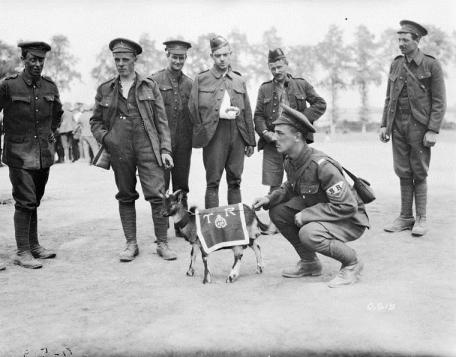
At all times, animals were alongside soldiers on the front as companions in misfortune. From the very beginning, military mascots have served to represent the group who adopted them. Even members of the Canadian Expeditionary Force had mascots during the First World War, as shown in the following image.

Group of soldiers around a goat wearing a cape with insignia.

Mascot of the 3rd Canadian Infantry Battalion, August 1916. Source

Visit our Flickr album for more photographs.

Questions or comments? We would love to hear from you!

Patrolling the French Shore with Louis Koenig

Newfoundland in the summer, completely inaccessible because of its winged garrison. Library and Archives Canada. (Source)

Did you know that thanks to the collection of Library and Archives Canada (LAC) it is possible to patrol the French Shore of the island of Newfoundland with Lieutenant Louis Koenig and discover this particular area where the French had cod fishing rights for almost 200 years, because of two treaties signed between France and England? Accompany Koenig and the crew of the French frigate La Clorinde during a campaign that brought them to Newfoundland, Cape Breton Island and Saint-Pierre and Miquelon in 1885.

Recognized by the French Navy for his artistic talents, Koenig created the 145 drawings and watercolours, the hand-drawn maps and the logbook, which are found in the Louis Koenig fonds and Louis Koenig Collection. The illustrations, most of which were done on site, show the landscapes and military installations he observed, as well as daily activities on board La Clorinde. The maps give three views of the French Shore and include notes by the artist.The logbook, also written by Koenig, documents the voyage, the places visited and gives his candid impressions of his experiences; devoting particular attention to the mosquitoes, which were apparently delighted to welcome the French sailors! The collection also includes a small sketchbook containing an illustrated, much more personal, account of the voyage, full of humour and whimsy presented by Koenig as a gift to La Clorinde’s commander, Félix-Auguste Le Clerc. Koenig also wrote an article Le « French Shore » (souvenirs de campagne à Terre-Neuve) (The “French Shore”, Memoirs of a Newfoundland Campaign), embellished with his maps and illustrations and published in 1890 in the periodical Tour du monde.

To order published documents that are unavailable online, use our online Request for Retrieval of Documents, or call 613-996-5115, or toll-free 1-866-578-7777, to consult them in person at 395 Wellington Street in Ottawa.

Enjoy the discoveries and view the Flickr set of images from Koenig’s albums!

Questions or comments? We would love to hear from you!