Discovering my grandfather, Robert Roy Greenhorn, a “Home Child” (Part 1)

Version française

Group of boys working in a field at the Philanthropic Society Farm School.By Beth Greenhorn

This article contains historical language and content that some may consider offensive, such as language used to refer to racial, ethnic, and cultural groups. Please see our historical language advisory for more information.

Robert Roy Greenhorn (1879–1962), my paternal grandfather, was among the thousands of children brought to Canada by William Quarrier’s Orphan Homes of Scotland. This made him a “Home Child,” a term I first encountered in 2003, when I began working at Library and Archives Canada (LAC). In fact, it was only in 2012 that I learned that my grandfather and two of his brothers, John and Norval, were Home Children. Eleven years have passed since I discovered this information. During the past summer, I decided that it was time to write about my grandfather’s story.

This is the first of a four-part series about Robert Roy Greenhorn and is a tribute to my grandfather. LAC is publishing this article on November 20 to mark National Child Day in Canada.

Photographic portrait printed on linen of a young man shown from the chest up, wearing a button-down shirt, tie, vest and suit jacket in an oval frame.

Robert Roy Greenhorn, unknown place, early 1900s. Courtesy of the author, Beth Greenhorn.

Like many Canadians, I had never heard the term Home Child and was not taught about Home Children in school. Nor was it ever mentioned by my father or older family members. I finally learned about child migration schemes while doing research for images to accompany an LAC podcast about Home Children in 2012. My curiosity about my grandfather and the circumstances as to why he emigrated to Canada was piqued. Thus began my journey to uncover his story.

From the 1860s to the mid-1900s, more than 100,000 orphaned, homeless and poverty-stricken children in Great Britain were relocated to Canada and other British colonies. They worked as indentured servants for families in rural Canada until they were 18 years of age, mostly as domestic help and farm labourers. The term for the children sent to Canada was Home Children because they went from emigration agency homes in Great Britain to receiving homes in Canada.

Industrialization in 19th-century Britain caused hardship and suffering for hundreds of thousands of people. This period saw a rise in pollution, poverty, slum housing and social inequalities (“The Home Children” by Patrick Stewart, p. 1). Children from poverty-stricken homes were particularly hard hit. A search through headlines of British newspapers during the Victorian era reveals the harsh labels given to children experiencing misfortune: “waifs and strays,” “paupers,” “delinquents” and “street urchins,” to name a few. There were no social welfare systems to care for the increasing numbers of impoverished, neglected and orphaned children. Describing the dire conditions of the working poor in industrial Great Britain, Patricia Roberts-Pichette writes in “About Home Children” (p. 7):

Most home children came from the poorest working-class families who lived in the worst slums of the great industrial cities. Their families were living in or had fallen into abject poverty because of job loss, illness and incapacity or death of the breadwinner. . . . Social activists, church and civic officials viewed them [children] as being in danger of adopting delinquent behaviours just to feed themselves and thus becoming criminals.

Philanthropic, benevolent and religious organizations were convinced that social and economic problems would be managed by removing the children, as Susan Elizabeth Brazeau explains in “They Were But Children: The Immigration of British Home Children to Canada” (p. 1):

The intention of the child migration schemes was to remove children from what were believed to be unhealthy and socially and morally unacceptable living conditions in England, and place them in Canadian homes, farms and families. Here, it was expected the children would learn skills and become productive members of the working class. . . . These children migrants came to be known as “Home Children.”

The British child migrant program thus served a few purposes: to lessen the burden created by destitute children in Great Britain, while increasing the population in the colonies, and providing a cheap source of farm labour.
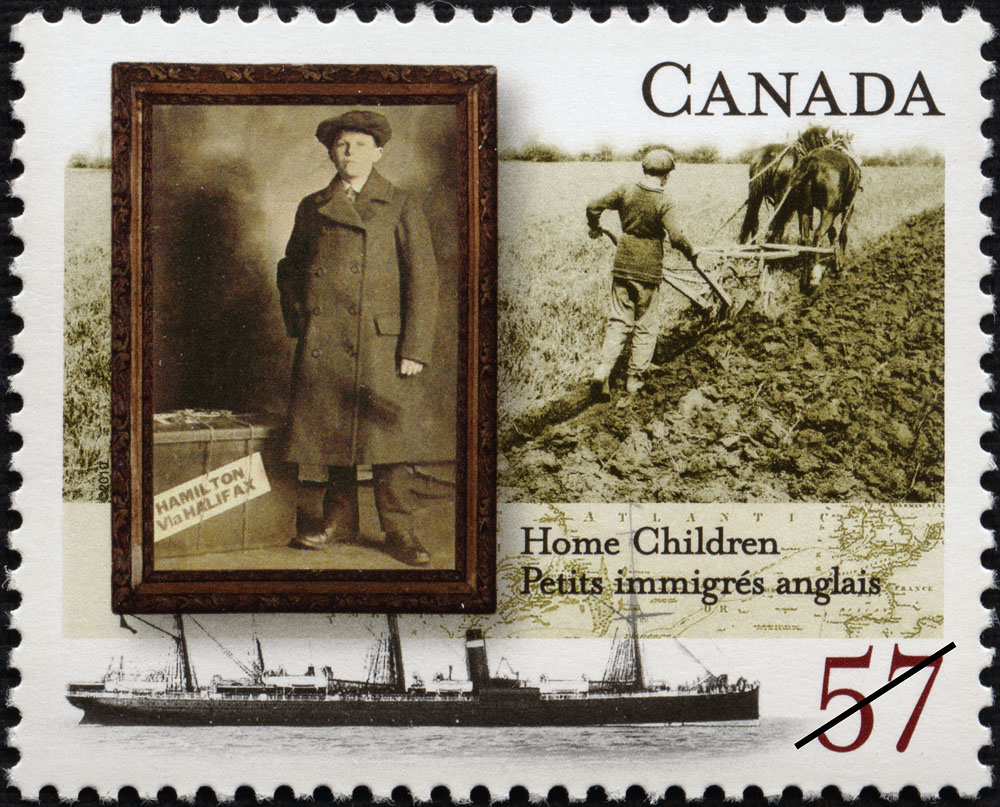
Postage stamp with a framed sepia photograph of a boy in a long coat with a suitcase, overlaid on a sepia photograph of a boy ploughing a field with two horses. There is a black-and-white photograph of a ship across the bottom of the stamp.

Canadian postage stamp, issued on September 1, 2010, to commemorate Home Children (e011047381).

Quarrier’s Orphan Homes of Scotland was among the many child migration agencies created in the 19th century. Founded by shoemaker and philanthropist William Quarrier (1829–1903), this private organization was responsible for bringing my grandfather and his brothers to Canada. From 1870 to 1938, Quarrier, and later his daughters, relocated more than 7,000 children to Canada, most of whom ended up in Ontario.

Sadly, I never met my paternal grandfather, Robert Roy Greenhorn. He passed away before I was born. My knowledge of him is what I pieced together from some recollections shared by my father, and a few family photographs. My father, the youngest in his family, had a close relationship with his mother, Blanche (née Carr, 1898–1970). As the “baby” of the family, and given the rigidly prescribed gender roles of the era, my father likely spent more time helping his mother and sisters around the house and vegetable gardens than with his father. My grandfather was also 51 years old when my father was born. This difference in age probably added to the lack of connection between the two. Consequently, most of my father’s memories of his childhood were about his mother and siblings, particularly his brother Arnold, who was the closest in age, being just three years older.

Black-and-white photograph of three women crouched in front of five men and a woman standing behind them.

Front row, left to right: Aunt “Jo” (Josephine), Aunt Jean and Aunt Jennie. Back row, left to right: Uncle Roy, Uncle Arnold, my grandfather Robert, my grandmother Blanche, Uncle John, and my father, Ralph, Philipsville, Ontario, 1947. Courtesy of the author, Beth Greenhorn.

I have little information about my grandfather Robert’s childhood. I know that he had two brothers, John and Norval, and that they were all born near Glasgow in Scotland and emigrated to Canada when they were boys. I also know that they came without their parents. I have since learned that they were orphaned when very young. I had always assumed that my grandfather and his brothers travelled together. While researching my grandfather’s story, I learned that Robert and John departed for Canada in March 1889, and Norval arrived five years later, in April 1894.

In an unpublished memoir from 2015, my father shared one of his few memories of my grandfather:

My dad. [He was] a hard worker… that was his forte. Yes, he laughed, and he was a pretty good hockey player so I understand, but I think the easiest way to sum it up was that the environment had really left its scars, and he was living behind that curtain of scars… I wish I’d asked him more questions about his childhood. I would have understood him more.

Initially, Canadians supported juvenile emigration organizations and welcomed the immigrant children. But as Susan Elizabeth Brazeau describes in “They Were But Children” (pp. 5–6), enthusiasm waned after stories began circulating of children running away, attacking their hosts, stealing food, starving, and in one case, dying. Public opinion changed from acceptance to mistrust, and people questioned whether Great Britain was “ridding itself of the lowest of the low: guttersnipes, idiots, the ill, and children with criminal intent.”

I will never know my grandfather Robert’s perceptions or his experiences as an orphan. Given the derogatory labels used to describe children from impoverished backgrounds, I am sure that the stigma and shame attached to being a Home Child did indeed leave a “curtain of scars.” I wanted to learn about my grandfather’s life and what might be buried behind the “curtain.” What happened to the boys’ parents? What were the circumstances causing him and his two brothers to become wards of the Orphan Homes of Scotland?

In the second article in this series, I will continue with Robert Roy Greenhorn’s story. This will take us to his roots in Gartsherrie and Falkirk, Scotland.

Additional resources


Beth Greenhorn is an Online Content Manager in the Outreach and Engagement Branch at Library and Archives Canada.

British Home Child Day: how more than 100,000 British Home Children contributed to Canada’s population

Five years ago, Jim Brownell, then Member of Provincial Parliament for Stormont-Dundas-South Glengarry, tabled Bill 185 to have September 28 proclaimed ‘British Home Child Day’.

Mr. Brownell has close links to two home children: his paternal grandmother and his great aunt. The Scottish-born sisters both arrived in Canada through the home child program. Between 1869 and the late 1930s, over 100,000 juvenile migrants were sent to Canada from the British Isles.

Mr. Brownell’s grandmother, Mary Scott Pearson, was born in Scotland and arrived in Canada on September 28, 1891 aboard the SS Hibernian. Her first home on Canadian soil would be the Fairknowe Home in Brockville, Ontario.

Perhaps you have come across a home child while researching your family history. It is estimated that eleven percent of the Canadian population can identify a home child as one of their ancestors.

Where to start my research to locate my ancestor?

Library and Archives Canada (LAC) holds extensive records to assist in your research on Home Children. These records include passenger lists, Immigration Branch correspondence files and inspection reports, non-government collections and private fonds (Middlemore’s), as well as indexes to some records held in the United Kingdom. Consult The Records section for search tips and explanations on the documents held at LAC.

Passenger lists and other immigration documents are often the first sources consulted. Not only are the names of children listed, but the name of the ship, the dates of departure and arrival, the name of the sending organization in the British Isles and the destination of the child in Canada are also included. All of these details are key in tracing immigrating ancestors.

A black and white image of a house with melting snow all around. In front of the house are two horse-drawn sleighs with people around them.

Miss Macpherson’s receiving home “Marchmont” in Belleville, Ontario (home for immigrant children from Britain) (MIKAN 3591133)

The Guide to Sending Organizations and Receiving Homes provides a list and description of associated places, societies and institutions in the United Kingdom and Ireland and the associated places and Homes in Canada. A fourth column gives the names of people associated with the organizations often mentioned in passenger Lists. For example, Thomas Barnardo and John Hobday were associated with Barnardo’s Homes. Agnes Burges and William and Mary Quarrier were associated with Quarrier’s Orphan Homes of Scotland, whose Fairknowe Home was based in Brockville, Ontario. Children who had been baptized in the Catholic faith were usually placed with Catholic families or religious congregations, often in Quebec.

Military sources and census records

Many home children grew up and enlisted in the Canadian Forces during both the First and the Second World Wars; some chose to remain in the United Kingdom after the war. Consult our Military Heritage page to research personnel service files and other military resources.

If you would like to discover more on where a child resided, consult the Census records for the relevant time period. Please note that home children can be researched with the same surname listed in the passenger list. Most home children kept their birth name and were not formally adopted by the family with whom they resided.

If you would like to ask us a question, please drop by the Genealogy desk at 395 Wellington Street, in Ottawa, or email us using our Genealogy Assistance Request form.

Finally, don’t forget to read previous articles about Home Children: Introduction, Edward Brignall, Harold Mornington, Wallace Ford and The Honourable James Murdock

Other sources

Home Children (Part VI)—Mary Scott Pearson, ancestor of former Ontario Member of Provincial Parliament Jim Brownell

Today’s article features Mary Scott Pearson who was born in Scotland. Mary’s name appears in the Scottish Census of 1881. The entry indicates that she lived in Glasgow with her sister Maggie and their widowed mother, also named Mary. The two sisters became orphans when their mother died in 1888. The next census (1891) indicates that the sisters lived at the Girls Industrial School in Maryhill, in the County of Lanarkshire.

The Pearson sisters were separated in September 1891 when Mary boarded the SS Hibernian en route to Canada as part of a group of 20 young women recruited to work as domestic servants. The young Scottish women’s transportation and accommodations were arranged by Ms. E. Cameron, an Industrial School official.

As in previous articles, you must first consult our main home children online resource. Enter the surname Pearson and the given name Mary into this database and it will generate only one result for Mary Pearson, age 14, whose destination was Saint John, New Brunswick. The Fairknowe foster home, administered by a charitable organization known as Quarriers, was Mary Pearson’s first place of residence in Canada.

Ten years after her arrival, according to the Census of 1901, Mary was living in Prescott, Ontario, with the family of Patrick MacMillen. She married Curtis Brownell five years later, on March 21, 1906, in Cornwall, County of Stormont. The couple’s first son, Earl Kenneth, was born in September of the following year.

Mary Scott Pearson and Curtis Brownell raised their family in Cornwall, where they lived until the time of their deaths; Curtis died in 1931 and Mary died in 1945.

Jim Brownell, son of Earl Kenneth Brownell, honours his grandmother’s arrival in Canada

Her grandson, Jim, elected Member of the Legislative Assembly of Ontario in 2003, travelled to Scotland in 2009 when he visited the city of Glasgow, officially representing the Government of Ontario. The articles that appeared in the Cornwall daily newspaper, the Standard Freeholder, on September 23, 2009 and May 25, 2011, describe the journey of Mary S. Pearson and her sister Maggie, and Mr. Brownell’s work to foster a better understanding of the often little-known home children movement.

In 2011, as Member of Provincial Parliament for Stormont-Dundas-South Glengarry, Jim Brownell tabled Bill 185 in the Legislative Assembly of Ontario to have September 28 proclaimed “British Home Child Day.” The purpose of the bill, which received royal assent on June 1 of that year, was to honour his grandmother and his great-aunt Maggie, as well as the more than 100,000 British home children.

Don’t forget to read the previous articles in this series on home children and listen to our podcast!

Happy hunting and enjoy your discoveries!

Home Children (Part V)—The Honourable James Murdock

Today’s article is about the Honourable James Murdock, a labour minister in Mackenzie King’s cabinet who was appointed senator in 1930. He arrived in Canada through the home children movement.

Since James Murdock was a Member of Parliament, the logical place to start your research is his biography on the Parliament of Canada website. There we find out that he was born in Brighton, England, on August 15, 1871. Additionally, an article in The Ottawa Citizen announcing the death of his wife Annette Follis in 1965 also states that James and Annette married in 1903.

As explained in previous articles, you must first consult our main home children online resource. Enter the surname Murdock and the first name James into this database and it will generate three results, including two for James Murdock, age six, who arrived in 1876 under the auspices of Annie Macpherson’s organization. Unfortunately, it is impossible to know which of the two references relates to the James Murdock we are looking for.

Other Library and Archives Canada sources also provide information about James Murdock and his family. The 1911 Census indicates that James Murdock and his wife Nettie (short for Annette) lived in Toronto South―the same district where Murdock would run for election in 1921―with their two children Basil and Elena, as well as a servant named Ada Hennings.

You can also find further references to James Murdock in other published sources, such as city directories and newspapers.

It is possible to learn more about the British origins of James Murdock or another home child by contacting the organization responsible for the child in question. In this case, it was an agency managed by Annie Macpherson, which was taken over by Dr. Barnardo’s organization in 1924 (Barnardo’s Family History Service).

Finally, don’t forget to read the previous articles in this series: Introduction, Part II on Edward Brignall, Part III on Harold Mornington and Part IV on Wallace Ford.

Happy hunting!

Questions or comments? We would love to hear from you!

Home Children (Part IV) — Wallace Ford

Today’s article is on American actor Wallace (Wally) Ford. Despite his difficult childhood, Ford had a successful show business career and appeared in over 200 films. He was born in Bolton, England, on February 12, 1898, and named Samuel Jones Grundy. He lived in a Barnardo Home before being sent to Canada, after which he stayed in several foster homes, including a farm in Manitoba.

As explained in previous articles, the first step is to search our main home children online resource. However, if you search this database for the surname Grundy and the first name Samuel, no results come up. A second attempt using just the surname Grundy is equally ineffective, so another strategy is in order.

Since biographical sources also contain the surname Jones, we will presume that Grundy was dropped and Jones was used as his family name. A search with the latter gives you an item display for Samuel Jones, seven years of age, part of a group of 163 children who arrived in Canada on July 1, 1905, on the SS Southwark. The Passenger Lists, 1865–1922 have been digitized and you can access an image online of the passenger list for the SS Southwark.

How did Samuel Jones become Wallace Ford? As a young teen, Samuel Jones ran away from the Manitoba farmer for whom he worked. In the United States, after the tragic death of his friend Wallace Ford, Samuel Jones adopted his deceased friend’s name to honour his memory. From then on, Canadian Samuel Jones was known as Wallace Ford on American soil.

In 1936, Wally Ford, who was now a well-known actor, found his mother, Catherine Jones. Thanks to co-operation between the Los Angeles Police Department and New Scotland Yard, and after over 20 years of searching, mother and son were reunited.

Finally, remember to consult the previous articles in this series: Introduction, Part II on Edward Brignall and Part III on Harold Mornington.

Happy hunting!

Questions or comments? We would love to hear from you!

The Home Children (part three) — Harold Mornington

The second article in this series of three explains how to find information about one of the British home children, Edward Brignall, who served in the Canadian Armed Forces during the First World War. This third article looks at another home child, Harold Mornington, who served in the British Army in the Second World War.

As with Edward Brignall, the process begins with a search of our main online resource on Home Children. Entering the family name Mornington and the given name Harold into the database yields a single reference; it indicates that Harold was 14 years old when he left Liverpool on March 11, 1932 aboard the SS Montclare, and arrived in Halifax on March 19, 1932. He was part of the last group of 36 children sent to Canada by the Barnardo agency.

The passenger lists from 1925 to 1935 have been digitized and can be consulted online. The digital image of the list of passengers aboard the SS Montclare can be examined as well, which confirms the information found in the home children database. It also contains other information, such as the name and address of Harold’s mother, Mrs. Mornington, who lived at 16 Orlando Street, in Caldmore, Walsall, England. More information about Harold Mornington’s family history can be found by contacting the Barnardo’s Family History Service.

Beginning in the 1920s, immigration inspectors drafted Juvenile Inspection Reports when conducting periodic evaluations of children brought to Canada by different agencies. These files are available only on microfilm. A search on reel T-15424 shows that between 1932 and 1936, Harold Mornington worked for five different employers in the Ontario districts of Durham, Brant, Oxford and Hastings.

A reference found on the site of the Commonwealth War Graves Commission reveals that sometime between 1936 and the beginning of the Second World War, Harold Mornington returned to England. He joined the British Army and died on May 23, 1941, while still a member of the Royal Artillery. He was the son of William Joseph and Elizabeth Mornington.

Lastly, Harold Mornington’s military service record is kept at The National Archives in the United Kingdom.

Questions or comments? We would love to hear from you!

Home Children (Part II)—Edward Brignall

Today’s article is on Edward Brignall, born in England on January 11, 1898; you will learn how to obtain information on him.

The first step is to search by entering the surname Brignall in our main online resource on home children. You will notice that no results are displayed; this could be explained by the fact that in those days many surnames were transcribed phonetically.

The next step is to use the wildcard character *. We suggest that you enter Brign* in the surname field.

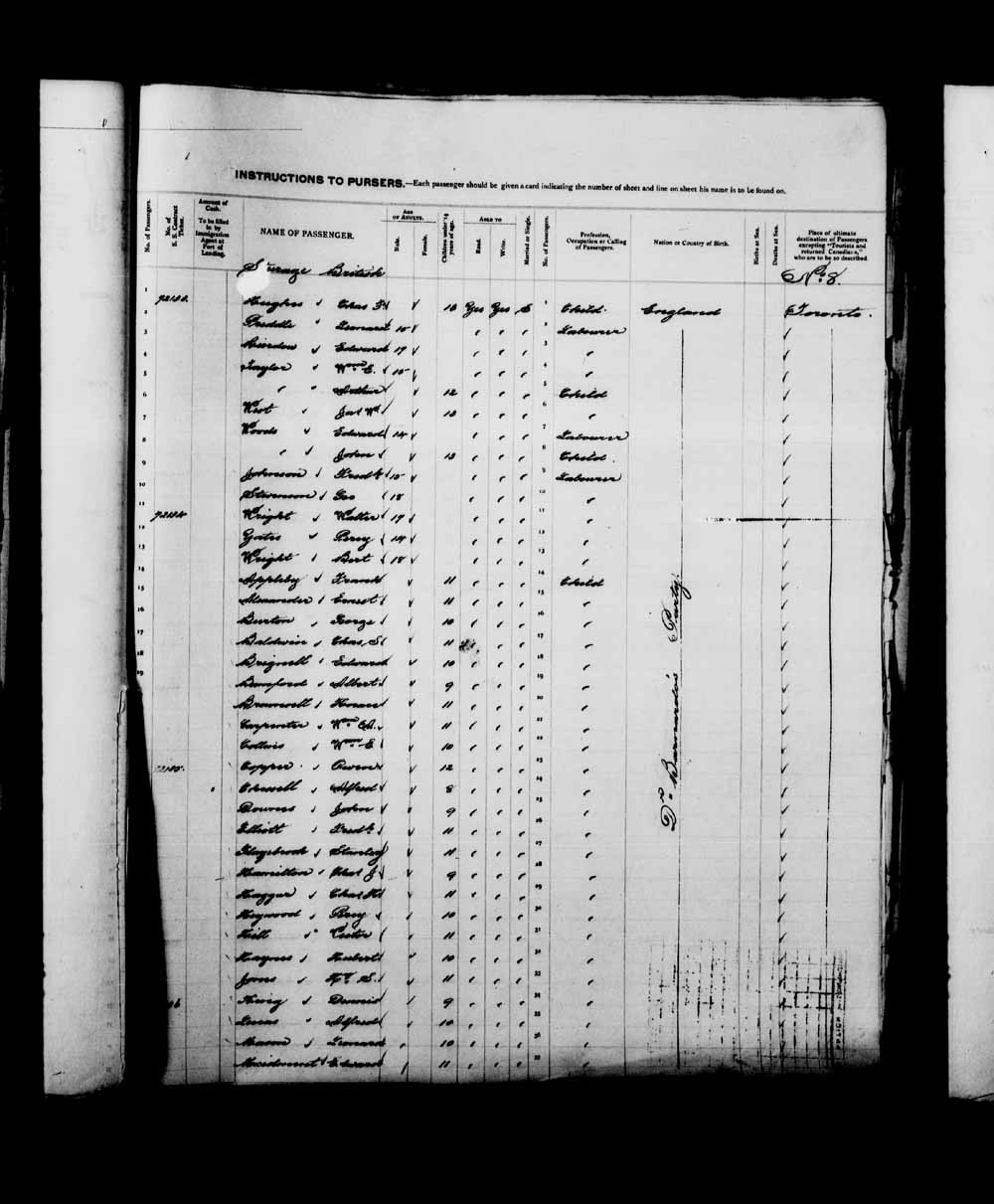
This search opens an item display for Edward Brignell, 10 years of age, who arrived in Canada on the SS Dominion on May 31, 1908, in the care of the Barnardo
charitable organization. Edward was part of a group of 109 girls and 219 boys. This information agrees with what we know.

The passenger lists from 1865 to 1922 have been digitized and you may consult them using our database Passenger Lists, 1865–1922. You may even examine a digitized image of the SS Dominion passenger list. Further information on Edward’s family background may be obtained by contacting the organization Barnardo’s Family History Service.

Several young English immigrants who settled in Canada served in the Canadian and British forces during both world wars; such is the case of Edward Brignall. To trace him, first search in our database Soldiers of the First World War. Just enter Brignall in
the surname field. This search generates five results, only one with the given name Edward:

Name: BRIGNALL, EDWARD
Regimental number(s): 922715
Reference: RG 150, Accession 1992-93/166, Box 1068 – 36
Date of Birth: 11/01/1898

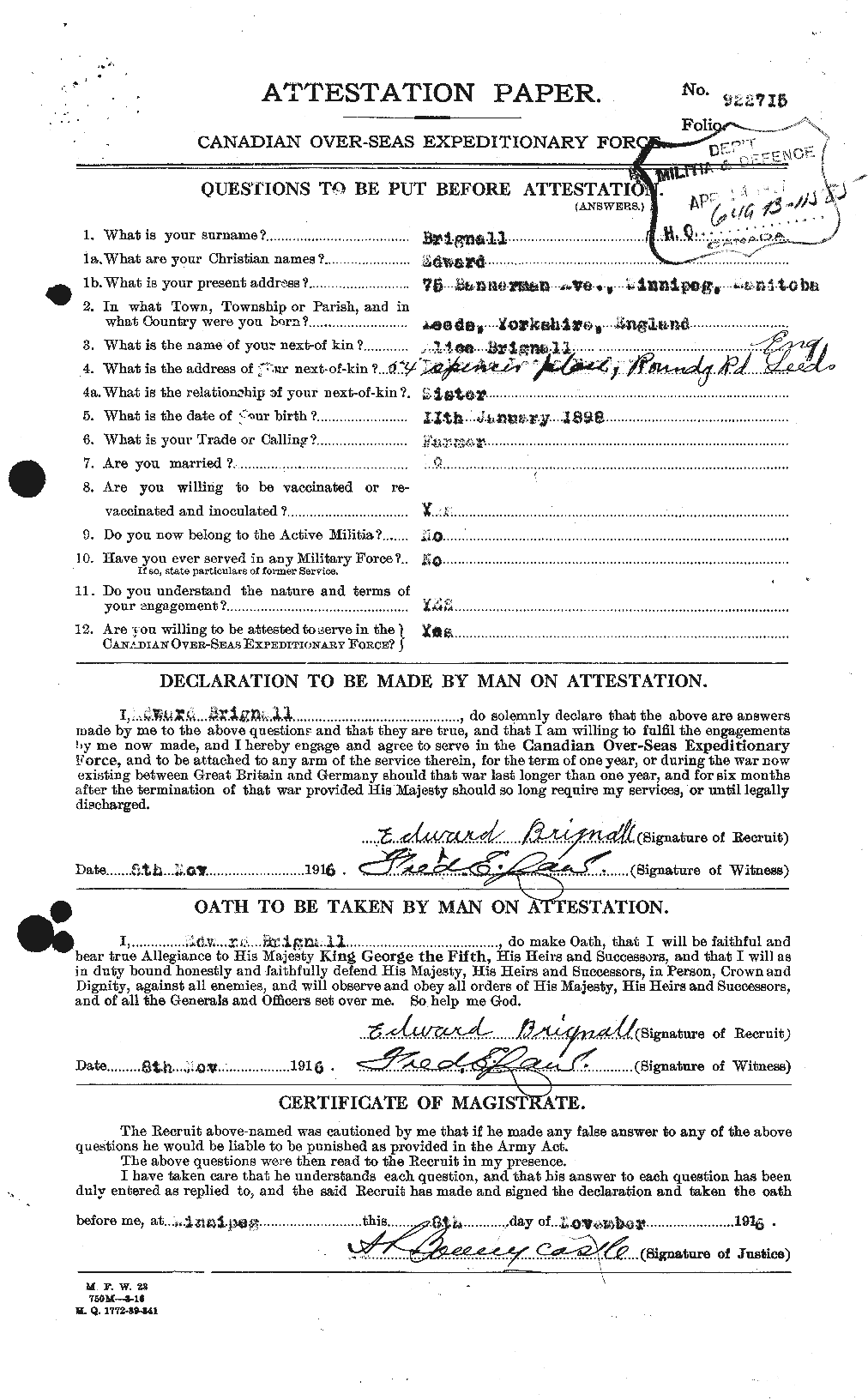
You may consult his attestation paper online to confirm his date of birth, find out
where he lived (i.e., 75 Bennerman Avenue, Winnipeg, Manitoba), and learn that his next of kin, his sister, Alice Brignall, resided in Leeds, England. By consulting his record, we learn that Edward died before leaving for Europe. Also available online are the death cards of First World War veterans; Edward’s shows that he died of pneumonia on January 23, 1917, at the Winnipeg General Hospital just a few months after he enlisted.

It is also possible to search the database of the Canadian Virtual War Memorial. There
we learn that Edward was the son of Edward and Dorothy Lever Brignall, of Leeds, England, and that he was buried at the Brookside Cemetery in Winnipeg, Manitoba.

Finally, remember to consult the first part of this series, entitled Home Children—Introduction.

Happy hunting!

Questions or comments?
We would love to hear from you!

Home Children—Introduction

The immigration of children from Great Britain accounts for a significant part of Canadian history. Between 1869 and the end of the 1930s, religious authorities and philanthropic organizations sent more than 100,000 poor, orphaned or abandoned children—better known as home children—to Canada, believing that they were offering them a better  chance for a healthy life. Many Canadians have an ancestor who experienced this often-misunderstood migration.

Anyone who came to Canada alone as a child was very likely one of the home children. Family members quite possibly obtained information on this from written documents or oral histories.

Library and Archives Canada has several genealogical records on home children, including passenger lists, correspondence, inspection report cards and various documents produced by different organizations that took part in the children’s transport and care.

Stay tuned for our upcoming series of articles on home children who later made their mark in Canada’s history, and on well-known people whose ancestors were home children. The series will help you discover our vast collection of genealogical resources that enable you to trace an ancestor who might have been one of the home children.

Questions or comments? We would love to hear from you!