“I want to ride my bicycle!”: Cycling in the Canadian Expeditionary Force during the First World War

Version française

By Dylan Roy

“Get on your bike and ride,” my mother often told me in my youth when I would ask for a lift somewhere. Although I would sometimes begrudge her for forcing me to stay active (being the indolent child that I was), looking back, I am glad that I biked to the places I needed to go in my teenage years. Biking provided not only exercise, but also a form of agency and sorely needed sociability.

On reflection, cycling is a virtually ubiquitous phenomenon wherever people live. It came to me as a surprise that even the Canadian military used cycling. I just didn’t think of the reasons why they would. To me, it seemed like a far-fetched thing and an activity in which only civilians partook. However, the Canadian military has implemented the use of cyclists within its ranks throughout much of its history.

This series will focus on the military units who used bicycles as one of their primary duties during their service. The first entry into this series will focus explicitly on the divisions that served during the First World War. So, strap on your helmet and start peddling down the road of the following paragraphs to learn more about the brave bikers who served in our military during the Great War.

Dozens of soldiers standing at attention while holding bicycles for a panoramic photograph.

Panoramic photograph of the 2nd Division Cycle Corps, Canadian Expeditionary Force. (e010932293)

Before starting, it is important to highlight that Library and Archives Canada (LAC) offers a wide variety of resources to find information concerning the cyclist divisions, companies and Corps that took part in the First World War. One of the handiest is the Guide to Sources Relating to Units of the Canadian Expeditionary Force: Cyclists. This guide can inform a researcher about many aspects of the cyclist units. However, be warned: there are some transcription errors mentioned in the preface to the guides on the Sources Relating to Units of the Canadian Expeditionary Force page. They are, nonetheless, valuable tools for research.

Outside of LAC, the Official History of the Canadian Army in the First World War: Canadian Expeditionary Force, 1914-1919 is another secondary source that can provide important information concerning the cycling units.

With that out of the way, what did the cyclist units actually do during the war? The Canadian Encyclopedia provides this succinct summary of the cyclist units: “In WWI young men with the cycling urge were encouraged to join the Canadian Corps Cyclists’ Battalion. Over 1000 men eventually did so, their duties ranging from message delivery and map reading to reconnaissance and actual combat.”

Moreover, since our troops were equipped with bicycles, it meant that they were relatively mobile compared to infantry units. They were therefore considered “mounted” and, in fact, fell under the same umbrella as the Canadian Light Horse regiment. When they said “get off your high horse,” the cyclist units took it very seriously. You can see where the cyclists fell in the military hierarchy with the 1918 Canadian Expeditionary Force (CEF) organization chart below:
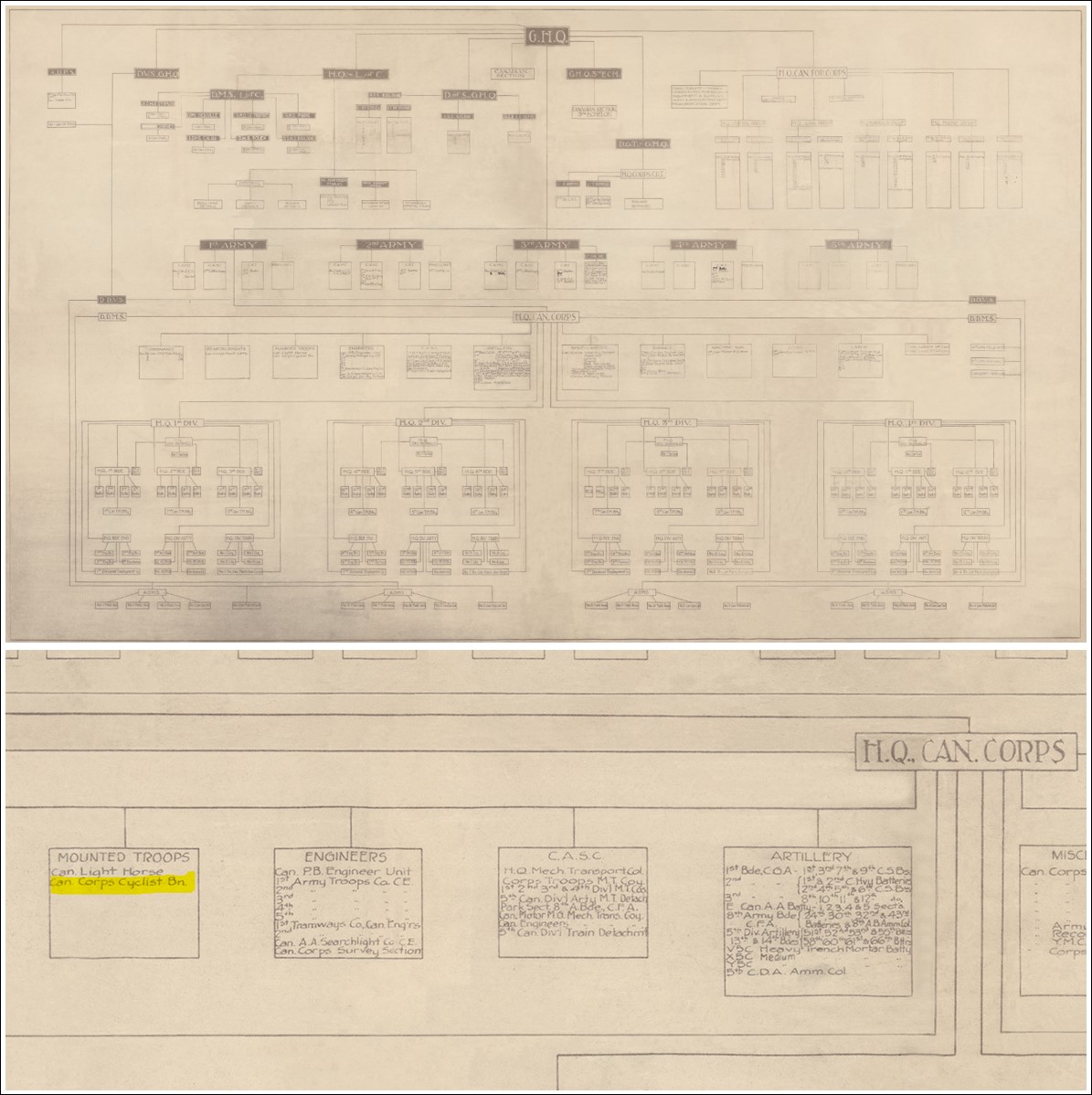
Two screenshots of a chart made for the organization of the Canadian Expeditionary Force (CEF) in 1918. The first chart outlines the hierarchy of the CEF during 1918 via chains of command. The second screenshot is from the same chart but highlights where the Canadian Corps Cyclist Battalion falls within the hierarchy.

Two screenshots of the 1918 Canadian Expeditionary Force organization chart. Full chart is displayed on top and the section which highlights the Canadian Corps Cyclist Battalion below. (Government of Canada website)

Although the cycling units were actively involved in the war, they first needed to be trained. LAC has a variety of videos on YouTube focusing on the Canadian military, including one that features some of the training aspect of the cyclist units titled The Divisional Cyclists : A Glimpse of a Day’s Training (1916).

The video demonstrates the importance of many topics, such as the more mundane aspects of military life (like laundry), while also shedding light on more crucial elements of training, such as drills, signalling and reconnaissance.
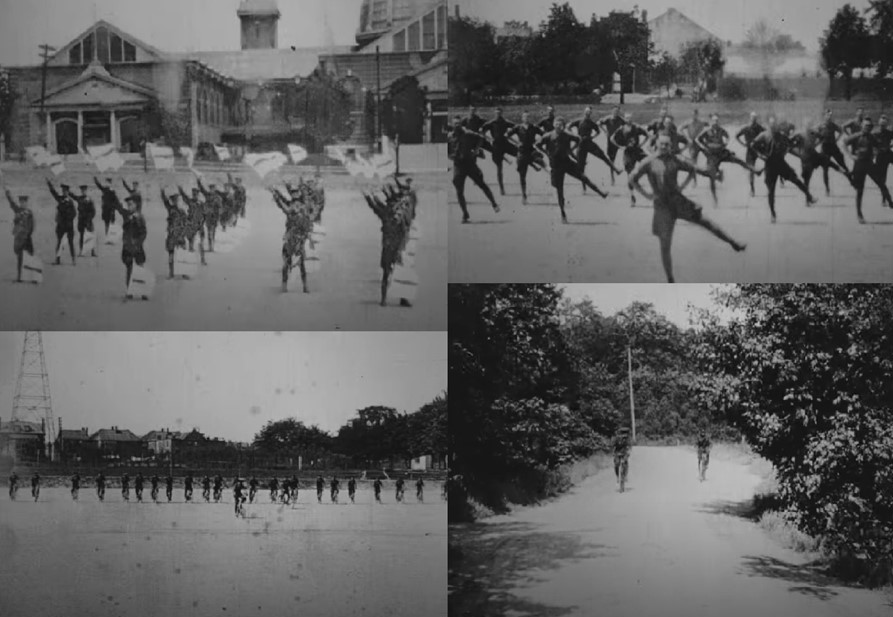
Four scenes from the film The Divisional Cyclists : A Glimpse of a Day's Training (1916). Top left features men in synchronization performing signalling drills with flags. Top right shows soldiers performing light aerobic exercises. Bottom left shows soldiers biking in unitary fashion along one another. Bottom right includes two men biking in a reconnaissance drill in a forest.

Four scenes from the video The Divisional Cyclists : A Glimpse of a Day’s Training (1916) demonstrating signalling, drill and reconnaissance training initiatives. (ISN 285582)

Once the cycling units had completed their training, they could partake directly in the war efforts. Our hardworking biking men-at-arms were no strangers to conflict, and they were part of some of the most notable battles of the First World War such as Ypres and Vimy. The following entry below from a war diary by the 1st Canadian Divisional Cyclist Company covers the horrific aspects of the battle of Ypres and how the division was involved on April 22nd, 1915, near Elverdinghe:

Terrific bombardment started on the front immediately EAST of here about 4:30 P.M. The whole line appeared to be enveloped by cloud of greenish smoke. At 6:30 P.M. requested arrival of many stragglers of the South African troops from the first line trenches all in a state nearing on collapse complaining of a new and deadly gas which had been wafted from the enemy’s trenches by a gentle NORTH-EAST wind, orders were given to D.M.T. to “stand-to.” At 7:15 orders came from DIV. H.Q. to proceed with all possible speed to there, which place was CHATEAU DES TROIS TOURST. Cyclists were ordered to “stand to” on the avenue leading to the ELVERDINGHE – YPRES road. Communication being down with various infantry, and artillery units of Division H.Q. from time to time asked for orderlies from the cyclists to report to different BRIGADE H.Q. as despatch riders. At 10:10 P.M. LIEUT. CHADWICK and No 1 Platoon were sent on a reconnoitering patrol on our immediate front across the canal. Corpl WINGFIELD with his section was despatched as a reconnoitering patrol behind the trench lines on our left.
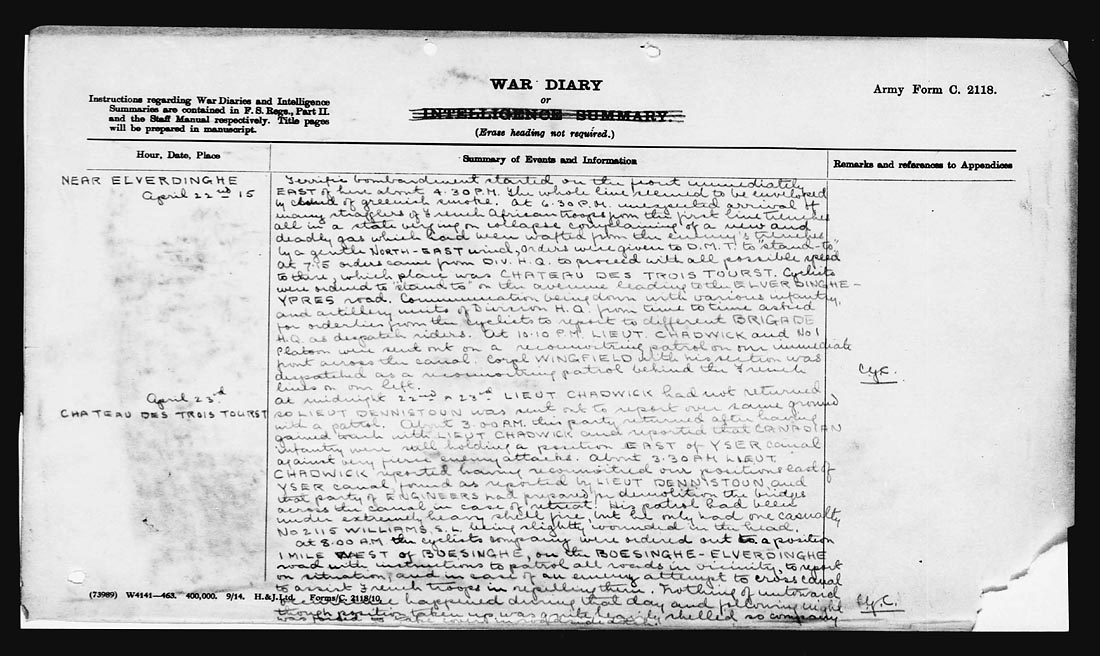
 

Screenshot of the war diary that was shared directly above.

Screenshot of War diaries – 1st Canadian Divisional Cyclist Company / Journal de guerre – 1re Compagnie divisionnaire canadienne de cyclistes. (e001131804, image 53)

The entry highlights the chaos of war and the hardships that many men suffered on that fateful day in April 1915. It also shares some of the more haunting aspects of the First World War, such as the use of gas described as green clouds of smoke. Additionally, it provides insight into some of the main tasks accomplished by the cyclists including communication, acting as despatches and reconnaissance.

The cyclist divisions continued to expand during the war and, as highlighted earlier, an entire battalion was eventually formed called the Canadian Corps Cyclist Battalion. At LAC, there is an entire sub-series devoted to this battalion that shares further information in the Biography/Administrative history section on how it was formed and eventually disbanded. It reads:

The Canadian Corps Cyclist Battalion was organized at Abeele in May 1916 under the command of Major A. McMillan, and was formed by amalgamating the 1st, 2nd, and 3rd Canadian Divisional Cyclist Companies. The battalion was demobilized at Toronto in April 1919 and was disbanded by General Order 208 of 15 November 1920. In Canada Cyclist Companies advertised for recruits “possessing more than average intelligence and a high standard of education.” (MIKAN 182377)

By viewing the lower-level descriptions from this sub-series, one can see records that pertain to the battalion. The sub-series includes a variety of topics such as a training syllabus of the reserve cyclist company and statements by Canadian prisoners of war (among others).
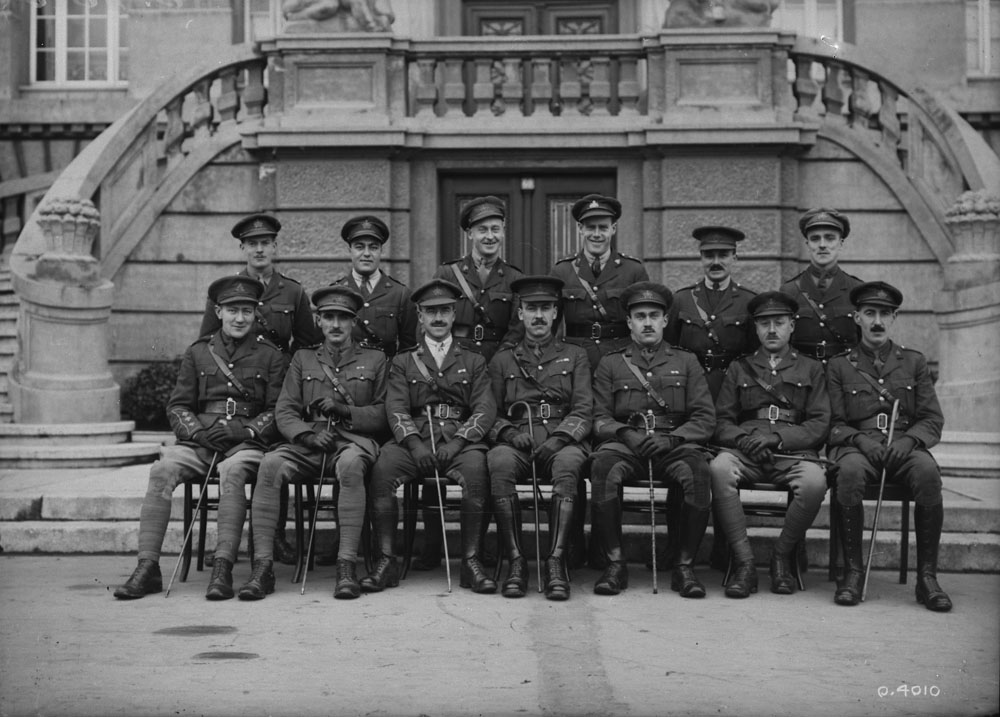
A black and white photograph of thirteen officers in uniform who served the Canadian Corps Cyclist Battalion taken in January 1919. Seven men sit on chairs in front of six men standing behind them.

Photograph of officers in the Canadian Corps Cyclist Battalion from January 1919. (PA-003928)

The Canadian cyclist units were no slouches, and they had a definitive impact on the war effort by facilitating reconnaissance, communication, signalling and direct combat. It is impressive to think that these men, who used very archaic forms of bicycles were able to tread the perilous terrain of Europe during the First World War to accomplish their duties while I, using a much better modern bike, complain about having to bike up a small hill on my way to work. It shows how much determination and bravery the men within the cyclist units of the Canadian military exerted during the First World War.

Additional Sources


Dylan Roy is a reference archivist in the Access and Services Branch at Library and Archives Canada.
The Final Charge of the Canadian Cavalry

Version française

By Ethan M. Coudenys

Shells were falling, machine guns were firing, and horses were whinnying as the final cavalry charge of the Great War on the Western Front took place at Moreuil Wood. The line had broken, and Field Marshal Douglas Haig called for the Canadian Cavalry Brigade—specifically the Lord Strathcona’s Horse—to charge through the gap in the line to advance further into German-controlled territory. This ill-fated charge would be the last wartime charge for the Canadians in military history.

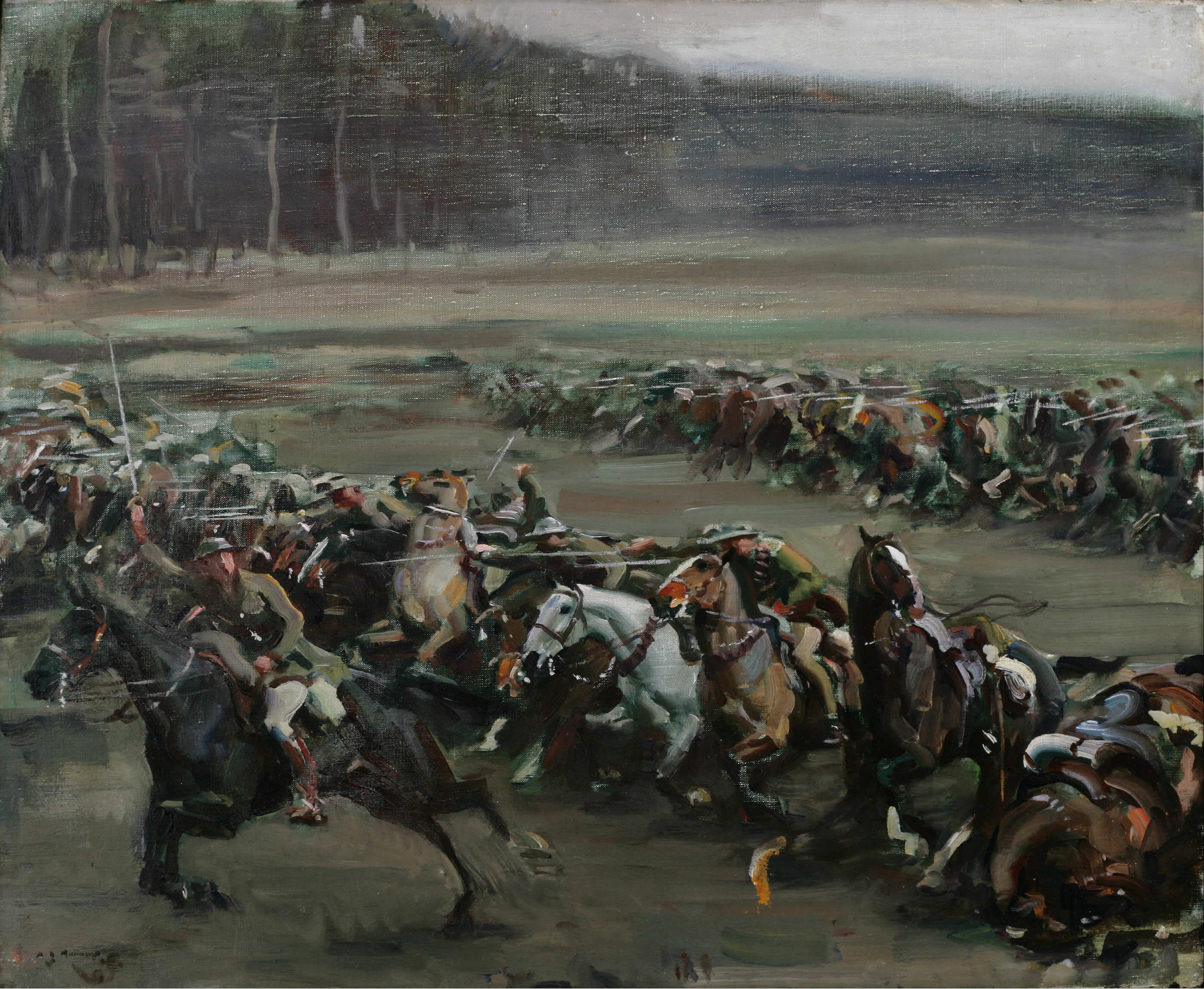
Canadian Cavalry Brigade on horseback charging.

Sir Alfred Munnings
The Charge of Flowerdew’s Squadron
CWM 19710261-0443
Beaverbrook Collection of War Art
Canadian War Museum

March 30, 1918, was the mid-point of the 100 Days Campaign—a campaign which saw incredible advances through German-controlled lines on the Western Front and the beginning of the final phase of the First World War. At Moreuil Wood, the infantry and artillery attacks had, in the opinion of the generals commanding the attack, broken the German defensive line, and for the first time since 1914, the Canadian Cavalry Brigade would remount and attack.

Between January 1915 and early 1918, cavalry soldiers—referred to as “troopers”—took on the role of infantry personnel. They worked in the same trenches as all the other soldiers and were required to defend and attack using the same tactics as the infantry. For all intents and purposes, they were infantry troops, however, they also had to pack their kits according to their actual designation: cavalry troopers. They were therefore always required to carry their tack, feed and water for their mounts, rations and water for themselves, ammunition, etc. Yet, they were not given the same packs as infantry troops. They were able to hold some of these supplies in their saddlebags, but they had to transport heavy equipment without a proper way of storing it.

Group of soldiers on horseback.

Lord Strathcona’s Horse in 1916, moving behind the front line (a000119).

Despite the negligible use of cavalry on the Western Front after the first months of the Great War, the cavalry remained at the forefront of the minds of those planning Allied offensives. In Great Britain, the General Planning Staff was largely composed of cavalry officers, and Douglas Haig was one of them. Cavalry was therefore considered vital to winning the war against the German Empire. Rarely used in battle as actual cavalry troopers, this final charge proved, once and for all, that in modern warfare, the cavalry was of little strategic value.

On that fateful day, Lieutenant Gordon Muriel Flowerdew led the Lord Strathcona’s Horse Company C cavalry group on two charges against a myriad of German defensive positions. Three hundred German infantrymen defended their position. Using the feared MG-08 heavy machine gun and the newly invented light machine gun, they mowed down the advancing cavalry within minutes. Nevertheless, the only surviving trooper remembers Lieutenant Flowerdew shouting “It’s a charge, boys! It’s a charge!” Racing at a full gallop, the squadron met the German Army, but ultimately failed in its attempt to take the position.

This earned Flowerdew the Victoria Cross, the highest award for bravery in the British Commonwealth. However, Flowerdew’s story did not end happily since his squadron lost all but one trooper in the attack.

Today, at Moreuil Wood, a small memorial commemorates the sacrifice made by Company C of the Lord Strathcona’s Horse. The battlefield there is strewn with the remains of the attacking Canadian horses, their men, and the German soldiers who defended their line. This was the last charge of the Canadian Cavalry Brigade. After the Second World War, the Canadian Cavalry Brigade was largely reorganized into armoured, tank and motorized corps. All but a small number of troopers were assigned ceremonial roles in the Royal Canadian Army.

Unfortunately, no wartime photographers were able to capture the final charge of Company C, led by Lieutenant Flowerdew, but the famous British painter, Sir Alfred Munnings, captured the moment and immortalized it in an oil painting completed in the 1920s. The painting is now held at the Canadian War Museum.

Additional resources


Ethan M. Coudenys is a Genealogy Consultant at Library and Archives Canada.

“Are You Fit, Soldier?”: Fitness in the CEF during the First World War

Version française

By Dylan Roy

Are you fit, soldier? Do you have what it takes to make it in the Canadian Expeditionary Force (CEF)? War is upon the world since 1914, and we need brave young recruits like yourself to take up the mantle of freedom and fight for the Crown!

However, before you can join the fight, we need to ensure that you are ready for the arduous rigours of battle! I do not say that lightly; it will be a gruelling task. Are you up for it?

To get you in shape, we need you to exercise regularly. However, the Special tables. Physical training note that “Exercises if correctly performed strengthen and stimulate every portion of the body. Some are harmful if correct positions are not assumed.” So remember, not only do you need to exercise, but you need to do it properly for it to be effective.

To get you in gear whilst carrying your gear, we need you to carry out the following exercises.

First, we need to train you how to stand at attention. Although it may seem like a simple thing, you must avoid two main faults: do not slouch back nor lean too far ahead. We need you straight and narrow. If you can first properly stand at attention, you are well on your way to being a disciplined soldier. For visual cues, consult the picture below:

Guide with two figures in incorrect positions of attention and two figures in correct positions of attention.

Guide on how to stand at attention (MIKAN 3831498).

Marching effectively is a fundamental aspect of any soldier worth his salt. However, one cannot simply march around willy-nilly. There needs to be structure and order in the way a soldier marches. The image below shows how to execute both a proper march and jump within the CEF’s principles:

Guide with three figures showing how to slow march, double march and upward jump.

Guide on how to properly march and jump within CEF’s principles (MIKAN 3831498).

Now that we have the fundamentals in order, we need to show you how we are going to make you true soldiers who can overcome the numerous obstacles that await you on the other side of the pond. This requires strength, agility and flexibility, and there are numerous exercises that will test such abilities.

“On-the-hands” exercises will allow you to rise up from a prone position. This is essential in warfare as taking cover and recovering from the prone position is crucial to success during battle. It could also be the determining factor between life and death.

Leg raises will test your core muscles as well as your upper body and legs. All these muscles work in conjunction with one another to facilitate full-body movements. A good soldier needs to be able to contort and control his body in many ways in order to execute both simple and complex actions.

Leg raises are great exercises as they can be performed in a variety of ways. You can do a sideways one-handed leg raise; a two-handed variation with the trunk facing the floor; and, finally, leg raises with your back on the ground. Remember, the core is the connector of both the arms and legs, and it therefore needs to be strong and flexible!

Below you will find examples of on-the-hands movements and leg raises, as well as the trunk backward-bend, which aids in flexibility. All these exercises will help to ensure both your safety and that of your comrades-at-arms while in battle!

Guide with five figures showing exercise positions of on the hands, on the left hand turn with leg raised, on the hands with leg raised, trunk backward-bend and right leg raised from lying on back with arms raised upward.

Guide of leg raise exercises and trunk backward-bend (MIKAN 3831498).

Where would the CEF be without the speed and agility of its soldiers? One way to ensure quick speed is through strong legs. To make a powerful lower body, train it! Exercises like heel raises and knee bends will strengthen the multitude of leg muscles necessary to run, sprint, march, jump, dip, duck, dodge and dive. Fortify them and you in turn fortify yourself! For examples of these two critical movements, see the picture below:

Guide with five figures showing position of closed, open and full open feet, heel raises and knee bends.

Guide on how to build strong legs (MIKAN 3831498).

Where would the legs be without the arms? We need strong soldiers who can lift their share and shoulder the burden that is sure to surface during the war. One of the best types of exercises to improve the strength of the arms is heaving exercises. As the Manual of physical training explains, “Heaving exercises are those in which the body hangs by the hands from some apparatus, either without other support or with the weight partially taken by the feet.” To see examples of heaving exercises, consult the image below:

Guide with eight figures showing the proper positions of pull-ups and one figure showing the incorrect way to do a pull-up.

Guide on how to improve arm strength through heaving exercises (MIKAN 3831502).

To conclude, we need soldiers who can not only face the hardships of war but who can overcome them. To do so requires strict discipline, obedience and regimentation. So what say you, soldier, are you fit enough to join the CEF?


Dylan Roy is a Reference Archivist in the Access and Services Branch at Library and Archives Canada.

Indigenous Peoples in the First World War: researching forgotten veterans

On the left of the graphic, Tatânga Mânî [Chief Walking Buffalo] [George McLean] in traditional regalia on horse. In the middle, Iggi and girl engaging in a “kunik”, a traditional greeting in Inuit culture. On the right, Maxime Marion, a Métis guide stands holding a rifle. In the background, there is a map of Upper and Lower Canada, and text from the Red River Settlement collection.By Ethan M. Coudenys

This article contains historical language and content that some may consider offensive, such as language used to refer to racial, ethnic and cultural groups. Please see our historical language advisory for more information.

Understanding the First World War from the perspective of the Indigenous Peoples of this land has been of paramount importance for many Indigenous researchers, such as myself. Dedicating hours upon hours to research a single Great War veteran is sometimes required just to identify that they were indeed Indigenous. While we have excellent resources about some of the very well-known First Nations, Inuit and Métis Nation service members from that war, there is still much to discover in this realm of historical knowledge.

This post is not meant to convey the story of the Indigenous people who served during the First World War, nor would I attempt to simply generalize the experiences of Indigenous peoples into a single blog post. Instead, I will share the stories of two very different individuals and relate how research techniques can be used to better research an Indigenous person who served in the Great War.

The story of John Shiwak

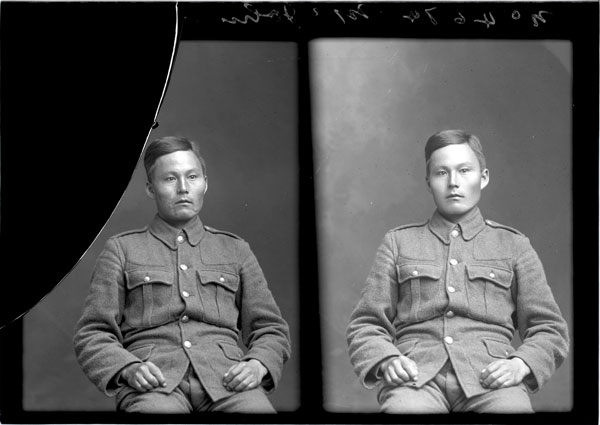
Two side-by-side photos of the same man seated and wearing an army uniform.

John Shiwak, Royal Newfoundland Regiment # 1735. The Rooms, Item E 29-45.

John Shiwak was born in 1889 in Rigolet, Labrador. A member of an Inuit community, he was an experienced hunter and trapper when he enlisted with the First (later “Royal”) Newfoundland Regiment on July 24, 1915. He was still in training when the regiment was sent over the top of the St. John’s Road trench at Beaumont-Hamel on July 1, 1916, the first day of the Battle of the Somme. When Shiwak joined the regiment in France a few weeks later, on July 24, he was one of many who saw the aftermath of the near destruction of the regiment in the 45 minutes that they fought on the Somme battlefield. In April 1917, Shiwak was promoted to lance corporal. Unfortunately, that November, less than a year before the guns fell silent, Lance Corporal John Shiwak met a sad end. In the middle of the battle for Masnières (during the larger First Battle of Cambrai), Shiwak’s unit was struck by a shell, killing him and six others.

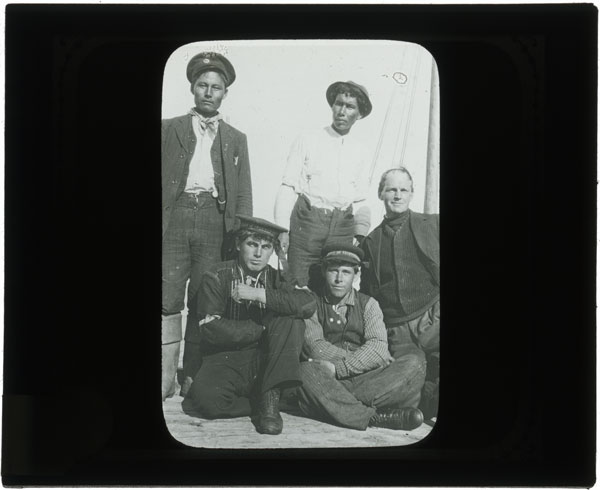
Group of five men standing or sitting.

Members of the Legion of Frontiersmen (before 1915); John Shiwak is standing at the left. The Rooms, Item IGA 10-25.

This story is not uncommon in accounts of the First World War. The Inuk man was killed in the line of duty, in the midst of his brothers in arms. Yet his story is even sadder: until now, the gravesite of Shiwak and those six other brave men were never located. It is theorized that a school was built above the grave, the construction happening without the knowledge that seven soldiers of the Great War were buried there. Nevertheless, as with all casualties without a known resting place, Shiwak is commemorated. His name is forever etched on the bronze plaques at the Beaumont-Hamel Newfoundland Memorial in France, and at a similar memorial in St. John’s, Newfoundland and Labrador.

The story of Angus Edwardson

The story of Private Angus Edwardson is of personal interest to me. He was my great-great-grandfather and fought at Passchendaele. He was born in 1894 in the northern, primarily Algonquin Anishinaabe, community of Lac-Barrière, about 300 kilometres northwest of Ottawa. On his enlistment form, Edwardson stated that he and his family resided in Oskélanéo, Quebec. For a very long time, our family did not know that he was Indigenous, nor did we know about his time in the trenches in any detail.

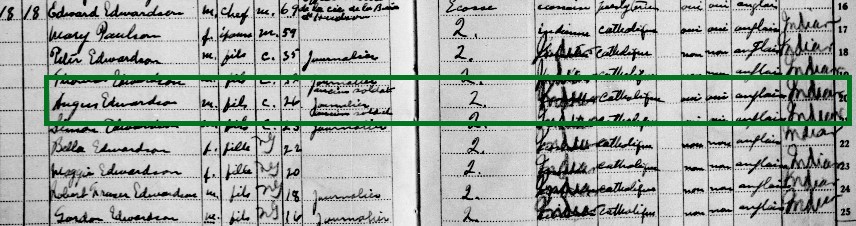
Luckily, in my line of work, one can discover some very interesting pieces of information. During a search through the 1921 Census, I found information that he was an “ancien soldat” (veteran); I was therefore able to find his attestation papers. While Edwardson’s story is much less noteworthy than that of Shiwak, his story provides an insight into the challenges of researching Indigenous men who fought in the Canadian Expeditionary Force (CEF) and indeed in the British forces as a whole.

Two pages of the attestation papers of Angus Edwardson.

Attestation papers of Angus Edwardson (regimental number 1090307).

In the physical description of Edwardson, the enlistment officer wrote that his complexion was “fair,” his eyes “blue,” and his hair “dark.” This description does not reflect the racial idea of an Indigenous person, nor did the enlistment officer note that Edwardson was First Nations by writing the commonly used term “Indian” under the section of the form entitled “Distinctive marks, and marks indicating congenital peculiarities or previous disease.”

From what we can see in his records, Edwardson was a member of the 253rd (Queens’ University) Highland Battalion, though he served with a number of other battalions and regiments during his time on the front. Notably, while serving with the 213th Battalion on August 28, 1918, he was wounded in the left hand by a bullet.

Challenges facing researchers

As I mentioned, not knowing that a member of the CEF was Indigenous is a major sticking point for researchers. The attestation files may not contain this information at all. In fact, this is very common in the later years of the First World War. Neither of the two men that I have written about have the telltale designation “Indian” on their attestation forms. The only way we can know for certain that these two men were indeed Indigenous is by relying on additional sources.

The first of such sources is the often-overlooked census records. The census provides vital information about research subjects, and individual information can greatly increase success in researching Indigenous members of the CEF and the Royal Newfoundland Regiment (RNR). In the case of Edwardson, I discovered that he was in fact Indigenous by looking at his record in the 1921 Census. For Shiwak, there was an entirely different route to finding his identity, which was incredibly difficult. I uncovered information about Shiwak’s ethnic heritage through the memoirs of Sydney Frost, a captain with the RNR, entitled A Blue Puttee at War. This memoir, however, is not the only way to find out that Shiwak was Indigenous.

List of names, ages and genders from the 1921 Census.

Census entry for Angus Edwardson and family, 1921 (e003065155).

Secondary sources about the First World War are numerous. For Shiwak, several appear when simply searching his name, but for other, lesser-known Indigenous members of the CEF, this may be more difficult. The excellent book For King and Kanata: Canadian Indians and the First World War by Timothy Winegard shows how we may be able to improve search techniques for Indigenous individuals and groups that served in the CEF. Though not explicitly, Winegard indicates the role of individual communities and their part in deciding to send men to enlist for the war effort. That said, this effort can be difficult, and it is worth reaching out to local genealogical societies and/or Indigenous communities for help in locating a list of names or simply an idea of how many men served from that community.

The final source of information that is quite useful in these cases is the so-called Indian Registers. These are archival documents with lists of names of members of bands. While the registers are a great resource for those researching members of a specific First Nations band and who are able to visit Library and Archives Canada in Ottawa, there are challenges remaining for those who do not know the band of their research subject or whether their subject died during the war. For individuals researching an Inuk or a member of a Métis Nation community, the challenges deepen, as there is very little primary source material from the period immediately after the Great War. It may be possible to identify Inuit or Métis Nation members of the CEF or RNR through secondary sources, but this can be challenging and take time.

Conclusion

Lance Corporal John Shiwak and Private Angus Edwardson both fought during the First World War. The former was Inuk and the latter was First Nations. The two cases exemplify the many challenges that face researchers when they are looking to find information about members of the CEF or RNR who were Indigenous. These challenges are multi-faceted, and they can pose significant difficulties in research into the stories of Indigenous veterans who fought in the Great War. There are some solutions and resources, including consulting archival records (census records specifically), checking with local Indigenous communities, and accessing some resources specific to Indigenous Peoples at Library and Archives Canada. Nevertheless, these proposed solutions can only go so far in helping researchers find information about Indigenous people who served in the First World War.

Additional resources 


Ethan M. Coudenys is a Genealogy Consultant at Library and Archives Canada. They are proudly of Innu heritage and the descendant of a residential school survivor.