A rediscovered manuscript: the first journal of John Norton (Teyoninhokarawen)

Version française

By Isabelle Charron

This article contains historical language and content that may be considered offensive, such as language used to refer to racial, ethnic and cultural groups. Please see our historical language advisory for more information.

Photo of a handwritten page from a journal.

First page of the journal of John Norton (item 6251788)
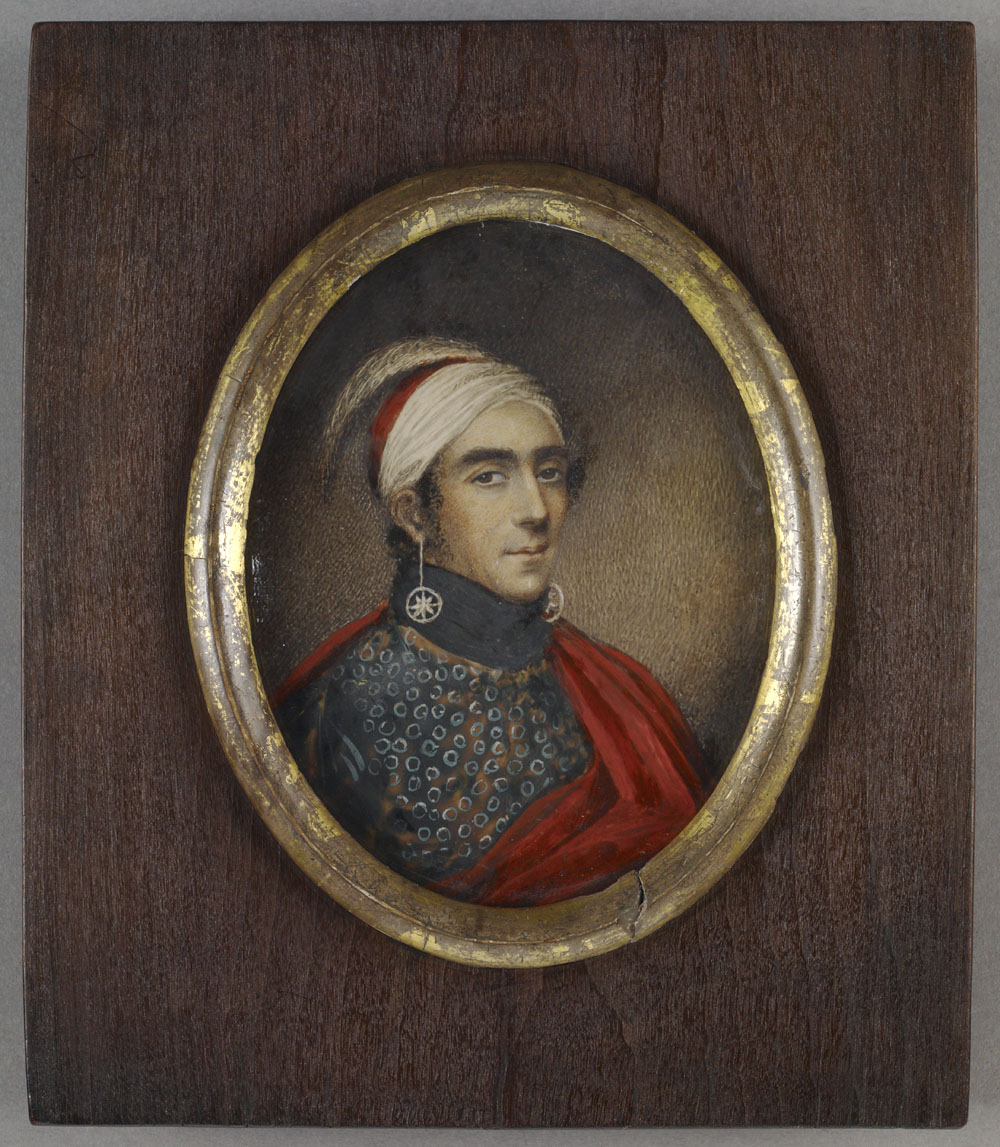
Image of an oval-shaped painting on ivory.

Portrait of John Norton by Mary Ann Knight, 1805 (e010933319)

Library and Archives Canada (LAC) recently acquired an unpublished autograph journal by John Norton (Teyoninhokarawen) (1770–1827), along with letters (John Norton Teyoninhokarawen fonds*). This acquisition was made possible by a contribution from the Library and Archives Canada Foundation. The journal’s existence was documented in correspondence from the early 19th century, but its location remained unknown until recently. These documents are an important link in the life and literary production of Norton, a fascinating character, as well as essential evidence for understanding the history of the Six Nations (Haudenosaunee), Canada and North America.

Born in Scotland, Norton had Indigenous ancestry: his father was Cherokee, brought to Great Britain by a British officer following the Anglo-Cherokee War, and his mother was Scottish. His family background shaped his astonishing journey. In addition, he was marked by military life from a very young age. His father, a soldier in the British army, took part in several campaigns in North America, during which his family followed him. In fact, Norton mentions in a letter that one of his earliest memories was the Battle of Bunker Hill (Boston, June 17, 1775) (item 6252667). Back in Scotland at an unknown date, he received an excellent education.

Norton and his parents were in the city of Québec in 1785. Like his father, he joined the army, but he deserted in 1787 at Fort Niagara. He later travelled and may have lived with the Cayuga Nation. In 1791, he worked as a schoolteacher in the Mohawk community of Tyendinaga (Bay of Quinte, Ontario). He then took part in battles in the Ohio Valley with various allied Indigenous peoples against American forces. He was also involved in the fur trade for Detroit merchant John Askin before being hired as an interpreter by the Department of Indian Affairs. He then lived with the Six Nations (Haudenosaunee) at the Grand River (Ontario) and became close to Mohawk Chief Joseph Brant (Thayendanegea). The latter adopted him as a nephew in 1797, and in 1799 Norton became chief for diplomacy and war for the Six Nations. He was given the Mohawk name of Teyoninhokarawen.

The Norton journal acquired by LAC is 275 pages long (item 6251788). He wrote it at the Grand River between 1806 and 1808 in the form of letters to a friend. He recounts his journey to England and Scotland in 1804–1805. It was at Brant’s request that he made this trip to clarify issues relating to Six Nations land ownership at the Grand River, in connection with the Haldimand Proclamation (October 25, 1784). His diplomatic mission failed because his authority was challenged by some, including William Claus, superintendent of Indian Affairs. However, on a personal level, Norton was able to reconnect with his maternal family and became a very popular figure among the political, business, religious, intellectual and aristocratic elite. He participated in social events and attended scientific conferences and debates in the House of Commons. He made valuable friends, including the brewer Robert Barclay, the Reverend John Owen and the second Duke of Northumberland (Hugh Percy), also a friend of Brant. During this time, Norton translated the Gospel of John into Kanien’kehá (Mohawk language), published by the British and Foreign Bible Society as of 1804 (OCLC number 47861587). In London, in 1805, artist Mary Ann Knight painted his portrait, now in LAC’s collection (item 2836984).

Pages from a handwritten journal.

Pages 183–185 of the journal of John Norton (e011845717)

In 1808, Norton sent his journal to Robert Barclay in England, who planned to publish it with the accompanying letters. This project, on which the Reverend Owen also worked, never materialized, and the documents remained in the Barclay family. In his journal, Norton describes his encounters and the places he visited. He expresses his thoughts on a variety of topics typical of his era and touching on colonial reality, such as the British army, American independence (and its consequences for Indigenous peoples on both sides of the border), freedom, slavery (he is an abolitionist), education, the status of women among Indigenous people, agriculture, trade (including the fur trade), business and land exploration. He plans several projects for the Haudenosaunee and is concerned about the education of young people. He questions the image of the Haudenosaunee portrayed by certain authors and insists on the refinement of their language. Christianity is also of great importance to Norton.

Norton’s correspondence reveals some details about his biography and his family (items 6252667 and 6258811). In it, he recalls his return to the Grand River in 1806, divisions in his community and his desire to take part in campaigns with the British army (item 6251790). He speaks about different Indigenous peoples and their relationships with British colonial authorities (items 6251794 and 6252528, for example). He promotes the alliance between Indigenous peoples and Great Britain but is very critical of the Department of Indian Affairs. This alliance proved essential in the War of 1812, during which Norton distinguished himself by leading groups of Indigenous warriors. He refers to this conflict in his letters (item 6258793), as well as his visit to the Cherokee in 1809–1810 (item 6258679). The correspondence also includes a transcript of a letter from chiefs of the Six Nations to Francis Gore, lieutenant governor of Upper Canada (item 6252665). Finally, a letter from someone close to Barclay confirms that George Prevost, governor-in-chief of British North America, held Norton in high regard (item 6258814).

It should be noted that Norton wrote a second journal while in England in 1815–1816, which covers his visit to the Cherokee, the War of 1812 and the history of the Six Nations. Still preserved in the Archives of the Duke of Northumberland at Alnwick Castle in England, this journal was published in 1970 and 2011, and the War of 1812 section was also published in 2019 (see references below).

A great traveller, polyglot, author, translator, letter writer, diplomat, politician, warrior, activist, trader, farmer, father, Scotsman, Cherokee, Haudenosaunee … so many epithets characterize John Norton, who already fascinated people during his lifetime. He is said to have been the inspiration for the main character in John Richardson’s 1832 novel Wacousta, a Canadian literary classic. Richardson had known Norton and was the grandson of John Askin, the fur trader for whom Norton had worked in his youth.

We hope that these newly acquired documents, which are important additions to our collection, will generate much interest and shed new light on Norton’s life and work, as well as on the history of the Haudenosaunee and Canada in the early 19th century.

Happy exploring!

To learn more

  • Alan James Finlayson, “Emerging from the Shadows: Recognizing John Norton,Ontario History, vol. 110, No. 2, fall 2018.
  • John Norton, A Mohawk Memoir from the War of 1812: John Norton—Teyoninhokarawen, Carl Benn, ed., Toronto, University of Toronto Press, 2019 (OCLC 1029641748).
  • John Norton, The Journal of Major John Norton, 1816, Carl F. Klink, James J. Talman, ed., introduction to new edition and additional notes by Carl Benn, Toronto, The Champlain Society, vol. 72, 2011 (1970) (OCLC 281457).
  • Carl F. Klinck, “Norton, John,” in Dictionary of Canadian Biography, vol. 6, University of Toronto/Université Laval, 2003 (1987).
  • Cecilia Morgan, Travellers Through Empire: Indigenous Voyages from Early Canada, Montréal & Kingston, McGill-Queen’s University Press, 2017 (OCLC 982091587).
  • Guest Curator: Shane McCord, Library and Archives Canada Blog, posted on September 14, 2017.

*Since these documents were created in English, their individual descriptions are also in English.


Isabelle Charron is a Senior Archivist in the Private Archives and Published Heritage Branch at Library and Archives Canada.

Charles Angus Cooke (Thawennensere): Language and knowledge keeper

On the left of the graphic, Tatânga Mânî [Chief Walking Buffalo] [George McLean] in traditional regalia on horse. In the middle, Iggi and girl engaging in a “kunik”, a traditional greeting in Inuit culture. On the right, Maxime Marion, a Métis guide stands holding a rifle. In the background, there is a map of Upper and Lower Canada, and text from the Red River Settlement collection.

This article contains historical language and content that some may consider offensive, for example, language used to refer to racial, ethnic and cultural groups. Please see our Historical language advisory for more information.

A painting depicting a canoe on a lake, with a house in the background, and trees and rocks in the foreground.
Ruins of Fort Senneville, Lac des Deux Montagnes, near Sainte-Anne, Quebec; view from west side of Tio’tia:ke (island of Montréal) looking northwest toward the Kanien’kehá:ka village of Kanehsata:ke (Oka), 1839 (c011891k)

The archival records of Charles Angus Cooke at Library and Archives Canada are invaluable for Kanienhkeha (Mohawk) language and culture revitalization. Cooke was born Thawennensere (Double Name) on Kanehsata:ke Territory (Oka, Quebec) in 1870. At age 11, he relocated to Wahta (Gibson, Ontario), and at age 23, he moved to Ottawa. These records of his important work are based on his knowledge of his ancestral language.

A typeset page of a newspaper with three columns.
Onkweonwe newspaper. Title from caption: “Aterientarajera naah ne Kasatstensera” (knowledge is strength). October 25, 1900 (OCLC 1007186921)

An original first edition of vol. 1, no 1 of Cooke’s newspaper Onkweonwe, dated October 25, 1900, is in Library and Archives Canada’s library collection. It is the only known surviving copy. The newspaper was groundbreaking because it was written entirely in the Kanienhkeha language and was the first to be produced in a First Nations language in Canada. Articles included current events, and topics such as foreign affairs, national affairs, the economy, sports, federal politics, hunting season dates, and the prices of produce and animals. The newspaper was a resource that could assist the economic endeavours of readers. It focused on and was distributed to communities in the region occupied by the Haudenosaunee (Iroquois) communities of the Six Nations all the way up to and including Wendake, a Huron-Wendat community in Loretteville, Quebec.

A map showing the grid of the Township of Gibson, with the labels Medora and Wood at the top and Baxter on the right.
Plan of part of the Township of Gibson, Ontario, now known as Wahta, around 1887 (e008311360)

When Cooke left Kanehsata:ke in 1881, he spoke only Kanienhkeha, but learned English after his first year at Wahta. He was a teacher there before being employed as a clerk for the Georgian Bay Lumber Company. At the age of 23 in 1893, Cooke was hired as a library clerk for what was then known as the Department of Indian Affairs in Ottawa. His position included being an interpreter, doing translation and performing clerical duties such as document classification. He was one of the early, if not the first, public servants from a First Nation to be employed by the federal government.

A black-and-white photograph of a street in winter. There is a signpost showing a railway crossing, houses, a person walking in the street and power line poles.
Street scene, Ottawa East, looking down toward the canal, December 14, 1895 (a view of Ottawa at the time that Cooke began his 33 years of employment at the Department of Indian Affairs) (a134222)

Cooke pursued progressive ideas for projects that would benefit First Nations, only to have his attempts thwarted by uncooperative supervisors. One of these projects included a dedicated Indigenous-specific library, but it was never implemented. In addition to his Onkweonwe newspaper, he was able to complete a Comparative and Synoptical Indian Dictionary.

A page with handwriting and stamps. At the bottom, it is signed “Yours sincerely, Charles Cooke.”
Saint François Agency, correspondence regarding the “Comparative Indian Vocabulary” (list of words frequently used by Indians), Charles A. Cooke, 1899–1902 (e007472965)

Additional language materials by Cooke are held in other institutions. An extensive compilation of Haudenosaunee names is held at the American Philosophical Society in Philadelphia, Pennsylvania. A copy of these records is kept at the Canadian Museum of History in Gatineau, Quebec, including a Kanienhkeha dictionary manuscript and other notes.

In 1913, Cooke assisted Marius Barbeau, an early ethnographer, in a grammatical study of Mohawk, Cayuga, Onondaga and Tuscarora languages. Barbeau would request his assistance again much later in Cooke’s life.

Cooke served as a recruiter during the First World War. He was seconded from the Department of Indian Affairs to help in enlisting what was to be a regiment composed entirely of First Nations soldiers, the 114th Battalion of the Canadian Expeditionary Force. He recruited in the Kanien’kehá:ka communities of Kanehsata:ke, Kahnawake and Akwesasne in Ontario and Quebec.

Cooke left the Department of Indian Affairs in 1926, having attained the position of Principal Clerk. He spent the next 12 years touring eastern Canada and the United States, reciting Haudenosaunee (Six Nations) and Huron-Wendat lore, songs and dances. In 1949 and 1951, he again assisted Barbeau as an interpreter at Six Nations of the Grand River in Ontario.

It is perhaps incomprehensible to the modern reader that, for all of his contributions and knowledge, Cooke worked in a political system that did not allow him to receive “Indian Status” under the Indian Act. As an adult, he made applications to register for First Nations Status, but these were never honoured. The applications would suggest that he was not registered as a child under the Indian Act. Cooke was born in 1870, six years before the Indian Act of 1876, so he may have not been registered during this time of upheaval for all Onkweonwe (First Nations peoples).

Between 1911 and 1926, Cooke sought recognition under the Indian Act as a member of the Dokis First Nation, based on his lineage from his Ojibwa grandfather, Showandai, who was a member of the Dokis Band. The Dokis Band refused Cooke’s claim. He was also never admitted into the Kanehsata:ke (Oka) Band or the Wahta (Gibson) Band.

Cooke’s life was an exceptional journey, from his ancestral roots to the intellectual and political front in Ottawa. He recruited his fellow Onkweonwe to join the armed forces for the First World War, was the cultural bridge for Barbeau’s research, and finally travelled and performed his Kanien’kehá:ka songs and dances throughout Canada and the United States. Cooke and his legacy are not forgotten by Onkweonwe today; he lives on through the important work he did, which is still accessible for the ongoing efforts of language and culture revitalization.

Elizabeth Kawenaa Montour is a project archivist in the Exhibitions and Online Content Division of the Public Services Branch at Library and Archives Canada.

First Nations cradleboards: understanding their significance and versatility

On the left of the graphic, Tatânga Mânî [Chief Walking Buffalo] [George McLean] in traditional regalia on horse. In the middle, Iggi and girl engaging in a “kunik”, a traditional greeting in Inuit culture. On the right, Maxime Marion, a Métis guide stands holding a rifle. In the background, there is a map of Upper and Lower Canada, and text from the Red River Settlement collection.

By Elizabeth Kawenaa Montour

Cradleboards are still an integral part of the cultural practices of First Nations peoples. I experienced using a cradleboard for my family when we received one from my mother-in-law. It was not new, the paint was flaking off and its footrest was wobbly. An antique restorer stabilized the paint and repaired the footrest. I selected a floral printed fabric to make a pad and embroidered a long sash of denim with multiple colours. I bundled my infant daughter in a thin flannel blanket, placed her on the cradleboard and wrapped the sash snugly around her. She was content when on the cradleboard and would usually fall asleep within minutes. I used it to bring her to local community events. Unfortunately, she outgrew it in about a month.

The cradleboard now decorates my home and is a reminder of those first few months of her life—it brings back cherished memories. Only later did I become aware of its cultural and historical significance while reading a book on First Nations cultural materials. The features of our cradleboard matched one that was over a hundred years old. Early First Nations cradleboards are in museums or private collections, as anthropologists and antique collectors visited communities and approached families directly to purchase and collect them.

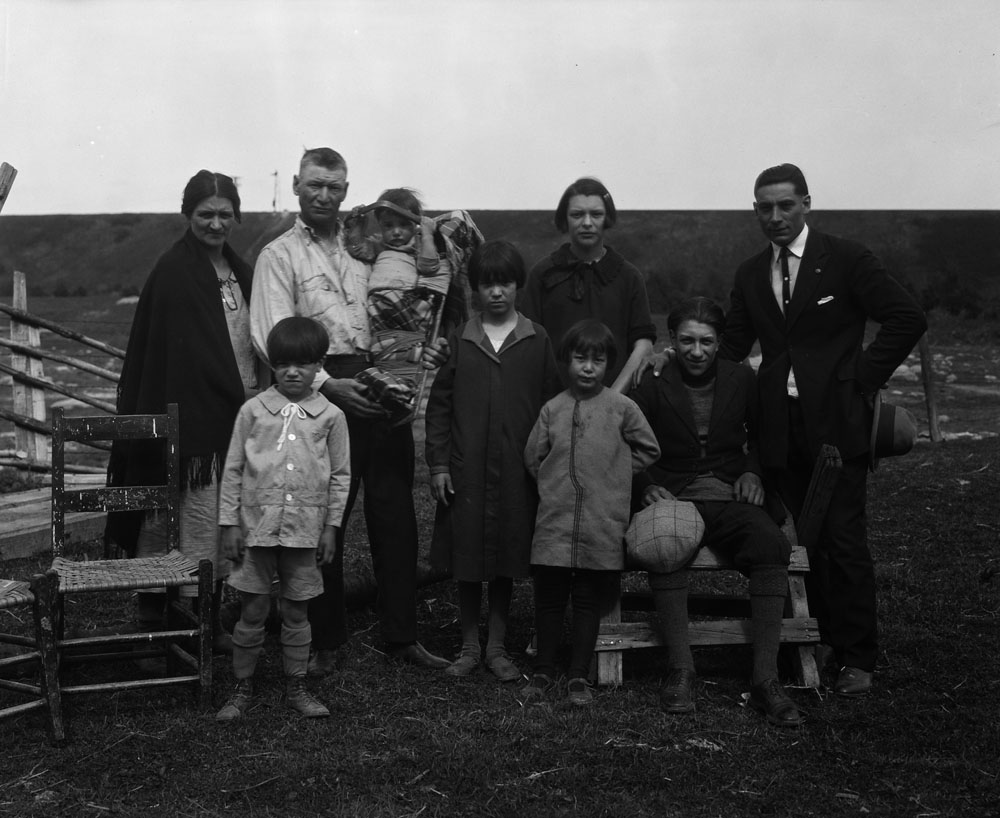
A black-and-white photograph of nine people facing the camera. A man is holding a baby in a cradleboard.

Caughnawaga [Kahnawake] reserve near Montréal [left to right: Kahentinetha Horn (née Delisle), Joseph Assenaienton Horn, Peter Ronaiakarakete Horn (Senior) holding Peter Horn (Junior), Theresa Deer (née Horn), Lilie Meloche (née Horn), unknown, Andrew Horn, unknown], ca. 1910 (e010859891)

From the East Coast to the West Coast, the design and materials for cradleboards correspond to the culture of each First Nation. Generally, cradleboards are used by the Algonquin, Haudenosaunee (Six Nations/Iroquois), Plains and West Coast First Nations. Cradleboards are different from other infant carrier–type baskets, bags, slings, carrying hoods and dugout-trough-style cradles.

A black-and-white photograph of three children. The youngest child is in a cradleboard that is embroidered with a pattern of flowers.

Two young girls standing on a wooden porch beside a boy in a cradleboard, Temagami First Nation, probably Lake Temagami, Ontario, unknown date (e011156793)

The construction of a cradleboard starts with a flat plank of wood to which functional components are added. The handle or canopy is at the top end and provides protection for the head. This part may be a bar of curved wood or a canopy of arched bark. A flat piece of wood or bark rail is attached close to the bottom of the board as a footrest and keeps the infant in place when the board is placed in an upright position. Materials that are used for the cradleboard may include wood, leather, bark, cord, plant fibres, woven fabrics or a combination of these. Cradleboards can be stylized by carving, shaping, painting or adding decoration to the different components. Since a newborn grows quickly, a second, larger board may be used to accommodate a growth spurt. Boards may be shared between families, with a new mother borrowing one when needed. Cradleboards can be commissioned ahead of the arrival of an infant and range from a simple utilitarian style to more artistic creations.

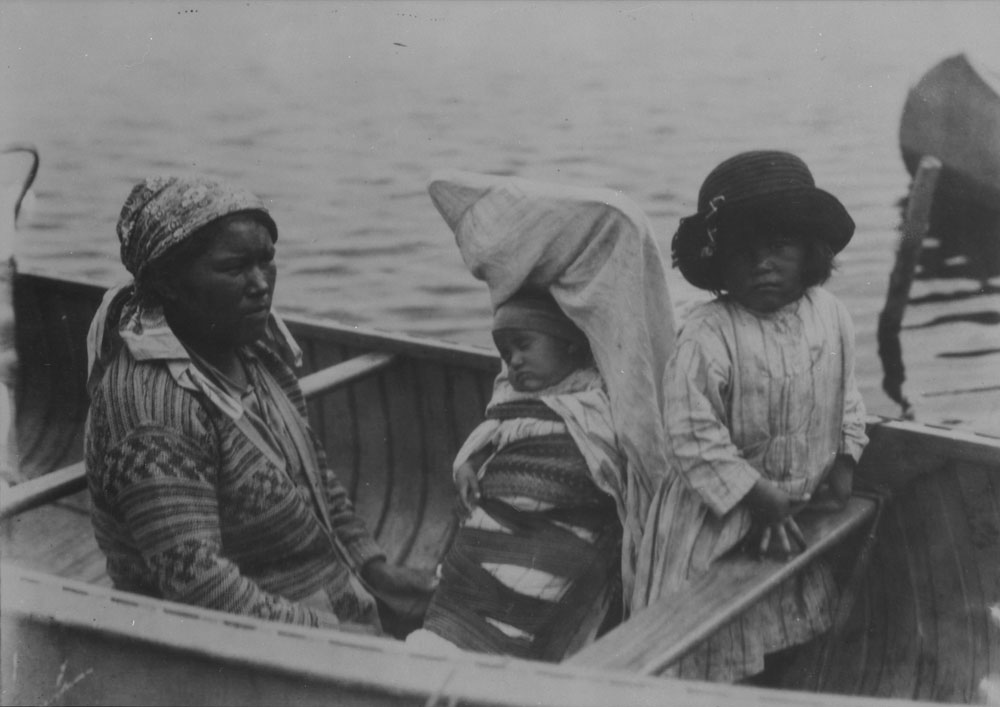
A black-and-white photograph of a woman and two children in a canoe. One of the children is sleeping in a cradleboard.

Atikamekw woman, infant on a cradleboard and young girl in a canoe, Sanmaur, Quebec, ca. 1928 (a044224)

A cradleboard enables a mother to return to her daily activities more easily after birth, while keeping her newborn close by her. The infant can be carried safely, while being comforted by the stimulation of being swaddled. Swaddling is done by bundling the newborn and securing its arms in a thin blanket with light pressure. This is thought to be good for the infant’s posture, as the back is flat on the board and the spine can be kept straight. When the cradleboard is placed horizontally, a cross bar attached under the board on the top end raises the head slightly higher than the bottom end. Using gravity, the infant’s blood circulation is enhanced. Of course, not all of the infant’s early life is spent on the cradleboard, as it is used as occasions warrant.

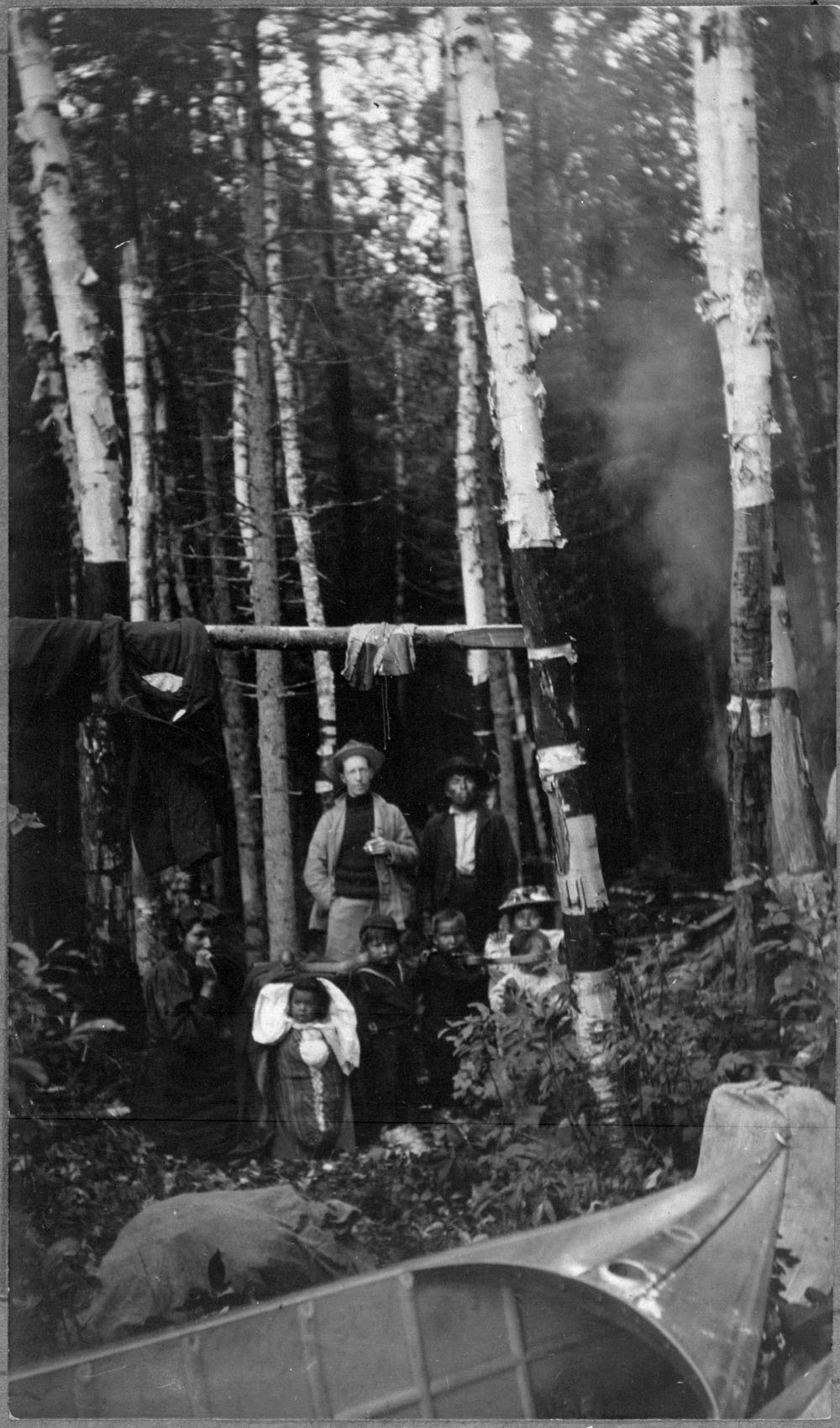
A black-and-white photograph of eight people, including a baby in a cradleboard in a forest. There is a canoe in the foreground.

First Nations family, Ishkaugua portage, [Newton Island, Ontario], 1905 (a059502)

Once the infant is wrapped in the swaddling material, it is placed on the cradleboard on a thinly padded cushion and secured by wrapping the sash several times around the child and board. Another technique is to place the infant in a leather or cloth bunting bag (also known as a moss bag) that is easily placed on or removed from the cradleboard. The bag is then attached to the cradleboard, the infant is placed in it and then secured with leather or cord laces. Sashes and extra covers may be made by the mother, relatives or friends and could include unique embroidery, beadwork and ribbon work designs. Designs featured may represent clans, traditional symbols, or motifs of plants, animals and nature.

Smaller versions of cradleboards are made for the children. These provide the opportunity for young girls to practice their nurturing skills while at play and prepares them for motherhood or caregiving. A cloth or corn-husk doll or a bundle of sage or other dried plant material is usually placed on the board

A black-and-white photograph of 7 women, a teenager and children on the shore of a lake. Two babies are in cradleboards.

Cree women and children at Little Grand Rapids, Manitoba, 1925 (a019995)

Eastern area

Haudenosaunee (Six Nations/Iroquois) and Algonquin-style cradleboards start with a flat plank of wood. On the backs of older Haudenosaunee boards, there are usually low-relief carved images of animals, flowers and leaves painted in basic colours of red, black, green, yellow and blue. There may be additional carving on the top end of the board, handle, footboard and wood bar. In rare examples, silver or metal inlays have been inserted on the wood bar.

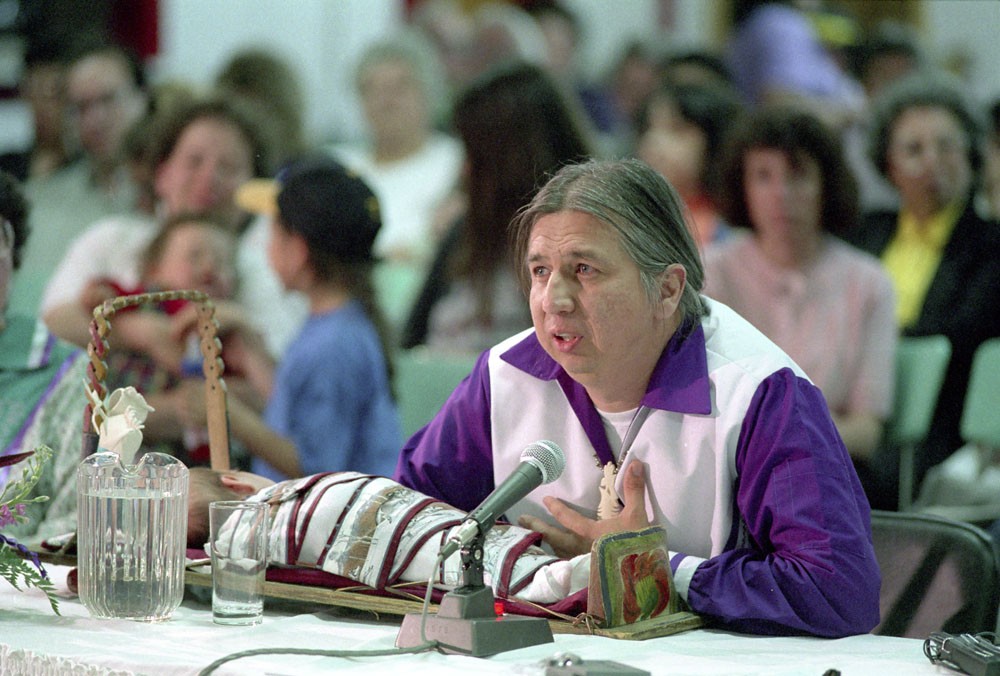
A colour photograph of a man in a purple and white shirt sitting at a table and speaking into a microphone. In front of him is a baby in a cradleboard with red and white fabric.

Kenneth Atsenienton (“the fire still burns”) Deer and grandson Shakowennenhawi (“he is carrying the words”) Deer at the Royal Commission on Aboriginal Peoples, Kahnawake, Quebec, May 1993 (e011207022)

Some of the wooden structural elements were attached with wood pegs. Handles were reinforced with leather strips, gut or cord. The curves on the wood handles were hardwood that had been steamed and bent. Haudenosaunee wood handles were straight across, while the Algonquin boards had a bowed wood handle. A cover can be draped over the handle to provide a quiet space or shield the infant from the elements. Objects might be hung from the handle for the child to look at, such as beaded strings, charms or possibly a baby rattle. Some Algonquin cradleboards had a one-piece rail attached to the board, which would go up each side, curving at the bottom and serving as a footrest.

A cradleboard could be carried on a person’s back by attaching straps or a tumpline to the cradleboard; these then went around the chest or forehead and left the hands free.

A watercolour painting of two women and a man. One of the women has a pipe in her hand and a baby in a cradleboard on her back. The man has a rifle in his hand.

This watercolour painting shows a woman carrying a baby in a cradleboard, ca. 1825–1826 (e008299398)

Western area

First Nations in the Plains region would cover the leather or fabric used for the cradleboard with their traditional beadwork styles. The infant was placed in an enveloping enclosure attached to the cradleboard.

Northwest Coast First Nations had more than one type of cradleboard, as well as a dugout-trough cradle. Cradleboards were made of woven plant fibres, cedar boards and hollowed-out logs.

The tradition of making new cradleboards is carried on today by First Nations carvers and craftspeople. In celebration of the birth of new generations, they may incorporate past knowledge in new designs including personalized elements and stylistic representations of present culture.

Visit the Flickr album for more images of cradleboards.

This blog is part of a series related to the Indigenous Documentary Heritage Initiatives. Learn how Library and Archives Canada (LAC) increases access to First Nations, Inuit and Métis Nation collections and supports communities in the preservation of Indigenous language recordings.


Elizabeth Kawenaa Montour is a project archivist in the Exhibitions and Online Content Division of the Public Services Branch at Library and Archives Canada.