Library and Archives Canada releases sixth podcast episode

Library and Archives Canada (LAC) is pleased to announce the release of its latest podcast episode: Home Children.

LAC Project Manager and Genealogist Marthe Séguin-Muntz along with John Sayers of the British Isles Family History Society of Greater Ottawa, join us to talk about the lives of Canada’s Home Children. They will discuss some of the incredible stories of hardship and prosperity in early Canada, share a wealth of resources available at LAC and provide helpful research tips and tools to discover your family history.

Subscribe to podcast episodes using RSS or iTunes, or just tune in at: Podcast – Discover Library and Archives Canada: Your History, Your Documentary Heritage

For more information, please contact us at podcast@bac-lac.gc.ca.

The Home Children (part three) — Harold Mornington

The second article in this series of three explains how to find information about one of the British home children, Edward Brignall, who served in the Canadian Armed Forces during the First World War. This third article looks at another home child, Harold Mornington, who served in the British Army in the Second World War.

As with Edward Brignall, the process begins with a search of our main online resource on Home Children. Entering the family name Mornington and the given name Harold into the database yields a single reference; it indicates that Harold was 14 years old when he left Liverpool on March 11, 1932 aboard the SS Montclare, and arrived in Halifax on March 19, 1932. He was part of the last group of 36 children sent to Canada by the Barnardo agency.

The passenger lists from 1925 to 1935 have been digitized and can be consulted online. The digital image of the list of passengers aboard the SS Montclare can be examined as well, which confirms the information found in the home children database. It also contains other information, such as the name and address of Harold’s mother, Mrs. Mornington, who lived at 16 Orlando Street, in Caldmore, Walsall, England. More information about Harold Mornington’s family history can be found by contacting the Barnardo’s Family History Service.

Beginning in the 1920s, immigration inspectors drafted Juvenile Inspection Reports when conducting periodic evaluations of children brought to Canada by different agencies. These files are available only on microfilm. A search on reel T-15424 shows that between 1932 and 1936, Harold Mornington worked for five different employers in the Ontario districts of Durham, Brant, Oxford and Hastings.

A reference found on the site of the Commonwealth War Graves Commission reveals that sometime between 1936 and the beginning of the Second World War, Harold Mornington returned to England. He joined the British Army and died on May 23, 1941, while still a member of the Royal Artillery. He was the son of William Joseph and Elizabeth Mornington.

Lastly, Harold Mornington’s military service record is kept at The National Archives in the United Kingdom.

Questions or comments? We would love to hear from you!

Home Children (Part II)—Edward Brignall

Today’s article is on Edward Brignall, born in England on January 11, 1898; you will learn how to obtain information on him.

The first step is to search by entering the surname Brignall in our main online resource on home children. You will notice that no results are displayed; this could be explained by the fact that in those days many surnames were transcribed phonetically.

The next step is to use the wildcard character *. We suggest that you enter Brign* in the surname field.

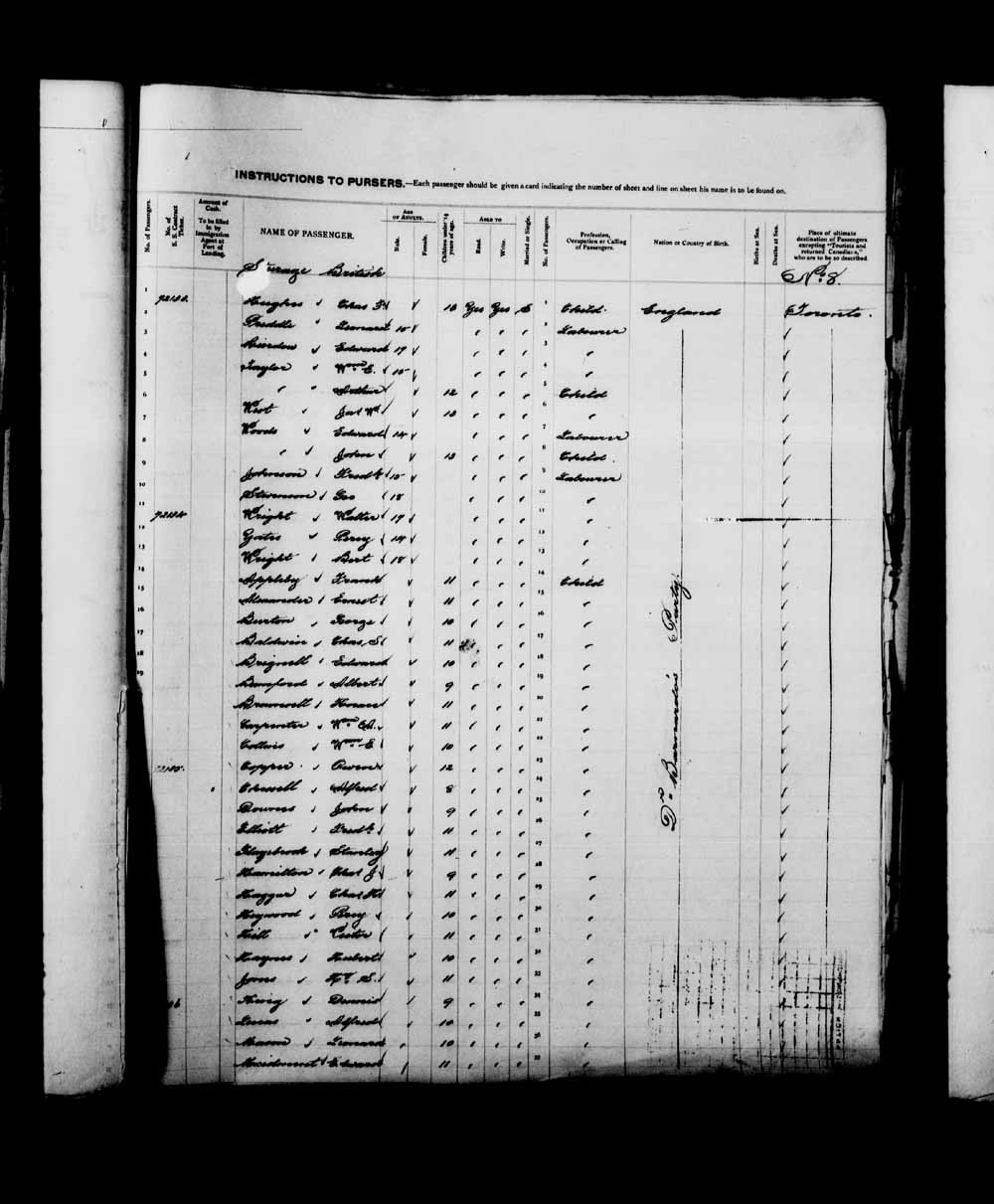
This search opens an item display for Edward Brignell, 10 years of age, who arrived in Canada on the SS Dominion on May 31, 1908, in the care of the Barnardo
charitable organization. Edward was part of a group of 109 girls and 219 boys. This information agrees with what we know.

The passenger lists from 1865 to 1922 have been digitized and you may consult them using our database Passenger Lists, 1865–1922. You may even examine a digitized image of the SS Dominion passenger list. Further information on Edward’s family background may be obtained by contacting the organization Barnardo’s Family History Service.

Several young English immigrants who settled in Canada served in the Canadian and British forces during both world wars; such is the case of Edward Brignall. To trace him, first search in our database Soldiers of the First World War. Just enter Brignall in
the surname field. This search generates five results, only one with the given name Edward:

Name: BRIGNALL, EDWARD
Regimental number(s): 922715
Reference: RG 150, Accession 1992-93/166, Box 1068 – 36
Date of Birth: 11/01/1898

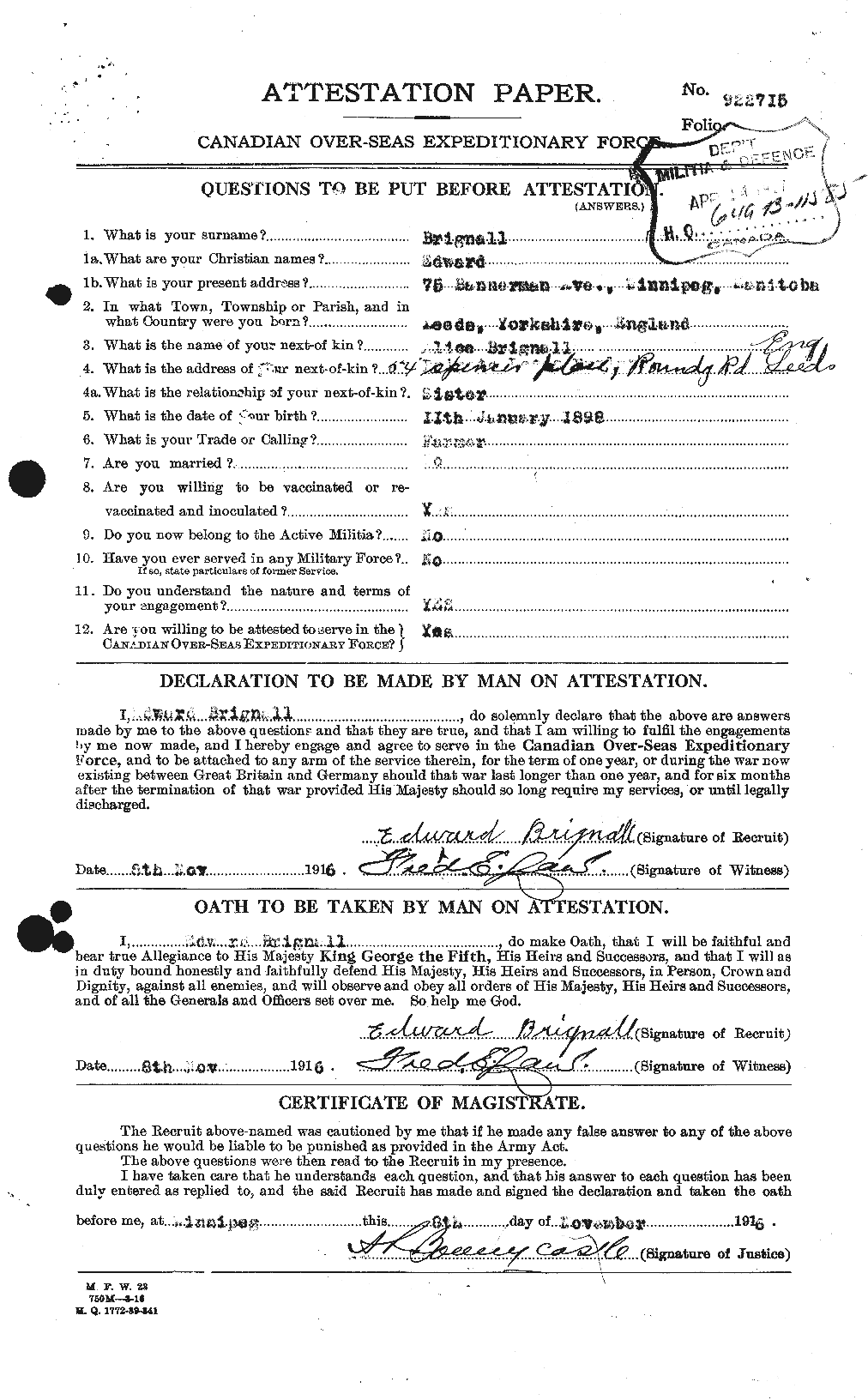
You may consult his attestation paper online to confirm his date of birth, find out
where he lived (i.e., 75 Bennerman Avenue, Winnipeg, Manitoba), and learn that his next of kin, his sister, Alice Brignall, resided in Leeds, England. By consulting his record, we learn that Edward died before leaving for Europe. Also available online are the death cards of First World War veterans; Edward’s shows that he died of pneumonia on January 23, 1917, at the Winnipeg General Hospital just a few months after he enlisted.

It is also possible to search the database of the Canadian Virtual War Memorial. There
we learn that Edward was the son of Edward and Dorothy Lever Brignall, of Leeds, England, and that he was buried at the Brookside Cemetery in Winnipeg, Manitoba.

Finally, remember to consult the first part of this series, entitled Home Children—Introduction.

Happy hunting!

Questions or comments?
We would love to hear from you!

Home Children—Introduction

The immigration of children from Great Britain accounts for a significant part of Canadian history. Between 1869 and the end of the 1930s, religious authorities and philanthropic organizations sent more than 100,000 poor, orphaned or abandoned children—better known as home children—to Canada, believing that they were offering them a better  chance for a healthy life. Many Canadians have an ancestor who experienced this often-misunderstood migration.

Anyone who came to Canada alone as a child was very likely one of the home children. Family members quite possibly obtained information on this from written documents or oral histories.

Library and Archives Canada has several genealogical records on home children, including passenger lists, correspondence, inspection report cards and various documents produced by different organizations that took part in the children’s transport and care.

Stay tuned for our upcoming series of articles on home children who later made their mark in Canada’s history, and on well-known people whose ancestors were home children. The series will help you discover our vast collection of genealogical resources that enable you to trace an ancestor who might have been one of the home children.

Questions or comments? We would love to hear from you!