Black Porter Perspectives: Giving Voice to Rail Service During and After the Second World War

Version française

By Stacey Zembrzycki

This four-part Black Porter Perspectives blog series is inspired by a striking and haunting set of images found within the Department of National Defence (DND) accession 1967-052. These photographs provide a window into service to country through various vantage points during and after the Second World War, revealing the intersections of class, race and duty.
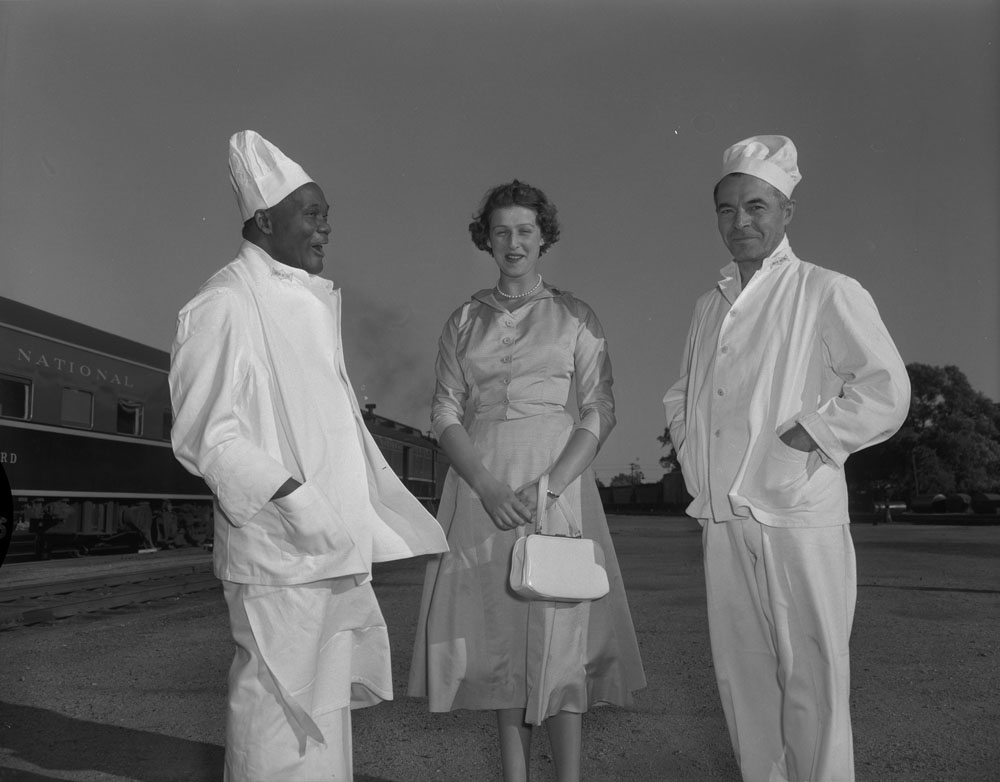
A white woman standing between a black man on the left and a white man on the right.

Princess Alexandra represents the British Crown on Canadian soil during her Royal Tour in 1954. (e011871943)

Volunteer, and in some cases, conscripted servicemen departing for and returning from battle offer us a glimpse into the realities of preparing for war, deploying to distant fronts, and returning home again.
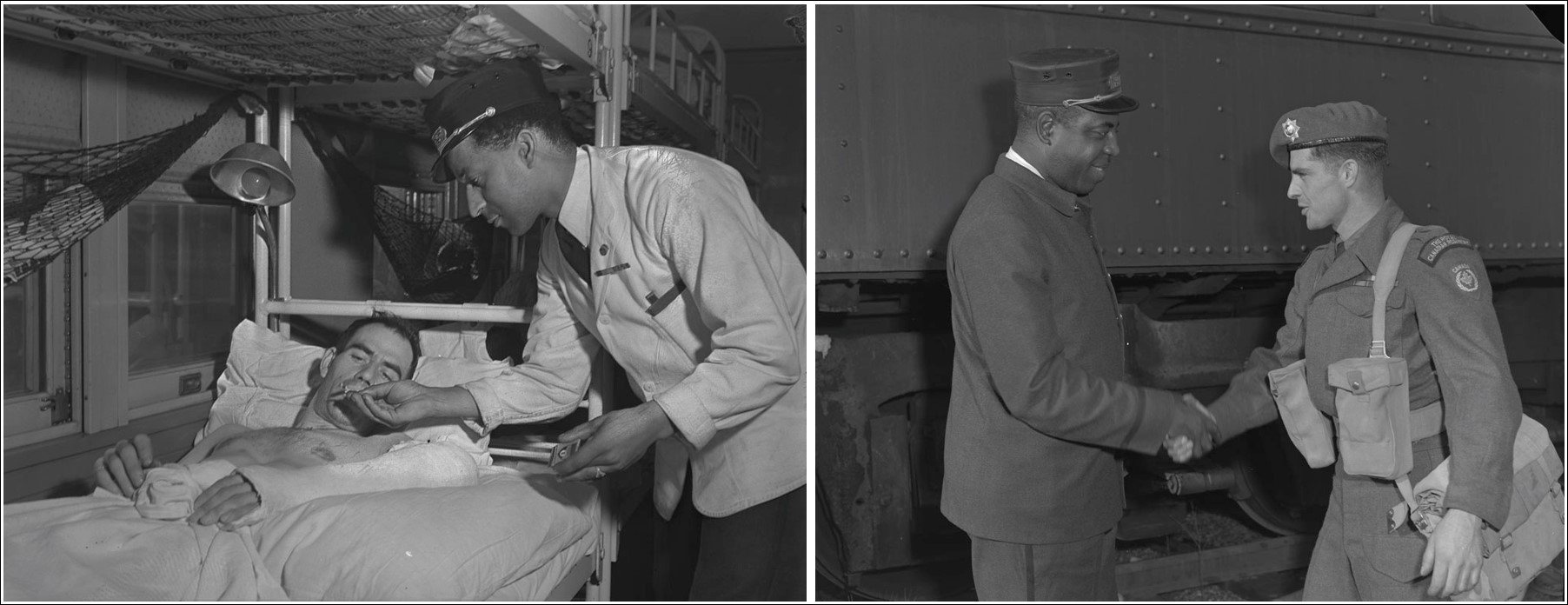
Side-by-side photographs of a Black sleeping car porter lighting a cigarette for an injured white soldier lying in a bed on a train, and of a Black sleeping car porter shaking hands with a white soldier.

Image on left: A sleeping car porter and an injured soldier on the Lady Nelson hospital train. Image on right: Porter Jim Jones of Calgary shakes hands with Private Harry Adams, a Halifax member of the Royal Canadian Regiment, as Canadian Army Special Force units arrive at Fort Lewis, Washington, for brigade-strength training. (e011871940 and e011871942)

Black men, often identified as train staff in the image descriptions, appear in every photograph—serving as the unifying thread in these historical moments. Their essential work, whether as cooks or sleeping car porters, made train travel possible, luxurious even, in times of war and peace. While this labour has often been silenced and overlooked in our national narratives, it is undeniably present in these images.

How can we begin to piece together the experiences that are captured in these images? One way is to turn to the Stanley G. Grizzle collection, particularly the interviews he conducted in 1986 and 1987 with former Canadian National (CN) and Canadian Pacific Railway (CPR) sleeping car porters. Grizzle sought to document the exploitative company culture Black men endured up to the mid-twentieth century and the long and complex struggle that ultimately led to their unionization. At the same time, he also made space for his narrators to recount memorable stories from their time on the rails. These recollections, if listened to closely, allow us to begin piecing together a narrative that enables us to better contextualize some of these DND images. Like the past, however, these moments remain fleeting and fragmentary, with much lost to history.

Five interview clips from Grizzle’s collection provide insight into what portering looked like during the Second World War. While these exchanges provide few details about the images above, they offer glimpses into porters’ working conditions and the added responsibilities they shouldered during wartime. Let’s listen to what these conversational tangents reveal about their experiences:

You can read the transcript from this sound clip here. (ISN 417383, File 1, 34:30)

You can read the transcript from this sound clip here. (ISN 417397, File 2, 9:26)

You can read the transcript from this sound clip here. (ISN 417379, File 1, 17:18)

You can read the transcript from this sound clip here. (ISN 417379, File 1, 5:56)

You can read the transcript from this sound clip here. (ISN 417386, File 1, 32:12)

The experiences of the men, the people they served, and their feelings about the additional duties thrust upon them as a result of the Second World War offer valuable insights that help humanize the role of portering. For George Forray, the demands of wartime rail service provided financial security, allowing him—and many others—to secure full-time employment during this turbulent period. Bill Overton, while recounting the hard-fought union gains he helped achieve, shared a story of being overwhelmed by 83 hungry Air Force cadets needing lunch. While there were white off-duty staff members on the train at the time, he explained the challenges of asking for their assistance. Through his account, we gain a deeper understanding of the intricacies and misunderstandings surrounding overtime pay during this era and the racialized structures that governed and divided rail workers.

In one of the clearest and most concise wartime stories in Grizzle’s collection, an unknown narrator recounts—despite audible breaks in the sound recording—details of transporting German prisoners of war. While he describes the sleeping cars’ physical environment and the meals served, much is left to the imagination, leaving gaps about how porters perceived this service and the potential dangers they faced. These insights are largely lost to history. Eddie Green builds on this discussion while speaking about the evolution of train technology in the early twentieth century. The reintroduction of outdated train cars to meet wartime demands posed significant challenges and physical dangers for porters, who had to navigate these risks while managing increased passenger loads. The stress would have been tremendous.

In many ways, the final interview clip brings the narrative full circle. In it, Joseph Morris Sealy reflects on how the high demand for wartime rail service paved the way for significant union gains. Government-backed wage increases served as a crucial starting point for negotiating the first collective agreement between the International Brotherhood of Sleeping Car Porters and the CPR in 1945. There was no going back to the way things were before the war. The uninterrupted movement of people and goods by rail had proven essential to sustaining a stable and functioning economy. Porters, fully aware of the critical role they played, fought to ensure they were treated fairly and justly compensated.

While piecing together the contextual information behind the images included above may not be possible, these accompanying narratives contain enough information to reveal what may have been happening before and after photographers captured these moments in time. They give a voice to the experiences of porters, shedding light on the complexities of their work during and after the Second World War. Yet, as with all historical sources, this oral and photographic evidence underscores the challenges of reconstructing the past—we must work with the fragments available to us. Despite their limitations, these sources compel us to fundamentally rethink our national narrative and the pivotal role of Black labour within it.

Additional Resources


Stacey Zembrzycki is an award-winning oral and public historian of immigrant, ethnic, refugee, and racialized experiences. She is a faculty member in the Department of History and Classics at Dawson College.

Have you heard of Léo Major, the liberator of Zwolle?

Version française

By Gilles Bertrand

French-Canadian soldier Léo Major was a hero of World War II and the Korean War. He is a multi‑decorated soldier who is recognized in the Netherlands for single-handedly liberating the city of Zwolle from the Germans on April 14, 1945. He is the only Canadian to have received the Distinguished Conduct Medal (DCM) twice for his actions in two different wars.

Photograph of a man wearing a military jacket

Sgt Léo Major, DCM and bar, in Korea, 1952 (e011408966)

Born on January 23, 1921, in New Bedford, Massachusetts, Léo Major grew up in Montréal. His family moved to Canada a year after his birth.

In the late 1930s, after working in various construction fields, he was employed as an apprentice plumber. He became unemployed in 1940 and decided to enlist in the Canadian Army. From 1940 to 1944, he underwent an intensive period of military training, the first year in New Brunswick and then the next three years in Europe.

His first battle took place on June 6, 1944, when he arrived in Normandy on Juno Beach with Le Régiment de la Chaudière. That same day, Léo captured a German Hanomag half-tracked armoured personnel vehicle.

Two days later, during a reconnaissance mission, Léo and four other soldiers came across a patrol of five elite German soldiers. They engaged and won the battle, but Léo lost the use of his left eye when a mortally wounded enemy soldier threw a phosphorus grenade at him. This earned Léo the nickname “one-eyed ghost.” Despite his injury, he refused to return to England and continued to act as a scout and sniper using only his right eye.

During the Battle of the Scheldt in the fall of 1944, Léo set out to search for a group of soldiers who had been delayed in returning from a patrol in the southern Netherlands. On his way, he took 93 German prisoners alone.

He suffered serious back injuries in February 1945 when the truck taking him back to camp exploded on a mine, killing all the other passengers on board. He again refused to be evacuated and, after a month’s rest, he returned to the battlefield.

On April 13, 1945, Léo and his friend Corporal Willie Arseneault volunteered for a reconnaissance mission. In the middle of the night, they made their way to the outskirts of Zwolle, a Dutch city of 50,000 inhabitants that was occupied by German troops. Corporal Arseneault was killed by enemy fire.

Determined to avenge his friend, Léo continued on, alone, with grenades and machine guns to attack the Nazi-occupied city. He spotted a bar with German officers inside and entered. He disarmed a French‑speaking, high-ranking officer and convinced him to leave the city with his men, claiming that Zwolle was surrounded by Canadian troops.

He raced through the city, firing everywhere to make it look like a Canadian offensive, and even set fire to the Gestapo headquarters. The Germans withdrew.

On the morning of April 14, 1945, thanks to Léo Major, the city of Zwolle was liberated from German troops and saved from the destructive artillery division attack that was to take place later that day. For this feat and for his bravery, Léo Major was awarded the DCM and received recognition from the people of Zwolle.

A typed page with the words War Diary or Intelligence Summary at the top and a table containing secret information.

Extract from a page of the April 1945 war diary of Le Régiment de la Chaudière. RG24 C 3, Volume number: 15181, File number: 743 (e011388179, article 6, image 7)

Returning to civilian life after the war, Léo worked as a plumber. Against all odds, despite his injuries and loss of vision in one eye, Léo volunteered for the Korean War in August 1950 and enlisted with the 2e Bataillon, Royal 22e Régiment.

In November 1951, Canadian troops from the Royal Canadian Regiment, Princess Patricia’s Canadian Light Infantry and the Royal 22e Régiment were sent to a new area occupied by the Americans at that time, on the front line along Hills 355 and 227. Hill 355 was an important strategic position because of its ideal vantage point over the area. Nicknamed “Little Gibraltar,” it was highly coveted by both sides in the battle and changed hands several times.

The Canadian troops faced a strong attack by the Chinese forces, who had retaken the hill. Léo Major was ordered to attack Hill 355 to relieve the pressure on the Canadian troops, who were almost surrounded by the Chinese 64th Army. With a group of 18 scouts, Léo set out in the middle of the night and managed to surprise the Chinese behind their own lines. He regained control of Hill 355 and its neighbour, Hill 227. He himself directed the mortar batteries by radio to the Chinese attackers who tried to retake the hill the next day. Despite being outnumbered, the Canadian soldiers withstood the onslaught of the Chinese troops and held their position for three days before being replaced by American troops. For taking and defending this strategic position, Léo Major was awarded the DCM a second time.

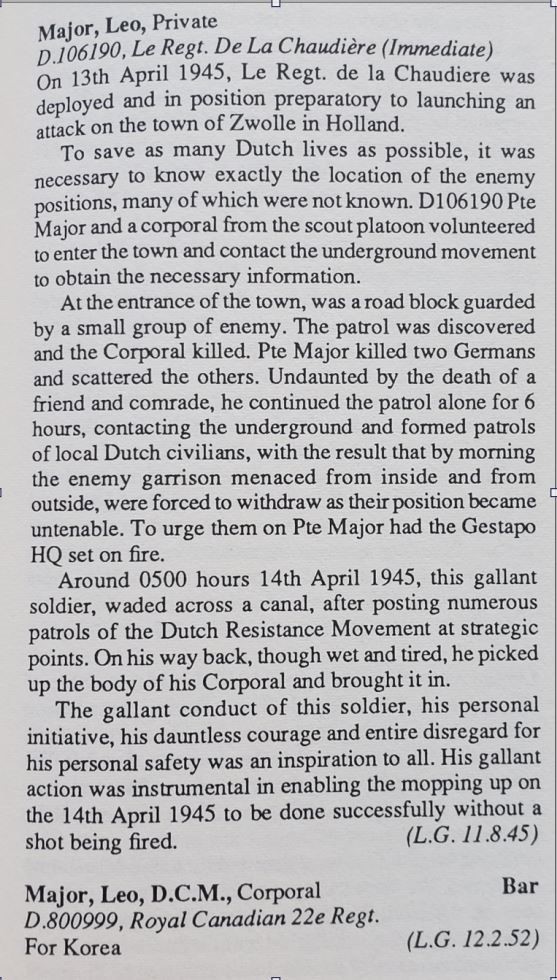
Photocopy of a book extract describing Léo Major’s actions and citations for his two DCMs.

Excerpt from George Brown’s book, For Distinguished Conduct in the Field: The Register of the Distinguished Conduct Medal, 1939–1992 (OCLC 32387704)

Léo Major was a man of action and great courage who did not shrink from obstacles. He had a strong head and sometimes challenged orders (for example, refusing to return to England after suffering serious injuries or to abandon his position on Hill 355) because he cared about the freedom of the people. He was only doing his duty, he would say, but in an exemplary way, we might add. This hero, who died on October 12, 2008, in Montréal, will never be forgotten.

Additional resources:


Gilles Bertrand is an archivist in the Reference Services Division of Library and Archives Canada.

The Korean War

In the wake of the Second World War, the Korean Peninsula was divided into two zones along the 38th parallel, with the North occupied by the Soviet Union and the South by the United States. Soon after the election of a northern communist government in 1948, open war broke out on June 25, 1950, when North Korean troops invaded the South.

Given the situation, the United Nations Security Council passed a resolution to approve sending troops to defend South Korea; a number of countries, including Canada, contributed by supplying armed forces.

The Royal 22e Regiment mortar platoon ready to fire, (left to right) Private Daniel Primeau, Private Raymond Romeo, and Private Julien Blondin, all of Montreal, Quebec.

The Royal 22e Regiment mortar platoon ready to fire, (left to right) Private Daniel Primeau, Private Raymond Romeo, and Private Julien Blondin, all of Montreal, Quebec. Source

More than 26,000 Canadian soldiers fought in the Korean War. They battled communist troops on the ground, while the Royal Canadian Navy—with eight warships—helped control the Korean coasts. The Royal Canadian Air Force did its part transporting troops and equipment. A few pilots saw combat at the controls of American fighter planes.

 Black-and-white photo of two Canadian snipers aiming at an unknown target..

Two snipers. Source

On July 27, 1953, an armistice agreement was signed at Panmunjom, bringing three years of fighting to an end.

In all, 516 Canadians lost their lives during this armed conflict. Their names are entered in The Books of Remembrance… The Korean War, exhibited at the Peace Tower in Ottawa and available online. These registers remind us of the important contribution and tremendous sacrifice of these Canadians.

The Library and Archives Canada collection contains many documents about this war, which marks the 60th anniversary of its armistice in 2013. Here are a few examples:

Part of the war diaries (War Diary, 1951) of the Commonwealth troops, including Canadian troops:

The war diary (1950–1951) of the advance party:

For more photos, visit our Flickr album.

For more information about ordering military service files, please read our blog article on this topic.

Reconnecting families through digitization

As part of Project Naming, a community engagement and photo identification project that aims to reconnect Inuit and their past, Library and Archives Canada (LAC) has undertaken the digitization of a series of photographs from the Indian and Northern Affairs Collection. These albums have been the starting point of a great story regarding a family from Nunavut.

In this collection, are a number of images of the Weetaltuk family taken during the summer of 1949 on the Cape Hope Islands in Nunavut. The original captions accompanying the photographs provided basic details. Fortunately, the database records for these images are now more complete after several family members contacted LAC to provide the names of relatives and other relevant information about these pictures. Most importantly, they were able to correct the Weetaltuk surname, as well as community names that had been incorrectly recorded. From the original captions, we knew that George Weetaltuk was a community leader, a skilled hunter and an expert boat builder. His family members explained the detailed process that George followed in creating his boats, as seen in this photograph of him with his son, William, and his adopted son, Simon Aodla, constructing an 11.58 metre (38-foot) boat.

Another record that the Weetaltuk family was able to correct was this group photograph taken in front of a log cabin. The caption states that this picture was taken on Cape Hope Islands. We now know that the picture was probably taken on nearby Charlton Island, James Bay, where for many years, George and his family resided while he was employed seasonally by the Hudson’s Bay Company. In addition to this information, the family was also able to identify five of the people in the photograph, and provide genealogical connections.

Weetaltuk family photograph. Back row: Adla (far left), married to William, George’s oldest son (2nd from left),  George Weetaltuk (centre) and his first wife, Ugugak (4th from left). Front row: George’s sons Alaku (far left) and Tommy (sitting on the ground). (PA-099605)

Weetaltuk family photograph. Back row: Adla (far left), married to William, George’s oldest son (2nd from left), George Weetaltuk (centre) and his first wife, Ugugak (4th from left). Front row: George’s sons Alaku (far left) and Tommy (sitting on the ground). (PA-099605) Source

In addition, another of George’s sons, Edward, was a member of the Princess Patricia’s Canadian Light Infantry. He was the first Canadian Inuk to serve in military combat with the Canadian Army during the Korean War. Following his 15 years of service, he began writing his life story. According to a news article, Edward (Eddy) Weetaltuk “wanted to show young Inuit that education was important and that Inuit can become anything they want and even become famous, if that’s what they want.” (Nunatsiaq Online, July 16, 2009)

Although Eddy started writing E9-422: Un Inuit, de la toundra à la guerre de Corée in 1974 (in French only), it was not published until 2009 only a few days before his death.

Through these family connections and dialogue with the community, our photographic collections are constantly improved and enriched for future generations.

For more information about Project Naming, read our Blog article, published on May 9, 2013, and listen to our Project Naming and Canada’s North podcast.