My Dear Friend: Letters from Normandy to our Canadian Soldiers

Version française

By Ariane Gauthier

As part of my work as a reference archivist at Library and Archives Canada (LAC), I often find myself delving into the many documents in the Second World War collection. Many people around the world are interested in the history of Canadians in this conflict and, more specifically, in the experiences of our soldiers. What I find even more fascinating is how the quest begins for the researchers I am lucky enough to work with. The starting point is often a personal story, passed down in a family or a small community: “I found out that my mother served in the Royal Canadian Air Force” or “I heard that my village hid a Canadian spy during the Second World War.” This is enough to fuel the fire of researchers, who then dig to find evidence or fill in these stories with new details.

My colleagues and I participate in this quest on an ad hoc basis, mainly to facilitate access to documents from LAC’s vast collection. When circumstances allow, we delve into the information in these documents in search of relevant details that can help researchers piece together the story they seek to understand.

That is how I found three letters from Normandy addressed to our Canadian soldiers. Unfortunately, the context of the letters, including the identity of the recipient, remains a mystery. I found these letters in a file from Royal Canadian Air Force headquarters (Reference: R112, RG24-G-3-1-a, BAN number: 2017-00032-9, Box number: 30, File number: 181.009 (D0624)). This file documents the experiences of Canadian soldiers who were captured and interned in prison camps during the Second World War. It also contains transcripts of interviews about the soldiers’ experiences.

In this case, the three letters are not linked to specific interviews and are included in this file as loose sheets. There is no correspondence explaining why they were placed in this file. Nor is it known whether these were letters addressed to soldiers who had been taken prisoner during the war. The information in these letters is truly the only information we have. In reality, though it may not seem like much, these three letters tell us a great deal about the experience of soldiers in Normandy and of the French, especially the risks faced by those who resisted the Germans.

Here are the letters in question:
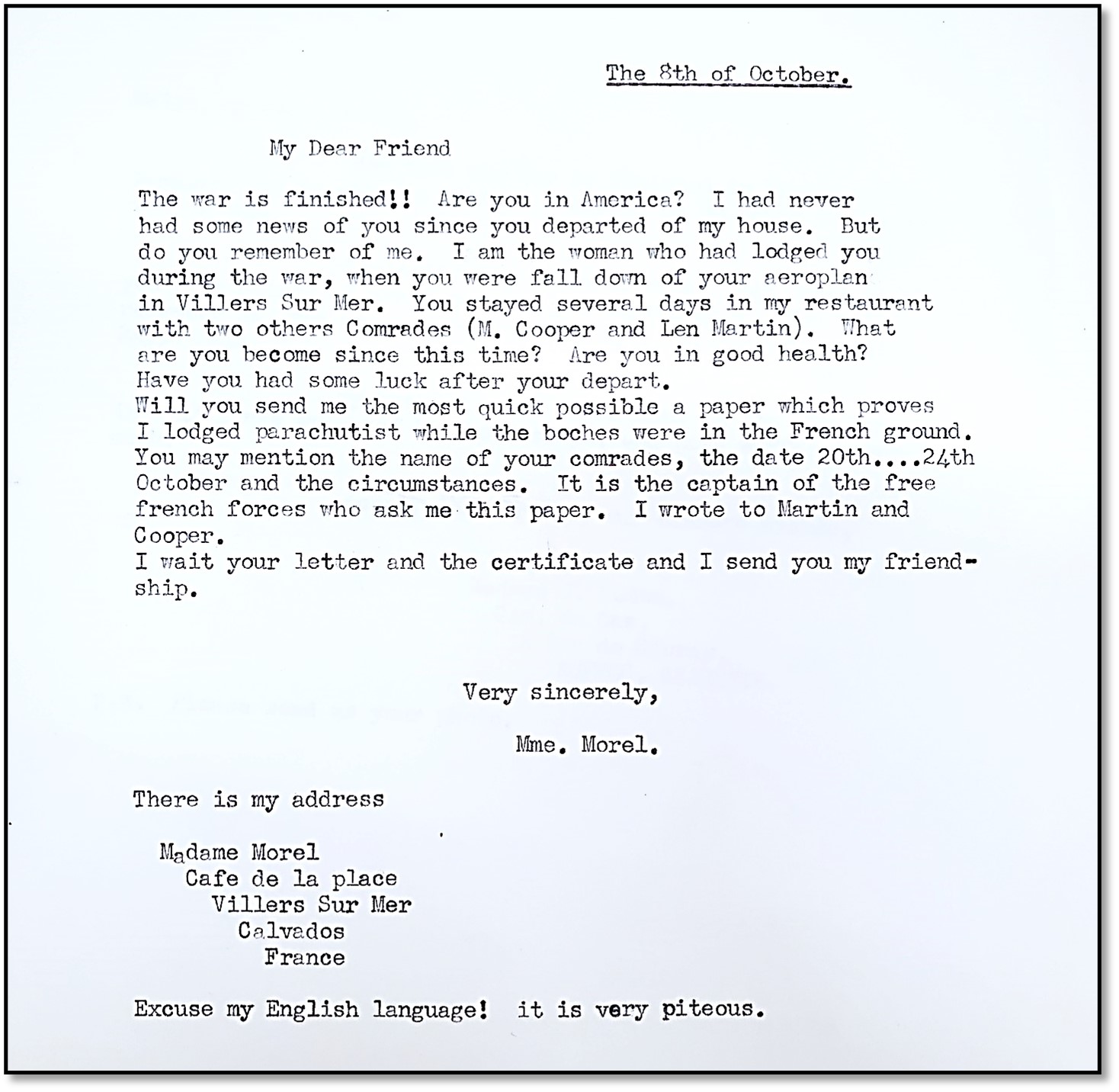
Letter to a Canadian soldier from Mrs. Morel, written on October 8. The year is not indicated on the letter. We only know that it was written and sent once the war was over.

Letter to a Canadian soldier from Mrs. Morel, dated October 8 (MIKAN 5034948)

In this first letter, we discover part of the story of Mrs. Morel, who apparently sheltered one of our soldiers after he jumped from a plane near Villers-sur-Mer. We learn that this soldier was a paratrooper and that he had taken refuge in Mrs. Morel’s restaurant with two of his fellow soldiers, M. Cooper and Len Martin, while the village was still under German occupation.

Letter written by Mrs. J. Cottu, expressing her desire to receive news of the soldier she sheltered in November 1943.

Letter to a Canadian soldier from Mrs. J. Cottu (MIKAN 5034948)

This second letter gives us a glimpse into the story of Mrs. J. Cottu and could possibly be related to that of the paratrooper mentioned in Mrs. Morel’s letter. Without more specific information, it is difficult to confirm this hypothesis, but the second letter refers to a Sergeant Martin (possibly Len Martin?) and places his departure in November. Mrs. Morel stated that she had taken in the soldier at the end of October, without specifying the year, so everything could fit together chronologically.

Mrs. J. Cottu mentions having housed three soldiers in her house in Ruffec in November 1943: the recipient of the letter, Sergeant Martin and Captain Ralph Palm. Although this story seems to have gone well, she said that she was arrested by the Gestapo in 1944 because of her husband’s activities. The seriousness of the situation is clear from this confession: “I was arrested by the Gestapo, and have suffered very much.”
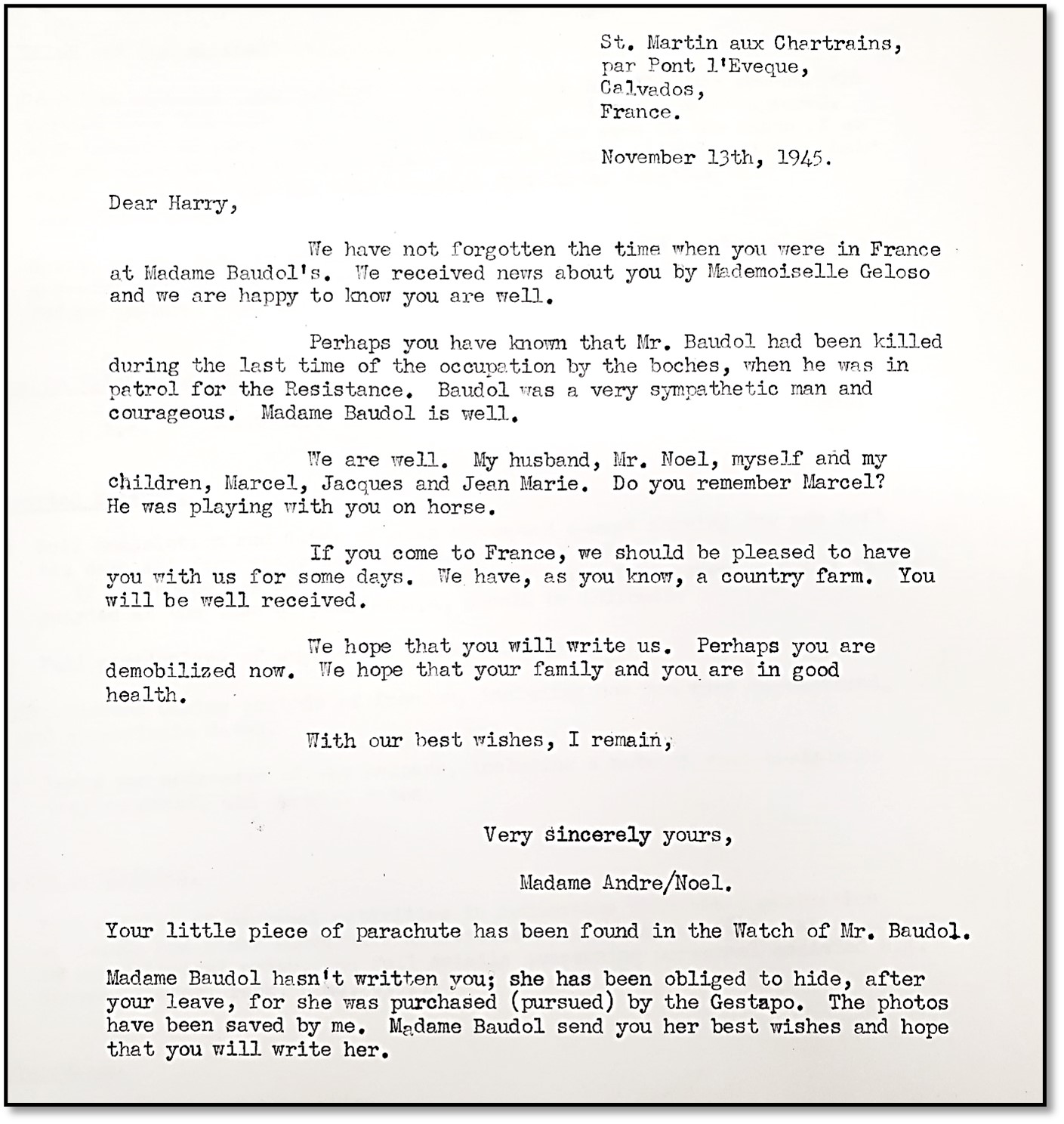
Letter written by Mrs. Noel to check on Harry and give him news about the French people he met during his stay in Saint-Martin-aux-Chartrains.

Letter to Harry from Mrs. Andre Noel, dated November 13, 1945. (MIKAN 5034948)

In this third letter, Mrs. Noel clearly illustrates the dangers that members of the Resistance faced. She bears the burden of announcing the death of Mr. Baudol, a member of the Resistance, who was killed while on patrol. She also shows us the strong bonds that Harry seems to have formed with the residents of Saint-Martin-aux-Chartrains. Although this letter expresses suffering, grief and fear, it also highlights the bravery and sacrifice of three families who came to the aid of a Canadian soldier.


Ariane Gauthier is a reference archivist with the Access and Services Branch at Library and Archives Canada.

“A Very Desolate Place”: The Lord Dufferin Letters

By Kelly Ferguson 

“I have always wanted to breathe the atmosphere of the New World,” writes Lord Dufferin, the third Governor General of Canada, to his close friends Mr. and Mrs. Sturgis. It was 1872 and Dufferin was preparing for his move to Canada, where he would spend the majority of the next six years.

When most of us think of the early governors general we may imagine stuffy noblemen coming to Canada as part of their duty to the monarchy. Sometimes it is hard to think of them as real people at all. These twelve letters, purchased by LAC at an auction in the summer of 2016, offer Canadians a glimpse into the motives and experiences of one of these aristocrats.

Yellow and brown composite photograph. Five people—Lord and Lady Dufferin and three of their children—are shown, each in their own individual shot. They are either sitting or standing for the portraits, dressed in costumes from the era of King James V of Scotland.

Lord and Lady Dufferin, and their children, dressed as the Court of King James V of Scotland in Ottawa, 1876 (MIKAN 3819711)

Lord Dufferin, although initially excited about the adventure of the “New World”, soon had to face the reality of what it meant to live in Canada in the 1870s. He was rather unimpressed with the living situation in Ottawa, complaining that the Governor General’s residence did not have enough space to entertain, that the roads were “strips of mud” and that the city was unfinished. He complained of the cold and the lack of things to do and soon realized that his time here would not be the exciting adventure for which he had hoped.

A yellow and brown image on albumen photographic paper of a winter scene in Ottawa, including several buildings, a road, and trees.

View from top of Dufferin’s tobogganing slide at Rideau Hall. Ottawa, 1878. (MIKAN 3819407)

While the living situation was not always up to his standards, Lord Dufferin took his position seriously. His letters discuss his efforts to bring “prestige” back to the job of Governor General. He also wrote about his opinions and actions as a neutral observer of one of the biggest political scandals of the time. The Pacific scandal saw the resignation of John A. Macdonald and the rise to power of Alexander Mackenzie and the Liberal party. Lord Dufferin’s letters discuss the scandal, expressing both sympathy for Macdonald and hope that the Opposition’s rise to power would be of benefit to Canada. From his letters, it is clear that he liked and respected both leaders.

A black and white photograph of a middle-aged man wearing a suit and standing for a portrait, with his right hand on a table and a chair next to him on the other side.

A portrait of Lord Dufferin, 1878. (MIKAN 3215134)

The Lord Dufferin letters lift the curtain a bit, offering us a more personal look at one of our early governors general. Lord Dufferin came to Canada to escape his boredom with the London scene and in search of something new. Although he was not always completely happy here, he worked hard to uphold the importance of the position. He was also diplomatic, having his own opinions on the Pacific scandal, but maintaining good working relationships with both leaders. Dufferin was Governor General at a crucial time. Canada had just become a country, the expansion west was just beginning, and Ottawa was a city “in progress”. The Dufferin letters not only humanize the man, they also ground the world in which he lived, breathing life into it and making it tangible for Canadians today.

A yellow and brown image on albumen photographic paper. A large wide frame shot of the crowd. Lord and Lady Dufferin sitting to the left at the head of the room.

A Fancy ball given by Lord Dufferin at Rideau Hall, 1876. (MIKAN 3260601)


Kelly Ferguson is a Master’s student from Carleton University working in the Governance and Political Archives Section at Library and Archives Canada.

Letters of a passionate politician: Library and Archives Canada’s collection of Wilfrid Laurier’s correspondence

By Théo Martin

Library and Archives Canada (LAC) is home to the fascinating correspondence of Wilfrid Laurier, Canada’s seventh prime minister and the first French-Canadian to hold that office. Wilfrid Laurier (1841–1919) was born in Saint-Lin, Quebec, and would go on to enjoy an outstanding career as a journalist, a lawyer, a politician and, of course, a prime minister.

c008103

Sir Wilfrid Laurier, ca. 1906, unknown photographer (MIKAN 3623433)

Continue reading