“I want to ride my bicycle!”: Cycling in the Canadian Expeditionary Force during the First World War

Version française

By Dylan Roy

“Get on your bike and ride,” my mother often told me in my youth when I would ask for a lift somewhere. Although I would sometimes begrudge her for forcing me to stay active (being the indolent child that I was), looking back, I am glad that I biked to the places I needed to go in my teenage years. Biking provided not only exercise, but also a form of agency and sorely needed sociability.

On reflection, cycling is a virtually ubiquitous phenomenon wherever people live. It came to me as a surprise that even the Canadian military used cycling. I just didn’t think of the reasons why they would. To me, it seemed like a far-fetched thing and an activity in which only civilians partook. However, the Canadian military has implemented the use of cyclists within its ranks throughout much of its history.

This series will focus on the military units who used bicycles as one of their primary duties during their service. The first entry into this series will focus explicitly on the divisions that served during the First World War. So, strap on your helmet and start peddling down the road of the following paragraphs to learn more about the brave bikers who served in our military during the Great War.

Dozens of soldiers standing at attention while holding bicycles for a panoramic photograph.

Panoramic photograph of the 2nd Division Cycle Corps, Canadian Expeditionary Force. (e010932293)

Before starting, it is important to highlight that Library and Archives Canada (LAC) offers a wide variety of resources to find information concerning the cyclist divisions, companies and Corps that took part in the First World War. One of the handiest is the Guide to Sources Relating to Units of the Canadian Expeditionary Force: Cyclists. This guide can inform a researcher about many aspects of the cyclist units. However, be warned: there are some transcription errors mentioned in the preface to the guides on the Sources Relating to Units of the Canadian Expeditionary Force page. They are, nonetheless, valuable tools for research.

Outside of LAC, the Official History of the Canadian Army in the First World War: Canadian Expeditionary Force, 1914-1919 is another secondary source that can provide important information concerning the cycling units.

With that out of the way, what did the cyclist units actually do during the war? The Canadian Encyclopedia provides this succinct summary of the cyclist units: “In WWI young men with the cycling urge were encouraged to join the Canadian Corps Cyclists’ Battalion. Over 1000 men eventually did so, their duties ranging from message delivery and map reading to reconnaissance and actual combat.”

Moreover, since our troops were equipped with bicycles, it meant that they were relatively mobile compared to infantry units. They were therefore considered “mounted” and, in fact, fell under the same umbrella as the Canadian Light Horse regiment. When they said “get off your high horse,” the cyclist units took it very seriously. You can see where the cyclists fell in the military hierarchy with the 1918 Canadian Expeditionary Force (CEF) organization chart below:
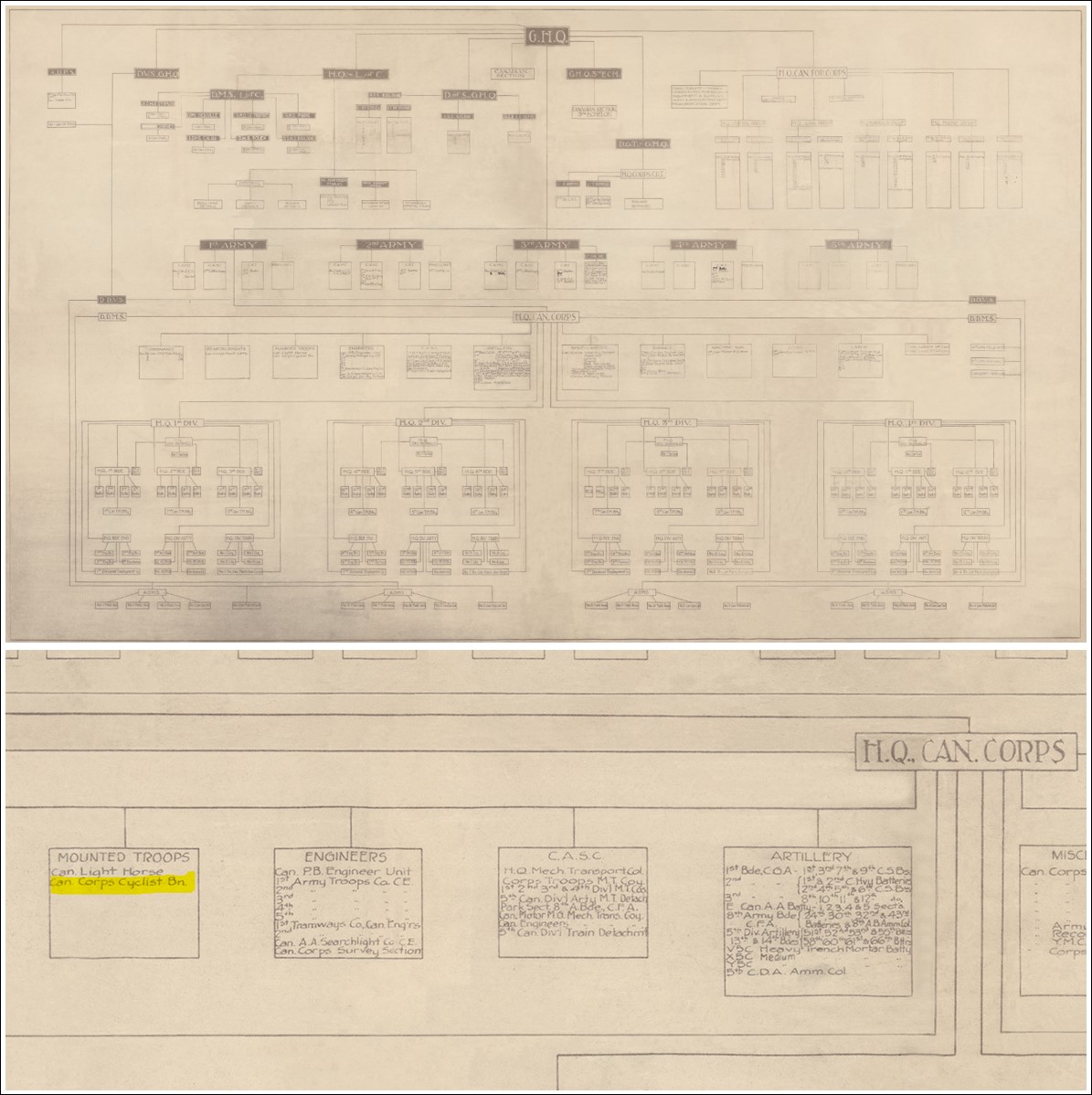
Two screenshots of a chart made for the organization of the Canadian Expeditionary Force (CEF) in 1918. The first chart outlines the hierarchy of the CEF during 1918 via chains of command. The second screenshot is from the same chart but highlights where the Canadian Corps Cyclist Battalion falls within the hierarchy.

Two screenshots of the 1918 Canadian Expeditionary Force organization chart. Full chart is displayed on top and the section which highlights the Canadian Corps Cyclist Battalion below. (Government of Canada website)

Although the cycling units were actively involved in the war, they first needed to be trained. LAC has a variety of videos on YouTube focusing on the Canadian military, including one that features some of the training aspect of the cyclist units titled The Divisional Cyclists : A Glimpse of a Day’s Training (1916).

The video demonstrates the importance of many topics, such as the more mundane aspects of military life (like laundry), while also shedding light on more crucial elements of training, such as drills, signalling and reconnaissance.
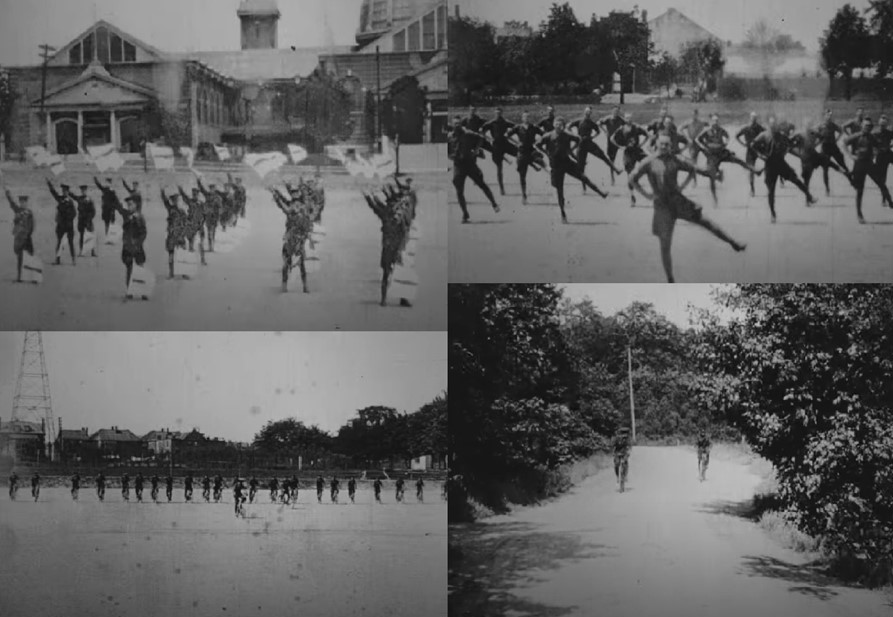
Four scenes from the film The Divisional Cyclists : A Glimpse of a Day's Training (1916). Top left features men in synchronization performing signalling drills with flags. Top right shows soldiers performing light aerobic exercises. Bottom left shows soldiers biking in unitary fashion along one another. Bottom right includes two men biking in a reconnaissance drill in a forest.

Four scenes from the video The Divisional Cyclists : A Glimpse of a Day’s Training (1916) demonstrating signalling, drill and reconnaissance training initiatives. (ISN 285582)

Once the cycling units had completed their training, they could partake directly in the war efforts. Our hardworking biking men-at-arms were no strangers to conflict, and they were part of some of the most notable battles of the First World War such as Ypres and Vimy. The following entry below from a war diary by the 1st Canadian Divisional Cyclist Company covers the horrific aspects of the battle of Ypres and how the division was involved on April 22nd, 1915, near Elverdinghe:

Terrific bombardment started on the front immediately EAST of here about 4:30 P.M. The whole line appeared to be enveloped by cloud of greenish smoke. At 6:30 P.M. requested arrival of many stragglers of the South African troops from the first line trenches all in a state nearing on collapse complaining of a new and deadly gas which had been wafted from the enemy’s trenches by a gentle NORTH-EAST wind, orders were given to D.M.T. to “stand-to.” At 7:15 orders came from DIV. H.Q. to proceed with all possible speed to there, which place was CHATEAU DES TROIS TOURST. Cyclists were ordered to “stand to” on the avenue leading to the ELVERDINGHE – YPRES road. Communication being down with various infantry, and artillery units of Division H.Q. from time to time asked for orderlies from the cyclists to report to different BRIGADE H.Q. as despatch riders. At 10:10 P.M. LIEUT. CHADWICK and No 1 Platoon were sent on a reconnoitering patrol on our immediate front across the canal. Corpl WINGFIELD with his section was despatched as a reconnoitering patrol behind the trench lines on our left.
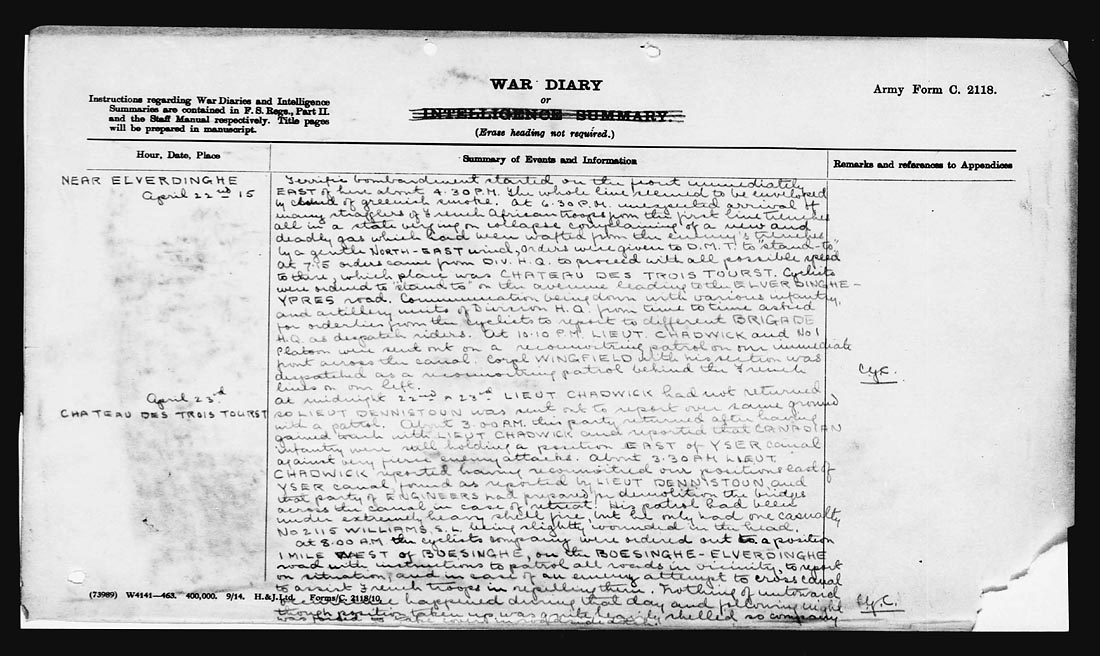
 

Screenshot of the war diary that was shared directly above.

Screenshot of War diaries – 1st Canadian Divisional Cyclist Company / Journal de guerre – 1re Compagnie divisionnaire canadienne de cyclistes. (e001131804, image 53)

The entry highlights the chaos of war and the hardships that many men suffered on that fateful day in April 1915. It also shares some of the more haunting aspects of the First World War, such as the use of gas described as green clouds of smoke. Additionally, it provides insight into some of the main tasks accomplished by the cyclists including communication, acting as despatches and reconnaissance.

The cyclist divisions continued to expand during the war and, as highlighted earlier, an entire battalion was eventually formed called the Canadian Corps Cyclist Battalion. At LAC, there is an entire sub-series devoted to this battalion that shares further information in the Biography/Administrative history section on how it was formed and eventually disbanded. It reads:

The Canadian Corps Cyclist Battalion was organized at Abeele in May 1916 under the command of Major A. McMillan, and was formed by amalgamating the 1st, 2nd, and 3rd Canadian Divisional Cyclist Companies. The battalion was demobilized at Toronto in April 1919 and was disbanded by General Order 208 of 15 November 1920. In Canada Cyclist Companies advertised for recruits “possessing more than average intelligence and a high standard of education.” (MIKAN 182377)

By viewing the lower-level descriptions from this sub-series, one can see records that pertain to the battalion. The sub-series includes a variety of topics such as a training syllabus of the reserve cyclist company and statements by Canadian prisoners of war (among others).
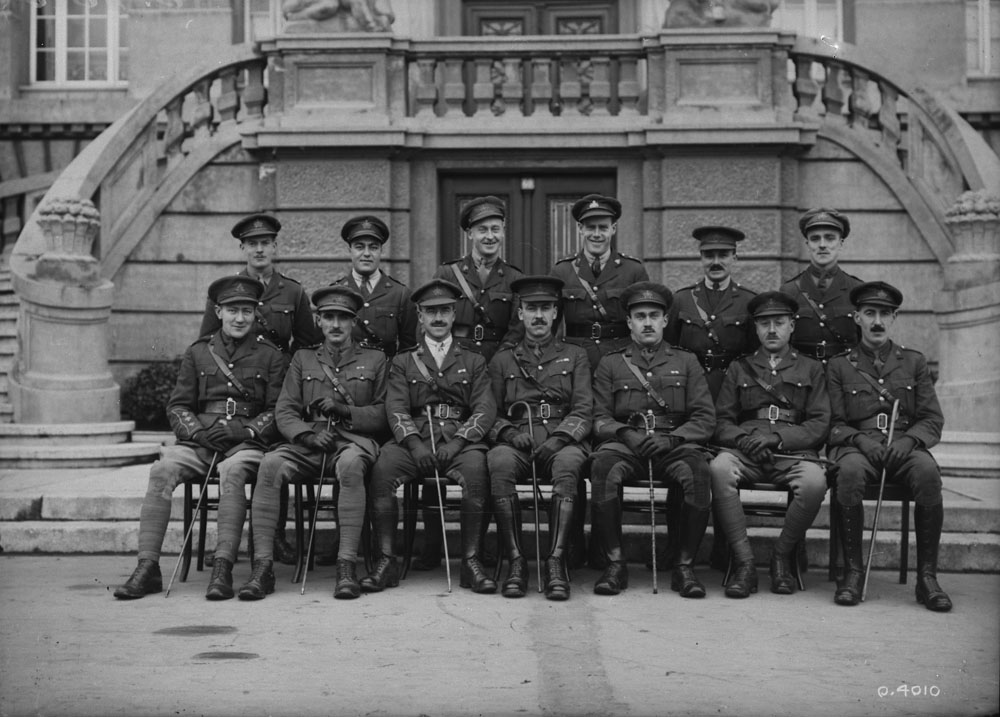
A black and white photograph of thirteen officers in uniform who served the Canadian Corps Cyclist Battalion taken in January 1919. Seven men sit on chairs in front of six men standing behind them.

Photograph of officers in the Canadian Corps Cyclist Battalion from January 1919. (PA-003928)

The Canadian cyclist units were no slouches, and they had a definitive impact on the war effort by facilitating reconnaissance, communication, signalling and direct combat. It is impressive to think that these men, who used very archaic forms of bicycles were able to tread the perilous terrain of Europe during the First World War to accomplish their duties while I, using a much better modern bike, complain about having to bike up a small hill on my way to work. It shows how much determination and bravery the men within the cyclist units of the Canadian military exerted during the First World War.

Additional Sources


Dylan Roy is a reference archivist in the Access and Services Branch at Library and Archives Canada.
Vimy Memorial visit: fact or fiction (now a trilogy)

Version française

By Rebecca Murray

In 2022, I wrote about researching my great-grandfather’s attendance at the 1936 unveiling of the Vimy Memorial. A year later, I shared another instalment, and now, I’m back with what feels like the conclusion to this journey through my family history.

We left off with the exciting discovery that Thomas C. Phillips had indeed been at or very near the Vimy Memorial in July 1936. However, we were still missing a key piece of the puzzle—how exactly did he get there and back home again?

Given the era, it’s likely that Thomas travelled by passenger ship. Family documents tell us that he sailed to France on the SS Alaunia and I confirmed online that this ship left Montréal on July 20, 1936—a tight, but feasible window for him to make it to the unveiling on July 26. So, this is where we pick it back up!

I turned my attention to passenger lists and related records, hoping to trace Thomas’s journey. My first stop—because I have learned that a problem shared is a problem halved AND I know how smart my colleagues are—was the Genealogy Desk! I spoke with one of my colleagues (you can do this too!), who advised me that post-1935 passenger lists are under the custody of Immigration, Refugees and Citizenship Canada and are accessible through Access to Information requests. Pre-1935 records, however, are organized into various datasets that are searchable on the Library and Archives Canada (LAC) website using a variety of keywords such as “passenger,” “immigration,” and “border.”

I hummed and hawed over this—those of you who love research will understand that handing over the reins to someone else wasn’t my first choice. Not wanting to rely entirely on others, I approached the research from a new angle. Which angle you ask? Well, I went all the way to the other side of the ocean! Instead of looking for arrival records, I decided to look for departures (or, Thomas’s return trip)! This led me to the National Archives of the United Kingdom and their digitized records on Findmypast, where I discovered not one, but two passengers named Thomas Phillips who sailed to Montréal in the summer of 1936. Another big thank you to my colleagues at the Genealogy Desk, whose expertise proved invaluable in this stage of the research.

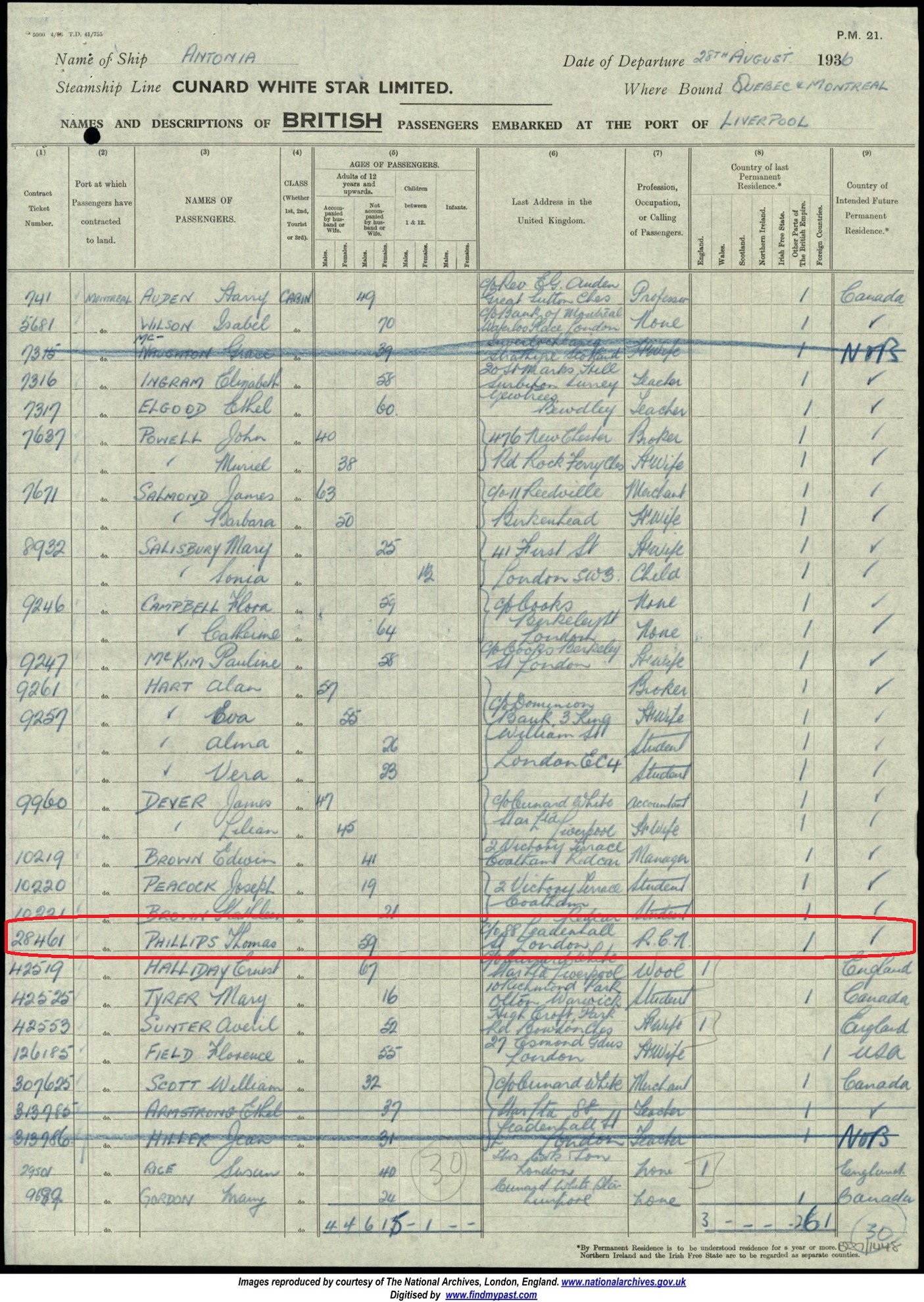
I reviewed the search results knowing that I should look for a departure date in the late summer and use Thomas’s birth year (1877) as an additional filter. I quickly found the relevant record: a passenger list for the SS Antonia, a Cunard ship built in the 1920s. Spotting Thomas’s name felt like one of those moments in the Reference Room where you want to fist pump and high-five someone—except, when you’re working remotely, all you get is a side-eye from the dog for interrupting his nap.

The form tells us a lot about the voyage and about Thomas. The SS Antonia departed Liverpool on August 28, 1936, bound for Quebec City and Montréal, Quebec. While most of the passenger data is standard, I found it neat to see column 8 or “Country of Last Permanent Residence,” which offers a breakdown of regions across the United Kingdom as well as options for “Other Parts of the British Empire” and “Foreign Countries.” Unsurprisingly, most of the passengers heading to Quebec on this voyage are listed as from “Other Parts of the British Empire”—perhaps other Canadian pilgrims who, like Thomas, had been in France the previous month for the unveiling of the Vimy Memorial.

Page from the passenger list of the SS Antonia, featuring the name of Thomas Phillips circled in red.

Passenger list for Cunard White Star Line’s SS Antonia with a departure date of August 28, 1936, from Liverpool, England. Information about Thomas Phillips is circled in red. Source: National Archives of the United Kingdom.

We also learn that Thomas’s last address in the United Kingdom was “c/o 88 Leadenhall St, London.” Naturally, my curiosity led me to investigate what was located at 88 Leadenhall Street in 1936. A quick Internet search revealed it was Cunard House, an eight-story building that housed the business offices of Cunard Line and its affiliated companies. Further digging suggested that it wasn’t uncommon for travellers by sea to use a “care of” (c/o) address, likely for ease of correspondence during their journey.

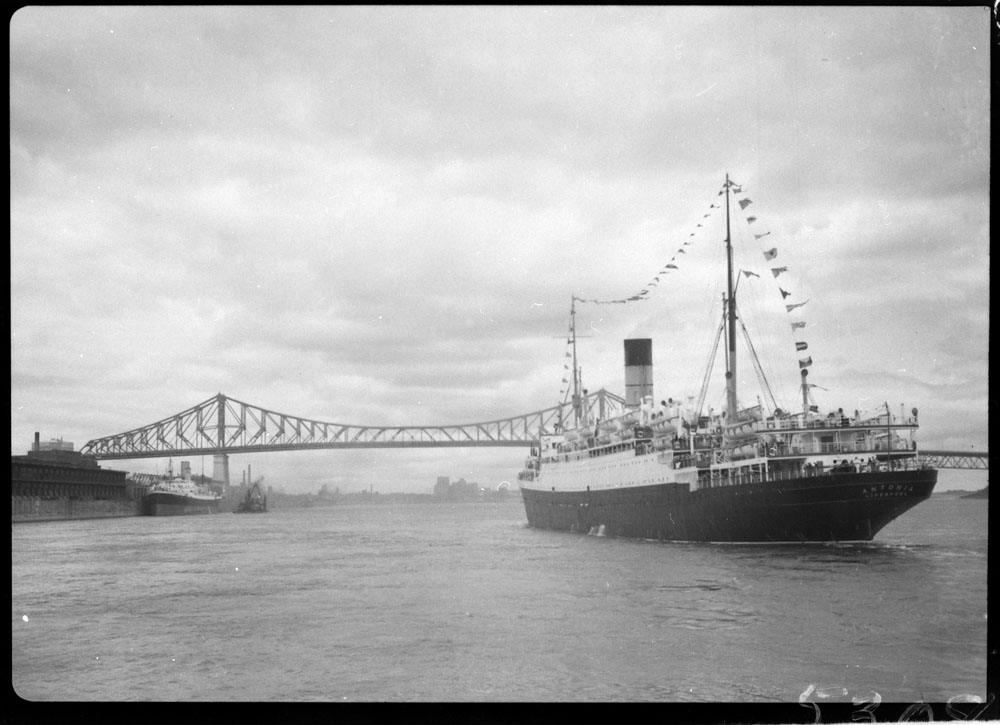
With this new information in hand, I turned to LAC’s archives to explore what else I could find about the SS Antonia and Thomas’s voyage. Archival holdings at LAC provide a rich narrative of the SS Antonia—from her early days as a passenger liner to her later role as a troop transporter during the Second World War. But of most interest to this researcher are the records related to the Vimy Pilgrimage! LAC even holds footage of the SS Antonia, as well as this beautiful photograph of her Europe-bound voyage earlier that summer.

A black-and-white photograph showing the SS Antonia, a two-toned passenger ship, moving across the water. In the background, the Jacques-Cartier Bridge and several docked ships can be seen.

Members of the Vimy Pilgrimage aboard the SS Antonia, departing from Montréal, Quebec, 1936. Source: Clifford M. Johnston/Library and Archives Canada/PA-056952.

I even scoured Montréal newspapers from early September to see if Thomas’s return was noted in the shipping news. While the Antonia’s arrival was documented, my great-grandfather didn’t make the papers. And so, this brings me to the conclusion of my research—sometimes the hardest part of archival work is knowing when you’re done.

I’ve delved into the original question of why my great-grandfather attended the unveiling of the Vimy Memorial, and along the way, uncovered answers to how he made the journey there and back. The research brought both exciting discoveries and inevitable disappointments—common in any archival exploration. Along with new insights, I’ve gained valuable research skills, which is always a welcome bonus. And far from feeling discouraged, I’m more eager than ever to tackle the next family history mystery. Bring it on!


Rebecca Murray is a Literary Programs Advisor in the Outreach and Engagement Branch at Library and Archives Canada.

Jellied Vegetable Salad: Less is More!

Version française

Cooking with Library and Archives Canada banner

By Rebecca Murray

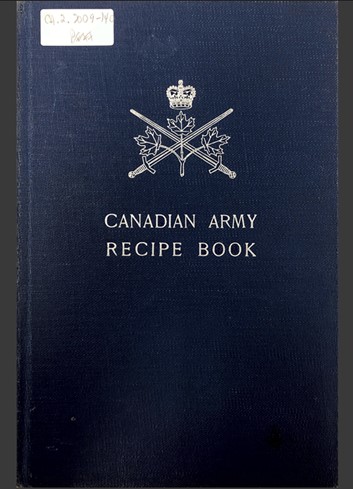
When I opened the Canadian Army Recipe Book, I didn’t just look for sweets—my eyes also landed on a variety of savoury recipes for breads, meat pies, and salads. Enter the Jellied Vegetable Salad!

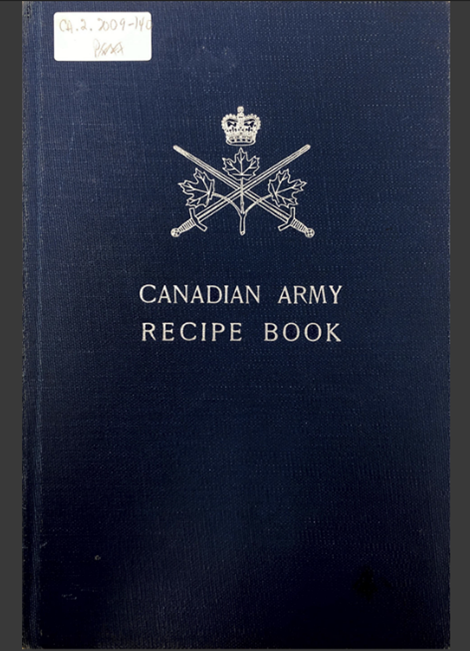
Blue, slightly worn book cover featuring the title “Canadian Army Recipe Book” in capital letters. Above the title is the Canadian Army badge topped by a St. Edward’s Crown. The badge displays three maple leaves on one stem and a pair of crossed swords, all in silvery grey.

Cover of the Canadian Army Recipe Book, published by the Department of National Defence,1961 (OCLC 299227447).

You might recognize jellied or layered salads from TV programs like That ‘70s Show or How I Met Your Mother. Or maybe you’ve had the “pleasure” of experiencing them firsthand at home. When I was invited to a family barbeque this past summer, I decided it was the perfect occasion to prepare this Jellied Vegetable Salad. But first, I had to assemble the ingredients and get cooking! Yes, you read that right—this salad involves actual cooking, which isn’t always fun in the summer heat, but it’s essential for pulling off this recipe!

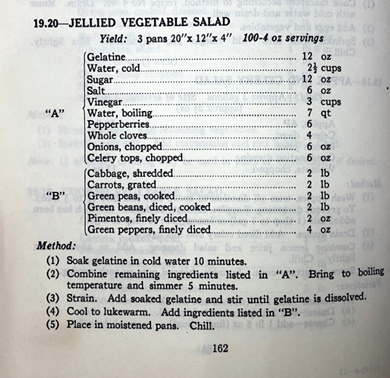
Page of text featuring a recipe for jellied vegetable salad.

Recipe for Jellied Vegetable Salad from the Canadian Army Recipe Book (OCLC 299227447).

Because the original recipe was meant to feed a crowd, I had to adjust the quantities—time to do some math! This time, I took my own advice and measured MANY times before cooking.

Ingredient Original quantity (full) Adjusted quantity (quarter)
Gelatin 12 oz. 3 oz. (90 ml)
Water, cold 2.5 cups 0.625 cups (150 ml)
Sugar 12 oz. 3 oz. (90 ml)
Salt 6 oz. 1.5 oz. (45 ml)
Vinegar 3 cups 3/4 cups (180 ml)
Water, boiling 7 qt. 1.75 qt. or 7 cups (1.75 L)
Pepperberries 6 1.5
Whole cloves 4 1
Onions, chopped 6 oz. 1.5 oz. (45 ml)
Celery tops, chopped 6 oz. 1.5 oz. (45 ml)
Cabbage, shredded 2 lb. 1/2 lb. (250 g)
Carrots, grated 2 lb. 1/2 lb. (250 g)
Green peas, cooked 2 lb. 1/2 lb. (250 g)
Green beans, diced, cooked 2 lb. 1/2 lb. (250 g)
Pimentos, finely diced 2 oz. 1/2 oz. (15 ml)
Green peppers, finely diced 4 oz. 1 oz. (30 ml)
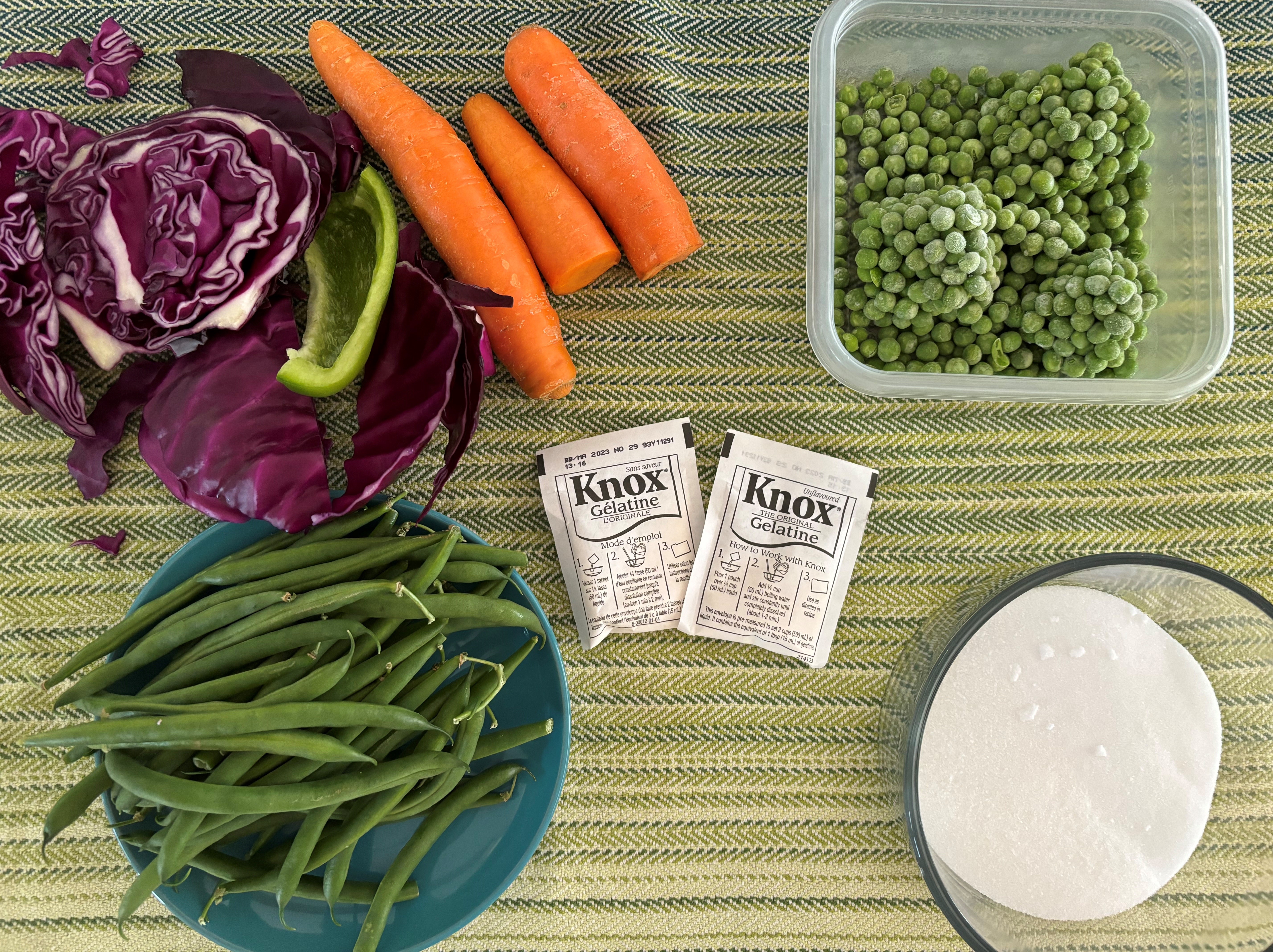
Fresh and dry ingredients presented on a green tea towel.

Ingredient prep, from left to right: green beans, cabbage, green pepper, carrots, gelatin packets, frozen peas, and the dry ingredients (sugar and salt). Photograph: Rebecca Murray.

Next up: ingredients! Once I’d figured out the quantities, I had to source the ingredients. Most were already in my pantry or easily purchasable. The one exception? Pepperberries, an Australian spice with fruity, spicy notes (not to be confused with peppercorns). Unable to find pepperberries and opting out of pimentos, I was pleasantly surprised the dish didn’t suffer for it. A last-minute save came from a VERY helpful neighbour who provided whole cloves. I also swapped green cabbage for purple, adding a vibrant twist that made the final dish not only delicious but a visual standout!

The structure of this recipe really resonated with me (and perhaps other archivists or cooks!). Grouping the ingredients into “A” and “B” made it easier to organize my prep work and keep everything separate as I worked. I was hesitant to alter the method, despite adjusting the quantities, but I did soak the gelatin for longer than the recommended 10 minutes and simmered the other “A” ingredients for five minutes while keeping a close eye (this smelled really good!).

One thing I would have appreciated is a time estimate for the cooling process in step 4. I left the mixture on the counter for about 45 minutes before moving on to the next step, which was honestly a bit intimidating, but also fun!

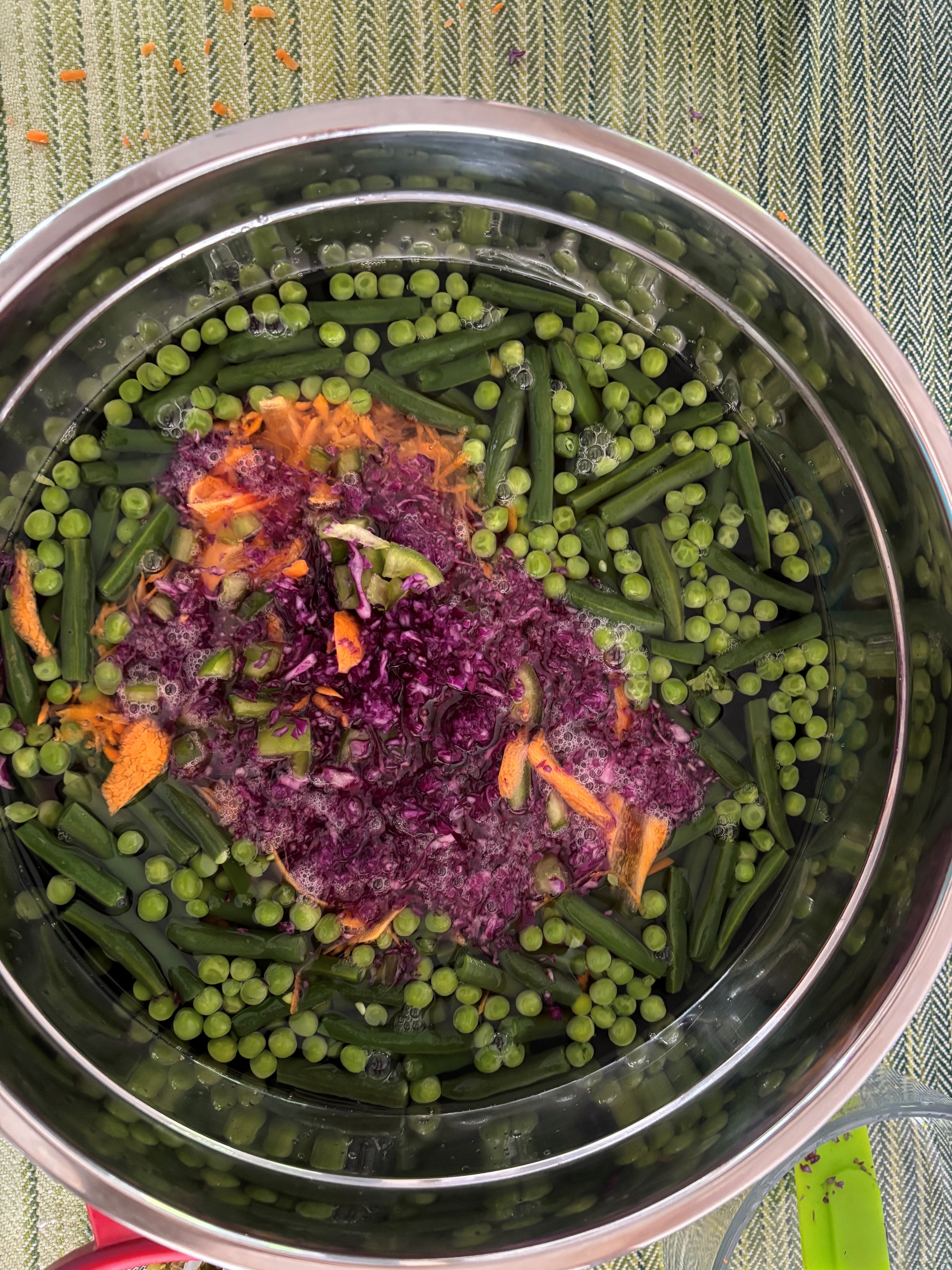
Here’s an in-progress look at the vegetables after I’d strained the broth (or “A” minus the gelatin and water) into “B.” I’m used to straining things over the sink, not into another bowl, so it was a near calamity when I headed to the sink, but I redirected myself to the counter in time for the first of two potentially perilous transfers!

An overview shot of a bowl filled with colourful vegetables in liquid.

A shot of the second part of step 4. Photograph: Rebecca Murray.

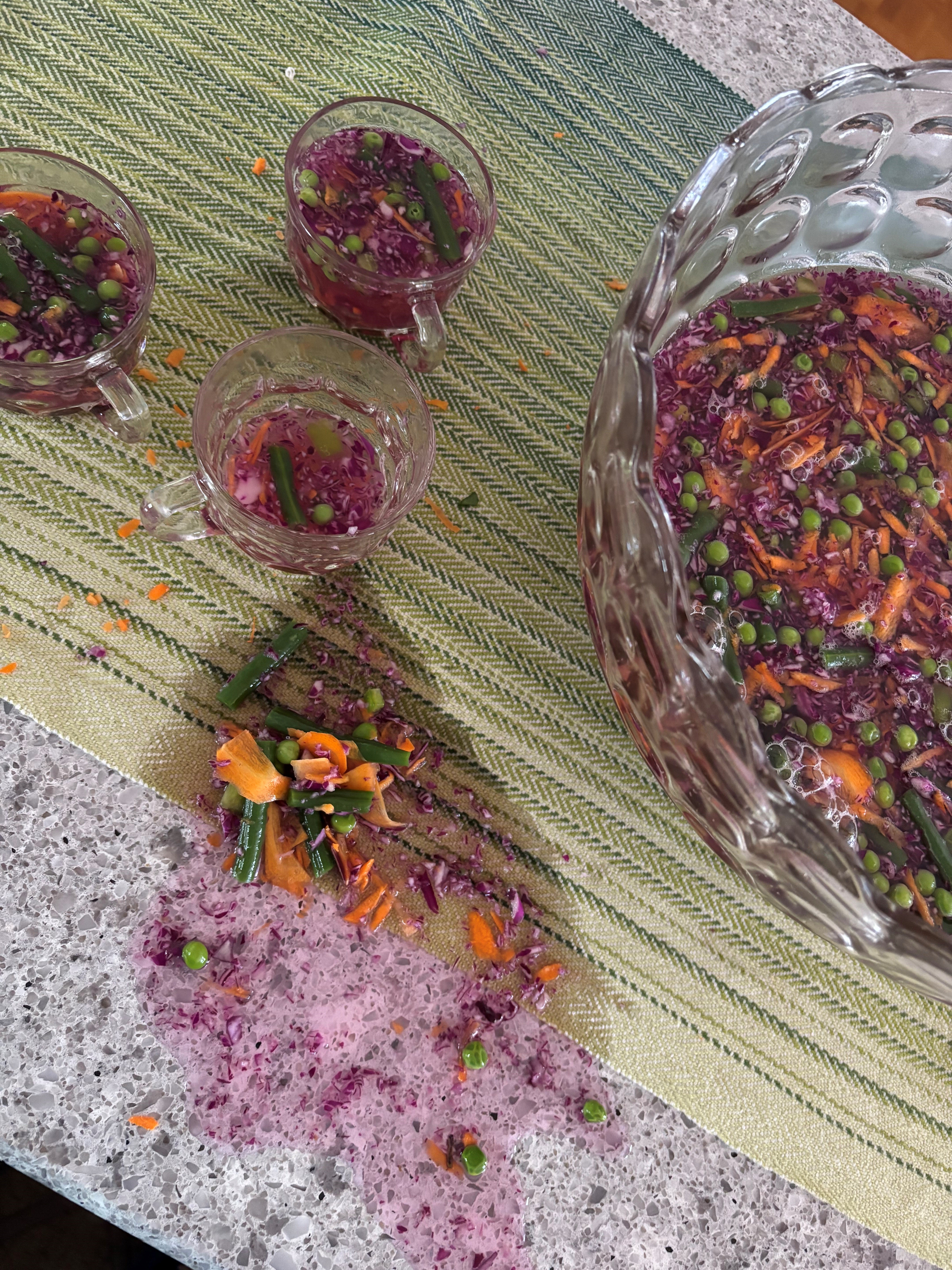
There was only one real “oopsie,” as pictured below. Surprisingly, it wasn’t during the risky transfer of hot broth (or “A” ingredients) into the awaiting “B” ingredients, but rather a clumsy attempt to rearrange the portions for a photo that caused a spill.

Three cups of purple jellied salad set against a green backdrop next to a larger bowl of the same dish. A small portion of the liquid and filling has spilled onto the green backdrop and grey counter.

Let’s not cry over spilled jellied salad—it almost looks like abstract art! Photograph: Rebecca Murray.

Overall, the feedback was positive, but my main takeaway is that less is more with this dish! It’s a relatively easy, make-ahead option and a perfect addition to any family gathering year-round.

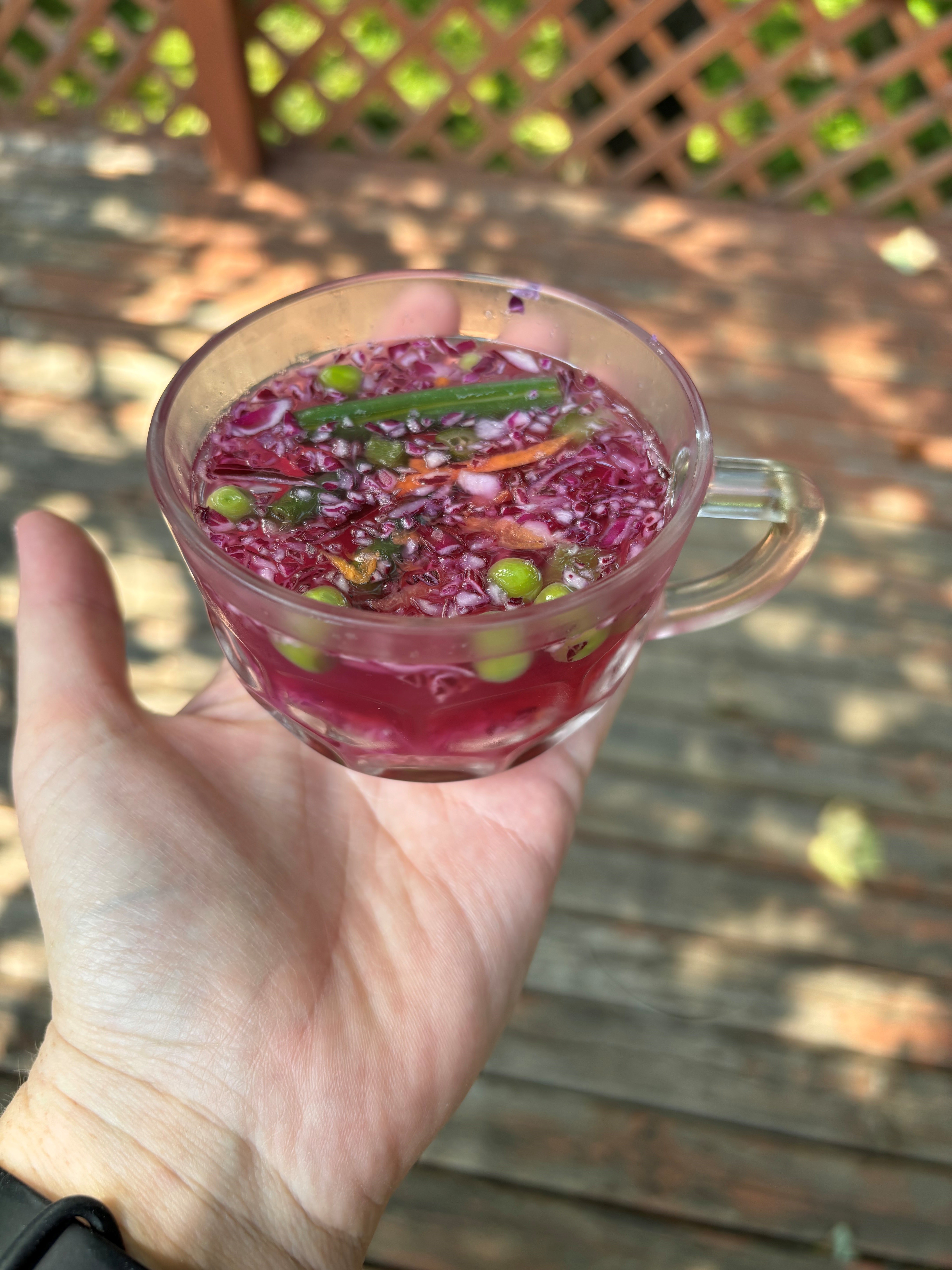
A hand holding a small glass cup filled with jellied salad.

A perfect serving of the jellied salad! Photograph: Rebecca Murray.

Bon appétit!

If you try this recipe, please share pictures of your results with us using the hashtag #CookingWithLAC and tagging our social media: FacebookInstagramX (Twitter)YouTubeFlickr and LinkedIn.

For more recipes in this series, go to #CookingWithLAC.


Rebecca Murray is a Literary Programs Advisor in the Outreach and Engagement Branch at Library and Archives Canada.
My Dear Friend: Letters from Normandy to our Canadian Soldiers

Version française

By Ariane Gauthier

As part of my work as a reference archivist at Library and Archives Canada (LAC), I often find myself delving into the many documents in the Second World War collection. Many people around the world are interested in the history of Canadians in this conflict and, more specifically, in the experiences of our soldiers. What I find even more fascinating is how the quest begins for the researchers I am lucky enough to work with. The starting point is often a personal story, passed down in a family or a small community: “I found out that my mother served in the Royal Canadian Air Force” or “I heard that my village hid a Canadian spy during the Second World War.” This is enough to fuel the fire of researchers, who then dig to find evidence or fill in these stories with new details.

My colleagues and I participate in this quest on an ad hoc basis, mainly to facilitate access to documents from LAC’s vast collection. When circumstances allow, we delve into the information in these documents in search of relevant details that can help researchers piece together the story they seek to understand.

That is how I found three letters from Normandy addressed to our Canadian soldiers. Unfortunately, the context of the letters, including the identity of the recipient, remains a mystery. I found these letters in a file from Royal Canadian Air Force headquarters (Reference: R112, RG24-G-3-1-a, BAN number: 2017-00032-9, Box number: 30, File number: 181.009 (D0624)). This file documents the experiences of Canadian soldiers who were captured and interned in prison camps during the Second World War. It also contains transcripts of interviews about the soldiers’ experiences.

In this case, the three letters are not linked to specific interviews and are included in this file as loose sheets. There is no correspondence explaining why they were placed in this file. Nor is it known whether these were letters addressed to soldiers who had been taken prisoner during the war. The information in these letters is truly the only information we have. In reality, though it may not seem like much, these three letters tell us a great deal about the experience of soldiers in Normandy and of the French, especially the risks faced by those who resisted the Germans.

Here are the letters in question:

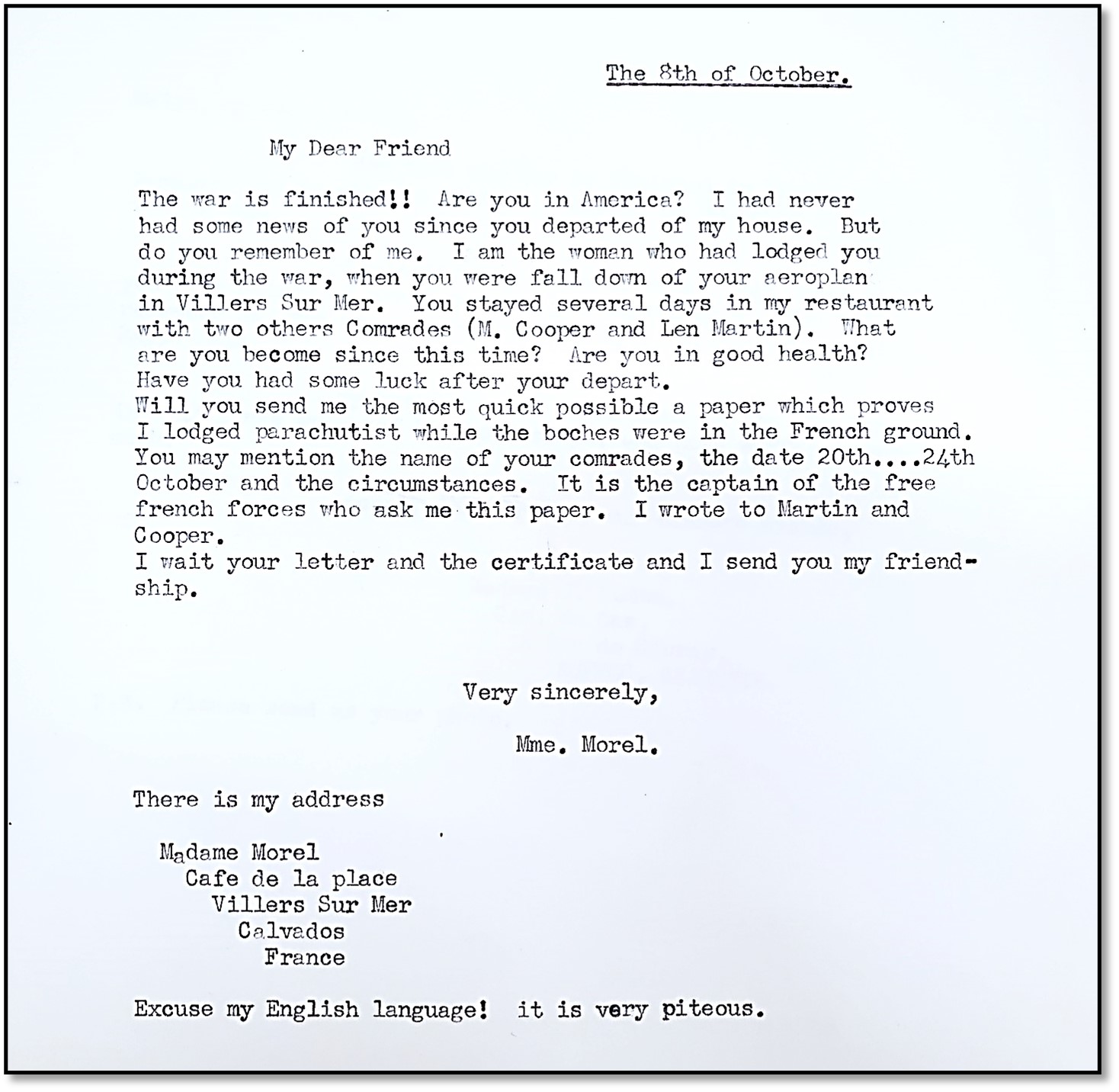
Letter to a Canadian soldier from Mrs. Morel, written on October 8. The year is not indicated on the letter. We only know that it was written and sent once the war was over.

Letter to a Canadian soldier from Mrs. Morel, dated October 8 (MIKAN 5034948)

In this first letter, we discover part of the story of Mrs. Morel, who apparently sheltered one of our soldiers after he jumped from a plane near Villers-sur-Mer. We learn that this soldier was a paratrooper and that he had taken refuge in Mrs. Morel’s restaurant with two of his fellow soldiers, M. Cooper and Len Martin, while the village was still under German occupation.

Letter written by Mrs. J. Cottu, expressing her desire to receive news of the soldier she sheltered in November 1943.

Letter to a Canadian soldier from Mrs. J. Cottu (MIKAN 5034948)

This second letter gives us a glimpse into the story of Mrs. J. Cottu and could possibly be related to that of the paratrooper mentioned in Mrs. Morel’s letter. Without more specific information, it is difficult to confirm this hypothesis, but the second letter refers to a Sergeant Martin (possibly Len Martin?) and places his departure in November. Mrs. Morel stated that she had taken in the soldier at the end of October, without specifying the year, so everything could fit together chronologically.

Mrs. J. Cottu mentions having housed three soldiers in her house in Ruffec in November 1943: the recipient of the letter, Sergeant Martin and Captain Ralph Palm. Although this story seems to have gone well, she said that she was arrested by the Gestapo in 1944 because of her husband’s activities. The seriousness of the situation is clear from this confession: “I was arrested by the Gestapo, and have suffered very much.”

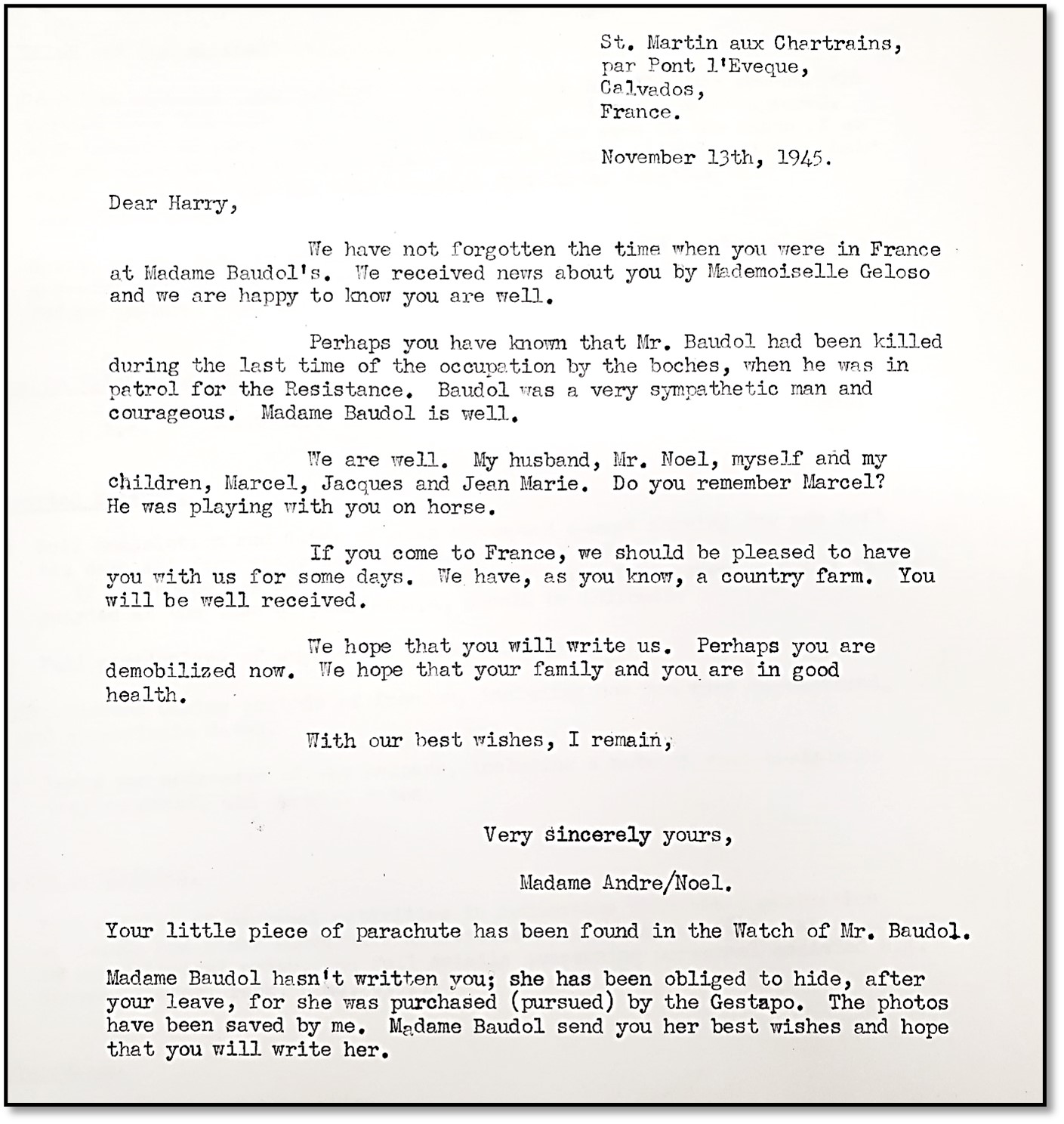
Letter written by Mrs. Noel to check on Harry and give him news about the French people he met during his stay in Saint-Martin-aux-Chartrains.

Letter to Harry from Mrs. Andre Noel, dated November 13, 1945. (MIKAN 5034948)

In this third letter, Mrs. Noel clearly illustrates the dangers that members of the Resistance faced. She bears the burden of announcing the death of Mr. Baudol, a member of the Resistance, who was killed while on patrol. She also shows us the strong bonds that Harry seems to have formed with the residents of Saint-Martin-aux-Chartrains. Although this letter expresses suffering, grief and fear, it also highlights the bravery and sacrifice of three families who came to the aid of a Canadian soldier.


Ariane Gauthier is a reference archivist with the Access and Services Branch at Library and Archives Canada.
Guide to DIY personal military displays

Version française

By Sacha Mathew

Did you know that you can easily make your own military heritage display by using the tools and digitized records found on the Library and Archives Canada website? Using the display we presented at a recent event as an example, I’ll show you step-by-step how you can make your very own display at home or at school.

Library and Archives Canada held a hugely successful Open House event in May, welcoming more than 3000 visitors to our Gatineau facilities and allowing them to enjoy an opportunity to view treasures in our vaults.

This small display of photographs and textual documents from our military collection was very popular. It had a personal touch, and many visitors asked us how we selected the records to display.

Overhead view of glass display case containing military photos and textual documents.

Military display used during LAC Open House event. Image courtesy of Alex Comber, archivist.

Your display can easily be tailored to present a person, an anniversary or a specific military unit. In our case, we wanted to highlight the 100th anniversary of the Royal Canadian Air Force (RCAF) taking place this year. That was our starting point.

Next, we needed to narrow our focus to make it easier to tell a story. Records give facts, but they don’t tell a story — that’s where interpreting the records comes in. Since the event was in Gatineau, we thought the public would be interested in exploring the personal stories of servicemen from the local area. We started by choosing the 425 “Alouette” Squadron, an RCAF unit. This is a French-Canadian bomber squadron established at the outbreak of the Second World War. By researching the 425 Squadron personnel roster and cross-referencing it with a list of RCAF casualties provided by the RCAF Association, we were able to find two local airmen: one from Montreal and the other from Ottawa.

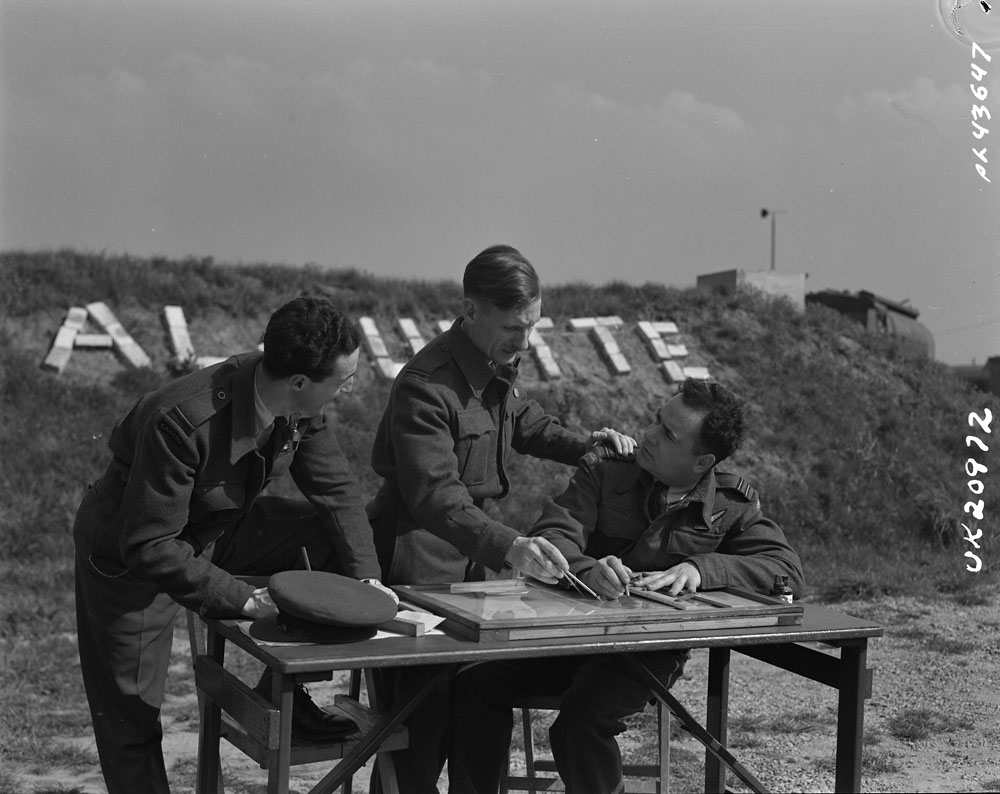
By an English airstrip, three Air Force officers planning while looking over a table with maps.

Pilot Officer J.W.L. Tessier; Pilot Officer J.A. Longmuir, DFC (Distinguished Flying Cross) of the Royal Air Force, attached to the Alouette squadron as Bomber Section Training Officer; and Flight Lieutenant Claude Bourassa, DFC, Commander of the French-Canadian squadron’s bomber section. 425 Squadron. 24 April 1945, PL-43647, e011160173.

For our display, we looked for specific individuals to feature in our display, which can also be done for local service members from your community or school. Choosing an individual is even easier if you are making a display for a family member, since you may already have someone in mind.

Once you’ve chosen an individual, you may look for their military personnel file. This file provides a tremendous amount of information and includes personal details (ever wonder what your great-grandfather’s address was in 1914?). The file can be easily found on the LAC website. However, it should be noted that not all records are open to the public and available online. All personnel files for the First World War are open and have been digitized (First World War Personnel Records), but only “War Dead” files are available online for the Second World War. “War Dead” refers to members that died during the war (Second World War Service Files – War Dead). Other Second World War and post-Second World War service files can still be obtained, but they must be requested through an Access to Information and Privacy request (Records you may request).

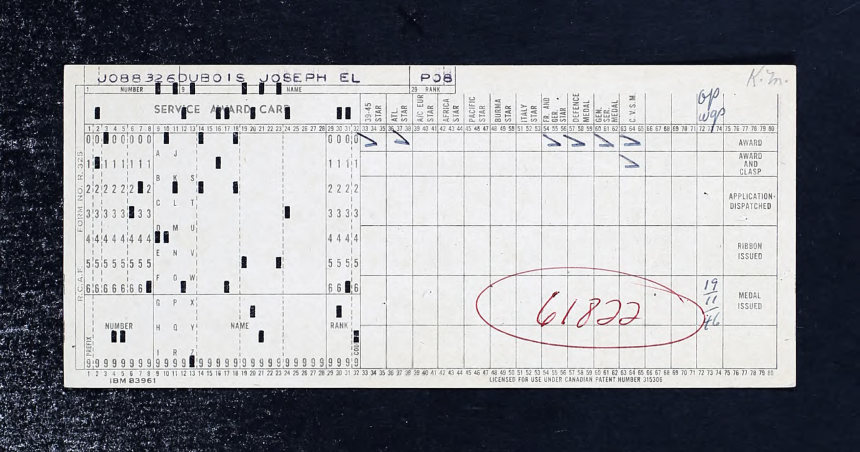
Now that you have the service file, you can decide what you want to display. For our display, we were limited by the size of the display case. If you have more space, you can pick as many documents as you like. You’ll find a variety of documents in the service file. For our airman, Pilot Officer (PO) J. Dubois, we selected a few documents that we found interesting: a letter of recommendation from his employer (T. Eaton & Co), his attestation papers, his medal card, his pay book, official correspondence with his parents in French and the report on his death. You can scroll through and read the digitized service file, then choose what you’d like to feature. Please remember to cite your sources, including reference numbers for archival documents.

As mentioned, interpreting the records you find can help you tell a story rather than just display your research. In the case of PO Dubois, we looked to his squadron records from the day he died, and we were able to better understand the circumstances of his final flight. Each of the three services has an official unit journal of their daily actions. They are called “War Diaries” for the Army, “Ship’s Logs” for the Navy and “Operations Record Books” for the RCAF. The personnel file gives you biographical information, and the unit journal gives you the context. The journal allows you to understand how the individual fits into the unit’s operations. You would interpret the documents by examining them together, giving you a much broader picture. That picture is the story, which you could write up or present orally.

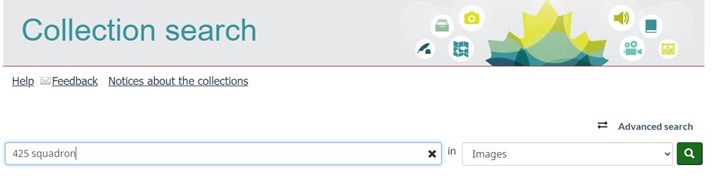
The only thing remaining is to add some photos to make the display more visually compelling. You may find the member’s photo in the service file, but this is not common for files from the World Wars. To find photos, I suggest setting Collection Search to “Images”. Here you can search by the unit designation and choose a few photos that are appropriate to the time frame that you are looking at. For our display, we easily found a few photos of 425 Squadron in England during the 1940s. Like the textual documents, it is important to give accurate photo credits for any photographs used in your display.

A screen capture from the LAC website showing the search bar set to “Images”.

Collection Search, LAC website.

By using the tools and resources from LAC’s online collection, you can make your own custom display for an individual or for a unit. It’s your choice how you’d like to present your display: you can print copies of documents and photos to make a framed display or scrapbook, or you can make a digital presentation. Making a display is an excellent way to connect with ancestors by learning about their lives, and it allows people to explore Canadian military heritage in a personal way. It is also an excellent research exercise and would prove a wonderful Remembrance Day project for young students.


Sacha Mathew is an archivist in the Government Archives Division at Library and Archives Canada.

First on the Lakes: HMCS Griffon

Version française

By Dylan Roy

Sometimes you come across a record that doesn’t necessarily make sense at first glance. This was my experience when I first looked at the archival description of the series HMCS Griffon. HMCS stands for “His/Her Majesty’s Canadian Ship” (you can find this and other military abbreviations used in service files on Library and Archives Canada’s website—this page is a wonderful tool for those not familiar with military abbreviations). Therefore, it shouldn’t be a surprise that I assumed these files were about a ship.

But lo and behold, me mateys, upon consulting the files I discovered that the “ship” turned out to be a facility in Port Arthur (now Thunder Bay).

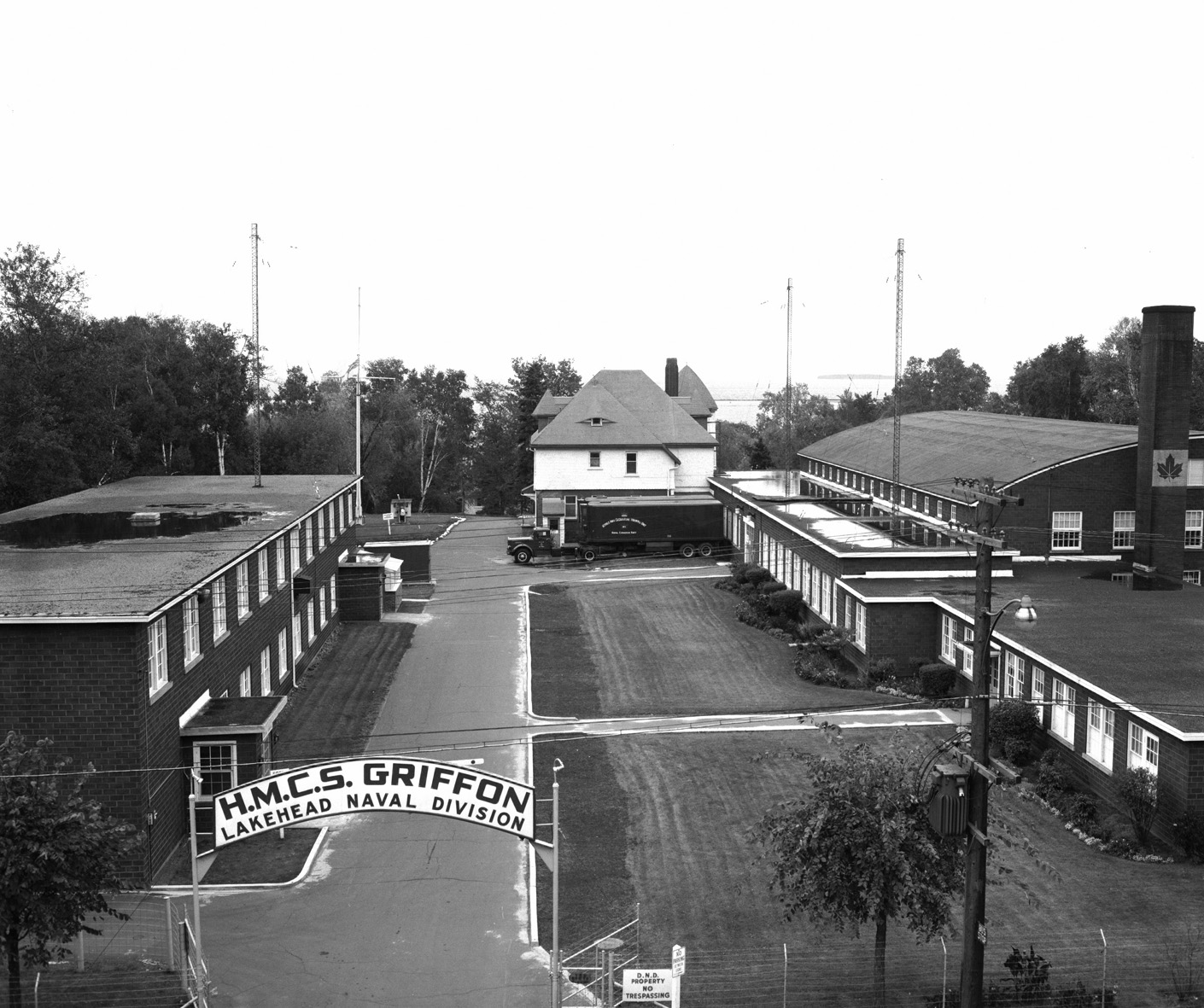
Black-and-white photograph of two long buildings facing each other, separated by a street. At the far end of the street, a truck is passing in front of a house-like building.

Photo of HMCS Griffon. Source: Government of Canada, National Security and Defence, Ships’ Histories: HMCS Griffon. Credit: Courtesy of The Royal Canadian Navy.

As the series relates, “[a] vacant garage was leased by naval reservists at the beginning of the Second World War, and, with the establishment of a policy of commissioning all ‘stone frigates,’ the garage became HMCS Griffon in 1941.” This led me down a rabbit hole of secondary sources to learn about stone frigates.

A stone frigate, to put it simply, is a naval vessel established on land. The British first employed this informal term: to bypass legal obligations that prevented them from ruling “over land,” they decided to commission the island Diamond Rock as a ship during one of their many wars with the French. This is a good way of understanding HMCS Griffon and its seemingly confusing title.

Badge in the form of a ring with a crown on top, the word GRIFFON at the base of the crown, and a griffin (mythical creature) inside the ring facing left.

The official badge of HMCS Griffon. Source: Government of Canada, National Security and Defence, List of Extant Commissioned Ships: HMCS Griffon. Credit: Courtesy of Department of National Defence.

From the Ships’ Histories on the Canadian government’s National Security and Defence web page, I learned that HMCS Griffon’s creation was based on several factors, most notably its relationship with the Sea Cadet program and the influence of the shipping industry in the Great Lakes region. HMCS Griffon was commissioned in 1940 and moved to its current location in Thunder Bay in 1944. During the Second World War, HMCS Griffon guided newly recruited sailors eastward as they made their way out of the prairies, thus indicating the importance of the facility’s geographic location in Canada.

Once I read up on these facts, I could better contextualize the records we have in our archival collection at Library and Archives Canada—this just goes to show how secondary source work can help researchers gain a better understanding of archival records (primary sources).

As mentioned, the first record I stumbled upon concerning HMCS Griffon was its series-level archival description. Reading through the series, I learned that it only contained five file-level descriptions as well as a linked accession.

Save for the accession, all the files were open, so I decided to peruse their contents. As luck would have it, all the files are found in the same archival box, Volume 11469 (an archival box is equivalent to an archival volume).

With the volume ordered, I was able to delve into the archival treasures found therein, which I shall share below.

The first file, HMCS GRIFFON: Ceremonies and functions, Official opening of HMCS GRIFFON, is a good file to start with as it shares some interesting discussions on the opening of the facility in 1944 and on its namesake. HMCS Griffon was named after a ship dubbed Le Griffon, which was constructed by storied French explorer René-Robert Cavelier, Sieur de La Salle.

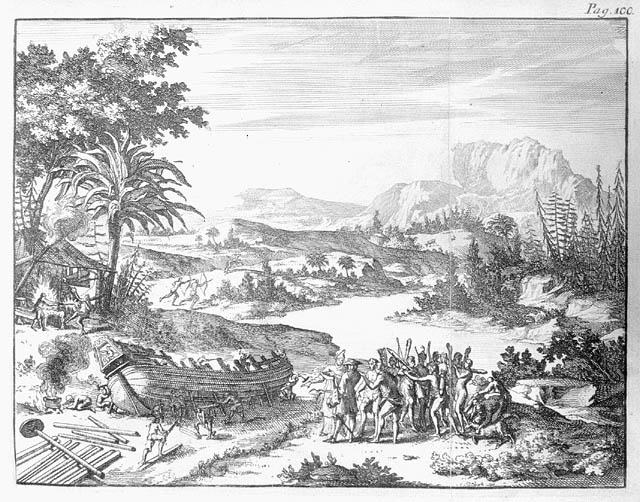
Print of people building a ship near a body of water surrounded by trees, with a mountain in the background.

The building of La Salle’s Le Griffon (c001225).

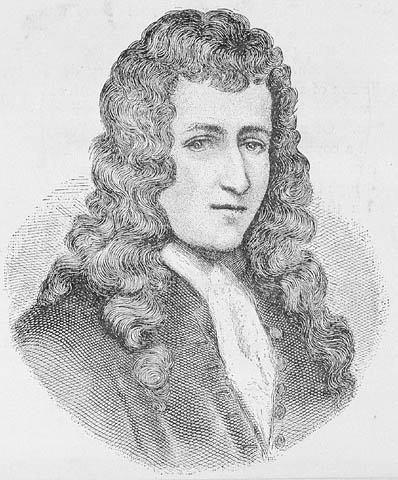
Black-and-white drawing of a man with long curly hair falling to his shoulders.

René-Robert Cavelier, Sieur de La Salle (c007802).

Le Griffon set sail in 1679 to take part in the burgeoning fur trade. Notably, it was the first full-sized sailing ship on the upper Great Lakes—this is the source of HMCS Griffon’s motto PRIMA IN LACUBUS (First on the Lakes). On its maiden voyage, Le Griffon set sail from an island near Green Bay, Wisconsin, and the ship was never seen again. This mystery intrigued many, including the commanding officer of HMCS Griffon, H.S.C. Wilson.

Wilson had received a bolt from a wreck, supposedly Le Griffon, that had been discovered in 1931 in the Mississagi Strait, near Manitoulin Island. Contrarily, a story surfaced about an Indigenous oral story of the real wreck of Le Griffon being close to Birch Island, near “Lescheneaux” or “Les Cheneaux.” C.H.J. Snider, of the Toronto Evening Telegram, returned a telegram to Wilson refuting the assertions of the latter wreck. This exchange shows the interest that some HMCS Griffon servicemen and women had in the history of their namesake. The location of the wreckage of Le Griffon remains a mystery to this day.

This exchange of telegrams was just part of the file. There were other notable entries, such as the invitation lists for the inauguration of HMCS Griffon and the various preparations made for the event.

Another fascinating file found in the series is HMCS GRIFFON: Reports of proceedings. Reports of proceedings are truly remarkable files as they demonstrate the day-to-day activities within a military establishment via various departments. For example, I was able to determine from the Sports Department that the popular sports at HMCS Griffon included basketball, volleyball and badminton. From a report in May 1955, I learned that baseball was less popular, as “[a]ttempts have been made to organize baseball games but insufficient interest was shown.”

Moreover, we can see the impact that marriage had on some servicewomen in a quote from a report posted by the Medical Department dated February 1955: “Wren Kingsley of the Medical Branch has been discharged following her recent marriage … Lt. Reta Pretrone was married this month resulting in absenteeism from several drills.”

These reports can shed light on both the operational management of the naval establishment as well as the more mundane happenings of HMCS Griffon.

As HMCS Griffon saw many men and women serve at the facility, accidents were bound to happen. The next excerpt, from the file HMCS GRIFFON: General information, RN personnel, shows us, in gruesome detail, a Board of Inquiry in 1945 about an unfortunate accident that occurred in the installation:

Board: What were you doing, that is, just what happened?

Answer: Machinist work, wood-cutting grooving some pieces of wood for boxes. It was a two inch mechanical saw and wood was brought across the bench and off about three feet from the side with about one foot space between the end of the wood and the wall. Most of the wood was wet, this piece was quite wet on the grain and dry on the end. As I was sawing this piece a young boy was trying to get around behind me, I turned my head to see that he did not shove me when at that moment the saw hit the dry end of the wood and it went through the wood very quickly taking my hand with it and cutting my fingers.

Following the inquiry, the board concluded:

It is the opinion of the board that Stoker BLACKMORE E suffered this accident while on leave and that it was not due to Naval Service. The Canadian Naval Authorities permit ratings to work whilst on leave thus alleviating the shortage of manpower. It is felt that this rating was justified in taking up this employment as it is his vocation in civilian life and the accident was primarily due not to inexperience on his part but to the fact that no guard or safety arrangements were supplied for this machine.

The Board of Inquiry process provides a glimpse into some of the practices that the Naval Service employed, such as employing a rating (a junior enlisted serviceman) instead of active servicemen when faced with shortages of manpower. It also illustrates some of the safety precautions, or lack thereof, on HMCS Griffon.

The files of HMCS Griffon series yielded some interesting facts about the stone frigate. Moreover, it gave me some broad and vivid descriptions of multiple events that transpired over time at the installation. It also shows how we can meld secondary sources with the primary sources themselves. All that said, HMCS Griffon will be remembered, in my mind, as the First on the Lakes.


Dylan Roy is a Reference Archivist in the Access and Services Branch at Library and Archives Canada.
Chocolate Cake from 1961

Version française

Cooking with Library and Archives Canada bannerBy Rebecca Murray

Who doesn’t love a slice of rich, moist chocolate cake? That’s what I thought when I took on the challenge of trying out a recipe from this Canadian Army Recipe Book from 1961.

A blue book cover with some suggestions of wear with the words “Canadian Army Recipe Book” written in capital letters under the badge of the Canadian Army: the St Edward’s Crown, three maple leaves on one stem and a pair of crossed swords, all in silvery grey.

The cover of the Canadian Army Recipe Book by the Department of National Defence circa 1961 (OCLC 299227447).

As I reviewed the recipes, many of which were familiar to me, I remarked three notable trends.

One: the quantities. Most of the recipes are written for 100 servings or more! As a home cook, I’m used to halving or doubling recipes, not trying to figure if I want to make a quarter or a fifth of the recipe at hand. Honestly, my usual deciding factor is the number of eggs; hard to split those in two! In tandem with the expected output of the recipe, the ingredients are all measured here in weight rather than in volume, to which I am much more accustomed. It’s clear that, in comparison with my colleague who looked at army recipes from 1943, this recipe book isn’t concerned at all with rationing!

Two: the organization. I have never encountered such a well laid-out, detailed and descriptive (yet not overly descriptive) cookbook. The first chapter is a general introduction that spells out method particulars (including what “folding” means — a note for Schitt’s Creek fans!), conversion charts and suggestions for choosing cuts of meat and how to prepare other ingredients for best results. As you can see in the particular recipe I tried, it also provides handy references to other recipes in the book so that duplication is minimal. I have, of course, seen this in other cookbooks, but what makes this one different is that everything is numbered for very easy reference.

Three: the simplicity of it all. Maybe I shouldn’t have been surprised, but in this age of new and exciting recipes and an abundance of “how to build a mashed potato mountain complete with gravy lava and dinosaurs” videos online, I was pleasantly surprised to find a selection of recipes that really speak to the basics. There’s a clear link between effort for maximum output!

Chocolate Cake.

Brown Bread.

Baked Beans.

Doughnuts.

The list goes on, and many recipes include variations that might have been appropriate for different seasons or holidays. There’s also a handy section that I copied out about “haversack lunches” because as a mom, you can never have too many ideas for what to put in a lunchbox. But I digress!

Chocolate cake!

A page of text including notes and methods as well as a list of ingredients for chocolate cake.

Recipe for chocolate cake from the Canadian Army Recipe Book, 1961 (OCLC 299227447).

The first step was to decide on an approximate quantity (output) and adjust the recipe accordingly. If you’ve got an eagle eye, you’ll see that I’ve made a math mistake in my conversions: the original quantities for sugar and flour differ, but I’ve converted and adjusted them to be equal measures.

That said, I didn’t notice this until after having mixed the ingredients and seen the cake pans into the oven — a small mistake that didn’t have an immediate impact on the final dish (or taste). A good reminder to measure twice and mix once!

Ingredient Original quantity (full) Adjusted quantity (quarter)
Fat 3 pounds, 8 ounces ⅞ pounds (396 grams)
Sugar 7 pounds 1 ¾ pounds (793 grams)
Eggs 4 ⅔ cups (approximately 24) 6 eggs
Vanilla 3 tbsp ¾ tbsp
Flour, pastry, unsifted 6 pounds, 4 ounces 1 ¾ pounds (793 grams)
Cocoa 1 pound ¼ pound (113 grams)
Baking Powder 5 ounces 1 ¼ ounces
Salt 1 ounce ¼ ounce
Milk 2 ½ quarts 2 ½ cups

Next, I assembled the ingredients. This wasn’t too daunting of a task, the ingredients for this cake being part and parcel of the basic pantry of many home cooks. A note for those who might be curious: I chose to use butter as my “fat” in the recipe. Alas, my experience with the butter wrapper was nothing compared to the day that inspired this blog post.

Wet and dry ingredients for a cake arranged in various vessels on a green tea towel.

The mise-en-place or preparation of ingredients. From left to right: flour, vanilla, sugar, eggs, butter, cocoa/baking powder/salt, milk. Courtesy of the author, Rebecca Murray.

I mixed ingredients as indicated in the method and then combined them gradually. Confession: I’m not always great at following recipe instructions. I tend to want to rush ahead, and sometimes I don’t take the care suggested in the early stages of many recipes. I also had a sous-chef with me who didn’t appreciate the pauses for photo taking and re-reading of the recipe! That said, with a lot of trial and error, I can now usually muddle through most basic recipes with a good balance of respect for the suggested method and the splash of personality I like to bring to my cooking.

I divided the batter into three (yes, three!) different cake pans and set them to bake at 350 degrees for the suggested 30 to 45 minutes. The cakes smelled SO good! The round cake was ready after approximately 40 minutes and the square one closer to 45, whereas the bundt pan cake needed between 50 and 55 minutes to fully cook. Remember that every appliance is different and that the presence of three cakes rather than just one probably impacted the bake time.

Three cakes on wire cooling racks, all light brown in colouring.

Three cakes baked from this recipe as they cool on the counter. Courtesy of the author, Rebecca Murray.

We chose to ice one of the cakes with a basic homemade recipe of icing sugar, butter, a splash of milk, peppermint extract and food colouring.

A cross section shot of a brown cake topped with green frosting. The cake sits on a glass platter.

A post taste-test cross section shot of the iced cake. Delicious! Courtesy of the author, Rebecca Murray.

The final consensus from those who taste tested the various cakes is that the recipe stands the test of time. As someone who doesn’t usually make cakes from scratch, this was a great reminder of how simple recipes can be so good and that the extra steps didn’t really take too much more time than I might normally need when whipping up something with a mix. Next time, I’d try a more classic icing flavour and colour – but green mint was fun too!

If you try this recipe, please share pictures of your results with us using the hashtag #CookingWithLAC and tagging our social media: FacebookInstagramX (Twitter)YouTubeFlickr and LinkedIn.


Rebecca Murray is a Literary Programs Advisor in the Outreach and Engagement Branch at Library and Archives Canada.
Women in the War: the Royal Canadian Air Force at 100

Version française

By Rebecca Murray

Please note that many of the visuals for this article were taken from digitized microfiche; as such, the image quality varies, and individual item-level catalogue descriptions are not always available.

The Royal Canadian Air Force (RCAF) is celebrating 100 years in 2024. Library and Archives Canada (LAC) holds records from the RCAF’s earliest days through to the 21st century. From its role in Canadian aviation to operations abroad, the RCAF has an important place in Canadian military history. Other posts on this site address infrastructure like airports (specifically RCAF Fort St. John) and notable moments such as the Avro Canada CF-105 Arrow. This post will focus on the photographic holdings of the RCAF at LAC, specifically the Second World War–era photographs of servicewomen.

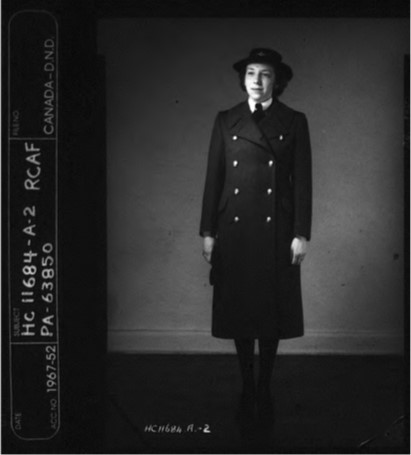
A uniformed woman stands against a blank wall.

HC 11684-A-2 “Great coat with hat and gloves,” 04/07/1941 (MIKAN 4532368).

Another colleague’s post outlines the history of the RCAF Women’s Division (RCAF-WD), so I won’t repeat it here, except to say that it was formed on July 2, 1941 (officially as the Canadian Women’s Auxiliary Air Force, changing its name by early 1942) and would eventually see more than 17,000 women serving within its ranks.

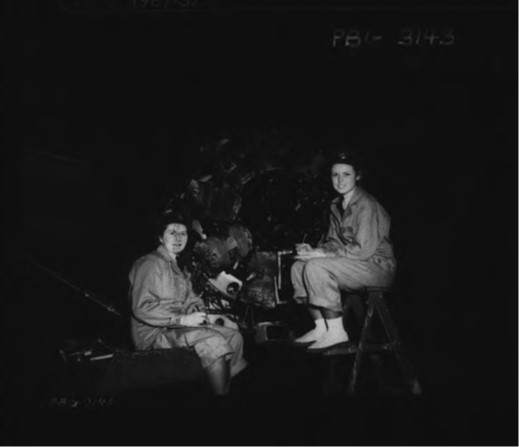
Two women wearing coveralls sit on either side of a propellor.

PBG-3143 “Women’s Division—Aero Engine Mech.,” 23/10/1942 (MIKAN 5271611).

The Department of National Defence fonds (RG24/R112) holds photographs of these women and documents their service during the Second World War era. Comprising over 500,000 photographs, this collection is a rich resource for anyone interested in the period as it includes photographs from both Canada and overseas. Over the past six years, I have been working closely with the photographs to find the servicewomen. Some of them are documented clearly and given centre stage in photographs. Others are found on the fringes, sometimes almost indistinguishable at first glance from their male counterparts in group photographs.

A seated uniformed man wearing glasses (left) looks towards a standing uniformed woman (right).

RE-1941-1 “Pay and Accounts Section (Crosswinds),” 25/09/1944 (MIKAN 4740938).

The occasion of the RCAF’s 100th birthday is a fitting moment to share the results of the work with this particular sub-series of photographs while highlighting the role that servicewomen played in the RCAF’s ranks during this period. Composed of 53 sub-sub-series of photographs, usually distinguished by location, the images vary widely—from aerial views of Canada to official portraits to post-war photographs of life and operations at European bases like North Luffenham and Station Grostenquin. The bread and butter of this sub-series, though, for most interested parties, is the imagery that documents the day-to-day operations and lives of servicemen and women during the Second World War, whether at home or abroad.

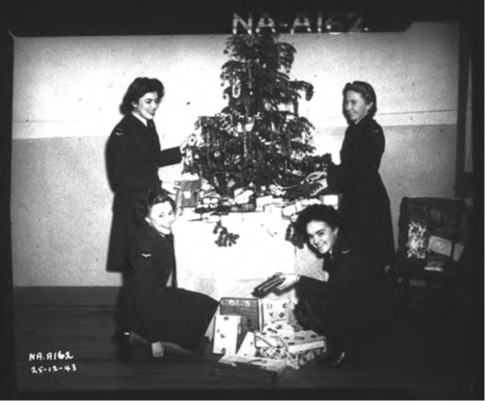
Four uniformed women stand and kneel around a Christmas tree positioned atop a table. Wrapped gifts appear on the floor and underneath the tree.

NA-A162 “WD’s Xmas tree & Xmas dance,” 25/12/1943 (MIKAN 4532479).

At over 160,000 distinct images, this sub-series is a treasure trove for any researcher with an interest in the period! Approximately 1,900 of those images (1%) are of servicewomen, both RCAF-WDs and nursing sisters who served in the RCAF. Servicewomen are best represented within this sub-series in photos from Ottawa, Rockcliffe or Headquarters, with strong representation from those taken at regional bases such as those in Newfoundland, Prince Edward Island and British Columbia.

The photographic collection shows us the WDs (as they were known colloquially) at work and play. They are often shown in groups celebrating holidays or fun moments against the backdrop of a horrific war. Other images suggest levity (see images NA-A162 above and SS-230B below) but also show the serious work being done (see image PBG-3143 earlier in this post). Formal group photographs, such as the nursing sisters shown in G-1448 below, are very common. For many of the more remote or rural bases, especially in the earliest years of the war, nursing sisters are the only women present in the associated photographic records.

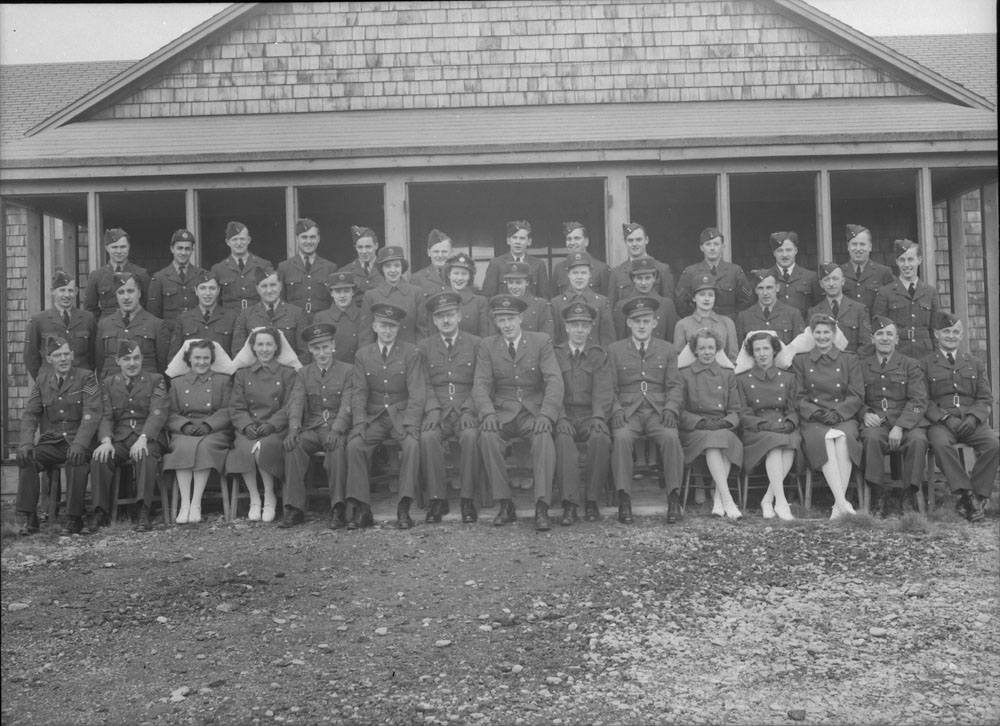
A formal group photo with 41 individuals, including 12 servicewomen, five of whom are wearing the distinctive white veil of a nursing sister. The group is organized in three rows; the front row is seated.

G-1448 “[Hospital staff, No. 1 Naval Air Gunnery School, R.N., Yarmouth, N.S.],” 05/01/1945 (a052262).

A group of fifteen women, mostly in civilian dress, engages in various leisure pursuits in what looks like a living room or lounge-like setting. Many appear to be engaged in needlecraft.

SS-230B “Sewing Circle (WD’s) Intelligence Officers,” 04/04/1943 (MIKAN 5285070).

Do you want to know more? Did your aunty or grandma serve in the RCAF-WD? Are you interested in knowing more about her service?

Check out LAC’s extensive resources and records related to the Second World War, including information on how to request military service files. Service files for Second World War—War Dead (1939–1947) are available via our online database.

Explore other photographic holdings at LAC, such as the PL prefix—Public Liaison Office sub-sub-series, a fabulous resource for RCAF photographs that sits, archive-wise, just outside of accession 1967-052 (the focus for this particular research project). Any researcher looking for a RCAF aunty or grandma (or grandpa!) in the archives should include these photographs in their search.

There’s more information about the RCAF’s Centennial on the official RCAF website.


Rebecca Murray is a Literary Programs Advisor in the Programs Division at Library and Archives Canada.
Dutch Apple Cake from 1943

Version française

Cooking with Library and Archives Canada bannerBy Ariane Gauthier

The Cook’s Recipe Manual is a collection of 300 recipes designed for military personnel who were part of the navy, army, air force munitions plants, camps, and schools. Printed in 1943, the goal of this cookbook was to make the most of army rations through simple recipes. Each recipe makes 100 or 125 servings, taking care to specify how many ounces should comprise a single serving. The recipes themselves were fitted for modest kitchens, meaning that the cook should still be able to successfully complete the recipe even if they don’t have electric cooking implements at their disposal.

This book is available online on Library and Archives Canada’s published collections catalogue Aurora: OCLC 3231635.

At the time that I picked up this book and undertook this latest challenge, we were well into autumn, and I had just returned home from apple picking with more apples than I could eat myself. I was flipping through the index of the cookbook, hoping to find an attractive recipe in which to funnel most of my apples, when I stumbled upon a recipe for “Dutch apple cake”.

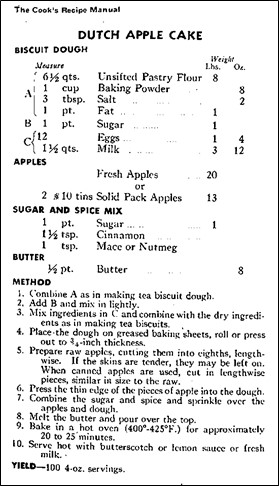
The recipe for Dutch apple cake, including a list of ingredients and the instructions.

A photo of the recipe for Dutch apple cake from The Cook’s Recipe Manual (OCLC 3231635). Please note the breakdown of recipe ingredients into categories A, B, and C, as well as the yield of 100 four-ounce servings.

Beyond the exorbitant amount of apples required, part of what attracted me to this recipe was that I did not know what a Dutch apple cake was. While it isn’t too difficult to put together, I had no visual image of its modern equivalent to keep in mind as I assembled this recipe and so, unlike the previous two recipes I tried, I went into this challenge ignorant of the expected result. Nevertheless, the first step was to assemble the ingredients.

The ingredients for the recipe: apples, eggs, butter, baking powder, salt, flour, sugar, milk, nutmeg, and cinnamon.

Ingredients used by the author to make the Dutch apple cake recipe from The Cook’s Recipe Manual. Courtesy of the author, Ariane Gauthier.

The next step was to do a bit of math, as I was not about to make a cake serving 100 portions. Instead, I settled on 10 portions and used the following quantities:

Biscuit dough
  • 2.6 cups of flour
  • 25 ml baking powder
  • 4.5 ml salt
  • 50 ml butter
  • 50 ml sugar
  • 2 eggs
  • 150 ml (oat) milk
Apples
  • 900 g apples
Sugar and spice mix
  • 50 ml sugar
  • a pinch of cinnamon and nutmeg
Butter
  • 50 ml butter

The ingredients comprising the dough of the Dutch apple cake are divided into three sections, A, B, and C, marking the order in which they will be incorporated. The first step is to mix the dry ingredients and the fat (in this case I opted for butter). The added instruction in the original recipe of “as in making tea biscuit dough” is unclear, so I opted to ignore it. The most it told me was that the recipe was written with a somewhat experienced reader in mind. Similarly, I didn’t quite understand why the sugar needed to be added separately, but I adhered to the order of things all the same.

Dry ingredients from the recipe being mixed with a whisk.

All the dry ingredients from sections A and B mixed with a whisk. Courtesy of the author, Ariane Gauthier.

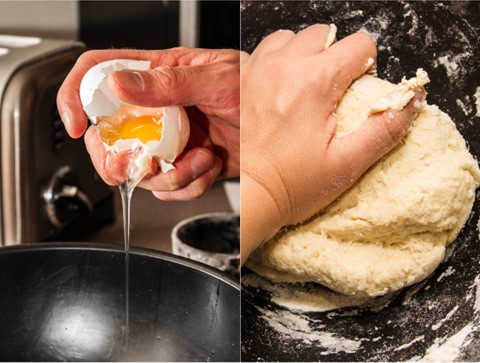
The last part of the dough recipe called to mix all the wet ingredients (section C) before incorporating them to the dry mix (sections A and B). I do not recommend using a whisk, as I did, because it’s incompatible with the thickness of the dough. I started using my hands before remembering that the cookbook’s author strongly recommended the use of electronic kitchen appliances, which I did possess but neglected during this phase of the process.

Side-by-side photos of an egg being cracked into a pan and dough being kneaded by hand.

Mixing the wet ingredients from section C with the dry ingredients from sections A and B. While the author used her hands, it’s recommended that you use a stand mixer should you possess one. Courtesy of the author, Ariane Gauthier.

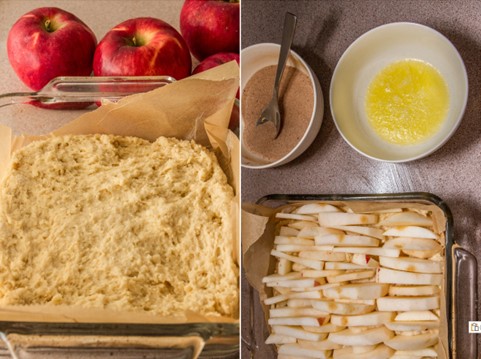
Once the dough was made, it needed to be put onto a baking sheet or baking tray lined with parchment paper. Then it was time to peel and slice 900 g of apples, cut them into eighths and insert them into the cake “thin edge” first. This frankly felt wrong as I was doing it, but I pushed through all the same.

Side-by-side photos of dough in a baking dish lined with parchment paper and the baking dish with slices of apples on top of the dough, with a bowl of melted butter and a bowl of sugar and spice mix next to it.

Setting the dough into a baking dish lined with parchment paper. The next step is to then insert the apples. Courtesy of the author, Ariane Gauthier.

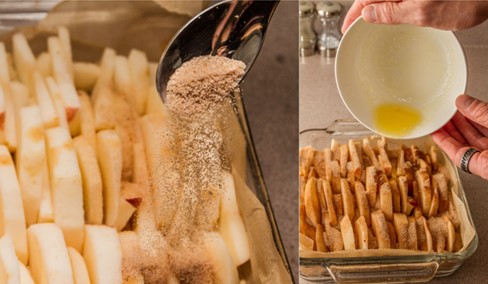
The final step was to make the sugar and spice mix and sprinkle it onto the cake as evenly as I could. Then I melted 50 ml of butter, which I drizzled overtop before sending it to the oven for 25 minutes at 400 ⁰F.

Side-by-side photos of the sugar and spice mix being sprinkled on top of the apple slices and the melted butter being drizzled on top of the apples and the sugar and spice mix.

Adding the sugar and spice mix and the butter onto the apple cake. This is the element chiefly responsible for giving the cake any flavour. Courtesy of the author, Ariane Gauthier.

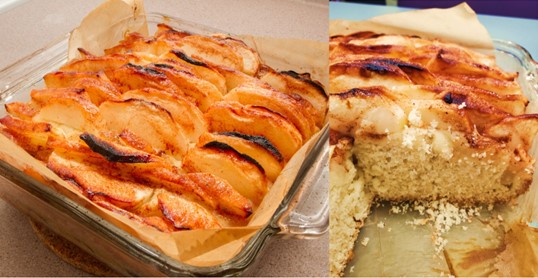
Having never made a Dutch apple cake before, I wasn’t sure what to expect. I felt as though this might very well be my first failure of a recipe, especially when I initially pulled the cake from the oven. It bubbled with butter and apple juice in a way that resembled a classic Québécois dish known as pouding chômeur, which, I was fairly certain, was wrong. For those who are unfamiliar, pouding chômeur is essentially a cake boiled in sweet syrup. However, part of the pleasure of following older recipes is opening the door to failure, and so I brought it to work the next day all the same for my colleagues to try. Here was the final result:

Side-by-side photos of the baked Dutch apple cake and a view of the layers after cutting into the cake.

The final product with a view of the cross section. Courtesy of the author, Ariane Gauthier.

What do you think?

I was surprised by how well it turned out, all things considered! The cake was fully cooked through, and the apples became quite jammy. That helped to keep the cake somewhat moist and wasn’t too sweet. I brought it to the Reference Section for another tasting and showed that, once again, these recipes can withstand the test of time!

If you try this recipe, please share pictures of your results with us using the hashtag #CookingWithLAC and tagging our social media: FacebookInstagramX (Twitter)YouTubeFlickr and LinkedIn.

Additional resources


Ariane Gauthier is a Reference Archivist in the Access and Services Branch at Library and Archives Canada.
The Life of Private Marcel Gauthier (Part 2)

Version française

By Ariane Gauthier

I first learned about Marcel Gauthier a few years ago when I was visiting the Bény-sur-Mer Canadian War Cemetery, in France. Although we share the same surname, Marcel is not my ancestor. Still, I have always remembered this young man—the only Gauthier buried in this large cemetery. With the release of the 1931 Census, I finally had the opportunity to learn more about him. As a result, I would like to share with you how the many resources of Library and Archives Canada (LAC) can be used to piece together a person’s life, such as an ancestor or a soldier.

The second part of this blog will explore Marcel Gauthier’s life, from his military enlistment to his death.

A black and white picture of a young man in his military uniform.

Photograph of Private Marcel Gauthier, age 21, published in an Ottawa newspaper to announce his death overseas (Canadian Virtual War Memorial).

Private Marcel Gauthier (Joseph Jean Marcel Gauthier)

  • C/102428
  • Le Régiment de la Chaudière, R.C.I.C.
  • Date of birth: November 18, 1922
  • Date of death: July 15, 1944
  • Age at time of death: 21 years old

His military record is available in LAC’s database Second World War Service Files—War Dead, 1939 to 1947.

On January 29, 1943, shortly after enlisting, Marcel left Ottawa to begin training in Cornwall, unaware that he would never see his hometown again.

Despite the convictions that led him to join the army, Marcel is not a model soldier. In Cornwall, he left his station, the camp hospital, without official permission. His seven-day absence resulted in disciplinary action being taken against him in the form of monetary penalties—in this case, the loss of three days’ pay—for being AWOL (absent without official leave). The rest of his training is without further incident. On April 1, 1943, Marcel is transferred to the Valcartier base where he joins the Voltigeurs de Québec infantry unit. On July 11, 1943, Marcel embarked on a ship bound for England, where he would train alongside 14,000 other Canadian soldiers in preparation for the Normandy landings. On September 3, 1943, he was transferred to the Régiment de la Chaudière, with which he would storm Juno Beach on the fateful day of June 6, 1944.

Training for the Normandy landings is very well documented, thanks in particular to war diaries. Produced by each regiment of the Canadian Army, these documents make it possible to follow their actions and activities. For example, the war diary of the Régiment de la Chaudière tells us that shortly after Marcel’s assignment on September 4, 1943, the order was given to move to Camp Shira, in Scotland, to carry out exercises in preparation for the landings. In the same month, the war diary describes the training and progress of the Régiment de la Chaudière’s four different companies, A, B, C and D, in reaching their targets, as well as incidents along the way.

The regiment’s war diary also includes regimental orders, which are precise enough to trace Marcel’s route at the time of the landings and during the Battle of Normandy, since they include his company and its movements. According to the regimental orders of September 1943, Marcel was assigned to D Company. On D-Day, Marcel was to remain on the landing craft until A and B companies had reached their objectives in the Nan White sector, before disembarking on the beach as reinforcements. To this end, the diary provides the training syllabus and describes the exercises carried out in preparation for the landing.

On June 6, 1944, Marcel embarked with D Company on the ship Clan Lamont, which was preparing to cross the English Channel. The last breakfast was served at 4:30 a.m. and then, by 6:20 a.m., everyone was aboard the ship that set off in turbulent seas toward Bernières-sur-Mer. Many were ill due to anxiety and seasickness. At 8:30 a.m., the Régiment de la Chaudière disembarked to join the fight in which the Queen’s Own Rifles Regiment was already engaged. But a storm the night before, which disrupted the tidal currents, combined with fierce resistance from the Germans, delayed the arrival and progress of the Queen’s Own Rifles. While they should have already taken Bernières-sur-Mer before the Régiment de la Chaudière arrived, they were trapped on the beach under enemy fire, unable to advance.

Close-up of a map of Juno Beach divided into sectors.

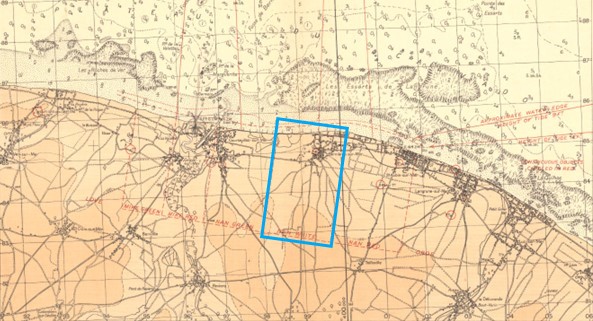
Detail from a map of the Juno Beach area (e011297133). The Régiment de la Chaudière landed in the Nan White sector at Bernières-sur-Mer.

Ultimately, the German defence gave way under pressure, allowing the Canadian Army to enter Bernières-sur-Mer and to secure the surrounding area. By day’s end, the companies of the Régiment de la Chaudière regrouped at Colomby-sur-Thaon, thus helping establish a bridgehead for the Allies in France. It was an important victory, but only the beginning of the Battle of Normandy, which would last for more than two months and claim many more lives.
Advances continued throughout the month of June. The Régiment de la Chaudière gradually approached the city of Caen to seize control of it. However, there was still one vital objective to conquer: Carpiquet. This village with its airfield had been fortified by the Germans, who relied heavily on it to resist the Allies. Taking Carpiquet and its airfield would be tantamount to dismantling the strategic point of the German air force closest to the Allies. It would also open the doors to the conquest of Caen.

The offensive on Carpiquet began on July 4 at 5:00 a.m. B and D companies were part of the first Allied assault group, advancing under cover of an enormous barrage provided by 428 guns and the 16-inch cannons of Royal Navy battleships HMS Rodney and HMS Roberts. However, the enemy’s defence was fierce. The Germans were better positioned and organized; they had even had time to fortify their positions with concrete walls at least six feet thick. That morning, they rained down a veritable deluge of artillery shells and mortar rounds. The first day’s action left many members of the Régiment de la Chaudière dead or wounded.

Canadian soldiers attend a briefing at Carpiquet airfield.

Briefing of Canadian infantrymen outside a hangar at the airfield, Carpiquet, France, July 12, 1944 (a162525). Taken after this vital point was seized, this photo reveals the ravages of this bloody battle.

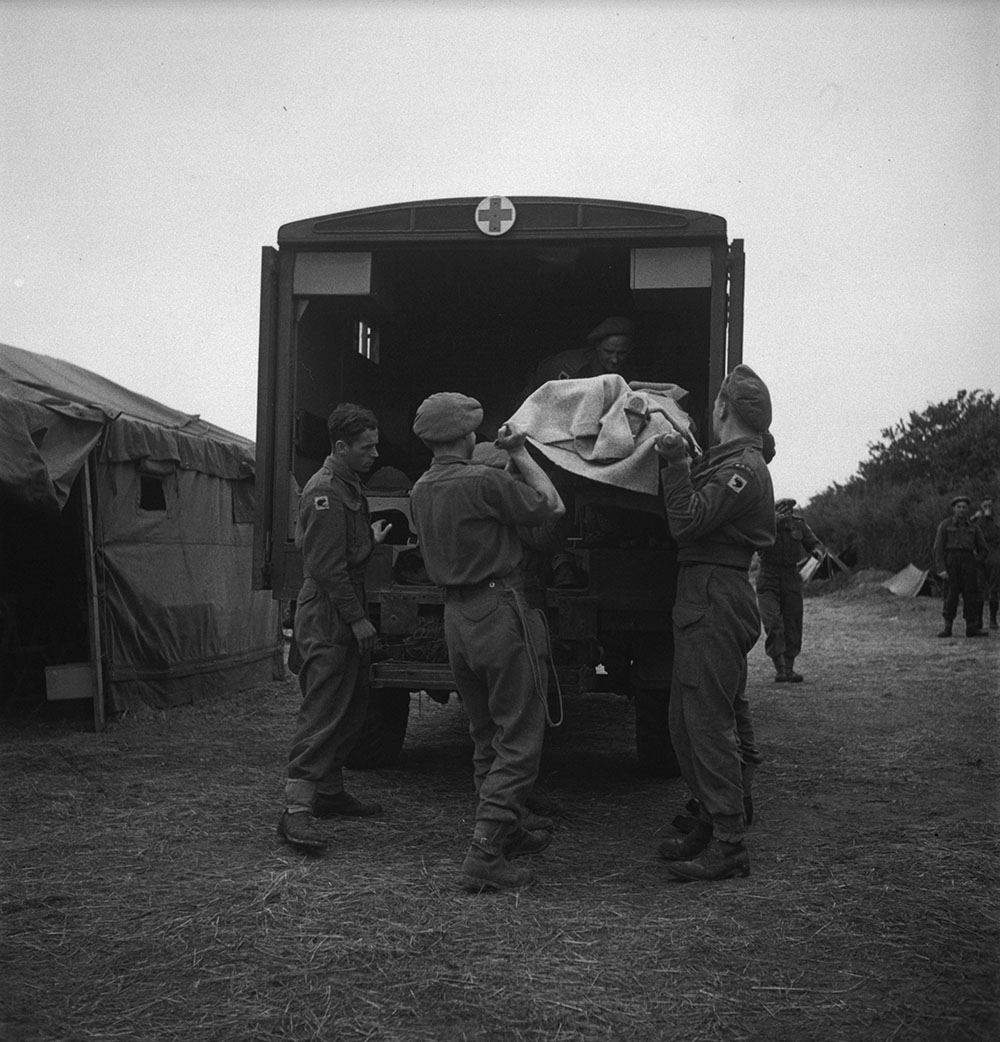
On July 8, 1944, Marcel Gauthier was hit by shell fragments. The explosion left him with a serious head wound and his regiment quickly brought him to the nearest Canadian Army Medical Corps station. He was taken to the 22nd Canadian Field Ambulance, then sent to Casualty Evacuation Station No. 34, and was finally admitted to the 81st British General Hospital where, despite the personnel’s best efforts, he succumbed to his injuries on July 15, 1944. He was posthumously awarded the France and Germany Star for his service.

Soldiers load a wounded soldier on a stretcher into a military ambulance.

A soldier of the Régiment de la Chaudière who was wounded on July 8, 1944, during the battle for Carpiquet receives care from the 14th Field Ambulance of the Canadian Army Medical Corps (a162740). This is not Marcel Gauthier, but one of his fellow soldiers.

Marcel Gauthier is buried in lot IX.A.11 at the Bény-sur-Mer Canadian War Cemetery. His gravestone bears the inscription submitted by his father, Henri: “Our dear Marcel, so far away from us, we will always think of you resting in peace,” where his name liveth for evermore.

Additional resources


Ariane Gauthier is a Reference Archivist with the Access and Services Branch of Library and Archives Canada.