Mirrors with Memory: Conserving Daguerreotypes in the Library and Archives Canada Collection—Part I

By Tania Passafiume and Jennifer Roger

The Daguerreotype, a one-of-a-kind photograph, was largely produced between 1839 and 1864. It was the first publicly-available photographic process and was renowned for its image detail and clarity.

The photographs are highly susceptible to image loss, corrosion build-up and other forms of deterioration caused by poor handling and environmental exposure.

To protect the image, the photographic plate was delicately placed under glass, from which it was separated by a protective mat.  This assembly was then hermetically sealed using paper tape and covered with a brass foil called a “preserver”. The entire package was housed in a small, often decorative, case made of leather, wood, papier mâché or moulded plastic, with an interior lining of silk or velvet.

Daguerreotype hallmarks or plate marks

Makers’ marks, known as hallmarks or plate marks are stamped markings found on many, but not all, daguerreotypes. When they are present, they are often found on the edge of the plate and are, thus, invisible when the daguerreotype is sealed. Marks typically consist of initials, symbols and numbers. The number most commonly found is “40”, which refers to the physical makeup of the plate, 1 part silver to 39 parts copper. Plate marks can offer clues about where the copper plate was manufactured and where the photographer sourced materials. They can sometimes also help to date an image.

When daguerreotypes were being prepared for the exhibition at the National Gallery of Canada, several of them were found to contain plate marks.A hand-tinted daguerreotype of three young women. The woman in the middle is standing between two women, who are seated. Continue reading

John Boyd

As Canadians we appreciate discovering stories about our country through the works of our painters and photographers, past and present. Canadian archives hold many collections, and sometimes the collection of a particular artist or photographer may contain literally thousands of images for us to explore. This is the case with photographer John Boyd whose collection at Library and Archives Canada (LAC) boasts 28,959 black-and-white photographs.

John Boyd (1865–1941) was born in Emyvale, Ireland. His family immigrated to Toronto in the late 1860s. He was a railway official as well as a photographer. His work with the railroad gave him ample opportunities to take photographs as he travelled across Ontario.

These photographs represent Boyd’s amateur work from 1898 to 1926. A large collection in itself, it is nonetheless dwarfed by the collections held at the City of Toronto Archives. One collection in particular is that of The Globe and Mail, which contains 140,000 of Boyd’s photographic negatives taken from 1922 to before his death in 1941.

The collections at LAC and the City of Toronto Archives complement each other in their dates of creation and subject matter.

The John Boyd fonds consists of photographs portraying all manner of Canadian life, all worth exploring. There are images of towns and cities, royal visits, military life, modes of transportation, industry and agriculture, social conditions, pastimes, and nature.

During the First World War, Boyd focused mainly on the home front, photographing recruiting campaigns, training exercises, and the manufacture of munitions, airplanes and ships. He also photographed everyday Canadians who contributed to the war effort at home as soldiers fought overseas. The following selection of images provides a glimpse of the activities during that time.

A black-and-white photograph of well-dressed men, women and children looking at and exploring an outdoor exhibit of a reconstructed Canadian military trench.

Visitors to a reconstructed 35th Battalion trench, Canadian National Exhibition, Toronto, Ontario, 1915 (MIKAN 3395547)

A black-and-white photograph of women, soldiers and children gathered outside a train. Other soldiers on the train are leaning out of the windows, presumably saying goodbye to their families.

Personnel of the Cycle Corps leaving Exhibition Camp for overseas service, Toronto, Ontario, May 15, 1915 (MIKAN 3194471)

A black-and-white photograph of two soldiers descending the steps of a train car. They are both looking down at the photographer and one is holding a kitten.

Volunteers for war and cat mascot with the 28th Regiment, Toronto, Ontario, August 22, 1914 (MIKAN 3403478)

A black-and-white photograph of soldiers re-enacting how they move out from their trenches for a crowd of spectators at an exhibition.

Soldiers moving out from their trenches, Exhibition Grounds, Toronto, Ontario, September 11, 1915 (MIKAN 3403554)

A black-and-white photograph of two soldiers stopped on a dirt road. One is taking a compass reading as the other takes notes.

Soldiers taking a compass traverse on the intelligence course at Camp Borden, Ontario, September 26, 1916 (MIKAN 3403628)

A black-and-white photograph of a soldier standing in a field holding a large wrench.

Private Vasili Salivarsky, D Company, 123rd Battalion, Toronto, Ontario, March 30, 1916 (MIKAN 3220871)

You can view a selection of Boyd’s images in this Flickr album. To explore the entire collection, start your exploration in the John Boyd fonds, and select “Lower-level descriptions.”

Happy searching!

Captain James Peters: War correspondent and photographer

Photography is now an integral part of our lives; our daily events are recorded whether they be monumental or mundane. From its beginnings in the 1830s, photography was used to chronicle the events of war. Early photographers struggled to capture the rapid action of combat as photographic equipment was unable to record movement. Consequently, early images of war were often staged recreations of the actual campaign. Generally, they depicted the less active aspects of war, such as portraits of soldiers, camp life, fortifications, artillery placements, and the battle sites before and after the action.

Captain James Peters recorded the dramatic events of the North-West Resistance as a photographer and a correspondent for the Quebec Morning Chronicle. The North-West Resistance was a five-month insurgency against the Canadian government, fought mainly by citizens of the Métis Nation and their First Nations allies. Peters was a pioneer in capturing the events on the battlefield.

Captain Peters and the “A” Battery of the Canadian Artillery left Quebec City on March 28, 1885 for the northwest. The “A” Battery was to provide artillery support for Major-General Frederick D. Middleton and the Canadian Militia. Peters would serve with Middleton at Fish Creek, Batoche and during the militia’s search for Mistahimaskwa (Big Bear). Continue reading

Hiding in Plain Sight: Discovering the Métis Nation in the Collection of Library and Archives Canada

Banner for the Hiding in Plain Sight exhibitionBy Beth Greenhorn

This article contains historical language and content that some may consider offensive, such as language used to refer to racial, ethnic and cultural groups. Please see our historical language advisory for more information.

Who Are the Métis?

The Métis Nation emerged as a distinct people during the course of the 18th and 19th centuries. They are the second largest of the three Indigenous peoples of Canada and are the descendants of First Nations peoples and Europeans involved in the fur trade.

Métis communities are found widely in Manitoba, Saskatchewan, Alberta, and the Northwest Territories, with a smaller number in British Columbia, Ontario, Minnesota, Montana and North Dakota.

Library and Archives Canada (LAC) has a great variety of archival documents pertaining to the Métis Nation (including textual records, photographs, artwork, maps, stamps and sound recordings); however, finding these records can be a challenge.

Challenges in Researching Métis Content in the Art and Photographic Collections

While there are easily identifiable portraits of well-known leaders and politicians, including these portraits of Louis Riel and Gabriel Dumont, images depicting less famous Métis are difficult to find. Original titles betray historical weaknesses when it comes to describing Métis content.

In many cases, the Métis have gone unrecognized or were mistaken for European or First Nations groups—such as the people in this photograph entitled “Chippewa Indians with Red River Carts at Dufferin.”
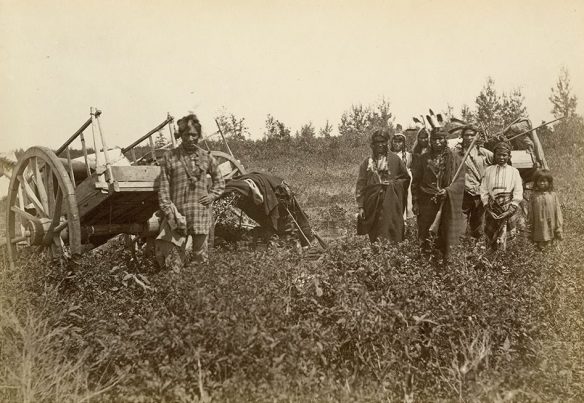
Black and white photograph of a man, on the left, wearing European clothing and standing in front of a Red River cart, and a group of First Nations men, women and children wearing First Nations-style clothing and standing in front of another Red River cart, on the right.

Chippewa Indians with Red River Carts at [Fort] Dufferin, Manitoba, 1873 (e011156519)

Clad in blankets and wearing feathered headdresses and other hair ornaments, the group on the right appears to belong to the Chippewa (Ojibwe) First Nation, as the title indicates. In contrast, the man on the left is dressed in a European jacket and pants and wears a different style of hat. However, both the man and the group pose in front of Red River carts, which are unique to Métis culture. Given his different style of clothing, coupled with the carts, it is possible that the man was Métis.

In other cases, archival descriptions exemplify colonial views of the “other” culture. Penned over a century ago, the language is often outdated, and the terminology racist, by today’s standards.
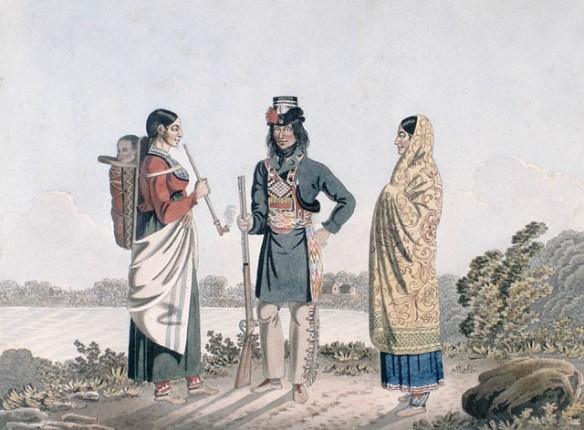
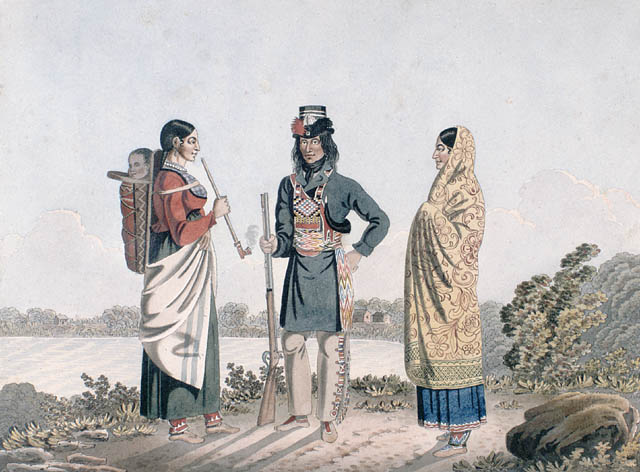
A watercolour landscape of a man, flanked by two women, standing in front of a body of water. The man is holding a rifle and the woman on the right is holding a long pipe and carrying an infant in a cradleboard on her back.

A halfcast [Métis] and His Two Wives, 1825-26 (e008299398)

Terms such as “halfcast,” “half-breed,” and “mixed breed” were widely used by the dominant society to describe members of the Métis Nation. This vocabulary is commonly found in older archival records.

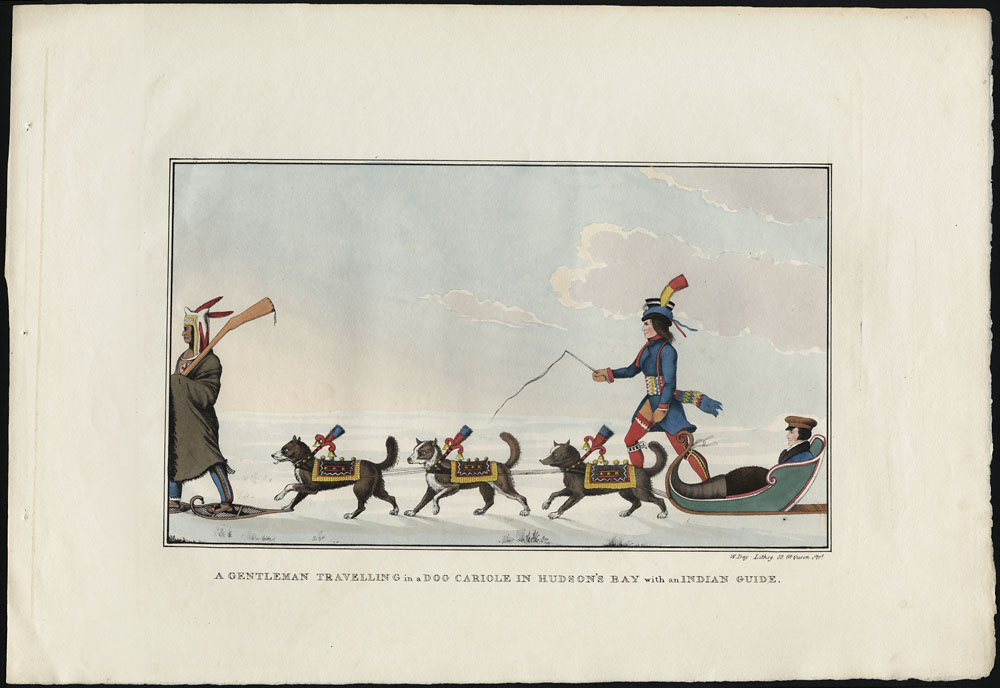
In other instances, descriptions of Métis were completely omitted, as is the case with this lithograph, entitled “A Gentleman travelling in a dog Cariole in Hudson’s Bay with an Indian Guide.”
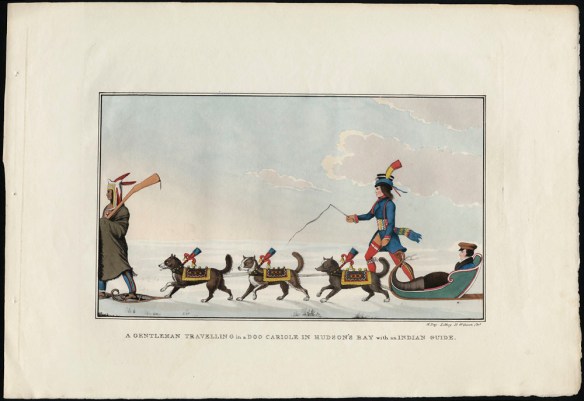
A lithograph of a snowy landscape with a man seated in a cariole (sled) pulled by three dogs in colourful coats. A man wearing a blanket and snowshoes is on the left in front of the dogs. A man holding a whip and wearing clothing associated with Métis culture (a long blue jacket, red leggings and an embellished hat) walks on the right-hand side of the sled.

A Gentleman travelling in a dog Cariole in Hudson’s Bay with an Indian Guide, 1825 (e002291419)

Hiding in Plain Sight: Discovering the Métis in the Collection of Library and Archives Canada

In the fall of 2014, a keyword search for “Métis” in art, photographic, cartographic and stamp records yielded less than 100 documents. LAC has since updated and revised over 1,800 records by adding “Métis” to the titles or descriptive notes in order to make these documents more accessible. In addition to improving existing records, LAC has digitized over 300 new photographic items pertaining to Métis history.

The Hiding in Plain Sight: Discovering the Métis in the Collection of Library and Archives Canada exhibition presents a selection of reproductions of artwork and photographs with Métis content. LAC hopes that the images featured in this exhibition will provide a better understanding of the history of the Métis Nation and that the public will be encouraged to research LAC’s collection.

The exhibition ran from February 11 to April 22, 2016, in the lobby of Library and Archives Canada at 395 Wellington Street, Ottawa.

Additional resources


Beth Greenhorn is a settler living on the unceded, traditional territory of the Kitigan Zibi Anishinabeg and the Algonquins of Pikwakanagan. She is a Senior Project Manager in the Outreach and Engagement Branch at Library and Archives Canada.

Mirrors with Memory: Daguerreotypes from Library and Archives Canada—an exhibition at the National Gallery of Canada

When the daguerreotype was invented in 1839, it was a revelation. The first photographic process to be made available to the public, daguerreotypes were shiny, reflective objects that delighted and astonished viewers by capturing the likenesses of friends and family with brilliant clarity. For the first time in history, portraits of loved ones could be recorded and shared or passed down to descendants. The impact of the daguerreotype and of photography on the lives of ordinary people was immense.

A hand-tinted daguerreotype portrait of a seated woman in a polka-dot dress.

Kate McDougall, ca. 1848 (MIKAN 3192966)

The science of capturing light on a photographic surface was co-developed in France by Louis-Jacques-Mandé Daguerre (1787–1851) and Joseph-Nicephore Niépce (1765–1833). Niépce died before practical success was achieved, and Daguerre went on to perfect the process. Highly polished silver-plated sheets of copper that were sensitized with iodine vapours and developed in mercury fumes, daguerreotypes created compelling, one-of-a-kind images with infinite detail.

A new exhibition at the National Gallery of Canada features examples of these special objects. While not rare, daguerreotypes are not often exhibited due to their susceptibility to light and environmental degradation. Drawn from the collection of Library and Archives Canada, the objects in this exhibition have undergone careful preservation and conservation treatment, and offer the viewer an extraordinary look at these unique photographs. Intimate, detailed and captivating, these objects—reflective by their very nature—are some of the earliest photographic glimpses of Canada in existence.

A daguerreotype photograph of a man (standing) and a woman sitting on the ground, among the destroyed remains of the brewery.

The Molson family brewery after the fire, Montréal, Quebec, 1858 (MIKAN 3192967)

The exhibition features street scenes as well portraits of both well-known and unknown personalities. Most likely taken in Europe in the late 1840s, the portrait of Maungwudaus, a member of the Anishnaabe Nation of the New Credit Mississauga, is one of the earliest photographic portraits of an Aboriginal person in the Library and Archives Canada collection. Maungwudaus grew up near what is now Kitchener-Waterloo, Ontario. Educated by Methodist missionaries, he later worked in mission outreach and as a translator and writer before finding acclaim as a performer in a “Wild West” show that he along with friends and family members, organized and travelled through parts of the U.S. and Europe. The troupe was celebrated in England and in France where Maungwudaus was presented with several medals by King Louis Philippe I.

Daguerreotype portrait of Maungwudaus wearing ceremonial dress including a feathered headdress and two medals.

Maungwudaus, ca. 1846 (MIKAN 3198805)

As one-of-a-kind objects designed to be stored in a closed case and looked at by one viewer at a time, daguerreotypes are intimate by nature. Some show the wear and tear expected of objects over a century old. Often, the names of the sitters or any other accompanying information has long since disappeared, making the exceptions even more special. One such example is the portrait of a group of merchants from Yarmouth, Nova Scotia, dated 1855. This daguerreotype had a small manuscript tucked inside at the back of the plate, which is signed by one of the sitters and lists all the members of the group, as well as the location of the sitting and the name of the daguerreotypist, Wellington Chase. In this portrait, among others, we can see Loran Ellis Baker, seated front row, centre. Twenty-four years old at the time of this portrait, Baker was one of Yarmouth’s most prominent businessmen and civic leaders, and a member of the Legislative Council of Nova Scotia from 1878 to 1900.

A velvet-lined case with a daguerreotype portrait of nine men: five seated in front, four standing.

Group of merchants from Yarmouth, Nova Scotia, 1855 (MIKAN 3622937)

Visit the exhibition at the National Gallery of Canada in Ottawa from September 4 to February 28, 2016.

Trailblazers: a road trip in the summer of ’54

Version française

By Beth Greenhorn

Four women, one Plymouth station wagon, five provinces, and four states in 38 days…

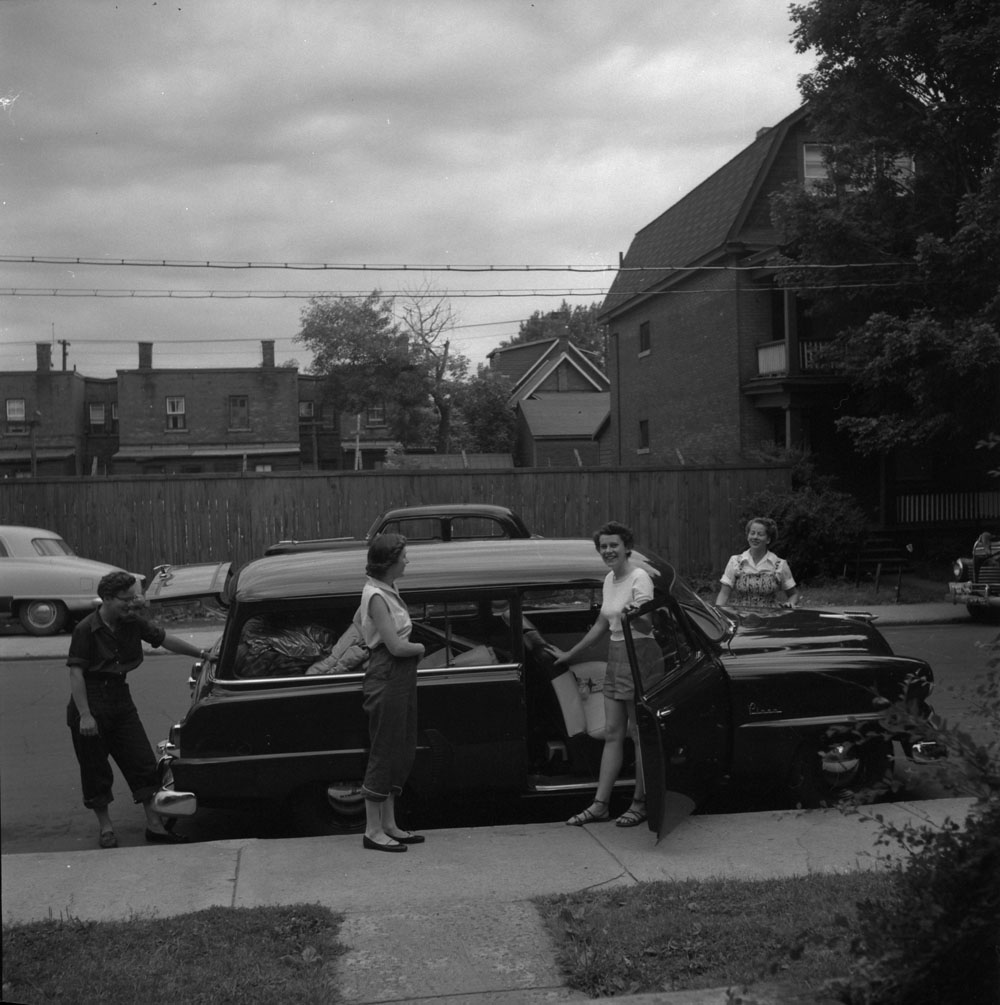
On July 31, 1954, freelance photographer Rosemary Gilliat and her girlfriends, Anna Brown, Audrey James and Helen Salkeld, left Ottawa, Ontario, for what would be an adventure of a lifetime—a road trip on the Trans-Canada Highway. Their final destination was Vancouver, British Columbia, and after a little more than a month of driving, the women covered over 12,000 kilometres before their return to Ottawa on September 6.

A black-and-white photograph of four women posing around a station wagon packed for a road trip.

Day One – July 31. Left to right: Helen Salkeld, Audrey James, Anna Brown and Rosemary Gilliat getting ready to leave Ottawa, Ontario, for their Trans-Canada Highway trip. (MIKAN 4306200)

Until the mid-twentieth century, the only way to travel and really ‘see’ Canada was by train. Following the Second World War, thousands of new immigrants from across the globe immigrated to Canada. This increase in population was coupled by a huge growth in the automobile industry. During the post-war years, and with Parliament passing the Trans-Canada Highway Act in 1949, construction had begun to link Canada’s major cities with paved roads.

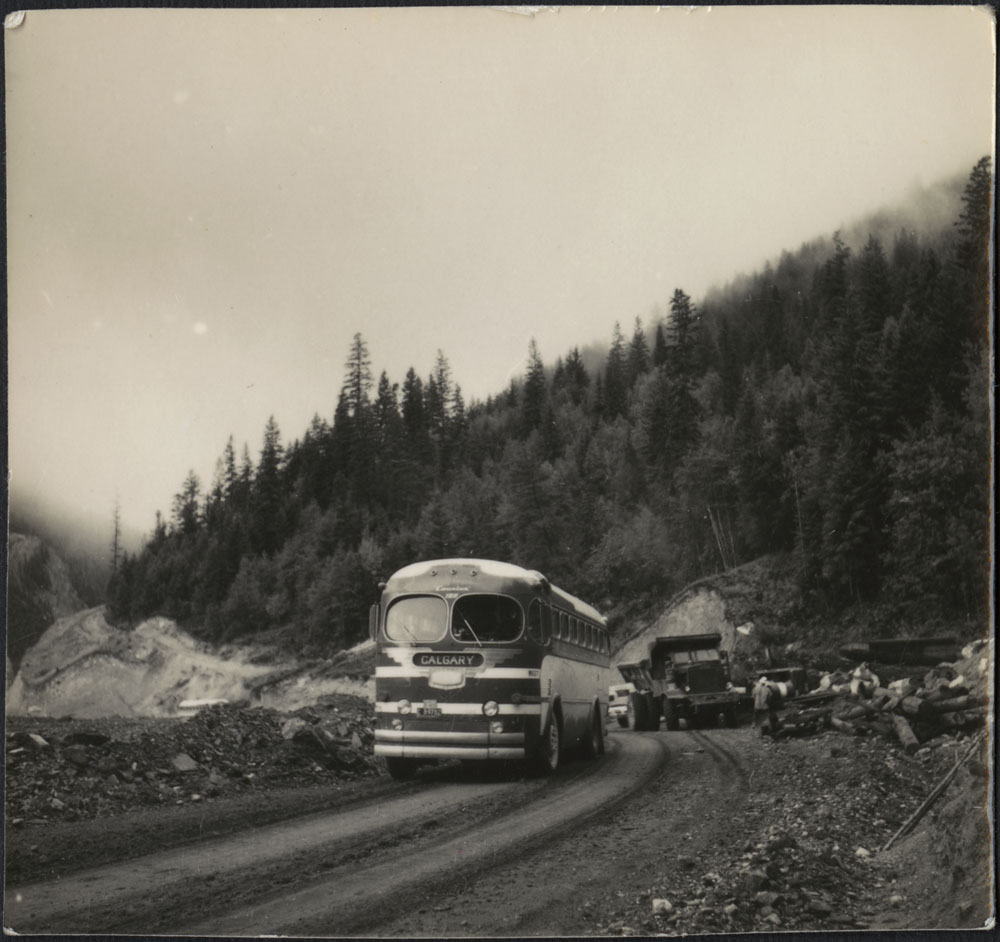
By the summer of 1954, work on the Trans-Canada Highway going west from Ottawa had started, but many stretches were still under construction, and in some areas work had not even begun. Rosemary described the road conditions near Cochrane, Ontario as “dirt and rutted and huge bumps which could easily break a spring.” At the border of Manitoba and Saskatchewan “the average road turned into a downright bad road, dried mud, stones lying on the road, dips & holes.” Further west, just past Kicking Horse Pass, British Columbia, the conditions became even more treacherous. Rosemary wrote:

“We soon came to bits of road under construction—engineers have been working at it already for two years. They have to blast out the side of the mountain—most of it above the C.P. Railway. We marvelled once more at the building of the railway through this impossible territory. The road was often just a rocky lane with towering rock walls above and jumbled masses of blasted rock below—other places were mud, with streams & pools of water on the road & one got the feeling that the whole lot might easily slip into the canyon hundreds of feet below.”

A black-and-white photograph of a public bus travelling on a gravel road and passing a construction crew working in the background. The area is mountainous.

Day 18 – August 17. The daily Calgary bus passes through a blasting area in Kicking Horse Canyon, British Columbia. Travel is between hours of 5 p.m. and 8 a.m. only on this stretch. (MIKAN 4359684)

In spite of the many challenging stretches of highway, the windshield of Helen’s Plymouth only suffered a few cracks from flying rocks and remained intact until the women returned to Ottawa, when it was replaced.

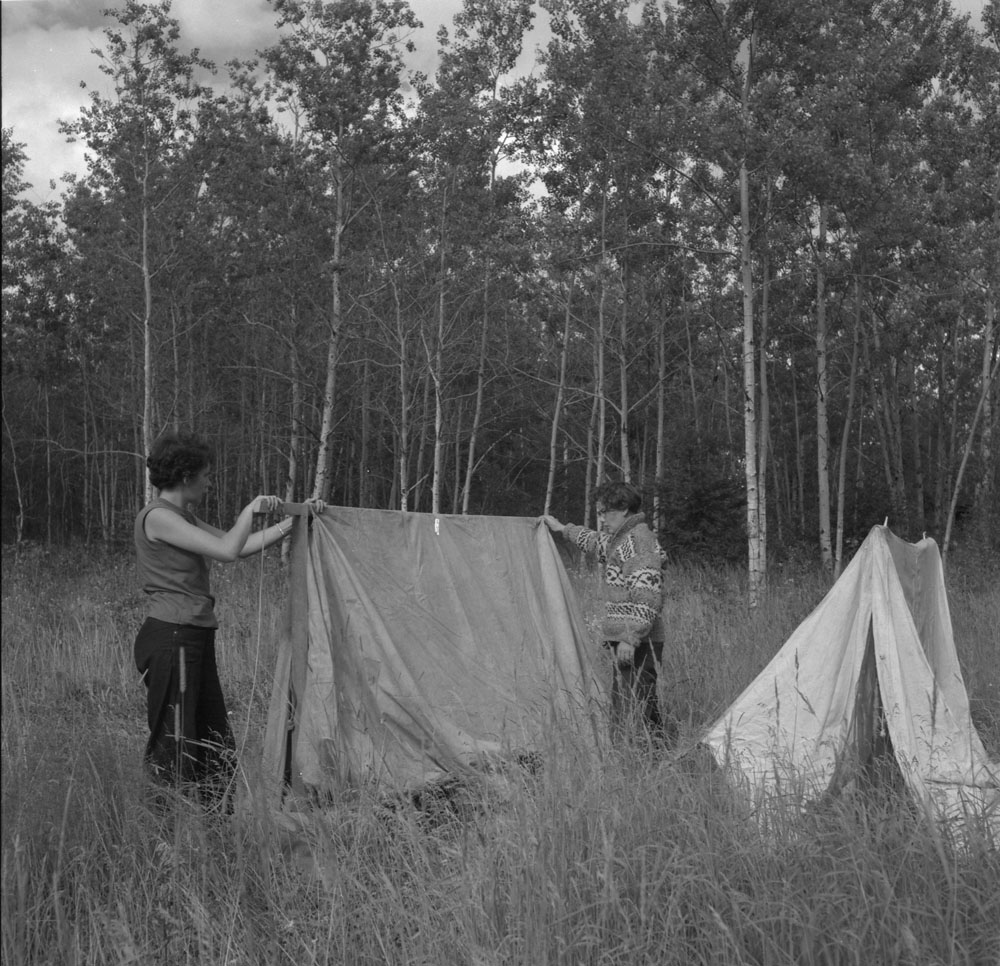
Rosemary and her friends were not what you would call stereotypical women, or even conventional tourists, for their era. While there were some amenities available along the Trans-Canada Highway in 1954, such as motels and public camping grounds, the women preferred to have lunch and camp in wooded and secluded areas off the beaten path. As Rosemary put it, “one wonders at all the days of the year one spends in bed—when it is so perfect camping—every morning and every evening being a revelation.”

A black-and-white photograph of two women putting up two tents in a meadow with long grass surrounded by trees.

Day 4 – August 3. Anna Brown and Helen Salkeld pitching their tents, English River, Ontario. (MIKAN 4306206)

Rosemary and her friends were seeking an “authentic” wilderness experience and were not discouraged by insects, rain or possible encounters with wildlife. Midway through their trip, Rosemary observed: “What always strikes me as odd is this business of people motoring 1000’s of miles into the wildest country in order to have all the luxuries they have at home in a different setting.”

A black-and-white photograph of three women in a wooded area preparing dinner in the rain.

Day 20 – August 19. Making dinner in the rain, near Yale, British Columbia. (MIKAN 4306339)

Packed to the max, Helen’s station wagon was loaded with all of their camping supplies and utensils. Among their equipment was a Coleman stove and two water bottles, but no cooler or ice for perishable food. So part of their daily routine included picking up groceries and finding drinking water while getting gas for the car. This was not a luxury vacation!

A colour photograph of two women in a grassy area with mountains in the distance—one is reading reclined on a picnic blanket and the other is kneeling at a camp stove located behind a station wagon.

Day 20 – August 19. Helen Salkeld and Audrey James relaxing after lunch near Cache Creek, British Columbia. (MIKAN 4323864)

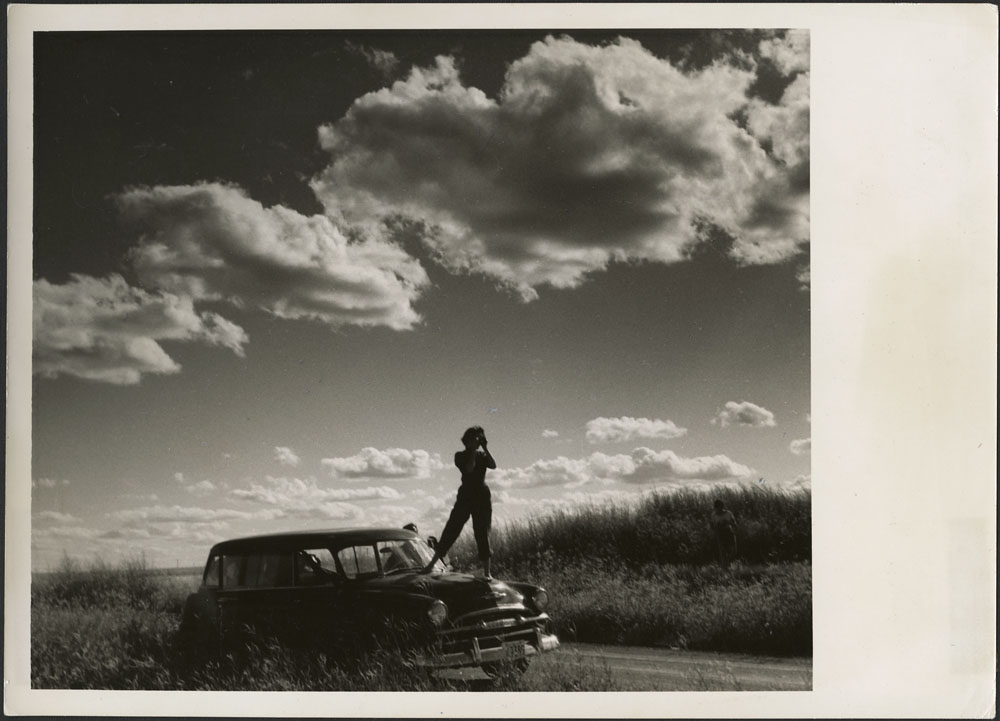
Their travels took them through remote forests and small towns of north and northwestern Ontario, endless kilometres of the golden prairies of Manitoba and Saskatchewan, the foothills and Rocky Mountains of Alberta, and along the rushing glacial rivers of British Columbia to Canada’s beautiful pacific coast. Rosemary recorded their fantastic adventures, taking hundreds of photographs and keeping a detailed travel diary that describes the people they met and things they experienced along the way, including friendly farmers, charismatic cowboys, and murderous mosquitoes.

A black-and-white photograph of a woman in silhouette taking a photograph while standing on the hood of a station wagon parked on the side of the road in the prairies.

Day 9 – August 8. Audrey James standing on the hood of Helen Salkeld’s station wagon taking a photograph of the prairies, southern Saskatchewan. (MIKAN 4814411)

On July 31, 2015, Library and Archives Canada launched Road trip—summer of ’54 on Facebook, which features a selection of Rosemary Gilliat’s photos and diary excerpts. Visit Facebook daily to see where she and her friends travelled and who they met along their journey. At the end of each week, these photographs will be added to Flickr.


Beth Greenhorn is a Senior Project Manager in the Outreach and Engagement Branch at Library and Archives Canada.

Photography of Yousuf Karsh now on Flickr

Yousuf Karsh came to Canada as a teenager and pursued his dream to become an internationally renowned photographer.

Images of national parks now on Flickr

Canada’s national parks are protected areas established under federal legislation to preserve Canada’s natural heritage for public understanding, appreciation and enjoyment. The parks are maintained for future generations and have existed in Canada for well over a century.

Images of cottages, cabins and camps now on Flickr

Cottages, cabins and camps are associated with weekend or vacation getaways by Canadians. They are a place to spend holidays with friends and family for a variety of outdoor sporting and leisure pursuits.

Self-serve photography

It used to be that the only way of getting copies of archival documents was a bit of a tedious process. Flagging the pages you wanted copied, filling out the form, handing in the information to the Consultation staff, and then waiting the 30 business days for the copies to be made. If you were not someone who was from the Ottawa-Gatineau area, you would then have to wait for the copies to be mailed out to you. If you were in the National Capital Region, but not a regular visitor, you might have to make a special trip to 395 Wellington Street to pick up your copies. Now the process can be much quicker if you choose. If you have a camera or a smartphone, you can now take digital images of our collection, rights and restrictions permitting. Once you have the material you wish to copy, simply check in with the Consultation staff, who will provide you with a quick form to fill out. You will need to provide the full reference number for the box or volume, along with your user card number and your name. The staff will verify restrictions of the documents and provide you with a green copy of the approved form. Here are some of the key points to remember about what is required from a technical standpoint of your camera or smartphone.

  • You must have a wrist strap, neck strap or tripod.
  • No flash can be used.
  • Photos cannot be taken before permission is given.
  • Your green permission slip must be visible at all times.
  • You can request a weight or book wedges to help you photograph larger items instead of forcing the items open.

There are also a few tripods available with either a camera mount or a smartphone mount, but they are loaned out on a first-come, first-served basis. You can see the Consultation staff for these as well. If you cannot come in during service hours and still wish to take photos, you can either fax in your filled out form (613-992-5921) or scan and email it to the following address: consultationtext@bac-lac.gc.ca, indicating your date of visit and which lockers have been assigned to you. You can get a copy of the form in person during service hours or by contacting the Consultation staff at the above mentioned email address. This service is also available in Genealogy and Reference Services during their service hours.